The War of Art: Break Through the Blocks and Win Your Inner Creative Battles by Steven Pressfield

Recommended by a few friends. I find this one holds a few solid truths, but maybe didn’t need to be book-length.

Good lessons: Steven Pressfield (author of The Legend of Bagger Vance, Gates of Fire, Tides of War, and many more) argues that anyone trying to do a good or great thing, whether it’s art, activism, or entrepreneurship, faces Resistance. (His capitalization.) Resistance can be a guide: when we feel Resistance, it means we should push in that direction; that’s where we’re meant to go, where we want on some level to go. (He points out that where there is Resistance, there is love – meaning our love or passion for the pursuit in question.) Fear is a sign of Resistance. We must undertake that which we fear. That’s Book One.

Book Two covers how to combat Resistance: by Turning Pro. This means treating our art, or whatever it is, as our day job. Treating it as our day job. (He is chiefly concerned with art, as his title suggests, and most chiefly with writing, because that’s what he knows.) In other words: take your work seriously (butt in chair, no excuses, etc.).

Book Three is concerned with what Pressfield calls angels, or we might call the Muse, or inspiration. It argues that certain strategies may be undertaken to make way for the Muse, to invite her in and make her feel comfortable. He quotes that common line from Somerset Maugham (?): “I write only when inspiration strikes. Fortunately it strikes every morning at nine o’clock sharp.” Actually he quotes this line in Book Two, but I think it fits in Book Three just as well. They build on each other, being, you know, all one book.

These are all good points, but even at just 165 pages and loads of white space, I think they could have been made a bit more succinctly. There are some instructive anecdotes: the Maugham quotation (which is likely misattributed), the winds of Aeolus (lesson about not stopping before the finish line), Henry Fonda’s fear (lesson: we all have it always), and a fun one about how great Lance Armstrong is (this book was published before his accomplishments were so besmirched). But there are also some instances of what I’ll call cuteness. “The professional endures adversity. He lets the birdshit splash down on his slicker, remembering that it comes clean with a heavy-duty hosing.” “If you’re in Calcutta working with the Mother Theresa Foundation and you’re thinking of bolting to launch a career in telemarketing…” I don’t know. There’s a thin line, perhaps, between useful examples and cutesiness. Personally, I feel it’s crossed here.

If this all sounds a little self-helpy, it did to me too. And the back cover’s a dead giveaway.
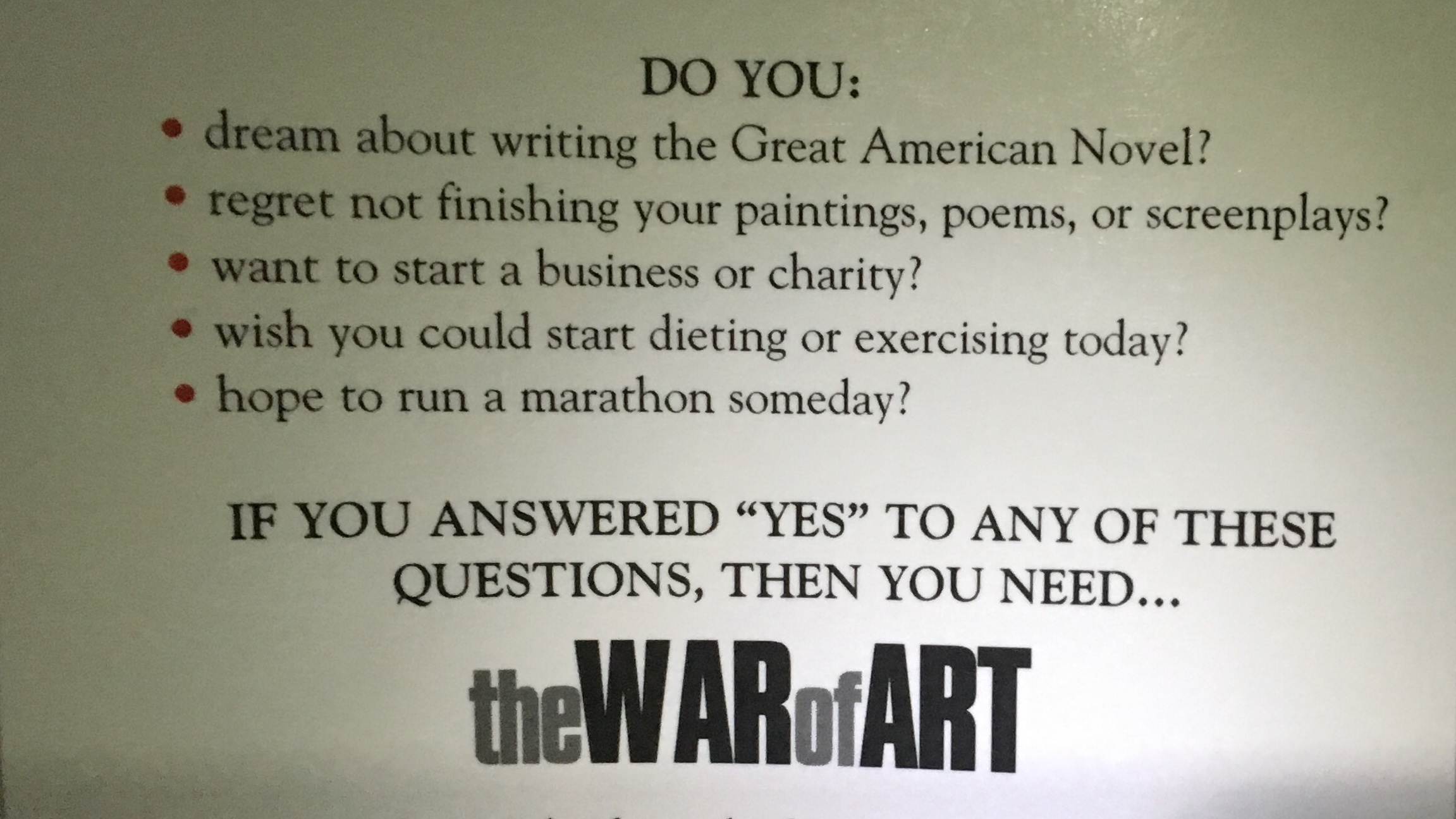
In the best self-helpy traditions, Pressfield calls upon God to back him up. “If you believe in God (and I do) you must declare Resistance evil, for it prevents us from achieving the life God intended when He endowed each of us with our own unique genius.” Again as a purely personal reaction, no thank you to the God stuff.

To be clear, I found myself turning Resistant to this book as early as Book One. Pressfield asks that we banish “trouble” from our lives, which seems to include the troubles of others (there’s a separate heading for self-dramatization, but they are clearly linked), which feels a little like cutting off the loved ones who need our support now and again; he’s against support, too. He allows that depression and anxiety “may” be real, but the other disorders were created by a marketing department. This is not a man you need in your personal life, friends. He “may” be a bit toxic.

There are good points here, to be sure. But the packaging was not precisely to my taste. Your mileage may vary.


Rating: 5 troubles to be avoided.

The Way Home: Tales from a Life Without Technology by Mark Boyle

This memoir about living off the grid and tech-free in County Galway will inspire, connect and slow down the most impatient of readers, and that is a very good thing.

Mark Boyle was The Moneyless Man in his memoir of that title, about the first of three years he spent living without money. The Way Home: Tales from a Life Without Technology covers another first year: Boyle has now made the shift to a life without modern technology in County Galway, Ireland. What is modern technology? Obviously, definitions are complicated, but for Boyle his new way of living means hauling his own water; fishing, foraging and gardening for his food; making his own beer and wine; and traveling by bicycle, by hitchhiking and on foot. (He beats himself up about monofilament fishing line but, within the book’s timeline, has not yet found an alternative.)

Organized as the diary of a year in its four seasons, The Way Home is a thoughtful study, often wise but always questioning and seeking. With frequent references to Edward Abbey, John Muir, Aldo Leopold, Robert Macfarlane, Wendell Berry, Henry David Thoreau and others, Boyle places himself in a grand tradition of intellectual naturalists and thinkers. He also makes repeated forays (both literally and in imagination and research) to Great Blasket Island, an unusually literary place where a technology-free lifestyle only recently ended. He aims to query every decision, investigate its outcomes: while writing this book using a pencil, he stops to consider the making of that tool–its wood and graphite and paint, the extraction of these materials and the transportation of the workers who made it. Boyle, stymied by the ecological impact of such a simple technology as a pencil, is a former vegan who now eats fish and venison. He is a man willing to rethink his outlook.

Boyle has a sense of humor as well as a deep sensitivity to the needs of people as well as the planet and its ecosystems. “Rome,” he reflects, “wasn’t demolished in a day,” as he gardens with the (plastic) tools available and plans for the future. His writing style is pensive and unhurried. His lifestyle is in many ways “slow,” as in slow food and slow transportation, and he observes that writing by hand after a longtime addiction to computers has slowed his thought processes, for the better. “Just as carpenters always recommend measuring twice and cutting once, I’ve begun thinking twice and writing once.”

The result is a deeply appealing examination of nearly all aspects of modern human life, by a thorough, careful, concerned narrator. Readers already considering various forms of disconnection from modern technologies–in favor of a reconnection with local plants, animals, soil and people–will be goaded and inspired. Those less attracted to composting their own feces will nonetheless be entranced by Boyle’s unusual lifestyle, and perhaps moved a little closer to the earth.


This review originally ran in the March 5, 2019 issue of Shelf Awareness for the Book Trade. To subscribe, click here.


Rating: 7 scythe blades.

The Absent Hand: Reimagining Our American Landscape by Suzannah Lessard

This broad social-historical consideration of American landscapes will satisfy and challenge the most serious reader.

Suzannah Lessard (The Architect of Desire) offers a broad cultural examination of place in The Absent Hand: Reimagining Our American Landscape. The result is a work of great scope that’s grounded by an interest in landscapes, the forces that shape them and how they in turn reshape us. Lessard chases big mysteries. “Always behind my readings of landscapes are the questions, Where are we…? and What is our relationship to our surroundings now?”

Lessard begins with a close description of “the village” where she lives near Albany, N.Y. She then travels outward, to visit a nearby friend and consider suburbophobia, and therefore the history of the suburbs–as foil to the city, as military defense concept, as commercial center, as “edge city.” Having considered terms like sprawl, metropolitan area, edgeless or stealth city and more, Lessard uses “atopia” to refer to landscapes “where contemporary development, directly expressing contemporary times, was unrestrained.” She is also quite interested in “online” as a place, from its origins in Cold War strategy through the option it provides as escape from real places.

Lessard is at her best when handling the ways place and people interact (Disney’s attempt to build a history theme park just south of Washington, D.C.), and on shakier ground when handling larger issues (market forces versus governmental powers). One of her finest chapters considers a mall in King of Prussia, Pa., and the tensions and challenges facing shopping malls across the country.

As Lessard shows, Cold War policy, the Depression, the legacy of slavery, racist housing policies, nuclear armament and more have all played roles in the development of the suburb and the contemporary landscape. Mixed in with these references, Lessard often cites works of art–Van Gogh, Shakespeare, Han vases–as means to understand place.

Lessard can speak from a place of economic comfort that may grate some readers, but the value of her decades of research is undeniable. The Absent Hand is often dense, as Lessard draws upon centuries of human history to make her arguments. In this ambitious work, place is examined, deconstructed and incrementally illuminated, even as our landscape changes anew.


This review originally ran in the February 19, 2019 issue of Shelf Awareness for the Book Trade. To subscribe, click here.


Rating: 5 paintings.

Shipping Container by Craig Martin

Another in the Object Lessons series, and I was rather excited about this one, because boxes and containerization are among my obsessions. But alas, Shipping Container let me down.

It starts out with promise: Craig Martin sits writing in a shipping container, “looking out over the dramatic landscape of Loch Long” in Scotland. I was pleased to encounter, on page 5, Donald Judd’s box-inspired and boxlike artwork (having just recently seen some Judd out in the West Texas desert) – somehow this coincidence felt both surprising and nearly inevitable. I was charmed to consider the statement that “things control our behavior, mediating how we travel from A to B, or open a door for example.” When Martin muses about the container as building component, its crossover uses, and its wide-reaching implications for shipping, globalization, and economics, I lean forward with interest.

Unfortunately, he quickly leaves dramatic landscapes and crossovers behind in favor of research, acronyms, and jargon-heavy theory (economic, strategic, logistical, tactical, and yawn). For this reader, there’s nothing wrong with research or acronyms, and not much wrong with theory, as long as it’s leavened with some of that dramatic landscape… or personality… or narrative. I kept reading, hoping that Martin would shift gears and reward me with something interesting, some whimsy, some surprise. But no.

He has a tendency to use 40 words where ten would do, as when he describes some of the finer points of smuggling: “Crucially, it is the ability to conceal such practices that is paramount. As described earlier, the use of false floors in containers is intended to make the container appear absolutely normal, should it ever be opened by Customs or security officials. Evidence of tampering is decisive, particularly the attempts by smugglers to conceal evidence of interference with containers themselves.” In other words, smugglers like to hide the fact that they are smuggling. I got impatient.

An overlong chapter on smuggling and security ends with the observation: “the ISO shipping container is an incredibly convenient box in which to move things, be they legal or not.” I spared you the first 28 words of that sentence, and look how neatly it concludes. Those 19 words, in fact, could sum up not only the chapter but the book.

You can see I got a bit prickly about Shipping Container. What I loved most about Sock and Souvenir was how widely they ranged over their subjects, how they let the simple sock or souvenir mean so many different things – how they surprised me. Here, I found a dry discussion of the shipping industry over time, with a few tantalizing tidbits at the very end about “cargotecture,” or shipping containers as building material again. (Me, I’ve seen container homes; drank beer in a container brewery; and used to race at a velodrome that stored its track bikes in containers onsite. This is not a new or surprising use of shipping containers. The surprise, if anything, was that this phenomenon didn’t receive more coverage.) I’m sorry to be so negative, but I haven’t much good to say. I wish I’d put this one down without finishing it, as I did Matthew Battles’s Tree. Not every Object Lesson is for me. Your mileage may vary.


Rating: 3 internecine discussions.

Vulture: The Private Life of an Unloved Bird by Katie Fallon

Disclosure: Katie Fallon was my first semester advisor at WVWC, and is a friend.


I have been looking forward to reading Vulture for years! I read Katie’s Cerulean Blues first, because Vulture was still awaiting publication; but if I’m honest, the bigger bird is the one I’m more naturally drawn to, and I know the turkey vulture was Ed Abbey’s favorite bird and all. I was really looking forward to this one.

And it had all the pleasant notes offered by familiarity, because by now I’ve heard Katie read from it a few times, so certain passages felt like old friends; and the personal content was familiar as well, because I know Katie personally (the names of her three daughters, for example, although only the first two come along within the timeline of this book). Reading this therefore felt a little like coming home, and you know how I like to feel at home in a book.

This is a book about vultures: the world over, but in particular the turkey vulture, which is Katie’s own favorite. It is also a personal memoir, about the author’s own life and coming-to-terms. As she considers the vulture’s place in mythology and historical relationships – often including associations with women and with motherhood – and observes vulture mothers caring for their young, she experiences her own much-desired first pregnancy. The places she goes in her own life, both geographically and emotionally, mirror the places she takes her reader in relationship to her subject. Along with her husband Jesse (a veterinarian specializing in birds), she travels to real-world locations in search of vultures: Hinckley, Ohio, for their “Return of the Buzzards” celebration; Pennsylvania’s Meadowcroft Rockshelter and Hawk Mountain Sanctuary; the Grand Canyon; India’s Hill of the Sacred Eagles; Gettysburg; and more. She also visits with an impressive array of vulture experts worldwide. This may be a beginner’s or introductory version of the vulture’s story, but it is also an authoritative and detailed one.

The book hits what I feel is a perfect balance between personal content (Katie’s life, family, and personal reasons for vulture adoration) and scientific. I remember Katie telling the story of (gulp) reading online reviews, the user-generated kind on Amazon and Goodreads and whatnot, and being bemused to see that everyone with negative feedback either found it had too much science or too much personal: in other words, they wanted an absolute, a commitment to one side or the other of that spectrum. This was funny to me because I thought her balancing of these two elements was perhaps the book’s most graceful accomplishment. Can’t please them all, can we.

For a final element, she adds a touch of speculation about the vulture’s inner life. Each chapter opens with a brief, italicized (and illustrated) paragraph featuring an imagined vulture at the center of the book. I found these so lovely, and a beautiful contribution. (Somewhere out there another reviewer is complaining that they ruined everything, I’m sure.) Katie occasionally anthropomorphizes within her chapters, too, but always with self-awareness and some hesitation: here is what she might be feeling, Katie might muse, even while acknowledging that birds are not people and this speculation is perhaps silly – but also natural, I think. Don’t we all anthropomorphize the animals we love best?

I’d like to close this review with a snippet of the final italicized from-a-vulture’s-eyes section.

She knew the seasons in her bones. She felt the length of days, the sun’s movements, the changes in the winds. Knew the smells of mud, gasoline, fish, rot. Knew palms, aspens, oceans, deserts. All were reborn in her, all connected. She held the whole world in her eyes.

Recommended.


Rating: 7 backpacks.

Little personal crossover: I’ve been keeping notes on a few birds over at my van-travel blog.

When Brooklyn Was Queer by Hugh Ryan

Thorough research, engaging storytelling, fascinating stories and a history of obscurity make this investigation of queer Brooklyn a compelling, essential read.

When Brooklyn Was Queer achieves everything one could want in a history: meticulous research, easy-reading narrative, fascinating small events within significant larger ones, and personal interest. Hugh Ryan, founder of the Pop-Up Museum of Queer History, investigates a very specific slice of history all but erased by prejudice and the passing of time.

The idea of Brooklyn, N.Y., having a significant queer history surprises many present residents, but Ryan cracks open what looks like a blank slate and finds richness there, beginning with the 1855 publication of Walt Whitman’s Leaves of Grass. Whitman represents an early association with Brooklyn and with white men who have sex with men (people of color and queer women did not appear in the historical record yet). From here, Ryan covers periods of growing visibility through turn-of-the-century newspapers and the theater; the rise in criminalization and persecution of queers in the 1910s; and the quick expansion of both the queer scene and Brooklyn at large in the 1920s.

The Depression, the end of Prohibition and the Hays movie code brought new strictures on a vibrant world of bars and cruising venues. Mobilization for World War II offered great opportunities for queer people, as men joined the armed forces and women went to work in factories and shipyards like the Brooklyn Navy Yard. Following the war, a societal move toward conservatism, the suburbanization of New York City and the shutdown of Brooklyn’s waterfront lead to what Ryan calls “the great erasure” of queer community and history.

When Brooklyn Was Queer considers the lives and contributions of well-known artists like Hart Crane, Marianne Moore and Truman Capote, and numerous lesser-known performers, businesspeople and blue-collar workers. Painstaking research and attention to detail highlight the richness and mystery of stories that have been largely hidden until now. Ryan is careful to point out the challenges of this kind of research. During many of the years covered here, homosexuality as a concept was unknown: a man could have sex with men but be “normal,” or he could be a “pervert,” based solely on appearance or mannerism. Vocabularies for such identities were at first nonexistent and varied over time. And much of the information collected about queer people in history is deeply problematic, recorded by hostile and prejudiced organizations, and presumably with limited cooperation by the people being studied. Finally, Ryan is sensitive to the intersecting limitations faced by women and people of color.

Only in his introduction and epilogue does Ryan share his personal connection to these stories, his own history in Brooklyn and his heartfelt desire for this history to be told. While the rest of his book takes the style of traditional history writings (no “I” pronoun), he reaches out in the final lines: “I look forward to having a future where we can also have a past, and I look forward to creating it with you.” Having been engrossed in these pages, his reader feels that same connection and hopefulness.


This review originally ran in the January 31, 2019 issue of Shelf Awareness for the Book Trade. To subscribe, click here.


Rating: 8 windows.

A Sense of Place by Wallace Stegner (audio)

To write about this essay collection, I must first tell you about the format.

From my research, it looks to me like the collection exists only on audio, and only on audiocassette. I bought the set of two cassette tapes some years ago, and have had them all this time, waiting for a way to listen to them. The only cassette player I could locate in my friends-and-family circle was a desktop item my father dug out of the attic for me; but its volume only goes so high, and Stegner came out of the machine so low that I could only hear him if I pressed my ear against the tape player, which I quickly tired of. (Thanks anyway, though, Pops.)

Then finally a friend bought me this outstanding gift: a cassette-to-MP3 converter! Who knew! Thank you so much, Margaret; it was a shame to use it for just the two tapes, but hopefully the guy I passed it on to gets some use out of it with his old rock tapes. Anyway, I was finally, after years of ownership, ready to listen to my Stegner as I drove north across west Texas.

And it is Stegner himself reading, which I think is a nice bonus, although he does have a bit of a somnolent monotone. The essays are not titled; he simply rolls from one into another, so that I was rarely clear on when one ended and another began, although changes of subject serve as loose guides. It’s an intriguing problem, the format of these essays and their absence from the world otherwise. I am a bit interested in transcribing them myself for posterity, if I could find the appropriate person to work with on that project. Hmm.

Now on to the essays, yes? I enjoyed listening. Stegner has a lot to offer: he has known several corners of this country very well at several times in particular, and he specializes in detail and color (literally and figuratively, as in “local color”). He can be relied upon for commentary about conservation issues, and although his positions sound a little obvious in 2019, coming from 1989. His storytelling style is soothing, especially read aloud in that drowsy voice of his. I do wish I had these on paper to read and look at; as it was, I had to let the stories and reflections wash over me, which was pleasurable, but leaves me with less to say for this review.

I made a few short recordings of lines that appealed to me. I have no idea what essays they are from.

The Wasatch in Utah… taught me the feel of safety… A man can tuck back in against mountains, the way Hemingway used to tuck back into the corner stool at Sloppy Joe’s, his back covered and all danger in front of him.

(Guess why I like that one. That would be Sloppy Joe’s in Key West; I’ve been there.)

We manage to breed saints, brutes, barbarians, and mudheads in all sorts of topographies and climates, but what country does to our way of seeing is another matter, at least for me. By and larger I do not know what I like, I like what I know.

I wish I had the line that came just before, too: his point was that topographies and climates don’t make people who are smart or stupid, moral or evil. It’s a point that’s important to me. People judged for their geographies is becoming a pet peeve of mine. And that last line: “I do not know what I like but I like what I know.” It makes sense somehow.

Every night in season [the frogs] conducted love concerts that could drown out conversation even inside the house. Stamp on the patio bricks and they fell silent so suddenly from such a crescendo of noise that the silence rang like quinine in the ears, the sort of silence I’ve heard nowhere else except in the middle of the Amazon jungle.

Silence rang like quinine! What an unexpected simile; and I’m not sure exactly what it means, not knowing what quinine sounds like in one’s ears; this is a line that I think would get picked apart by certain creative writing professors I’ve known, but I appreciate it. I don’t know what quinine rings like, but the surprise pleases me, and I’m willing to take it on faith that that was some silence, whew. Now, the Amazon jungle as a place of silence I trust a little less: I imagine a jungle being rather a noisy place, what with all the life going on there, the peeps and rustles and dripping that surely must be going on. But perhaps Stegner has been to the Amazon. I have not.

There were other startling lines, and worthwhile observations. I wish I could share the text of these essays with you. Barring that, take my word for it, unless you have a tape deck and $16.48 (which will buy you the tapes right now on that other Amazon; more from AbeBooks).

Even with all the hassles it took me to listen to A Sense of Place: worth it.


Rating: 7 names.

I’ll Gather My Geese by Hallie Crawford Stillwell

It has been a long while since I read a book given me by Fil (three years!), but I remain grateful. I’ve been recently traveling in the Big Bend region (and you can check out my travels here), and so I packed this one along.

Hallie Stillwell was born in Waco, but when she was a year old the family moved to West Texas, and (aside from three years in New Mexico) she would live the rest of her life there. The towns she knows best and describes here – Alpine, Marathon, San Angelo, Ozona – are familiar to me from my visits to the region, and there is always a warm fuzzy feeling when I recognize the places I encounter in books.

Hallie moved to Presidio in 1916 at age 18 to teach school, leaving at 20 to marry a rancher, Roy, in the borderlands. She would be by his side until his death in 1948. She was born in 1897 and died in 1997, just shy of her 100th birthday: that fact alone would make her memoir significant – just think of all the changes she’d seen. As Hallie briefly catalogs in her preface, she lived through Pancho Villa’s revolution; the Spanish influenza epidemic; the 1929 crash and the Depression; two world wars; and countless technological advances. This is her memoir.

The title is explained: her father thought, when she headed to bordertown Presidio (where I ate lunch just the other day) as a teenager to work, that she was chasing wild geese. She told him that she’d gather them then. This is a phrase that recurs, and shows the early strength of character that would mark her life. This book has a style I recognize: the writing is uncomplicated, straightforward, not a work of fine art but of reportage. I did note some fun colloquialisms: “not worth a tinker’s dam,” “so upset that I could have fought a circle of saws.” But the point is the stories, not the writing.

I also noted Hallie’s habit to sum up her feelings. Often sections of text end with a remark about how contended and happy her family was; or, conversely, about how frustrating Roy could be, with his taciturn nature and resistance to change. However Roy irritates her, though, or however often she bemoans her own inexperience and ignorance of ranching operations, she always returns to the refrain: “I remember thinking… ‘I hope our lives will always be this way.'” “I felt that my life was complete… I often wondered what more I could want.” The overall effect is of a woman pleased with her lot, through the unbelievably hard times and Roy’s often obnoxious (though often funny) behavior. This kind of refrain could get tiresome, as Pollyanna as it is. But it felt authentic here. Perhaps Hallie is trying to convince herself as much as she is us, in looking back at a life that was hard but worthwhile. It feels real. It also feels in line with the untutored, amateur, honest memoir style.

I was a bit disappointed to see this book end with Roy’s death, as she lived almost another 50 years after that point. The “In Memoriam” epilogue to my memorial printing says, “Roy’s death in 1948 at the beginning of the longest drought of the century impelled Hallie to diversify. Having already mastered the roles of teacher, rancher, marksman, and mother, she became a justice of the peace, barber, journalist, author, storekeeper, RV innkeeper, and celebrity.” (Markswoman, please!) But none of these stories are told in this volume. I think that’s a loss.

But what is here is fine reading, and I do recommend it.


Rating: 7 head of cattle.

Women Warriors: An Unexpected History by Pamela D. Toler

This entertaining and informative history of women warriors briskly covers huge swathes of time and place, arguing for the significance of a phenomenon as old as warfare itself.

With Women Warriors: An Unexpected History, Pamela Toler (The Heroines of Mercy Street: The Real Nurses of the Civil War) reveals a history many readers will meet with surprise as well as fascination. By the end of this brisk accounting of just some of the many women warriors Toler found in her research, she makes it clear that while little known, this phenomenon is neither new nor unusual.

Women Warriors is a broad examination that spans history from the second millennium BCE through the present, and across Europe, Asia, Africa and the Americas. Toler details dozens of examples, from the better-known (Matilda of Tuscany, Njinga, Begum Sahib and, of course, Joan of Arc) to the obscure (Ani Pachen, Mawiyya, Bouboulina), in two- or three-page summaries. She notes primary sources in each case and questions “facts” where appropriate (for example, numbers of troops are notoriously dubious), often presenting a fact in the main body and then questioning it in a footnote. Chapters organize women warriors into mothers, daughters, queens, widows; besieged defenders and leaders of attacks; women disguised as men and women undisguised.

Plentiful footnotes serve an important role, especially evidencing a certain wry humor, as when Toler repeatedly and impatiently points out the tendency to compliment women as behaving like men and to denigrate men as behaving like women (a habit consistent throughout history and common to women as well as men). Double standards are likewise emphasized, as in the way historians and archeologists have examined evidence. For example, the grave known as the “Birka man,” from 834 CE, had long been considered that of a male because of the martial burial items found with him. In 2014, a bioarcheologist determined that the bones were actually that of a female. Despite follow-up DNA testing, scholars, archeologists and historians continue to argue about the identification of the Birka woman. As Toler points out, the scholarly contortions now employed to deny her status as warrior were never mentioned while her skeleton was assumed to be that of a male.

With such copious content, Toler has been careful to keep her book a manageable length: at just over 200 pages, Women Warriors is an easy entry to an expansive topic. Toler found thousands of examples of women warriors in her research–many more than are contained in these pages–and argues that this proliferation deserves to be treated as more than a series of freak anomalies. In conclusion, answering an earlier historian’s claim that women in warfare are “the most insignificant exceptions,” Toler sums up: “Exceptions within the context of their time and place? Yes. Exceptions over the scope of human history? Not so much. Insignificant? Hell, no!”


This review originally ran in the January 17, 2019 issue of Shelf Awareness for the Book Trade. To subscribe, click here.


Rating: 7 naginata.

Scott Russell Sanders in recent Orion, Brian Doyle, and considering death

A synchronicity: my father sent me a recently published essay by Scott Russell Sanders that coincides with some reading and thinking I’ve been doing lately.

The essay occurred in the Autumn 2018 issue of Orion, which you can purchase here, but cannot read without purchasing – sorry. It’s called “At the Gates of Deep Darkness,” and it is about the dire cancer diagnosis of Sanders’s son, Jesse, who is 40 and has young children. In it, Sanders tries to navigate grief, and the intersection of his religious upbringing with his devotion to science, his love for this world and his sadness & anger at Jesse’s coming end.

It’s an essay I appreciate in many ways: for its language, its attention to detail, its careful plotting of divergent beliefs and feelings, and its place within Sanders’s body of work. I enjoyed his listing of “great pioneers such as Emerson, Thoreau, Muir, Leopold, and Carson, as well as accomplished contemporaries such as Barry Lopez, Terry Tempest Williams, Chet Raymo, John Elder, Kathleen Dean Moore, Pattiann Rogers, and David James Duncan” – what a list! – with whom he has some things in common. I really do recommend it.

But, separately, what is interesting about this as synchronicity is my recent reading of Brian Doyle’s short essay “Joyous Voladoras,” which you can read here. It was assigned by Matt Ferrence* for his seminar, and when Matt and I got a chance to talk more later, he told me it’s an excerpt (?) or vastly shortened version (?) of Doyle’s book The Wet Engine, which I have not read but of course want to. It’s about the heart – the hummingbird heart, and Doyle’s own. The book makes it clear, though, that this interest in the heart was inspired by his very young son’s need for open heart surgery.

His son survived, and is now an adult, and Doyle has since died (in 2017). When my father sent me the Sanders essay, he said it “presents us, like Doyle does, with a thoughtful writer wrestling with faith in real time in public.” Pops means Doyle wrestling with his own mortality, as he did while dying very quickly of brain cancer. But fresh off “Joyous Voladoras,” I thought of the even closer parallel, of worrying for one’s child.

Grief, obviously, is one of those universal topics. Sanders acknowledges, “In sharing this personal story, I do not mean to impose my grief on readers, for we all have more than enough griefs to bear, both public and private.” Even grief for a child is common enough. But for artists such as Sanders or Doyle, there is still something to offer. Sanders continues, “I tell of Jesse’s cancer because it has made clear to me the persistence of those questions, intuitions, fears, and longings that inspired my early devotion to church-going and Bible-reading. I still puzzle over the sources of suffering; I still experience wonder and terror and awe; I still yearn for a sense of meaning; I still seek to understand the all-encompassing wholeness to which I belong.” And onward. This is why we read, and this is why we write.

Among the lines that I marked in Sanders’s essay:

My calling of Jesse’s name is timed to the rhythm of my footsteps, my breath, my heartbeat. A mother’s heartbeat is the first sound we hear. Once outside the womb, we respond to that rhythm in the beating of drums, in the bass notes of music, in the iambic pentameter of poetry.

The heartbeat, again, took me back to Doyle and the hummingbird heart, which comes to be everyone’s heart. The unique and the universal.

Do go read Doyle – it will take only minutes, and you’ll feel so much. And consider that issue of Orion, which I imagine contains other gems than this one. Consider too the full-length Doyle book, which I’ve added to my to-do list (Dog help me). Thanks for following me on this winding path today and always.


*Matt Ferrence was a guest faculty member at this most recent residency at my MFA program, at West Virginia Wesleyan College. We really hit it off and had several good conversations; I’m glad to know him and although I haven’t read it yet, I’m confident that I can recommend his book Appalachia North, forthcoming on February 1! (There will be a review here, eventually.)