The Adventures of Sam Spade (audio)

Here’s an interesting one for you. I had to do a little research to figure out exactly what I have here, and I’m still unclear on a few issues. Please pardon my rather lengthy introductory remarks.

Sam Spade is a character created by Dashiell Hammett in The Maltese Falcon, which I have not read but very much want to. Dashiell Hammett shares some early pulp-classic mystery genre credit with Raymond Chandler, who I have read (just a little) and enjoyed; also, Hammett was partner to Lillian Hellman for some 30 years. “The Adventures of Sam Spade” was a radio series in the 1940’s through 1951, based on Hammett’s character, but I think that Hammett was uninvolved (or marginally involved) in the radio version. His name (says Wikipedia) was removed from the show when his association with the Communist Party became known.

This three-cd set presents six episodes of the radio show, “digitally remastered” and “including never-before-released episodes” – I take it to mean these are original recordings, then, although I haven’t been able to confirm that in my (casual) online research. They do include advertisements for Wildroot Creme Oil, a hair product that was the show’s sponsor. These advertisements are initially somewhat charming in being period pieces, but they are many, and like any advertisement, they get old. Again, this speaks to the authentic feel of the production.

So what about the stories? The six episodes are… “The Insomnia Caper” (1948), “Sam and the Psyche” (1946), “Love Letter” (1949), “The Overjord Caper” (1949), “The Bow Window Caper” (1947), and “The Charogagogmanchogagogchabuna-mungamog Caper” (1949). Howard Duff plays Sam Spade and Lurene Tuttle plays his secretary Effie. These are radio shows rather than your average audiobook, so they include sound effects – gunshots, breaking glass, revving engines, traffic noise – and not just reading of the stories; rather than a single narrator doing voices for different characters, various actors play each character. This is classic pulp stuff, and it’s great fun. There is a definite element of tongue-in-cheek (at least that’s my reading, I can’t speak to the original intent, and the 1940’s are pretty remote to me, but surely…?) in Sam’s character: he is the exemplar of the wise-cracking, hard-boiled, tough-guy detective.

Each story tends to involve a person hiring Sam as a PI, often against Sam’s own wishes: in “Love Letter”, he gets a love letter from a woman he doesn’t know and heads to the assigned meeting point to find himself immediately involved in a situation he’d rather have avoided. His clients are as dodgy as any other character in the story; and there is often a woman who tries to seduce (or seduces) Sam, as a means of distracting him from a plot. Howard Duff’s gruff playing of the role is a large part of the effective mood of these stories.

While the plot of each is formulaic and somewhat forgettable, and the characters are rather stock, that needn’t detract from the fun of these stories. Formulas are often successful and that’s why they’re repeated (think about Agatha Christie). As a regular listener to audiobooks, this radio format that came with multiple actors and sound effects was a refreshing change. The Adventures of Sam Spade is a little simplistic, and definitely easy listening, but great fun, and different from the usual fare.


Rating: 6 double crosses.

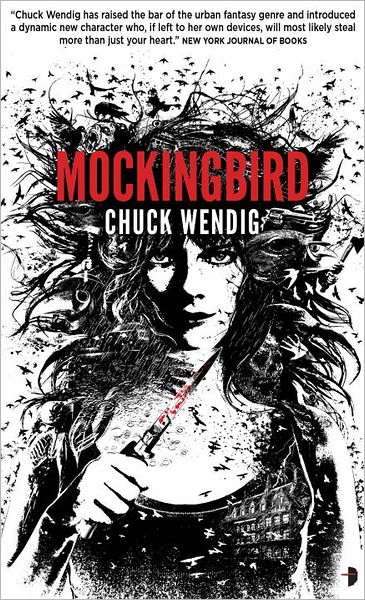
Mockingbird by Chuck Wendig

Wendig does it again! You know, it says a great deal about how well his stock is doing at pagesofjulia when I pick up his new book immediately upon its release – this, in a world where my TBR shelves are three and the stacks on the desk are… many. He’s right up there with Tana French.

We left off with Blackbirds, you will recall. Miriam Black, that foulmouthed psychic badass bad girl, had decided to try to settle down with Louis and ignore her (dubious) “gift.” We meet here again here in Mockingbird, and the informed reader will not be surprised to learn that things don’t go so smoothly for her as she’d hoped. In the opening scene, she foresees a bloody death in the immediate future and intervenes… and her life with Louis, rocky at best, comes apart. The lesson Miriam learned in the last book was how to interfere with fate for the cause of Good. Which raises a question: can murder ever be righteous, virtuous, redeemed? The question this book raises is, does the same answer apply when the roles are switched around?

I don’t want to say anything more about plot here (and hopefully I’ve been vague enough), but I will say that this continues in the gritty, grainy badass vein established by Blackbirds. Miriam is her old self, and I love her for it. Louis is rather his old self too, and he was pretty charming. A new and likeable character is born in a certain schoolteacher undaunted by mortality; and we meet a … there’s a villain. And the villain is interesting, too. And there are little girls.

The strengths of Blackbirds are all present: pacing, characterization, and loads and loads of atmosphere. I am crazy for Miriam’s brand of crazy. She undergoes a change here, something that feels alarmingly like altruism; she almost seems to be capable of forming bonds. And like Blackbirds, it ends with a twist. I’m afraid I can’t say much more about the book without feeling like I’m giving something away… the plot really needs to be revealed in your reading. What I can say is about style. Wendig is almost Hemingwayesque (what? roll with it), but even punchier, and harsher. Come to think of it, maybe I could say the same about Miriam.

Forgive my brief review; but please be impressed by the fact that I will, again, pick up the next book as soon as it’s released. Apparently that will be Cormorant. Get with it, Wendig.


Rating: 7 psychic visions.

Blackbirds by Chuck Wendig

My paperback copy of Blackbirds instructs me (on the back cover, at the top, near the spine) to “file under Urban Fantasy.” I am a fan of these labels, not least as a librarian (!), especially with a book like this one that deviates from my usual genres a little bit. (My usual genres, if you’re a new reader, are mystery/thriller and various nonfiction, especially biography/memoir and nature writing.) So, this is fantasy. Urban. With paranormal aspects. And a very dark tone.

Miriam Black knows when and how people will die. All it takes is skin-on-skin contact. Shake her hand, bump her bare arm on the bus, and she sees your final minutes or moments in a flash. This is, not surprisingly, disturbing and traumatic for Miriam, but she’s learned how to make it work for her. She describes herself as a vulture, not a falcon: she doesn’t cause death (indeed, when she’s tried to stop it, she can’t, and often makes things worse), but she feeds off it. At the very least, she’ll rob the corpse.

This has gone on for a number of years at the opening scene of Blackbirds, and Miriam has developed a cynical, detached outlook that allows her to view death without so much internal damage. Of course, she’s experienced trauma in her life, not all of it linked to her unique gift. But then two forces impact the carefully orchestrated system she’s worked out. First, she meets a man – a nice man, in fact – and shakes his hand, and sees something she’s never seen before: a death scene in which she plays a role. Next, she meets another man who knows what she is and what she can do, and wraps her up in his own con.

The chronology of this story jumps around, which is a format not all readers appreciate, I know; but I think it works nicely here. We follow Miriam through “real time” in main chapters, and spliced in between are interludes, in which we hear her story as told to a young journalist, and the stories of other characters as told to Miriam. Chronology is further confused by the time-travel element in Miriam’s vision. Well, it’s not time travel, but it is a brief view of future events: she sees what happens and knows exactly when, without the benefit of knowing where or why. So we know what we’re rushing up to, but not how to get there.

This is a fast-paced, tremendously suspenseful read. I read it through in one sitting. [Warning: make time for this.] The sense of time passing, of momentum, is great. I couldn’t put this book down and halt the progression of Miriam’s fate; the stakes were too high! While there’s a feeling of inevitability, the ending applies a twist. I loved the dark atmosphere, too. Miriam is damaged, foul-mouthed, crude, but good-hearted and vulnerable, like so many great hero-villains. [While not entirely like any of them, Miriam evokes certain elements of Jack Reacher, Dave Robicheaux, Harry Bosch, Lizbeth Salander, and Mallory.*] In fact, my pleasant-surprise-observation is that this book is more similar to some of my murder mystery/thriller favorites than I expected. I think I feared a gothic blood-sucking-evil-death darkness and/or horror elements that would be too much for me, but instead I find this a great crossover read, and will be seeking more Wendig. Apparently there is a sequel coming soon! I am anxious!


*Fictional characters written by, respectively, Lee Child, James Lee Burke, Michael Connelly, Stieg Larsson, and Carol O’Connell.


Rating: 8 deadly daydreams.

Teaser Tuesdays: Blackbirds by Chuck Wendig

Teaser Tuesdays is a weekly bookish meme, hosted by MizB of Should Be Reading. Anyone can play along! Just open your current read to a random page and share a few sentences. Be careful not to include spoilers!

I’ve been a fan of Chuck Wendig’s blog for some time, but just now got around to reading one of his books, Blackbirds. And it was fabulous! Here’s a taste:

Miriam’s been walking for a half-hour, and the thoughts that run through her mind have serious legs. Terrible thoughts jog swift laps.

Is that not a great line? This is actually an example of one of the details of Wendig’s writing that I appreciate: the personification of things like, well, thoughts. It’s evocative. Miriam is just the kind of character I find fascinating, too: cynical, damaged, tough but vulnerable, and of course, well-developed. (As a character. Not in her bosom.)

And what are you reading today?

Teaser Tuesdays: Claire DeWitt and the City of the Dead by Sara Gran, again

Teaser Tuesdays is a weekly bookish meme, hosted by MizB of Should Be Reading. Anyone can play along! Just open your current read to a random page and share a few sentences. Be careful not to include spoilers!


That’s right, you’re getting a repeat today. I teased you from this book two weeks ago, but this passage was too funny to me to skip. Enjoy.

The black alligator purse had been Constance’s. Supposedly it had been custom made for Constance in Paris by Mademoiselle herself. It was bigger on the inside than on the outside, and could get almost anything through an x-ray machine or a Geiger counter. It had pockets inside pockets, secrets inside secrets. The solution to approximately 17 mysteries could be found in this purse at any given moment. In a jam, it could unfold into a tent and I could live in it until circumstances improved.

As I said in my review of this book, there is a mystical element. Constance’s purse may very well actually unfold into a tent. I like these details. If you had a magic purse, what would you want it to do for you?


Be advised: I’m out of town, so you’re viewing pre-scheduled posts until April 9. I love your comments and will respond when I return! But I’ll be out of touch for a bit. Thanks for stopping by!

Claire DeWitt and the City of the Dead by Sara Gran (audio)

The “City of the Dead” is New Orleans during & after Hurricane Katrina, and that’s what drew me to this mystery. That’s the whole sum total of my knowledge of Sara Gran’s book when I began it, and that was enough. I love New Orleans and I think my favorite mysteries are those with a strong sense of place, a well-developed sense of location as a pivotal part of the story – stories that couldn’t happen anywhere but where they do. (I’m thinking of Harry Bosch’s Los Angeles, Tana French’s Ireland, Lisa Gardner’s Boston, James Lee Burke’s New Iberia.) And even as far away as Houston – not so far, especially considering all the Katrina-displaced New Orleanians who now live here – the idea of Katrina is evocative and powerful. So the idea of a mystery set in Katrina’s New Orleans was enough to sell me. Of course, that wouldn’t necessarily make the book good… I’ll give Sara Gran herself credit for doing that.

This was a great, and entertaining read (listen). It’s part mystery and part study of New Orleans, and large part mystical magical musings – but perhaps that last is necessary of a study of New Orleans, with myth, legend, Mardi Gras Indians intruding upon the mystery. Our private investigator, Claire DeWitt, bends the classic hard-drinking, silent-loner-type PI to fit into New Orleans’s unique culture: she uses hard drugs and channels her detective hero, Jacques Silette (author of Détection, her bible of detective skills) as well as her mentor, the late Constance, former apprentice to Silette himself. Claire is sort of secondarily hunting her childhood friend and former fellow junior detective, Tracy, who disappeared so many years ago.

So what is the mystery? Claire comes down to NO from California when she’s hired by Leon, who wants to know what happened to his uncle, Vic Willing. Vic disappeared during Katrina, never to be seen again. I’m not sure we ever really settled why this indicates foul play, as lots of people got “lost” in Katrina, but it’s accepted throughout the story that something sinister must have befallen him, and I’m okay with getting on that train. Vic was a successful local DA, and fed birds from his apartment. And there the clues seem to end. Claire quickly gets herself entangled with some local delinquent youngsters, and has various adventures involving gunplay and drugs. Despite her hard exterior, she’s a bit of a softie towards these young men who’ve been dealt “a bad hand,” but she doesn’t let it show much. The mystery of Vic’s disappearance is not the star of this book. Its eventual wrap-up is a bit simplistic; as a strict, standalone mystery it might not impress. But that’s not what this book is about. Rather, several other threads steal the spotlight: Claire’s relationship with Andray and Terell; her relationship with her late mentor Constance; and the mystery (unresolved – maybe that’s another book?) of Tracy’s childhood disappearance, not to mention the interest (the framing element, if you will) of Claire’s nontraditional methods of detection, including throwing the I Ching and analyzing dreams and drug-induced hallucinations. Claire’s approach to mysteries in general is mystical.

There are also some decidedly funny moments; I giggled out loud several times (which will always make people look at me funny). Claire’s voice is wry and cynical, and she speaks in metaphors and self-deprecates. She’s prickly but altogether someone I’d like to know. In conclusion, while Claire has certain qualities in common with your traditional loner-drunken-detective archetype (which, by the way, is not a criticism!), she has plenty of unique quirks that make her very interesting to know. The mystery here is only a backdrop for the drama of New Orleans to play against. Claire DeWitt and the City of the Dead includes a number of characters I’d like to know better, and while it has a satisfactory and complete ending, it does leave the door open for a sequel. Sara Gran! I want it! Recommended.


Rating: 7 grumpy detectives.

Teaser Tuesdays: Claire DeWitt and the City of the Dead by Sara Gran

Teaser Tuesdays is a weekly bookish meme, hosted by MizB of Should Be Reading. Anyone can play along! Just open your current read to a random page and share a few sentences. Be careful not to include spoilers!

I’ve only just started this one, but this line struck me immediately.

New Orleans was a little like England. People were comfortable with class distinctions.

These two sentences are very expressive. I’m not your #1 expert on New Orleans or anything, but I live just 5-6 hours away and have been a number of times; I love the city and Katrina has certainly affected me and all Houstonians. With my moderate level of New Orleans knowledge, I see what she’s driving at here. I like this book so far.

What are you reading?

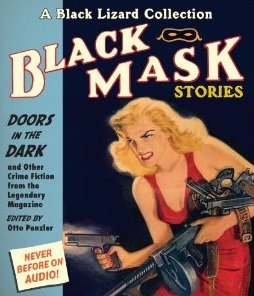
Black Mask (audio)

Classic hard-boiled crime stories from the historic and genre-defining pulp magazine Black Mask, in a beautifully performed audio collection.


Black Mask magazine (1920-1951) was a defining force in the pulp-magazine genre of hard-boiled detective stories, and this collection offers five representative pieces for the first time in the audio format. The excellent spoken performances are a rare treat, especially when finding stories of this vintage is in itself a challenge. The masters of the genre are represented in this collection, including Dashiell Hammett, under a pseudonym. Don’t skip the introduction, either: it’s a worthwhile and informative history of pulp magazines, the detective/crime genre, a number of classic authors, and Black Mask in particular. Each story has its own short introduction as well, adding to the value of the collection.

“The Phantom Crook” takes on organized crime in order to free a damsel in distress from blackmail. A case of arson and apparent murder is not what it appears. Another blackmail case threatens to take advantage of a well-meaning but bad-tempered newspaper photographer. A drunken reporter tails a detective into a warehouse district in pursuit of a crook. And in the final tale, a Florida private investigator named Sail, working off his boat, investigates a case of sunken treasure while the bodies stack up. In each story, the gritty, taut suspense is reinforced by an appropriately gruff audio performance.

Black Mask has released a total of three collections of short stories. The following two promise more of the same: dark, suspenseful, character-rich crime drama. Readers of the modern hard-boiled detective/P.I. genre owe it to themselves to check out their roots in these fine examples of detective-noir classics.


I wrote this review for Shelf Awareness for Readers. To subscribe, click here, and you’ll receive two issues per week of book reviews and other bookish fun!

The Big Sleep by Raymond Chandler (audio)

I know Chandler as the mystery author who inspired, among others, Michael Connelly. Connelly is one of my favorite genre authors and cites Chandler as an influence on his work. In fact, Shelf Awareness quotes him (as their Book Brahmin on April 22, 2011), in answer to a question of the book that changed his life: “The Long Goodbye by Raymond Chandler. I was a casual reader of genre fiction. This book made me want to write it.” Thank goodness for that!

I read The Long Goodbye first (and before the above quotation!), and found it to be delightful. I recognized Connelly in his writing style and Harry Bosch in the style of his lead detective. (Of course obviously the influence went the other way around.) So when I saw The Big Sleep on audio – unabridged, necessarily – I snapped it up. I believe the latter was actually his most-renowned work.

You can’t help but like a guy who doesn’t write that “time passed slowly”, but rather writes

Another army of sluggish minutes dragged by.

That’s pretty great. And this:

‘It’s goddamn funny in this police racket how an old woman can look out of a window and see a guy running and pick him out of a lineup six months later, but we can show hotel help a clear photo and they just can’t be sure.’

‘That’s one of the qualifications for good hotel help,’ I said.

You see my point, right? There are some awfully clever, funny, classic moments in this story; Chandler is a fine writer with a distinct style.

The actual story qualifies, too, as clever, funny, and classic. It’s easy to see that this man is one of the fathers of the genre I love. I’m a bit ashamed to note that I’ve read mostly recent authors, and neglected their heritage.

In this novel, Philip Marlowe, PI, is asked to look into a little matter of blackmail for General Sternwood, who has two young, beautiful, highly deviant and troublesome daughters. Marlowe is a man of relatively few, but quite witty words. He fends off both sisters at various point or another while looking into the missing husband of one, unasked. He’s a classic PI; he drinks alone in the morning; I’m pretty sure he wears one of those pulp detective hats – a fedora? At any rate, he releases the Sternwoods from the blackmail and pulls all the pieces together at the end to explain the missing husband too. It’s a tidy little ending, crowned by some grumbled musings on The Human Situation and The Big Sleep.

I liked this book very much and recommend it to readers of detective fiction who want to go back to the genre’s roots.

Do you read in the present or in the past? Do you miss the past, if you read in the present? I know I love my current genre authors (Lee Child, Michael Connelly, James Lee Burke, Elizabeth George) but it’s important and definitely enjoyable also to appreciate the pioneers. I’ve enjoyed Agatha Christie, Raymond Chandler, and one little gem from A.A. Milne; I’ve got a P.G. Wodehouse waiting in the wings. What are YOU up to?