book beginnings on Friday: The Cormorant by Chuck Wendig

Thanks to Rose City Reader for hosting this meme. To participate, share the first line or two of the book you are currently reading and, if you feel so moved, let us know what your first impressions were based on that first line.

cormorant

Following on Blackbirds and Mockingbird, Chuck Wendig returns us to the strange and darkly wonderful world of Miriam Black with The Cormorant. I like cormorants (we have them in the bayous ’round here) and I like Wendig’s weird sense of humor. First, the dedication: “To all the foul-mouthed miscreants and deviants who are fans of Miriam, and who make this book possible.” Thank you, sir.

It begins:

“And the Lord said, let there be light.”

A flutter of black fabric, and the hood is gone.

Miriam winces.

Right on schedule.

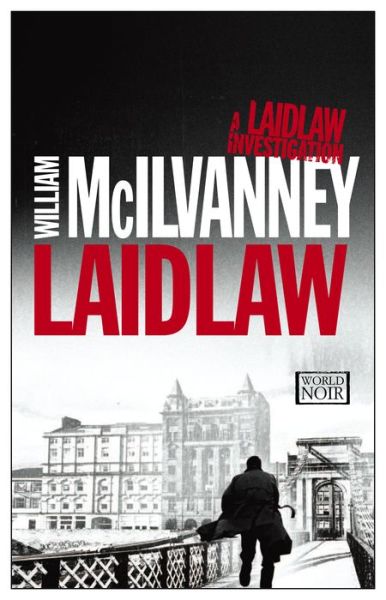
Laidlaw by William McIlvanney

A literary Scottish noir mystery from the 1970s–heavy on character, setting and lyricism–lives up to its reputation in this reissue.

laidlaw

Originally published in 1977, William McIlvanney’s Laidlaw, the first book in a trilogy, set a standard for noir mystery. In this reissue, McIlvanney’s gruff, broad strokes read as freshly as ever.

Glaswegian detective inspector Laidlaw is the quintessential hardened, hard-drinking cop. Sarcasm, problems at home and a prickly exterior belie a sensitive man who believes that his society bears some responsibility for every crime he investigates.

Laidlaw is approached by a thug he’s dealt with before: Bud Lawson’s daughter hasn’t come home from the club, and Lawson wants Laidlaw’s help. Where other cops hold Bud’s criminal past against him, Laidlaw is willing to assist. For this case, he is partnered with the ambitious and impressionable young detective constable Harkness, who is meant to act as liaison between Laidlaw’s unconventional tactics and the police establishment. Harkness is an excellent foil for Laidlaw’s methods and worldview, and the growth and development of their relationship throughout is a satisfying side plot.

A murdered teenage girl does not, on the surface, look to be related to the network of thugs and gangsters that run Glasgow’s criminal industry. But her killer–exposed to the reader early on–quickly becomes a pawn. Bud Lawson’s gangster associates want him so they can exercise their revenge; other gangsters with other connections want him spirited safely out of town; and, of course, Laidlaw has his own goals–though, as he asks, “Who thinks the law has anything to do with justice?”

The phonetically spelled Scottish brogue adds color to dialogue, and McIlvanney’s remarkable lyricism is surprisingly refined in this dark, coarse world (“She waited patiently for his head to come back from a walk around his guilt”). His strengths are both character and setting: Laidlaw is a complex individual, harder on himself than on anyone else, with an iconoclastic nature and difficulty with authority figures. The Glasgow McIlvanney evokes, rife with poverty and an unglamorous criminal underbelly, is absolutely compelling, and is a precursor to strong mystery settings like Michael Connelly’s Los Angeles or James Lee Burke’s Louisiana.

Laidlaw is not so much action-packed–although there is plenty of head-busting–as it is considered, psychological and concerned with the existential. McIlvanney has earned his reputation as the father of the “tartan noir” crime-writing genre that includes Ian Rankin, Denise Mina and Val McDermid. Readers will be glad to know that the next two books in this trilogy are set for re-release in late 2014.


This review originally ran in the May 12, 2014 issue of Shelf Awareness for the Book Trade. To subscribe, click here.


Rating: 5 pubs.

Teaser Tuesdays: The Mad and the Bad by Jean-Patrick Manchette

Teaser Tuesdays is a weekly bookish meme, hosted by MizB of Should Be Reading.

mad and bad

The Mad and the Bad exemplifies “hard-boiled.” It is both spare and opulent, and very bloody and French.

Stiff-backed, glass in hand, he left through the side-door, and Julie hesitated for a moment before pouring herself a brandy which she downed, standing, in a single gulp, reminded of a time when, freezing cold at dawn, she would stand at a bar and wash down black coffee with four shots of calvados at the start of a day of wandering, tears, fatigue, and despair.

I am not always pleased by that many clauses (you know I prefer semicolons to commas!) but I like this lengthy sentence and its evocations. Freezing cold at dawn with black coffee and booze, tears and despair? It’s almost a cartoon of noir. Almost.

This quotation comes from an uncorrected advance proof and is subject to change.

Teaser Tuesdays: Laidlaw by William McIlvanney

Teaser Tuesdays is a weekly bookish meme, hosted by MizB of Should Be Reading.

laidlaw

Laidlaw was originally published in 1977, and is back in this new reissue, due out in June. McIlvanney has a unique style, literary and lyrical but also gritty and dark. I liked these lines for their nuance and contradictions…

The entry was dank. The darkness was soothing. You groped through smells. The soft hurryings must be rats. There was a stairway that would have been dangerous for someone who had anything to lose.

…by which I mean, Hemingway, right? Short sentences and a lots of sensory detail; and an almost tongue-in-cheek overdoing of the tension in that final line. I like it. Stay tuned.

This quotation comes from an uncorrected advance proof and is subject to change.

Maximum Shelf: The Weight of Blood by Laura McHugh

Maximum Shelf is the weekly Shelf Awareness feature focusing on an upcoming title we love and believe will be a great handselling opportunity for booksellers everywhere. The features are written by our editors and reviewers and the publisher has helped support the issue.

This review was published by Shelf Awareness on January 15, 2014.


weight of blood

“That Cheri Stoddard was found at all was the thing that set people on edge, even more so than the condition of her body.” So opens Laura McHugh’s delightfully and darkly disturbing debut novel, The Weight of Blood. The town of Henbane is agitated because it is so good at keepings its secrets–and bodies are so easy to hide in the twisted, wooded Ozark Mountains.

The story begins with the first-person perspective of 18-year-old Lucy Dane. Lucy has it pretty good: she has a reliable best friend, a loving relationship with her father, and neighbors who make up an extended family of sorts. And she’s just begun working in her uncle’s store, where she gets to rub elbows with the sexy Daniel. But Lucy is troubled by the disappearance of her sort-of friend Cheri, a developmentally disabled schoolmate whose freshly dead body was only recently discovered–a year after she went missing. She’s also still troubled by the unexplained disappearance of her mother, Lila, who walked out of the house carrying a handgun and nothing else when Lucy was a year old.

The perspective then shifts to that of Lila herself as a young woman, newcomer to the Danes’ hometown of Henbane. Henbane is almost a character unto itself, insular, suspicious and largely unmarked by passing time. For a fee, residents can avoid a “city burial” (embalmment and the involvement of the authorities) in favor of a private grave-digging service. And the local lawyer will advise you not to trust local police until you find out who’s related to whom. It is anything but a friendly destination for a damaged teenager like Lila, who immediately runs up against the Dane brothers: the older Crete, who runs several businesses including a farm and a store, and his little brother, Carl, who becomes her husband before she turns 19. Superstitions have her labeled a witch before she’s unpacked her few belongings.

Through Lila’s eyes, the reader will find out slightly more about her background than Lucy knows, but Lila works hard to remain a mystery to both the reader and Henbane locals, including Carl. The perspectives continue to alternate. While Lucy keeps the reader up to date on current goings-on, it is through Lila that we begin to learn the ugly secrets that Henbane keeps. Other characters, too, get occasional chapters told from their point of view (in omniscient third person; only Lila and Lucy get first-person treatment), and one of the strengths of The Weight of Blood is that its engaging, complex, fully wrought characters extend beyond its protagonists. Lucy’s best friend, Bess, and Bess’s mother, Gabby (who was, in turn, best friend to Lila); Carl and Crete; the love interest, Daniel; a surrogate grandmother; and a local drug dealer all get sensitive handling and character development. But it is the measured building of tension and the careful doling out of hints of evil that star, as Lucy’s coming-of-age experience brings the classic bildungsroman to meet the gritty thriller.

While helping Daniel clean out an old trailer belonging to her uncle, Lucy discovers a clue: a lost item that she knows used to belong to Cheri, because Lucy gave it to her. Next, Bess overhears a reference that she shouldn’t have. With Daniel’s cautious support, Lucy begins to look into Cheri’s death, and the matter of where she spent that unaccounted-for year. But, of course, in a town this small, where everyone recognizes headlights and knows where a particular truck might be heading, investigations are dangerous. Like her mother before her, Lucy is told outright that it would be risky to go to the police for help. And as she probes the question of Cheri’s fate, and finds it apparently linked to her mother’s, Lucy will be disturbed at how close her inquiries lead her to home.

Carl and Crete, the Dane brothers, are heir not only to the off-the-books grave-digging business, the combined local grocery store and restaurant, and various secrets, but also to mental illness and corruption. As its title suggests, The Weight of Blood is concerned with the strength of our bonds to our family, and the tension between biological ties of blood and the families we choose for ourselves. In a remarkably convincing portrayal of young adulthood, Lucy allows McHugh to explore themes of loyalty: where it’s owed, and to what extremes.

The atmosphere McHugh evokes in this masterful debut is wonderfully spooky, exemplifying Southern noir with a backwoods mountain twist and a matter-of-fact willingness to bury its dead out back and walk away. Taut pacing, lively suspense and atmosphere are the strongest points of a novel that also has an engaging plot and beautifully built, sympathetic characters to its credit. For fans of dark, suspenseful, well-structured thrillers, The Weight of Blood is a delicious and nail-biting treat.


Rating: 7 baby possums.

Come back tomorrow for my interview with McHugh!

The Fame Thief by Timothy Hallinan

Timothy Hallinan’s quirky thief/detective (last seen in Little Elvises) is forced to delve into long-past Hollywood scandals by a nonagenarian crime boss.

famethief
The Fame Thief is Timothy Hallinan’s third novel starring Junior Bender, a professional burglar with a second calling as a crook’s detective–because bad guys need their mysteries solved, too. Irwin Dressler, no less powerful a crime boss for his 93 years of age, hires Junior against his will for a strange 60-year-old case, the theft of a Hollywood actress’s most valuable asset: her fame.

Dolores La Marr was a kid from Scranton, scarcely beginning to make it big in 1940s Tinseltown, when her association with that era’s fashionable gangsters landed her in a nasty, full-color scandal. Strangely, no one but Dolly took the fall, and all these decades later, Dressler still wants to find out who set her up. Junior quickly learns that this mystery is not as dead as it seems, and that some dangers only increase with age.

The refreshingly unassuming Junior is a fun riff on the typical private investigator: his specialty–committing crimes, rather than solving them–brings him an unusual perspective. The elderly Dressler is a fabulous, deadpan wiseguy in “eye-agonizing” golf pants, backed up by two unusually domestic versions of the standard muscled goon. And Junior’s own domestic concerns–a teenage daughter, her jokester boyfriend, an ex-wife and a randy new girlfriend–fill out the eccentric, likable cast. Fast-paced action and a building body count pair nicely with humor in this series, bound to keep the reader coming back for more.


This review originally ran in the July 12, 2013 issue of Shelf Awareness for Readers. To subscribe, click here, and you’ll receive two issues per week of book reviews and other bookish fun!


Rating: 6 slow-speed car chases.

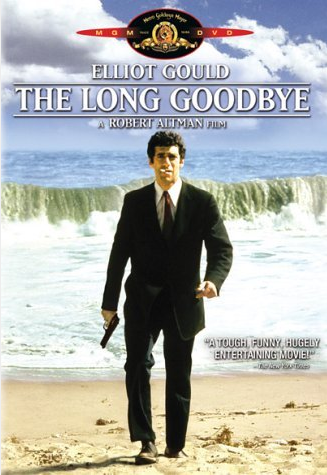
movie: The Long Goodbye (1973)

longgoodbyeThis 1973 film is based on the 1953 book by Raymond Chandler, which I read so long ago (and apparently pre-blog) that I don’t entirely trust my recollections. I’m pretty sure there are significant divergences in movie form from the plot of the book – what else is new.

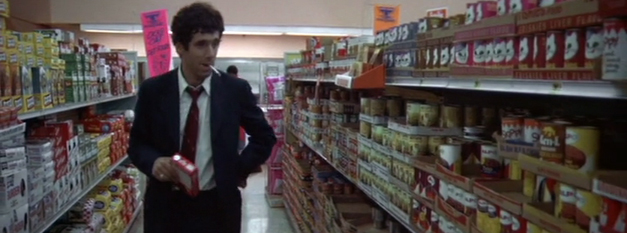
Raymond Chandler’s 1940’s-50’s private detective hero, Philip Marlowe, has been updated here to fit into 1970’s Hollywood. In the opening scene, Marlowe is awakened by his cat, who insists on being fed at 3 in the morning; upon awakening, the first thing Marlowe does is light up a cigarette, an action we will see repeated ad nauseam. (Husband and I guesstimate that at least 50 cigarettes are smoked in this movie by Marlowe alone. The only times he’s not smoking are when he’s lighting up or in police custody.) He then heads to the 24-hour store for cat food. Still smoking.

and brownie mix, for the hippie neighbor girls

and brownie mix, for the hippie neighbor girls

Marlowe’s friend Lennox asks for a ride into Tijuana following some trouble with his wife; after performing this favor, the cops show up to inform Marlowe that Lennox had just killed his wife, an accusation that Marlowe does not believe. Likewise Lennox’s apparent suicide in Mexico a few days later. Meanwhile, Marlowe takes a case from a ritzy blonde wife of a temporarily missing alcoholic writer who is so Hemingway:
hem
This couple, the Wades, turn out to be tied up with the now-dead Lennoxes. Marlowe’s old-fashioned loyalty to his friend is poorly rewarded. He loses his cat. It’s a sad story.

Despite numerous plot changes from the novel (Wikipedia agrees), and the notable reset to 1970’s California, including violent gangsters and a young Arnold Schwarzenegger I had trouble recognizing, I thought this movie did faithfully reflect the iconic character of Philip Marlowe. I liked the humorous addition of the hippie neighbor girls (topless, with the candles and their yoga, a great distraction to Marlowe’s male visitors) and the (less humorous) gangsters, too. The ending in Mexico was the greatest divergence from the novel but I can appreciate it. Overall, a real win: this film keeps the spirit of the original and updates it somewhat, and great visuals and Marlowe’s pulpy, rough demeanor appropriately take center stage.


Rating: 8 portraits of James Madison.

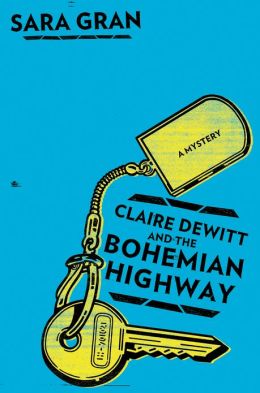
Claire DeWitt and the Bohemian Highway by Sara Gran

A singularly weird and drug-fueled private eye, not for the faint-hearted.

gran

Sara Gran’s Claire DeWitt and the Bohemian Highway gives us a refreshingly bizarre twist on the classic private investigator. Readers of Claire DeWitt and the City of the Dead will recognize Claire’s copious and indiscriminate drug use (she never fails to check a medicine cabinet and pocket the contents; she seeks dealers like she seeks clues) and her generally hard-bitten lifestyle. Similarly unconventional is her somewhat metaphysical style of detection, guided in part by a controversial dead French detective who speaks to Claire through his book.

When Claire’s ex-boyfriend Paul is murdered, and several of his valuable guitars go missing, his wife, Lydia, hires Claire to look into things. A simultaneous case involves a diminishing herd of miniature horses up in Marin County: Claire suspects they may be committing suicide. The action shifts from contemporary San Francisco, where Claire hunts Paul’s guitars and his killer, to the Brooklyn of Claire’s adolescence, where she and two friends once investigated a missing girl. One of those friends will later go missing herself; and the whispers of the missing Tracy, the dead Paul and the possibly suicidal miniature horses haunt Claire as she tries to keep it together and solve a murder through the haze of various uppers and downers.

Strange, distinctive characters are one of Gran’s greatest strengths, coupled with a strong sense of place and a gritty atmosphere of depravity and mysticism. Dark, classic PI adventures with an unprecedented zaniness mixed in make Claire DeWitt a rare reading experience.


This review originally ran in the June 25, 2013 issue of Shelf Awareness for Readers. To subscribe, click here, and you’ll receive two issues per week of book reviews and other bookish fun!


Rating: 8 bumps.

Teaser Tuesdays: Claire DeWitt and the Bohemian Highway by Sara Gran

Teaser Tuesdays is a weekly bookish meme, hosted by MizB of Should Be Reading. The idea is to open your current read to a random page and share a few sentences. And try not to include spoilers!

gran

I am enjoying the second in a mystery series starring Claire DeWitt, a dark and disturbed private investigator in the tradition of classic PI’s, but female and drug-addled. She’s a funky riff on an archetype: I dig her.

The cops can only do so much. Even if they mean well, even if they’re geniuses, they have fifty or so cases and limited overtime and wives and husbands and children and mortgages. That’s why you hire a private eye. Because if she’s smart, the private eye has none of those things.

I like to imagine her saying these lines in a gruff, hoarse voice. I think she’d make good film.

This quotation comes from an uncorrected advance proof and is subject to change.

The Rage by Gene Kerrigan

A noir crime novel featuring the collision of a motley group of characters in modern Ireland.

rage

The Rage by Gene Kerrigan (The Midnight Choir) is a multifaceted, character-driven story of crime and remorse. Vincent Naylor, freshly out of prison, is back to planning a robbery with his old accomplices, most notably his beloved big brother, Noel. Bob Tidey is an experienced and jaded police detective, still devoted to doing good but with the growing feeling that his employers limit his best efforts. Maura Coady is a retired nun living with her guilt and regrets. When Maura witnesses something out the front window of her apartment that doesn’t look quite right, she calls Tidey to report it, setting in motion a string of events that run counter to the Naylor brothers’ movements toward the next big score. The reader watches each player’s trajectory on this collision course, but still won’t guess the big finish until it crashes into place.

The Rage will please readers of crime thrillers and literary fiction alike. The atmosphere effectively evokes contemporary Ireland, with all its discontent and economic frustration, and in this way brings to mind Tana French’s lyrical Dublin Murder Squad mystery series. Bob Tidey’s cynicism and gruff efforts at romance recall Michael Connelly’s hero Detective Harry Bosch. The intersecting story lines and crescendo of action create a cinematic effect. Kerrigan’s compelling characters carry this thriller breathlessly through to its climax, but it is the engaging dialogue, thoughtful and absorbing prose and social conscience that make The Rage memorable.


This review originally ran in the February 8, 2013 issue of Shelf Awareness for Readers. To subscribe, click here, and you’ll receive two issues per week of book reviews and other bookish fun!


Rating: 6 regrets.