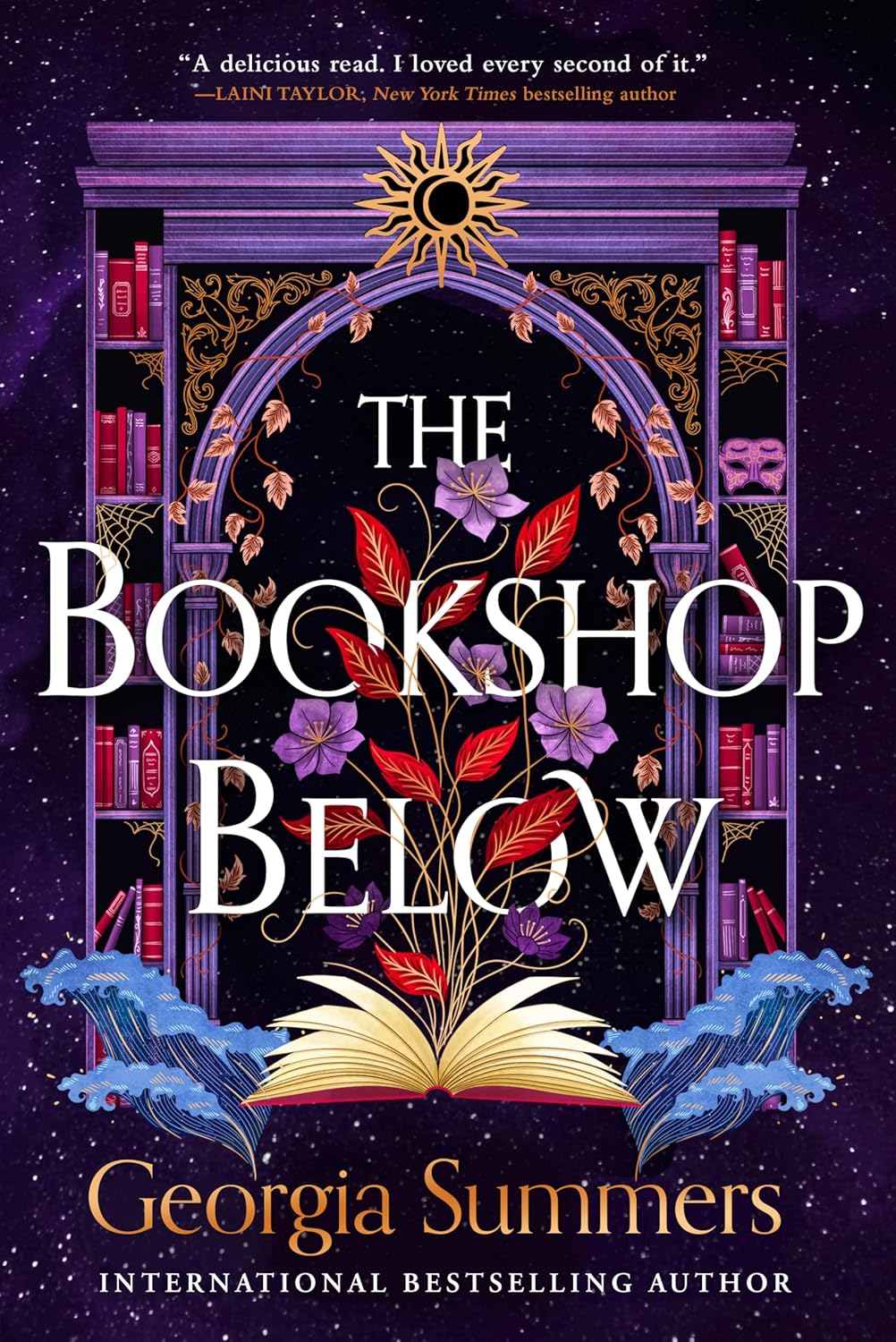
The Bookshop Below by Georgia Summers

This dark fantasy about the magic of books and the power of love is both heartrending and inspiring.

Georgia Summers (The City of Stardust) renders an enchanting world of self-sabotage, romance, deadly ink magic, and dearly beloved bookstores in her sophomore novel, The Bookshop Below. London was once full of shops where books and the magic they held could be exchanged for the priceless: self-extracted teeth, a lock of hair, a firstborn child. In contemporary times, the force that imbues books and bookshops with their power, through the particular magical workings of booksellers, is fading. Now Cassandra, a disgraced former bookseller, is drawn back into the life that exiled her, just in time to die along with the world she reveres–or, perhaps, to save it.

She’s been living as Cass Holt for years, getting by (and keeping her hands on the books she loves) in the most ignoble fashion: Cass is a book thief. She is also one of the most talented readers–wielders of the magic within enchanted books; now she sells that gift without scruples to whomever can pay. But Cass once had another name: “Cassandra Fairfax, named after a woman whose words melted into thin air no matter how truthful they were, with the surname of a character in disguise from a novel by a long-dead author. Layers upon layers of insubstantiality.”

Summers’s enchanting fantasy opens with Cassandra in great danger, called to return, reluctantly, to the bookshop where she was raised, trained, and then banished by her mentor, Chiron. She was once his protégé, destined to become an owner one day. Now, just as suddenly, she finds herself reinstated, struggling to rehabilitate Chiron’s decayed shop “and all its finicky, unpredictable moods.” She is in over her head, wrestling with her considerable guilt over past crimes against bookshops, against the underground river that powers the bookshop systems in ways Cassandra has yet to understand, and against Chiron himself. She is in danger from enemies who know about her deeds as Cass Holt, and whatever is threatening the bookshops. Cassandra must manage a bookseller she feels lucky to hire, a wonderfully capable woman named Byron; a handsome, magnetic rival named Lowell Sharpe; and the duty she feels to solve the mysteries of what happened to Chiron and why the magic bookshops are disappearing. Cassandra is not sure she wants to be here at all, let alone on the hook for saving everything she knows from destruction. But she feels she owes a debt. She finds she cares about people she never expected to. And she uncovers an enormous secret about her own origins that upends the stakes entirely.

The Bookshop Below offers a delicious combination of shadowy, sinister magic, wistful romance, propulsive action, and the utter reverence one holds for the right book. Summers excels at transporting her readers to a dreamy otherworld where anything is possible.


This review originally ran in the September 26, 2025 issue of Shelf Awareness for the Book Trade. To subscribe, click here.


Rating: 8 mugs that say “I slay comma splices.”

Harmattan Season by Tochi Onyebuchi

My first Onyebuchi is an interesting one to characterize as to genre. Harmattan Season is a PI story with some classic noir elements: protagonist Boubacar is down on his luck, a little self-sabotaging, unsure of what he’s working toward, fighting some old demons and secrets. It’s historical fiction, set in a West African nation under French colonial rule in a not-quite-modern timeline. It’s fantasy, or speculative fiction: there is magic afoot. One could argue it’s dystopian, but the colonial rule bit kind of covers that already.

Onyebuchi has a firm grasp of pacing and suspense, and Bouba is a compelling central character. He’s mixed race, or deux fois (“two times”), half French and half indigenous, and struggles with that identity: does it mean he gets part of each of two worlds? Or none of either? Does he fit in a little bit everywhere, or nowhere at all? The reader will learn slowly that his in-between status is further indicated morally by some of his past actions.

“Fortune always left whatever room I walked into, which is why I don’t leave my place much these days.” In the opening scene, Bouba is awakened in the middle of the night by banging on his front door. A woman stumbles in, holding a bleeding abdominal wound. She asks him to hide her; he does, as the police arrive next. One of them, it turns out, is an old associate of Bouba’s – you might even say a friend, or the closest thing he has. They leave. The woman has vanished. Unpaid, Bouba spend most of the rest of the novel trying to solve the mystery of the bleeding woman: who she was, what happened to her. He will uncover many layers of intrigue, wrongdoing, and attempted corrections, in spheres both political and personal.

I think a better grasp of West African history and politics would have given me a deeper understanding of some plot elements – and some linguistic background might have helped as well. There were a few unfamiliar words, some of which I got from French (like deux fois), some of which seem to belong to Onyebuchi’s fictional world (dugulenw), but some of which are not his invention (like the title’s harmattan, a dry seasonal West African wind). How many of the latter, or how many slight variations or references, did I miss? This is a good example of how reading ‘the other’ can be a bit more challenging but also why it’s important to do it. I’m just noting where I might have missed some nuance. Partly, I think, for this reason, I had a slow time getting engaged with the momentum of the plot, but we got there, and I wound up feeling involved with Bouba’s wellbeing and that of the community he gradually decided he belonged to.

I think Onyebuchi is a skilled writer with a fascinating and fresh take on genre intersections, and I’m curious about what else he’s done.


Rating: 7 apples.

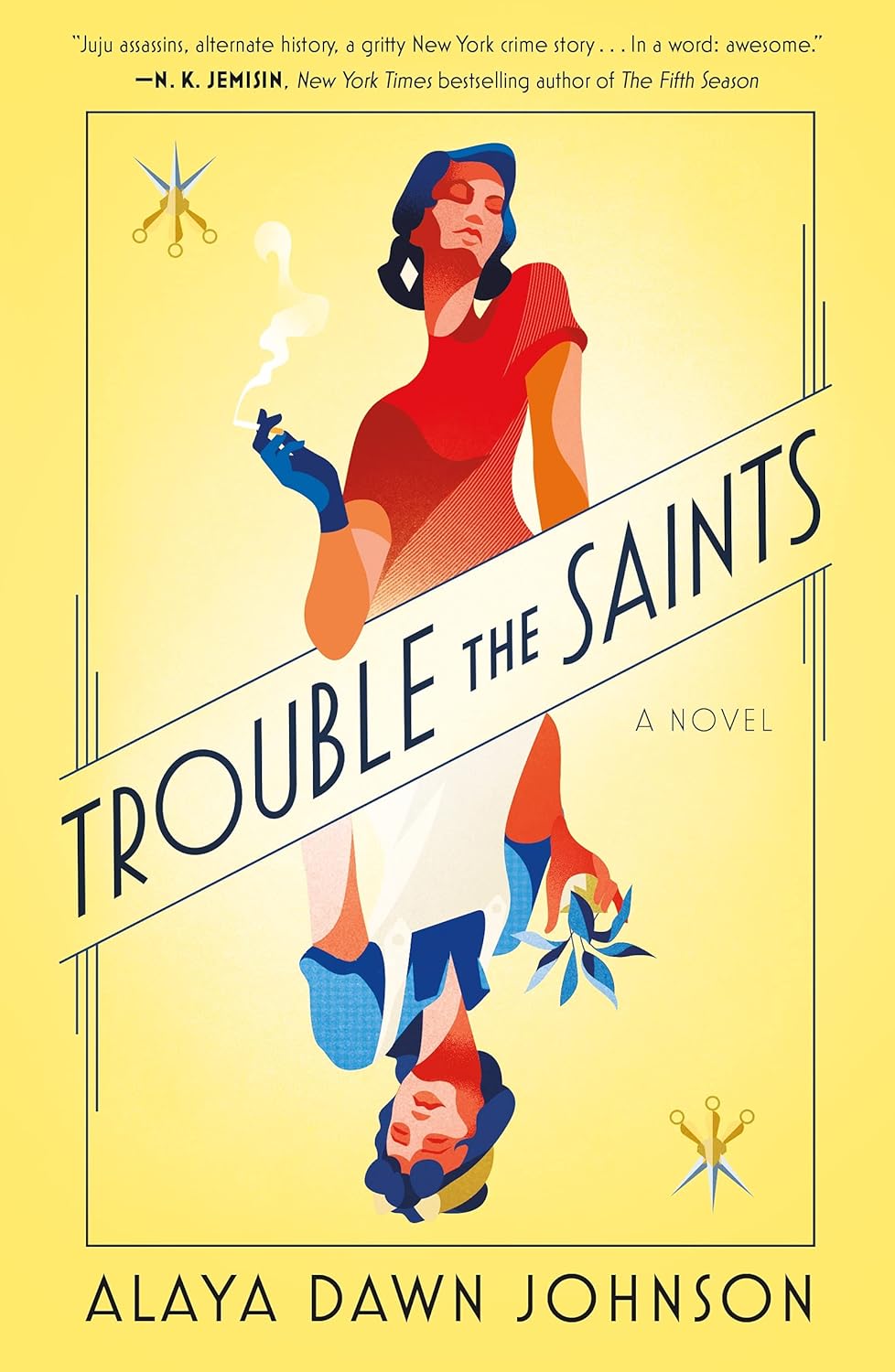
Trouble the Saints by Alaya Dawn Johnson

Trouble the Saints is bewitching, mesmerizing. It begins mid-scene, a move that is always risky but can have big rewards: the writer asks the reader to wade through a little confusion in favor of action and immediacy, trusting her to wrangle the context clues and have patience with the pace at which details and secrets unfold. It’s well done here. There are cards, and dreams, and magic hands – saints’ hands – and a violent backstory for a protagonist who is however strongly committed to her own concept of justice. The reader finds out as she does how she’s been betrayed – and by the one she loves the most.

Phyllis, or Pea or Sweet Pea to those she is close to, is a paid assassin for a Russian mobster in early 1940s New York City. She is known as Victor’s knife, or Victor’s angel – because she only agrees to kill when the victim deserves to die. She is also a ‘high yellow’ woman of color passing for white in a pretty high-stakes setting. Her years-ago lover, Dev, is a Hindu man guided by karma and reincarnation; he could not abide Pea’s work. His current partner is also one of Pea’s dearest friends, the singer/dancer/entertainment manager Tamara, who is Black enough to suffer the full weight of prejudice and discrimination when Pea can sometimes skirt it. So: violence, organized crime, race and racism and colorism, oh and Hitler’s on the rise, and also Pea’s immaculate skill with her knives is owing to her saints’ hands, which manifest in different ways for different individuals. Dev can sense threats with his. Tamara doesn’t have the hands, but she is an oracle: with her great-aunt’s cards she can read fortunes, or the future, or both – the rules are revealed slowly, to us as well as to these characters. There are others, with different backgrounds, skin tones, and degrees of magic or understanding. Danger and hauntings are everywhere, but there is also romance and the kind of connection that transcends that label.

Trouble the Saints is an astonishing book that keeps surprising, not least with its changes in perspective. These subjects range widely and never feel overambitious for the remarkable Alaya Dawn Johnson, who imbues even the gruesome with poetry. She’s a new name to me but one I’ll be looking for. It took me a day or two to recover, and I’m still thinking about love, friendship, and what we carry on with us. Whew.


Rating: 8 letters.

The Staircase in the Woods by Chuck Wendig

Former best friends reenter a scene of horror in this clever, terrifying novel about the dangers that lurk in friendships, home, and the self.

The singular Chuck Wendig (Blackbirds and more) brings his trademark blend of humor, profanity, and shrewd observation to the weirdly charismatic The Staircase in the Woods. Chilling, disturbing, and deliciously entertaining, this horror novel stars a group of one-time best friends who reunite as adults across a chasm of time and trauma. Nick is as abrasive as ever, but at least he gets them all back together again. Hamish has traded in his Birkenstocks, jam bands, and extra weight for fitness, church, and family. Lore (formerly Lauren) has achieved professional success, but only through an increasingly belligerent go-it-alone approach. Owen (aka Nailbiter) is barely surviving his mental health woes. And Matty, once their golden boy, hasn’t been seen since that day in the woods in 1998. Five teens went camping, four came back out again. Now, more than 20 years later, they have a chance to try to find out what went wrong–or lose themselves like Matty did.

Four dysfunctional adults walk into a different set of woods, fighting among themselves and against their own demons, and enter a sinister otherworld that may have consumed their friend. Wendig’s narrative emphasizes the strengths and failures of friendship, and the difficulties of both childhood and adulthood. His snark is obscenity laden but also earnest in its compassion. The Staircase in the Woods deals in torture, violence, and abuse, especially within families, portraying how connection to place and the importance of home can cause at least as much pain as comfort. The result is haunting and unforgettable.


This review originally ran in the May 2, 2025 issue of Shelf Awareness for Readers. To subscribe, click here, and you’ll receive two issues per week of book reviews and other bookish news.


Rating: 7 cuts.

Bad Nature by Ariel Courage

Bleakly funny, gloomy, and magnetic, this novel’s revenge-fueled, terminal road trip will tender surprising truths.

Ariel Courage presents a provocative, hypnotic excursion with her debut novel, Bad Nature, which offers a road trip, a revenge fantasy, and a snarky sendup of American culture.

Courage’s mesmerizingly repellent protagonist, Hester, is a successful lawyer with money to burn–one form of revenge upon her “impracticable, unprofitable” upbringing–and an antiseptic lifestyle kept up by a personal trainer, a dermatologist, a cosmetic dentist, and other professionals. In her nondescript but designer-decorated Manhattan condo, she has regular, emotionless sex with the “objectively repulsive” building super.

Hester relates early in her narrative: “I was always going to kill my father.” This intention shifts from someday to immediate when, just after her 40th birthday, she receives a breast cancer diagnosis. The oncologist tells her that, without treatment, she has six months to live. With characteristic, practiced detachment, Hester quits her job and leaves Manhattan in her Jaguar E-type, aiming for her long-estranged father’s new home in Death Valley. She will kill him and then herself with the gun in her glove box. Simple.

Hester’s cross-country road trip is beset with trouble. She loses the E-type to theft at a Philadelphia rest stop, and with it, her gun and her mother’s ashes. The first lesson that her wealth–an important feature of her constructed armor–will not solve all her problems comes when she must settle for an insultingly affordable rental car. She picks up a hitchhiker: “what my mother had euphemistically called an urban outdoorsman and what in college I would’ve called a crustpunk.” This young man, John, becomes her unlikely companion on a convoluted and indirect route toward the eventual destination. John is a principled traveler: eschewing consumerism, he photographs Superfund sites, documenting destruction. Stops along the way include Hester’s (only) ex-boyfriend from college and a friend (likewise) from high school, with disappointing if predictable results. Hester gets sicker. The outcome of her larger journey is less easy to guess.

Caustic Hester is aware she has “daddy issues” but “I’d rather pluck his eyeballs out with a fork and eat them jellied on toast than endure five minutes of therapy.” Her first-person voice is deeply sarcastic, darkly funny, and almost entirely self-aware. Bad Nature‘s title offers commentary on Hester’s terminal cancer (and her mother’s), on the violent impulses of her hated father (and her own), on the environmental devastation John is called to witness. Even more than wealth, rigorous self-grooming, and personal aloofness, Hester’s carefully cultivated cynicism is her final weapon, and its potential loss might be the most painful and surprising part of this madcap expedition. Courage delights and challenges with this mashup of emotions, until readers may be surprised, in turn, to care about Hester after all.


This review originally ran in the March 6, 2025 issue of Shelf Awareness for the Book Trade. To subscribe, click here.


Rating: 7 dirty fingernails.

The Queen City Detective Agency by Snowden Wright

A disgruntled PI and a plot as wildly complicated as the history of the American South itself combine in this spectacular, darkly funny mystery.

Snowden Wright (American Pop; Play Pretty Blues) immerses his readers in a gritty, troubled small-town Mississippi with The Queen City Detective Agency, and introduces an indomitable protagonist.

It’s the 1980s and the country is about to reinaugurate Ronald Reagan when a small-time felon called Turnip does “a Greg Louganis off the roof” of the county courthouse in Meridian, Miss. Turnip was implicated in the murder, allegedly by hire, of a successful local real estate developer, and rumored to be involved with a mythical criminal syndicate called the Dixie Mafia that may or may not actually exist. Turnip’s suspicious death (by rooftop dive, or was it by poison?) and the murder he may or may not have helped arrange wind up entangled with cockfighting rings, domestic violence, child brides, centuries-old institutional racism and class discrimination, and much more.

Enter Clementine Baldwin (that’s Clem or Ms. Baldwin to you) of Queen City Detective Agency in Meridian, a decaying railroad town that was once the second-largest in the state. “Clem loathed this place and its vitiated nostalgia, redolent of an era when that idiot Atticus Finch thought he could win a rigged game, when you needed a tool to open a can of beer…. At least the beer cans had gotten better.” A disillusioned former cop, Clem is also a Black woman in a city, state, and nation that respects neither. She’d rather just be called a private investigator than a lady PI. For her second-in-command, she went looking for a prop: “completely useless in most circumstances, but, in hers, as handy as locking hubs on a muddy day. In other words, the prop had to be a white man. The guy needed to have hominy for gray matter….” But instead she found Dixon Hicks, “whose name said it all,” a prop who turned out to be a good partner and even a good friend.

Clem is a quintessential hard-boiled detective with entirely legitimate beefs with the world around her. She drinks too much, but who wouldn’t? Partnered with the genuinely, surprisingly good Dixon, she is a smart, courageous, flawed heroine, with plenty of dark humor and a storied past. Wright’s prose is clever and delightfully funny even while handling serious social ills. The Queen City Detective Agency is a remarkable work of Southern noir, featuring crackpot characters both silly and sinister, a longstanding history of greed and white privilege, and an unforgettable private investigator. Readers will be anxious for more featuring Ms. Baldwin.


This review originally ran in the June 14, 2024 issue of Shelf Awareness for the Book Trade. To subscribe, click here.


Rating: 8 rocks.

Maximum Shelf: Creation Lake by Rachel Kushner

Maximum Shelf is the weekly Shelf Awareness feature focusing on an upcoming title we love and believe will be a great handselling opportunity for booksellers everywhere. The features are written by our editors and reviewers and the publisher has helped support the issue.

This review was published by Shelf Awareness on May 8, 2024.


Rachel Kushner (The Flamethrowers, The Mars Room) envelops her readers in an absorbing tale of espionage, philosophy, intrigue, and chaos with her noir fourth novel, Creation Lake.

An unnamed narrator opens these pages with extended quotations from the e-mails of a man named Bruno Lacombe, which she is reading without his knowledge. Bruno’s ideas will form an important thread throughout the novel, although he never appears in the flesh; the epistolary sections offer a perspective on events, a worldview, in juxtaposition to the narrator’s. She begins by reading his e-mails as part of her job, but their meaning will shift. And Bruno’s corporeal absence allows for some question as to his true form.

This narrator, presently using the alias Sadie Smith, is an American woman living in France. A former FBI spy, she was fired after a case she worked as an undercover agent did not bring the trial result the agency desired. Now she performs similar work for shadowy private interests: she takes on a character and infiltrates a group, instigating as well as observing its actions. In the Guyenne region of France, she is to penetrate an organization of anarchist environmental and anti-civilization activists called Le Moulin and learn of their involvement in a recent act of sabotage. The assignment to observe and investigate becomes an assignment to provoke further action, and she may yet be asked for more.

Creation Lake has layers. It is partly a spy novel. “Sadie” gains entry to the Moulinards through her fiancé, Lucien, a wealthy, privileged young man she easily seduced and moved in with following a carefully planned “cold bump” that Lucien thinks was an accidental encounter. She moves through the community she’s been assigned to, playing one character off the other, with readers privy to her inner commentary about both the assigned mission and the personalities of her new acquaintances. Along with her sexual relationship with Lucien (enacted with carefully concealed distaste), she carries on another affair that is more pleasurable but no more honest. She can be funny, cutting, and disarmingly self-critical. Despite holding all the cards–at least in her own view–“Sadie” is not precisely a highly organized personality.

Creation Lake is also in part an exploration of philosophies, as Bruno preaches the virtues and qualities of the Neanderthal and other early relatives and forebears of Homo sapiens. An enigmatic figure, he lives in a cave and extols the virtues of primitivism by e-mail. Kushner’s not-necessarily-reliable narrator brings a certain amount of mystery herself: amoral, even nihilistic, she seemingly cares not a bit about the principles at question in her work, but only about her paycheck and a few simple pleasures. Unmoored by the FBI, she has no leader or cause to follow, barely pausing at collateral violence. Importantly, her role with the Moulinards is that of a sympathetic outsider hired to translate their writings. Rather than a true convert, she is able to ask questions, showing curiosity and a friendly skepticism. This allows her to fully explore the Moulinards’ beliefs, although she is unimpressed by their devotion to principle.

None of these characters is heroic or even especially virtuous; the narrator points out the hypocrisy and self-serving nature of the activists. “Charisma does not originate inside the person called ‘charismatic.’ It comes from the need of others to believe that special people exist.” On the other hand, she may find herself more susceptible to the philosophies of the unseen Bruno than she was equipped for. Bruno apparently writes these e-mails for one audience–the Moulinards–but they will perhaps have their greatest effect on the audience he is apparently unaware of.

With punchy short chapters and bursts of action, the plot builds tension to a boiling point while resisting any convention or formula of the spy novel genre, which it reinvents as much as it inhabits. Kushner’s pacing is inexorable, ratcheting up tensions to propel readers to a surprising ending. Spare, even stark, Creation Lake considers the past and the future of humankind without sentiment, letting the narrator’s unblinking observations stand alone. She is hardworking and apathetic, drinking a bit too much and going through the motions of a job that she has no particularly strong feelings about.

If Kushner’s expansive plot considers no less than the very origin and fate of humanity, “Sadie” considers only her next destination. As focused as she can be on the job at hand, her approach to life is profoundly blurred. Gritty and hard-edged, this is a novel of both cynicism and belief, with a mysterious narrator at its center, adrift but anchoring its plot. There is something dark at work throughout, but Kushner keeps a sense of fun, pleasure, and unexpected humor as well. “Deep down, even if they lack the courage to admit it, inside each person, they know that the world is lawless and chaotic and random.” Taut and propulsive, Creation Lake leaves its readers with plenty to think about once its pages close.


Rating: 7 cans of warm beer.

Come back Friday for my interview with Kushner.

Maximum Shelf: All the Sinners Bleed by S. A. Cosby

Maximum Shelf is the weekly Shelf Awareness feature focusing on an upcoming title we love and believe will be a great handselling opportunity for booksellers everywhere. The features are written by our editors and reviewers and the publisher has helped support the issue.

This review was published by Shelf Awareness on February 13, 2023.


From S.A. Cosby, author of Blacktop Wasteland and Razorblade Tears, All the Sinners Bleed is a lushly dark mystery set in fictional Charon County in Southeastern Virginia and starring a Black sheriff in a town that’s not at all sure it’s ready for one. Recently elected Sheriff Titus Crown is out to right some wrongs from the inside: police corruption, racism and profiling, law enforcers living above the law. He’s also dodging a few traumas of his own. Having come home to Charon County means he gets to live with and help his aging father, but it also means he’s reminded of his beloved late mother. His brother lives in town but rarely comes around. Titus has a local girlfriend who’s very sweet and good for him, but sort of unremarkable; he has a sense he should love her more. He’s haunted by the events that ended his FBI career in Indiana. Running a small staff of deputies in a small Southern town has its own challenges, mostly manageable ones; he hopes to redeem himself in this way from wrongs only hinted at.

But then there’s a call about an active gunman at the high school in town. In minutes, Titus is looking at a popular teacher of decades shot to death in his classroom, and a young Black man killed by deputies while the school–and via their cell phone videos, the entire Internet–watched. Before Latrell Macdonald died, “with a wolf’s snout in his left hand and cradling a .30-30 like a newborn in the crook of his right arm,” he spoke of crimes that make Titus’s blood run cold. The ensuing investigation will crack Charon County wide open, and challenge to the core Titus’s plans to clean up his hometown and make amends for things that happened in Indiana.

Titus is no investigative slouch. “His instructors at the Academy had their own version of String Theory. The way they explained it, there were invisible strings that vibrated unseen in the liminal spaces between sunrise and secrets, between rumor, shadows, and lies. Strings that pulled all this together. All you had to do was find the seam and unravel it. Or rip it apart.” His years with the Bureau and training under his friend and mentor there give him an edge on profiling and pursuing an enemy who seems determined to toy with him. He finds the remains of badly tortured and murdered Black boys and girls; as he investigates, the body count only rises. An old girlfriend from his FBI years appears, asking to interview him for her crime podcast; his father pleads with him to come back to church. The Sons of the Confederacy are planning a march at the upcoming Fall Fest, and a strange story surfaces about a reclusive fire-and-brimstone snake-handling preacher. Increasingly distressed at his inability to keep his county safe, Titus is plagued by memories and the present evil attacking his home. On less and less sleep, he doggedly puts in work. “He went over a few other emails, reviewed the gas expense reports, checked the arrest log from last night, updated the Sheriff department’s social media page…. It felt strange to attend to the mundane and the profane at the same time but that was a defining aspect of the job.”

All the Sinners Bleed is noir with a particular American Southern twist. Place figures heavily. “The soil of Charon County, like most towns and counties in the South, was sown with generations of tears…. Blood and tears. Violence and mayhem. Love and hate. These were the rocks upon which the South was built.” Cosby deals in timely themes: returning home and reckoning with old wounds and crimes; the unsavory histories of the places we love; the legacies of Confederate statues, of slavery and racism; the darkness within all of us, even those playing the good guys; the role of police and policing. His prose is gruff, poetic but stark: “The clouds gathered like young men on a corner getting ready for a fight.” Titus has a code like that of Michael Connelly’s Detective Harry Bosch: “Either we all matter or no one matters. Everyone deserves to have someone speak for them.” He believes that something hard and mean dwells in every heart–and in a few, true evil. What has beset Charon County is not supernatural. It is merely the wages of sin (as his churchgoing neighbors might say), or the county’s bloody past coming back around. There is something of the lone gunslinger–damaged but virtuous–in Titus Crown, who stands against the worst elements of human nature. Like Cosby’s previous novels, All the Sinners Bleed is often grim, but it lands on a surprisingly hopeful, even joyful ending.

For fans of gritty, dark mysteries with an interest in the very real and contemporary demons of United States culture and history, Cosby’s work offers a sinister but satisfying voyage into the best and worst of returning home and starting fresh.


Rating: 7 sheep.

Come back Monday for my interview with Cosby.

The Ballad of Black Tom by Victor LaValle

People who move to New York always make the same mistake… They come looking for magic, whether evil or good, and nothing will convince them it isn’t here.

The year is 1924, and Charles Thomas Tester wouldn’t call himself a con man; he thinks of himself as an entertainer. He’s not much of a musician, unlike his beloved father, but he knows how to put on the right look and scrape a living where he can. It helps to leave Harlem, where he supports his father and himself in a tenement apartment, and travel to the likes of Red Hook and Flushing. There’s risk there for a Black man, but more to be gained, too. Charles plays off wealthier New Yorkers’ search for magic–until he gets into more than he’d bargained for. In Flatbush he meets a wealthy eccentric named Robert Suydam with ideas about how to change the world. An anxious, sensitive police detective and a burly bully of a private investigator are on the tail of the unlikely allies, Charles and Suydam; between them they will certainly change the shape of the world, in unexpected ways.

The Ballad of Black Tom has magic and race and racism and wishes and love and violence and simple street entertainers’ illusions. There are characters from different walks of life – I love the varieties of ethnic foods available in the Victoria Society. Charles Thomas Tester is both a straightforwardly relatable character – loves his father, just wants a little financial wiggle room – and a dangerous enigma. This book is short, but it casts a spell. Victor LaValle continues to intrigue me. Recall that I loved one book of his and couldn’t finish the next. This one is compelling. I have The Devil in Silver waiting on my shelf. We shall see.

Meanwhile, Black Tom will keep me thinking for a while – not least with its final prophecy.


Rating: 7 pages.

Thunderbird by Chuck Wendig

It’s been years since I got into a Wendig, but I had an itch. Frankly, at this point the specific events of previous books in this series (Blackbirds, Mockingbird, The Cormorant) are blurry, but the character of Miriam Black and the shape of those events still have a clear flavor for me, and I missed her. So, Thunderbird is book 4. Miriam is traveling the southwest states, deep in nic fits as she tries to quit smoking, running through the deserts. She’s searching for a woman who might just be able to relieve her of her curse, her gift, whatever it is.

Miriam’s curse is that when she touches a person for the first time – skin to skin – she can see how they die. She’s used this to her advantage, and she’s occasionally used it to try and change the events she sees, but that’s tricky: to change a death she has to cause a death. She’s ready for it to just all be over; she’s trying to get healthy and be a better person; she’d like to try and settle down. (Yes, this is all a little unbelievable to those who know Miriam; she’s as surprised as anyone.) But she’s having trouble finding the woman, and naturally, she’s running into all kinds of trouble along the way. For example, a crazy woman trying to protect her son; a mad militia; and an FBI agent following her around. Also, Miriam’s got an accomplice of sorts this time: a woman named Gabby who wants them to be more than friends.

It’s a fevered run around the New Mexico and Arizona badlands and cities. There’s lots of violence and some dark magic. There’s a kid in danger; and we learn more about Miriam’s past than we knew before. There are birds, magical birds, “a Hitchcockian apocalypse.” There are double- and triple-crosses, and of course there’s Miriam herself, who is an angry, profoundly antisocial, foul-mouthed, dirty, bad woman, who is also a sentimental softie. She reminds me of Mickey Milkovich. She’s got a certain badassness to her, but unlike a Reacher-type hero, she excels in poor decision making.

I thoroughly enjoyed this read. It’s snappy and well-paced; chapters are extremely short. Some of them are ‘interludes’ that shift backwards in time to help give context. It feels like a cinematic technique in which scenes move kind of choppily in time and space; we are often just a little off-balance, but that’s Miriam’s experience, too. She takes a pretty good beating in this book; perceptions are often challenged and challenging.

I find Wendig’s secondary characters engaging – friends like Louis and Gabby, enemies like those in this book, and then the ones who don’t quite fit either category at first – and entertaining, and the plot keeps me hooked and moving. Crisp pacing and clever language are definitely part of the appeal. But I think it’s clear that it’s the character of Miriam herself that makes this work; I’m here for her, whatever she does and whoever else comes along for the ride. She’s intoxicating, deeply messed up and sympathetic and with a delightfully sick sense of humor. I love her. I’m going to go order book 5 right now. Good stuff, Wendig. Keep it coming.


Rating: 7 cigarettes.