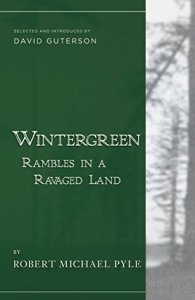
 As I mentioned last week, I read Wintergreen in preparation for a class I am taking this very weekend from the author, Robert Michael Pyle. It was an intriguing read, and I’m looking forward to learning from the man himself.
The copy I read, borrowed from Pops, is a Pharos Edition, meaning that “one of today’s most exciting authors” hand-picked and introduced it in a reprint. Wintergreen was originally published in 1986 by Scribner; this 2015 edition is being called a 30-year anniversary, and David Guterson (The Other, Snow Falling on Cedars) brought it to Pharos.
In a word, Wintergreen is a book in defense of the ravaged land of the subtitle. That land is the Willapa Hills of southwest Washington (near where the Oregon line meets the coast), where Pyle settled after growing up in Colorado and studying in Seattle and at Yale, and some other stops along the way including Great Britain. This land is ravaged, of course, by logging; but Pyle argues that it is still beautiful, still deeply rich in natural wonders, and worth saving. Pyle is a biologist and a writer, and his style is both reverent and carefully descriptive and detailed. His tone can be occasionally irreverent and jokey; he is conversational, humble, and disarming, absolutely likable. I intend to like him, when I meet him.
In his own words,
This is the plan of the book: to describe the Willapa Hills and the wildlife they support, both native and alien; to examine the impact of intensive forestry upon the land and its life; and finally, to assay the ability of organisms (including ourselves) to survive in the aftermath of massive resource extraction. Throughout, questions of biogeography, ecology, and evolution in the wet, wintergreen world find their way into the text.
And four sections of four essays each do this work, as promised. It is kept from being overly square, in that structure, by Guterson’s intro, a Prologue, and an updated Afterword written for this 2015 edition.
I felt a great affinity for the sense of place that is so central to this work, especially because the place Pyle loves is an underdog, a humble and much-derided place. He writes,
In attending to these neglected hills I try to appreciate them for what they still are, without holding against them what they once were.
He takes his reader leisurely through what this place once was – the hugest of the huge old-growth Douglas firs et al, the ones whose stumps were repurposed as roomy homes for families – and what it is now – second-, third- and fourth-growth, and stump fields that however hold their own beauty, and remarkably biodiversity. He writes beautifully. There is undeniable poetry in the line,
The backs of old barns break and ancient boats and Studebakers deliquesce into the fundament.
Or, when introduced (and little-loved) nutria are quirkily described:
Wombatlike but generally black, they add a definite presence to an already-altered ecosystem, and they are somewhat more interesting than cows.
His audience is understood to be somewhat sympathetic to his feelings and beliefs: that the natural world deserves our protecting even while that is a rather arrogant concept; that old growth forests are special; that green is good. He takes some background knowledge for granted (first approaching the question, “what is old growth?” on page 198), but this is not much of a risk. He is right about the background his readers come to him with.
As he acknowledges in the newly-added Afterword, some of the specific details of politics, policy, and specific local conditions in the 1986 edition are a little dated now. But none are incorrect; and he brings us up to date in this Afterword. The questions I noted during my reading were well answered. Any period-specific feeling to the whole is enriching, if slightly distracting: it makes this text feel grounded in time as well as literal ground.
The pace of these 369 pages is not rushed, but indeed rambling. Patient readers, however, who love a certain level of detail and a good, rain-soaked, mature story, will be well rewarded.
Rating: 8 individually loved stumps.
Filed under: book reviews | Tagged: creative nonfiction, essays, nature, nonfiction, sense of place | 5 Comments »









 pagesofjulia