A Walk About Town: Columbus and San Antonio, Texas

A Walk About Town is a meme hosted by Natalie over at Coffee and a Book Chick.

Last weekend, Husband and I took a trip out to San Antonio, just because. It was a fairly uneventful weekend for us, in all the right ways.

First we headed out to my family’s country home near Columbus, Texas, for Friday night. I don’t suppose I shared this information here at the time, but back in early September it burned in one of the many wildfires Texas has experienced during this year of record-setting drought. Here’s what I wrote at the time to share with friends & family when we visited to survey the damage:

From the rumors we’d heard, we expected to find scorched earth, flattened, lunar – and it wasn’t that bad at all, so I guess the overall impression is a good one. Obviously we have been extremely lucky (I said, dodged a bullet and Husband said, more like a bomb), and some of our neighbors weren’t; driving in we saw several houses along our road that had burned down to the ground.

But, it was still hard to see the destruction. Our barn is a mess of sheet metal, with the burned-out tractor buried beneath it. Parts of our property are paved ankle-deep in ash, with a few big trees standing and no undergrowth. Parts seem virtually untouched. Most of it is in between, with greatly reduced undergrowth but many larger trees standing. We guess this is because the winds were high enough to take the fire through relatively quickly.

I’m an amateur at this stuff and have no idea how many of the larger scorched trees will live, but figure some, at least, should; and I know that ash can enrich the soil for the next generation of vegetation. I’m so relieved to see that we don’t now own a solid piece of bleak, sun-baked ash. I have hope for the relatively near future. And the fact that our house was saved is great. It reeks of smoke but the first time we can open it up for 48 hours should make great progress there – right?

Just want to say thank you to the fire crews who worked to save our house. Ours, and the nearest neighbors’, were both saved literally at the door step by their efforts. Many of our neighbors out there have their primary residences and means of livelihood on the land, which we didn’t, so clearly we’re far luckier than most.

We also packed up some clothes, toiletries, dry goods, and books to take to donate for those who lost their homes. It was surprisingly hard to find someone to take them in the town of Columbus; I think it took us 6 tries before we found a well-informed woman who said they had more than they could go through already (!) but directed us to the local radio station, who were filling a trailer to take to Bastrop. Bastrop lost many 1000’s of homes and we’re glad that our stuff will go somewhere where it’s needed.

It’s been kind of a disturbing thing to see but really, all the news is good where we’re concerned.

Several months later, we’re doing really well. Pops has replaced the tractor (insurance money!) and we’re about to break ground on the new barn. The house smells fine. The ground is green again just about everywhere. Still unclear on which and how many trees will survive, but really it’s going to be okay.

I took a few shots here (all clickable for larger views):
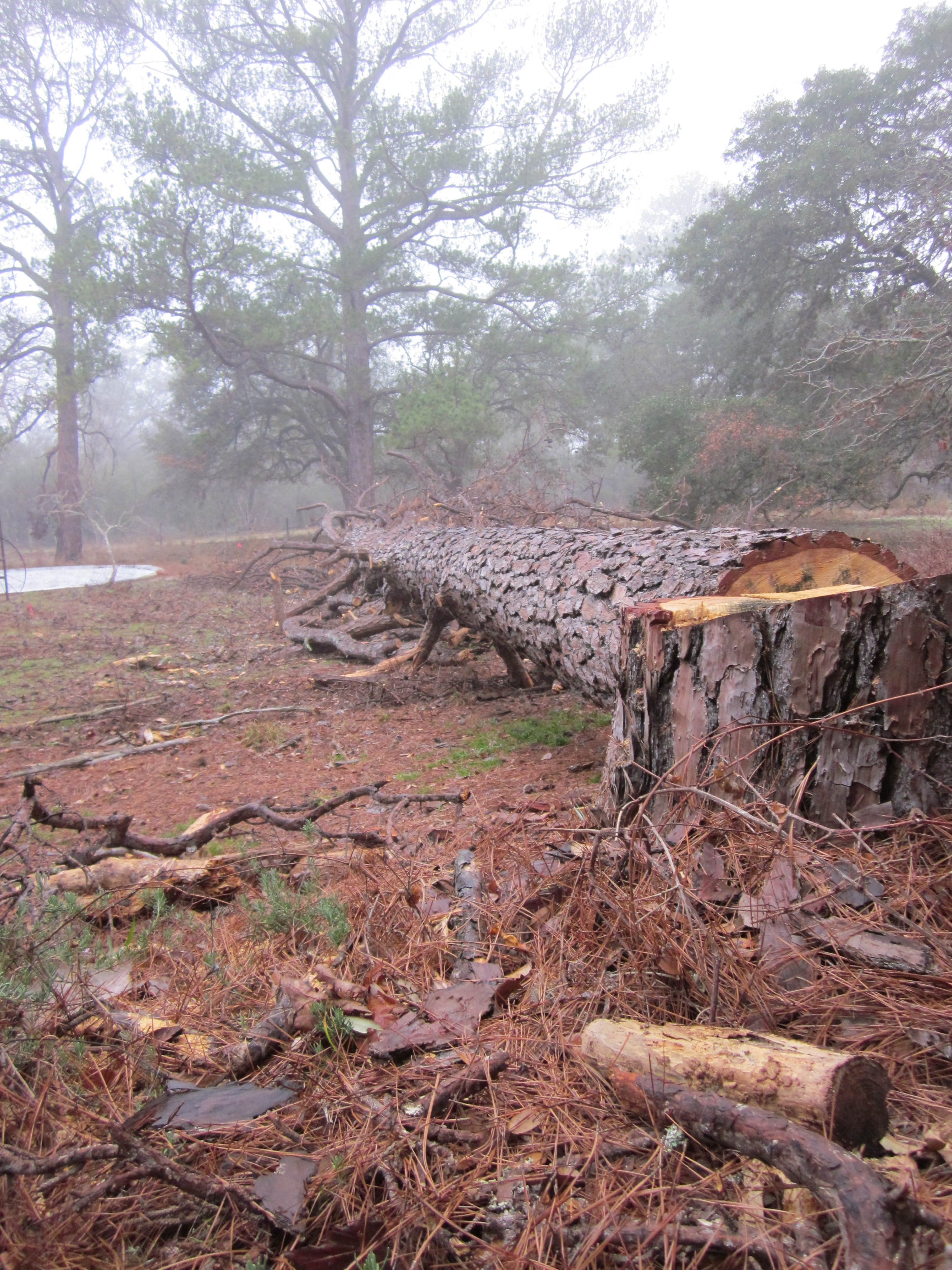
70-year-old pine, victim of drought, not fire
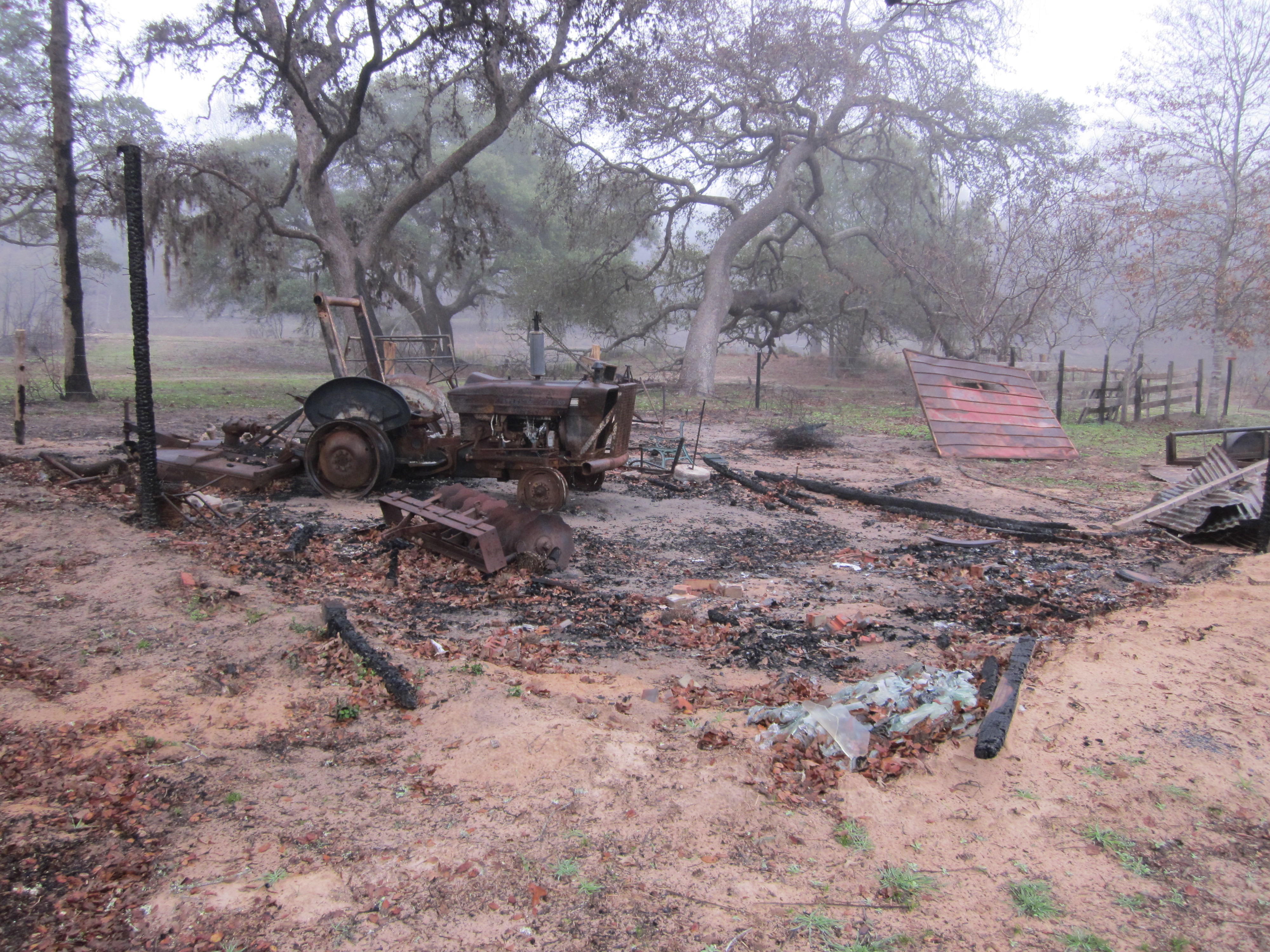

site of old barn with old tractor


There’s even some water in the pond again. (Not much.)

misty morning at very low pond

Saturday morning we headed on to San Antonio. When we first hit town we went straight to Freetail Brewing, a brewpub that Pops greatly admires. Unfortunately I took no pictures! But we had a lovely long lunch there, and sampled every beer they had on tap (no small feat at 14 beers – don’t worry, mostly we had little taster glasses). Our favorites were the Tadarida IPA (the hoppier of the two American-style IPAs available), the Rye Wit (just what it sounds; nice little peppery notes from the rye), and the Ate II (a sour wit with champagne yeast – yum!).

Then down into downtown San Antonio. We stayed just across the street from the Alamo, and walked the riverwalk.

bearded Husband on the riverwalk


night view


We were even happier when we found the quieter end of the riverwalk. The bar zone, at the center loop (see map here) resembles Bourbon Street in New Orleans or Duval Street in Key West or any other super-busy touristy bar zone, while the stretch up north was more the quiet, scenic stroll we were looking for.

the quieter end


We visited the Alamo during the day, right after checking in to the hotel, and it’s quite the hopping place; plenty of plaques and educational devices and exhibits, full of people of all ages and backgrounds (with the military very well-represented), and all free, which I think is great. Husband got the best picture after dark when heading back to the hotel:

Alamo at night

As I said, it was an uneventful weekend. We walked, looked around, ate and drank, and relaxed. Just what I needed: a little change of scenery.

Thanks Natalie for hosting! Maybe one of these days I’ll do a hometown Walk About Town… what is everybody else up to?

The Absolute #1 Best Book of 2011

Ahem. Did I not make a point of choosing an overall favorite when I did that year-end post the other day? Shame on me. Sorry. I shall keep this brief. I just want to say that the best book I read in 2011 was…

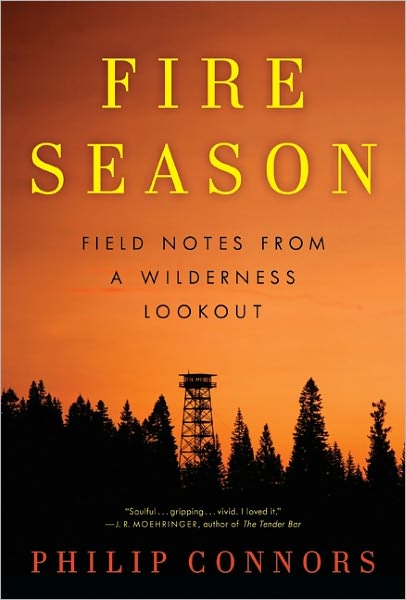
Fire Season by Philip Connors.

If you’re interested, you can read my review; read my father’s review; or read about how Fire Season inspired my father and eventually me into some further reading.

It doesn’t hurt, of course, that this talented author whose book touched my life so much back in May, ended up contacting me and has been a pleasant correspondent ever since! But no, it’s not a popularity contest; Fire Season wins for what’s in between its pages, alone. Thanks Phil for writing, though. 🙂

Honorable mention goes to Dorothy Canfield’s The Home-Maker.

Black Sun by Edward Abbey

I love Edward Abbey for Desert Solitaire, and for his reputation (compounded of course by my love of Fire Season too). My Pops has gotten into him this year, and has brought me quite a few of his books, and I’ve been excited to pick them up. I confess I chose this one for its setting as I’m now working on completing the Where Are You Reading? Challenge, and it covers Arizona for me. But oh! this book has value all on its own. Those 3-4 other Abbey books that are sitting on my shelf right now just moved up the list a little bit. He wrote more nonfiction than fiction, and his best-known novel is The Monkey Wrench Gang; this lesser-known novel involves a fire lookout, which was my attraction (see again Fire Season).

The story is this. Will Gatlin has abandoned his life as college professor and husband to become a reclusive fire lookout in the Grand Canyon National Park. He is mostly alone up there, but does get a few visits and letters from his friend Art Ballantine, who still teaches college but expends more energy on chasing women. To say he is obsessed with sex, breasts, the female anatomy (he uses the c-word), young girls in every application, would be putting it mildly; his letters are raving and silly and self-deprecatingly intellectual. And very funny. In between Ballantine missives Will does his fire-lookout work, observes nature – these parts are poetic, loving and appreciative – and carries on a love affair with a girl named Sandy. I’m not sure we ever learn Will’s age, but he is probably old enough to be nineteen-year-old Sandy’s father. She is a virgin when they meet, and engaged to another man, but none of this stops them from cavorting the wilds (desert, river, canyon and forest) in the nude, wittily teasing one another and having wonderful sex. Here Abbey falls into that lamentable and oh-so-distinctive habit that older male writers sometimes fall into (Papa included!) of creating nubile young beauties who want nothing more than to have endless sex with old men. It’s unfortunate in that it seems to give away the author’s own dirty-old-man fantasies (I don’t know this about Abbey in particular but it is my reaction to the cliché). But if we can move past this issue, Will and Sandy have a great time running around the wilderness, la dee da. That is, until Sandy disappears and her fiancé shows up to accuse Will of disappearing her and punches him in the face.

Abbey writes beautifully, lyrically about nature and about love or at least attraction. The letters from Ballantine (and others) are amusing. The story is tragic, but it requires a certain overlooking of the older man’s fantasy before we could really sympathize with Will’s sense of loss. If you can move past this, it’s a beautiful little story with flora and fauna of the Grand Canyon painting the background. I was only partly successful in that requisite overlooking, but enjoyed it all the same. I have great hope for the other Abbey books waiting on my shelves.

I thought I could clearly see connections in Abbey’s writing style and subject matter to Keruoac, as well as Philip Connors, who in Fire Season acknowledges the debt. I recommend Black Sun, unless of course you’ve had too much euphoric losing of teenage virginities to much older men, in which case perhaps start with Desert Solitaire and I’ll let you know how the rest of them go, too!

book beginnings on Friday: Black Sun by Edward Abbey

Thanks to Katy at A Few More Pages for hosting this meme. To participate, share the first line or two of the book you are currently reading and, if you feel so moved, let us know what your first impressions were based on that first line.

Black Sun is a novel by Edward Abbey (renowned author of much nonfiction, whose best-known novel is The Monkey Wrench Gang; he has been called “the Thoreau of the West”) about a fire lookout. If you read my earlier review of Fire Season you will understand my interest in the subject. I like it so far. Check out this beginning:

Each day begins like any other. Gently. Cautiously. The way he likes it. A dawn wind through the forest, the questioning calls of obscure birds. He hears the flutelike song, cool as silver, of a hermit thrush.

I love this picture of a day beginning gently, the way he likes it… very evocative, mood-setting.

What are you reading this weekend?

Pops’s visit to Powell’s Books in Portland

Just wanted to share a few photos from my father’s trip to the famous Powell’s Books in Portland, Oregon.

A quotation he thought we’d like, on one of their blackboards (I especially appreciate that the book’s location is noted!)

LOVE these bike racks with related book titles. (click to enlarge and read ’em all)

“our room at the trendy Ace Hotel – old encyclopedia pages wallpapered to plaster walls!” (is this especially for Powell’s customers?)


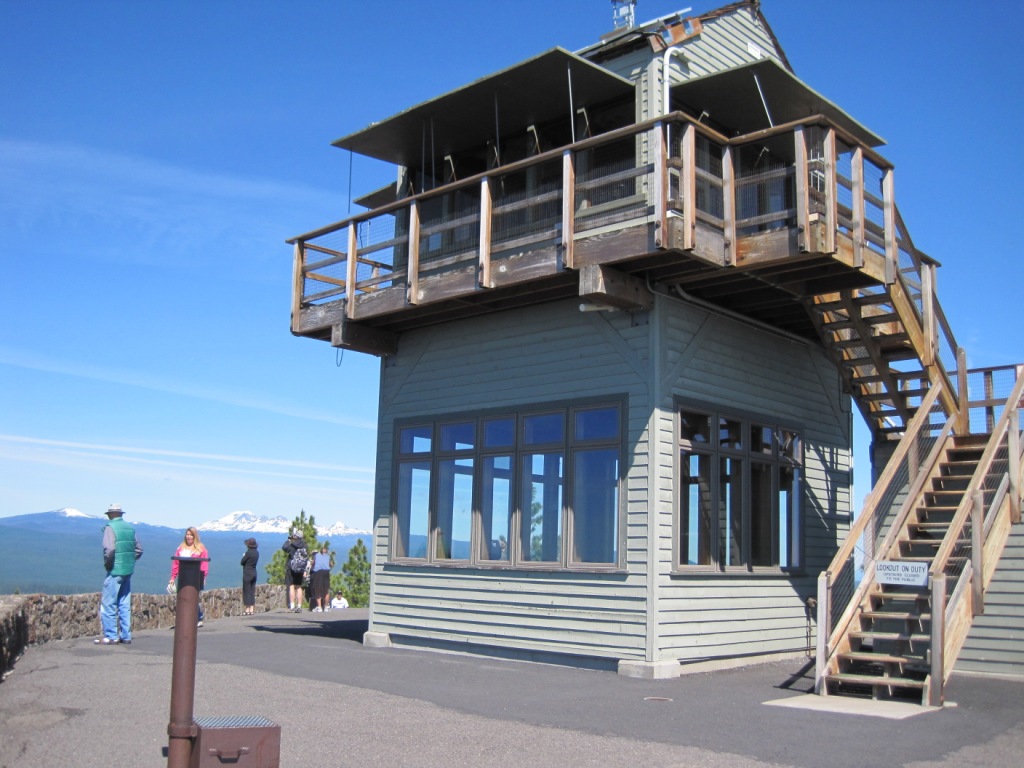
And, well, this one is not so directly connected, but: you may recall that Pops and I both read and both raved about Fire Season, by Philip Connors. (My review… and his) So he snapped this fire lookout station for me “at the top of a volcanic butte south of Bend, with a view of the Cascade snow-caps as far north as Mt. Hood, and east into the Oregon desert.” Very nice, Pops.

On a related note: Pops has also been getting into Edward Abbey this summer. I’m not sure if I had a role in that or not; I did strongly (forcibly?) recommend Fire Season to him and cite Edward Abbey as a related recommendation. He may have gotten there on his own, but at any rate the two authors (Connors & Abbey) have a clear link. He actually approached Powell’s with an Edward Abbey need, and reported that, while he’s aware that Abbey is a somewhat obscure choice, they had a full shelf of it and were very happy to talk and help. He points out that this is unsurprising, for Portland and for Powell’s – should be a specialty of theirs – but no less gratifying. He bought three books, including one of Abbey’s novels. I’m not sure I even knew he wrote fiction!


So, I have only read his Desert Solitaire, which I believe is his best-known. It is the nonfiction account of his solitary experience as a park ranger at Arches National Park near Moab, Utah. I read it many years ago, and I retain more of an impression than a distinct memory; what I do recall is that I found it very moving. I recently picked up another of his, The Journey Home, although I haven’t cracked it open yet.

And now Pops has three new books, including a novel. He mentioned that the novel is about a fire lookout, so I think that makes it Black Sun. I’m hoping that he’ll report back to us here on his continued reading, and maybe even loan me a book or two! Hm, Pops?

guest review: Fire Season by Philip Connors, from Pops

Today we’re visiting my father again, who’s traveling this summer. I put the screws on to compel him to buy a copy of Fire Season for himself to read on the road because I loved it so much (see here). I promised to buy it off him if he regretted the purchase; and I may, anyway, because I want to own a copy. Actually, though, I don’t know if it’s for sale. He did like it. I’m compiling some of his thoughts via email to share with you; they’re mostly in response to my original post (see link above) but I thought his slightly different perspective was worth sharing. Here’s Pops.

I finished Fire Season yesterday while I was camping in the finest of the rain forest valleys in Olympic NP, the Hoh river. I found it as exceptional as you said. The timing was impeccable; e.g. I was reading his passages about the magical meditative element of long walks… (or, I would say, endurance activities – you could read Bill McKibben’s Long Distance for a bit of the same; I found it wonderful, and you should know who McKibben is anyway for his potential to be one of the great environmental soothsayers of our time) …and it helped me decide a plan for my Monday walk: a full 10 hour day of wandering up and down the valley in rain and mist marveling at the magical forest – when I wasn’t daydreaming. I loved how he wove in stories of Kerouac, Edward Abbey, Chief Victorio, Alice the dog, Aldo Leopold, Cormac McCarthy, Gary Snyder (new to me) – and others. And we certainly learn about wildfires. Thanks for the tip.

So glad you liked it!! [And, incidentally, what safety precautions are you taking on 10-hour walks? Do you call Mom to let her know you’re going off on such things, and then call in when you return?]

And have you made the connection with current events? – with a massive fire burning for weeks now in eastern Arizona (the western borders of Fire Season) and today all around the Carlsbad Caverns area in NM (within the eastern horizon view of Fire Season).

Maybe not specifically those fires; but West Texas has been ravaged for months and it made my reading of the book a touch more personal. This spring race series, we raced two races in a row only to hear that the race course saw a wildfire start as we were leaving. (We promise we didn’t start these fires.) One was in Arksansas, one in central Texas. And we have a friend/teammate who tried to race in Ft. Davis, but the event was canceled due to one of the bigger fires we’ve seen; it swept across a considerable part of the state we’re used to driving and riding through. Close to home.

Did you also make the connection that we all went camping in the Gila Wilderness twice when you were 3 and 4 yrs old? (and that, because we had been there before you were born)

No, of course I don’t remember that, but very cool!

I really endorse what you said about his eclectic voice, and the many priceless vignettes he blends into his story. (I really wish I had read it with a highlighter!)

I also found him to be an endless stream of contradictions (perhaps we all are?) – he could be a sedentary slug for hours/days on end, but was also often driven to minimalist walks & overnights (an evening walk from a summit inevitably involves a serious down & UP!); he obviously functioned well in cities & bars, as well as wilderness; he became well versed in much wilderness language, yet succumbed to the elementary, pitiful, dreadful trap of the young fawn.

I cried over the fawn.

And, re: your comment about the contradictions. I am reminded of David Guterson’s The Other as well as Jon Krakauer’s Into the Wild (the first, fiction, the latter non) – both books about young men going into the wilderness, thinking they wanted to get away from it all, but also strangely and paradoxically clinging to certain odd elements of society. As the protagonists of both books came to unpleasant ends, I think perhaps Connors has found the perfectly balanced way to do it! In fact, I think I mentioned balance in my initial review. The writing in his book is balanced; and his interactions with his world are balanced. His saintly wife helps him be balanced. I daresay we all aspire to a lifestyle like this; I know I do, and I think, Pops, that you do. But then, you’re closer than most of us right now!

Based on your and my reactions, I’m guessing that readers will appreciate many different aspects of this book. You particularly noted the lessons about wildfire & forest policy, which I knew much of already. I loved the many references and new details about Kerouac, Snyder and the various personalities of the Beat generation who so influenced my 60s & 70s, and subsequent characters like Edward Abbey and Dave Foreman.

You barely mention Alice! I thought she was an elusive minor character, disappearing for times but playing a key role at many turns. Moments were familiar to Barley’s world; like her unilateral retreat to accompany Martha home from the lookout summit, and her personality change from city to wilds. Most poignant – Alice evoked my most secret lonely moments, far up a mountain trail without Barley’s companion spirit, spunk and relentless energy. “Alice is the only living being I know who will take a forty-mile walk in the woods without any need of cajoling, planning, or consulting a calendar.”

My apologies to Alice; you’re entirely right… she was a special creature and character, and a neat side-story proving (yet again) that dogs are our best friends and offer relationships unlike what we humans can offer one another. Here, I’ll treat our readers to a picture:

Hops (brown) & Ritchey (short white hair) who live with Husband and I, and my parents' Barley (scruffy white hair)

Finally: “…the movements of my limbs help my mind move too, out of its loops and grooves and onto a plane of equipoise… If I weren’t a walker I suppose I would be a television addict, a dope fiend, a social butterfly.”

Because I had to look it up, I’ll share. Equipoise: an equal distribution of weight; even balance; equilibrium.

Thank you for your musings, Pops. I hope we’re (still) encouraging folks to find this book! I think I’m ready to call this my best read of 2011 to date.

Fire Season by Philip Connors


EDIT: You might also want to check out my father’s review, and friend Tassava’s, of same.


This is an amazing book. The first sentences immediately grabbed me. Connors works summers in a teeny, tiny tower room way up in the sky in the Gila National Forest in New Mexico, as a fire lookout. His job is to spot smoke and call it in for control or “management” of the fires. But his “field notes” tell so much more than the story of his career as a lookout. This is the story of his time alone in the Gila, and of the visitors he receives and the visits he pays back to town; it’s the story of his and his dog Alice’s interactions with nature. It’s the story of fire and smoke and the Forest Service’s management of fire. It’s a history of fire, of the Forest Service, of the Gila, of so very many aspects of our nation’s history, and the natural history of the southwest. Connors discusses the varied reactions the government has had to fire: the policy of fire suppression, consistently and in every case, versus the concept of “controlled” or “prescribed” burns, and the ongoing debates. He contemplates society, its benefits and our occasional desire to escape it. He discusses his unique model of marriage, in which he spends some five months a year living alone and mostly out of touch. He also relates ecological issues like fire as a natural control mechanism, erosion, and the preferences of flora and fauna. And more.

I found Fire Season astounding and important. There’s a zen-like balance in it. Connors is a rather balanced man, in that he still craves human contact; he’s not an entirely back-to-the-wild isolationist, nor does he fail to appreciate cold beer and a variety of media. But he achieves a special and rare state of commune with nature, too. His writing, for me, parallels this balance. He can wax philosophical, crafting lyrical, beautiful odes and hymns of reverence to nature, fire, and life; but he never gets overly wordy, tempering the poetry with (still beautifully written) narrative history.

Connors tells so many little stories I would love to pull out of this book and share as vignettes. For example, the story of Apache Chief Victorio’s last stand (that lasted over a year) in the vicinity of the lookout tower where Connors is stationed:

That September day in 1879, on the headwaters of Ghost Creek, marks a peculiar moment in America’s westward march: black soldiers, most of them former slaves or the sons of slaves, commanded by white officers, guided by Navajo scouts, hunting down Apaches to make the region safe for Anglo and Hispanic miners and ranchers. The melting pot set to boil.

Or the history of the smokejumpers, which I didn’t know before – the parachuting firefighters who pre-date paratroopers and taught them their trade. Or the tale of the Electric Cowboy. Or the story of the little fawn. I cried, mostly because I empathized. Really, it could be read as a series of anecdotes; but the whole is greater than the sum of its parts. The larger story is important, too. I even glimpsed traces of the training I’ve received in trail-building and (more broadly) land management.

The history, the lore, the anecdotes, the author’s relationship with nature, his relationship with his wife, the landscape of the Gila, the details about local species of bird, fish, and game… there are so many gems in this thoughtful, loving, lovely book. I am not doing it justice. It’s a very special book and I strongly recommend this to everyone, no matter who you are. But I especially recommend it if you are… a nature lover, a hiker, a dog lover, a government bureaucrat, a pyromaniac, an environmentalist, a city dweller, a romantic, a firefighter, a skydiver, a cribbage player, a whiskey drinker, a writer, a loner, a philosopher, a historian, a student, or a teacher. This book goes on The List.

Teaser Tuesdays: Fire Season by Philip Connors


Teaser Tuesdays is a weekly bookish meme, hosted by MizB of Should Be Reading. Anyone can play along! Just do the following:

* Grab your current read
* Open to a random page
* Share two (2) “teaser” sentences from somewhere on that page
* BE CAREFUL NOT TO INCLUDE SPOILERS! (make sure that what you share doesn’t give too much away! You don’t want to ruin the book for others!)
* Share the title & author, too, so that other TT participants can add the book to their TBR Lists if they like your teasers!


In a tiny room in a tower 10,000 feet above sea level, Connors keeps watch for fire over New Mexico’s Gila National Forest. This contemplation of solitude and the power of nature sounds like Edward Abbey’s Desert Solitaire which I enjoyed so much. I’m looking forward to it. From page 75:

No matter the length or sweetness of a reprieve, the wind always returns, gales to test the endurance of anyone exposed in a high place. Trees that elsewhere grow a hundred feet tall here hug the ground like shrubs, shrunken, gnarled, and twisted, as if cowering from an invisible foe.

Lovely. I anticipate beautiful writing and a study of nature and natural places. I’ll let you know!