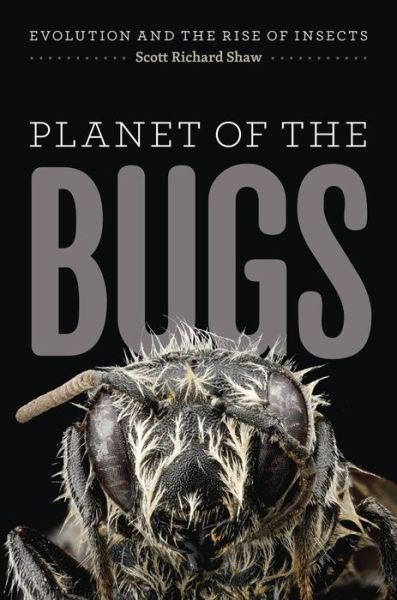
Teaser Tuesdays: Planet of the Bugs by Scott Richard Shaw

Teaser Tuesdays is a weekly bookish meme, hosted by MizB of Should Be Reading.

bugs

I am choosing my teaser sentences today off the very first page of the charmingly titled Planet of the Bugs (although it is not quite a book beginning, since these are not the first lines). What wonderful examples of evocative, lovely writing, though; I couldn’t help but share.

As the songs of frogs, katydids, crickets, and cicadas emanated from the forest, my boots sloshed along the pathway. Typical of San Ramon, it had been raining all day, the trail oozed treacherously slick with slippery mud, and water was everywhere. On mushroom caps sprouting from a rotting log by the trail, silvery droplets rolled to the edge, clung briefly shimmering – then fell away. The sounds of water were all around, bubbling and gurgling over mossy rocks in the river, chattering in nameless streams and rivulets. A light mist was still falling, and the emerald vegetation, dappled in a hundred shades of green, was dripping and glistening with raindrops.

Doesn’t that just make you want to dive right in – bugs or no bugs?

This quotation comes from an uncorrected advance proof and is subject to change.

guest review: Fire Season by Philips Connors, from Tassava

reviewYou will recall from way back my original post about this very fine book, and my dad’s review of same. Now I have another to add to the accolades.


fireFrom his website, I’d like to share with you my buddy Christopher Tassava’s review (even with the undeserved praise in that opening line).

My ridiculously well-read friend Julia recommended that I read Fire Season, a book-length essay by Philip Connors on his work as a fire-tower lookout in the mountain forests of New Mexico. Connors’ writing is amazing, evoking both the wildness of his setting (which I now have a deep desire to see firsthand) and the civilized nature of his work, which aims, at its base, to preserve what man values in nature. I loved lines like

Time spent being a lookout isn’t spent at all. Every day in a lookout is a day not subtracted from the sum of one’s life.

which seems as true for my favorite outdoor activity (riding bikes!) as it does for being a lookout.

Connors’ skills at crafting prose are matched by his skills at explaining the American perspectives on fire and on wilderness. Much of the book concerns how the U.S. Forest Service – Connors’ employer – has understood the primordial force of wildfire, and how it has reacted to it. The historical material is fascinating on its own (someone seriously proposed clear cutting the Rockies to prevent fires!) and as context for Connors’ own stints in the watchtower. Not all of the fires he spots garner a response from the Forest Service: some are left to burn acres and miles of forest, contributing to the endless natural cycle of burning and growth.

But Connors also adds his voice to the conversation about what wilderness is, and what it’s for. He comes down in favor of preserving wilderness for its own sake: not as a place for humans to “recharge” but as a place apart from humans and, I thought by the end of the book, better than we are.

Glad you loved it, Tassava! Next up is Dirt Work, which I believe he is also loving. Stay tuned.

from Orion: “Raptorous” by Brian Doyle

The other day, Pops emailed me:

You MUST read this. It is a work of literary richness in a mere page, informative & inspiring, on a subject you will appreciate. I read it twice – I love his word-use here; would you blog about a single-page essay?

I would, Pops!

He added, “notice who & where he is.” From Orion,

Brian Doyle is the editor of the University of Portland’s Portland Magazine in Oregon. His most recent book is The Plover, from St. Martin’s Press.

And the article in question is here.

I certainly agree with the lovely words. How many times could you happily read “hawk-addled and owl-absorbed and falcon-haunted and eagle-maniacal”? (Many times.) Muscles on their muscles! I thought first about my Husband, who loves birds (and has rescued several in and around our backyard). I think Doyle is right that many of us are addled, absorbed, haunted and maniacal about, particularly, birds of prey; but beyond them, as well, I certainly hope.

I also think it’s interesting to consider the etymology of the words “rapture” and “raptor.” I had never given conscious thought to their link, although it’s obvious at a glance, isn’t it? I think of rapture as having a religious connotation; but there’s much more to it than that. Just a few links here. I had not considered the more sinister connection to rape.

Birds and rapture have a place in my own little bird-world, too. Our backyard has been very active with the birds this summer. Because we’re growing delicious fruits back there, we’ve seen more, and more diverse birds than every before. (The bird bath doesn’t hurt either in dry Houston summers.) We have had lots of grapes growing along the back fence: 10301452_10203853874376171_9205261055523974740_n
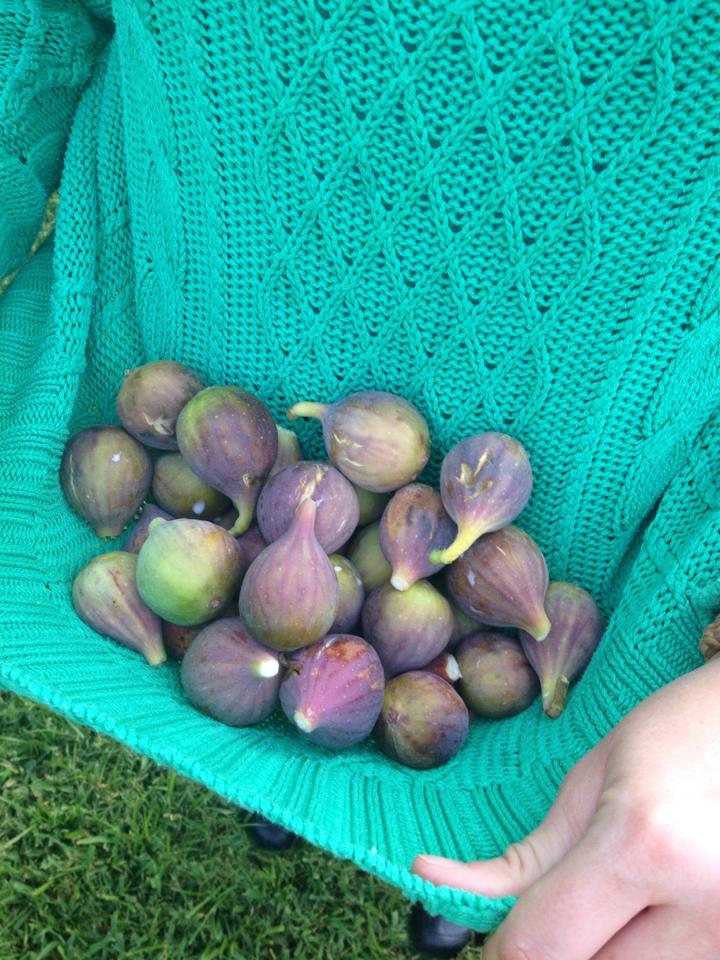
and lots of figs:
10453468_10204111061085678_3107840873699884198_n
and a mama with her babies in our young oak tree:
10497046_10204088767568354_5612090893893219405_o
(Of course none of these are birds of prey. I’m being generous in my interpretation of Doyle’s writing, which is clearly about birds of prey specifically. But I think we can appreciate them all… and our little bird farm is encircled by hawks…)

All of this was joined a few years ago by a lovely piece by my aunt Janet, the sculptor. Its title is Rapture, and it was displayed in her home in Austin:
rapture austin
before joining us here in Houston:
rapture houston
to become a part of our backyard landscape (full of birds, although none are pictured here):
10306253_10203808143952939_4179928191057459515_n
(There is a little dog hidden in there, Where’s-Waldo-style, if you look closely.)

Brian Doyle’s ‘raptorous’ writing is well appreciated this season. Thanks, Pops.

vocabulary lessons: The Fish in the Forest by Dale Stokes

If you’re interested: see other vocabulary lessons as well.


fish forestAs you know, I found the salmon’s story in The Fish in the Forest simply mesmerizing. I also learned a lot – and not just about salmon. Here are some vocabulary words I had to look up.

epiphytes attach to their host plants for support and as a means to reach more sunlight… but are traditionally classified as non-parasitic”: “There are epiphytic plants that grow on trunks and branches high in the forest canopy…”

relict, “a surviving species of an otherwise extinct group of organisms”: “The present salmon populations in the Pacific Northwest stem from relict populations that have been extant since the last ice age…” (I suspected a typo here for “relic” – this being a pre-publication proof edition, typos would not surprise. But no, I learned something new here. “Relict” is perfectly appropriate.)

trophically, “of or relating to nutrition”: “Even when not preying on salmon directly, humpbacks are linked to them trophically because they feed on fishes that compete with salmon for food.” Further explained a little later on within the book itself: “The troph in heterotroph and autotroph implies nourishment…” In other words, what we’re talking about here (in context) is organisms that are linked on the food chain, or the food web. They are trophically linked.(Another that looked like a possible typo; except that “tropically” would have made no sense in context!)

collocate, “to occur in conjunction with something”: “The other two races have overlapping ranges along the coast but seldom interact or collocate.”

semelparous, “reproducing or breeding only once in a lifetime” (or, to put it more bluntly, once they breed, they die): “Their life history of anadromy and semelparity transports millions of tons of salmon flesh into nutrient-poor freshwaters that then shape the entire Salmon Forest.”

gestalt, “the general quality or character of something”: “All living things possess a unique gestalt…”

I had previously come across the concept of anadromy (I don’t recall where) and looked it up (defined: “ascending rivers from the sea for breeding”); but finding it repeatedly in this book made me curious about the pronunciation of anadromous: “…the critical return to freshwater to spawn is called an anadromous life history…”

I like a good vocabulary lesson alongside a fine reading experience – don’t you? Or does reaching for the dictionary frustrate you?

The Fish in the Forest by Dale Stokes

The thoroughly engrossing story of the salmon and its science.

fish forest

Seven species of salmon inhabit the Pacific in strikingly diverse ecosystems–ocean, river and stream, forest–in California, Alaska, the Bering Sea, Japan, Korea and Russia. Research oceanographer Dale Stokes calls these territories the “Salmon Forest” in The Fish in the Forest, a loving study of the salmon’s place in our world.

Salmon may strike some readers as a potentially dull subject, but in Stokes’s knowledgeable hands, the singular story of this fish is utterly riveting. Pacific salmon are anadromous and semelparous (born in fresh water, they mature in the salty ocean before swimming back up rivers and streams to breed just once and then die shortly thereafter); they possess an internal compass and map, enabling them to navigate over thousands of kilometers to the waterways of their birth; they are temporally aware, following a timetable for their reproduction and death.

Stokes presents a good deal of hard science (such as the complex cellular interchange of ions that allows them to survive in both salt and fresh water), but all of it is easily understandable. He explains why salmon are a keystone species; their feat of bringing rich marine nutrients well inland and at every point on a complex food web; and the interconnectedness of every resident in the Salmon Forest. Doc White’s 70 color photographs are stunning, focusing not only on fish and forest, but also the species of wolf, bear and eagle that interact with the salmon.

Fans of the Pacific Northwest, trees, water and nature, and readers concerned with ecology or science, will find much to enjoy in this gorgeous and illuminating fish tale.


This review originally ran in the July 1, 2014 issue of Shelf Awareness for Readers. To subscribe, click here, and you’ll receive two issues per week of book reviews and other bookish fun!


Rating: 8 alevins.

“Tawny Grammar” by Gary Snyder

And with this post Gary Snyder gets his own tag.

wildEssays from The Practice of the Wild:

  1. The Etiquette of Freedom
  2. The Place, the Region, and the Commons
  3. Tawny Grammar

I am struck, again, at how we encounter the same phrases over and over in this world and in our reading… just days ago I read Land of Love and Drowning, in which certain scenes are set to the song, “Rum and Coca Cola” – generally credited to the Andrews Sisters but originally by Lord Invader. Here it is in the opening pages of Snyder’s essay “Tawny Grammar,” in which he makes the point that music and dance belong to time and place. One time-and-place’s song or dance may be popular in other times and places, but will never belong to them the way – for example – Snyder has formed a memory of dancing with a girl for the first time to this song in 1943. His next point is that, as we established in “The Place, the Region, and the Commons” that we no longer belong to place, “we are not quite sure what our home music is.”

He then takes his reader on a trip to a remote Alaskan village, where he muses with local teacher friends on the question of what it is reasonable, realistic, helpful to teach the children there.

So these children should prepare to be mining engineers? The company will bring its own experts with it. Heavy equipment operator? Maybe. Computers? Computers are in all the schools of the Far North, along with video cameras. There may be more computer literacy in the schools of northwest Alaska than in those of Los Angeles. Even so, there is no guarantee that any school anywhere in the whole world can give a child an education which will be of practical use in twenty yeras. So much is changing so fast – except, perhaps, caribou migrations and the berry ripening.

Good gosh, he wrote this in what year? Still true… my profession, librarianship, has been talking for decades about CHANGE and how we will adapt (the need to be more than people who stamp due dates in books), but this problem is not unique to us. The world is indeed changing so fast; and while I love the idea that caribou migrations and berry ripening may be our constants, and that’s partly true, it’s also true that mass extinctions and climate change have begun to prove him wrong.

He writes about the Inupiaq values posted in the village classroom, and the contradictions we teach our kids: in this case, tribal values vs. external Western societal ones, “one for getting what’s yours, another for being decent.” I am strongly reminded of another few lines – I can’t for the life of me remember who wrote them; was it Doug Peacock? – something to the effect that war is traumatic for our youth because we teach them from the beginning that killing is wrong, right up to the moment we send them out to kill, and then expect them to come home and readjust.

More discussion of our interrelatedness, the importance of social constructs, perspectives, and recognizing the nonhuman world too:

American society… operates under the delusion that we are each a kind of “solitary knower” – that we exist as rootless intelligences without layers of localized contexts. Just a “self” and the “world.” In this there is no real recognition that grandparents, place, grammar, pets, friends, lovers, children, tools, the poems and songs we remember, are what we think with.

He goes on to tell us what he means by grammar, and the importance of language in our interactions with the world, and muse on what language really means. Under the subheading “Nature’s Writing”:

The stratigraphy of rocks, layers of pollen in a swamp, the outward expanding circles in the trunk of a tree, can be seen as texts. The calligraphy of rivers winding back and forth over the land leaving layer upon layer of traces of previous riverbeds is texts.

While this makes for a lovely metaphor, I think he means it – and I understand it – far more literally. “A text is information stored through time.”

I was tempted to play with his Whorfian challenge:

“Is there any experience whatsoever that is not mediated by language?” I banged my heavy beer mug sharply on the table and half a dozen people jumped and looked at us. We had to give up and laugh at this point, since it always seems to come back to an ordinary mystery.

Isn’t that an example of just such a one? Or in other words, if a tree falls in the forest, etc. If we have an experience – a shared but wordless experience – have we experienced it, or shared it, any the less for not discussing it in language?

As much as I enjoyed this essay, which was intelligent, thoughtful, musing, informed, and seasoned by references to the classics and mythologies from around the world (I love this), I found myself wondering if there was a point coming down the line. Of course, there rather was, but it was typically cerebral and conceptual in nature, so I needed Snyder to help me wrap it up. He does so in his conversation with a linguist friend, about whether language is biology, and whether it follows evolutionary lines (sort of, in its own way, but not in the way biology does); and finally by quoting Thoreau and Dōgen. The end point, as I take it, is this: language should not be a weapon, considered as belonging to humans alone and used to differentiate ourselves from the world, but should be considered one of the many ways in which we live in and with rather than above.

I close by asking a question. Do we agree with Snyder in the following suspicion?

Nonhuman nature, I cannot help feeling, is well inclined toward humanity and only wishes modern people were more reciprocal, not so bloody.


Up next, essay 4: “Good, Wild, Sacred.”

Gone Feral: Tracking My Dad Through the Wild by Novella Carpenter

Back-to-basics urban farmer Novella Carpenter investigates family in her second contemplative memoir.

gone feral

When Novella Carpenter was 36, her father went missing. It turned out to be a false alarm, but the threat of losing him helped Novella realize that, if she was ever to get to know George Carpenter, she might be running out of time, since their relationship had been stuck somewhere between uneasy and estranged for years. Gone Feral: Tracking My Dad Through the Wild charts her journey home.

After a romantic meeting in 1969 San Miguel de Allende, Mexico, her parents embarked on an idealistic European tour before settling on a farm in Idaho in “voluntary poverty.” But the marriage ended when Novella and her sister were five and seven, and their mother moved them to Washington State; Novella didn’t see much of her father after that. Now, three decades later, she has a small urban farm in Oakland, Calif., which she documented in her memoir Farm City. When she and her boyfriend, Bill, decide to try to get pregnant, she wonders about her own genetic legacy. Breeding ducks, chickens and milk goats has taught her the importance of the stock line. In working to become a parent herself, after the scare of George going missing, she goes in search of her father, hoping to build the relationship they never had.

George is still scraping by near the Idaho farm where Novella was born. He’s a regular backwoods curmudgeon, making a meager living by logging and cutting firewood and sharing his cabin with wild animals. She hopes they’ll go fly-fishing, re-creating the romance of A River Runs Through It. Maybe they’ll forage for wild foods or he’ll teach her how to fell a tree perfectly. Instead, he rants about the devils that possess the old family farm and exhibits previously unnoticed signs of post-traumatic stress disorder (the legacy of his service in the Korean War). Novella is disturbed, angered all over again at what she sees as his abandonment, and concerned about the genes she’ll pass on to a child, if she ever succeeds in getting pregnant.

Gone Feral is reflective, as Novella ponders the paradoxes of her upbringing–for example, the liberal hippie value system (hers and her mother’s) that rejects her father the mountain man–and wonders what it is she really wants for her own child. Traveling through the country and her own past teaches her about herself, her origins, and how to build a future that includes father as well as child.


This review originally ran in the May 20, 2014 issue of Shelf Awareness for the Book Trade. To subscribe, click here.


Rating: 5 babies.

The Reef: A Passionate History: The Great Barrier Reef from Captain Cook to Climate Change by Iain McCalman

The Great Barrier Reef is both easily understood and awe-inspiring in this history of its discovery, exploitation and beauty.

reef

With The Reef, Iain McCalman (Darwin’s Armada) has composed “a passionate history” of the Great Barrier Reef, opening with his own long-awaited voyage (part of a reenactment of Captain Cook’s original trip). Following the prologue, he withdraws to the role of historian rather than participant, and chronicles the Great Barrier Reef as known to Western society over the last few centuries.

The Reef is divided into three parts. Beginning in 1770 with Captain Cook and proceeding through later explorers who helped chart the reefs in the 1800s, “Terror” emphasizes the threat the reef posed to ships and their navigators, and the fear of cannibals and others thought to inhabit the area. In Part II, “Nurture,” the reef begins to offer refuge for those seeking to escape civilization or make a fresh start. Europeans are taken in by native islanders, or discover island paradise; naturalists arrive, captivated by the biodiversity and beauty of the area while beginning to realize that coral is a resource that can be exploited. “Wonder” sees the scientific community take an interest, disagreeing about the origins and biology of the reef. Ecology emerges as a new field of study, its proponents seeking to place the reef in the larger context of other natural environments, to study relationships and cause and effect. Individual activists work to defend the unusual and changing ecosystem from mining, oil spills, overfishing and the rough use of tourism.

At the end, we are introduced to nature-loving scientist J.E.N. Veron, nicknamed “Charlie” after Charles Darwin, an engaging character who communicates the final dire message of the Great Barrier Reef’s looming extinction. Returning to the personal nature of his prologue, McCalman’s epilogue speaks to the grim consequences of climate change but holds forth hope as well.

The few images in The Reef include portraits of the personalities involved but not the corals themselves (although McCalman refers his reader to books that offer the latter). This work’s strengths include a coherent structure, friendly narrative style and a reasoned culminating call to action that does not disrupt its primary role as a comprehensive history. Plentiful notes indicate strong research, but McCalman’s writing is accessible to any reader interested in the intersection of science, nature and history. From perceived threat to resource to paradise destination to climate-change indicator–Charlie Veron calls corals “the canaries of climate change”–the Great Barrier Reef is fully explored in this engaging study.


This review originally ran as a *starred review* in the May 6, 2014 issue of Shelf Awareness for the Book Trade. To subscribe, click here.


Rating: 7 dives.

“The Place, the Region, and the Commons” by Gary Snyder

This is the second essay in Gary Snyder’s collection, The Practice of the Wild. The first was “The Etiquette of Freedom.” I am proceeding, very, verrrry slowly.

wildI found this essay much more accessible than the first, which you may recall I found a little bit dryly academic and theoretical and less useful for reclaiming or repurposing our real world. This one jumps right in with a discussion of what a place means to us, and what it used to mean to us. In human history, there was a time when we were defined by our physical, geographical surroundings; culture was inextricable from the place in which it was set, with mythical explanations for a nearby mountain or a nearby stream, and close cultural understandings of native plants and their uses, etc. This really got me thinking about how disconnected we are now from our place – which of course is Snyder’s point. For instance, pardon my getting personal here, but I have wondered about my own cultural identity in terms of place…

I was born in Texas and have lived here all my life: just shy of 32 years at present. My mother is a native Texan, too, and lived here over 60 years before she left. My father’s parents moved around a lot when he was growing up, so in a way he’s from nowhere; but the family roots have always been in New England (Vermont, mostly), and he clearly identifies with that past, despite having lived in Texas for the majority of his years, too. I’m from the South (maybe not the “Deep South”; under many folks’ definitions, Texas doesn’t generally qualify, or only East Texas does), but I’m also from the fourth-largest city in the country, so I’m no country girl. And I’ve been brought up by radical leftists, so I am politically very much a minority in my home region. As a city girl, I’m also guilty of the removal from my local plants & trees that Snyder cites. I have sometimes had the odd feeling that my father is surprised to find that he’s raised a Southern girl – but he raised his daughter in Texas for all her life, so whence this surprise? I think he thinks of himself as somehow not a Southerner despite all his years here. He was born in the region; spend a few years of elementary, high school, and college years here; he raised his daughter here. Is he not “from” the South because he doesn’t think of himself that way?

Sorry to have gotten sidetracked. What I’m trying to point out is that we no longer have our fingers in the dirt where we were born or live, figuratively or literally; but we used to. And that’s what Snyder is getting at. No wonder we’re confused or distressed; we don’t know who we are any more.

He talks about bioregions, about the naturalness of conceiving borders based on ecosystems, or the area in which a certain plant grows or a certain animal roams. Why draw county lines so that one county stretches over a high mountain pass that allows no travel for part of the year? Better to use that high ridgeline as a boundary line. Etc.

I stood with my climbing partner (Allen Ginsberg) on the summit of Glacier Peak looking all ways round, ridge after ridge and peak after peak, as far as we could see. To the west across Puget Sound were the farther peaks of the Olympic Mountains. He said: “You mean there’s a senator for all this?”

And then he talks about the concept of the “commons,” which ruled for much of human history worldwide. The commons were that land that was usable by all for shared grazing, gathering firewood, building materials, and general foraging; it served as a buffer zone between the absolute wild and the village, therefore allowing the wild to exist in itself, and contributing to the health and well-being of both wild and village. I love the line, “the parts less visited are ‘where the bears are.'” It reminded me of that old-time phrase seen on maps where the known world ends: “here be dragons,” which is charmingly fantastical and filled with possibilities. (There is also a good book by that title.) The commons are about the wild; but they’re also about human society, culture, our relationships with each other – as much as they are about our relationships with the rest of the world, the parts that aren’t human. He writes, “The commons is a level of organization of human society that includes the nonhuman.”

This segues nicely into a discussion of a human compact or contract not only with one another (what we call “society” – the agreement that we won’t kill each other [except in times of war… don’t get me started]), but with the nonhuman world. The idea that we owe something to that nonhuman world, that flowers and trees and newts and grizzly bears and even dirt are entities that we should, must, respect is an idea that I find self-evident; but clearly that isn’t the majority opinion, or we wouldn’t be where we are today. Derrick Jensen knows what I mean.

Of course then Snyder is compelled to tell us about the death of the commons, the enclosing of those common spaces around the world and how and when it took place, and its economical and ecological toll. In search of ever-increasing profits and the famous “growth” we worship, we fenced in the commons, made them private land (or exploitable “public” land), stripped them of resources and exported those resources for money. Now we have less wild, fewer resources, and the rural homeless were sent to the cities to work for wages. Again, I find these arguments easy to agree with – I’m nodding throughout – but not everyone will react that way. Finally, he debunks the “so-called tragedy of the commons,” the idea that if it’s free to all, some will abuse it. He points out that commons are properly not ungoverned, but are governed by the community, and that this model worked for a great many years.

A survival of commons practice in Swedish law allows anyone to enter private farmland to pick berries or mushrooms, to cross on foot, and to camp out of sight of the house.

Can you just imagine!! I can’t, not living in Texas, where we shoot people for setting foot on our property.

I love the bioregional perspective, and I certainly agree that “we need to make a world-scale ‘Natural Contract’ with the oceans, the air, the birds in the sky.” I think he speaks to the beautiful idea of the commons – community-based, in a community that is larger than humankind – articulately and passionately and sensibly. I wish more people would read his work.

Teaser Tuesdays: The Practice of the Wild by Gary Snyder

Teaser Tuesdays is a weekly bookish meme, hosted by MizB of Should Be Reading.

wild

From essay #2, “The Place, the Region, and the Commons,” I wanted to share a Thoreau reference.

Thoreau says in “Walking” that an area twenty miles in diameter will be enough to occupy a lifetime of close exploration on foot – you will never exhaust its details.

And it rather makes sense. We travel far and wide, but if we only made our world smaller and noticed it more, we’d be satisfied with less space. This is an observation also made by Harold Fry in another book I’m reading; he’s a fictional character, but I think that’s okay.