The Company of Owls by Polly Atkin

A poet and nature writer shares the grace, beauty, and lessons in her quiet observations of “my neighbours, the owls” in this loving memoir.

Polly Atkin (Some of Us Just Fall) brings a poet’s sensibility to a contemplative study of nature and self with her memoir The Company of Owls. From her home in the village of Grasmere in England’s Lake District, Atkin can hear tawny owls calling to one another; on short walks, she feels privileged to watch them hunting, nesting, raising their young. During and after the Covid-19 lockdown, she marveled at their lives, so little known to us, and mused on isolation, companionship, humans’ relationship to the rest of the natural world, and more. Not an ornithologist by training, Atkin feels drawn to her poorly understood subject, associated with both wisdom and death, night-dwelling but sun-loving: “This book is about owls, but it is also about me.”

Atkin, who lives with several chronic illnesses that limit her mobility and ability to work in traditional ways, found herself under lockdown questioning the nature of solitude and our many reactions to it. She made art of Middle English words for aloneness: uplokkid, reclused, onlihede, and solnes, which become chapter titles. “But the more times I wrote the words out, the more shades of meaning leached from my brushstrokes. The more ambiguous I felt my state of seclusion to be, the more ambiguous I felt about isolation.” She related to what she perceives as the owls’ need for both separation and togetherness. In her own insomnia, she connected to their apparent affinity for both darkness and light. “Without other humans to see you and claim you as theirs, you feel less and less like one of them, more and more likely something else. Something nocturnal. Something unbound.” She watched a trio of owlets navigate siblinghood, and worked to resist what felt like anthropomorphism.

This is a classic memoir in its meditative pacing, thoughtfulness, and self-examination. And of course its author, with several volumes of poetry to her name, takes special care with both language and detail. The Company of Owls balances a careful focus on the hyperlocal owls immediately surrounding Atkin’s home, and a survey approach to the history of owls in the region, the humans who study them, and the owls Atkin encounters online via friends and algorithms. Despite the easy assumption (as she notes) that “technology disconnects us from the world around us,” Atkin benefits from a larger world of owls. That wider lens improves her view of what lies just beyond her own home: the Lake District’s tawny owls, in their small movements, births, and deaths. Atkin’s lovely, reflective memoir reminds all readers to slow down, listen, and find joy.


This review originally ran in the November 24, 2025 issue of Shelf Awareness for the Book Trade. To subscribe, click here.


Rating: 7 tourists.

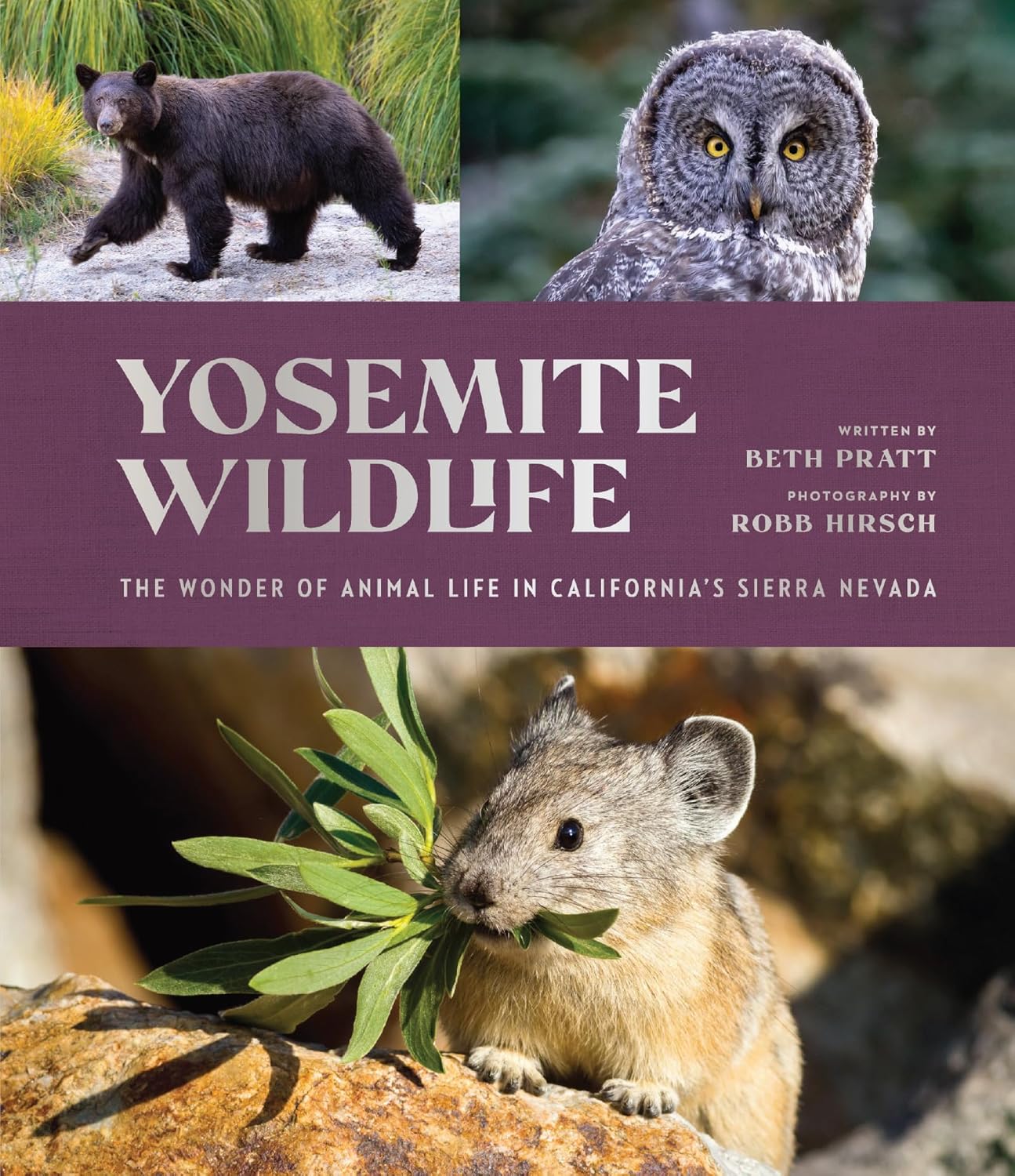
Yosemite Wildlife: The Wonder of Animal Life in California’s Sierra Nevada by Beth Pratt; photographs by Robb Hirsch

Environmental leader and lifelong Yosemite lover Beth Pratt partners with biologist and wildlife photographer Robb Hirsch to offer Yosemite Wildlife: The Wonder of Animal Life in California’s Sierra Nevada, the first book in 100 years to address this national gem’s diverse animal wildlife. With more than 300 images, Yosemite Wildlife is also rich in Pratt’s accessible prose; this thorough survey of observations and storytelling is designed to update a 1924 publication for the historical record. As a beautifully produced, large-format, glossy presentation, it also exhibits Pratt’s and Hirsch’s expertise and passion for a place that is much more than just its famous geology and dramatic scenery. With plentiful archival records, historical images, and personal stories from park staff and naturalists, it’s an informative document as well as a stunning visual feast.

Conservation success stories and profiles of Yosemite’s human defenders over the years accompany Hirsch’s sumptuous images of the iconic black bear and mule deer, the Sierra green sulphur butterfly, the northwestern pond turtle, raptors and songbirds, dragonflies and butterflies, charismatic predators, shy shrews, quirky herptiles, and more. Exquisite.


This review originally ran in the November 4, 2025 gift issue of Shelf Awareness for Readers. To subscribe, click here, and you’ll receive two issues per week of book reviews and other bookish fun.


Rating: 8 push-ups.

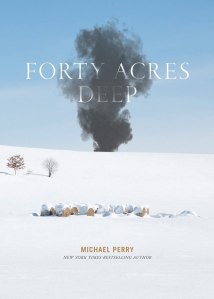
Forty Acres Deep by Michael Perry

A loan from a dear friend, from one of his favorite authors, and I can see why. This novella-length story was absolutely grim, but often funny, too, and deals with some serious messages. I don’t do this often, but let me give a big **content warning** for suicide.

It begins:

Harold had come to consider the accumulating weight of snow on the farmhouse roof as his life’s unfinished business. Daily the load grew… on his heart, his head, the creaking eaves.

A few paragraphs later:

She died a month ago, and he hadn’t plowed the driveway since.

That sets the stage pretty well for us, and all on page 1 (no spoilers). Harold has lived on the same farm all his life, inherited from his father, in a vague midwestern setting where they get a lot of snow. They were dairy farmers, but the economics of that lifestyle got increasingly hard, and then the barn burned – with the cattle in it – a trauma as well as a financial blow. He turned to beef cattle, although one hard winter, with he and the wife both down with the flu, he had to send them to market at the worst time of year, and thus got out of that business. He tried cash crops, but the prices dropped out of beans and corn, too. He leased the land to a farmer who never showed up in person; instead he sent “hired-hand agronomists with wands and laptops and satellite-guided monster machines.” There is a definite note of ‘things these days’ and ‘good old days,’ phrases against which Harold – to his own derision a part-time follower of philosopher and poetry – consciously rebels. He is an old, straight, white man, and he notes his own prejudices and old-fashioned attitudes, and actively interrogates them.

“She” was his wife, and when she dies, Harold wraps her in blankets and puts her out on the porch. He can’t bring himself to face the world. Instead he shovels the walk to the chicken coop, cares for the hens and eats their eggs with canned beans, almost his only remaining provision. He runs the kerosene-powered torpedo heaters, pointed up at the pole barns’ roofs, hoping to keep them from collapsing under the weight of the snow. He ruminates, contemplates, checks remembered quotations in his old philosophy texts. We see him visit town just a few times, where he has a minor but meaningful interaction with a barista whose context could hardly be more different from Harold’s. (It doesn’t take much interaction to hold significance for Harold, who mostly speaks only to his chickens, or himself.)

Harold is an interesting character. When he discovered Montaigne as a teenager: “instead of what he expected a French philosopher might write about, he found references to sex and farts. This was silly and appealed mostly to his dumb teen prurience, but it also implied that philosophy might be accessible and relevant even for a horny rube in barn boots.” He is both country farmer and philosophy student, both privileged old white guy and actively interested in the pronouns, the rainbow flag, and the new ways of thinking. He knows he’s not accomplishing anything big here, but I think you’ll join me in respecting his small curiosities.

Perry is a masterful writer. Harold’s story is almost unrelentingly, deeply depressing – that’s hardly a strong enough word. Nothing goes right, everyone he’s ever cared for is dead, there is nothing left to hope for. His story is also extremely funny: Harold possesses a remarkable sense of humor, and Perry renders it in prose that often surprises while commenting (cynically, of course) on the American condition. “Another yoga-panted woman was griping down at him from her Denali over how much he undercharged for digging her prairie restoration patch.” “After sundown the horizon to the west glowed with encroaching fitness center, brewpubs, and mitotic apartment complexes.” Even as the snow-buried landscape obscures, buries, kills, it is beautiful, and so is this book: both story and line-by-line writing. Harold has a hell of a vocabulary, too. He makes fun of himself for knowing how the meaning and spelling of ‘jejune’ but not how to pronounce it (me neither, Harold). Echolalia, misophonia, cotyledon, vermiculite, hyperacusis, exudation, popple whip.

One of Harold’s last backhoe jobs was for a wealthy architect who hired him to rearrange a set of decorative boulders amidst the shrubbery surrounding a cavernous riding stable. Afterward, when they were settling up, Harold said, “Nice pole barn.” He truly intended the compliment. The architect stared at him blankly for a beat, then, as if dictating from behind a lectern, declared, “It is a custom barndominium-slash-hippodrome.” Harold waited for the slow grin that would concede the absurdity of the extravagant jargon, but after an uncomfortable straight-faced silence, the man slipped an iPhone from his velveteen corduroys and said, “Do you accept Apple Pay?” Omnipresent, Harold thought, were the signs that contemporary culture was leaving him the dust. “Nope,” said Harold, and handed the man an invoice scribbled out on a carbon paper slip.

Lest you think this is overly crabby: Harold (and therefore, obviously, Perry) is aware of his own part in this caricature. At an entirely separate set of reflections, “You are being petulant, he thought. And grandiose.” He excels at the unwieldy, surprising, barking-laugh-out-loud list: “the world’s privileged hordes were content to skate along on… the secondhand grease of star-spangled draft-dodgers peddling hot water heaters, bald eagle throw rugs, and resentment.” Etc.

It’s not all this wordy. “At first light every tree branch, every blackberry cane, every stick and stem was a hoarfrost wand. The sky was clear, the air was still, and sunlight splintered every which way.” It can be as clean and smooth as snow-covered fields, where every tool or piece of garbage is softened over into something vague and beautiful.

This is a masterful piece of art. Extremely grim and dour, but beautiful.


Rating: 9 pictures.

“Consider the Shovel” at Highland Outdoors


I am really honored to have had this piece published (much) earlier this year at Highland Outdoors, a mag I’ve long admired (and wrote about here). You should really check out the whole issue (that’s spring 2025), or more of them available on their website, or you can subscribe! But at any rate, here’s yours truly talking trailwork.

I’m so pleased.

Maximum Shelf: Sea Change: Unlikely Allies and a Success Story of Oceanic Proportions by James Workman and Amanda Leland

Maximum Shelf is the weekly Shelf Awareness feature focusing on an upcoming title we love and believe will be a great handselling opportunity for booksellers everywhere. The features are written by our editors and reviewers and the publisher has helped support the issue.

This review was published by Shelf Awareness on September 11, 2025.


Journalist and entrepreneur James Workman and Amanda Leland, executive director of Environmental Defense Fund, present a rare story of ecological recovery with Sea Change: Unlikely Allies and a Success Story of Oceanic Proportions. In the concept known as “catch shares,” fishers are allotted proportional shares of a limited quantity of fish to be harvested; the demonstrated outcome improves the health of fisheries as well as the lives and livelihoods of commercial fisherfolk. Through the lens of engaging characters and locally based stories, Workman and Leland suggest this strategy may be applicable to other challenges around the world: “This revolutionary social contract with the sea has not only slowed, stopped, and in some cases reversed the devastating effects of overfishing along our coasts, but the centrality of pragmatism and collaboration could help solve some of the thorniest and most urgent natural resource challenges we confront worldwide–including the climate crisis.”

In an easy-to-read, storytelling style, Workman and Leland describe how catch shares have been proposed and enacted, often amid great conflict. The authors also detail how this strategy has led to safer and more profitable fishing while helping recover fish populations. Even former opponents have become involved in supporting and expanding such programs. Sea Change wisely focuses on delightful, colorful characters, opening with Keith “Buddy” Guindon, who grew up fishing the Great Lakes and then made a career in Galveston, Tex. Big, brash, a self-described pirate with a “reputation as a grim reaper of the aquatic world,” he’s an ideal protagonist. “A barrel of a man with amused eyes, a gruff voice and a Santa Claus beard, Buddy is a Galveston legend.” Since arriving there in the late 1970s, “he has consistently outmuscled and outfoxed every other fisherman in the western Gulf.” An early, outspoken detractor of catch shares, Buddy rapidly morphed into one of its champions, proselytizing across the United States and the world.

Fisheries in the United States and around the world have been, in recent years, suffering various stages of overuse. As the problem grows exponentially–fewer fish, longer hours, greater rush in more unsafe conditions, lower prices–so does the solution. When fishermen are assured of their fair share of the total catch, they can be more methodical, efficient, and selective about their work. They can avoid dangerous weather conditions, work shorter shifts with less rush, save on fuel, reduce bycatch and waste, bring in higher-quality product and command higher prices, even tailor their harvest to market. In Alaska’s pollock fishery, for example, “Each shareholder could set a unique and more unhurried pace to catch his quota. Vessels dropped trawl nets into the sea less often and more selectively, with fewer ‘tows’ per day. Waste from having to throw back both regulatory discards (fish that are marketable but illegal to keep) and accidental bycatch (species with no market value) plummeted. Fishermen began to insist on and provide credible data, sharing information on how much they caught where and at what time just as soon as it was available.”

Moreover, as the fish population, health, and habitat recover, fishers and communities become safer and more secure. Fishermen like Buddy, generally fiercely independent individualists, learn to work together not only in allocating shares but in enforcing rules and developing technologies to assist in transparency and improved fishing practices. Fishers learn to work with scientists and environmentalists–not traditional partners–and everyone with a stake in the fishery’s health learns to play a more responsible role.

Often following Buddy’s own journey, Sea Change is structured as a movement from the microcosm to the macro, in sections titled “Personal,” “Local,” “Regional,” “National,” and finally “Global,” where readers see Buddy travel to Tokyo’s Tsukiji fish market, and share his support for catch shares with Japan’s commercial harvesters. The narrative progresses from highly specific successes to globally applicable potentials. Coercive, top-down policies set by government or environmental agencies had long rankled the likes of Buddy, who reflexively pushed back; but catch shares depend on cooperative buy-in from the fishers themselves and incentivize them to protect overfished populations of their own volition.

Catch shares is in some ways an innovation, but also based on traditional relationships across many small coastal societies throughout history: the concept that everyone takes a share according to ability and need, and that everyone contributes to responsible stewardship. It is a version of the concept of the commons, in which a public resource is both used and maintained by the public. The “tragedy of the commons,” in turn, is the fear that if one party does not use up their share–or more than their share–another will. This mindset encourages irresponsible use: if someone else is going to overharvest, it might as well be me, some might think. But with appropriate monitoring–another piece of the system whose development wound up actively involving fishermen–Buddy and the others were able to relax, build trust, and fish smarter.

From local fisheries to global trends, Sea Change samples best and worst practices to highlight the great promise of catch shares to help both fish populations and the people who rely upon them for livelihoods and nutrition. This accessible study emphasizes galvanizing opportunities to make positive change in myriad other areas of policy and sorely needed optimism in the world of environmental thinking and planning.


Rating: 6 hooks.

Come back Monday for my interview with Workman & Leland.

rerun: Gone to the Woods: Surviving a Lost Childhood by Gary Paulsen

I still think about this book and should find time for a reread. In case you missed it, please check on Gary Paulsen and his wonders (and traumas).

I had not thought of Gary Paulsen in years, until I saw the Shelf Awareness review of this new book. (Hat tip to my colleague Jen Forbus for that review.) Paulsen might have been the first author I really fixated on; I remember setting out to own all his books, and while I didn’t get very far (maybe six or eight of them), I’m pretty sure I wrote “Julie’s Gary Paulsen library” or some such inside the cover of each one, and had them set up on their own little shelf. Early signs of something, there. My favorite was Hatchet, of course, and its sequel; and I vividly remember a scene from the beginning of another book where the narrator watches a… chipmunk? eating another creature, blood down its front… what book was that?

Anyway – when I saw that he’s returned with a memoir of his own childhood, I was sold. And let me tell you. This book had me entranced from the opening lines. I wept.

Gone to the Woods has an innocence and a simplicity built into its writing style and the value system, I think, of its narrator. This makes it accessible to younger readers, but not at all to them alone. I think this is a memoir for everyone. Paulsen tells his story in the third person, calling his protagonist only ‘the boy,’ although the name ‘Gary’ is used once or twice by other characters. This helps to give the boy an elemental quality, like he’s sort of an archetypal boy, although his story is very specific. When the book opens, he is five years old, living in Chicago with his mother in 1944. She has a factory job, and coming from a small farm in northern Minnesota, is “not even remotely prepared to resist the temptations of the big city.” She lives in the bars and does not parent her small son, who she’s trained to perform for the men who try to win her favor. Grandmother hears of this lifestyle and is “critical, then concerned, and finally… past horrified and well into scandalized.” Her solution colors the boy’s method of problem-solving for life: “If it doesn’t work Here, go over There.”

The first adventure of the book, then, is the five-year-old boy’s solo journey by train from Chicago to International Falls, Minnesota. This takes several days and involves a train absolutely jam-packed with severely injured soldiers, smelling of and oozing pain and death, so that the boy is physically ill from it all – because didn’t I say, his father, who he’s never met, is a soldier off in the war. The boy becomes stuck in a train toilet, among other things, and observes out the train window the woods that will become his sanctuary. By the time he arrives at his aunt and uncle’s farm he is wrung out with exhaustion, trauma, and confusion. But the farm will be a perfect place for him, the first place he feels he belongs, is valued, is taught. He’s given his own room and bed. It’s lovely. Then it’s taken away from him.

I’ll stop summarizing here. The boy’s upbringing is one trauma after another, including a few years on the streets of American-occupied Manila, and a continuing absence of parental concern. I appreciate that the narrator is slow to judge his parents, and I think it would have been easy (narratively speaking) to be ugly about the mother’s drinking and many boyfriends, for example, but neither the young boy nor the adult man who writes these lines takes that easy road. (At least until the teenager’s perspective, at which point he thinks of both parents as vipers. But this is about the damage they do to him, rather than some puritanical judgment of mom’s moral choices.) He is an unjudgmental creature in general. Paulsen is wonderfully good at the innocent child’s perspective, elements of which are present in the teenager too.

Trauma after trauma, but with a few bright points, like the aunt and uncle in the Minnesota woods, and a saintly librarian when he is thirteen years old who makes him a gift of notebook and pencil, for whom this book might be considered a gift in return. And the woods and rivers and streams, which are always a bright point. From age five, the boy learns that the woods will allow him to take care of himself, even when he lives in a city again, keeping to the alleys and nights to avoid bullies, and escaping to the stream where he can fish for food or shoot squirrels and rabbits when his parents fail to provide for him. Even in Manila, a city of a certain sort of trauma (truly, the violence and death this child witnesses by his sixth birthday is unfathomable), he finds beauty and human kindness.

At times the events were hard for me to take in, and I wondered if younger readers were really the right audience for this. But on reflection, I think Paulsen offers just enough. I think children might take away what they need from this book – I’m no proponent of censoring life’s pains from kids – and it’s the adult mind and perspective that makes it even harder to read, if that makes sense.

The story is harrowing but also lovely, always riveting, and an important testimonial from a generation that we will eventually lose access to. It is excruciatingly beautiful in how it’s told. The immediacy of traveling with the boy is heart-rending and direct. I can’t imagine how this book could be improved upon.


Rating: 10 willow branches.

The Wild Dark: Finding the Night Sky in the Age of Light by Craig Childs

A longtime nature writer directs his gaze upward with this travelogue and love song for the dark night sky.

Prolific nature writer Craig Childs (The Secret Knowledge of Water; Atlas of a Lost World) takes readers on a journey away from the light with The Wild Dark: Finding the Night Sky in the Age of Light. He’s in search of a clear view of the heavens, stars, constellations, planets, galaxies, and beyond–and all that they stand for–and offers a quest narrative with a circular structure, which starts and ends in that bastion of illumination, Las Vegas, Nev.

Childs teamed up with an old friend and fellow adventurer, Irvin Fox-Fernandez, and together the two men rode loaded off-road bicycles north out of the city, which his friend called “Bortle-hopping.” Bortle, Childs explains, “is a naked-eye scale for determining a night sky’s quality”; in this book, Childs describes moving from Las Vegas’s Bortle 9 to the joys and profundities of Bortle 1, “where only stellar light and backscatter from sunshine in space can be seen.” He chronicles this trip with lyricism, gentle humor, and an obvious passion for darkness preserved, for the human ability to consider something larger than ourselves: “Beaming overhead, they live their lives regardless of how we see them, and for all I’ve heard that stars don’t care, I disagree. I just don’t know what they care about.” As environmental causes go, this one entails an easy fix: just turn the lights off. Referring to mythology, biology, archeoastronomy, and more, Childs makes a strong argument.

Beautifully written, fervent, and lavish in imagery both light and dark, The Wild Dark is a moving call to action.


This review originally ran in the May 30, 2025 issue of Shelf Awareness for Readers. To subscribe, click here, and you’ll receive two issues per week of book reviews and other bookish news.


Rating: 6 ginger cookies.

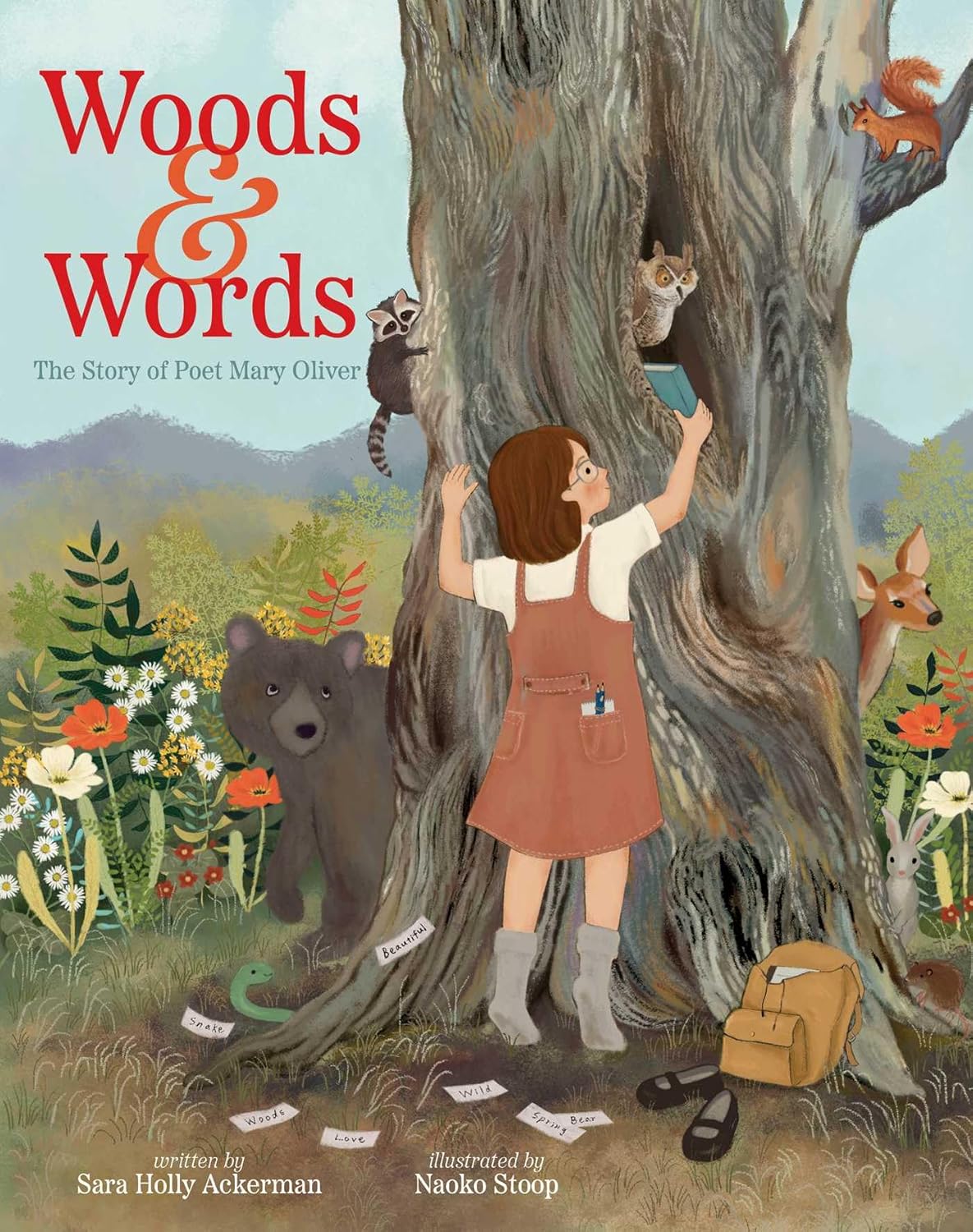
Woods & Words: The Story of Poet Mary Oliver by Sara Holly Ackerman, illus. by Naoko Stoop

I was sold on this book by my Shelf Awareness colleague’s review. I purchased it for some young friends who I think will enjoy it, but that was partly a reason to enjoy it myself first, before I passed it on.

This is a beautiful book, in its simple storytelling, its lovely sentiments and the values it communicates, and in the charming illustrations, full of plants and animals and sweetly expressive human faces. Rated for ages 4-8, it took only a few minutes to page through once, but will reward multiple and slower readings. I liked looking for the critters tucked away in the illustrations’ crevices, and reading through the words that trip and twist across the pages (outside of the narrative). I love that this story, which can be appreciated for its own sake, also introduces young readers to the life of Mary Oliver, an artist for whom mainstream “success” was not guaranteed. The Author’s Note notes that Mary Oliver’s home life, as a child, was “difficult.” She was a woman, she was queer, and she wrote poems that were defiantly “plain,” diverging from a tradition that makes poems less accessible to us regular people. This is what we love her for; but it presented some barriers in her acceptance by critics.

So, a beautifully rendered illustrated children’s book bringing the life of a great American poet to young people. An utter joy to read and look at, much like Oliver’s poetry. Strongly recommend for the kids in your life, and you will enjoy sharing it with them. More of this, please.


Rating: 9 shingles.

North Woods by Daniel Mason

A gift from a dear friend, this novel is different. It could be categorized as a collection of linked shorts, in various formats (formally playful, you might say), including epistolary. The stories that make up North Woods are connected across history by place: together, they track a single location, a small valley in what will become western Massachusetts, from early colonial America until the more-or-less present and into the future. We are used to novels and stories being connected by character or plot. We are familiar with stories that center place heavily – I’m thinking of Rebecca, Housekeeping, The City We Became, The Rope Swing. This one felt a bit more… kaleidoscopic.

They had come to the spot in the freshness of June, chased from the village by its people, following deer path through the forest, the valleys, the fern groves, and the quaking bogs.

Fast they ran!

So opens the novel, and it takes several paragraphs until the reference to ‘harquebuses‘ (I had to look it up) gives us a clue as to setting in time. I loved how the fens and meadows, bramble and thickets, bear caves and tree hollows could have been anywhen. The couple who run remain nameless, and we learn very little of their story in their four-page chapter, but we see them stop in a valley: “a clearing, beaver stumps and pale-green seedlings rising from the rich black ash.” “Here,” says the man, and there they stop with their chicken and their squash and corn seeds and fragments of potato. And scene.

Subsequent residents – most of them human – find the log and stone hut built by this original couple, experience joys and hardships there, and add to that structure. A veteran of the American Revolution establishes an apple orchard. His twin daughters, after his death, grow old preserving his legacy and bickering with each other, unto a shocking end. A mountain lion briefly occupies the abandoned dwelling, hoarding her kills. A slave catcher hunts other prey in the area, eventually homing in on the house in the overgrown orchard, but will not find what he seeks. A painter finds a haven there, in a gorgeous valley where he can observe nature and work on landscapes and studies of birds nests, fungus, and trees; he pursues a forbidden love. In his old age, a nurse comes to assist him, and finds a love of her own that will fare no better. (It begins to feel like the home in the valley, at this point with many additions and “improvements,” might be a site of bad luck.) A mystic plies her trade, claiming to drive out a haunting, but has bitten off a bigger haunting than she’s realized. The chestnut blight settles in. A mother struggles to care for her disturbed son, who is schizophrenic, or haunted, or maybe both (?). The son wrestles with his delusions, or, his heightened knowledge of reality; his sister, an academic on the west coast, grapples with her brother’s life’s work. A newlywed couple lives out a fantasy, and a bark beetle expresses its lusts in parallel, in one of the weirder sections of this novel (and that’s saying something). (The chapters that feature nonhuman characters – spores, beetles, panthers – are delightfully immersive, but also somehow inherently creepy, in a way that feels anthropomorphic.) A lonely old woman narrowly avoids a dangerous con artist, a crime writer discovers an ancient grave, a metal detectorist goes seeking evidence, and a graduate student searches for spring ephemerals but encounters a ghost. The world turns.

It was a fascinating experience to sink into this place. There were not many characters or episodes to like or even especially enjoy; there was often a sense of watching something disquieting take place. I definitely loved the consideration of place over time, the natural world, and the different ways we interact with it. I loved the orchardist, the painter, and the graduate student most of all. I do love a zoom in on a procreative beetle. It was a disjointed experience, one I’ll not soon forget, but also don’t feel a firm grasp of. Maybe I need more time out of this book to figure out what it did for me. Maybe this is an instance of the author demonstrated prowess for its own sake. (As ever, your mileage may vary.) If you get into it, please do let me know what you think.


Rating: 7 antlers, turtle shells, and bird eggs.

You Are Here: Poetry in the Natural World, ed. by Ada Limón

First of all, for those who know me, you will appreciate that this title grabbed my attention pretty hard. I like nature; I like poetry with a little more reservation (such that I’ve waited about a year since this book’s publication to pick it up), but I was intrigued. This anthology was put together by Ada Limón, our national poet laureate (still current as I type). It begins with a foreword by Carla Hayden, librarian of Congress (also current as of now), in a lovely single page; Limón’s three-page introduction is even more moving, describing an important tree and a choice. “When I was first asked what I wanted to create for a national poetry project during my tenure as the 24th Poet Laureate of the United States, I remember staring out the window of my office in the Library of Congress thinking, I just want us all to write poems and save the planet.” She immediately recognizes this impulse as both unlikely and vital. She invites us all to write our own poems alongside those in these pages, exhorts us to do something, to offer something back. “Because nature is not a place to visit. Nature is who we are.”

It feels appropriate, then, that the collection opens with Carrie Fountain’s “You Belong to the World,” which remains one of my favorites. (Fountain was recently the poet laureate of Texas.) This is followed by 49 more poems by just over 50 poets (there is I think just one collaboration), all American poets and all contemporary, just a handful previously published (and all of those in either The Atlantic or the New Yorker, go figure). They come in a variety of lengths, forms, and styles, and while they all deal with ‘nature,’ they approach that rather broad, abstract subject in different ways. Some describe or love or appreciate (or fear) a specific species or being; some consider fire, water shortages, and other crises; many dwell at the intersection of people with ‘nature’ (although, as Limón and Fountain remind us, those are not separate). Some I find pleasingly literal and narrative (remember I fear poetry at least a little). I have a more difficult time with the further-reaching figurative ones, and some I had to allow to just be sound that washes over. Ah well. Here are my favorite poems of the fifty:
“You Belong to the World,” Carrie Fountain
“When the Fact of the Your Gaze Means Nothing, Then You Are Truly Alongside,” Donika Kelly
“Eat,” Joy Harjo
“Letters,” Ilya Kaminsky
“Rabbitbrush,” Molly McCully Brown
“Lighthouse,” Ellen Bass
“Mouth of the Canyon,” Traci Brimhall
“Aerial View,” Jericho Brown (he wants to be a giraffe!)
“Canine Superpowers,” Michael Kleber-Diggs
“Hackberry,” Cecily Parks
“Taking the Magnolia,” Paisley Rekdal (common thread: I like tree poems)
“Darkling I Listen,” Adam Clay
“Remembering a honeymoon hike near Drakes Bay, California, while I cook our dinner at the feet of Colorado’s Front Range,” Camille T. Dungy (I confess I was waiting for a love poem)
“Heliophilia,” Aimee Nezhukumatathil
“Twenty Minutes in the Backyard,” Alberto Ríos
“To Little Black Girls, Risking Flower,” Patricia Smith
“Reasons to Live,” Ruth Awad
and let me give you the last two lines of one poem (Eduardo C. Corral’s “To a Blooming Saguaro”) and the first two lines of the next one (Diane Seuss’s “Nature, Which Cannot be Driven To”):
“My mother is my favorite immigrant. / After her? The sonnet.”
“To drive to it is to drive through it. / Like a stalker, it is in the back seat of the car.”

Well. That’s nearly half of the poems. Not bad, hey?

Even though poetry is scary, join me in giving it a try. It helps to read aloud. Write poems and save the planet. Sit under a tree.


Rating: 7 ears.