Among the Mad by Jacqueline Winspear

It’s that time again! The sixth Maisie Dobbs book is entitled Among the Mad, and takes place within London (and surrounding environs, of course). Maisie is conscripted formally into the machine that is New Scotland Yard when she’s mentioned by name in a threatening letter aimed at the government. As is usual, this case involves the aftermath of WWI and its veterans, in the context of the depression in England. Also as usual, there is a personal embodiment in Maisie’s own life: Billy Beale’s wife is still struggling to process the death of their young daughter. The general issue is shell-shock, or what we would now call post-traumatic stress. Maisie is touched by the plight of veterans who are still suffering less obvious wounds, like psychological, mental, or emotional ones, and who are unable to find work or meaning in a changing world.

This was, for me, perhaps a lackluster episode in Maisie’s story. It had all the familiar elements: themes of social and economic injustice and the sobering reality of depressed post-war England; Maisie’s search for belonging in between social classes (although she’s more and more integrated into the middle class; more on that in a minute) and with few real friends; the immorality and futility of war, with foreshadowing of the next world war to come. Maisie does continue to grow. She displays a work of art in her home, a tapestry we can assume she made in the weaving class she was attending in the last book. At the end of the book, she buys a camera, which I interpret as both another artistic/creative outlet, and a connection to other humans. She displays photographs as a means of reminding herself of her relationships. She also starts seeing more of Priscilla, and seems to open up more; but I’m bothered by her acting as Psychologist & Investigator (and therapist) in their friendship. It may not be sufficiently different from her day job, if that makes sense. But these are all positive developments. And then there’s the big one, at the end of the book, when she declares (to herself at least) that she has regained her soul. The healing suggested by Simon’s death seems to have begun.

About Maisie’s social standing: did anyone notice that Catherine Jones accused Maisie of not knowing want, and Maisie didn’t correct her? And later, in considering the possibility that a foundling could have become a successful scientist, she concludes that such social/economic climbing would be impossible – “unless, of course, he was something of a chameleon. Like herself.” It sounds to me like Maisie’s made a pretty successful climb, but it’s left her as isolated as ever.

She does see some developments in her romantic life. It seems that Stratton continues to be interested, but frankly, I never saw him as a serious option. I know some of my fellow readers-along liked him as a candidate for love in Maisie’s life, but I felt he was a bit one-dimensional from the start, and a bit patronizing of Maisie as female detective. He’s come a long way in respecting her professionally, I’ll give him that. But still, aside from being a single parent, I don’t think we know anything interesting about him. I liked Dr. Dene, for his sense of humor and personal connection via Maurice; but that didn’t take. It was too early for Maisie. Our new friend MacFarlane, though, is more of a firecracker. He has more personality. I like him as an option for Maisie very much. I like his style, and I like that she fed him dinner in her apartment (!) and they shared really a very intimate evening. I hope to see more of him.

The mystery was engaging, too, and Winspear continues to twist her readers’ heartstrings with the criminal-as-victim and really very sad national situation that breeds situations like this one. It’s very poignant, powerful stuff. Still, I guess it’s beginning to be a bit patterned for my liking. I hope she’ll mix things up a bit in the next installment, The Mapping of Love and Death, which we shall discuss in another two weeks.

We saw less of Maurice in this book – really hardly saw him at all. There is discussion of he, and Maisie’s father Frankie, aging. She has precious few close friends, and I notice she’s not very forthcoming or honest with her father about her life. It really bothered me that she didn’t tell him about her injury at the start of the book. I know she likes to be a tough guy, and independent, but really. A single woman with a father who loves her should let him take care of her when she’s hurt at Christmas! At any rate, I’m glad she’s drawing closer to Priscilla, but hope she continues to expand her little circle, especially with the hinting at Maurice & Frankie’s mortality.

I still adore Billy, and find his family’s situation one of the stronger points of every book, actually. They feel very real to me, and perhaps because we follow them for the whole series (as opposed to the characters in each case, who come and go), they feel like Winspear’s best representation of the national malady. I think I am most anxious for them between books. The Beales, and Maisie’s love life, are my greatest concerns going into the next installment. I do like the mysteries, but I would like to see a little variety in the structure & subject of the next one.

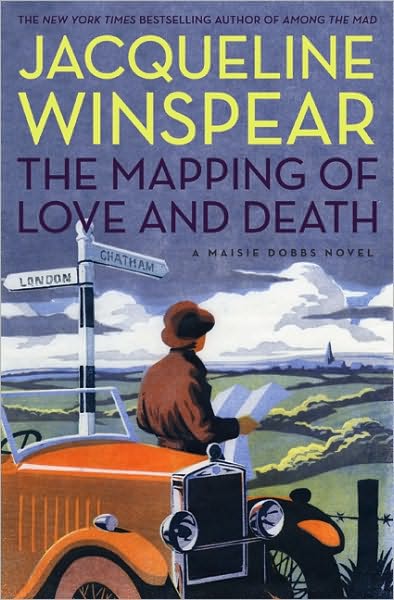
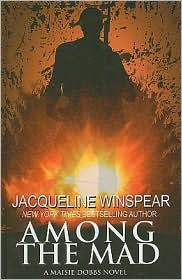
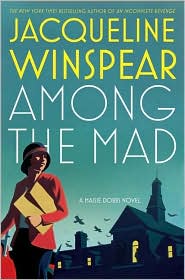
Let’s discuss covers, briefly. For those of you also reading the series: the first image, above, is the standard hardcover design. It matches the rest of the series (at least the copies I’ve picked up), and I like the continuity; it’s recognizable. I like her cloche, too. 🙂 (remember, I got my own in Maisie’s honor!) But this time I accidentally picked a large print edition (that was weird; had to turn pages much faster), whose cover you also see above. Although it’s not visually recognizable as belonging to the series, I think it expresses the subject matter (at least of the mystery part of the book) better. I guess the usual series covers are more about Maisie; the large print cover is more about post-war madness. What do you think?

Despite some gentle criticisms, I still like Maisie and can’t wait to see her through! We have just two books left – the last having been released just last week. I’m so glad I’m involved with this series, and am so glad to have a group of people to share her with. Don’t forget to check in with Book Club Girl, where this book is being discussed. And we’ll meet again in two weeks for The Mapping of Love and Death.

book beginnings on Friday: options

Thanks to Katy at A Few More Pages for hosting this meme. To participate: Share the first line (or two) of the book you are currently reading on your blog or in the comments. Include the title and the author so we know what you’re reading. Then, if you feel so moved, let us know what your first impressions were based on that first line, and let us know if you liked or did not like the sentence. (You might also consider visiting the original post where you can link to your own book beginning.)
I’m breaking the rules again. I’m not sure what I’m going to read next. I will hopefully finish both Main Street and Dethroning the King this weekend (and will likely not post at all over the weekend, which is my usual habit). But I did want to share a few books that have recently been published that I’m interested in reading. Perhaps you can help me choose!

First of all, Heather Gudenkauf’s These Things Hidden begins:

I stand when I see Devin Kineally walking toward me, dressed as usual in her lawyer-gray suit, her high heels clicking against the tiled floor. I take a big breath and pick up my small bag filled with my few possessions.

To me, this indicates that the narrator has seen this Kineally woman before, knows her “usual” suit color, and is not feeling so hot about the action to come. I have read the blurbs (and a review or two) of this book and am excited about what sounds like a thrilling and intriguing, um, thriller.

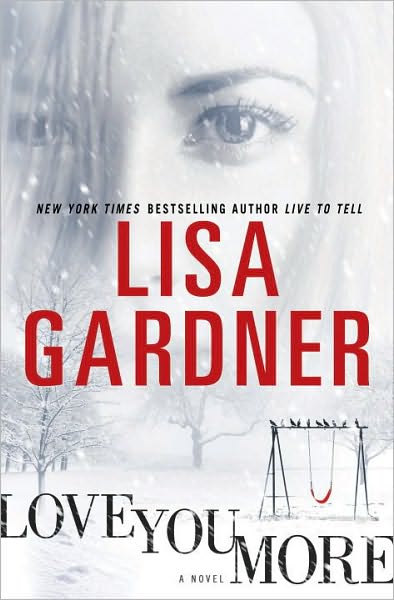
And then there’s Lisa Gardner’s Love You More. From the Prologue:

Who do you love? It’s a question anyone should be able to answer. A question that defines a life, creates a future, guides most minutes of one’s days. Simple, elegant, encompassing.

This is a bit general and philosophical for my tastes, and not such a grabber, for me at least, but chapter one does me better:

Sergeant Detective D.D. Warren prided herself on her excellent investigative skills. Having served over a dozen years with the Boston PD, she believed working a homicide scene wasn’t simply a matter of walking the walk or talking the talk, but rather of total sensory immersion.

Now that will grab me. I like a good detective and a good crime scene; this is my favorite kind of light reading. I’ve read some about this book, too – I’ve never read Lisa Gardner before, but this one sounds wonderful, and I can’t wait to get into it. Although again I’m noticing a sort of emotional theme of maternity, parenting, mother-child bonding, family, etc. I’ve mentioned this before and it bothers me somewhat. I wonder if this is a recent theme in publishing? Or just the ones I’m stumbling across? Any thoughts?

Anywho, sorry, got distracted. Either of these books appeal to me for a next read – or it could always be something off my TBR bookcase at home. 🙂 Do you have a vote? What shall I tackle next? (Perhaps the next one of these two to be returned to my library, hmm…)

movie: The Lincoln Lawyer (2011)

I didn’t let being sick stop me! I made the Husband take me to a movie Friday night! So I saw the first Michael-Connelly-book-made-into-a-movie on opening night! This is especially momentous because the Husband does not Do Movies. This is the second movie we have seen together in a theatre. (He has a slightly higher tolerance at home on the couch. Like maybe 10 movies, ever.)

It was pretty great! I was excited, because it’s Connelly, and it’s a great story, and I thought McConaughey had some potential as Mickey Haller. (I hadn’t thought of Haller as being quite that pretty, myself, when I read the book, but I was open.) But I was also concerned, just as in reading The Paris Wife (which I loved! did you notice?), because I love Connelly and the movie is never as good as the book, and there was a high risk of disappointment.

cute Maggie McFierce

But I liked it! Yay! (The Husband did too. Remember he’s a part-time Connelly fan.) Of course, being a two-hour Hollywood movie, it cut significantly from the book. I was tolerant. It stayed with the feel of the plot; Haller was a baller, and his being pretty worked, and I thought Marisa Tomei was the CUTEST Maggie McFierce. It was enjoyable. Was it a Connelly novel? Heck no, but it followed his atmosphere, and I enjoyed it. And then I went to bed.

McConaughey with Connelly

I wonder if maybe he sold that book for a movie, first, to see how it would go, rather than any of the Bosch series. I figure once he releases Bosch to the big screen, he will have committed, and will have to let them keeping making Bosch, for better or worse. Which led to a question: who do we like to play Bosch? Anybody? The Husband had an idea, but I didn’t know the actor so it hasn’t stuck in my head. I have no ideas because I’m not very good at Hollywood. :-/ Please share! Who is Bosch? I see him as being stout and muscled, not terribly tall, with dark hair, and weathered by violence and stress, but still a touch ruggedly handsome while NOT being pretty. Who is this?

An Incomplete Revenge, by Jacqueline Winspear. and, tattoos

Another very enjoyable Maisie Dobbs book! I am definitely hooked on the series at this point. Immediately after finishing An Incomplete Revenge, I started reading Pardonable Lies – that is, the third book in the series that I skipped over. Good stuff.

In this episode, Maisie ends up following Billy Beale and his family on their “working vacation” out to Kent, to pick hops and enjoy the air away from “the Smoke” (which apparently is London – I’m learning some Britishisms from these books, for sure). James Compton, the son of her original patroness and supporter, has come looking for her help in his business dealings in the small town of Heronsdene. His concern is with the strange events there, including petty crime and a fairly regular occurrence of arson. Since the Beales were already to be in the area, Maisie can use her assistant as usual.

I really liked the way this book opened with another woman’s perspective on Maisie – the weaving instructor, Marta, observes her and makes some guesses about her life. I appreciated an outsider’s view of her, since I think we often get Maisie’s point of view, even in third person.

We quickly learn some new and, I think, important details about Maisie’s personal history and past that I found valuable in understanding her, as well as entertaining in their own right. I’m glad Winspear gave her this new dimension. As I’ve said throughout the series, if Maisie lacks anything, it’s dimensions; perhaps Winspear is wise to mete them out sparingly like this, though, since I’m so interested and on the edge of my seat. Give me more! MORE!

The story itself (avoiding spoilers here) I found heartwrenching. I was surprised at the degree of forgiveness shown in the end – although the offended party does not call it forgiveness (he says, “that is not for me to do”), he does forbear to take (ahem) Complete Revenge. It was a satisfyingly complex and twisting story, with Winspear’s characteristic overarching, large-scale, human-condition themes, and I found the exotic addition of the gypsies to be a point of interest, too.

A few things caught my eye in this book. I really enjoyed the beautiful, sensual description on pages 219-220 of the War Office Repository. The polished dark wood floors, hushed tones, and onionskin papers, along with the emotions of the people doing their research (as imagined by Maisie), and the helpful clerk, “reminded [Maisie] of a library.” (They did me, too.) I’m a librarian, and am always excited to get a mention. 🙂

Another connection in this book that I REALLY enjoyed was the hop-picking! I’m a big fan of beer – I used to sell it for a living, and I’ve made pretty significant plans over it (like flying overseas), and it’s pretty important in my family – both my parents, and the Husband, and I are all beer people. And the HOPS are my favorite part. I’ve never picked any, but I have munched on fresh-dried ones, and, yum. I even have a tattoo: …because our littlest dog is named Hops, so now I have a tattoo for each dog. Here is Ritchey:

…and the two real-life models.

At any rate. Thanks for bearing with me through the tattoo gallery 🙂 (there’s more where that came from, but I shall spare you). I’ll be commenting, as well, over at Book Club Girl‘s discussion post. Come on over! I’m so glad I’m participating in this read-along; it’s been great fun and I’ve discovered a new series I really enjoy.

Pardonable Lies by Jacqueline Winspear

Book 3 of the Maisie Dobbs mystery series by Jacqueline Winspear is called Pardonable Lies. From the author’s website (because I’m lazy, and because this is a fine one) I give you a synopsis:

In the third novel of this unique and masterly crime series, a deathbed plea from his wife leads Sir Cecil Lawton, KC, to seek the aid of Maisie Dobbs, psychologist and investigator. As Maisie soon learns, Agnes Lawton never accepted that her aviator son was killed in the Great War, a torment that led her not only to the edge of madness but also to the doors of those who practice the dark arts and commune with the spirit world. Determined to prove Ralph Lawton either dead or alive, Maisie is plunged into a case that tests her spiritual strength, as well as her regard for her mentor, Maurice Blanche. The mission will bring her to France and reunite her with her old friend Priscilla Evernden, who lost three brothers in the war, one of whom has an intriguing connection to the case.

Set against a finely drawn portrait of life between the World Wars, Pardonable Lies is “a thrilling mystery that will enthrall fans of Jacqueline Winspear’s heroine and likely win her new ones” (Detroit Free Press).

This episode involves the rift between Maisie and her mentor, Maurice. I’m not terribly impressed with Maisie’s decision-making in this book. I think it’s a time of growth and learning for her, though. Out of her rift with Maurice comes a greater independence in her own work (which is rather patronizingly and, I thought, unnecessarily explained to us by Winspear), which she did need. But she also showed a stubbornness in this book that endangers her own health and therefore those things she cares so much about: her business, her cases, Billy’s employment. She needs to confess that she’s human, and be willing to accept help when it’s both offered and needed. I was also frustrated with her treatment of Dr. Dene. I know she has precious little experience “walking out with” a man, and her one love affair ended tragically and she’s hurt. Still, I felt that she treated Dene rather cruelly. Surely someone as intuitive as Maisie could come up with more humane behavior towards a man who rather loves her, who she cares for (if less) in return. But I guess that’s the great irony: psychologists with screwy relationships, mechanics whose cars don’t run. Right?

But, I had a good time with Maisie, again; enjoyed the several cases she solved and the puzzles she unriddled. I thought the case of Avril was interesting, but I especially enjoyed the cases of the two missing soldiers. I think Winspear’s best subject matter may be the war and it’s painful aftermath; perhaps that’s why these were such powerful, moving stories. That, and I love Priscilla and enjoy getting to know her family.

Although I am very, very late, I am heading over to Book Club Girl‘s website to join the discussion about this book, so come on over there with me if you like. On Monday, March 14, I’ll be posting, and we’ll be discussing, An Incomplete Revenge. Next up (in order, and on time!) I’ll be reading-along book 6 of the Maisie series, Among the Mad. Stay tuned!

Teaser Tuesdays: Pardonable Lies


Teaser Tuesdays is a weekly bookish meme, hosted by MizB of Should Be Reading. Anyone can play along! Just do the following:

* Grab your current read
* Open to a random page
* Share two (2) “teaser” sentences from somewhere on that page
* BE CAREFUL NOT TO INCLUDE SPOILERS! (make sure that what you share doesn’t give too much away! You don’t want to ruin the book for others!)
* Share the title & author, too, so that other TT participants can add the book to their TBR Lists if they like your teasers!

I finished An Incomplete Revenge last night, and enjoyed it so much! (My post will be up on Monday, in timing with the Maisie Dobbs Read-Along.) So I started right in on book #3 which I had skipped over: Pardonable Lies. I DO like my Maisie.

So today, from page 149:

Maisie left London before seven in the morning, her clothes, books, and papers packed in a small case of dark brown leather with straps across to ensure her belongings were secure. She carried her black document case and wore a gray-and-blue tweed jacket with a pale gray silk blouse, light gray woolen trousers, black shoes, and, to top off her ensemble, a dark gray hat with a broader brim than usual, a black band and a dark blue feather on the side, which was attached to the band with a deep blue stone in a sapphire cut.

You know, I said earlier in our read-along that the fashion details weren’t my cuppa because I’m pretty fashion-unconscious and all, but I’m changing my mind. I really enjoy being able to picture these details, and I really appreciate Maisie’s style; she’s simple but classy, even elegant, even if Priscilla does think she’s too plain. That’s how I see her.

I think this passage sees Maisie off on her journey back to France for the first time since the war, and I happen to have a fairly strong, foreshadowed feeling that things don’t go well for her there. But doesn’t she look smart heading off? I like the items like the black document case, and her nurse’s watch, that follow her through the series and whose histories we know. It gives a neat sense of continuity; it’s rewarding us for reading the whole series. (And here I am out of order, sigh, what else is new. I like it fine this way though.)

I am enjoying Maisie yet again! Stay tuned!

book beginnings on Friday: An Incomplete Revenge

Thanks to Katy at A Few More Pages for hosting this meme. To participate: Share the first line (or two) of the book you are currently reading on your blog or in the comments. Include the title and the author so we know what you’re reading. Then, if you feel so moved, let us know what your first impressions were based on that first line, and let us know if you liked or did not like the sentence. (You might also consider visiting the original post where you can link to your own book beginning.)

Today I’ll introduce you and me both to the next book in Jacqueline Winspear’s Maisie Dobbs series: An Incomplete Revenge. I am, in fact, reasonably certain that this is the very next book to follow the one I have just read, so hopefully no more snafus of that sort. I never did get around to reading Pardonable Lies; maybe I’ll get around to it one of these days. I always was a fan of reading out of order. 🙂

Without further ado, your book beginning, from the prologue:

The old woman rested on the steps of her home, a caravan set apart from those of the rest of her family, her tribe. She pulled a clay pipe from her pocket, inspected the dregs of tobacco in the small barrel, shrugged, and struck a match against the rim of a water butt tied to the side of her traveling home.

What’s this? Gypsies? Maisie is stepping out of her standard circles here, although I suppose she was always ready to do that. I would like to see something other than the same moneyed Brits hire her; perhaps we could go back to France or do some other sort of travel. Or, gypsies. Okay. This is a source of variety; I’ll take it.

Will you be enjoying Maisie with me? I think the Read-Along has us writing this one up on Monday the 14th, so I shall start reading this weekend!

Sorry, I know it’s been a bit sparse around here this week. Hopefully I’m about caught up and ready to be a good (daily) blogger again. 🙂 Enjoy your weekend!

Messenger of Truth, by Jacqueline Winspear

So. As I discovered earlier, I read this book out of order. Somehow I thought I was on book 3 and this turns out to be book 4 and although I do have book 3, Pardonable Lies, I haven’t yet started it.

Even so, Messenger of Truth was my favorite Maisie book yet. She got more human, more multi-faceted, in my opinion. She was tempted by friendship with Georgiana; that speaks of human weakness. She gets lonely. This has been one of my complaints about Maisie, that she lacks this human quality, so for me this developed her. We can see she’s still not ready for a romantic relationship, though. At least she’s now struggling with the question of it.

On the other hand, I’m also still enjoying the macro view of the world, if you will. Maisie and Billy have slightly different perspectives, but both are bothered by the haves vs. have-nots issue. In past books, discussion of the war and the post-war depression have given me a similarly satisfying treatment of the larger world. I want Maisie to be a real person; but I also like it when Winspear deals with these macro issues.

Here comes the SPOILER:


I was surprised that Winspear let Lizzie die! I guess I have to respect her for going whole hog. It’s realistic that she would die, I guess.

I still find the series interesting. I still look forward to seeing what’s going to happen to Maisie. I still intend to read book 3. :-/ But… there’s still something a bit… sanitized or somehow not entirely, grittily human about this series, for me. On the other hand, I like Maisie so much that I bought THIS!

see! my new cloche!


Call me Mad for Maisie 🙂

vacation reading: a series of short reviews

The Strange Case of Dr. Jekyll and Mr. Hyde by Robert Louis Stevenson. Still a good story! Spooky and short, it’s a bit reminiscent of Poe. Action-packed and efficient. I would not have sworn I had read this before, but now I recognize that I have. What a classic. I highly recommend this as a bang-for-the buck, action-packed, early sci-fi spookster with a bit of meditation on the human condition. Not sure if I should count this for the Classics Challenge as its a re-read. :-/


Worth Dying For by Lee Child. (audiobook) Surprisingly good as audio. I wasn’t sure. I’m such a BOOK purist that audio doesn’t always work for me; but it can’t be argued with on a road trip. Part of what made it special, too, is that I got to share it with the Husband, who doesn’t normally read. He got really into it, and we shared this suspenseful adventure together. That’s priceless.

Classic Jack Reacher! He’s such a Rambo. It’s a bit comical in the over-the-top violence and general bad-ass-ness, but I eat it up. It’s great fun. We both enjoy the slight absurdity of it, while also appreciating that we can count on this guy to get it right. And I finally begin to understand, at least a little bit, what was so frustratingly up-in-the-air at the end of 61 Hours. This may be my favorite Reacher novel yet.


The Ballad of Typhoid Mary by J.F. Federspiel. Opening quotation: “Life is strange and the world is bad.” (Thomas Wolfe) This sets the tone.

This is another creepy story. It’s historical fiction, and I have made a note in large letters to read up on the concept of Typhoid Mary and how much we know about her in the real world. She was a carrier of typhoid fever: she never got sick herself, but she made people around her sick, to the tune of several hundred at least. She was a cook, passionate about cooking for people, despite seeming to understand that she was killing them. She wasn’t a serial killer; she didn’t do it on purpose; she just didn’t let it stop her. What can we expect, in an age with poor understanding of hygiene and the spreading of disease, of a poor, uneducated, abused & orphaned young woman with no opportunities who suspects she might, in some way, be responsible for all these deaths around her? This was a fascinating read, and another very short one, too.


The Man Who Mistook His Wife for a Hat by Oliver Sacks.This is a collection of case studies, or short stories, or essays, by a neurologist who also fancies himself a philosopher with literary leanings. It was quite attention-grabbing, and I had to keep putting it down to tell the Husband stories. Reading about brain injuries or anomalies of the brain is infinitely more interesting to me since I had my bad wreck and experienced some brain injury and healing of my own. The most interesting thing about a number of these cases is that these patients often don’t realize that anything is wrong!

Sacks’s approach is to contemplate the relationship between mind, body, and soul, which perhaps too few of our hard scientists do. It still ended up a bit on the hard-science side for me, perhaps; he made a number of references (unexplained) to other hard scientists, which made it a bit less accessible to us laypersons. But I loved the stories, the concepts, possibilities, complexities of the human mind.


In the Woods by Tana French. I’ve been hankering for more of Tana French since reading Faithful Place. I really fell for that Frank Mackey! This one opens with immediately recognizable poetry-in-prose, stark, gritty, and strongly Irish. Then I was disappointed to recognize a familiar story: grown male detective forced to confront unsolved childhood trauma of missing friend(s). Argh! But I guess why mess with a good thing…

Oh man. I stayed up nearly all night to finish this book. (and this, in a place where I LIKE to get up to watch the sun rise!) Same story my head; it did have its plot similarities but it was so gripping and spooky, like a ghost story, except even spookier because there was nothing supernatural at all, just creepily realistic human nature. I can’t wait to get the next book!

Side note: the beautiful, tragic, doomed, perfect friendship reminded me somewhat of One Day by David Nicholls, which had an entirely different tone to it.


Echo Park by Michael Connelly. (audiobook)Another highly enjoy audiobook! This one unabridged, thank goodness. (I realized AFTER we listened to Worth Dying For that it was abridged, and now have to go back and read the book.) Connelly, for all that he’s sort of stark and black-and-white, also strikes me as a poet; I love that Bosch “educates” his ice with vodka. That’s unique! I’ve read this book before, but it’s been long enough that I still enjoyed the mystery. I like all the background or frame elements in Connelly, like the jazz (and I like that the Library of Congress, and some clever librarian there, make an appearance in relation to the jazz), and the audio format took advantage and gave us a few jazz riffs in the background here and there, which was a nice touch. I hadn’t really thought about using music on on audiobook, and actually, there were some other snippets of music added that I didn’t think worked so well; but jazz behind Connelly is a strong choice.


Whatever You Say I Am (the life and times of Eminem) by Anthony Bozza.I put this in the same category as the Hefner biography, actually. These are some highly controversial men, offensive to many if not to all, who have impacted our world; without making a value judgment, I can say I find them interesting to read about. My feelings about Eminem are complicated, just like with Hefner. (I was talking with my Pops the other night along these lines and we put Reagan in the same category but that’s a whole new can of worms.) I haven’t finished this book, am less than halfway through, but I can say I really enjoy the way Bozza puts his reader fully into a time and place. For example, to help place us in the year in which Eminem was working to release his first album, he gives us a full rundown of the musical hits and award winners of the year in various categories, as well as what movies and television were hot. Now, I’m not generally all that up to date on pop culture, but this worked for me; it really evoked a time in my life. I think that works for all of us, because isn’t sound or music second only to smell as a mnemonic? Doesn’t hearing a particular song take to you a time and place? At any rate, I’m enjoying this biographical study of a controversial figure.


And finally, By-Line: Ernest Hemingway. As I’ve said, I’m enjoying reading Hemingway’s usual tone and style, that I know so well, used in journalism. I hadn’t read any of his journalism before. I guess the nonfiction I’ve read would be Death in the Afternoon and A Moveable Feast, and then all that fiction that’s so heavily autobiographical. Any Hemingway I can get, I like.


I’ll keep you up to date on the books I still have to finish; and I have a few Maisie books waiting for me. I might finally be caught up!

Tuesday Teasers: Birds of a Feather, by Jacqueline Winspear


Teaser Tuesdays is a weekly bookish meme, hosted by MizB of Should Be Reading. Anyone can play along! Just do the following:

* Grab your current read
* Open to a random page
* Share two (2) “teaser” sentences from somewhere on that page
* BE CAREFUL NOT TO INCLUDE SPOILERS! (make sure that what you share doesn’t give too much away! You don’t want to ruin the book for others!)
* Share the title & author, too, so that other TT participants can add the book to their TBR Lists if they like your teasers!


From page 120 of Jacqueline Winspear’s Birds of a Feather:

She was anxious to interview the housekeeper and be on her way back to Chelstone, to plan the next part of her visit to Kent. She was abundantly aware that the initial meeting with Joseph Waite had taken place almost a week ago, and she was not yet certain she had located her client’s daughter.

This is a fine portrayal of Maisie: a bit anxious and all business! Hopefully there’s some fun in her future, too.