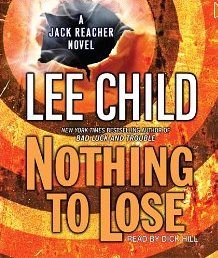
Nothing to Lose by Lee Child (audio)

Lee Child is one of my favorites, as you will know if you’ve been following my blog. His serial character, Jack Reacher, is a tough guy with a good heart who travels the country with nothing but his ATM card, an expired passport, and a folding toothbrush to slow him down. He’s a retired military policeman, just trying to enjoy the scenery, but he keeps getting pulled into hairy situations in which he decides to right the wrongs of the world and protect the little people.

In Nothing to Lose, we observe yet another of those episodes. Reacher is trying to travel diagonally across the country, from Maine down to San Diego. While moving west across Colorado, he stalls in a town called Hope, unable to hitch a ride into the neighboring town of Despair. (Yes, these names have meaning. You’re so sharp!) So he walks instead, but only to discover that the inhabitants of Despair don’t want him around.

Reacher eventually teams up with the sometimes-reluctant Officer Vaughan of the Hope PD. The town of Despair seems to have a lot to hide. At first glance, it’s an unpleasant little company town, owned entirely by the self-satisfied owner of the metal recycling plant, Mr. Thurman, who is also the mayor and the lay preacher. But there’s oh so much beneath the surface, including ties to international military concerns; and Mr. Thurman and his thugs are willing to go to great lengths to get Reacher, and any other stranger, far away.

This, along with the last Reacher I read (or rather, listened to), Gone Tomorrow, tackles issues of politics, the military and US foreign relations. Reacher is surprisingly anti-war, for being military – that is, not anti-war exactly, but against stupid wars of racism and oil-sucking that get American kids killed. He’s a very rational, thinking man. I like this about him. Don’t worry, the politics are way, way background.

Like all the Jack Reacher novels, this one is fast-paced, suspenseful, exciting, and has sympathetic, likeable, complex characters. You’ll be on the edge of your seat; you’ll care very much about what happens. You’ll be outraged along with Reacher, you’ll cheer him on, and you’ll be first impressed and then feel vindicated by his prowess.

I definitely enjoy the Reacher series on audio. Dick Hill is great at Reacher; he’s started to be Reacher inside my head. These get me to and from work very happily every day. 🙂 Thanks Lee Child and thanks Dick Hill, and keep ’em coming! (Unabridged, please.)

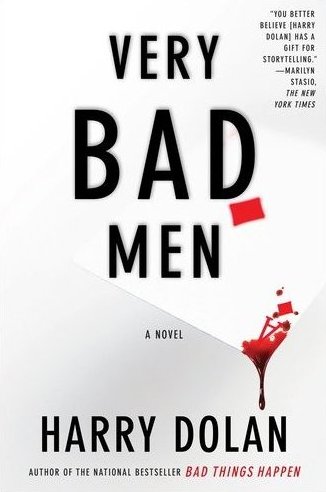
book beginnings on Friday: Very Bad Men by Harry Dolan

Thanks to Katy at A Few More Pages for hosting this meme. To participate: Share the first line (or two) of the book you are currently reading on your blog or in the comments. Include the title and the author so we know what you’re reading. Then, if you feel so moved, let us know what your first impressions were based on that first line, and let us know if you liked or did not like the sentence.

I have been really thoroughly enjoying this thriller from the author of Bad Things Happen. It begins:

There’s a necklace in my office, a string of glass beads. It hangs over the arm of my desk lamp, and any little movement can set it swaying. The beads are a middle shade of blue, the color of an evening sky, and when the light plays over them they look cool and bright and alive.

So far I have nothing but good things to say about this book; but I can’t say too many of them until my review comes out over at Shelf Awareness, so stay tuned.

This quotation comes from an uncorrected advance proof and is subject to change.

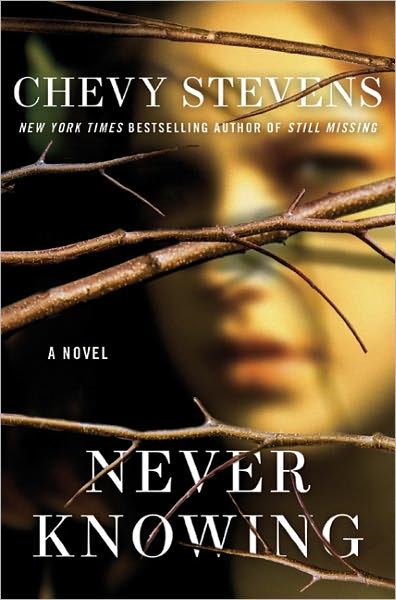
book beginnings on Friday: Never Knowing by Chevy Stevens

Thanks to Katy at A Few More Pages for hosting this meme. To participate: Share the first line (or two) of the book you are currently reading on your blog or in the comments. Include the title and the author so we know what you’re reading. Then, if you feel so moved, let us know what your first impressions were based on that first line, and let us know if you liked or did not like the sentence.

Never Knowing is by the author of Still Missing which I read a few months ago. The book begins,

I thought I could handle it, Nadine. After all those years of seeing you, all those times I talked about whether I should look for my birth mother, I finally did it.

The format appears to follow that of Still Missing, in that it has not chapters but “sessions,” apparently with a therapist.

I like the set-up in these first two sentences. We already know several things: that the narrator does not know her birth mother, that a search for her has been begun, and that the narrator has not “handled it” as she thought she could. Roll: suspense. I’m ready!

(Note: this quotation comes from an Advanced Reader Copy and is subject to change.)

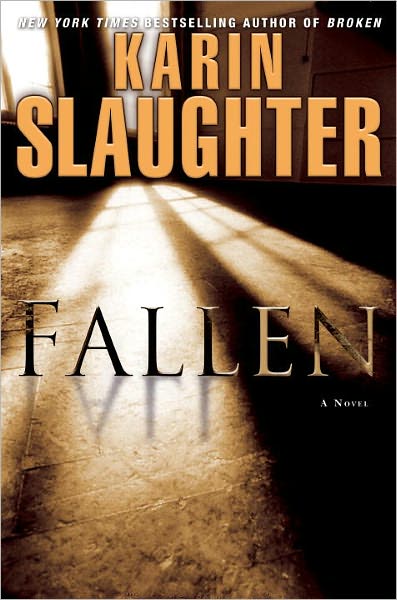
book beginnings on Friday: Fallen by Karin Slaughter

Thanks to Katy at A Few More Pages for hosting this meme. To participate: Share the first line (or two) of the book you are currently reading on your blog or in the comments. Include the title and the author so we know what you’re reading. Then, if you feel so moved, let us know what your first impressions were based on that first line, and let us know if you liked or did not like the sentence.

Karin Slaughter’s newest thriller, Fallen, begins slowly – like for six sentences.

Faith Mitchell dumped the contents of her purse onto the passenger seat of her Mini, trying to find something to eat. Except for a furry piece of gum and a peanut of dubious origin, there was nothing remotely edible.

By page two, you will be reluctant to EVER put this book down again. In other words, I’m enjoying it. That’s all I’ll say for now.

This quotation comes from an Advance Reader’s Edition and is subject to change.

The Big Sleep by Raymond Chandler (audio)

I know Chandler as the mystery author who inspired, among others, Michael Connelly. Connelly is one of my favorite genre authors and cites Chandler as an influence on his work. In fact, Shelf Awareness quotes him (as their Book Brahmin on April 22, 2011), in answer to a question of the book that changed his life: “The Long Goodbye by Raymond Chandler. I was a casual reader of genre fiction. This book made me want to write it.” Thank goodness for that!

I read The Long Goodbye first (and before the above quotation!), and found it to be delightful. I recognized Connelly in his writing style and Harry Bosch in the style of his lead detective. (Of course obviously the influence went the other way around.) So when I saw The Big Sleep on audio – unabridged, necessarily – I snapped it up. I believe the latter was actually his most-renowned work.

You can’t help but like a guy who doesn’t write that “time passed slowly”, but rather writes

Another army of sluggish minutes dragged by.

That’s pretty great. And this:

‘It’s goddamn funny in this police racket how an old woman can look out of a window and see a guy running and pick him out of a lineup six months later, but we can show hotel help a clear photo and they just can’t be sure.’

‘That’s one of the qualifications for good hotel help,’ I said.

You see my point, right? There are some awfully clever, funny, classic moments in this story; Chandler is a fine writer with a distinct style.

The actual story qualifies, too, as clever, funny, and classic. It’s easy to see that this man is one of the fathers of the genre I love. I’m a bit ashamed to note that I’ve read mostly recent authors, and neglected their heritage.

In this novel, Philip Marlowe, PI, is asked to look into a little matter of blackmail for General Sternwood, who has two young, beautiful, highly deviant and troublesome daughters. Marlowe is a man of relatively few, but quite witty words. He fends off both sisters at various point or another while looking into the missing husband of one, unasked. He’s a classic PI; he drinks alone in the morning; I’m pretty sure he wears one of those pulp detective hats – a fedora? At any rate, he releases the Sternwoods from the blackmail and pulls all the pieces together at the end to explain the missing husband too. It’s a tidy little ending, crowned by some grumbled musings on The Human Situation and The Big Sleep.

I liked this book very much and recommend it to readers of detective fiction who want to go back to the genre’s roots.

Do you read in the present or in the past? Do you miss the past, if you read in the present? I know I love my current genre authors (Lee Child, Michael Connelly, James Lee Burke, Elizabeth George) but it’s important and definitely enjoyable also to appreciate the pioneers. I’ve enjoyed Agatha Christie, Raymond Chandler, and one little gem from A.A. Milne; I’ve got a P.G. Wodehouse waiting in the wings. What are YOU up to?

book beginnings on Friday: Jersey Law by Ron Liebman

Thanks to Katy at A Few More Pages for hosting this meme. To participate: Share the first line (or two) of the book you are currently reading on your blog or in the comments. Include the title and the author so we know what you’re reading. Then, if you feel so moved, let us know what your first impressions were based on that first line, and let us know if you liked or did not like the sentence.

Jersey Law looks to be a funny legal thriller with a heavy New Jersey accent.

Reginald Shawn Dupree, inmate number 65392, Camden County Jail, is definitely not liking the situation he has found himself in.

He shrugs as best he can, given that Slippery Williams’s two beefy fellow inmates have effectively strapped him in place, each man firmly grasping Reginald’s muscled arms, just about lifting his feet off the ground.

I like my genre fiction hard-boiled, so we’re off to a fine start!

Note: I’m reading an advanced proof for review, so this book beginning is subject to change.

The Red House Mystery by A.A. Milne

What a little treat! This slim volume informs me, on the back, that it’s the only detective novel ever written by Milne, best known as the author of the Winnie the Pooh books. I love Pooh, and I love detective novels, so this seemed like an obvious choice. I noted a few weeks ago that it begins with a tone very like Pooh. I was encouraged.

I thought this was a delightful little book. For starters, I have the Vintage Books “Rediscovered Classic” (as pictured), which opens with a new-for-the-edition introduction by the author. These 3 1/2 pages are worth reading in themselves. Milne is clever and funny, and bothered by the trends of literary taste. He discusses the merits of what he believes to be the perfect murder-mystery. I thought his brief critique of the genre and his own book were very funny and ironic.

This is a mystery in the amateur-sleuth-plus-sidekick tradition. (Holmes and Watson are constantly referenced.) Our protagonist, Antony Gillingham, is a gentleman of leisure who happens upon the Red House just as a murder has apparently taken place in a locked room. Assisted by his friend, Bill, a guest at the Red House (his Watson), Tony sets upon the mystery. Who killed Robert, evil brother to the man of the house, Mark? Where has Mark disappeared to? And what is Cayley, Mark’s right-hand man, up to? There are secret passageways and croquet sets involved. It’s very classic. Tony and Bill make a cute team, and Milne’s tone remains remarkably faithful to what I love about Pooh: tongue-in-cheek, self-deprecating, and picturesque. It’s great fun.

When it was over, I felt sad. I do have other reading to do, but this was such an enjoyable experience. I liked that it was short; it was just right for my weekend and just right for the moment in the way that books sometimes are. But I’m also sorry it’s over. I may have to go hunt up some Wodehouse next, what ho!

Gone Tomorrow by Lee Child (audio)

YAY for Lee Child as usual! Especially after a couple of unimpressive audiobooks in a row, it’s been such sweet relief to hear Dick Hill’s deadpan narrative. I feel like he suits Jack Reacher very well.

Backstory: Jack Reacher is a serial character. He’s a former MP (military policeman), fairly decorated, who’s retired young to travel the country at random. He has enough money to get by just wandering, and seems to want to be left alone (although it’s not clear what would occupy him if it weren’t for the circumstances that keep drawing him in). He is repeatedly pulled, against his will, into events of dangerous or criminal intrigue, and he uses his general bad-ass-ness to beat up the bad guys and uplift the righteous little people.

I really appreciate Reacher. He’s a character that works for me very well. He’s almost a superhero – big, strong, smart, quick-thinking, and with a general inclination to do the right thing. He has integrity. He’s just about perfect; but just when he starts to really look like a caricature, we find he’s not so perfect after all. In Worth Dying For, the bad guys got him tied up and hurt for a little while; I was surprised to see him thwarted. But you can’t keep Reacher down. In Gone Tomorrow, too, he gets captured and held, but not forever! I’m not saying he’s an entirely realistic character or anything, but for my tastes, Child pulls back just in time, right before I say “oh, come on…”

And he’s not just a physical hero – although he is enormous, very strong, has no body fat, is a highly skilled gunman, a formidable hand-to-hand fighter, etc. He’s also smart, and an expert in all things military as well as in many other obscure areas of knowledge. It’s a bit uncanny, how much he knows and how much he can figure out. But in this area, too, he’s pulled back from the brink of cartoonish superiority: for example, Lila Hoth convinces him of the American military’s role in a time and place he didn’t think it was possible. I like that in this conversation he listens, asks discerning questions, and isn’t afraid to learn, even to be wrong. In short, Reacher is, to me, a real hero: almost perfect but with a few human deficiencies and – best of all – aware of them (rare though they be).

I also get these little nuggets of information. Like, he muses that there are experts out there who could look at the dimensions of the bricks, and the arrangement of them, in his unknown little dungeon-cell, and know pretty precisely where the building is and when it was built. But Reacher’s not one of those experts. (I’m paraphrasing the audiobook from memory.) See what I mean? It might have been just a little too much if Reacher had been the brick expert, too, on top of everything else. And what a cool little historical nugget. Of course there are brick experts; it makes perfect sense. It had never occurred to me, though.

At any rate, aside from my ramblings about the wonder that is Reacher, this is a good book. I love the little details. When Reacher wakes up after being drugged, he wonders how long he’s been out; with all four limbs bound, he ducks his head to rub his chin against his shirt, thereby feeling how much stubble he has. Now he can make an educated guess. This is a neat detail – evocative, realistic, and also impressive. Reiterates how proficient this guy is. I just hope we really do have guys this effective in our military and/or law enforcement systems.

I came across just one or two points of contention. I think the 9/11 aftermath and international politics was rather clever but also rather pat; 9/11 politics is a fairly common thread in mystery-intrigue genre fiction, and I was a little disappointed and a little bored there for a minute, although Child handled it fairly uniquely. And I was a little bothered by a certain person, for whom English is not a native language, uttering sentences like “…you employed a deductive process. Do you think you are uniquely talented? Do you think that deductive processes are unavailable to others?” This didn’t sound very realistic for this character to me.

But overall this was another great Reacher story. Fast-paced, gritty, suspenseful, funny and witty, and, for me, just the right balance of realism and hero-worshipping-fantasy. Go get you some Jack Reacher right now if you have any interest in action-adventure, mysteries, intrigue, or loveable heroes.

book beginnings on Friday: Nothing to Lose by Lee Child

Thanks to Katy at A Few More Pages for hosting this meme. To participate: Share the first line (or two) of the book you are currently reading on your blog or in the comments. Include the title and the author so we know what you’re reading. Then, if you feel so moved, let us know what your first impressions were based on that first line, and let us know if you liked or did not like the sentence. You might also consider stopping by the original post.

I am listening to this one in the car on audio. (You will note, if you’ve been following, that I am listening to more and more audio. More on that later, but suffice it to say the format is more or less working for me.) I love my Lee Child… Here’s your book beginning:

The sun was only half as hot as he had known sun to be, but it was hot enough to keep him confused and dizzy. He was very weak. He had not eaten for seventy-two hours, or taken water for forty-eight.

I have faith, Reacher! Especially as there’s so much more yet to come. 🙂

Iphigenia in Forest Hills: Anatomy of a Murder Trial by Janet Malcolm

So, Janet Malcolm is a journalist and writes for the New Yorker as well as having published a number of acclaimed works of nonfiction and biography. I have been interested for some time in reading The Silent Woman (biography of Sylvia Plath), and actually own Two Lives (of Gertrude Stein and Alice B. Toklas), although I have not yet read it. Her latest release is Iphigenia in Forest Hills, and I was interested enough to buy it at once, for the library, and to take it to lunch with my on the day of its arrival to start reading it.

First impressions: I guess the cover is boring to you here in image form, but I find it striking and respectable in its simplicity. I wish more books would try this style of straightforwardness; not that I don’t appreciate beautiful, elegant, well-designed covers that involve color and images, but this slim, simple, black book is very eye-catching in a world of graphics.

It starts off very strong. I’ve said before, my kind of nonfiction is narrative style; this is just right for me. Malcolm has a voice in her own story, including occasionally referring to herself: how she would have reacted to a certain question in the jury selection process, for example. Or, later in the book, how she interacted with the families in question during interviews; or her discussion of the different journalists and their interactions during the trial. I like that Malcolm plays a part in the book. It seems more realistic that way. Who can help being a part of the story she writes, especially in a case such as this? Malcolm followed the case for many months. She couldn’t have helped but be involved on some level.

The story is this. NYC is home to a community of Bukharan Jews in a neighborhood called Forest Hills, in Queens. Boy meets girl; they marry, and have a baby girl. Four years later, husband Daniel is murdered while handing off daughter to ex-wife. She stands trial for his murder, along with the man who allegedly fired the gun, as her hired hit man.

There are accusations that Daniel physically abused his wife and sexually abused their young daughter. There is a heated custody battle and suspicions of emotional neglect and attempts to turn her against one parent or another. The event that allegedly pushes the wife to have the husband killed, is that a custody judge chooses to remove the child from her mother’s care and place her with her father. This looks like a crazy decision, since the child barely knows her father and he was not asking for custody, merely visitation rights. There is questionable evidence; both the prosecuting and defense attorneys come in confident of victory. There are issues of culture. I learned a lot about the Bukharan sect of Jews, which I knew nothing about before reading this book.

Iphigenia in Forest Hills reads a little bit like a courtroom-procedural novel of criminal intrigue. Our questions, however, are not finally answered, as they almost certainly would be in a novel. Malcolm is not sure whether Mazeltuv Borukhova did, in fact, hire Mikhail Mallayev to kill her ex-husband Daniel Malakov. (Her title, by the way, is part of what initially attracted me to this book, along with Malcolm’s excellent reputation as an author of biographical nonfiction. It references the story of Agamemnon and his family, which I know best, and love, as told by Aeschylus. Of which, more below.*) I love that Malcolm interviews and interacts with both families and both sides involved in the legal battle, while noting her personal reactions including any bias she sees herself develop. She recognizes and gives weight to emotional reactions and personalities. It’s not a sterile treatment – because our legal justice system is far from sterile. In the end, she doesn’t tell us what really happened, because she doesn’t know. The blurb inside the front cover begins with the defining quotation of the book:

She couldn’t have done it and she must have done it.

So there you have it. A story of ambiguities and questions, beautifully and insightfully told, from myriad angles. My first Malcolm read has come far too late, and I’m more eager than ever to get into more of hers.


*The Oresteia by Aeschylus is a trilogy of ancient Greek tragedies: The Agamemnon, The Libation Bearers, and The Eumenides. I could go on all day; I love ancient Greek drama. But I’ll try to be brief. Iphigenia’s story:

As the Greeks prepare to sail to Troy (to lay seige, in the Trojan War, to recover Helen, wife of Agamemnon’s brother, stolen by Paris), the winds are against them; to appease an angry goddess, they choose to sacrifice Agamemnon’s daughter, Iphigenia. She is brought to the harbor in a wedding dress, believing she will marry Achilles, but instead is killed by her father, who then sails for Troy. Upon Agamemnon’s triumphant return ten years later, his wife (Iphigenia’s mother), Clytemnestra, along with her new lover, entrap and kill Agamemnon.

Thus, Malcolm’s title suggests that the mother in this story, Borukhova, is so angered by the “theft” of her daughter (through custody court, not sacrificial slaughter) by the girl’s father that she has him killed (by a man implied to be her new lover). As I said, I was drawn in by this allusive title. I find the allegory a bit weak in the end: the daughter in Malcolm’s story is not murdered (although there is some question that she might have been raped!); and the title’s implication suggests a bias that Malcolm generally does not profess in the body of the book. But still, it is a dramatic title, one that got my attention; and it makes a larger point, that this tale is one of epic tragedy and does no one good in the end. There is no victor; no one’s lot is improved by these sordid events (as the victim’s father points out repeatedly), regardless of whether Daniel Malakov was a good man and doctor or a deplorable and sick abuser.

I recommend Janet Malcolm’s Iphigenia in Forest Hills; and I also recommend Aeschylus!!