The Greatest Lie of All by Jillian Cantor

A young actress takes on the role of a glamorous romance author and gets more mystery–and romance–than she’d reckoned for.


The Greatest Lie of All by Jillian Cantor (Half Life; The Hours Count; Margot; The Lost Letter) is a propulsively paced story of intrigue, romance, and suspense starring two women a generation apart navigating family, love, secrets, and art. In one of their several parallels, each uses a professional pseudonym, so that four names delineate these two character arcs.

Readers meet the young, up-and-coming actress Amelia Grant just after the death of her beloved mother, and in the moment when she discovers her actor boyfriend in bed with his costar. At this low, Amelia is primed to accept her biggest role yet: to play the fabulously successful romance author Gloria Diamond in a biopic. Gloria had been Amelia’s mother’s favorite; it feels like a sign and a way to be close to the mother she’s lost, the only person who had called her by her birth name, Annie.

Heartbroken but determined, Amelia travels from Los Angeles to Gloria’s remote Seattle-area home to get to know her subject before filming begins. But “the Gloria Diamond” is distinctly unfriendly, cold, and dismissive. Even as Amelia finds a tentative friendship with Gloria’s son, Will (“cute, in an academic kind of way”), she despairs at ever understanding what makes the older woman tick. Gloria’s career was built on her famous, brief romance with her late husband, Will’s father. But the more Amelia learns, the less convincing that story is. She embarks on an informal investigation fueled by shadowy motives: her desire to play a “true” Gloria Diamond; her curiosity about the nature of love, especially as her mother so appreciated it in Diamond’s fiction; and Will’s reluctant desire to understand his mother. As she pursues the history of the author once known as Mary Forrester–Mare to her friends–Amelia begins to wonder about her own role in the drama unfolding before her.

In chapters that shift between Amelia’s perspective and that of the young Mare, The Greatest Lie of All shines in its plot twists and surprises, and, most of all, its pacing, which accelerates from a slow burn to a heart-thumping momentum. The tension increases, stakes rising as Gloria/Mare and Amelia/Annie must reckon with their pasts to chart their shared present. Danger accompanies every possibility of romance, and family history matters more than it originally appears. Cantor’s experienced hand shows in this classically crafted thriller, which will keep its readers tautly engaged to the final scene.


This review originally ran in the September 24, 2024 issue of Shelf Awareness for the Book Trade. To subscribe, click here.


Rating: 6 glasses of wine.

The Drowned by John Banville

A recluse discovers an abandoned car and winds up involved in a missing-person case with Strafford and Quirke, who are back at work in this novel of secrets and quiet desperation.

John Banville’s The Drowned transports readers to a dour small town on the 1950s Irish coast, where one tragedy after another makes a small cast of characters reconsider what they know and value in the world they inhabit. In his established style, Banville (The Singularities; Snow; Ancient Light; Holy Orders writing as Benjamin Black) offers a stark series of events in understated tones and with a handful of voices. These include Dublin Detective Inspector Strafford and the brilliant pathologist Quirke.

“He had lived alone for so long, so far away from the world and its endless swarms of people, that when he saw the strange thing standing at a slight list in the middle of the field below the house, for a second he didn’t know what it was.” It turns out to be a luxury motorcar, abandoned, engine still running. The loner who discovers it actively avoids human contact: “Yes, life, so-called, was a birthday party gone wild, with shouting and squabbling, and games he didn’t know the rules of, and one lot ganging up on the other, and knocking each other down and dancing in a ring like savages, the whole mad rampage going on in a haze of dust and noise and horrible, hot stinks.” He approaches, against his better judgment, and winds up involved in a missing-person case, which will draw Strafford to town, even as the detective wrestles with his own relationships: an estranged wife, a much younger girlfriend, and ever-complicating ties to Dr. Quirke. “We have one thing in common, at least,” Quirke quips to Strafford. “Death.” Death is an obvious theme, not only in the two characters’ professional lives but throughout Banville’s troubled setting.

Enriched by Banford’s attention to detail, the narrative grows more compelling in its telling by these and other characters, each suffering more or less alone even when they are married, partnered, or set next to immediate family. “The least of remembered things are the most affecting. That walk, the birdlike turn of her head, those trim ankles.” The Drowned is slow building, sedately paced, and grim, but wickedly absorbing. By the mystery’s denouement, some readers will have guessed the perpetrator’s identity, but it is less that identity and more the psychology of it that is Banville’s final blow. Through these intricacies and its murky sense of foreboding, this inexorable novel will continue to advance Banville’s considerable reputation.


This review originally ran in the July 29, 2024 issue of Shelf Awareness for the Book Trade. To subscribe, click here.


Rating: 7 barstools.

Case Histories by Kate Atkinson

Unusually for me, I watched the television series first, and it is a striking series, and obviously colored my imaginings while reading this novel. It might have been desirable (for the usual reasons) to do it in the other order, but gosh, I think this is a rare case of each enriching the other. (Also, it has been long enough that I was still able to find surprises while reading. It pays to be forgetful if you read and reread mysteries.)

This is a brilliant novel. I love everything about it. It feels a touch genre-bendy, with the title and the three different cases intertwined, although it is of course not unheard of to see a PI or detective involved with multiple cases at once. Case Histories introduces three distinct mysteries before we meet Jackson Brodie, a retired military policeman and regular copper now working on his own. He has a grumpy receptionist, a recently remarried ex-wife, and an eight-year-old daughter he’s crazy about. He runs, off and on smokes cigarettes, and listens to moody American female country music stars (Emmylou Harris, Lucinda Williams, Allison Moorer). He’s from the north of England but now lives, and the novel is set, in Cambridge, a location with lots to contribute to the story. (I looked it up and confirmed my confusion about location: the TV series is set in Edinburgh. Also an impactful setting, but boy, they threw me off with that one. Cambridge does so much work here though! Was it too challenging to film there?) Jackson has enough to worry about with his divorce and entirely real dental problems–he’s become a regular with a heavy-breathing, magnetic dentist named Sharon, although it’s unclear if she is in on the sexual tension between them–but some earlier traumas are also at work upon our protagonist, that the reader will only find out about late in the book.

I called Jackson the protagonist and I do feel that way (although maybe, again, influenced by the TV show), but there are a few other issues percolating too. Mr. Wyre mourns his younger (and undeniably favorite daughter), murdered in his office while he was briefly away, several years ago. The crime remains unsolved. A woman with a shadowy past makes yet another fresh start. The Land sisters, Julia and Amelia, go through their father’s house after his death and find a clue in the long-ago disappearance of the youngest sister, Olivia. (They consider themselves the two remaining Land sisters of four, even though Sylvia is alive and well, in a convent.) Steve Spencer believes his wife is cheating on him. A wealthy, obnoxious elderly widow named Binky Rain is convinced someone is stealing her cats. A young homeless woman with yellow hair crosses paths repeatedly with multiple characters, asking “Can you help me?” All of these large and small worries, crimes, puzzles will become Jackson’s problem in one way or another. He is long-suffering (and the toothaches don’t help), a bit hapless, but good. His relationship with his daughter Marlee is very sweet.

I think one of the things I love about this book is the layers of personality that the main characters and even some of the less-central ones exhibit. Jackson’s dental troubles, the country music he prefers, his frustrations with his ex, his running (which I think played a larger role on television than it does here), fill him out. The Land sisters are both pathos-ridden and hysterically funny. Marlee is a gem. Jackson’s old buddy Howell remains mostly theoretical, off-screen, but appears for a brief, funny scene in the hospital, where Jackson concedes, “he supposed his daughter would be pretty safe on a sheep farm in the middle of nowhere, surrounded by Russian gangsters.” Case Histories is like that: off-kilter, random, funny, emotive in the still-waters sort of way, concerned with profound ills but also basically good folks. Steeped in the kinds of details that make these things work. I can’t wait to read more Jackson Brodie.


Rating: 9 sweets.

The Queen City Detective Agency by Snowden Wright

A disgruntled PI and a plot as wildly complicated as the history of the American South itself combine in this spectacular, darkly funny mystery.

Snowden Wright (American Pop; Play Pretty Blues) immerses his readers in a gritty, troubled small-town Mississippi with The Queen City Detective Agency, and introduces an indomitable protagonist.

It’s the 1980s and the country is about to reinaugurate Ronald Reagan when a small-time felon called Turnip does “a Greg Louganis off the roof” of the county courthouse in Meridian, Miss. Turnip was implicated in the murder, allegedly by hire, of a successful local real estate developer, and rumored to be involved with a mythical criminal syndicate called the Dixie Mafia that may or may not actually exist. Turnip’s suspicious death (by rooftop dive, or was it by poison?) and the murder he may or may not have helped arrange wind up entangled with cockfighting rings, domestic violence, child brides, centuries-old institutional racism and class discrimination, and much more.

Enter Clementine Baldwin (that’s Clem or Ms. Baldwin to you) of Queen City Detective Agency in Meridian, a decaying railroad town that was once the second-largest in the state. “Clem loathed this place and its vitiated nostalgia, redolent of an era when that idiot Atticus Finch thought he could win a rigged game, when you needed a tool to open a can of beer…. At least the beer cans had gotten better.” A disillusioned former cop, Clem is also a Black woman in a city, state, and nation that respects neither. She’d rather just be called a private investigator than a lady PI. For her second-in-command, she went looking for a prop: “completely useless in most circumstances, but, in hers, as handy as locking hubs on a muddy day. In other words, the prop had to be a white man. The guy needed to have hominy for gray matter….” But instead she found Dixon Hicks, “whose name said it all,” a prop who turned out to be a good partner and even a good friend.

Clem is a quintessential hard-boiled detective with entirely legitimate beefs with the world around her. She drinks too much, but who wouldn’t? Partnered with the genuinely, surprisingly good Dixon, she is a smart, courageous, flawed heroine, with plenty of dark humor and a storied past. Wright’s prose is clever and delightfully funny even while handling serious social ills. The Queen City Detective Agency is a remarkable work of Southern noir, featuring crackpot characters both silly and sinister, a longstanding history of greed and white privilege, and an unforgettable private investigator. Readers will be anxious for more featuring Ms. Baldwin.


This review originally ran in the June 14, 2024 issue of Shelf Awareness for the Book Trade. To subscribe, click here.


Rating: 8 rocks.

Gallows Drop by Mari Hannah

Back on the fence about this series, but I keep coming back for more. Hannah is doing something right.

Pros: page-turner. I stay riveted, engaged and invested. I was drawn in, in this book in particular, by the possibility that we were finally going to get into the heart of Kate’s biggest issue in her personal and private lives: her conflicted relationship with her own sexuality and her attempt to live a closeted life at work while maintaining a same-sex relationship with (no less) a colleague. That conflict feels like the shoe that’s been waiting to drop for this whole series, and the specter of resolving it was a major pull – as well as the mystery plot being a solid one. (I don’t think I’ve ever had beef with the mystery itself in any of these books.)

More ambivalent: the central conflict about Kate’s coming out, and the solidifying of her relationship with Jo, threatened to be a bit on the nose, especially in combination with the mystery plot and the potential relevance of gay identity in that storyline. “Suddenly she couldn’t differentiate between her own situation and that of —–. If she found out that his death was connected to his homosexuality it would open up a wound she’d been hiding for years. A bleeding open wound she’d been trying and failing to live with. The reason she’d thrown away all that was good in her life.” Not only on-the-nose, but awfully thoroughly spelled out for my tastes. Let the reader do a little work!

Cons: dialog and sentence-level writing continue to distract me. Speaking of thoroughly spelled out, would a cop really need to say, “I’ll call you later, if I can. Service is patchy here. Sometimes it works, sometimes not.” In the 2010s, you have to explain what patchy service means? Or in describing scraps of debris on the ground: “Some kind of confectionary wrapper… and what looks suspiciously like a cannabis joint.” No humor, no irony: “what looks suspiciously like a cannabis joint.” Nobody talks like that. There was also a continued emphasis on ‘stuff’ when ANY noun would do more and better.

The resolution of the plot puzzle felt a bit chaotic. Not quite a deus ex machina, but multiple (and unrelated) unhinged characters running roughshod. Upon finishing the book I was left a little muddled as to who did what to whom, because it all dissolved into mayhem. And fair enough, because that’s the way the world goes sometimes, but this was not Hannah’s cleanest finish. And speaking of the finish: literally the last line of this novel thrusts us upon the hugest cliffhanger I’ve seen in a while, and quite a fantastical one to boot. I don’t think I’m happy with this move.

Despite all this, my experience in reading was that I really enjoyed the book, in some mammoth sessions. And started the next one immediately. So, not sure where this leaves us. It’s not a love/hate relationship, but certainly a love/not-love relationship that I am in with the DCI Kate Daniels series.

Help.


Rating: 6 gobs of spit.

EDIT: The next book in this series, Without a Trace, was distressingly bad. I cannot review it here and am not sure where to turn next. Warning.

Killing for Keeps by Mari Hannah

Doing another short-short review of this fifth book in the DCI Kate Daniels series.

Pros: compelling plot; compulsively readable. I continue to care about the protagonist even though she frustrates me with her choices! I remain fully invested in Kate’s character arc, and would have immediately dived into book six if I had had it handy. I love secondary character Hank Gormley even more.

Cons: the writing does continue to take me out of the story, only momentarily, but over and over. There continue to be too many ‘things’ where a better noun is almost always available. Some logical leaps don’t feel quite earned for me. (I’m so sorry I did not make note of these for examples. It’s a credit to the book that I wasn’t motivated to go find a pen. Or, I was camping in below-freezing weather and didn’t want to get out of bed.) Each book’s murder mystery plot is electric, but Kate’s romantic difficulties feel stalled and I wish we would get a move on.

What can I say? The pros are absolutely winning and I suspect I’m going to rocket through the next few books as I get a hold of them. But not without qualifications. I wonder if I’ve just been missing the genre; I’m going to try Kate Atkinson next. Any other tips?


Rating: 7 parakeets.

Fatal Games by Mari Hannah

Book four in the DCI Kate Daniels series (following most recently Deadly Deceit) is Fatal Games, for me the most successful to date. I’ve enjoyed each of the previous three books, but always with some reservations, and wishing for a bit more of Daniels’ personal side, feeling she was a bit underdeveloped, perhaps. This time something finally really clicked for me. Don’t get me wrong: the fact that I’m still here for book four means something was working, but this one knocked it out of the park in a new way.

For one thing, I felt that we got into some personal life: not so much that of Kate herself, actually, but especially a few other characters. In fact, I’m beginning to buy that Kate is truly defined by an absence of personal life! (This is not a new message from the author, but maybe it took some convincing.) Secondary characters have more layers: I really like Daniels’ second in command, Hank, who is a real friend as well as professional Watson type. Her ex, Jo, also a professional colleague, is definitely more well rounded. And now we meet Emily, a friend to the rest, who appears mid-crisis: recently widowed, she has just returned to work as a prison psychologist, not the least stressful job to begin with, let alone grieving and struggling to parent a grieving twenty-year-old to boot. When further trauma presents itself – this being a murder-mystery series, friends – Emily does not cope well. Kate is perhaps not showing her best self when she says that her friend is “acting as mad as a box of frogs,” but she’s not exactly wrong, either. One character in particular gave me the creeps; I was not sure if he was going to turn out to be an actual bad guy (in the murder-mystery sense) or ‘just’ a really toxic dude, but ew. Throw in a manipulative psychotic sex offender and a few prison guards of questionable moral standing, and you’ve got a motley crew.

The mystery was properly complex, the cast of characters increasingly compelling, Kate herself showing the usual conflict between wanting to have a life outside work and being incapable of it. It started working for me in this book like it hasn’t before. I could feel her wanting, and trying, and then being consumed once again by the job – which, to be fair, is pretty soul-consuming, and it’s hard to be angry with someone for wanting to solve crimes and save lives… but if you’re her prospective partner, you do want some of her attention. Poor Jo.

The plot, which I’ve not even touched on yet, does involve murdered young girls. There are some truly heinous criminals. And even the law-abiding ones ostensibly on the ‘right’ side can offer some frustrations. It’s a hard-boiled mystery – note that blurb on the front cover that credits Hannah with ‘a dark heart.’ I’m on board like never before.


Rating: 8 gifts.

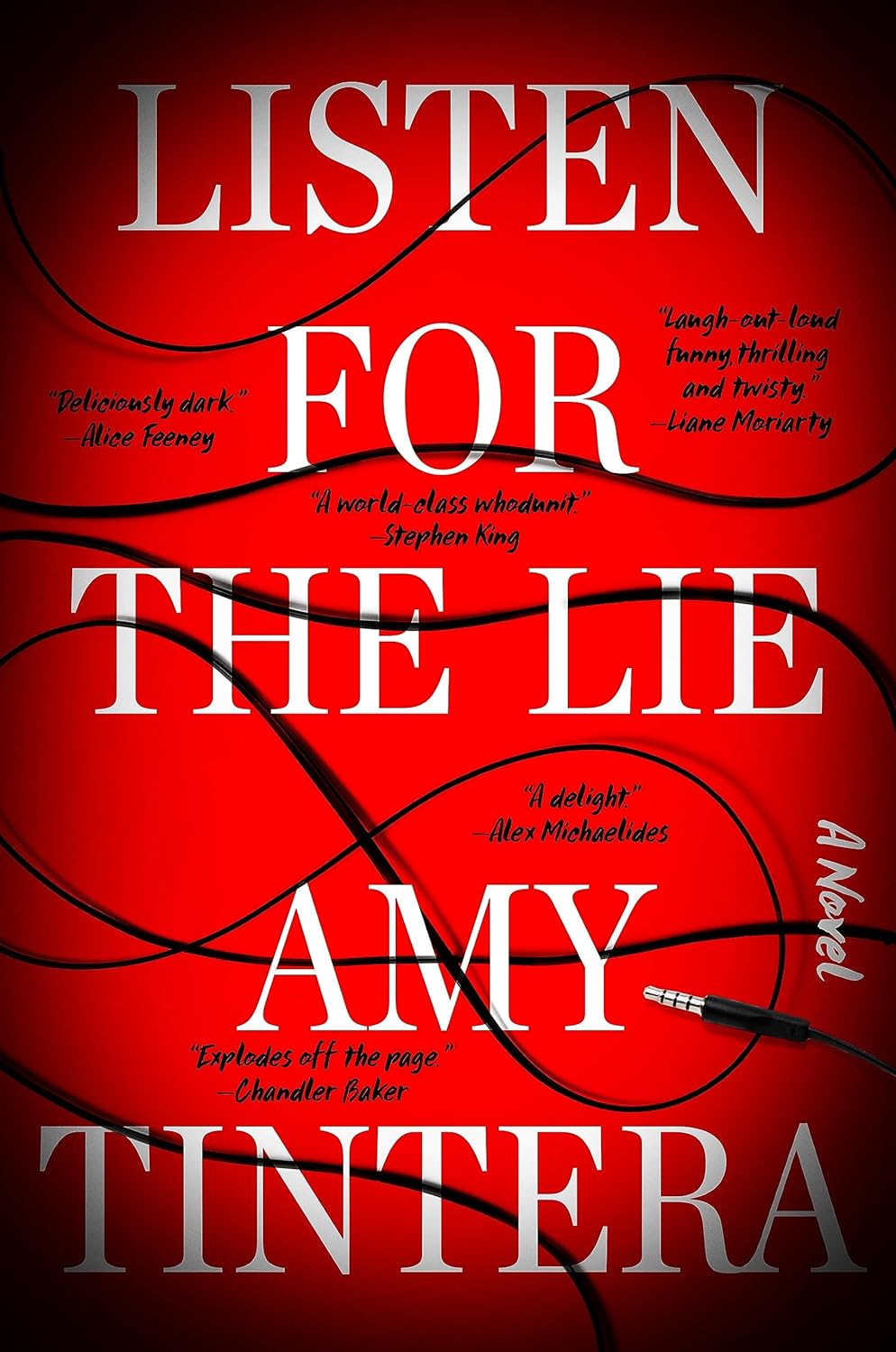
Listen for the Lie by Amy Tintera

Small-town dramas, sharp humor, strong characters, and a touch of romance spice up a genuinely fun mystery.

With Listen for the Lie, Amy Tintera (Reboot; The Q) offers a sexy, compelling mystery as her adult debut. Entertaining characters act out the intrigues of murder and of small-town life, with dark humor, propulsive pacing, and a properly confounding whodunit.

Lucy Chase has been living a not-particularly-successful life in Los Angeles. When the novel opens, she has just been outed by a true-crime podcast as the overwhelmingly favored suspect in the murder of her best friend five years earlier, in the small Texas town where they both grew up. Now that she’s been fired from her job and her boyfriend is trying to break up with her, she lets her grandmother (her last friend and defender in the world, it seems) talk her into coming home for a visit. Back in Plumpton, Tex., she immediately runs into Ben Owens, the true-crime podcaster who’s on his way to ruining her life. He is obnoxiously sexy, and perhaps less out to get her than she’d originally thought, but Lucy’s hometown offers her no comforts.

One morning, after they left a party together, Savvy was discovered dead in the woods, and Lucy was found nearby, walking down a back road, covered in Savvy’s blood, her skin under Savvy’s nails, and her fingermarks bruised into Savvy’s flesh. Lucy had a head injury; she’s never remembered anything about that night. Her then-husband and her parents, along with the rest of the town, were quick to assume her guilt, but there was insufficient evidence to charge her with Savvy’s murder. Lucy decided to move far away, to L.A., and try to start a new life. Not that it was going well, but being back in Plumpton, with everyone staring her down, sure of her guilt, is worse. Lucy is spirited, witty, and bold; if “innocent people don’t make sarcastic comments,” she’s guilty as can be.

Strangely, Ben, the annoyingly attractive podcaster, is the only one to question why everyone in this town (including Lucy herself) was so quick to assume Lucy’s guilt. The circumstantial evidence is damning, but Ben is able, with amateur detective work, to expose enough secrets to complicate the case considerably. Lucy is as surprised as anyone.

The murder suspect’s amnesia throws a wrench in readers’ ability to guess at Tintera’s plot twists. Even as Lucy wrestles with trauma, balancing guardedness with rare vulnerabilities, she and Savvy reveal a real sense of fun. Plumpton is a thoroughly realized setting, complete with neighborhood personalities and an authentic small-town dynamic. Listen for the Lie is quite sexy, compulsively readable, and laugh-out-loud funny, and Tintera has left herself healthy room for a sequel.


This review originally ran in the January 4, 2024 issue of Shelf Awareness for the Book Trade. To subscribe, click here.


Rating: 7 wineries.

The Hunter by Tana French

Tana French is at her best with this character-focused sequel to The Searcher, featuring humor, angst, pathos, and mystery in a tiny Irish village.

In The Hunter, Tana French (The Searcher; The Witch Elm; The Trespasser; and more), building on the success of eight previous novels, delivers the mystery, atmosphere, and feeling her fans have come to expect.

Following the events of The Searcher, French takes her readers back to the tiny Irish townland of Ardnakelty, where former Chicago Police Department detective Cal Hooper has settled to live a quiet, scenic life and repair furniture. He’s already gotten more than he signed up for, including a lovely, levelheaded girlfriend named Lena; a surrogate teenaged daughter, Trey; and a place in the local social circles (and the pub). But when Trey’s long-absent father resurfaces with a get-rich-quick scheme, he threatens the equilibrium of various village relationships, including those Cal holds most dear. The previous novel saw Cal struggle to find his role in a new place; in The Hunter, he knows what he has to lose and, even more importantly, what Trey does.

French is at her best in this novel, showcasing its sharp, scintillating sense of place (Ardnakelty is a character unto itself) and powerful mood of foreboding and that of secrets deeply held. “The overhead bulb isn’t bright enough,” she writes, “and the fringed lampshade gives its light a murky tinge; when the men stay still to listen, it smears deep, tricky shadows into their faces.” Later, she writes: “The mountain is sly. From far off, its low, rounded curves look almost harmless…. It’s a place whose dangers only come into focus when you’re already engaged with them.” This kind of ambience is cut by sudden, surprising bursts of laugh-out-loud humor.

Cal Hooper can be likened to a old western hero, with his staunch personal code; he equally recalls a hard-boiled detective: he’s retired but, despite best efforts, he’s not done investigating. The father-daughter dynamic so delicately established between Cal and Trey–who share no blood and met only two years ago in the previous novel–is heart-wrenching, gorgeously written, and under threat. He trusts her, but she’s “much too young to have something the size of her future in her hands.” Cal and Lena’s relationship is equally engaging, quietly wholesome, and firm. French has never shied away from weighty themes, and here her protagonists wrestle with vulnerability, revenge, and the danger of letting the past determine the future. French masters beautiful descriptions, easy, natural dialogue, a darkly twisting plot, high stakes, and compelling characters. The Hunter is perhaps her finest work–and leaves readers thirsty for more of Cal’s story.


This review originally ran in the December 19, 2023 issue of Shelf Awareness for the Book Trade. To subscribe, click here.


Rating: 9 jars of jam.

Village in the Dark by Iris Yamashita

Characters from all walks of life come together in this madcap second entry in a mystery series set in Alaska starring strong female leads.

Screenwriter and author Iris Yamashita (City Under One Roof) presents the second installment in a series featuring Detective Cara Kennedy. Village in the Dark is an alternately moody and wacky mystery set in Anchorage and rural Alaska.

The previous year, Cara buried the remains of her husband and son, recovered some time after they disappeared on a family camping trip. As Village in the Dark opens, Cara stands by their gravesites, watching the exhumation she’s requested in order further to investigate their deaths. She’s been placed on long-term disability from the Anchorage Police Department after a failed psych evaluation, so her inquiries will be a bit trickier than usual, even without the personal element. But she’s found pictures of her late loved ones on a gangster’s cell phone, along with other people who keep turning up dead.

Chapters from Cara’s point of view alternate with those of Ellie, hotelier and busybody at Point Mettier, “the city under one roof”: all 205 residents stacked in a single high-rise building in the Alaskan backcountry. Ellie “always had the best interests of the townsfolk in mind whether they appreciated it or not.” A bit later, these points of view are joined by that of a young woman named Mia, who grew up in the sealed-off community of Unity, where women and children have banded together in avoidance of the men who have abused them. Mia has just recently, in adulthood, joined “Man’s World” (the “world outside the village”), where she’s encountered even more trouble than her mother and “aunties” warned her about. Cara and Ellie, who’ve met before (in City Under One Roof) and do not particularly get along, are now bonded by loss, and must work together to keep their communities safe. Mia’s involvement is slower to become clear.

Village in the Dark offers a mystery with both steadily increasing tension and body count, plus plenty of tragedy–not only death, but abuse, neglect, and societal ills. These are balanced with comic elements and moments of zaniness, as when Ellie leads “one of the stranger posses in the history of posses. An innkeeper, a storekeeper, a Japanese lounge singer, and a cancer-ridden geezer.” These characters are just the beginning in Point Mettier, a town with an attitude nearly as suspicious and insular as that of Unity. Long-lost family members reappear and disappear; Cara hesitantly explores new romance; murders will be committed and possibly solved, and Yamashita leaves her readers well set up for the next episode in Cara’s Alaskan adventures.


This review originally ran in the December 4, 2023 issue of Shelf Awareness for the Book Trade. To subscribe, click here.


Rating: 6 cigarettes.