Burned by Thomas Enger, trans. by Charlotte Barslund

Henning Juul is an investigative crime reporter in Oslo, just returning to work after a two-year hiatus. He needed that time to recover and mourn after a fire in his flat killed his six-year-old son and badly burned Henning himself. His scars are external as well as internal: Henning is overwhelmed by guilt at having failed to save his son Jonas, and his wife Nora divorced him while he was in the hospital recuperating. With this backdrop, Henning returns to work reluctantly, and is immediately confronted by a horrific crime: a beautiful, talented, popular college student has been half-buried, stoned to death, flogged, and partially dismembered. Yes, you read that right. On the cop shows they call that “overkill.” And finally, Henning is assigned to work this case with his ex-wife’s new boyfriend.

As it turns out, the new boyfriend storyline doesn’t really go anywhere; the plot revolves around Henning’s investigation of the murder case. He does experience some angst over his ex-wife; more so over his son; but primarily we stick to the murder-mystery thread. The case at hand imitates a movie script the dead girl wrote, which is an interesting plot device; there is some question as to whether this is a Muslim honor-killing under somebody’s interpretation of sharia law, or whether the cops’ arrest of the victim’s Muslim boyfriend indicates racism and/or a jumping to too-easy conclusions. As you are beginning to understand, there’s a lot going on here.

That may be one of the downfalls of Burned, though. This plot undertakes many interesting inquiries, and resolves few if any to satisfaction. We get a good picture of Henning’s inner workings, at least; as a series character he shows promise. The tragedy of his own disfigurement, the loss of his son (to death) and his wife (to divorce), and his psychological trauma definitely lend themselves to another book or several. But the many plot threads picked up in this book are mostly put back down again after cursory treatment, which left me feeling a little bit jarred and jumbled. There were several small details that were left unexplained. There were loose ends.

Also the prose was decidedly awkward at times; it’s translated, so I’m assuming this criticism goes to the translator rather than the author. I give you my favorite example, a travesty of pronouns:

Henning sighs. Perhaps it’s right that Jonas is here now, he thinks. My lovely, lovely boy. He remembers the leap through the flames, how he tried to shield his face with his hands and arms, his hair which caught fire, the burning and the stinging, Jonas’s eyes when he saw him, how he helped extinguish the flames, before they got to them.

Really. I tell you. Even if it were the only example – which it wasn’t – a sentence like this will help to ruin a reading experience for me.

It wasn’t all bad, really. Henning is an engaging character and I cared what happened to him. I wanted the solution to the puzzle, which motivated me to keep reading. That solution disappointed me, frankly, but I still care about Henning. The ending clearly leaves the door open for more of him, and I confess I’m tempted. But with this many loose ends, I’m not sure I’ll subject myself to the frustration again (particularly when compounded with such stylistic offenses as the pronoun mess above). Not a complete failure, but far from a raging success, I’m sorry to say.

Many thanks to the publisher for the copy they sent me, all the same!

The Man Who Smiled by Henning Mankell (audio)

My experience with Scandinavian thrillers is very limited, and no, I have not read any Stieg Larsson. Henning Mankell is reputed to be a standard of the genre that Larsson dominates these days. I was curious and hoped to find a new thriller/mystery author so I picked up this audiobook.

Mankell’s serial character, Kurt Wallander, is a detective in the Ystad police force in Sweden. When the book opens, he’s on leave, trying to recover from the experience of having killed a man – justifiably, in self defense, but still. He has just decided to retire permanently when an old friend, Sten Torstensson, appears, begging Wallander to look into his (Sten’s) father’s death. Gustav Torstensson’s death was ruled accidental – a car crash – but Sten believes he was murdered. Wallander refuses to rejoin the police force – until Sten is killed just weeks later. This convinces our detective, and he comes back to work to investigate the two deaths, and the crimes that spiral on from there.

I am not terribly impressed. The case is rather convoluted, but not convincingly so; I am not enraptured by the twisting threads of guilt and intrigue; I am not held on the edge of my seat. The investigation of the crime is drawn out; many pages pass in which relatively little happens. I was impatient at some point to get the thing over with, especially since the reader knows who the bad guy is from the beginning, thus killing the suspense. (Sometimes this is done well, but not here.) Wallander is somewhat developed as a character, but I felt that we were told more than made to feel his trauma, his personal demons, the difficult family relationships he struggles with. (I’m willing to allow that it might help to read the whole series, or to read in order. But then again, I feel that any individual novel should stand alone, too.) There was a certain amount of… well, it sounded like whining to me.

One detail I struggled with: I know that guns are far, far less prevalent in Scandinavia than they are here in my native USA (and my native Texas in particular). But I still have trouble believing that a Swedish police officer, when approached by a man brandishing a pistol – not aimed at him, and with assurances that he means well – would faint. This and other details felt unrealistic to me and took away from my ability to get lost in the story. That, or the Swedish police are wussies?

In one of the final scenes we supposedly learn all the details and backstory and tie up the loose ends, but the explanation of all those loose ends wasn’t convincing to me; it felt unfinished. And forgive me for being jaded – maybe I’ve been exposed to too much hyper-violent stateside crime drama – but Wallander’s deep shock at the depravity of the crimes in this story felt a little bit extreme to me. Again – this is a police officer? Is this really the worst he’s ever seen by an exponential factor?

Sorry for being harsh, Mr. Mankell; I understand you have a devoted following. But either I missed something, or I need to steer clear of Kurt Wallander in future.

Soulless by Gail Carriger

My friend Amy told me about the Parasol Protectorate series, and I was intrigued. It took me a while to find a copy of this, the first in the series, but it was worth finding!

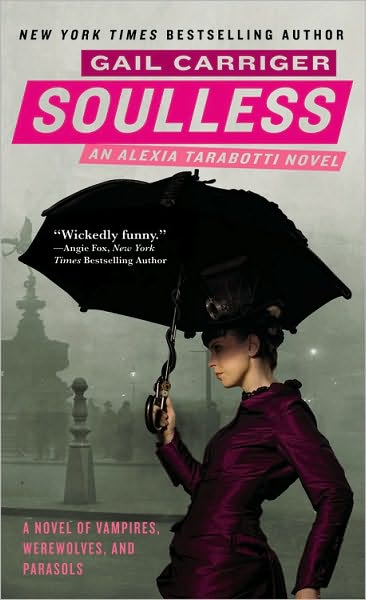
The cover asserts that this is “a novel of vampires, werewolves and parasols,” and so the uniqueness begins. The series is set in Victorian London, and combines the genres of paranormal romance and steampunk along with, I suppose, alternate history. And there is a mystery as well. Most interesting.

Alexia Tarabotti is a confirmed spinster of the advanced age of twenty-six. There are several setbacks to her marriageability: her father is both dead and (was) Italian; he gave her a swarthy complexion; her nose is rather large; she is tall; and her personality is far too assertive and prickly to make her a decent wife. Furthermore, she is a preternatural – meaning, she has no soul. In Alexia’s society, werewolves and vampires are well-integrated into society (if not entirely accepted in all circles). To become a vampire or a werewolf, one must have an excess of soul; Alexia’s total lack thereof means that she can, with a touch, neutralize supernatural qualities. At the opening of the book, a vampire attacks her and in defending her, she accidentally kills him. The werewolf authority sent to investigate the death is a peer, one Lord Maccon, with whom she has tangled in the past. As new vampires begin appearing where they shouldn’t, and known vampires (and werewolves) fail to appear where they should, Alexia comes under suspicion. The clever and not-to-be-daunted Alexia, with her preternatural abilities to help her along, works on solving the mystery, further motivated on repeated attempts to abduct her. Lord Maccon works on the mystery because it’s his job. The two have some personality clashes but are also drawn to each other (cue the classic romance-novel device).

There is no arguing against the absolute silliness of this book, but it is oh! so much fun! I really enjoyed the romance that develops between Lord Maccon and Alexia. They struggle with understanding one another’s culture in their courtship: his involves pack dynamics that she’s unfamiliar with, and hers involves chaperones and proper proceedings that Alexia herself is not terribly comfortable with, being such a spinster. Carriger writes some very funny scenes; I giggled aloud. The mystery is engaging. The steampunk background was totally new to me and didn’t necessarily add anything to the appeal, other than being a layer of interest, something shiny to look at between steamy scenes.

I am surprised at myself, because I haven’t liked any paranormal romances yet; but despite the vampires (Lord Akeldama is great fun!) and the werewolves (Lord Maccon is really a sexy beast) this was an engaging, entertaining, clever story with a very likeable main character. I think I’ll seek out more of the Parasol Protectorate series! I wonder if we’ll ever learn more about the incident involving the hedgehog?? Thanks Amy for a very strong recommendation!

Definitely Dead by Charlaine Harris (audio)

Definitely Dead is a Sookie Stackhouse book from the Southern Vampire Mystery series. Yes. Southern Vampire Mystery Series. The television series True Blood is based on these books. This is not my standard reading material, but (this is becoming a theme) I picked it to cover Louisiana for the Where Are You Reading? Challenge, on rhapsodyinbooks‘s recommendation. I like James Lee Burke for Louisiana normally, but took this opportunity to expand my knowledge (if not my reading loves) – for professional reasons as a librarian, if for no other reason. One of my first pleasant surprises was the narration; Johanna Parker’s southern accent is fun. (Her Irish accent, for Father Riordan, on the other hand, is a travesty. Luckily we don’t hear too much from him.) The redeeming features didn’t end there; Sookie is a pleasant, likeable enough protagonist. She’s a little bumbling, and she struggles a little bit with her sense of self-worth, but she’s not whiny; she’s just human. Ha – that’s a joke, as her being human makes her fairly unique in Bon Temps, Louisiana, a world full of supernatural beings: were-wolves, were-panthers, were-tigers, vampires, goblins, and sundry shape-shifters.

In this book, Sookie is being attacked by various enemies: one, the family of the Pelt girl that she apparently killed in an earlier book, and two, okay I won’t give it away just yet… The vampire Queen of Louisiana (what a funny phrase, it made me smile every time) marries the King of Arkansas (even funnier!) in a political match, but Sophie’s cousin Hadley is the Queen’s real love. Hadley has just died, and when Sookie goes into New Orleans to clean out her apartment she finds a dead werewolf in the closet – and the intrigue just increases from there. Meanwhile, Sookie begins to date a sexy were-tiger, Quinn; he’s there with her when she’s attacked on several occasions, so they bond while fighting various supernatural beings. There is an unusual sex scene between the two of them that I am still contemplating and finding unlikely, but I’ll let you discover that one on your own.

It’s an odd world that Harris builds here; a number of phrases got me giggling just for their oddity (I wish I’d taken better notes here). It was strange enough to me that the novelty was rather amusing, although I guess regular readers of paranormal whatnot are beyond this. Sookie is relatively charming, and Quinn is an attractive character; I found myself entertained once I got into things. But this book is no literary feat. The dialog can be awkward, and I found enough grammatical errors to be distracting.

In the end, this wasn’t a painfully bad book to listen to. (Well, the cd’s in my audio copy were badly scratched and sometimes that got a little painful, but I don’t hold Harris or Sookie responsible for that.) It had its moments, but it failed to make me care deeply; the world Harris built was more silly than interesting. Unfortunately I don’t care what happens to Sookie next, although I wish her well.

The Affair by Lee Child (audio)

The brand-newest Reacher, just out a few weeks now, is another flashback or prequel: it’s 1997, and Reacher is still in the army. He is sent out to Carter Crossing, Mississippi to do damage control on a murder case that threatens the army’s good reputation. There’s a lot of politics involved: the local army base is sending companies secretly into Kosovo, and one of the captains in question is the son of a senator in the Armed Services Committee. It develops that this very captain has some connections to the murdered woman – or maybe his father the senator does. Reacher breezes into town intending to remain under cover while investigating the case parallel to the above-board MP working from the base; but his cover is immediately blown by the local sheriff, a former Marine MP herself. The one murdered woman turns out to be the third in a series of similar killings – the first two having been ignored apparently because they were black. And then more people start dying. What exactly is going on here? And who can Reacher trust? He’s inclined to trust Elizabeth Devereaux, the sheriff, but he’s getting conflicting messages from various sources at the army.

The Affair is in several ways a standard Reacher production, and in several ways not. Reacher does his investigating; he’s a smart guy and he figures things out; he eventually will get the bad guy(s), no doubt about that. There is rather less ass-kicking in this book, though. Husband was disappointed, and I was just flat-out surprised at how easily and relatively bloodlessly the hooligans were taken down. There is rather more sex – Reacher does tend to get laid in many of the books, but the sex got a little more attention in this one. It was well done – I’m not complaining – but I was a little confused at the shifting focus. I wonder if Child has figured out that he has a number of female fans swooning over Reacher and decided to play up to them (us)? As a swooning Reacher fan myself, let me say: more ass-kicking please! I don’t begrudge him the sex but that was never the primary focus, and I’d rather stick with the classic model of ass-kicking with sex on the side, rather than the other way around.

This bit is very slightly spoilery… I had some trouble suspending disbelief as we discovered all the mistakes made by the illustrious Elizabeth Devereaux in investigating the murders before Reacher’s arrival. If she’s such a veteran hotshot MP herself, how did she miss that there was no blood on the white collar of the woman who had her THROAT CUT? Etc. She beats Neagley at the mind game at which the latter supposedly excels but makes all kinds of amateurish mistakes in the murder investigation. It just didn’t ring true for me. End spoiler. But hey, maybe I’m just mad at the whole Reacher camp right now because… have you heard? They’ve cast Tom Cruise, of all people, to play him in the movie they’re making of One Shot! Blasphemy, says I. Reacher is supposed to be 6’3″ and 230+ pounds, muscular, and blonde. Sigh. And I’m not alone – you should see the Reacher fans raising hell over at the facebook page.

But all in all, this was another satisfying edition of the Reacher adventure. I liked it. It just wasn’t my favorite. I wonder where Child is going to take Reacher from here? It occurs to me that he’s getting older (possibly a reason to keep writing prequels!) – but Child came up with another possible plot thread here: the younger version of Reacher, named Duncan Monroe, just a bit earlier in his career and otherwise apparently a spitting image. I guess we could always revisit Monroe as Reacher ages. What do you do with an aging hero? Realistically we could see him forced to accept some realities and calm down a bit; but action/adventure/thriller/hero/mysteries don’t always take the realistic route! At any rate I’m still hooked in. What’s next, Reacher?

Play With Fire by Dana Stabenow

I picked up this Kate Shugak mystery just to satisfy my need for an Alaska-set book, for the Where Are You Reading? Challenge. (This is becoming an issue around here.) But unlike some I have picked up just for their settings, this book was worth the time.

Kate Shugak was a police detective in Alaska but is now retired; she is also an Aleut (one kind of native Alaskan), with an interesting background. In Play With Fire, a forest fire the fall before has caused an extraordinary crop of morel mushrooms to pop up in the backcountry, and Kate is picking them to sell to an enthusiastic international market when she discovers a decomposing corpse. The same day, a young boy named Matthew shows up with some crumpled bills and hires her to search for his missing father. If this sounds awfully much like a coincidence, you are correct.

The mystery takes Kate into a small town with a very creepy religious tyrant and undertones of Jerry Falwell. Stabenow shares some details of the natural environment, flora and fauna, especially mushroom trivia. For me, the best part was learning about Shugak’s experience as a young “native” in Alaska, with snippets of cultural information and language; I would go back to this series for more of the same. I really enjoy a strong sense of place in my mystery novels, and this one has it. I would also return for more of Kate’s romance with Jack Morgan. So far he’s rather typical-romance-novel-hero by which I mean, perfect – but I’m not sick of him yet. Not a new favorite, but noteworthy.

The Most Dangerous Thing by Laura Lippman

The three Halloran brothers, Tim, Sean and Go-Go (Gordon), and two neighbor girls, Mickey and Gwen, were inseparable for a short time in childhood. During that period, they played in the enormous wooded Leakin Park behind their neighborhood, did normal childhood things, learned about some adult things, and maybe did some bad things. At the start of this book, the adult Go-Go dies. The other four – but mostly Gwen – look back at their childhood, consider guilt and responsibility, and wonder how well their secrets have been kept over the years.

Lippman handles family relationships, and friendships, and neighborhood whisperings fairly well. I felt that the most effective moments, the most evocative and emotional scenes, are the ones dealing with secrets and relationships. I feel for Tim in his desire to befriend his three daughters, and his feeling that his all-female family overwhelms him. Sean’s fear that his own son is gay is less sympathetic, but still feels very real. I thought Mickey was a pretty interesting character, both as a child and in adulthood. And the parents – Tim Sr. and Doris, Rita and Rick (and her various other men), and Tally and Dr. Robison – were very well drawn; they came across as real people to me.

The suspense was well done in that I had to keep coming back and opening the book; I was drawn along, I wanted to know what was going to happen next. The parent-child dynamics, and the development of them – Gwen’s observations of her adopted daughter, for instance – were engaging.

But the plot was weak, in my opinion. The mystery of what happened in the woods, after all the questions and all the intrigue, wasn’t as outrageous or shocking as it should have been; the big reveal was something of a let-down for me. I regretted not getting to know Go-Go better. The mystery of Go-Go was sort of the mystery of the book – that we didn’t know him was the point – but still, I missed more knowledge in that area; I think it might have improved my experience. Considering how well Lippman draws characters, relationships, and emotional impacts, I think she could have done a lot with him.

So while this book was engaging and entertaining during the reading – I couldn’t put it down for a day or two, and enjoyed it during those hours – I didn’t take much away from it. I fear I will forget it quickly. (I read Lippman’s earlier novel, I’d Know You Anywhere, and it kind of went the same way. My memory of it is vague; another similar book I read around the same time, Chevy Stevens’s Still Missing, made a far greater impression.) I can’t get all that excited about Lippman, although I do read rave reviews, so I know some people do.

I read this book to cover Maryland for the Where Are You Reading? Challenge, and it did its job. Although, here’s another minor beef: I love a strong sense of place in a mystery novel. If I’m reading about a place I’m familiar with, it’s great fun with to get a sense of familiarity. If I’m reading about a place I’m not familiar with – like Baltimore – I enjoy learning about a new place without actually traveling there. But Lippman’s Baltimore didn’t come alive; it didn’t make an impression on me as a city with personality. (Maybe Baltimore really doesn’t have a personality. But I’ll give it the benefit of the doubt. Most cities do.) So, this book didn’t do too much more for me than fulfill my need for a Maryland-set story. I think I’m about done with Lippman.

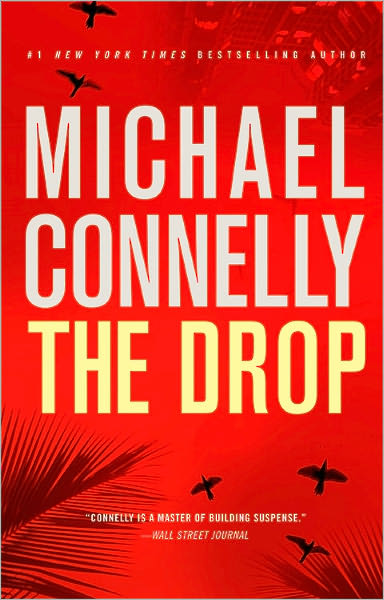
Teaser Tuesdays: The Drop by Michael Connelly

Teaser Tuesdays is a weekly bookish meme, hosted by MizB of Should Be Reading. Anyone can play along! Just open your current read to a random page and share a few sentences. Be careful not to include spoilers!

Number 17 in the Harry Bosch series, can you believe it? I love this guy. I was afraid the quality was falling off a bit (especially with The Fifth Witness, ugh, come on Connelly!) but I think we’re back on track with this one. Here’s your teaser for the day (from page 330 of my galley copy):

“But what would you do if you quit?”

“I’m not sure but I know one thing. I think I would be able to be a better father. You know, be around more.”

“That doesn’t necessarily make you a better father. Remember that.”

Bosch nodded. He sometimes had a hard time believing he was talking to a fifteen year old. This was one of those times.

Don’t worry, I haven’t given anything away. Are you a Connelly fan? How do you think the series has progressed over the years? I can’t believe we’re at 17 already!!

This quotation comes from an uncorrected advance proof and is subject to change.

Turn of Mind by Alice LaPlante

This was a sad and fascinating book. I read it in a day – not unheard of, but fairly rare considering that it was a regular work day. Started on my lunch break and finished before bedtime. It was absorbing and unique. A murder-mystery, yes, but also sort of a psychological thriller. The unique framing element of the book is this:

Dr. Jennifer White is sixty-four, and has dementia. When the book opens, she’s in the early-to-mid stages of the disease, living at home with a full-time, live-in caretaker. Her best friend of several decades, who is also her three-doors-down neighbor and godmother to her daughter, has been murdered, several fingers cleanly amputated. Dr. White (whose specialty was hand surgery, ahem) is a suspect, and doesn’t know herself whether she did it or not. Her story is told in first-person; we read snippets from the notebook she keeps, hear conversations, and listen to her private thoughts as she struggles with the questions. The questions are only rarely about Amanda’s murder. In reading about this book I thought the murder case was the main focus, but it’s not. Dr. White is only occasionally aware of the question of her friend’s death, because she’s only occasionally aware that her friend is dead. Her disease and its progression, her confusion, the attempts by her adult children to shape her future, and her eventual fate are the book’s main concern – because we see through Dr. White’s eyes.

The mystery of who killed Amanda is different from the usual mystery we encounter, because we don’t see a murderer trying to cover his or her tracks. Dr. White’s children, and the lawyer they hire, work to protect her from an investigation that may damage her fragile mental health. At one point it is decided that she did kill her friend, but the legal system of course won’t take its normal course even in that event. (I’m not giving it away; there are still twists and turns.) And again, the mystery is not the primary focus of the book. As Dr. White’s story unfolds – backwards, in snippets, jumping around chronologically, and never reliably – talk about an unreliable narrator – we learn more about her husband, Amanda, Amanda’s husband, and Dr. White’s two children, as well as the hired caretaker and even the primary police investigator. Of course, no one’s story is simple or unblemished.

A fascinating and engrossing mystery is only part of the attraction of this book. It’s an exploration into the head of an Alzheimer’s sufferer, engaging and overwhelming and sad and riveting. Make no mistake: this is a terribly sad story. Being young myself, and having parents in excellent health and with plenty of youth and life left, I hadn’t thought much about nursing homes, but this book’s portrayal terrified me. If you can steel yourself for the tragedy, though, this is a beautiful story, communicated in a unique format, gripping and sensitive. I recommend it highly.

The Enemy by Lee Child (audio)


The 8th book in Child’s Jack Reacher series is a flashback, a prequel, set in Reacher’s days of employment with the U.S. Army. He is an MP (military police) major and it’s New Year’s Eve, 1989. The Berlin Wall has just come down, Soviet Russia is collapsing, and the U.S. military is facing major changes. Reacher has just been transferred from Panama to Fort Bird in North Carolina when people start dying. He enlists the help of young Lieutenant Summer and the two of them quickly find themselves drawing outside the lines – the military establishment repeatedly orders them off the case, makes threats, and finally demands their arrest. As we expect of Reacher, though, he solves the crimes and fixes everybody up right.


This is fun for several reasons. We finally see Reacher on the job. We see him and his brother Joe interacting; Joe is only treated in the past tense in the other books. (Well, there is the short story The Second Son also, in which the brothers are teenagers.) We meet Reacher’s mother and learn something about her past that her sons never knew; this is an especially poignant moment.

A few things are different in this book, too. For one thing, Reacher does fix up the problems and solve the mysteries; but it doesn’t end on quite as hopeful a note as the other books tend to. In his retired, roaming life, Reacher generally sets off into the sunset at the end of the book, headed for unknown adventures, with a world of possibilities ahead of him. At the end of The Enemy, he’s still in the army, but things have changed irrevocably; the end of his career is foreshadowed, and we begin to understand why he chose to get out. There’s a sadness. He wasn’t able to right all the wrongs. Something that’s not different in this book: I’m sad to see Summer go. But the characters we come to love in each book are always necessarily gone at the end; Reacher moves on.

Suspension of disbelief is necessary in every Reacher book; he’s too good, too strong, too smart, too perfectly-timed and awesome to be real. But I have a good time and I can play along. This time I had a little more difficultly with the suspension of disbelief, though, because he went so far off the reservation while in the army. I’m accustomed to seeing him not play nice, but he’s usually a renegade wanderer; it’s a little more bizarre to see him be just as much a rebellious loner while he’s still in the military.

But putting that quibble aside, it’s a highly enjoyable book as usual, and fans of the series will appreciate the backstory and further character development (of Reacher, as well as his brother and mother) provided by this flashback.