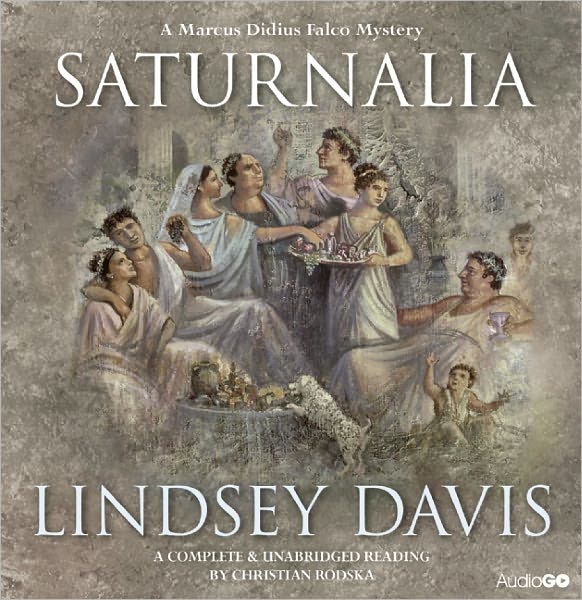
Saturnalia by Lindsey Davis (audio)

Saturnalia is book 18 in a series, and my first, but it didn’t bother me any. I followed everything just fine. Perhaps the characters would have been richer if I’d been getting to know them progressively better for 18 books (!), but I found them rather well-drawn even in this one.

Our main man (and first-person narrator) is Marcus Didius Falco. He is employed as a “private informer”, which seems to be ancient Rome’s version of a private investigator (at least in Davis’s ancient Rome). He is called in by the government of Vespasian to try and recover an escaped political prisoner, a German woman named Veleda that Falco knew years ago; his brother-in-law Justinus, in fact, had something of a brief romance with her. Now, Veleda has gone missing, a headless corpse has been attributed to her, and in an especially personal twist, Justinus disappears at the same time. His wife is furious, thinking he’s off rekindling an old flame with Veleda. Falco is left searching for both of them – Veleda, for pay and for the sake of the empire (although in secret, as the public is unaware she’d been captured in the first place), and Justinus for the sake of family peace. Add to all this the bacchanalia of Saturnalia, the December holiday in which masters serve their slaves and everything is turned on it ear. Falco attends wild parties, hangs out in graveyards interrogating ghosts, does battle with the Chief Spy (a bumbling government employee with whom he apparently spars regularly), finds the odd lost dog… and carries on a very sweet relationship with his wife, Helena. I liked her addition to the story: she is from a social strata above Falco’s (her father is a senator), and routinely assists him in his investigations. Their relationship is well-done. She’s spunky, intelligent, not to be tamed, but also a doting wife; their home life feels very real and likeable, although I wonder if Helena is not a few centuries ahead of her time.

Which brings me to the historical question(s). I am no scholar of ancient Rome. This world felt real to me, and I was happy being immersed in it for the course of this book, but I cannot speak to the historical accuracy. It was great fun, but I make no promises.

This was a fun mystery. Falco has a great tongue-in-cheek, irreverent, dry humor, and the narrator of this audio version, Christian Rodska, represents that tone well. Saturnalia leans toward the ridiculous, with that straight face that makes such things all the more funny. The historical setting was new to me, but I had a good time with it.


Rating: 4 Roman senators.

Teaser Tuesdays: Saturnalia by Lindsey Davis

Teaser Tuesdays is a weekly bookish meme, hosted by MizB of Should Be Reading. Anyone can play along! Just open your current read to a random page and share a few sentences. Be careful not to include spoilers!

I’ve just started this audiobook, randomly selected from the new-to-me series of mysteries by Lindsey Davis set in ancient Rome. (This book opens in AD 76.) It is rather late in the series, but that never stops me. So far I’m charmed by the humorous moments, and I like the audio-narrator, Christian Rodska, too. From almost the very beginning, here’s your teaser:

Pa gazed at me with those tricky brown eyes, running his hands through the wild grey curls that still clustered on his wicked old head. He was daring me to be flippant.

I like that “wicked old head” and the “tricky brown eyes.” There’s something a little bit engrossing about Pa, and I like the main character-narrator, Marcus Didius Falco. Hope you’re enjoying whatever you’re reading this week!

Teaser Tuesdays: Claire DeWitt and the City of the Dead by Sara Gran, again

Teaser Tuesdays is a weekly bookish meme, hosted by MizB of Should Be Reading. Anyone can play along! Just open your current read to a random page and share a few sentences. Be careful not to include spoilers!


That’s right, you’re getting a repeat today. I teased you from this book two weeks ago, but this passage was too funny to me to skip. Enjoy.

The black alligator purse had been Constance’s. Supposedly it had been custom made for Constance in Paris by Mademoiselle herself. It was bigger on the inside than on the outside, and could get almost anything through an x-ray machine or a Geiger counter. It had pockets inside pockets, secrets inside secrets. The solution to approximately 17 mysteries could be found in this purse at any given moment. In a jam, it could unfold into a tent and I could live in it until circumstances improved.

As I said in my review of this book, there is a mystical element. Constance’s purse may very well actually unfold into a tent. I like these details. If you had a magic purse, what would you want it to do for you?


Be advised: I’m out of town, so you’re viewing pre-scheduled posts until April 9. I love your comments and will respond when I return! But I’ll be out of touch for a bit. Thanks for stopping by!

Claire DeWitt and the City of the Dead by Sara Gran (audio)

The “City of the Dead” is New Orleans during & after Hurricane Katrina, and that’s what drew me to this mystery. That’s the whole sum total of my knowledge of Sara Gran’s book when I began it, and that was enough. I love New Orleans and I think my favorite mysteries are those with a strong sense of place, a well-developed sense of location as a pivotal part of the story – stories that couldn’t happen anywhere but where they do. (I’m thinking of Harry Bosch’s Los Angeles, Tana French’s Ireland, Lisa Gardner’s Boston, James Lee Burke’s New Iberia.) And even as far away as Houston – not so far, especially considering all the Katrina-displaced New Orleanians who now live here – the idea of Katrina is evocative and powerful. So the idea of a mystery set in Katrina’s New Orleans was enough to sell me. Of course, that wouldn’t necessarily make the book good… I’ll give Sara Gran herself credit for doing that.

This was a great, and entertaining read (listen). It’s part mystery and part study of New Orleans, and large part mystical magical musings – but perhaps that last is necessary of a study of New Orleans, with myth, legend, Mardi Gras Indians intruding upon the mystery. Our private investigator, Claire DeWitt, bends the classic hard-drinking, silent-loner-type PI to fit into New Orleans’s unique culture: she uses hard drugs and channels her detective hero, Jacques Silette (author of Détection, her bible of detective skills) as well as her mentor, the late Constance, former apprentice to Silette himself. Claire is sort of secondarily hunting her childhood friend and former fellow junior detective, Tracy, who disappeared so many years ago.

So what is the mystery? Claire comes down to NO from California when she’s hired by Leon, who wants to know what happened to his uncle, Vic Willing. Vic disappeared during Katrina, never to be seen again. I’m not sure we ever really settled why this indicates foul play, as lots of people got “lost” in Katrina, but it’s accepted throughout the story that something sinister must have befallen him, and I’m okay with getting on that train. Vic was a successful local DA, and fed birds from his apartment. And there the clues seem to end. Claire quickly gets herself entangled with some local delinquent youngsters, and has various adventures involving gunplay and drugs. Despite her hard exterior, she’s a bit of a softie towards these young men who’ve been dealt “a bad hand,” but she doesn’t let it show much. The mystery of Vic’s disappearance is not the star of this book. Its eventual wrap-up is a bit simplistic; as a strict, standalone mystery it might not impress. But that’s not what this book is about. Rather, several other threads steal the spotlight: Claire’s relationship with Andray and Terell; her relationship with her late mentor Constance; and the mystery (unresolved – maybe that’s another book?) of Tracy’s childhood disappearance, not to mention the interest (the framing element, if you will) of Claire’s nontraditional methods of detection, including throwing the I Ching and analyzing dreams and drug-induced hallucinations. Claire’s approach to mysteries in general is mystical.

There are also some decidedly funny moments; I giggled out loud several times (which will always make people look at me funny). Claire’s voice is wry and cynical, and she speaks in metaphors and self-deprecates. She’s prickly but altogether someone I’d like to know. In conclusion, while Claire has certain qualities in common with your traditional loner-drunken-detective archetype (which, by the way, is not a criticism!), she has plenty of unique quirks that make her very interesting to know. The mystery here is only a backdrop for the drama of New Orleans to play against. Claire DeWitt and the City of the Dead includes a number of characters I’d like to know better, and while it has a satisfactory and complete ending, it does leave the door open for a sequel. Sara Gran! I want it! Recommended.


Rating: 7 grumpy detectives.

final review: The Likeness by Tana French (audio)


Well, I don’t suppose I have much more to say about this one than I already did in my early review, other than to assure you that the positive feelings persisted! Tana French kept me guessing til the end, and she had me deeply invested in her characters. The final denouement was satisfying. Cassie felt real to me; all the characters felt real to me. I was sorry it was over, and especially sorry that I’ve now read all three of French’s novels. This is in my opinion her best. I hope there are more to come – and I hope Heather O’Neill narrates them.

I ended up feeling that The Likeness is really very reminiscent of Rebecca in some aspects: the house as a character, as a force, with a personality and motivations all its own, with a history that intrudes upon the lives of the present residents even when they’re unaware of that history… and more (avoiding spoilers). Further, the mood and tone of this book share a slightly spooky atmosphere, a sense of foreboding, a feeling of something unknown looking over one’s shoulder, with Rebecca. But it’s not derivative. No, The Likeness is a fresh, new piece of work, with accomplishments all its own. I would love to hear Tana French’s explanation of the role she feels Rebecca plays in this novel, though.

I’ve been asked if I think it’s necessary to read In the Woods first. That’s French’s first novel, and introduces some of the characters we meet here. I don’t think it’s all at necessary. (Full disclosure: I’m a fan of reading series out of order.) I read In the Woods about 2 years ago, and don’t really remember it at all. Those characters that transfer over into this book are in very different circumstances now, and their histories are explained enough that I felt comfortable. That said, there is much reference to “that big thing that happened that changed everything,” and “that thing” is not explicated at all. I wasn’t bothered by it; some readers may feel motivated to go read the first book to answer their questions. I didn’t find it necessary. If that’s the kind of thing that bothers you, by all means go read In the Woods first. I found The Likeness far superior, but to each her own; maybe you’ll feel the opposite. I guess my main point here is that while these two books share characters, they are not serial in the sense that the action of the first book is built upon in the second. They can confidently stand alone.

This book is amazing and I found it unique. (Simon has drawn a comparison to Tess Gerritsen’s Body Double. I may have to go find that one.) Beyond that, I refer you back to my earlier post (link at top of this one) in which I rave. The ravings stand.


Rating: 9 questions of identity.

Teaser Tuesdays: Claire DeWitt and the City of the Dead by Sara Gran

Teaser Tuesdays is a weekly bookish meme, hosted by MizB of Should Be Reading. Anyone can play along! Just open your current read to a random page and share a few sentences. Be careful not to include spoilers!

I’ve only just started this one, but this line struck me immediately.

New Orleans was a little like England. People were comfortable with class distinctions.

These two sentences are very expressive. I’m not your #1 expert on New Orleans or anything, but I live just 5-6 hours away and have been a number of times; I love the city and Katrina has certainly affected me and all Houstonians. With my moderate level of New Orleans knowledge, I see what she’s driving at here. I like this book so far.

What are you reading?

early review: The Likeness by Tana French (audio)

I’m doing something a little bit different here today. I’m so bursting with enthusiasm for this book that I’m going to post my review-ish thoughts now, even though I’m only about 1/3 of the way through. Then I’ll write my normal review when I’ve finished, and we’ll see if I still love it. Ready?


Ohhh I am reeling over this wonderful book! This is my third Tana French, and three is all she’s written so far; hurry, Tana! I need more!

First of all, I find the plot to be very imaginative and engaging. I think about this book all day and at night, and itch to get back into my car or somewhere I can listen to more of it. I think it’s a unique premise; at least I’ve never encountered anything quite like it.

Cassie Maddox is a Dublin detective. She worked undercover, then murder, but these days is cooling her heels in domestic violence, recovering from the trauma of an old case and cautiously enjoying a relationship with a fellow detective, Sam, from the murder squad. Sam calls her up early one morning in a panic: he needs her at a murder scene right away, which doesn’t make any sense. When she gets there, she’s reunited with her old boss from undercover, Frank Mackey, which also doesn’t make sense. Then she sees the body. Not only is this girl her virtual twin (Sam’s panic explained: he thought it was her), she’s using the name Alexandra “Lexie” Madison. She’s using Cassie’s old undercover identity. She was pretending to be who Cassie used to pretend to be.

Frank talks Cassie into returning to undercover, becoming Lexie Madison again, and infiltrating this second pretend Lexie’s life, living with her housemates and teaching her classes and working on her thesis, pretending Lexie was just injured and not killed at all. Ostensibly the goal is to solve the murder, but everyone has their own motivations. Cassie needs to understand why this mystery girl took on her old cover, and what threat may still remain to her. She suspects that Frank is excited at the challenge of this unprecedented investigatory technique. And Sam just wants her safe, doesn’t want her undercover living a pretend dead girl’s life; but he recognizes yet another reason she needs to do this: she desperately misses the electric buzz of working undercover.

So Cassie enters Whitethorn House, to share her life with four fellow English students. The five are unnaturally close; they share a chemistry, and clearly, they share secrets. But is one of their secrets the identity of Lexie’s murderer?

This is a remarkable work of suspense and atmosphere. There is an undercurrent, too, of psychological terror; Cassie is frequently stunned, pinned, by what she and the dead version of Lexie share, finds herself frighteningly at home in this other person’s clothing, relationships, home, routine. I never leave Cassie’s dramatic, pins-and-needles double life. She absolutely has me wrapped up in her world, her tendency to relax in Lexie’s life even though that’s the last thing an undercover should do, her total focus on who this girl was. Add clever turns of phrase; moments of laugh-out-loud hilarity; the brusquely loving relationships between Cassie and Sam and (even better) Cassie the hardnosed detective and her old boss Frank; a fully-developed Irish setting; and an enormously complex, real, and likeable heroine… and you have far and away the best work of fiction I’ve encountered this year.

Oh, and the audio production: more raves. Heather O’Neill does Cassie’s Dublin accent delightfully. I love the singsong, lilting quality and the emotion she puts into every scene. The voices of Cassie, Frank, Sam, and Lexie’s housemates – not to mention Lexie herself, whose voice is different from Cassie’s – are distinguishable from one another. And she perfectly imparts that suspenseful, atmospheric tone, which reminded me from the first lines of du Maurier’s Rebecca. Whitethorn House, like Manderley, is almost a character in itself; it seems to have moods, personality, and secrets.

I can’t say enough good things about this book, or about the audio production. Rush out and find yourself some Tana French. Tana: write more books!

book beginnings on Friday: The Likeness by Tana French

Thanks to Katy at A Few More Pages for hosting this meme. To participate, share the first line or two of the book you are currently reading and, if you feel so moved, let us know what your first impressions were based on that first line.

I loved Tana French’s In the Woods and Faithful Place, and as I plan an upcoming trip to Ireland (my first), it seemed natural to pick up another Irish-set mystery. Bonus: this one is an audiobook, so I’m hoping to adjust a little bit to the accents I’ll be encountering soon! (I’m not always so good with accents. At least it’s not Scotland; that’s an accent I really can’t decipher.) We begin:

Some nights, if I’m sleeping on my own, I still dream about Whitethorn House. In the dream it’s always spring, cool fine light with a late-afternoon haze.

That’s lovely, in my opinion. It’s atmospheric. One of the things I love about French is the sense of place she creates in her books, which of course is of special interest now since I’m planning a trip there. And this beginning is almost reminiscent of Rebecca, isn’t it? Last night I dreamt I went to Manderley again…

Boca Daze by Steven M. Forman

A witty sexagenarian PI who’s unafraid to take on a wacky variety of villains all at once.

Steven M. Forman’s third novel (following Boca Knights and Boca Mournings) checks back in with retired Boston cop Eddie Perlmutter, better known as the Boca Knight. Now firmly established as a private investigator in South Florida, Eddie is hit by several cases simultaneously. First, a homeless man claiming to be the Depression-era sad clown Weary Willie is attacked, and a local reporter asks Eddie to look into the circumstances. Then a new friend, World War II vet Herb Brown, suggests an investigation into a too-good-to-be-true investment scheme. For good measure, an old mobster acquaintance (and former foe from his days with the Boston PD) asks Eddie to take on the Florida “pill mills.” Eventually the Boca Knight finds himself staking out a Catholic church, traveling to Tallahassee to lobby the state legislature and palling around with a homeless woman with a tragic past. All this, while experimenting with Viagra to try to keep up with his much-younger girlfriend.

Eddie is wry and self-deprecating; the overall tone is humorous, his battles with “Mr. Johnson” especially so. Don’t sell Eddie short, though: despite the laughs, he can still take on gangsters a fraction of his age. Forman briefly but seriously addresses the Florida health crisis caused by a barely regulated prescription drug market, and then Boca Daze wraps up all its tragedies neatly and hopefully, with a wedding and a boxing match. Fans of lighthearted mysteries, South Florida or elderly heroes will be more than pleased with the Boca Knight’s latest quests.


This review originally ran as a *starred review* in the February 7, 2012 issue of Shelf Awareness for Readers. To subscribe, click here, and you’ll receive two issues per week of book reviews and other bookish fun!

The Chalk Girl by Carol O’Connell

Carol O’Connell’s Mallory returns to take on a case with nonstop twisting intrigues.


The little girl in Central Park has red hair, starry blue eyes and a dazzling smile; she reminds people of an elf or a fairy, and tells stories of blood raining out of the sky and an uncle who turned into a tree, and demands hugs from everyone she meets. The fairy tale halts abruptly, however, with the discovery of a body in a tree, hogtied and seemingly dead. And it’s not the only one. Coco, as she calls herself, presents a perplexing mystery. Where did she come from? Who does she belong to? Where did she get the strange explanations for the blood on her shirt and, most important, what kind of a witness will she make, if the NYPD ever manages to solve the homicides?

Detective Mallory, the protagonist of nine previous novels, is just back from three months of unauthorized down time and is none too stable herself; she and Coco may have more in common than meets the eye. But the case quickly grows bigger than a wandering child and a series of well-planned murders. Conspiracies and deceits connect Coco with the upper echelons of political power in the city, from high society to the DA’s office, even the police department–and Mallory’s investigation will reveal a chilly tale of torment stretching back 15 years. Unlike the spritely Coco, though, Mallory is a terrifying force to be reckoned with. Her methods are cold, merciless and conniving; her colleagues doubt she even has a heart. If nothing else, Coco’s tormenters can expect justice at Mallory’s hands.


This review originally ran in the January 20, 2012 issue of Shelf Awareness for Readers. To subscribe, click here, and you’ll receive two issues per week of book reviews and other bookish fun!