Murders in the Rue Morgue by Edgar Allen Poe

Available as 11 pages in quite small type here.

I am 98% sure that I was led to this story by a mention in Judith Flanders’s The Invention of Murder. I’m always up for some Poe; he’s batting 1000 with me. I have a complete works volume on my shelves somewhere; maybe one of these days…

I’m pretty sure the reason I came to this story from the above book is that it is cited as one of the earliest mystery stories in literature, that is, in which a detective (in this case an amateur) puzzles through the clues to come to a conclusion of whodunit. It begins with a fairly lengthy (several long paragraphs) discussion of analytical powers, in which our narrator argues that whist or draughts are both more challenging intellectual games than chess. [I am not familiar with whist or draughts so can’t comment on that.] The point of all this rather cerebral discussion finally becomes clear: the narrator’s roommate, a Frenchman named Dupin, is an analytical genius. He can tell what the narrator is thinking. And he will solve… The Murders in the Rue Morgue.

by Daniel Urrabieta y Vierge [Public domain], via Wikimedia Commons (click to enlarge)

illustration by Daniel Urrabieta y Vierge, via Wikimedia Commons (click to enlarge)

In a tone and a climate I recognize from The Invention of Murder, we learn that a mother and daughter have been brutally killed in their home on the Rue Morgue. All the doors are locked from within, and a very large amount of cash has been left behind, spilled on the floor. The Parisian police are stumped. Dupin, however, reasons through what clues he finds – having been allowed special access to the crime scene, naturally – and comes to a very strange and improbable, but correct, conclusion. Occam’s Razor aside.

The strengths of this short story, as always with Poe, lie in its atmosphere: brooding, dark, melancholy, cerebral. The character of Dupin is not well-rounded or human, but that’s okay. He plays a role. Our narrator is there, Watson-style, to provide a foil for Dupin’s analysis. The solution to the mystery is most strange and enjoyable for its strangeness. Realism this is not.

An enjoyable quick read and a good early example of a genre I love. Well worth a few minutes.


Rating: 8 thick tresses of grey human hair.

The Fame Thief by Timothy Hallinan

Timothy Hallinan’s quirky thief/detective (last seen in Little Elvises) is forced to delve into long-past Hollywood scandals by a nonagenarian crime boss.

famethief
The Fame Thief is Timothy Hallinan’s third novel starring Junior Bender, a professional burglar with a second calling as a crook’s detective–because bad guys need their mysteries solved, too. Irwin Dressler, no less powerful a crime boss for his 93 years of age, hires Junior against his will for a strange 60-year-old case, the theft of a Hollywood actress’s most valuable asset: her fame.

Dolores La Marr was a kid from Scranton, scarcely beginning to make it big in 1940s Tinseltown, when her association with that era’s fashionable gangsters landed her in a nasty, full-color scandal. Strangely, no one but Dolly took the fall, and all these decades later, Dressler still wants to find out who set her up. Junior quickly learns that this mystery is not as dead as it seems, and that some dangers only increase with age.

The refreshingly unassuming Junior is a fun riff on the typical private investigator: his specialty–committing crimes, rather than solving them–brings him an unusual perspective. The elderly Dressler is a fabulous, deadpan wiseguy in “eye-agonizing” golf pants, backed up by two unusually domestic versions of the standard muscled goon. And Junior’s own domestic concerns–a teenage daughter, her jokester boyfriend, an ex-wife and a randy new girlfriend–fill out the eccentric, likable cast. Fast-paced action and a building body count pair nicely with humor in this series, bound to keep the reader coming back for more.


This review originally ran in the July 12, 2013 issue of Shelf Awareness for Readers. To subscribe, click here, and you’ll receive two issues per week of book reviews and other bookish fun!


Rating: 6 slow-speed car chases.

movie: The Long Goodbye (1973)

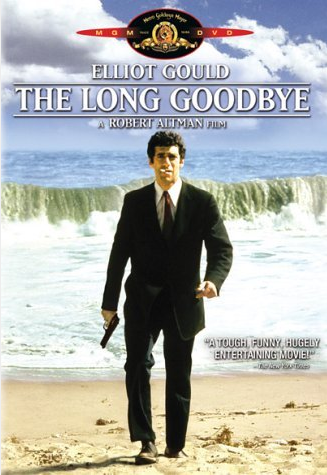
longgoodbyeThis 1973 film is based on the 1953 book by Raymond Chandler, which I read so long ago (and apparently pre-blog) that I don’t entirely trust my recollections. I’m pretty sure there are significant divergences in movie form from the plot of the book – what else is new.

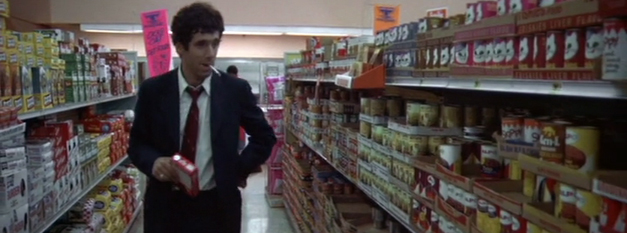
Raymond Chandler’s 1940’s-50’s private detective hero, Philip Marlowe, has been updated here to fit into 1970’s Hollywood. In the opening scene, Marlowe is awakened by his cat, who insists on being fed at 3 in the morning; upon awakening, the first thing Marlowe does is light up a cigarette, an action we will see repeated ad nauseam. (Husband and I guesstimate that at least 50 cigarettes are smoked in this movie by Marlowe alone. The only times he’s not smoking are when he’s lighting up or in police custody.) He then heads to the 24-hour store for cat food. Still smoking.

and brownie mix, for the hippie neighbor girls

and brownie mix, for the hippie neighbor girls

Marlowe’s friend Lennox asks for a ride into Tijuana following some trouble with his wife; after performing this favor, the cops show up to inform Marlowe that Lennox had just killed his wife, an accusation that Marlowe does not believe. Likewise Lennox’s apparent suicide in Mexico a few days later. Meanwhile, Marlowe takes a case from a ritzy blonde wife of a temporarily missing alcoholic writer who is so Hemingway:
hem
This couple, the Wades, turn out to be tied up with the now-dead Lennoxes. Marlowe’s old-fashioned loyalty to his friend is poorly rewarded. He loses his cat. It’s a sad story.

Despite numerous plot changes from the novel (Wikipedia agrees), and the notable reset to 1970’s California, including violent gangsters and a young Arnold Schwarzenegger I had trouble recognizing, I thought this movie did faithfully reflect the iconic character of Philip Marlowe. I liked the humorous addition of the hippie neighbor girls (topless, with the candles and their yoga, a great distraction to Marlowe’s male visitors) and the (less humorous) gangsters, too. The ending in Mexico was the greatest divergence from the novel but I can appreciate it. Overall, a real win: this film keeps the spirit of the original and updates it somewhat, and great visuals and Marlowe’s pulpy, rough demeanor appropriately take center stage.


Rating: 8 portraits of James Madison.

Teaser Tuesdays: Holy Orders by Benjamin Black

Teaser Tuesdays is a weekly bookish meme, hosted by MizB of Should Be Reading. The idea is to open your current read to a random page and share a few sentences. And try not to include spoilers!

holyorders

This is Benjamin Black’s 6th novel in the series (beginning with Christine Falls) starring Dublin pathologist Quirke, a crusty, curmudgeonly Irishman if ever there were such a one. Take, for example, his reaction to the young new bartender at his usual. (This goes on for a long paragraph.)

He found particularly irritating the way the young man had of throwing up his chin and yanking his fake bow tie to the end of its elastic and letting it snap back with a sharp smack. No, as far as Quirke was concerned, Frankie was exactly what McGonagle’s did not need.

I am amused; although, to be clear, this is more of a dark, weary mystery than a lark. Stay tuned for the review to come closer to the publication date (late August).

This quotation comes from an uncorrected advance proof and is subject to change.

Claire DeWitt and the Bohemian Highway by Sara Gran

A singularly weird and drug-fueled private eye, not for the faint-hearted.

gran

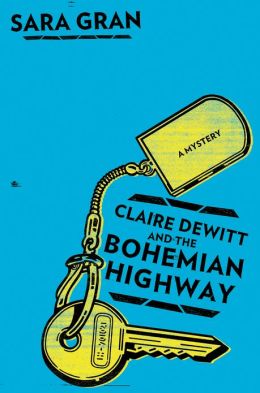
Sara Gran’s Claire DeWitt and the Bohemian Highway gives us a refreshingly bizarre twist on the classic private investigator. Readers of Claire DeWitt and the City of the Dead will recognize Claire’s copious and indiscriminate drug use (she never fails to check a medicine cabinet and pocket the contents; she seeks dealers like she seeks clues) and her generally hard-bitten lifestyle. Similarly unconventional is her somewhat metaphysical style of detection, guided in part by a controversial dead French detective who speaks to Claire through his book.

When Claire’s ex-boyfriend Paul is murdered, and several of his valuable guitars go missing, his wife, Lydia, hires Claire to look into things. A simultaneous case involves a diminishing herd of miniature horses up in Marin County: Claire suspects they may be committing suicide. The action shifts from contemporary San Francisco, where Claire hunts Paul’s guitars and his killer, to the Brooklyn of Claire’s adolescence, where she and two friends once investigated a missing girl. One of those friends will later go missing herself; and the whispers of the missing Tracy, the dead Paul and the possibly suicidal miniature horses haunt Claire as she tries to keep it together and solve a murder through the haze of various uppers and downers.

Strange, distinctive characters are one of Gran’s greatest strengths, coupled with a strong sense of place and a gritty atmosphere of depravity and mysticism. Dark, classic PI adventures with an unprecedented zaniness mixed in make Claire DeWitt a rare reading experience.


This review originally ran in the June 25, 2013 issue of Shelf Awareness for Readers. To subscribe, click here, and you’ll receive two issues per week of book reviews and other bookish fun!


Rating: 8 bumps.

Teaser Tuesdays: Light of the World by James Lee Burke

Teaser Tuesdays is a weekly bookish meme, hosted by MizB of Should Be Reading. The idea is to open your current read to a random page and share a few sentences. And try not to include spoilers!

lightoftheworld

The new Robicheaux novel from James Lee Burke comes out in late July. I am loving it. He’s one of my favorites, although some of his books are better than others (what do we want, that’s true of most of our work, whatever it may be!), and the good news is: this one is wonderful. I had trouble choosing which lovely passage to share with you, but this one won out:

Most GIs hated Vietnam and its corruption and humid weather and the stink of buffalo feces in its rice paddies. Not Clete. The banyan and palm trees, the clouds of steam rising off a rainforest, the French colonial architecture, the neon-lit backstreet bars of Saigon, a sudden downpour clicking on clusters of philodendron and banana fronds in a courtyard, the sloe-eyed girls who beckoned from a balcony, an angelus bell ringing at 6 a.m., all of these things could have been postcards mailed to him from the city of his birth.

Isn’t that something. My mother points out that this will mean more to you if you’re familiar with serial character Clete Purcel, whose hometown is New Orleans. (Obviously.)

And in honor of Dave and Clete, I mixed myself a drink to accompany Light of the World: a riff on a mix that they both enjoy (Dave’s is virgin, I suspect Clete’s is not). Mine included Dr. Pepper, cherry moonshine, orange juice, and was garnished with a Twizzler. Sorry I didn’t take a picture for you!

This quotation comes from an uncorrected advance proof and is subject to change.

The Silver Swan by Benjamin Black (audio)

swanThis is book 2 in a series, because I couldn’t find book 1; so be it. You know I don’t bother too much with these things, anyway.

Set in Dublin, and thus very enjoyable as an audiobook with those Irish accents – various Irish accents based on region, of course. I’m no connoisseur of dialect but I can hear the different effect coming through and I appreciate it. Having visited there now, too, I think I might call an Irish accent the most musical and pleasant to listen to that I know.

Our protagonist (I started to call him a hero; but I think the jury is out) is named Quirke, and he’s a pathologist, meaning he performs autopsies. The scene is set when an old friend – hardly more than an acquaintance – from school calls up to request that Quirke forgo cutting open his recently dead wife, Deidre Hunt, professionally known as Laura Swan. (No, not what you’re thinking. She’s a beautician.) Deirdre is an apparent suicide. Quirke goes poking around where he doesn’t belong. He behaves awfully like a detective, but of course he isn’t; although it is hinted at that in the first tale of his adventures, Christine Falls, which I missed, Quirke likewise tried to do the cops’ job for them, and it didn’t turn out well for him. Ah well, these hard-boiled types never learn, and Quirke goes looking into Deirdre’s life and habits. He discovers a former lover with an angry wife, and some financial troubles, but none of that is as interesting as Quirke’s own family drama. Apparently he had a daughter who was passed off as his niece until just a few years ago; so he has a “new”, adult child; and she becomes embroiled herself with Deirdre Hunt’s life and menfolk. Oh, and Quirke has the classic characteristic of being a reformed or reforming alcoholic; there are scenes where he hangs out in bars (to talk to his informant) and yearns for a drink. No real new ground there.

As a mystery, there were a few odd elements here. Quirke behaves very much like a detective, which is tolerated surprisingly well by everyone, including the detectives; yes, there’s a little complaining, but no efforts to limit his actions. On top of that, I thought the husband was a fine suspect from the very start – that is, once we’ve established that Deirdre was murdered, which is a conclusion danced around for much of the book. The husband then requests that no autopsy be performed; and yet Quirke never really does get around to suspecting him. I was left feeling that I had missed something; and maybe I did, but I think in that case at least some of the blame falls on the story.

I enjoyed this read somewhat, but frankly, I think most of my enjoyment lay in the lovely Irish voices telling the story. Other than that, it was just fine.


Rating: 5 very neutral shrugs of my shoulders for this one.

Teaser Tuesdays: The Silver Swan by Benjamin Black

Teaser Tuesdays is a weekly bookish meme, hosted by MizB of Should Be Reading. The idea is to open your current read to a random page and share a few sentences. And try not to include spoilers!

swan

In chatting with one of my volunteers at work, we agreed upon Lee Child and Michael Connelly; I recommended James Lee Burke, whom she (a Louisiana native, no less!) had never heard of, and she’s loving him. Her reciprocal recommendation was one Benjamin Black, whom I had never heard of; but I think I’m going to like him. His hero/detective type is a pathologist – the one who does the autopsies. And it’s set in Dublin. This audio version, especially, is great fun because I love the lilting Irish accent. Here’s your teaser:

The waters into which Deirdre Hunt’s corpse had plunged were deep and turbid. The autopsy he had done on that other young woman two years ago had raised a wave of mud and filth, in the lees of which he was still wading. Was he not now in danger of another foul drenching? Do nothing, his better judgment told him; stay on dry land.

I chose one of the more dramatic bits for you.

I’m enjoying this! And what’s your new read this week?

Teaser Tuesdays: Claire DeWitt and the Bohemian Highway by Sara Gran

Teaser Tuesdays is a weekly bookish meme, hosted by MizB of Should Be Reading. The idea is to open your current read to a random page and share a few sentences. And try not to include spoilers!

gran

I am enjoying the second in a mystery series starring Claire DeWitt, a dark and disturbed private investigator in the tradition of classic PI’s, but female and drug-addled. She’s a funky riff on an archetype: I dig her.

The cops can only do so much. Even if they mean well, even if they’re geniuses, they have fifty or so cases and limited overtime and wives and husbands and children and mortgages. That’s why you hire a private eye. Because if she’s smart, the private eye has none of those things.

I like to imagine her saying these lines in a gruff, hoarse voice. I think she’d make good film.

This quotation comes from an uncorrected advance proof and is subject to change.

Lost in a Good Book by Jasper Fforde

lostAll those books on my shelves waiting to be read, and I couldn’t resist taking this one out from my local library and jumping in. You will recall that I enjoyed the first Thursday Next book on audio. I couldn’t find this one in that format, so text it is. I have some observations on the format, but first, what is it about?

Thursday Next is back, recently married, and pregnant. She and Landen are happy, but overwhelmed by the publicity linked to her successful but still controversial victory over Acheron Hades, which involved changing the ending of Jane Eyre. The forces of darkness are not through, however: Goliath Corporation wants Jack Schitt back (oh, these names!), and his brother Schitt-Hawse is not afraid to use some pretty ugly blackmail techniques to get him. Landen is in trouble, and Thursday will have to follow Schitt into Poe’s The Raven to execute both men’s safe return. And finally, Acheron Hades may be dead, but (shockingly) he had friends…

Everything I liked about the first book is here: silliness and hilarity, but also some rather sober statements on the ugliness of war, and an evil, all-powerful corporation that is both deliciously ogreish and frighteningly true to life. Not to mention that most central quality: that in this alternate world, books and literature are deeply important to everyone. This fantasy is deeply enjoyable for those of us who feel that way in the real world but who are, sadly, the minority.

What is better about book 2 than book 1 is that there is far more entering of books: in this edition, Thursday acquires the skill, with the help of the Cheshire Cat and Miss Havisham, of reading herself into any book she chooses. Thus we get to visit Sense and Sensibility and The Raven, and of course Great Expectations, as well as a few others, even unpublished manuscripts. Great fun! This aspect of the story’s possibilities (that is, the possibilities of Fforde’s delightful invented world) is not perhaps exploited fully; but the series continues, and I am joyfully anxious to read the next installment.

Format-wise, I loved the voices (and the accents) on the audiobook I listened to of book 1; but there’s a lot to be had in the print version of this one. For one thing, certain inhabitants of Book-World speak to Thursday in foot-notes, which only she can hear and which appear to me as actual foot-notes on the bottom of the page – the disjointedness of which was quite appropriate. I don’t know how that would have been executed in audio format. And there are other things: spellings, subscripts, and the like, that are very much printing jokes, and thus best (only?) enjoyed in print. So while I like the convenience of audio (and the accents!), this may be a series to read in actual book form. Which is probably how Thursday and her Book-World/JurisFiction cohorts would have it, anyway.


Rating: 7 pounds of cheese. (It fits, really.)