No Names by Greg Hewett

This dazzling first novel applies poetry to the overawing power of art, friendship, and the ways in which many forms of love blend into one.

Following five books of poetry, Greg Hewett (Blindsight; darkacre) astonishes with a transcendent first novel about friendship, desire, music, loss, and love in its many forms. No Names is rough-edged, glittering, and brilliant as it spans decades and lives, traveling from a fictional American refinery town to Europe’s capitals, from Copenhagen to a place known simply as the Island, and back again.

Solitary teenager Mike’s world expands when he meets easy, outgoing Pete, with whom he shares a love of literature and especially music, and a nearly instant firm bond. Music, for Mike, is all bound up with sex and violence and epiphany: “It’s like I’m busting out of the prison of myself and giving to the world whatever part of me that’s worth anything.” The two guitarists form a punk band in the late 1970s, and with their two bandmates take off on a rocketing tour of the United States and then Europe that ends in enigma and tragedy.

In 1993, another angst-ridden teen from the same gritty, class-divided hometown discovers a dusty record in his mother’s attic and goes looking for a mostly forgotten punk band. Isaac will pursue the mystery of the No Names until he unearths Mike on a remote island in the Faroes, where the haunted older man has been living as a hermit since the band’s 1978 dissolution: “a mythical musician who, for a time, dwelt here and filled the place with songs.” Mike is supported by a Danish classical pianist named Daniel who had briefly been a friend to the band. On the island, Mike describes to Daniel “a state of ecstasy, or ekstasis–that is, becoming entranced, being brought out of oneself” by the aurora borealis, but these lines could as easily describe their relationship with music, or with one another. Mike, Pete, Daniel, and Isaac, among others, form permutations and re-combinations of friendship, affection, artistic inspiration, love, and desire.

Hewett brings a poet’s ear for language to a complexly layered story that treats sex, drugs, and rock & roll as simultaneously hard-grained and gorgeous. His evocations of music and the power of the muse are tantalizing and apt, as are his lines about the strain of finding oneself, of love and lust and pain. By the time No Names flashes forward to 2018, readers will be spellbound, and as much in love with the novel’s protagonists as they are variously entangled with one another. Hewett’s first novel is scintillating and absolutely unforgettable.


This review originally ran in the March 14, 2025 issue of Shelf Awareness for the Book Trade. To subscribe, click here.


Rating: 10 walnuts.

Personal Stereo by Rebecca Tuhus-Dubrow

The humble Walkman: “a machine for daydreaming.”

Another solid entry in the Object Lessons series. I enjoyed the examination of technology in culture, and the question of what makes something alarming, hot, obsolete, and cool again.

Rebecca Tuhus-Dubrow organizes Personal Stereo into three sections or chapters: ‘Novelty,’ ‘Norm,’ ‘Nostalgia.’ In the first, we learn about the origin of the Walkman (a term she mostly uses throughout, to mean most iterations of the thing, as Kleenex, Tupperware and Xerox stand in for off-brand versions) in postwar Japan. This means learning a bit about the origins of Sony, where various stories circulate about the Walkman’s genesis (one of Sony’s main characters apparently let it be known that he “quietly encouraged the proliferation” of these various accounts, which add to the product’s mystique). Meanwhile, a German-Brazilian claims at least parallel invention of the same concept, and he was eventually given a settlement from Sony. Complicating the legal issue is the question of whether the personal stereo constituted an invention at all, since it involved more simplification and miniaturization of preexisting technologies – removal of the recording element of a ‘tape recorder’ being key to the Walkman. The simplification bit will be relevant later in Tuhus-Dubrow’s study.

And then there was the Walkman, and the world was enraptured, in love, and enraged. What was very new was having music* personally delivered, right up against one’s earparts, according to one’s choice, in stereo, with what counted at the time as great, hifi quality. Users described the experience as dreamy, druglike. Critics did not like seeing people check out in public. There was the secrecy: what is she listening to? There was the rudeness: put on headphones and you telegraph that you don’t want to be approached! There were safety concerns: headphones were banned in some places while driving or crossing the street. And there was the larger question of social norms, of values, of the meaning of public space. Tuhus-Dubrow compares and contrasts the Walkman to the boombox (more public, loud, annoying, but also more obviously about sharing rather than checking out) and the cassette tape to the record, the CD, and the MP3. And then there is the Walkman vs. the iPod and then the smartphone, where the naysayers’ complaints about the Walkman become tenfold threats. Considering unitasker technologies against the modern smartphone: “A clock (or a record player or a Walkman) is like a charming pastry shop or produce stand, a clothing boutique or Parisian boulangerie. A smartphone is like Walmart.”

[*It wasn’t just music: consumers used their Walkmans as well for audiobooks and transcripts, exercise tapes and work, as Tuhus-Dubrow points out. But music was a big part of the impetus and the main use we all remember and think of, isn’t it?]

In ‘Nostalgia,’ Tuhus-Dubrow considers that word’s origins and the concept, then questions: why this item? (Confession: this reader had not realized there was quite so much modern excitement about the Walkman. I guess I knew the cassette tape was having a moment? For the curious, this book was published in 2017.) What confers value on a thing from the past? Partly, its associations with happy memories or better times; but that works best for those of us who experienced, and appreciated, the thing. There is much to the concept of simplification, that value of the unitasker. As much as the Walkman gave its users a sudden increase in choice, in control – whatever tape I want, wherever I go! – the iPod and then the smartphone have increased that to near infinity, and it turns out that we don’t actually want all the choices at any given moment. Also, one of those obvious-now-that-you-mention-it observations: “Technological nostalgia depends on obsolescence.” Sort of a supply/demand issue.

When the Object Lessons series gets it right, I find these little books so very satisfying. They are short enough (generally around 100 pages, or a little over) to read in a day (as I did). They offer a moderately deep dive into a thing I maybe hadn’t thought very hard about before. In the hands of the right author, even the mundane objects of the world – and this is very much the point of this series – offer opportunities to explore, study, and contemplate surprisingly diverse and often philosophical questions. Personal Stereo was a most worthwhile venture for this reader.


Rating: 7 mix tapes.

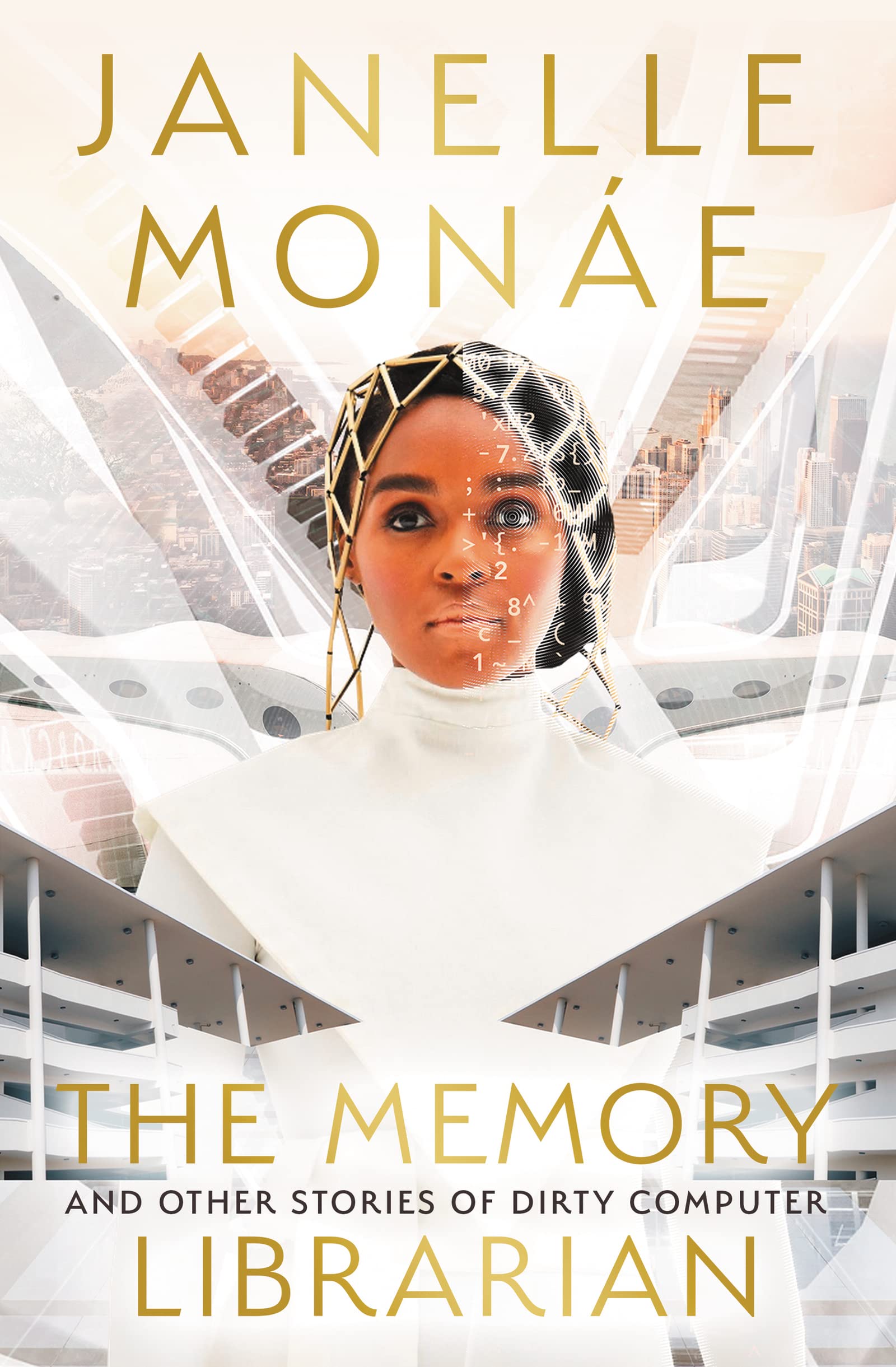
The Memory Librarian: And Other Stories of Dirty Computer by Janelle Monáe

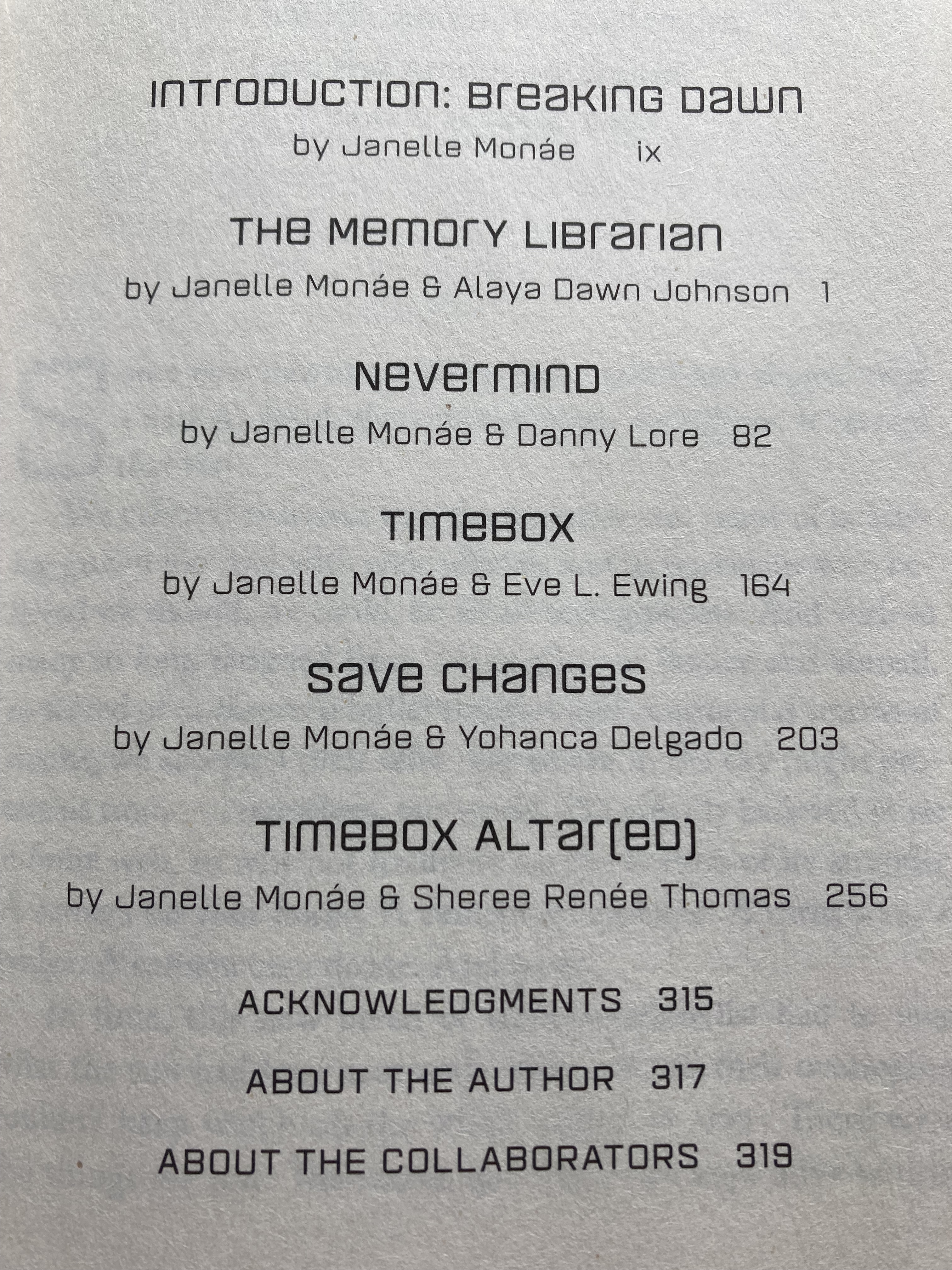
Janelle Monáe’s book is a collection of linked stories – quite long ones – with a handful of coauthors listed, by story (see image below). As the subtitle indicates, the book is a companion, or an expansion, of Monáe’s album Dirty Computer. I know concept albums, and I know accompanying movies (The Wall being a big one for me), but this is the first time I can remember seeing a book version. The Memory Librarian expands on the album’s worldview, and does some mighty worldbuilding; I am pleased.

The opening Introduction, “Breaking Dawn,” was a bit weird and abstract for me; I felt like I was missing something, so it took me a few pages to engage. But the first story, “The Memory Librarian,” took right off. I had to learn about the world we’re in, which was consistent throughout the book – the stories didn’t really have recurring characters (except in the most glancing references), but it was definitely the same world. New Dawn is the authoritarian power, policing its cities and towns with cameras on drones and fearsome Rangers patrolling the streets. People are referred to as computers and must be “clean,” or free from difference, weirdness, subversion, creativity; if they are found to be dirty, they will be cleansed. Notably, queerness is considered “dirty,” and racism is alive and well in New Dawn too. A state-approved drug called Nevermind helps to erase memories; outlaw substances or “remixes” free the mind, in ways that New Dawn absolutely does not approve.

“The Memory Librarian” focuses on a young, ambitious woman named Seshet, with a promising career as (yes) a memory librarian under New Dawn, although as a Black, queer woman she must watch her back hard too. She collects people’s memories (which they can exchange for currency) and helps keep them “clean.” Her own past is mostly lost to her. But then she meets a compelling woman and has to question her relationship to New Dawn, to authority, to her own history, her loyalties and the value of memories and dreams. This story had me fully invested; I was rooting for Seshet and Alethia, and feeling the pressures of their world. Then “Nevermind” introduced the Hotel Pynk, and the gender politics at play even among an apparently progressive feminist enclave. “Timebox” featured a toxic relationship that quite upset but also intrigued me; I think this will be one of the more memorable stories for me. “Save Changes” handles family (and the inheritance of resistance), and “Timebox Altar[ed]” stars children, and brings in more hope than I felt in any previous stories; it has a dreamy, colorful mood that felt good as a way to end the book.

I enjoyed both the stories in their creative concepts and the ways in which they were executed (written). I appreciated the emphasis on the value of diversity (in so many ways) and the importance of art, free thinking, and the freedom to be weird. I liked that these stories trended longer – from 50 to 80-some pages, long enough to get well involved (plus their interconnectedness). I continue to be a Monáe fan, and I’m very impressed with her entry into this different medium. I assume the coauthors brought something useful to that process; and I think it’s worth noting that even though Monáe was joined by a different one for each story, they fit together seamlessly. Someone was on top of the editing. Solid effort; do recommend.


Rating: 7 masks.

I’m Possible: A Story of Survival, a Tuba, and the Small Miracle of a Big Dream by Richard Antoine White

After a childhood of homelessness and few options, the narrator of this rousing memoir becomes a professional orchestra musician and an inspiration.

Richard Antoine White’s memoir I’m Possible: A Story of Survival, a Tuba, and the Small Miracle of a Big Dream begins onstage, with a professional orchestra performance facing “the plumage of red seats,” then flashes back to the narrator’s childhood, homeless on the streets of the Sandtown neighborhood in Baltimore, Md. The tension between these two scenes outlines his story. White is the first African American to earn a doctorate of music in tuba performance; his family and community background has included addiction, violence, poverty, instability and racism. In his prologue, he sets the upbeat tone he’ll hold throughout this memoir. “I want you to read this story and feel like you are a superhero,” he writes. “I am possible. You are possible. Everything is possible.”

White recounts how he survived his mother’s addiction, childhood homelessness, unforgiving Baltimore winters and much more. He was lucky to find family in more senses than the biological, and lucky to find the trumpet (in fourth grade) and, later, the tuba. He journey takes him from Sandtown to the suburbs to the Baltimore School for the Arts, then to the Peabody Institute at Johns Hopkins, graduate school at Indiana University and eventually the New Mexico Symphony Orchestra. He enjoys strong friendships and excellent mentorships, and becomes a hard worker. Music is an escape, “a light going on in the dark. Like seeing a star for the first time.”

White writes passionately about his studies and relationships, his tone disarmingly direct, with flashes of lyric brilliance: “The look on her face was flint and it struck against the steel in me and sparked.” I’m Possible is both a life story and a series of character sketches; White conveys his love for his biological mother and then for the couple who raised him, whom he calls Mom and Dad, and his many friends, mentors and students shine as well. (Look for a cameo by “a skinny upperclassman with a raspy voice named Tupac Shakur, who schooled me.”) White’s message is tirelessly uplifting: he is no genius, he insists, “although I do possess a profound belief in what is possible and a deep gratitude for how I came to be here,” and he reliably credits those who helped him along the way.

This is a story of perseverance, hard work and a little luck; of love of music and the importance of community and both built and biological families. White also comments throughout on the role of racism in his experience and in that of so many in the United States. His casual, earnest storytelling style beautifully suits this moving narrative, and admirably achieves a tone that is stirring but not saccharine. Readers will find his account touching and inspirational.


This review originally ran in the September 7, 2021 issue of Shelf Awareness for the Book Trade. To subscribe, click here.


Rating: 7 Cup Noodles.

movie: Summer of Soul (2021)

I got to see this back at the Pickford in Bellingham with my parents, and it was a real treat.

All the voices I’ve been hearing about this movie, from friends and from reviews, have been unanimous, and I’m in agreement: this is a very special film, from a few angles. Summer of Soul is a documentary mining archival footage, never before seen, from 1969’s Harlem Cultural Festival. Never heard of it? That’s not surprising. The footage sat in storage for some 50 years; the same summer, Woodstock stole the spotlight, and this historic event (or events – the festival took place over six weekends) faded away like so much Black American history has. It’s thanks to Questlove, of the Roots, director of this film, that we’re learning about it now. The festival showcased jazz, funk, gospel, blues and soul, via names like Stevie Wonder, BB King, Mavis Staples, Gladys Knight, Mahalia Jackson, Sly and the Family Stone, Fifth Dimension, and many more. These performers played to tens of thousands in Harlem each weekend (an estimated 300,000 total). Here we see original footage spliced with recent interviews with performers and audience members, and other historical footage for context, so that the music is set against the Vietnam War, the civil rights movement, the moon landing, the assassinations of the 1960s, and more.

The festival footage is entrancing, and the music is transcendent, and if the film had stuck to that content, it would have been worth seeing. But including the historical context lifts it up several levels, making it not only a joy to see but Important. The context is a little harder to watch – it’s serious, especially because it highlights how far we haven’t come. But the music remains an absolute joy, too. If there are moments that might make you cry (Jesse Jackson recounting Martin Luther King, Jr.’s final moments to the crowd), the footage of the sublime musical performances rarely failed to make me smile wide, as the crowd did – I loved those shots of so many joyful people of all ages and appearances. Many of those interviewed, both musicians and audience, commented on how significant it was to look out at a crowd of that many Black people gathered together. (There were non-Black attendees, but very few.) I guess I was a little surprised that Harlemites would feel that way; but the gathering itself was unprecedented, wasn’t it. This felt like an important point, especially because so many mentioned it.

Depending on age and background, some viewers will find this film very educational; even those familiar with the time, place and milieu will find something enlightening, and the music is sure to blow every mind. It sent me out of that theatre feeling more full and nourished than I went in. It also comments on ever-relevant parts of our ongoing history as a nation. Very strongly recommended, for music fans and for us all.


Rating: 9 smiling faces.

The Company We Keep: Drive-By Truckers’ Homecoming and the Fan Community

Continuing with DBT and Wes Freed (see also this review from last week), here’s another big beautiful coffee-table book about the Truckers and their fans. The subject here is more focused than the Truckers generally: it’s about the annual event called Homecoming, a three-night series of shows at the 40 Watt Club in Athens, Georgia, DBT’s “home” even as members have moved away over the years. In particular it concentrates on 2018’s Homecoming, when this book was being put together. There’s still quite a bit of band info and history, but the annual event and that ‘fan community’ of the subtitle are front and center.

The Company We Keep was put together as a fundraiser for the incomparable Nuçi’s Space. As such it’s a lovely effort; I’m always glad to give to this cause. As a final product I think it’s less than perfect; I would like to see the fan interviews, in particular, more carefully edited and proofread, that is, both for grammatical errors and for redundancy and long-windedness. Some sections and writers could have used more context or introduction. It can sometimes feel indulgent of the fan community, as if they are talking among themselves and to one another, and I’m welcome to listen in but it’s not really for me as much as it’s about themselves. Ironically, with themes of friendly inclusiveness, the book feels a little exclusive, a little in-group.

Despite being a glossy, large-format production, this book contains quite a bit of text. There are chapters about the rock show itself; opening bands; the club; the town; Nuçi’s Space; the fans; weddings, wakes, and friendships; and more. It’s led by a foreword by Patterson Hood, and I’m always glad to hear from him in any form. I marked a few points that felt like they encapsulated different parts of why I love this band so much. Hood: “Cooley and I have always written songs that used geography as an anchor to hold down some big ideas or stories.” Jay Gonzalez: “[Patterson]’s always trying to break down barriers, to bring people together socially and otherwise.” Gonzalez again: DBT is “a ‘lyric band’… but the music matters too, otherwise there’s poetry for that. And good lyrics are not ‘like poetry,’ it’s about how the music and lyrics work together, and Patterson and Cooley are definitely songwriters [not poets].” Trae Crowder (a comedian who’s opened for them at Homecoming): “My whole life I had never understood why being from the south and speaking with a drawl meant that you had to look and think and act and feel a certain way, and I could tell that DBT were wondering that same thing, and they were doing it out loud. This band was for me, by god, and has been ever since.”

Carter King, of Futurebirds (another opener), contributes an essay I found really well done as a piece of writing, regardless of its content (also sympathetic and hilarious). Reading more about the good work of Nuçi’s, including the Camp Amped Band, is always rewarding. I was thrilled to learn about a fan who’d written his undergraduate thesis about the Truckers; it’s available here. (I went and read it, too, and while a lot of the music theory went right over my head, it’s another well-designed piece of writing, entertaining and with some clear ideas to boot.)

These were high points. I regretted a few details – the need for editing; the in-group feel. But there was good Truckers content, and a good cause means I’d have no regrets even if it had had far less to offer.


Rating: 7 notes.

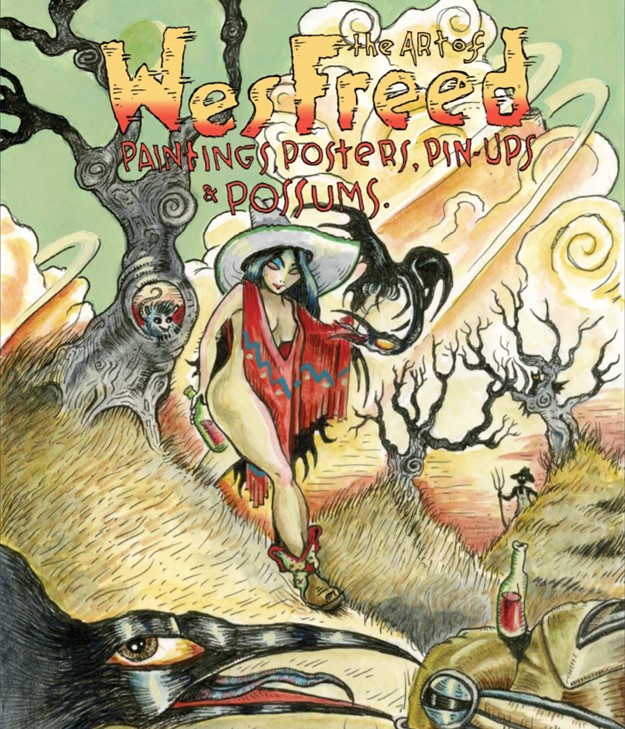
The Art of Wes Freed: Paintings, Pin-Ups & Possums

I know Wes Freed’s artwork via the Drive-By Truckers, one of my greatest musical loves, and this visual art is inextricable for me from that music. Freed writes, “I don’t separate the drawings and paintings I create from the music I make, or from the music I listen to and love so much.” So there you go. I was an easy sell for his book, which comes in chapters by category of art (of which DBT is the biggest), and with a foreword by Patterson Hood.

I can’t imagine how many DBT pieces Freed has created over the years; this can only be a tiny sampling. Next are rock’n’roll legends, including Hank, Johnny, Gram Parsons, Bowie, the Dead, and more; one of the prints that hangs on my wall, of a scene from a Jason Isbell song, is included. (My Townes Van Zandt is absent.) There’s a chapter of Capital City Barn Dance fliers – that’s a monthly show put on by Freed and his then-wife for years. It was interesting to see the kinds of acts who played those shows, and see how much crossover there’s been between my musical tastes and the bands Freed has worked with – Cracker, Camper van Beethoven, the Supersuckers, Those Darlings, and more. I shouldn’t be surprised! Then there’s artwork from Freed’s own bands, some from a comic strip called Willard’s Garage, and photographs of sculptures and cutouts. I would love to someday own a big, solid Moongal like he makes in three dimensions. (I would also like more Freed-drawn tattoos. Time will tell.)

This is a beautiful, large-format, glossy, full-color production. It contains few words: just Hood’s brief foreword and a still-briefer intro to each chapter by Freed. The rock’n’roll legends chapter includes captions. I guess I’d love to learn a little more, but it’s the art that we’re here for, and I can’t get enough of it. I’d buy another several volumes this size just to see more of Freed’s perfectly recognizable, wacky, intoxicating imagination in action.


Rating: 9 moongals.

If you would like to consider owning some Freed art, too, check out his Facebook page, where he posts new prints for sale. They’re quite affordable and he is nice to work with.

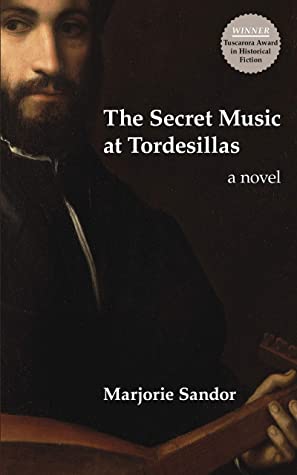
The Secret Music at Tordesillas by Marjorie Sandor

Disclosure: I was sent a copy of this book by the author in exchange for my honest review.


Marjorie Sandor (author of the lovely essay “Rhapsody in Green“) shines a light on the Spanish Inquisition through the voice and music of one man with her historical novel The Secret Music at Tordesillas. It is 1555, and the Spanish Queen Juana I of Castile, also known as Juana (or Joan) the Mad, has just died at Tordesillas following forty-seven years of gentile captivity. One of the handful of musicians employed for her entertainment is the elderly Juan de Granada, who chose not to leave the palace when the rest of Juana’s retinue did; instead, he remains to be questioned by inquisitors, firstly over the fact that he is not at church. The novel is told in his first-person perspective as he recounts his life for a very specific audience, the commissioner and scribe sent to investigate rumors of a secret Jew at Tordesillas. This choice of narrative voice and audience is the first interesting move by Sandor to bring her subject to light. The ways in which Juan aims to ingratiate himself serve to characterize and set the tone; we are always clear on who holds the power in this transaction.

Juan’s story begins by cycling back to 1492, when the Jewish quarter of Granada was conquered and cleared out, and ten-year-old Juan was baptized. He relates how his family and neighborhood were torn apart and forced to assimilate, how he escaped, and how he came to be a part of Infanta Juana’s household as a small boy. Clutching his father’s oud (“that antiquated ‘lute’ of the Moors”) and already well trained in music, he is lucky to continue his musical education and play for royalty. He travels with Juana to Flanders for her wedding to Archduke Philippe, and then back to Spain; he is rarely away from her, in fact, in all his years. And therefore he is frequently with Inés de Castro as well, one of Juana’s most trusted ladies, and a central figure in Juan’s long life.

The old man sits for hours spinning his story for the commissioner and the scribe; there is a hint of Arabian nights in the way he holds his audience, both those two in the book and us, the readers. Between the times he brings us back to his immediate situation – under threat of the suspicion of his inquisitors – we get lost in the story, the present tense of young boy and then young man and then maturity. Juan and Inés, and others, walk a fine line between dangerous secret Jewish traditions and outward propriety. Numerous cultural, musical, and culinary details mark this tightrope.

I confess I was often confused. Better familiarity with this period in history and Spanish and Jewish cultures would have made me a much better reader for this novel. Perhaps I’m unusually ignorant of this material; if you’re like me in that regard, be prepared to keep close track of the details, and perhaps to do a little research as you go.

One of the first things I notice about Sandor’s writing is its lyricism, which is fitting since this is a novel about music and the appreciation of music. I was unfamiliar as well with the implications of musical instruments and styles, but didn’t feel troubled about that; the way Juan talks about his family background and the significance of music was effective and affecting. It was often a lovely story to get lost in, even if I sometimes missed a cue. It is also, of course, a disturbing story. “You know how vigilant the pious are. It is their duty to keep an eye on us all.”

It has been a theme for a few reviews now that I’ve gotten a bit bogged down in the middle of a book. Especially after a few such experiences in a row, I guess this is likely to be at least as much about me as about the books in question. This story is both lovely and absorbing; I don’t know what to say about my small struggles. Perhaps because of my unfamiliarity with the historical period, I was not the perfect audience. There is always so much more to learn!


Rating: 7 lemons.

National Theatre Live at Home presents A Streetcar Named Desire (2014), and other stuff I’ve taken in this week

This week’s release from NT Live is A Streetcar Named Desire, available here til this Thursday, when we’ll get This House. In classic Tennessee Williams style, this play (certainly one of his best-known) is bleak as hell, and frankly it was a little hard to watch, and a little overwrought, possibly even draggy (at three hours long); but I think all of that is as written, and certainly very well produced. Perhaps not to be taken on in the darkest of moods.

This Young Vic production stars Gillian Anderson (yes, of the X-Files) as Blanche, with a hunky Ben Foster as Stanley Kowalski; in my opinion he delivered that mix of sexy, smoldering, and threatening that Brando so beautifully performed in the 1951 film (and presumably in the 1947 Broadway original). I think it’s always an accomplishment when an actor (author, whomever) can convince me that someone is simultaneously detestable and desirable. Vanessa Kirby as Stella rounds out a perfect cast.

The other notable detail is in the set: the entire thing rotates slowly, from the time Blanche takes her first giant slug of whiskey. I dug the way NT Live filmed it, to offer us an experience something like what the live audience would have had: sometimes the actors are obscured; they and we are kept a bit off-balance. It emphasizes the fact that Blanche’s world is tilting and insecure, and she’s not always sure where she stands.

That Blanche is a decidedly unlikeable character. More than I remember. It’s been years since I saw the film, but I feel like Brando’s Stanley was less sympathetic than Foster’s. Blanche grates; but the fact that she grates on Stanley is a big part of the story, isn’t it, so it only makes us more involved if we feel that way, too. It’s agonizing. I took a break partway through, because I was frustrated with Blanche and, to be honest, the play felt a bit long. (Live audiences got an intermission, so it’s fair.) It’s a hell of a professionally produced, totally convincing spectacle, and I admire Tennessee Williams so much, but he doesn’t exactly go easy on his audience. I do recommend this production.


Rating: 7 foxes.

In other news, I’ve become addicted to a show called Shameless, which is silly and quite compelling. (I’m watching the American version, but I’ll hit the British one, too.) This week there was no Patterson Hood concert but there was a Mike Cooley one – I missed his first and was so sorry when I heard he’d done “Daddy’s Cup,” a song I feel strongly about. Oh, man, it was an excellent set on Friday night. Cooley at his best is all beauty and soul and songwriting talent, and sass. These versions of “English Oceans” and “Love Like This” were better than the recorded ones, in my opinion, and I loved his finishing with “Space City.” There is an intimacy to these home concerts – music delivered from the artist’s home to my own, where I seem to sit just a few feet away from him. It makes me feel close to people I’ve felt close to for years, in different ways.

Cooley crooning

This past week, Jason Isbell’s new album Reunions dropped (you can buy it here), and he is one of the bright stars in the sky I see. It’s another good one, with no duds and several real gems. On my first few listens, the tracks that especially speak to me are “Dreamsicle,” “Only Children,” and “Be Afraid.” But they’re all special. A friend asked me the other day what Isbell album she should start with, and boy, that was a hard question. There are now seven studio albums plus his work with the Truckers, and there’s not a one that I’d want my friend to pass up. I ended up recommending “Here We Rest,” because it has several of the songs on it that are most important to me. But it hurt me to choose just one. So, another Isbell album is more to love… I’m still building in my mind the Isbell-related project I need to work on.

That’s it for this past week, folks. Thank goodness for the arts.

National Theatre Live at Home presents Barber Shop Chronicles (2018), and weekly internet round-up

This week’s release by National Theatre Live at Home was the London Roundhouse 2018 production of Barber Shop Chronicles, viewable here until this Thursday when they’ll give us A Streetcar Named Desire, which I am definitely looking forward to.

I went into this play (by Inua Ellams) knowing nothing, and it was delightful. It took some time to grow on me, though. Initially it felt like a series of distinct vignettes from this barbershop and then this one and then this one, which was a little hard to get into. But over time I saw the connections form, and it got increasingly satisfying. Also, there are a number of accents and dialects and pidgin forms of English – I definitely recommend subtitles. This probably made it a little more difficult at first, too, but it ended up added to the richness of the final product. There is definitely musicality and character in the sounds of speech. I counsel patience – it will be rewarded.

In six barber shops in six cities – Lagos, London, Accra, Haware, Johannesburg, and Kampala – men grouse and argue and joke and talk shit, and get a little hair cut. Five African cities, then, and the London shop is rooted in African culture as well; this is an all-Black, all-male cast, with several actors playing multiple roles. It’s very much about the African diaspora in some ways. (There is one Jamaican character, who is careful to distinguish himself from “you crazy Africans.”) The play runs the course of just one day, beginning at 6 a.m. when the Lagos barber is awakened by a man begging for a special early morning job, and finishing at 9 p.m. in London when a barber agrees to stay late for a customer with a similar request. Conversations range widely but coalesce around themes of family, especially relationships between fathers and sons; government and nations, with some hint that Mandela and Mugabe were symbolic fathers (for better or for worse) to their countries; and with a hint of football (no, the global kind – soccer) running through, as Chelsea plays Barcelona on the day in question. The football thread isn’t overdone, but it’s a nice note of continuity. I won’t say too much about it, but again, look for connections to tie it all together and make meaning (sum greater than its parts).

Between scenes, there is popular music and some dance as the men rearrange barber chairs to indicate a new set. It’s a vibrant, lively play throughout, full of life, whether cruelty or love, gravity or jest. There’s advice to be had on women, sex, parenting, race and racism, the job market, politics, academics, and philosophy. “In dark times, the barbershop is a lighthouse.” It’s truly lovely. By the end, I was beaming, and sorry to see these guys go.

Another fine offering from NT Live; can’t wait for the next one.


Rating: 8 posters.

In other things that have pleased me online this week… I have come across several of these, but here’s the latest: famous works of art recreated in quarantine. Some are astonishing in their faithfulness to the original, some in their creativity; some are delightfully absurd, some are lovely works of art in their own right. (And then there’s the ridiculous comment on Saturn by Rubens that set everybody off, if you’re into hilariously dumb comments). I enjoyed paging through them and will click on such compilations every time.

Likewise the rate my Skype room Twitter account. I was over the moon about this, spent way too much time (be warned) and laughed out loud. I should have been taking notes for if/when I have to do more online teaching in the future (eek). If you have to Skype/Zoom/etc., pay attention.

I attended another Patterson Hood concert (from his attic to my living room) on Wednesday, and I do love this man. The way he slaps his acoustic guitar to add percussion. The way he whoops and hollers – it must be hard to keep that live-show energy playing to the internet in your attic. The way he counsels us on current events and speaks to my heart. It’s like an embrace from an old friend, and those are in short supply these days. He dedicated an emotional performance of “What It Means” to Ahmaud Arbery and made me cry. Next week we’re promised a family-mythology-themed show, and I’ll be there.

Patterson Hood

Weather’s getting warmer and I’ve been outside a lot in the last week; hoping for more of that, for sure. And I am reading like crazy. Stay tuned!