NBC’s The Wiz Live! (2015)

I missed round one, but got to see NBC’s encore showing of the remake of The Wiz, a 1974 retelling in turn of The Wonderful Wizard of Oz, set in an urban and African-American cultural context. It has been much talked about and enjoyed, and I’d heard a little bit about Shanice Williams, who plays Dorothy: she’s just 19 and has never been involved in anything this big before, which is its own underdog story. And who doesn’t love that story?

wiz

First, let me admit that I am unfamiliar with the 1974 show (though pretty familiar with the 1900 original), so I can make no comparisons there. I approached this as a happily enjoyable, entertaining remake on a well-loved classic, with a twist, and with a young new star. It was all of those things. There were some changes made for the stage – like, Toto is only present in the opening and closing scenes, in Kansas, and doesn’t make it to Oz. I guess it was too hard to get a dog’s cooperation for the whole. The journey from the house-dropping scene in Munchkinland to the Emerald City was much compressed, and I was sorry about that. The magical slippers are returned to silver, which is how L. Frank Baum wrote them, rather than Hollywood’s red. There was a new mini-storyline, wherein Dorothy is actually from Omaha, only recently living with Aunt Em after her parents’ deaths. Thus, in her searching for home she has to parse which of these places really is home, which I thought was a nice addition for depth, and which I identified with personally, too. The original story is very much about a concept of home, but even more complexly so in this rendition. I approve. Oh, and of course: the Wiz is a woman this time around! “His” false public character is still male, but the ballooned-in accident from Omaha is female. I found this a welcome twist.

Overall it was far from a flawed performance, though. There were some rough spots: imperfect synchronization of effects, the Wiz tripping on “his” robe. Though star-studded, the acting was a little uneven. I thought the Tin Man (Ne-Yo) was genius; the Lion (David Allen Grier) was a little underplayed, a little blank. The Scarecrow (Elijah Kelley) actually became a little unlikeable to me, as a character, for the first time ever. Queen Latifah as the Wiz was a great casting idea, but fell a little short: it felt like the songs she had to sing were a little below her usual register, and she didn’t get to belt out like we know she can do so well. Once she stepped out of her Wiz costume, though, and became the woman behind the mask, she hit just the right notes – in portraying her character, that is. I did appreciate Stephanie Mills as Aunt Em – and also appreciated the nod to her role as the original Dorothy in 1974. Shanice Williams herself is beyond complaint, though. I found her engaging and heartfelt, fully committed to song, dance and acting.

As a filmed stage production, I found The Wiz thoroughly disappointing, but that’s because National Theatre Live has got me so spoiled. The work NT Live does is unparalleled excellence: I actually remember myself as being at those shows, rather than in a movie theatre. The camera angle changes: it shows the whole stage (including the front edge, so we can see it’s a stage), different parts in medium-close-up, and close-up angles on individual characters. We see all the set changes (no commercials), so we get the feeling for a real, live stage show. The Wiz clearly took a very different approach. We saw no stage settings (commercial breaks!), and the angle never cut so widely as to give a feeling for the stage itself. For that matter, NT Live shows shots of the audience before and after the show and during intermission, so that I feel like I’m with that crowd in London (or wherever). It remains unclear to me whether there was an audience present for The Wiz. And if not, what a shame for the players. Filming of a stage show is clearly not NBC’s strong suit here.

Uneven performances (but some of them were stellar!), some very fine singing and a classically loveable story make for a pleasing experience, if you didn’t expect too much coming in.


Rating: 7 winged warriors.

National Theatre Live presents Jane Eyre (2015)

Pops suggested this stage production of Jane Eyre to me, and I confess that I was at first hesitant. Jane Eyre is not among my favorite novels. Perhaps in juxtaposition to Wuthering Heights, I at some point developed some rather negative feelings about it. (Recall my discussion with Erin Blakemore, here.) But it was an intriguing concept, this adaptation to the stage; and I have been nothing but impressed with past National Theatre Live performances (Treasure Island; A View From the Bridge). So we went.

The Lincoln Theatre in Mount Vernon (a town about 30 minutes south of where I live now) is always a treat, and we found a tiny hole-in-the-wall Thai place beforehand that was worthwhile, too. And I had rearranged my mindset by the time we got there. It has been years since I read Jane Eyre. And I love the stage. This will be great, I thought. Of course it was!

JaneEyre

As we have seen at past NT Live shows, the set design was innovative and well done: so extraordinarily simple, just a few platforms and levels of planking, with lots of stairs and ladders throughout, so that the players create the impression of distance covered by sort of doing laps. And because there was no decor, any space could be anyplace at all. Same with the actors: I believe it was a crew of about six who played every character in the story, by simple costume changes and adjustments in accent and attitude; we never had trouble following along. Another less-is-more approach, which is always a clear winner with me. I think I’m done with elaborate costuming and set design. (She says, until the next beautifully elaborate production comes along.)

I was taken with the way they put together this adaptation, too. The company did it cooperatively, through improvisation: they all read the book, got up and freestyled. There’s a great clip, Devising Jane Eyre – and you get a glimpse of some of the actors there. (Then check out the trailer.) It’s a stripped-down version this way, purified if you will. This is not the Jane Eyre I remember. I remember Jane Eyre being a rational, thinking woman’s novel, almost austere, where Wuthering Heights was all passion; but this play was steeped in passion, as well as that groundbreaking feminist thought that we recall Jane for. She still makes (the same) choices of self-deprivation, but they are made with passion. I loved this woman. This company made of Bronte’s work something different – and, for me, better. (I can hear the novel’s fans gasping. They’re just personal reactions, folks.)

The acting was magnificent, and I will say that this version of Rochester was a heartthrob (also something I do not recall from the novel). But all the acting was magnificent. The woman who played Jane’s friend from boarding school, and later played the pastor Rivers who proposes, was perfect in every role; and the woman who played Jane’s mother, then the maid, then Rochester’s girlfriend, was stunning. Even Rochester’s dog, Pilot, is a joy to watch, played by a man (great fun). The communication of Jane’s inner thoughts – always a problem in adapting books to screenplays or stage plays – is solved with pure genius: a group of (I think) 4 actors gather round her, all talking at once, like a Greek chorus inside her head. She dialogues with them. Pops and I were both mesmerized by this inventive and entertaining solution.

Another unique angle we observed was gender- and race-bending (if you will). There were two black actors who fit right into the story without comment or need for explanation; we both liked that introduction, a modernization if you will, since historically Jane Eyre’s mother was decidedly not black; but we were happy to see it fit right in. And during Jane’s stay as a student at Lowood Institution, a boarding school for girls, all the same actors played her classmates – including two men, one of them bearded. But we understood: in this scene, these are all little girls. I think we were both tickled by these new angles, and happy to play along.

The cues used to switch us from Jane as newborn baby, to Jane as young girl, to teacher, to governess, to bride, etc. were simple but effective. She never left the stage, I don’t think, in the whole performance; she made tiny costume changes onstage, not hidden but as part of the action. Her Greek chorus helped her changed into her wedding dress and then back again into the costume of her lower social standing, and this was a symbolic and important part of the story. I liked this new way of signalling changes in time, place and action. Again, minimalist but effective.

The stark simplicity of stage and costuming, and even in the number of actors involved, and the distillation of the novel to its most powerful, moving, and passionate elements, was supremely successful. I regret my hesitation: I will see anything produced by National Theatre Live. And on that note, let me point out that all those fine folks in the Bristol audience paid a lot more money than I did to see this play in person; but I got close-up shots and all the right angles. The invisible element to the National Theatre Live format is cinematography. They claim, and it is true, that each of us at the Lincoln Theatre in Mount Vernon, Washington had the best seat in the house. What a deal.

And now the question of whether to reread. When I try a beer again after years, that I used to love, and I no longer like it: have my tastes changed, or my very taste buds; or have they changed the recipe on the beer? When your professionally-fit bicycle no longer feels right, has the bike changed? No, your body has aged. I wonder if I would appreciate the novel more today because of my age, maturity, life experience then I did when I was… I think I read this as a teen and again in my early twenties. Or is it just this production that worked so well for me? What do you think?

Not in question is my rating of this theatre experience. Go find yourself some NT Live: it’s worth it.


Rating: 10 fires burning brightly.

best movies of 2015

I am as surprised as anyone to see that I reviewed fifteen movies in 2015. For me, this is a lot. We are not a big movie-watching family: Husband can’t sit still that long. So I thought I’d put up a new kind of best-of post, in honor of some great films I saw this year.

I gave one movie a 10 this year, although it is sort of a mixed-media piece, if you will: the Young Vic’s A View From the Bridge, which is a live-filmed stage production. I am going to count it, because it’s done cinematically, not just with a stationary camera in the audience. As I am learning, any National Theatre Live productions are worth making time for.

I gave several ratings of 9:

And, I can’t help but mention the National Theatre Live offering of Treasure Island, which I rated an 8 at the time but still think fondly of.

Funnily, perhaps unsurprisingly, not a one of these was a Hollywood new release (although several documentaries were new).

It’s been a great year for movies for me; I feel privileged. Here’s to some quality screen time in 2016.

movie: American Psycho (2000)

Lots of movies around here, hm? I mean, relatively speaking. I think I will add a movie section to this year’s best-of list!

american psycho

Following Psycho, I was drawn to this later work which has only tangential relation to that Hitchcock classic. American Psycho was released in 2000 and set in the late 1980’s. Christian Bale is Patrick Bateman, a wealthy young man ostensibly employed by his father’s mergers-and-acquisitions firm on Wall Street (he doesn’t really work). He’s creepy, just like all his peers: deeply materialistic and concerned with fitting into a type, womanizing, narcissistic, spoiled; he snorts coke in the bathrooms of nightclubs and exclusive restaurants and swaps fiances with his friends. The level of detail that goes into some of the markers of this type is extraordinary, and a big part of what establishes this movie’s satirical dark humor. This was one of my favorite features, this oddly close attention. For example, Patrick compares business cards with his “friends” (colleagues he actually strongly dislikes): they all look alike, in colors like eggshell, white, and off white (Patrick’s is a color called “bone,” naturally), and yet they see distinctions in what is clearly a heated competition. Patrick uses “I have to return some video tapes” as an all-purpose excuse. Late in the movie, in yet another scene obsessing over dinner reservations, one of his “friends” says, “I’m not really hungry, I just need to have reservations somewhere.” This stuff cracked me up completely.

The first, oh, maybe close to the first half of the movie is caught up in slow-paced scenes like this that specialize in the absurd by focusing on minutia. The opening scene focuses on Patrick’s beauty regimen: quite elaborate. During these scenes, we hear a lot of Patrick’s interior monologue, intimate, low-spoken. The effect throughout this early section of the film is arty and frankly weird; I think Husband was checked out. And then the killing begins. Patrick Bateman is the movie’s titular psycho, and there is much blood (although happily no graphic gore in terms of body parts or brains, just… blood). It’s jarring, the transition from business cards and moisturizers to wild laughter and blood spatter. And of course jarring is the point.

The movie has a big reveal at the very end that leaves the question of Patrick’s crimes, and his level of psychosis, perfectly ambiguous. I will leave this spoiler-free but say that Husband and I were left with only conjectures, and no clear interpretation. This could be fascinating, or maddening, depending on your personality. I poked around the internet and found that no one else is really sure, either (link contains piles of spoilers). I am a little unsatisfied by this lack of closure, but it will also keep me thinking about this movie for some time, so that is probably a victory for its makers – who, however, according to the above link, wished they’d left things less ambiguous. Sort that one out.

A thoroughly strange and memorable film, and I’m glad I spent my time watching it, although some of my other feelings are less clear to me.


Rating: 7 business cards.

movie: The Winding Stream (2014)

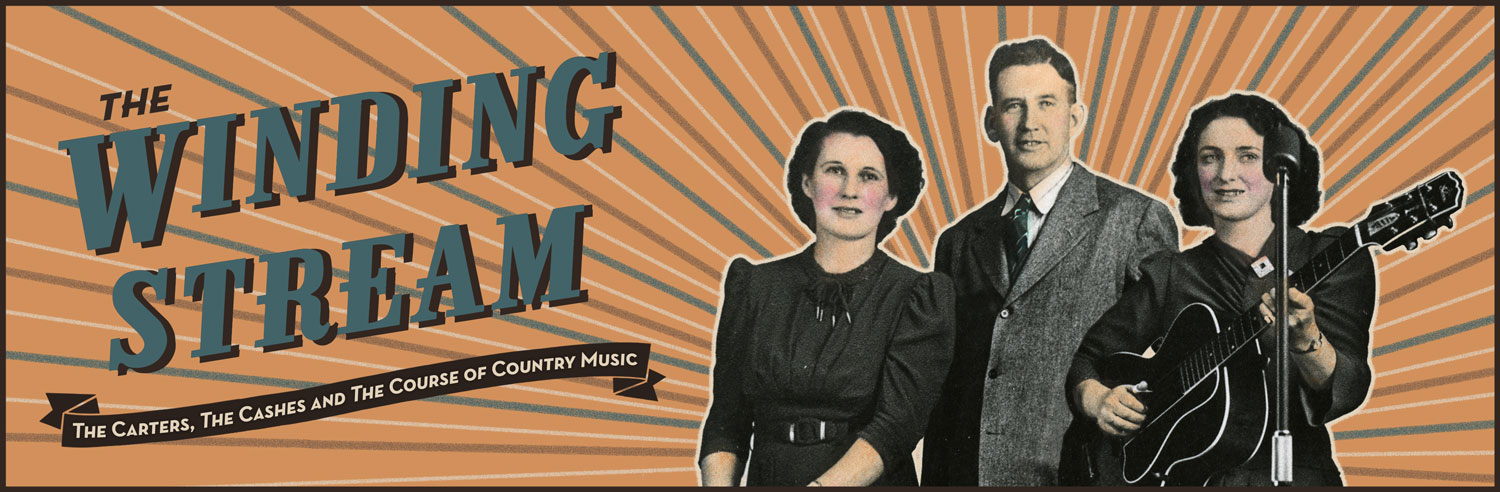
The Winding Stream is a documentary about the contributions of the Carter Family (plus Johnny Cash) to music as we know it. I was deeply impressed, and learned a lot, and was reminded here and there of another excellent music-history documentary, Muscle Shoals.

source

source (click to enlarge)

The Carter Family began with the trio of A.P. Carter, his wife Sara, and Sara’s cousin Maybelle (also a Carter by marriage to A.P.’s brother), who began playing music together in the 1920’s. The scope of the story is astounding, how many of these Carters there were and are, how many songs they recorded – the original trio left 260 recordings behind as their legacy, if I remember correctly. A.P. was an early music ethnologist, who traveled throughout his region – the Appalachian mountains of Virginia – seeking out old songs, “mountain music” as they called it (there was no “country music” yet). He noted the lyrics and the tunes and took them home, where he and Sara and Maybelle arranged them, rebuilding them somewhat, and then recorded them for the Victor Talking Machine Company. Today it occurs to us to wonder about the ethical implications of all these songs ending up being Carter songs; but as the movie points out, back then there was no concept of music being “owned” by anyone in particular. And but for A.P.’s avid, even obsessed calling to save this old music (even at the cost of his family life), many of those songs would have been lost to history in the Appalachian hills.

The trio eventually became part of a radio empire in Mexico, just across the border from Del Rio, Texas: “border radio” sprang up to avoid U.S. regulations, and used a high-powered frequency to send their programs across the States. (Stranger than fiction: the founder of the Del Rio border radio station was a doctor famous for his goat gland transplant procedure that supposedly boosted men’s sexual function and who promoted female circumcision [to make women less frigid, he claimed].) This is how a young boy named Johnny Cash first heard the Carter Family singing their old-timey songs. The group by this time involved some of the next generation, including Maybelle’s three daughters who would eventually be the Carter Sisters; one of them was little June. As Johnny Cash grew in stature, he kept Mama Maybelle close: in footage from his late life, he calls her the biggest star he ever knew.

The story goes on from there. You’ve heard of Johnny’s daughter (June’s daughter-in-law), Roseanne Cash. Their only child together, John Carter Cash, appears in the movie with his wife, an avid student of the Carter Family history who inspired him to learn more about his own legacy. These contemporary Carters still play the old music. In fact, one of the impressive details is in how many Carters there have been, and how they all seem to have had that music running in their veins: it was just a part of their lives, it appears, and they all could play. For example, Janette Carter, A.P. and Sara’s daughter, appears throughout the documentary, recalling her parents and their career. Only late in the movie do we learn that A.P. asked her on his deathbed to continue the legacy – and so she opened a dance hall and picked up her guitar and played. All of these characters – so many Carters – are rich, colorful figures in a compelling history.

As with Muscle Shoals, this film inspired a purchase: we went out immediately and bought an album by the Carolina Chocolate Drops after discovering them onscreen. One of the points made throughout is that the Carters have influenced all the music we know today. Like the (better-known) Beatles, everything that came after had a note of Carter Family in it.

Not only an extraordinary story, The Winding Stream is a well-produced and visually pleasing documentary, rich with family, detail, and emotion. I will say that in the animation of old black-and-white photographs of the original trio performing their music, the moving, blinking eyes were entirely creepy. But this was a rare treat of a movie. I learned a lot, and the music was outstanding.


Rating: 9 songs saved from extinction by A.P. Carter.

movie: Rear Window (1954)

Happily, after some disappointment with The Birds the other night, I moved directly into another Hitchcock film that pleased me far more. I found Rear Window entertaining, clever, funny, and visually pleasing. Jimmy Stewart and Grace Kelly don’t hurt, of course. But fundamentally, I think murder-mystery ages better than horror, and that is what Rear Window is: not horror, but a noir murder mystery, which is one of my favorite things.

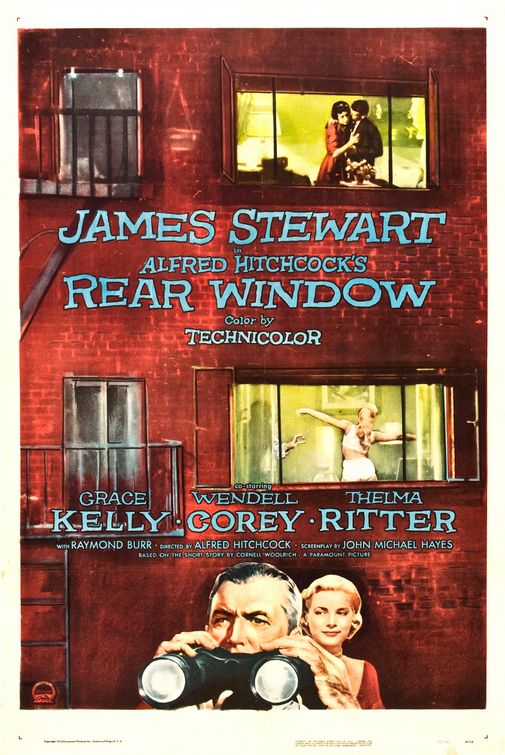
rear windowJames Stewart is L.B. Jefferies (“Jeff”), successful photographer of the adventurous sort, known for action shots, combat and the like. He is laid up with a broken leg, in a wheelchair, in his apartment, which suits him poorly, of course. Also irksome is his girlfriend and would-be fiancé, the lovely Lisa (Grace Kelly), a wealthy socialite he feels can’t possibly accept his life on the edge. Bored and bothered, he takes to spying on his neighbors out the window. The entire movie takes place from this perspective: we only ever see the inside of Jeff’s apartment, and the view he sees out its window, into a courtyard and the windows that also look upon it. There’s a middle-aged couple with a little dog; a female sculptor; a young ballerina who entertains many men; a slightly older, lonely woman; a composer struggling with his latest work; and a salesman who appears to be entirely tired of caring for his invalid wife. Jeff is visited by Lisa as well as a nurse, and a police detective friend he calls on for help when he thinks he’s witnessed a murder.

I loved the visuals: both James Stewart and Grace Kelly (particularly in tandem), and the vignette-style views of courtyard and other apartments, almost a shadowbox effect. I loved the survey of lives and loves provided by Jeff’s perspective. The lives he peeks into represent a range of experiences of life, different levels of contentment. I thought the suspense was well-done in a classic, thunder-and-lightning, guns-and-beautiful-ladies style. Even the puzzle itself – the whodunit – was engaging, if imperfect. The business with the flashbulbs struck me as quite ridiculous, but I laughed good-naturedly, because the overall effect of the story, the sets and the cast was so enjoyable. My fourth Hitchcock film is definitely my favorite. Fans of Agatha Christie will be pleased.


Rating: 9 little red pills.

movie: The Birds (1963)

I am continuing my studies of Hitchcock with The Birds, after reading the short story just the other day. As I anticipated, it changed a great deal in adapting for the screen: in fact, only the concept of the birds attacking carried over; none of the characters or the setting were the same. (It was still set on a shore, but in California, not England.)

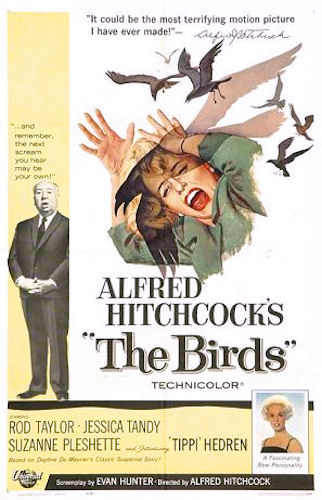
the birdsAnd I must admit, this was a sillier movie than Psycho. For one thing, The Birds necessitated special effects, and 1963 special effects do not play well in 2015. The attacking birds were a low point in the action, for their unrealism. (I suspect the sound effects of rioting birds were provided by screeching cats.) For that matter, the threat the birds posed read well on the page, but did not ring true onscreen: much flailing, of people and of birds, but not much evidence of real danger. As in Psycho, drivers persisted in getting into their cars via the passenger door. Also, they walk into one another’s homes – even strangers’ homes – right through the (unlocked) front door, sometimes without knocking. This I find most strange (and it happened in Psycho, too). Was this a 1960’s reality??

The early storyline begins in the bird shop and involves two people engaged in a bit of a feud; this quickly and strangely progresses into gift-giving and making out, which progression was not entirely transparent to me. I was interested in the friendship developing between Melanie and Annie, though. More so than in Psycho, I found a few of these characters to be fairly interesting people, and I liked that most of the key characters were women, Mitch being defined by relationships with mother, sister, ex-girlfriend and new girlfriend. But then our female lead, who had been a fairly strong woman, became a big heap of limp weakness, which was thoroughly disappointing. (Although perhaps unsurprising, considering 1963.) There was one visual, of a moonlit car on beach with birds, that I found striking. Other than that, this one gets a general ‘meh,’ and does not satisfy in the way that Psycho did. I’m happy to believe it did better than this in its own time, but it translates poorly to the modern one.

For me, not Hitchcock’s best.


Rating: 5 crows.

movie: Psycho (1960)

How about a horror movie for Friday the 13th, hmmmm?

I enjoyed this Hitchcock classic. I don’t care what Husband says.

He says he can’t believe people were frightened by this. But I think that 1960 was a different time. Susanne Antonetta writes in Body Toxic, “Nobody was supposed to talk about Psycho. My parents came home unable to sleep.” I can believe that this movie was scarier then; I thought it was scary now, although I certainly noted the ways in which it’s dated: slower paced, longer pauses, far less graphic (on which more in a moment). The psychological question is every bit as chilling as ever. The bones of this movie are still scary; the production is of another era, is all.

Some of the elements for which Hitchcock is known – creative camera angles (downright innovative at the time), stark, simple shots and sets, psychological drama, and in this case, low budget black-and-white – were plainly evident. For that matter, it was graphically violent for its time, I’m told. (We noted that there was strangely little blood in that one scene, but maybe it was a lot by comparison.) It’s a little hard to see these things in context, as I was neither alive nor a movie-goer in 1960 when this film was released. But even from the vantage point of 2015 – when new releases are frantically fast-paced and horror movies flow with blood – I can see the artistry here. It’s a different viewing experience now than it would have been then. Now, it looks vintage, dated, but still charming, and still chilling. Janet Leigh’s pin-up-style beauty is classic; all those shots of her dramatic mascara in black-and-white are arty in a way you don’t really see any more. The one really famous scene was striking, again, whatever Husband may think. I also noted the MacGuffin (a term I learned just the other day while looking up Hitchcock). Actually, the item that bothered me was not a shortage of frightfulness, but a hole in logic: it didn’t make sense to me that Lila and Sam would be so confident in the existence of Mother when they have just talked to two people who saw her buried. (Spoiler in white text – highlight or select to view.)

If you notice I’m being cagey about the plot, it’s because I hold out hope that there may still be someone out there like me, who has never seen this movie and really doesn’t know much going in; and for that person, should I reach her or him, I am avoiding all plot description. Go see it blind, Hypothetical Reader.

I’m on board for the classic thriller/suspense/horror genre, and I like a good psychological twist. More Hitchcock to come.


Rating: 7 sandwiches.

Final note: Husband was deeply frustrated by the consistent habit of drivers, traveling alone, to get in and out of their cars via the passenger-side door, sliding across the bench seat. I have offered that the hoods on these old cars are so long that maybe this really does provide a short cut?

movie: Montage of Heck (2015)

Montage of Heck is the recently released documentary about Kurt Cobain’s life, and we got to see it in the theatre during Pickford’s Doctober. In a word, it was an unsurprisingly depressing, but compelling glimpse into an interior life that I did not know a whole lot about. It was well put together and enjoyable (in a depressing way) to watch. It was also fairly interpretive, on which more in a minute.

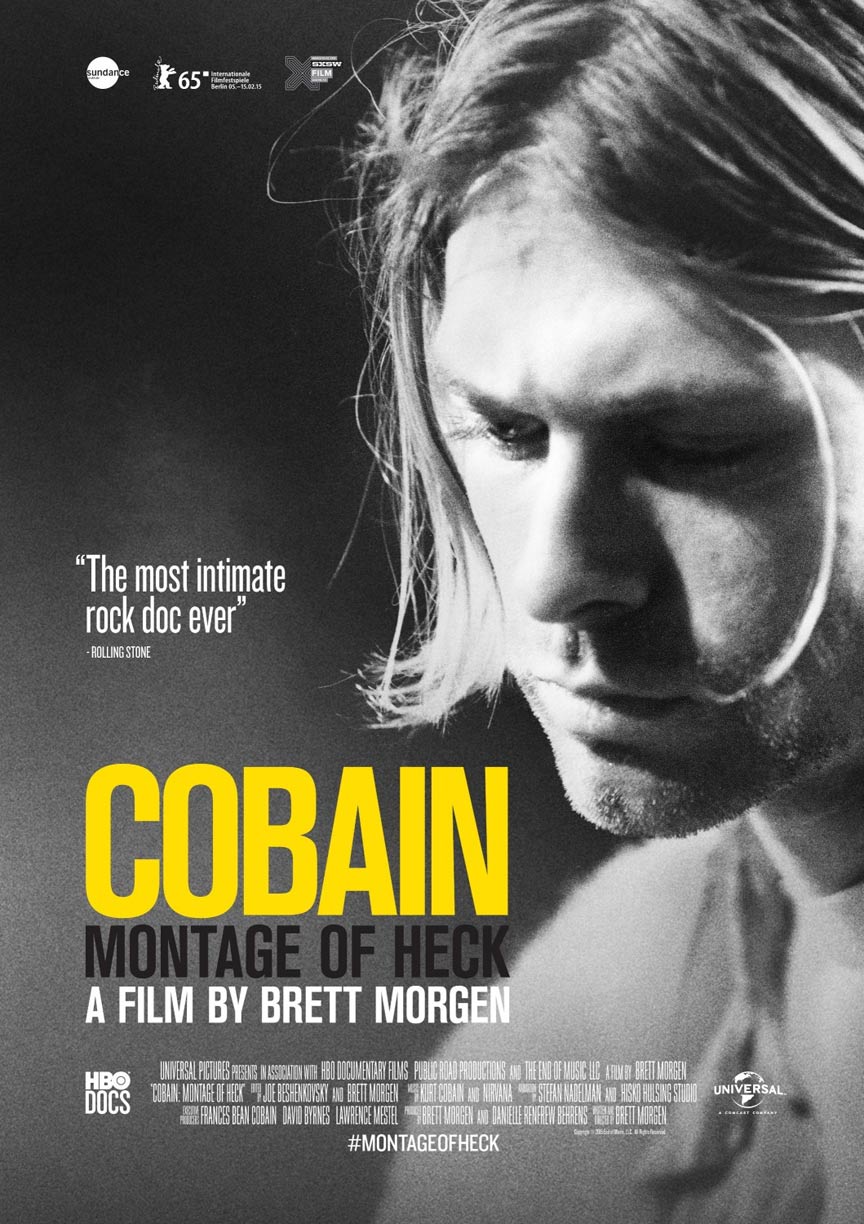
montage of heckAs a piece of art in its own right, I found this to be a fine film. I like the collage effect, of old home videos, recent video (of interviews with Kurt’s parents, Courtney Love, and Nirvana bassist Krist Novoselic, among others), concert footage, stills and animations from Kurt’s journals and sketchbooks, and animations of Kurt’s life. It was dynamic and expressive, like him. I learned a lot about him (I like Nirvana but am no super-fan, and no expert on his life), like that all-too-familiar combination of genius creativity, hyperactivity, and disturbance. I didn’t know about his stomach problems or the ex-girlfriend Tracy. It’s an enthralling story, and this movie made it immediate, and moving.

On the other hand, I am troubled by my lack of understanding of how real any of this is. I said earlier that the film is quite interpretive. The soundtrack includes synthesized and orchestral renditions of Nirvana songs: what would Kurt think about that? And the animations of his journals and sketches assume chronology and intention; who knows for sure? Contemporary footage of Kurt’s father and step-mother leaves the former looking nearly catatonic; I can’t believe there isn’t an editorial angle on that. Kurt’s daughter Frances is a co-executive producer. She’s family; she has as much business here as anyone. But she never knew him, as she was not yet two when he died. Even with the best of intentions, who knows how much she got right? Not to assume she had total control over the content…

Any time an artist dies, their work will be interpreted and presented to the public by someone else. And all artists die, although not all so young as Kurt Cobain. This is not a new concern. But this film did more interpretive work than it necessarily needed to do, and that just got me a little curious, and a little anxious. I like knowing where the line is drawn, and here I don’t know. If I knew more about his life beforehand I’d be better equipped to make judgments, but of course that would come with preconceptions and bias, too. And then there’s this guy who says it’s all a load of sh*t, and who do we believe?

As Husband pointed out, the footage of Kurt and Courtney in their apartment with baby Frances was hard to watch. Some of their home life goofing off was sweet, in a messy way – it really looked like they had fun together – but once there was a baby around it got more straightforwardly disturbing. What did we expect, though?

While I’m exploring expectations: the movie does not deal with his suicide at all, other than stating it in plain white text on a black screen. I’m sure some of us came for the sensationalism of learning more about his death, and those folks will be disappointed. But I can’t argue with the dignity – or maybe just the shying away from pain – involved in turning away. At what point should we expect his family or anyone who loved him to turn his death into movie theatre entertainment? What do we want, crime scene photos of splattered brain matter? I’m okay with this treatment.

This was a pretty great movie, unto itself. But it left me with more questions than answers, and feeling a little unsettled about the idea of Truth. Maybe that’s not the point. Beware Montage of Heck as an authoritative source on the life of Kurt Cobain; but for visual imagery and a moving experience, please enjoy.


Rating: a conflicted 7 unwashed locks.

guest review: movie: Run Free, from Pops (2015)

Pops has been to see the documentary film Run Free, which handles the subject matter of Born to Run which he’s earlier reviewed for us. His review is below.

In follow-up to the Micah True, Caballo Blanco story introduced in McDougall’s book, I saw the just-released doc film by Seattle director Sterling Noren: Run Free. Noren began working on the general idea of a film after a chance meeting with True in Mexico in 2009. After Born to Run was published, True heard Hollywood was planning a film so he requested that Noren help tell the “real story” with his own film.

Noren’s film is wonderful; his work benefits from True’s cooperation and many interviews with central characters including McDougall, runner Scott Jurek and Luis Escobar, who also contributes great still photos taken over the years. It features the beautiful & magical Copper Canyon in Mexico, the special native towns there and of course the Tarahumara themselves – and True’s special relationship with the place & its people.

Filming includes the 2012 version of Caballo Blanco’s Copper Canyon ultra race; and then Noren’s crew was on hand for the immediate aftermath when True goes missing in the Gila Wilderness (as I related in my earlier book review.) McDougall’s fun & mythical tale as told in the book becomes starkly real in the film – both in the simplicity of Tarahumara subsistence culture, and the sad poetry of True’s final, fatal run.

The film’s narrative effectively invites us into the eccentric world of its main character & the close network of ultra runners, which makes their role in the wilderness search & subsequent memorial events all the more poignant. It’s a powerful story for those who can connect, from a number of perspectives. For this runner, four decades in, it was that and more.

Thanks, Pops. I’m glad – but not surprised – that you found it so powerful.