National Theatre Live presents War Horse (2014)

National Theatre Live does it again with War Horse, an encore edition of a performance from 2014. Husband and I saw this live-filmed play at a San Antonio movie theatre on December 8, 2016. I am again going to rave about a stellar story, staging and performance (as well as the NT Live delivery system which I love more and more).

war-horseThe story, based on the novel by Michael Morpurgo, involves a horse and a boy. The year is 1912. Boy’s drunken father unwisely obtains horse while drunk, and boy is tasked with training and racing horse til it becomes saleable at a profit. The boy, Albert, names his horse Joey, and the two become very close; then World War I breaks out, and drunken dad sells Joey to the army. This is an evil thing for him to do, although he does point out later that the army would eventually have come for the horse under anyway. Joey sees battle and various masters. Albert runs away to lie about his age and join the army, in search of his beloved and noble friend.

It is a striking story with all the right emotional notes. Elements of Black Beauty and White Fang, etc., but that’s really to say that the best animal stories contain the same elements, not that anyone is copying anyone else. I cried twice (no spoilers here); but I will say that in the proverbial sense, when librarians (etc.) talk about books and ask “does the dog die?” – here, the dog does not die. This is a figurative dog, y’all. Added to the classic beloved and noble animal story is war; youth and innocence; friendship, loyalty and reconciliation; even some family dynamics. Very thorough and appealing, theme-wise.

But how does this great story with so much potential make it to the stage? Well, the first problem is working with animals, right? So the smart folks at NT Live worked with a South African puppet company, and the results are mindblowing. The horses are life-size (at least), operated by three puppeteers. As a colt, Joey is worked by three people moving alongside; but as an adult, two puppeteers stand inside the body of the puppet, and one outside operates the head. No efforts are made to hide the puppeteers. The show opened with a few lines of monologue and a song while colt-Joey explores the stage, as (I interpret) the audience gets a chance to get used to this set-up. In these moments, I concentrated on seeing the horse and not his three operators; but I quickly turned to watching the operators themselves, because what an interesting job! Immediately, this choice became a non-issue: the horses were astonishingly lifelike. They articulate complexly: every joint of the legs, the full curve of the neck, tail and ears, accompanied by the snorts and breathing provided by the puppeteer actors, as well as full-body shivers or heaving breaths – all of this absolutely brought a convincing, living horse to the stage. The actors who occasionally appear to the eye nearby (they’re there all along, but only occasionally did they appear to me, so absorbed was I in the horse himself) only add to the impression of artistry.

On top of the complicated and inspired puppetry, the company used lighting, projection and sound effects to bring a whole world to an extremely simple stage design. As we’ve seen before most notably in A View From the Bridge, the settings and props were minimal, but very effective. I won’t say too much about this part. But I think it’s fascinating how very much can be done with so little, with the not insignificant contribution of lighting effects; and here the light & sound helped to emphasize another thread of the plot, in a neat trick that I’ll leave for your viewing pleasure, because you’ll want to rush out and find this performance near you.

Of course the acting was superb, blah blah… one expects that from National Theatre Live, and they absolutely meet expectations. I’ve said it before, but the beauty is that this unique format – the live-filmed stage play on a movie theatre screen – really takes advantage of the best of both worlds. I get to see some of the world’s finest actors close-up, more cheaply than flying to London, with a pack of peanut butter M&Ms I snuck into the theatre. This is certainly one of the finest NT Live plays I’ve gotten to see, and I feel so lucky.

I don’t think the cinematography necessarily did as much as in some shows I’ve seen – fewer close-ups than I remember, that sort of thing – or maybe it just disappeared in the richness of the whole experience. This is certainly not a weakness. The shots varied and moved with the action, and it was all perfectly effective. I’m not sure I can think of a way to improve upon this performance and the way it was delivered to me in central Texas.

Perhaps the best part of all of this for me was that Husband really enjoyed it, too. Frankly I was a little worried he’d find it slow; but the emotional impact of the story, and the wild achievements of the creativity of staging & the puppets themselves, impressed him as they did me. There you go, folks, the highest praise: pleases all audiences.

I always recommend NT Live highly. This might just be the best I’ve seen (I don’t know, who can choose, don’t miss A View From the Bridge or Jane Eyre either). It’s playing in a number of theatres; please do yourself a favor and see if you can find a showing. Enjoy.


Rating: 10 collars.

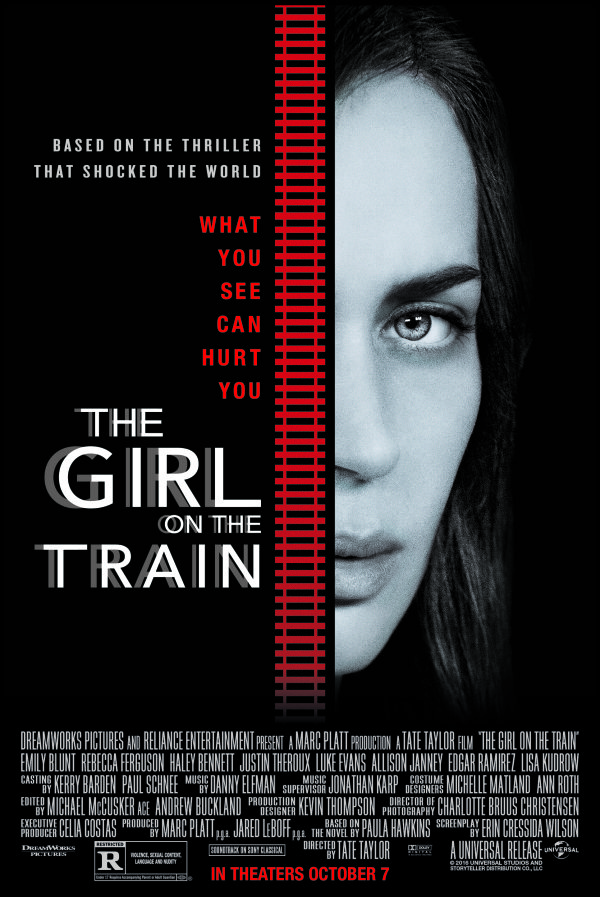
movie: The Girl on the Train (2016)

The Girl on the Train is based on the novel of the same title by Paula Hawkins. I have not read the book, and knew nothing of it when I was invited with a group of friends to go see it in the theatre. For a total unknown like that, I found it quite enjoyable. One of my dates who had read the book reported some changes in adaptation, and it sounds like the book was better; but what else is knew. I think the real issue is that books don’t become movies and still resemble their book-selves. This is natural. Perhaps we should stop expecting bookishness from film.

girl-on-the-trainRachel is divorced, and having some trouble moving on. She takes the train to work everyday past her former home, where her ex-husband lives with new wife and baby. She obsesses. Then she shifts her obsession, just slightly, to the couple who live a few doors down from her ex. She watches them; she imagines them the perfect couple. She sees something; and things spin out of control.

Suspense and surprise are a big part of this movie’s thrill, so I’ll leave it at that. There is a major plot turn I’m afraid to even hint at, but it’s a good one. Another big part of this movie’s thrill are blood and violence: not a great quantity of it, but what there is is fairly graphic, so be warned (or teased). As some critics have noted, there is not enormous character development (this was the main departure from the book, according to my memory of my movie date’s report). But the acting is more than fair, in my opinion, and I would call this story – at least the movie version of it – plot-driven rather than character-driven, so it still worked out okay for me. I enjoyed the mystery, the twists and surprises, and the bloody denouement. This was an entertaining thriller. Not mind-blowing, but worth the price of entry. I’m even interested in the book now – even though I know its secrets – and that may be the nicest part of all.


Rating: 7 wine bottles opened.

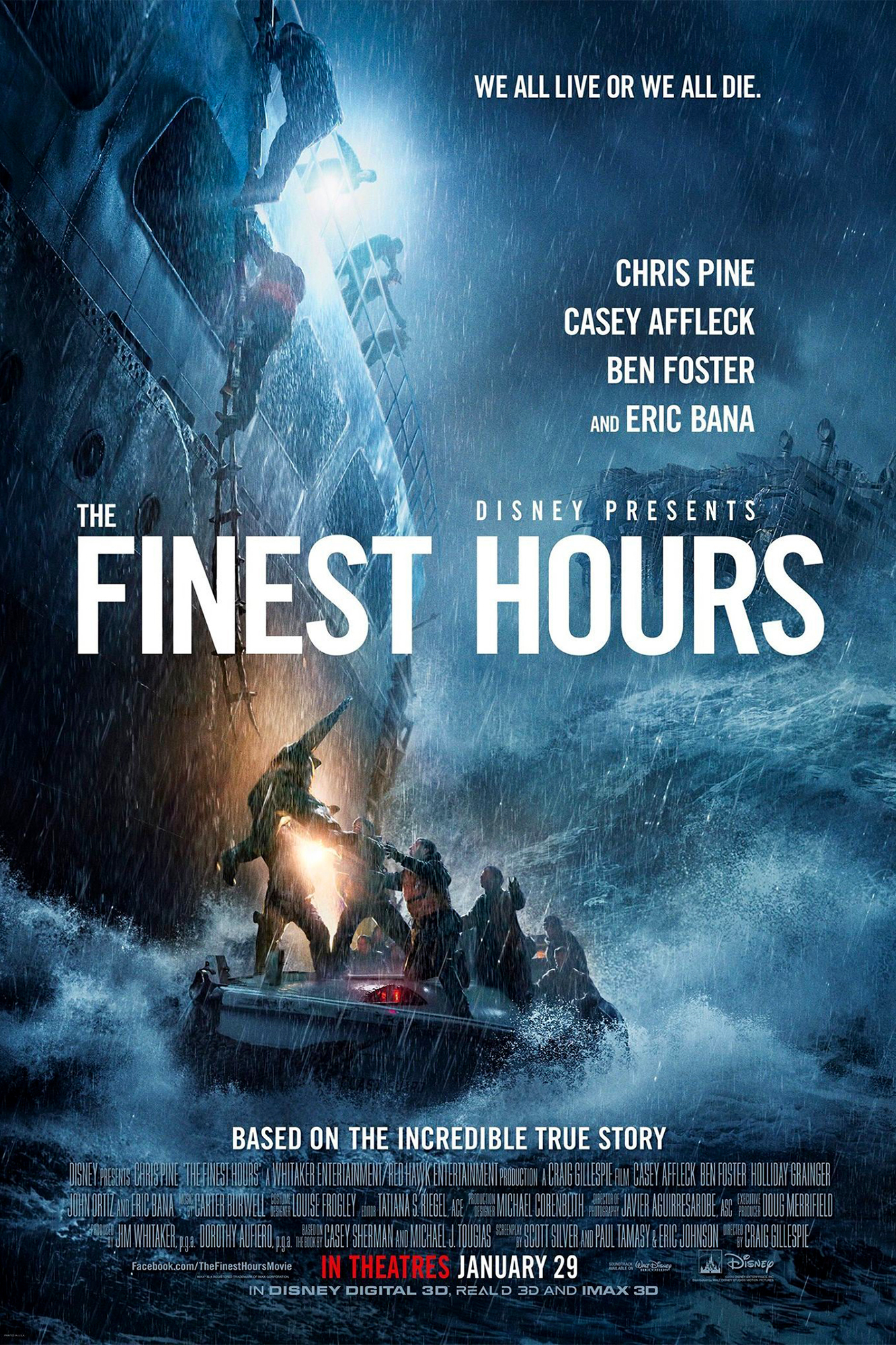
movie: The Finest Hours (2016)

Our very first television event in the new home. Hops (the littler dog) was so grateful to see a couch again!


finest-hoursI think I can sum this one up briefly. Good: astounding story (based on a true one), fine acting, very fine action & cinematography; exciting, suspenseful, moving. Bad: weak romance, lack of character nuance, laughably unrealistic action & technical details.

The U.S. Coast Guard’s rescue of much of the crew of the SS Pendleton tanker in 1952 – a true event – is an impressive story, and that was captured here. The broadest details of the rescue are hard to believe, but they are a part of recorded history. This action/drama is both an appropriate recognition of this event, and a little bit of a sullying, because it made such a mess of it in smaller ways.

The romance between hero Bernie Webber (who piloted the rescue craft) and Miriam is a little flat, and both characters are caricatures. The evolution Miriam experiences in the course of the movie is predictable and therefore less moving than it might have been, if the characters had been more complex and realized. I’m not sure the romance was necessary to make the movie work, although Miriam is of course a character in real life and so perhaps did deserve to be there… in which case I wish they’d either done more with her (let us see a multifaceted human), or done less (show that the man had a girlfriend who worried when he did his dangerous job; we can all extrapolate from that).

The technical details of the action scenes were flawed. In a huge storm, the rescue boat repeatedly goes under big waves – waves ten times its height – with two crew members sort of hanging on its deck. They remain there; one even keeps his hat. C’mon, guys. Could that little boat really submarine like that?? Lights on and everything, like it was meant for underwater use. I don’t know the answer to this question. But it looks implausible to this laywoman; and if indeed this was a true capability of a little teeny boat in the 1950’s, I wish they’d explicated that fact, because wow. The precise dropping of crew members from big tanker into teeny boat in high seas was wildly implausible as well. It’s very cold, but rarely does anyone’s breath show foggy, and repeated dousings do no harm to our rescue crew. Oh, and when their compass was swept overboard, I admit I laughed out loud at the notion that the Coast Guard wouldn’t have known to strap its compass down somehow (not to mention the 36 eventual passengers on this small vessel, seamen all, none of whom carries a compass in his pocket). Add to this goofs like the pipe wrench being used backwards… that’s the sort of small-scale mistake that wouldn’t have shown up or bothered this viewer much, if it weren’t for the bigger things. How about Bernie’s magical ability to steer straight towards the tanker, and then again straight back toward the docks of home, with no visibility or compass? Movies are about some suspension of disbelief. But the movie has to earn that, or confess itself a fantasy, and this one fell a little short.

Again: great story, great scenery, action and acting. Poor technical execution of a true history that probably deserved better. For entertainment, I do recommend it as an exciting ride. But if you’re as persnickety as I am, you may have some problems.


Rating: 6 or 7 knit hats on the boat, depending on your personal preferences.

Globe On Screen presents The Merchant of Venice (2016)

I went to see Shakespeare’s The Merchant of Venice recently, as part of the Globe On Screen series (similar to NT Live, a live recording of a stage play in London).

merchant-of-venice

I don’t think it’s terribly arguable that this is Shakespeare’s most anti-Semitic play: it centers around Shylock, a Jewish moneylender who agrees to make a loan with “a pound of flesh” as the collateral. He then insists on taking his pound of flesh, even when the principal is offered back to him by the borrower’s friends. A court case ensues in which he is defeated and forced to surrender his wealth and convert to Christianity. This, it is implied, is a just ending. The other side of the plot involves a courtship that ends in (classic Shakespeare) a double wedding and a happily-ever-after for two playful couples. Oh, and a third couple: Shylock’s daughter elopes & converts herself to marry a Christian. Oh happy day.

It is a very fine play, with perfectly pitched wit and humor as well as a few memorable dramatic scenes, perhaps most famously Shylock’s “Hath not a Jew eyes?” speech. And it was beautifully performed, of course, by the Globe’s professional team. And yet… it’s hard to watch the nastiness that is inherent to the play itself. (There is some casual racism, in addition to the anti-Semitism, when the heiress expresses dismay at a suitor’s dark skin, and hopes for no more “of his complexion.”) As is so often the case with Shakespeare–himself a shadowy historical character, if you’ll excuse the pun–we wonder now what exactly he meant: arguments have been made that this play actually intends to draw attention to anti-Semitism so as to work against it. I think of The Taming of the Shrew, a play I read as sneakily feminist rather than the opposite. But The Merchant of Venice feels pretty hateful to me.

As my parents and I recognized, this production highlighted the religious conflict, especially through the physical performance of Shylock’s daughter Jessica, who speaks volumes with her facial expressions; and especially-especially in the final scene. Shakespeare’s text finishes with the lovers’ lighthearted, celebratory lines. But this stage production followed those lines with a painful scene in which Shylock is baptized while his daughter wails and mourns. It made me physically uncomfortable. Finishing on this note, rather than kissy-kissy, drives home the play’s more sober points.

So was Shakespeare merely using the material he knew, speaking in the slurs of his time? Was he a Jew-hater with an ax to grind? Or was he slyly hoping to point out the hypocrisies of anti-Semitism? Shylock is indeed an abused underdog: he lists the crimes committed against him, says he wishes only for fair treatment, points out that charging interest on loans is how he makes a living, and isn’t it his right? In these points he is sympathetic (in the sense that the reader/viewer naturally sympathizes with him). When Antonio defaults on the loan, his insistence on the pound of flesh is increasingly vindictive and unreasonable, especially when the principal loaned is offered to him again, then doubled. I remain unclear on how exactly the default occurs: were they just late getting the money back to him? Anyway. Shylock is less and less a likeable character as he rages on, demanding blood–although he does have a point about what the legal system owes him, and likewise, that he is only handing out the kind of treatment he’s received in the past.

If a Jew wrong a Christian,
what is his humility? Revenge. If a Christian
wrong a Jew, what should his sufferance be by
Christian example? Why, revenge.

Still. Nobody likes him when he waves his knife around.

But then, upon legal defeat, the forced conversion really rankles with me. I was left unsettled by the whole business. The romance is nice, and the comic disguise-and-other-capers business between the lovers is as great as Shakespeare always is when it comes to that stuff. But I can’t sit right with the treatment of the Shylock character. How are we supposed to work with this kind of material today?

I don’t have the answer to that. I give this performance a good rating: it is a good play, well-produced. But it didn’t leave me sighing with pleasure.


Rating: 8 uncomfortable moments.

movie: Annie (1982)

annieCaught this one on television just by accident, and it served as a good reminder – that nostalgia or sentiment can count for so much, and is entirely relative and individual in its effects.

I recently reviewed Stand by Me, which I found just so-so. I watched it to better appreciate a book (review still forthcoming) about the author’s attachment to that movie, and I found that the movie did less for me, although I could imagine how it might have felt to see it for the first time at twelve, or nine, or so. Well, perhaps for me that movie is Annie. I was born in the same year that this film was, and it’s the first musical I remember seeing, and I recall its impact well. I probably sang these songs 1,000 times, and I’m pretty sure I sang one or two (“Maybe”, “Tomorrow”) in show choir, as well. I knew every line as it was spoken.

And what’s even stranger is that I’d forgotten all about it til it came on television. I often read or do other things while Husband has the television on; but this movie brought my head up, and took me back. I hadn’t thought about it in years! but every word still echoed in my head. They’d been there all along.

This isn’t a movie review at all, is it. I’m just considering what a funny thing memory is – that we can forget we have them, but still store hours of dialog and lyrics in our heads; that associations with time and place and formative events can make us love a movie regardless of its objective worth. (And what is that, in art, anyway?) Annie didn’t get great reviews (only a score of 52% on Rotten Tomatoes), but I’m not even insulted when Roger Ebert writes, “It’s like some kind of dumb toy that doesn’t do anything or go anywhere, but it is fun to watch as it spins mindlessly around and around.” (That is one of the kinder lines in his review, actually.) Because I get that it is just the nostalgia that does it for me. (Although, to answer your wondering, Mr. Ebert, kids did like this movie. At least one did.)

More objectively, I find this movie a little saccharine, a little stiff and unrealistic in its characterizations, and a little flip about the real concerns of its Depression-era setting and treatment of children, etc. These are some of the standard criticisms, and they’re not wrong. But on the other hand, it’s relentlessly uplifting – if you’re up for that sort of thing – and the songs are undeniably catchy. Carol Burnett’s Miss Hannigan is perfectly wonderful, and she’s one of the characters I remember best. Albert Finney as Daddy Warbucks gives a fine performance as well. It’s a movie not without its charms, although it is essentially sentiment, spitshine and song. But it made its impression on me. I’ve loved many musicals since, but this was the first.


Rating: 8 tap dances, from a purely subjective perspective.

movie: Walking Tall (1973)

walking tallIn this movie, Buford Pusser returns home, after a stint in the Marines and a career as a wrestler, to McNairy County, Tennessee with his wife and two children. The town has changed since he’s been away. Almost immediately, he gets beaten nearly to death at a bar where he busted the house cheating at craps. The sheriff wants nothing to do with the case, and tells him to drop it. Buford returns to the juke joint to beat the crap out of his attackers in turn; represents himself at trial for assault charges, and wins; and then goes on to run for sheriff, and win.
As the spunky new sheriff, Buford is determined to run the gambling, prostitution and illegal stills out of his home county. Corruption runs so high, however, that he is nearly a one-man crusade. He has a staff of deputies, a few of whom are loyal. But it’s uphill work.

This plot is based on a true story, and here I’ll confess that my interest is not in this movie in its own right. Instead, I am fascinated by the larger debate this movie is a part of: the legend and history of Sheriff Buford Pusser, in its various representations. I first heard of Pusser and Walking Tall in a couple of Drive-by Truckers songs. (Regular readers may recall this is my favorite band.) In “The Buford Stick,” I heard the perspective that Buford Pusser was a crooked sheriff and a bully, messing around with a system that had worked just fine before he came along, thank you. Or, from the lead-in to “The Boys From Alabama”:

We’re gonna take you up to McNairy County, Tennessee
Back in the days when Sheriff Buford Pusser ran things around there
Sheriff Buford Pusser was tryin’ to clean up McNairy County, Tennessee
From all them boot leggers that was bringin’ crime and corruption
And illegal liquor into his little dry county
And for his troubles he got ambushed, and his wife was murdered, and his house got blown up
And they made a movie about it called “Walkin’ Tall”
This is the other side of that story

And that’s what I knew about the movie.

One of the many things I love about the Truckers is that they are unafraid to look at the complexity of the real world, its ugliness, and they don’t turn to the easy out of choosing sides: they are neither consistently pro-establishment nor anti-authority, because it’s not that clear-cut, is it. In the case of Sheriff Buford Pusser, with these two songs, they experiment with the perspective of McNairy County’s criminal element – or, to put it another way, “a hardworking man with a family to feed.” In other songs and other cases drawn from real life, the Truckers continue to question corruption in positions of authority.

The movie shows Pusser in an on-balance-positive light; among other things, he pushes (not always gracefully) for civil rights for the black residents of McNairy County. But even in this portrayal, there are disturbing glimpses: he is not a fan of rights for the (alleged!) criminals he pursues, and I didn’t enjoy the scene when he is arresting a prostitute and slaps her ass. This history, like so many in life, was probably pretty complicated, with good guys and bad guys on both side of the law – or, good and bad within each guy.

I love this stuff: layers, ambiguity, and especially the intersection of art (movies, songs) and deeply serious real life. This is probably a great example of the interdisciplinary nature of life. (Even a teaching opportunity!) Literature and other creative, fictional forms comment on life, which responds to literature.

So I found the viewing experience engrossing, for reasons outside the movie itself. The movie itself is fine, and interesting; it certainly paints a picture of a time and place. And I think even without a backstory that it should provoke some consideration: like, just how “good” are the good guys? A social study, to be sure. I’d recommend this for any number of audiences.


Rating: 8 routine matters.

movie: Dirty Harry (1971)

I watched this movie because of a tiny mention of it in the description of a seminar I was preparing to attend. It was totally unnecessary as prep but what the heck, it was an excuse to see a classic I’d never seen before.

dirty harryWell, heck. I’m sure I’m supposed to admire this one, and I can certainly acknowledge that it must have looked much different in 1971. 1971. Do you realize that was 45 years ago? Golly. How old was Clint Eastwood in 1971? (He was 41 years old in 1971.)

This one is too well-known and much-written-about for me to waste many words on plot summation. “Dirty Harry” is Inspector Harry Callahan of the San Francisco Police Department, and he is investigating a crazed killer who calls himself Scorpio. Harry is a curmudgeonly fellow who is unhappy to be paired with the new, “young” cop Chico (who doesn’t look any younger than Harry to me).

So, in a different era, this movie must have had a very different effect on audiences. Some old films seem to hold up better than others. Here, I just found too much to pick at. How does $200,000 in tens and twenties fit into a little handbag? How did the doctor know to call in about the guy with the knife wound? (Presumably they put out an APB, but off-screen?) And with Harry being such an experienced investigator and all, it didn’t really ring true for me that he got his first lesson in evidence admissibility, legal searches, etc. in that lawyer’s office on this case. Maybe I’ve seen too many police procedurals. Finally, Harry’s classic line about how many bullets are left in the gun and do you feel lucky, punk? really fell short for me considering that other guns seemed to have unlimited bullets in them (as others also caught). Husband joked, “what are these, Walking Dead guns?” Ha.

More broadly, the killer Scorpio’s motivations, or the nature of his psychopathy, are never made clear. Again, maybe I’ve seen too many more modern shows. Harry’s general “dirty” attitude likewise receives no explanation or backstory. It’s just a shoot-em-up, and for pure shock effect, the 45 years that have passed since filming have done this film no favors. Perhaps if I had the nostalgia to attach me…

Sorry, fans.


Rating: 5 bullets.

movie: Stand by Me (1986)

Some months from now, you will see my review of Stephen King’s The Body, by Aaron Burch. One of the Bookmarked series, this slim book combines personal essay with literary appreciation – or in this case, film appreciation. Stand by Me is a movie based on Stephen King’s novella “The Body,” out of Different Seasons (a collection that also included “Rita Hayworth and the Shawshank Redemption”). For this reason, I put the book down halfway through to see this movie for the first time.

stand by meReleased in 1986, set in flashbacks to 1959, Stand by Me stars River Phoenix, Wil Wheaton, Corey Feldman and Jerry O’Connell as four childhood friends. Over a weekend, they hike through the woods to view the dead body of a boy their age, learning along the way about friendship and loss. It is a coming-of-age story.

I think I can see Burch’s attachment to this film, but it had a different effect on me, coming to it in adulthood. The emotional tones are there: sweet friendship, the pain of helpless childhood and loss at any time of life, nostalgia. I get them all, but I can see from here how they work; I didn’t get bowled over as Burch did. It is undeniably a sweet and sad story, though.

I marveled at how loving these boys are: lots of hugging, arms around one another, extended eye contact, explicit words of comfort. Have we gotten more homophobic as a culture since these days? I can’t see little boys loving each other this earnestly and physically today, which is sad. Maybe I’m wrong. I hope I am.

I enjoyed the humor, the pathos and the loving friendships. It was worth my time – especially in being able to appreciate Burch’s story. But I’m afraid it doesn’t have the same effect on an adult today that it did on a kid in the 1980’s, and I regret that. I’m also interested in “The Body” now (of course).

A worthwhile snapshot in time, but not one that reads the same now, unsurprisingly.


Rating: 7 cigarettes.

movie: Genius (2016)

I have had a book on my shelf for years called Max Perkins: Editor of Genius, by A. Scott Berg. I haven’t gotten around to reading it yet, sadly. But you know I was thrilled to see this movie come out. Genius is based on the book: it’s about Max Perkins of Charles Scribner’s Sons publishing house, who shepherded the careers of Ernest Hemingway, F. Scott Fitzgerald and Thomas Wolfe, among many others.

geniusThis movie is about Perkins’s relationship with Thomas Wolfe (although Fitzgerald and Hemingway make brief appearances). I knew almost nothing about Wolfe when I came to the film, and my impressions of Perkins were hazy, based on what I know of Fitzgerald and Hemingway: I understood him to be a decent, humble, kind man, well-suited to handle such stormy personalities and expert at doing so. He is known to be both a very fine editor and a very fine guardian and guide to the difficult men who were his three most famous writers.

These impressions were held up by the film. Perkins (Colin Firth) is quiet and modest and professional. Thomas Wolfe (Jude Law) is wild: noisy, passionate, emotive. Talented, but unrestrained in several senses. He sought a father and Perkins sought a son, and their relationship is characterized as such. Together they produced Look Homeward, Angel and Of Time and the River.

Wolfe’s lover and patron Aline Bernstein, played by Nicole Kidman, is an especially tragic character. The couple’s threats and fights add pathos and drama to that already provided by Perkins’s conflicts with his own wife (he is perhaps overly committed to his work) and the fiery, explosive talent Wolfe sprays across his life and Perkins’s offices. The acting is great – to be expected from such a cast.

Following closely on my viewing of Papa, I saw parallels. Literary talents can be oh so dramatic, and their lives can be woeful, tragic and (again) dramatic. I enjoyed both movies very much, but I confess they often hit the same emotional notes. This strikes me as accurate; but I can see where a viewer less invested than I am could perhaps get a little weary. These are the risks of loving characters like Hemingway and Thomas Wolfe.

For fans of these writers, their work and their community, not to be missed. Very fine acting & production and a fine film all around.


Rating: 8 marks.

movie: Papa: Hemingway in Cuba (2015)

YARI-PAOS-01_27x40_031816.inddI’m afraid I’m quite late in writing this review: it has been at least a month since I saw this movie at a local theatre. I was really hoping for a reprise so I could take Husband to see it, and see it a second time for myself, but no luck. I recall my impressions, though, and will share them here.

The story is that of a young Miami reporter who idolizes Hemingway. In the film he is Ed Myers; in real life he was Denne Bart Peticlerc, who wrote the screenplay. Myers, played by Giovanni Ribisi (who I really like), writes Hemingway an adoring letter which he does not mean to send. His girlfriend sends it on, which results in a phone call from Papa himself, and an invitation to visit the Finca Vigía, the Hemingway home in Havana. A friendship develops between Myers, Hemingway and Hemingway’s 4th wife Mary.

This is also the first U.S./Hollywood filming to take place in Cuba since the 1959 revolution, an interesting factoid and one that should cue us to look closely at setting and extras.

Papa: Hemingway in Cuba has been criticized. Some reviewers find it lacking in background introduction to Hemingway’s story (no problem for this viewer, but okay, noted), or poorly acted, or melodramatic. I enjoyed the movie quite a bit, but I’ll allow that my fascination (not to say obsession) with the subject may have helped.

It is hard to watch Hemingway and Mary fight, and watch Hemingway struggle with depression and mental illness. It is melodramatic; but so, I think, was his life. It was actually rather painful to see it portrayed, but I do think it’s a pretty accurate portrayal. There were some hilarious as well as pathos-ridden, and very apt, scenes involving Hemingway’s performances in life–because his life was a performance–and Myers’s obvious discomfort. I was occasionally uncomfortable, too. I think Hemingway had that effect on people.

Adrian Sparks plays Papa, rather uncannily, I’d say.

The backdrop was most interesting, especially when I think about how filming took place. There were a few wide-angle shots of streets filled with gleaming, colorful 1950’s American cars: I imagine it took a little looking to find such mint-condition specimens (shot in 2014 but to match a late-50’s setting), but of course these are the cars still largely piloting Havana today. I wondered about the extras, such as musicians playing in bars. How were they hired? How did they approach this project? What a weird, meta-meditation on the persistent issues with U.S.-Cuban relations today. All of which does belong in any story about Hemingway.

In a nod to the Chicago Sun-Times review linked above, I will recommend this movie to viewers with a certain familiarity with the Hemingway story. And be prepared for sad, disturbing scenes. But the one presupposes the other: Hemingway’s life was indeed filled with scenes like these.


Rating: 7 skinny dips.