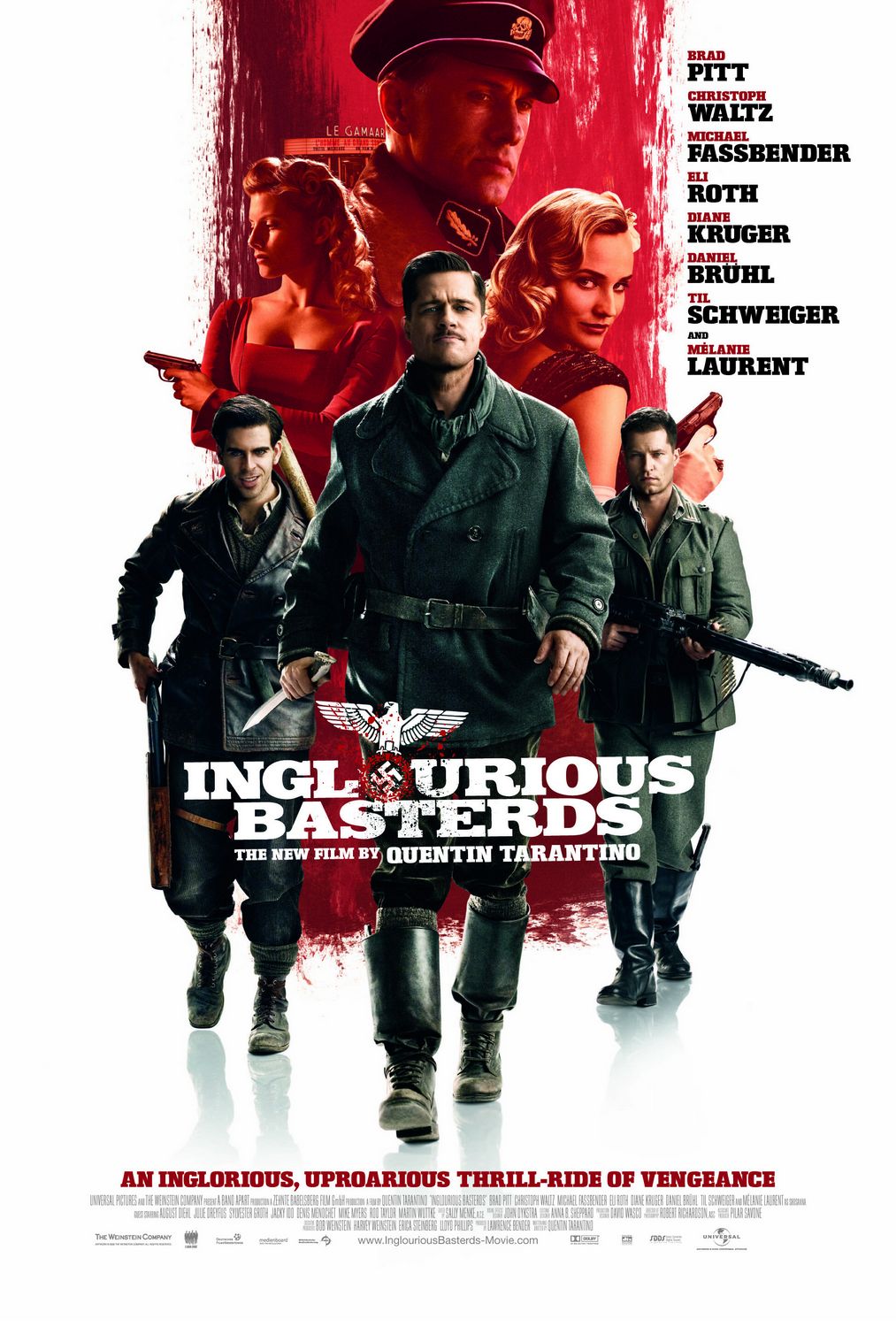
movie: Inglourious Basterds (2009)

inglouriousYes, spellcheck, that is how you spell this movie title.

It’s movie week here at pagesofjulia, isn’t it? Funny how that happens. Inglourious Basterds is another Tarantino film, from 2009, an alternate-history of World War II starring Brad Pitt as the heavily-Southern-accented leader of an American military team called the “Basterds,” and Christoph Waltz (who was positively outstanding in Django Unchained) as an S.S. leader named Landa. In this telling, the Basterds put together a plot to kill Hitler; but they’re racing a young Jewish woman named Shosanna (played beautifully by the lovely Mélanie Laurent), whose family was killed several years earlier by the “Jew Hunter” Landa. Shosanna is being courted by a young Nazi war hero, but her hatred (obviously) still burns hot, and she takes advantage of an unlooked-for opportunity to plan her own assassination of Hitler & the Nazi leadership.

In my opinion, this is not Tarantino’s best work. There are the requisite bloody scenes and over-the-top clever dialogue – the latter normally a fantastical element I enjoy, but here it kind of fell flat for me. Shosanna’s character is lovely and I felt that she could have been a little better explored. Landa’s character was also eye-catchingly evil. Maybe I just don’t like Brad Pitt, but the Basterds were less interesting than they should have been; maybe a little more character development there. The two parallel plots to kill Hitler could also have been more deeply mapped out for me. The whole thing lacked depth and interest for me, especially compared with Tarantino’s fine work in other films. [My favorites include Pulp Fiction, Natural Born Killers, and my personal favorite, True Romance, which Tarantino wrote but did not direct. Both Kill Bill‘s were great, and Django Unchained was outstanding as well.]

Perhaps I am not entirely sold on the beauty of a farcical WWII history in Tarantino style. Why would that be, when I appreciated the Tarantino treatment of slavery so much? I don’t know. I credit incomplete character development and a storyline that tried to accomplish too much without delving deeply enough into any of its plots. Sadly, not up to Tarantino’s standards in my book.


Rating: 4 scalpings.

On the plus side, I’m celebrating today’s over-Hallmarked, under-romantic holiday with Tarantino, and that makes me feel good. Happy Valentine’s Day!

movie: Lonely are the Brave (1962)

Here’s another movie I made a point to find after reading the book. Very few of Edward Abbey’s books have made it into film. His most famous novel, The Monkey-Wrench Gang, has been optioned repeatedly but appears doomed to never grace the silver screen, owing (I think rather obviously) to its anti-establishment themes: no Hollywood mogul would involve himself in something so sacrilegious. But The Brave Cowboy was made into a movie starring Kirk Douglas in 1962. Here he is fighting a one-armed man with one arm behind his back in a raunchy saloon:

fighting

The movie is faithful to the book’s plot only in its actions, and not in its motives. The cowboy Jack does ride into town on his horse with the intention of busting his old buddy Paul out of jail; he does kiss Paul’s wife in the process; he does end up in the mountains fighting an archetypal battle against the sheriff and his men, complete with military technologies and sweeping vistas.

vista

It is, in short, a fine Western. What the movie version left out, however, is Jack and Paul’s past together as political protesters. There’s no mention of what Paul’s doing in jail in the first place (dodging the draft, and refusing to take conscientious-objector status), let alone their history in anarchist organizations and their shared hatred of The Man. That would be a little too much even for our Western hero, presumably: better that he be nostalgic about the days of horse and rider herding sheep, and not specifically interested in taking down the federal government. Can’t say I’m surprised. My final gripe would be that the sheriff, Morey, was not cast nearly as fat and bumbling as he reads in the book. At least they left in the taking down of the helicopter; that was fun.

This movie is a simplified and sanitized version of the better book upon which it was based; but that’s what I mostly expect from movies made from books. Some of the dialog seems to have materialized out of thin air, most definitely in the case of Jack’s monologue about being a loner – I suspect Abbey could have rendered such a scene much finer (and funnier) if he’d wanted it in his story in the first place. But it was still a fun romp alongside an Abbey-like hero, just dumbed down. I don’t regret my 90 minutes, but it sure is nice to dream about a proper movie made of The Monkey-Wrench Gang or the like. Sigh. Not a bad film, but not too terribly close to its literary origin.


Rating: 5 stoic grins.

Closing credits: thanks to my neighbor Adrian for helping me find this not-easy-to-find movie. You get a 10-star rating, Adrian!

movie: Carrie (1976)

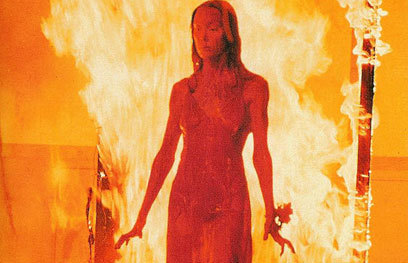
You will recall that I recently read Stephen King’s Carrie, and was very impressed. I then made it a point to watch the classic 1976 movie starring Cissy Spacek.

classic shot from the final scenes.

classic shot from the final scenes.

The movie is reasonably faithful to the book in terms of simple plot. Carrie gets her period, is abused by the girls at school, is asked to the prom by popular Tommy whose popular girlfriend Sue has put him up to it (for mostly altruistic motives), is abused at prom, goes red in the face and uses her recently discovered special powers to get hers back.

But the book lost a lot in its translation to film. For one thing, the structure of the book was part of what made the total package so striking; and we necessarily lost a huge majority of the interior thoughts shared in the original. We lost important pieces of Carrie’s family history (the stones falling on her house were left out entirely) and of Chris and Billy’s evil machinations. Also, wasn’t Margaret White entirely too pretty on screen??

I thought the movie did capture the creepiness factor fairly well, although I was not much frightened by the movie, maybe because I already knew everything that was going to happen and felt less a sense of dread than I would have if it had all come as a surprise. (Although I’m easily frightened by movies. So, maybe take a half point off for not frightening me.) I will say one thing, and this is a spoiler if you haven’t seen the film, so highlight the following white text if you want to read: the final scene, where Sue takes flowers to Carrie’s grave (or home site?) and Carrie reaches up and grabs her wrist “from beyond” – that wasn’t in the book and I swear I jumped a foot when that hand appeared. Holy smokes, I was frightened. But I don’t know where that even fits in the story crafted by Stephen King, so again, I’m not giving full points for this.

Final conclusion: a fine movie, entertaining, but hardly worthy of the book it was based on. What else is new?


Rating: 5 cruel high school girls.

movie: Rosemary’s Baby (1968)

I meant to watch Lonely Are the Brave, the movie based on the Ed Abbey novel The Brave Cowboy that I read recently. But I couldn’t find it on my neighbor’s Netflix. So we watched Rosemary’s Baby, instead. Also based on a book, but one I haven’t read, this is a 1968 horror movie directed by Roman Polanski and starring Mia Farrow.

Rosemary (Farrow) and her husband Guy move into an apartment in New York City with big rooms and a strange history; in fact the whole building is known for odd and eerie happenings, including the suicide of a young woman Rosemary meets once when she moves in. Rosemary is trying to become pregnant. Guy makes friends with the rather nosy, creepy older couple that lives down the hall, the Castevets. After a strange night when it seems that Rosemary has been drugged, she does become pregnant, and she’s thrilled; but the experience is mostly pain & suffering. The Castevets set her up with an obstetrician who prescribes herbal drinks mixed by Mrs. Castevet, and doesn’t take seriously Rosemary’s extreme pain. And when the baby is born… well. If you want the spoilers, they’re out there on the internet.

photo credit

Rosemary is frightened. (photo credit)


Despite its age, which sometimes weakens the effect of movies like this one which rely upon emotional impact (when they seem dated, silly, or have poor special effects), Rosemary’s Baby succeeded in freaking me out. It was noticeably dated, of course, in terms of Rosemary’s outfits, the decor of the apartment, and the somewhat revolting gender roles in Rosemary and Guy’s marriage. Funnily, it reminded me of The Shining, made fuller 12 years later in 1980: the opening scene has Rosemary & Guy being shown around the apartment they will rent, full of a sense of foreboding, and recalled the scene in The Shining when Jack Torrance and family are shown around the Overlook Hotel. This datedness was rather charming, though, and any connection I felt to The Shining could only do it good. And the creepy factor was fully there. Neighbor Gracie and I both wished they had shown a particular frightening item at the end of the movie, which we only see through Rosemary’s horrified reaction; but with the special effects available at the time it would have been poorly done, which is clearly why Polanski refrained, for the best.

A quick dip into a disturbing story, well done, even after 45 years.


Rating: 7 mystery herbs.

movie: Django Unchained (2012)

Django Unchained is the latest from Quentin Tarantino, who wrote the screen play and also acts and directs. I am a fan of Tarantino, and was anxious to see this one in the theatre. We’re not necessarily a family that goes to movies very often at all; but for the second time in about ten days (following Lincoln), we did make it out for this one.


First, a quick plot synopsis. Django is a slave at the beginning of the movie, who is purchased by a former dentist turned bounty hunter, the German Dr. Schultz. Dr. Schultz wants Django to help him identify three brothers with a price on their heads; he frees Django in exchange for his help, as he doesn’t approve of the peculiar institution. The two men get along, and Django tells Dr. Schultz about his wife, Broomhilda, still in slavery in an unknown location. Dr. Schultz is taken by the idea of this slave woman with the German name: Django tells him she was taught to speak German, too, by her first mistress. They agree to work together to raise funds and then ride south to find Broomhilda and buy her freedom, too. When they go to do so, they find her at a plantation know as Candieland, owned by the depraved and very wealthy Mr. Candie. The plot is to not let him know which slave they’re really after; so they pretend that they’re interested in buying a Mandingo fighter: a slave trained to fight other slaves to the death. (Slate says there is no historical evidence of this practice.) Then they’ll casually slip Broomhilda’s purchase in on the way out, predicated upon Dr. Schultz’s appreciation of hearing his native tongue spoken after so many years in the States.

But this is Tarantino, so all does not go according to plan. Also because this is Tarantino, there is a great deal of bloodshed. Much of what I see on the internet about this movie involves warnings about all the gore; which warnings are appropriate, but I guess I would think that, if you were familiar with Tarantino, then his name on this film would be enough to warn you.

Django‘s treatment of slavery is raw, cringe-worthy, and (I think) pretty fair and realistic. The n-word is slathered on generously; but this is historically accurate. I have a medium-to-high tolerance for on-screen violence, but there were two scenes that I looked away from. It’s not pretty stuff, kids; but neither was slavery. On the other hand (and, again, as we expect from Tarantino), there is some bizarrely effective comedy, at the Klan’s expense (IMDB points out that reference to the Klan is anachronistic, FYI). And here’s a bonus: as my father observed, there are no female victims in this movie. Broomhilda is enslaved, but not otherwise victimized. It would have been so easy – and historically plausible – to have her raped; but Tarantino refrained, and we all appreciated that.

This movie strikes me as a historically faithful portrayal of the ugliness of slavery, even while Candie’s depraved playground of violence perhaps leans towards the fantastic end of such things. But there are elements of film genres other than historical drama: this is very much a western, for one thing, with the classic spaghetti-western music playing in several key scenes. (There is also some more modern, decidedly anachronistic music in other scenes. I didn’t find it too jarring, although I did notice it.) And – I keep using this phrase – in classic Tarantino fashion, it’s a fairy tale, too. Django’s ability to ride a horse (bareback, no less) and use a gun seemed highly improbable to me, but I went along with it. I may be biased, because True Romance is my favorite Tarantino flick of all time (he wrote but did not direct), but I was favorably reminded of that film in some of its fairy-tale qualities.

In a few words, Django Unchained is everything we should expect from Tarantino: blood and gore, twisted humor, clever dialogue, fairy-tale endings, and more blood. Also, the acting is excellent. If you like Tarantino (meaning: if you can handle the violence), DO see this movie.


Rating: 9 splattered walls.

movie: Lincoln (2012)

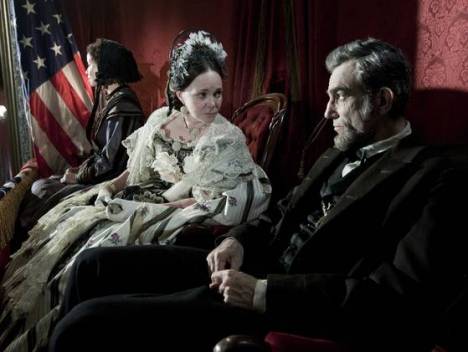
In honor of my mother’s birthday recently, Husband and I accompanied my parents to see Steven Spielberg’s Lincoln, starring Daniel Day Lewis, Sally Field, and Tommy Lee Jones, backed up by a further star-studded cast. It was truly impressive, as expected.

Daniel Day Lewis as Lincoln and Sally Field as Mary Todd Lincoln (Photo: David James, DreamWorks II/Twentieth Century Fox)

Daniel Day Lewis as Lincoln and Sally Field as Mary Todd Lincoln (photo credit)

There is no shortage out there of positive reviews of this movie, many of which say it better than I can and know the historical details better than I do, so I shall try to keep this brief. As promised, Daniel Day Lewis IS Lincoln. The visual impact of Lewis’s Lincoln, and of the period costume and cinematic effect (use of light and shadow, especially) is very good – but again, this is Spielberg, so no great surprises. The emotional impact is great, too. The scene where the 13th amendment is voted in, and the reactions to that vote, I found very powerful. It was an enjoyable experience.

I felt somewhat, and Pops expressed a similar feeling, that this movie’s view of history was a little “feel-good.” My vague recollection of American history yields a more cynical view, in which the Civil War was not so much about the human rights of black people as it was about states’ rights vs. federalism, economics, and yes, slavery, but more as an issue of the above (economy, industry) than as a civil rights issue. Specifically, I believe I recall reading the Lincoln-Douglas debates for a freshman political science course and noting that Lincoln was not quite the egalitarian the movie represents – although, to be fair, the movie does have him balk at black suffrage. At any rate, it felt like this Lincoln encourages us, as Americans, to be proud of our very principled, virtuous past, to a degree perhaps a tad simplified and glorified. That said, it DID feel good. So your feelings about this question depend on what you want from the film – historical accuracy, or fuzzy feelings.

This cast was outstanding. Aside from the big names D.D. Lewis, Sally Field, and Tommy Lee Jones (and Spielberg), you will recognize a great many faces further, and everyone did an outstanding job. (Between us, my group of 4 recognized actors from Breaking Away, Bad News Bears, ER, and Mr. Deeds, and that was fun.) I think I enjoyed Tommy Lee Jones’s Thaddeus Stevens the best. Now, the acting and the screenwriting tended towards the theatrical or dramatic rather than the realistic; many, perhaps the majority of the scenes involve grand, sweeping, profound statements, delivered with lifted chin. But this, too, is not necessarily a criticism. It’s not realism, but theatre – finely produced theatre.

As you know, I am always curious about historical accuracy in works of historical fiction or dramatizations. In this case, we all wondered about Stevens’s relationship with his housekeeper: in the movie, they are lovers. I poked around the internet enough to see that historians have speculated but cannot confirm such a theory; and it was Pops that sent along this excellent link, in which Slate discusses historical accuracy throughout the film. Don’t hesitate to click on some of the links within it, too: I did and found it all fascinating.

I will leave you here with the idea that this is a magnificent, entertaining, thought-provoking, if slightly rosy portrayal of our 16th president, presented by an outstanding cast.


Rating: 7 flashing eyes.

movie: The Perfect Storm (2000)

You may recall that I listened to the audio version of Sebastian Junger’s The Perfect Storm a few months back, and loved it. I think it was my father who mentioned that the movie was quite good; and I’ve been meaning to see it. I was actually a little sleep-deprived when Husband found it the other night and put it on, a little late; I was worried that I would find myself nodding off (often a problem with movie-watching for me). But no such danger with this film.

perfectstormThe movie was made in 2000, based on the book of 1997. An all-start cast bodes well: George Clooney, John C. Reilly, and oh my goodness, Mark Wahlberg, for whom I have a real weakness. Also William Fichtner, whom I knew by face but not by name. I’ll go light on the plot summary (you can see my book review for that) and instead concentrate on the impact of the movie and its relationship to the book.

I had no trouble staying awake to watch this movie with clenched fists and jaw, because it is ceaselessly suspenseful, dramatic, action-packed. My adrenaline pumped as I watched men and women fight for their lives; and having read the book and thus knowing (in a general sense, movies not always being entirely faithful to the book) what happens did not relieve my nerves at all. In this way it was true to the book, which is also edge-of-the-seat thrilling. For that matter, the book takes forays into various supportive details: boat design, the physics of wave dynamics, meteorology, the history of Gloucester, Mass. as a fishing village, etc. I don’t recall that I ever felt bored or impatient with these digressions; they supported the story and were interesting in themselves. But (and perhaps this is obvious, as it’s a Hollywood film) the movie never went there. The movie cuts out some of the action and lots of the details, and this supports its different goal. Where the book is both awesome and scientific, the film is all high-energy drama. They’re both great, but a little different.

I found the emotional impact of the movie to be significant. I asked Husband about his feelings while we watched, and he didn’t seem to understand the question; we could speculate about the traditional gender role responses to questions about feelings, or we could assume that he would have been more emotionally affected if he’d also read the book, but I don’t need to parse that issue here. *I* felt that the scenes of homecoming, leave-taking, and mourning were greatly moving.

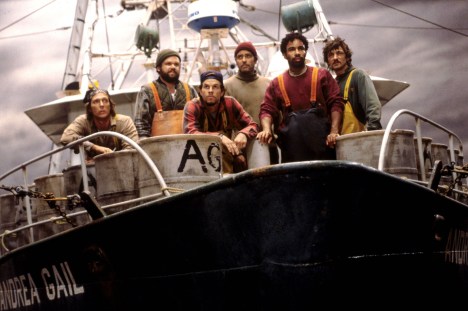
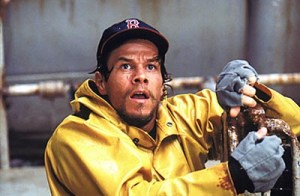
The greatest strengths of the movie were some of the greatest strengths of the book: emotional impact, thrilling action, consideration of the awe-inspiring power of natural forces. I’m not sure that this is always true of movies and books that are both effective, so I wanted to make that observation. A further strength of the movie was visual effect: giant waves and lives hanging in the balance make for some impressive images. Not to mention, the handsome cast allows for some sweet shots as well:
perfectstormcast

And although I haven’t pictured her here, Diane Lane makes a lovely Christina (Bobby/Mark Wahlberg’s girlfriend), and their relationship is every bit as sweet and endearing onscreen as on the page. I give full marks to all the cast. This was a very enjoyable and riveting movie to watch. I did miss some of what the book gave me that the movie didn’t, but I think the film did as much as a film can do with a book, and utilized the format’s strengths (like stunning images) to best advantage. Great stuff.

markymark
And in closing, I would like to point out that it is always a pleasure to watch Mark Wahlberg do anything.


Rating: 7 swordfish.

movie: The Shining (1980)

The 1977 novel by Stephen King which I just reviewed was made into a movie by Stanley Kubrick in 1980. Husband and I planned to watch it on Halloween (as I’d just finished the book) but we couldn’t even wait that long.

I struggle to retain a little perspective as I write this review. I loved the book very much. Movies made from books are often disappointing, and I keep reminding myself, this is not because they are less good, only different. The format requires that they compress the action, often curtailing development of characters and plot, to fit into two hours or so. Interior thoughts and motivations are often lost (see recent discussion). None of which means that movies can’t be good; they just can’t be books.

As you’re already gathering, this movie disappointed me in that it wasn’t just like the book. In fact, they have relatively little in common. Both are about the Torrance family: Jack, Wendy, and Danny. Jack is still a recovering alcoholic, still takes the caretaker job at the Overlook Hotel. Dick Hallorann still befriends Danny, although their friendship is much less profound. My first great let-down was in Hallorann: I found him sort of bumbling in the movie, less developed, certainly less capable and fun, less someone I want to hang out with. For that matter, my earliest warning was in the character of Ullman, the hotel manager: a real creep in the book, he was an oily but not exceptionally unpleasant nonentity in the movie… I guess these are the sacrifices we make to time restraints. And of course, the monsters are reduced in number and in detail, again presumably because of the time limitations. Most damningly, a certain key character meets an entirely different ending in the movie, which I have a hard time forgiving. I have to keep reminding myself, these are different stories.

But the real departure from book to movie, it seems to me, is in the source of the evil. As I noted, in the book, Jack is an essentially good – flawed, but human – man, husband, and father. The Overlook Hotel is an evil entity that preys upon his weaknesses and takes him over. Jack as man is redeemed somewhat. In the movie, though, Jack goes insane and tries to kill his wife and child. No redemption there.

But how was the movie as just a movie, without these unrealistic comparisons to the book? Okay, I’m trying. As a movie it was indeed spooky. It created atmosphere. The scenes with Danny riding his Big Wheel through the halls alone were powerful. For that matter, the images were all powerful – and absolutely iconic today. (I could have identified all of the images in this post for you before I saw the movie. And I am a pop culture dunce.) Stanley Kubrick did his Stanley Kubrick thing. I think it would have been an enjoyable and impactful movie experience, had I seen it first. Clearly, however, the book ruined me for it. Which is so often the case. However, I also think that the movie would have ruined me for the book. Scatman Crothers’ portrayal of Hallorann was not at all what I’d pictured, and I like my conception of him better. So there’s a conundrum. If you have to pick one format, kids, I recommend the book.


Rating: 5 advantages taken.

movie: Night of the Living Dead (1968)

In case you haven’t been around here much, I’m not a big movie watcher. I didn’t watch a lot of tv as a kid; am not real strong on pop culture; and horror movies were never my top choice. Also, my parents hadn’t yet met in 1968. So this movie was altogether new to me when Husband and I sat down on Halloween and watched Night of the Living Dead, the original 1968 black and white movie in which a group of strangers gathers in a farmhouse to defend themselves against …we would now call them zombies, although that term isn’t used in the film. In the film, they’re called ‘ghouls.’

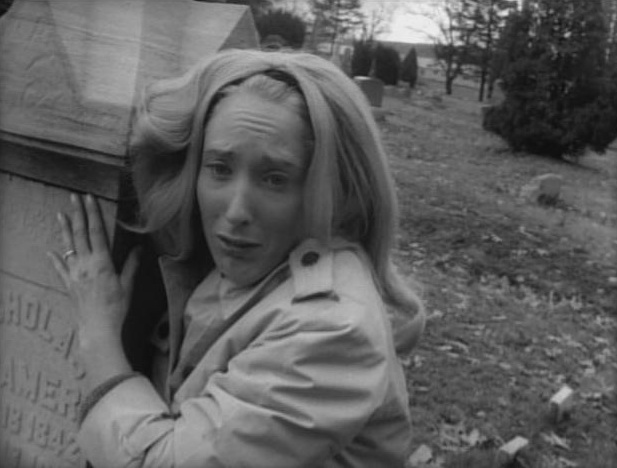
Barbra


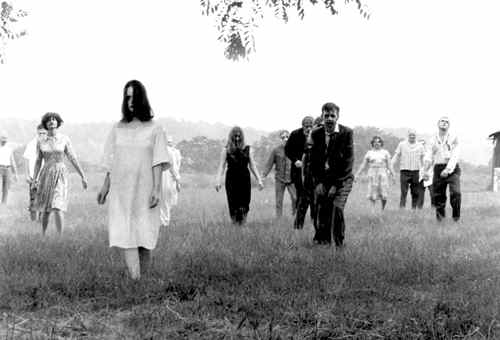
In the opening scene, Barbra and her brother Johnny are visiting their father’s grave (and Johnny’s being a real pill about it, by the way) when a ghoul approaches and… goodbye Johnny. Barbra runs to a farmhouse, chased by the undead, and holes up, soon to be joined by a stranger named Ben. Ben keeps his calm and has a plan to board up and defend the farmhouse, while Barbra becomes hysterical and then catatonic. It turns out that they have company: another group of frightened (living) people were already hiding in the basement. There’s a young couple, and an older married couple with an injured daughter. The movie covers just the one night, in which the zombies, I mean ghouls, mill about outside and the people inside make plans to escape. The radio and television inform them that there is an epidemic of ghouls ravaging the country, killing people and eating them.

‘ghouls’


Cinematographically, this film struck me favorably. I am no student of this art form, especially in black and white, but the few black and white films I’ve seen have impressed me with their use of light and shadow – necessarily, since that’s the big visual contrast they have to work with. Certain aspects of the movie were woefully dated: pacing is always the first I notice with older movies, since we have such short attention spans these days; the dialog felt stilted and abrupt; the acting was overly dramatic; and can I just gripe about Barbra for a moment? What a worthless weak female figure, and how disgusting is that? I imagine her portrayal took some heat in 1968, too! But just as I started to scoff at these faults, I’d jump in my seat. Despite the dated aspects, that fine use of light & dark and the suspense, the surprises, and let me say, the terror of the undead eating people is still scary. I can see why this movie was a hit and why it still draws a following. I can see why some consider it a classic.

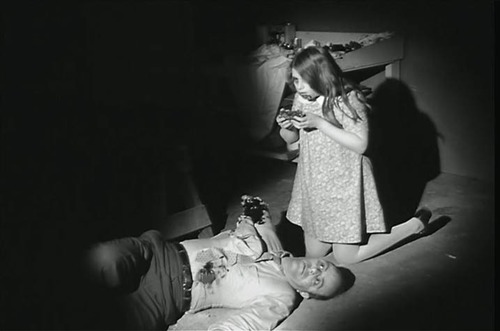
yep. still scary


I do have one final complaint, relating to how the movie ends. I won’t articulate it here, in case you want to go discover it yourself. I will only say, I have a certain James Dean movie in mind, which did it better.

I enjoyed this movie far more than I expected to at about 20 minutes in. Touché, old movies. Happy Halloween.


Rating: 6 groans ‘n’ moans.

movie: We Need to Talk About Kevin (2011)

I just happened across this movie the other day. I really enjoyed the book by Lionel Shriver – pre-blog, sorry, but I’ll recap here very briefly. The book is an epistolary novel, meaning it comes to us in the form of a series of letters from Eva to her husband Franklin. Their family has clearly suffered a tragedy of sorts, which goes unnamed until the very end, and the source of that tragedy, equally clearly, is their son Kevin. Eva is trying to process her difficulty with Kevin, and to figure out where the blame for what’s wrong with him lies. Was it in him from the start? Or was she a bad mother, and turned him bad? She felt the evil in him while he was still in the womb – or maybe she was just a non-nurturing mother. To me, that was the overarching question of the book: where did the badness come from? And it’s an interesting question. At the risk of sounding creepy, I guess I also found it kind of refreshing to see a presentation of motherhood that wasn’t all roses, sunshine, and easy bonding. Not all readers, or bloggers, enjoyed the book (by a long shot!), but I did. And I found its big reveal surprising. Important tip: if you want to enjoy the book, don’t let anybody spoil it for you! (No spoilers here.)

So, the movie. I was interested in two things: how well would the movie communicate the profound creepiness of Kevin the little boy? And how would the epistolary format difficulty be overcome? As in the case of book-to-movie The Lovely Bones, which in book form is narrated from heaven, the voice of Eva in her letters is difficult to translate into movie form unless you’re going to have Eva’s character voiceover the whole thing, which doesn’t sound appealing. (Qualifier: I only read and never watched The Lovely Bones. Apparently the film met with mixed reviews.)

As to the first question, they made Kevin creepy as hell, which was perfect. His manipulation of one parent while showing his dark side to the other reminded me of that terrifying woman-child in Orphan (shudder). I thought the toddler Kevin was great; before he started speaking, he would glower at his mother until I thought surely he was going to blurt obscenities. But this is just a little boy!

Eva with little Kevin


And as to the second question, how to translate the epistolary format, the film took an arty, quiet, disjointed approach. There may be a technical term for this style – I am so very far from being a film buff. It reminded me of Punch Drunk Love, that outlier of Adam Sandler’s ouvre, which is far less tragic than this one, but what can I say, I don’t see a lot of movies. The chronology jumped around. And this raised a whole new question for me, one I can’t answer. Is the final big reveal as surprising in the movie as it is in the book? Since I knew it going in, I can’t say.

Throughout, the movie relies heavily on the repetition of one highly (screamingly) symbolic color, red, and is extremely quiet. Dialogue is very sparse. It drags along a little, but that might be part of the arty nature of it. (Short attention spans, beware.) It expresses terror in a whisper – an awfully effective technique. It communicated the same discomfort, questions, and alarm that the book did, and like the book, it’s not for everyone. But I think this film does what it set out to do.