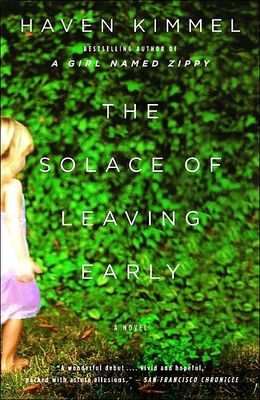
rerun: The Solace of Leaving Early by Haven Kimmel

From early in my career with Havel Kimmel: please enjoy this review from April of 2013.

Langston Braverman has recently returned to her hometown of Haddington, Indiana. Very close to receiving her PhD she walked out of her oral exams. She is a strange, exceptionally erudite but socially fragile and problematic young woman. She has a dog named Germane: “named not after Germaine Greer, but as in: Germane to this conversation.” (I love that.)

Amos Townsend is Haddington’s pastor, of only a year or two now. He is tormented by the death of a local named Alice; he feels that he should have been able to stop her death, and he is struggling with his faith, which is actually nothing new.

Alice’s two children are left in limbo; their crazy aunt Gail has turned out to be unfit, and their grandmother Beulah is clearly too near death herself to wrangle with two traumatized little girls. Upon Alice’s death, they dispose of their original names, Madeline and Eloise, and state that they are now called Immaculata and Epiphany. They wear costumes from a Renaissance drama from school, that their mother made, all the time. Complete with hats: the tall cone-shaped kind with ribbons streaming off the tops.

Langston’s mother AnnaLee picks up some of the slack, and then insists that Langston step up: she is not in school, not working, and these children need her. Of course, Amos plays a role as well, so that this village will truly raise a child.

Langston and Amos are the stars of this story (along with the striking Immaculata and Epiphany, of course). When they meet, they repel one another like magnets. Despite sharing tastes and interests in reading, philosophy, theology, and (I can’t stress this enough) their particular brands of weird, they repel. And, as is clearly a theme in Kimmel’s work, the cerebral content, the philosophies and theologies that shape this part of the story are complex and thoroughly explored. I think I said this in my last Kimmel review, but: her many references partly pique me to go off and study, and partly exhaust me, making me so glad I don’t have to read Whitehead and Tillich and Frithjof Schuon. It makes me sit back and… wonder… that all these strange, complex, learned thoughts that Langston has are thoughts that Kimmel had to have first, had to conceive to put them in her heroine’s mouth; think of that.

Immaculata and Epiphany see Mary (the Mother of God) in the dogwood tree in their grandmother Beulah’s backyard. Naturally, because that is the kind of world this is. It is very strange and is a kind of beautiful, and again I observe that Kimmel’s gift is to create a midwestern small-town world that is both hopelessly humdrum and depressing and everyday, and also strange and exalted and worthy of examination.

What happens to our exquisitely odd cast of characters should definitely remain a surprise to you, reader. It’s pretty great, though.

I love this author SO MUCH that I am struggling to write reviews; but I will keep reading her. Next up is The Used World, and I am, of course, working to get my hands on her best-known bestselling memoir, A Girl Named Zippy.

I’ll close, as I tend to with Kimmel, with a few lines from the book that particularly caught my eye. Where these have, in the past, been lovely examples of her use of language, these are more concepts that I really liked. There is a book theme here. And the language is great – observe the curry comb, is that an image or what – but it’s the concepts that I like most here:

Amos knew as well as anyone what went into writing a book, having written a master’s thesis, and he considered the process to be akin to having one’s nerves stripped with a curry comb.

Maybe he knows what goes into writing a book as well as anyone… who hasn’t written a book?

The most intractable aspect of his bachelorhood was that Amos was uncomfortable eating without reading; he felt as if he were wasting both time and food.

Me too, Amos. I’m right there with you.

Amos tapped his fingers on his bony knees. “Why do you have a book and I don’t?”

“Because I’m a woman, Amos.”

“Yes, but why do you have a book and I never do in a situation like this?”

AnnaLee put the book down. “I carry a bag. I also have safety pins and emergency money, and a package of those little wet towelettes. We live in Indiana. I could get stopped by a train, I could get bored. I always carry a book.” She went back to reading.

How perfect is that. “We live in Indiana, Amos!” Perhaps it goes without saying that I, too, try to keep a book with me at all times? I fail on safety pins and wet towelettes, though.

I’m sure I’ve failed to do this book justice. But it’s divine.

Rating: 9 ribbons on a hat.

Lovely. I should reread her sometime.

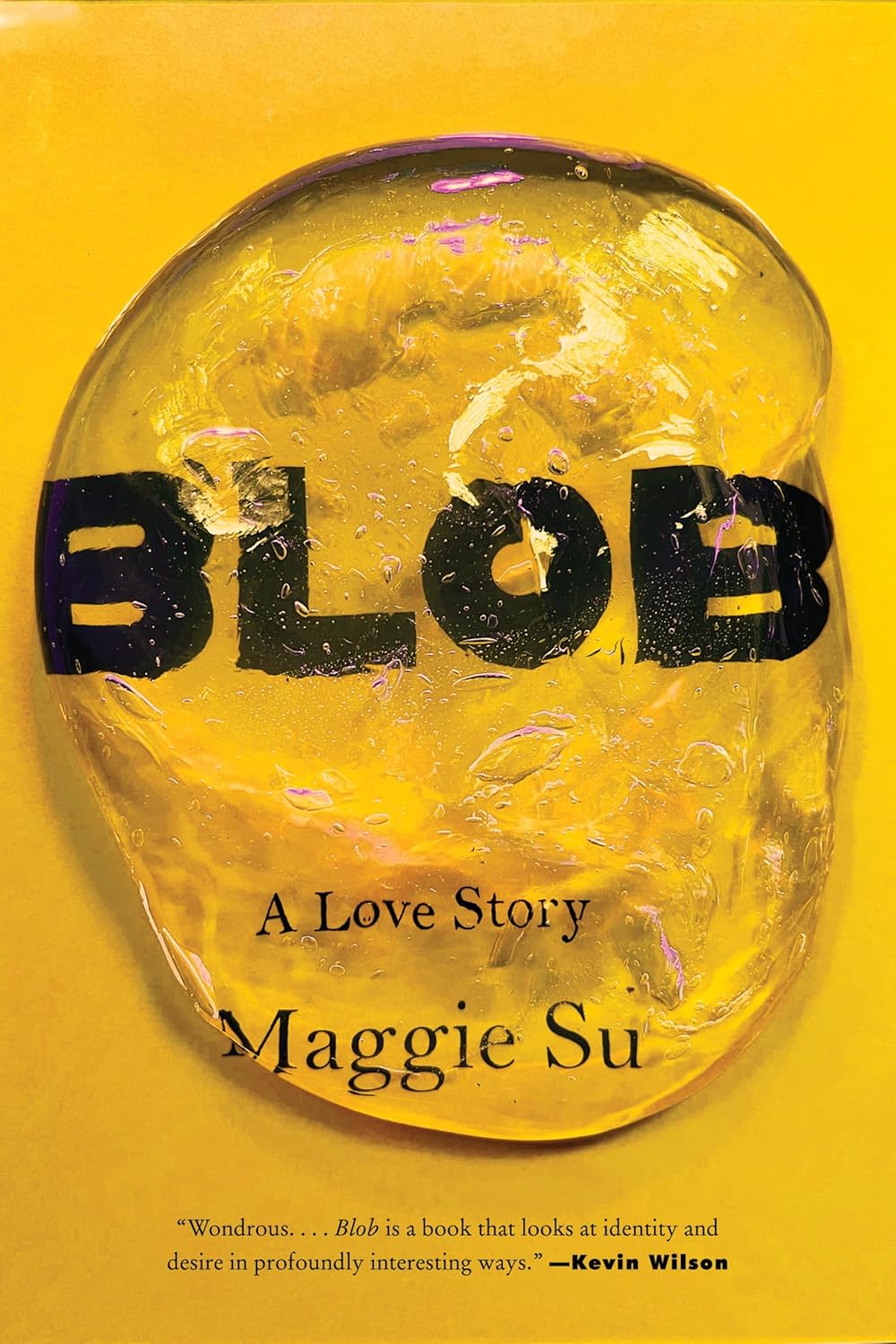
Blob: A Love Story by Maggie Su

This quirky, funny, pained novel considers the challenge, for any of us, of becoming fully human.

Maggie Su’s Blob: A Love Story is a funny and pathos-ridden tale of social awkwardness and self-realization; a modern, delayed coming-of-age. Su’s narrative voice is perfectly pitched for her inelegant but deeply sympathetic protagonist.

Vi is a 24-year-old townie and college dropout in a midwestern college town. She works a hotel chain’s front desk next to a too-perfect perky blonde named Rachel. Vi is still suffering from a breakup eight months ago, barely slogging through her days. Her Taiwanese father and white mother are well-meaning and supportive, but they have trouble connecting with Vi, who has always been a loner; her older brother can be a pain, but he cares, even when Vi struggles to. Then, on a night she ventures out for the rare social occasion, she stumbles upon something new in the alley behind a bar during a drag show: a shapeless blob with a mouth and two eyes. She carries it home and, under Vi’s yearning influence, it grows.

The evolving blob, which Vi will come to call Bob (it starts as a malapropism), is the only fantastical detail in a story otherwise rooted in a very familiar world, featuring the casual racism of Vi’s hometown and her awkwardness with social situations. Bob takes in lots of television (and Fruity Pebbles), and after examining the pictures Vi shows him of movie stars like young Hugh Grant and Ryan Gosling, fashions himself into a tall, stunningly handsome white man with a six-pack. Vi presents him as a hookup or boyfriend; the world has trouble assimilating their match. The pairing is, in fact, a strain. “For a while, he seemed happy enough to eat and breathe and exist–the perfect companion. I should’ve anticipated that molding him into a man would trigger something deeper, some sort of existential awakening. Now he’s just like everyone else. He has needs and desires beyond me…. He could leave without me ever knowing why.” The fear of being left, of course, is key to Vi’s difficulties in navigating the world.

What makes Blob special is its mix of heartrending conflict and silly, self-aware humor. Truly cringy scenes balance sweet ones. Rachel performs off and on as a friend–but Vi scarcely knows how to care for her own problems, let alone anyone else’s, and her past attempts at friendship have often ended in unintended cruelty. Su excels with characters who can be significantly flawed but stir the reader’s empathy. Even Bob, despite beginning his life as a blob, has a surprising amount of personality. In the end, discomfiting though it may be, Blob makes incisive observations about life for a 20-something trying to make it on her own. Blobs and humans alike may yet find home.


This review originally ran in the November 8, 2024 issue of Shelf Awareness for the Book Trade. To subscribe, click here.


Rating: 7 handfuls of cereal.

Lines by Sung J. Woo

Disclosure: I was sent an advanced review copy of this book in exchange for my honest review.


This book came to me in an unusual way, and I just happened (entirely by accident, as far as I’m aware with my conscious brain!) to pick it up a few days before its publication date, and finished reading it on the very eve. So, happy birthday to this book just published on Tuesday (October 29, 2024). And a brilliant book it is: deeply beautiful, full of tragedy and pain but also awe and even bliss and the exaltation of quiet, daily acts of love and creation.

Lines contains two parallel stories. A prologue sets the hinging scene: early on a foggy Saturday morning in New York City, two locals walk in opposite directions near the entrance to Washington Square Park. Joshua Kozlov is forty years old, and not thrilled about his daily grind, nor his recent birthday. Abby Kim is twenty-nine, a working artist and a distance cyclist. They bump into each other, a full-on collision, ending in an unintended hug, laughter, coffee, and a lightning-quick rush to marry just two months later. Or, they walk past each other in the fog.

The rest of the novel follows both storylines, “Apart” and “Together,” in chapters that feature parallel events in the lives of two Abbys and two versions of the man called Josh or Joshua. Josh(ua) is an aspiring novelist in both lines, Abby always a painter with a passion for miniatures. They have the same friends and colleagues. They are recognizable but very different versions of themselves. In the first and greatest subversion of my expectations, the “Apart” narrative thread is not an absence of romance, a tragic missed-connection sort of story. Both Abby and Josh have found meaningful love, for one thing, with other partners. They have fulfilling lives in many ways. But they still find each other: searching for a birthday gift for his beloved wife, Josh is drawn to a hand-painted locket of Abby’s. He becomes a patron, and she becomes a muse, as he writes a series of flash fiction pieces based on miniature paintings of scenes from one of Abby’s solo European cycle-tours. They share a deep connection.

The title of Lines, I think, has several meanings. You could think of the two parallel stories as threads, or lines. Josh(ua) writes in lines, of course, and Abby draws with them. The concept implies connection, ties. Like much about the novel, its title is subtle, a whisper.

This book is definitely about possibilities, and multiplicities. What if there were another version of my life, my choices, my loves? It’s about art, inspiration, the balance between creative work for pay and for pure creative joy. It’s about the different kinds of love and commitment that exist in the world, about births and deaths. Neither version of this story is without pain, but there is wonder and sweetness even in the tragic moments. I’m not sure there is a final “right” place for either Abby or Josh(ua) to be, and that’s an artistic choice on Woo’s part that I respect deeply. Simple, clean-cut, black-and-white solutions are easier to write but feel less true.

My copy of Lines (an ARC, of course), came with a glossy, full-color insert featuring the 16 miniature paintings that star in the story – they are Abby’s, in the fictional version, and in real life are credited to Dina Brodsky. Josh tells Abby in the book (in their “Apart” line) that he’s working on a novel about their story, but will swap their ethnicities: he’ll make the female character Belarusian and the man, Korean. Sung J. Woo is Korean-American. Brodsky is a cyclist as well as a painter. This reader, at least, cannot help but be curious about the lines drawn between life and art! Brodsky’s paintings are indeed hypnotic, and I feel happily lost in the layers of ekphrasis: a novel about writing about painting… the images themselves, the writing by Josh, within the writing by Woo. I’m writing this review within minutes of finishing the book, and I’m sure I’m missing so much. But I also know I’ll be thinking about it for a long time.

I feel so lucky to have this book come across my desk, and to have opened it almost eight months later, to finish it (quite by accident) on the eve of its publication – what are the chances? It’s nearly as magical as what’s inside.

Check it out. And thank you so much for reaching out, Sung.


Rating: 9 flights.

I Made It Out of Clay by Beth Kander

As Eve’s life devolves into crisis, she creates a golem to solve it all, in this lovely, absorbing novel of grief, dark humor, and love and friendship, with a dash of magic.

Beth Kander’s I Made It Out of Clay is a lovely, absorbing novel of grief, dark humor, and love and friendship, with a dash of magic.

In contemporary urban Chicago, as the holiday season approaches, Eve is struggling: she’s about to turn 40 years old, and she’s nowhere near done grieving her beloved father, who died just over a year ago. Eve and her father always loved Christmas–a guilty pleasure in their Jewish family not shared by the surviving members. Layoffs are threatened at work, her best friend has been distant, she’s had some disturbing encounters on the train recently, and she’s begun hallucinating her dearly departed grandmother, a Holocaust survivor who seems to be trying to warn Eve of something. Eve is not close to her mother (overbearing) or her younger sister Rosie (overly perfect), who’s scheduled her wedding for Eve’s 40th birthday weekend. Eve has (foolishly) promised to bring a plus one to Rosie’s wedding, but she’s so far failed to find a date. Unfortunately, her neighbor crush doesn’t seem to get her jokes or her cringeworthy attempts at flirtation.

In desperation, late at night and rather drunk, Eve recalls a story told by her grandmother, ventures into the dank corners of her apartment’s basement, and builds herself a golem out of foundation clay. A golem serves as protector and companion in Jewish tradition, and she feels in dire need of both. The next morning, a hungover Eve wakes up to find a handsome (and very naked) man in her apartment. She is horrified, in disbelief, attracted to him, and a little disgusted with herself. Is Eve’s golem a figment of her imagination? A monstrosity? Or the answer to her fondest wishes? Heading into Rosie’s wedding, all of Eve’s crises–work, friendships, the absence of romance, family strife, civil unrest in the wider world–crash and crescendo together. A golem is either the best or worst idea she’s ever had.

I Made It Out of Clay is a charming rework of a traditional tale. Frequently grim, it explores some of the darker elements of modern life: depression, loneliness, grief, bigotry. But it’s also sweet and very funny, especially in the moments when Eve lets her friends and, eventually, family into her life, and finds that they may have some of their own struggles. Kander gifts her readers with a novel that is often serious and sad, but ultimately uplifting, as Eve learns, “This isn’t the end of anything. It’s just one more beginning, like every damn day can be if we just let it.”


This review originally ran in the October 4, 2024 issue of Shelf Awareness for the Book Trade. To subscribe, click here.


Rating: 7 bagels.

The Greatest Lie of All by Jillian Cantor

A young actress takes on the role of a glamorous romance author and gets more mystery–and romance–than she’d reckoned for.


The Greatest Lie of All by Jillian Cantor (Half Life; The Hours Count; Margot; The Lost Letter) is a propulsively paced story of intrigue, romance, and suspense starring two women a generation apart navigating family, love, secrets, and art. In one of their several parallels, each uses a professional pseudonym, so that four names delineate these two character arcs.

Readers meet the young, up-and-coming actress Amelia Grant just after the death of her beloved mother, and in the moment when she discovers her actor boyfriend in bed with his costar. At this low, Amelia is primed to accept her biggest role yet: to play the fabulously successful romance author Gloria Diamond in a biopic. Gloria had been Amelia’s mother’s favorite; it feels like a sign and a way to be close to the mother she’s lost, the only person who had called her by her birth name, Annie.

Heartbroken but determined, Amelia travels from Los Angeles to Gloria’s remote Seattle-area home to get to know her subject before filming begins. But “the Gloria Diamond” is distinctly unfriendly, cold, and dismissive. Even as Amelia finds a tentative friendship with Gloria’s son, Will (“cute, in an academic kind of way”), she despairs at ever understanding what makes the older woman tick. Gloria’s career was built on her famous, brief romance with her late husband, Will’s father. But the more Amelia learns, the less convincing that story is. She embarks on an informal investigation fueled by shadowy motives: her desire to play a “true” Gloria Diamond; her curiosity about the nature of love, especially as her mother so appreciated it in Diamond’s fiction; and Will’s reluctant desire to understand his mother. As she pursues the history of the author once known as Mary Forrester–Mare to her friends–Amelia begins to wonder about her own role in the drama unfolding before her.

In chapters that shift between Amelia’s perspective and that of the young Mare, The Greatest Lie of All shines in its plot twists and surprises, and, most of all, its pacing, which accelerates from a slow burn to a heart-thumping momentum. The tension increases, stakes rising as Gloria/Mare and Amelia/Annie must reckon with their pasts to chart their shared present. Danger accompanies every possibility of romance, and family history matters more than it originally appears. Cantor’s experienced hand shows in this classically crafted thriller, which will keep its readers tautly engaged to the final scene.


This review originally ran in the September 24, 2024 issue of Shelf Awareness for the Book Trade. To subscribe, click here.


Rating: 6 glasses of wine.

Maximum Shelf: More or Less Maddy by Lisa Genova

Maximum Shelf is the weekly Shelf Awareness feature focusing on an upcoming title we love and believe will be a great handselling opportunity for booksellers everywhere. The features are written by our editors and reviewers and the publisher has helped support the issue.

This review was published by Shelf Awareness on August 27, 2024.


Harvard-trained neuroscientist Lisa Genova debuted as a novelist with Still Alice (2007), about a woman who is diagnosed with early-onset Alzheimer’s disease. Genova’s later novels Left Neglected, Love Anthony, Inside the O’Briens, and Every Note Played feature characters with hemi-spatial neglect, autism, Huntington’s disease, and ALS, respectively. Her sixth novel, More or Less Maddy, follows a young woman with bipolar disorder. As ever, Genova brings both an expert understanding of the neuroscience and a masterful eye for compelling characters in an emotionally textured narrative. Maddy’s story is completely absorbing; it may keep readers up all night.

Maddy Banks has had a privileged upbringing in suburban Connecticut. There were some tough times in her early childhood, and her father is a shadowy figure. But since her mother, Amy, remarried, it’s been easy: dinners at the country club, a popular boyfriend, a highly successful older sister, and an easygoing jock of an older brother. In high school, “each day was laid out for her like a matching outfit on a bed, when both her inner and outer worlds felt organized, predictable, happy, and light. Life was handed to her like a potted succulent, small and tidy and requiring little effort to maintain.” But the transition to college has not been smooth: “She remembers herself then… and it’s as if she was a different girl in another lifetime. She can’t pinpoint exactly how, but she doesn’t feel like she used to feel.”

Her first year at NYU is a shock: “The impossible-to-keep-up-with workload, living with a roommate who drove her crazy, having no clue what to major in, still not finding her passion or her tribe, losing [her boyfriend] Adam. Twice.” In her sophomore year, Maddy’s diagnosed at the student health center with depression. The antidepressants she’s prescribed help to set off her first manic episode, a big splashy event that results in her first stay in a mental hospital. Maddy and her family–who are loving, if not always graceful with the challenges they face–are in for a roller coaster.

In her more stable moments, and especially during the hypomania that often precedes full mania, Maddy develops an interest in stand-up comedy. Along with her love for Taylor Swift–and delusions about their friendship, with a budding business and creative relationship–Maddy’s passion for comedy becomes a trigger for her mother: getting excited about comedy, Amy Banks believes, means a manic episode is imminent. But while Maddy does not in fact have a personal relationship with Taylor Swift, she does have a gift and a passion for comedy. In Amy’s country-club world, this is not a reasonable life path. But Maddy wants it to be. It is one of the tricks of bipolar disorder that “real” excitements can be mistaken for illness, making it difficult for Maddy to pursue her legitimate dreams.

Maddy, her family, and readers learn about bipolar disorder together, with accompanying denial, anger, grief, the ups and downs of sorting out medications and side effects, and relapses. It is heartrending to see Maddy’s anguished efforts to come to terms with her disorder and to dissect what is real and healthy from what is delusion. Readers are privy to her self-talk: “It’s okay to feel disappointed and sad.”; “It’s okay to be happy.”; “It’s okay to be giddy.” It is one of the greatest gifts of fiction to allow readers into experiences that are not their own, to find empathy. Genova’s descriptions of Maddy’s episodes are evocative, clear, and relatable: “Before her hypomania ripened to rotten, there was a delicious sweetness to her thoughts and life. She had a massive amount of unearned confidence in her ability to do anything that struck her fancy. She made big dick energy look flaccid by comparison.”

Secondary characters are equally convincing and essential. Amy is capable of actions that frustrate Maddy (and readers), but she also genuinely wants the best for her child. Maddy’s sister, Emily, is almost too perfect–life comes easily for her, and it’s the life of their mother–but she is goodhearted, and that seems to be the life she truly wants. Maddy’s high school boyfriend, Adam, is one example of the gradual realization that things are not always as they appear. He had the right markers–basketball star, handsome, popular–but readers, and Emily, see some red flags in his treatment of Maddy, who goes on to make other exemplary friends and meet other objectionable characters along her rocky path.

It is an important element of Maddy’s development that she chooses to embrace her own unique self–her sense of humor, her interests, her differences–rather than follow the cookie-cutter plan laid out by her upbringing. “When Maddy was growing up, being normal was always the unquestioned goal…. Normal was her default, unexamined way of life. It meant fitting in, blending with the colors, sounds, and shapes around her.” All young people are out to find themselves; Maddy must live her own version of that. She is not defined by her disease, but is rather a complex young woman navigating the expected tumult of coming-of-age with added complications. Her story is affecting, harrowing, beautiful, and enlightening, as well as a great pleasure to read.


Rating: 8 notebooks.

Come back Monday for my interview with Genova.

Blue Light Hours by Bruna Dantas Lobato

A mother and daughter separated by continents navigate distance and intimacy through the “miraculous blue light” of video calls in this haunting debut.

National Book Award-winning translator Bruna Dantas Lobato makes her authorial debut with Blue Light Hours, a subtle, contemplative story of a mother and daughter divided by 4,000 miles, who come together via screentime and memory. With love, care, quiet humor, and pervasive yearning, this thoughtful story explores the dilemmas of coming of age and leaving home, the tension between separation and connection.

On a full scholarship, the daughter departs her home in Natal, Brazil, “prepared to brave the world, even if it hurt me,” for a liberal arts college in a remote part of Vermont, leaving behind a mother who suffers from insomnia, migraines, and depression. The daughter navigates unfamiliar culture, food, and language, while the mother observes her first Christmas alone. The daughter feels guilt, torn between two very different lives. “I stared into my green tea, wishing someone… had warned me about how hard it would be to leave, how hard to stay.” Both women rely on their Skype calls: “On the shiny blue screen, there was my mother, my friend, the only person who always knew me.”

This story is told in three sections, “Daughter,” “Mother,” and “Reunion,” but “Daughter” occupies the bulk of the book, so that readers see her loneliness and her striving to make a new life work, even as she worries about what she’s left behind. “Daughter” is also the only section told in first-person perspective, while “Mother” identifies that character only as “the mother,” although both protagonists remain nameless. In “Reunion,” the mother travels to New York City and they make Grandma’s chicken soup together, “dipping pieces of bread into their old lives.” A moving passage details the items in the daughter’s bathroom, all the gadgets and conveniences that are unfamiliar to the mother, and the mother’s brief wish for the simpler bathroom of home. “But when she turned the crystal knob on the bathroom door and saw her daughter at the end of the hallway, sifting powdered sugar on French toast with a wand, she couldn’t help but take the wish back. She couldn’t resist thinking that things were perfect just as they were, golden faucets and all, without any gleaming glass between them.”

Blue Light Hours documents with wisdom and tenderness what is gained and lost when one leaves a home to build another, and the less universal experience of putting a 27-hour flight between mother and child. It tells painful, beautiful truths: with independence comes loneliness as well as freedom, and raising a daughter also involves losing her. Dantas Lobato’s careful, lovely prose will linger long after these pages end.


This review originally ran in the August 15, 2024 issue of Shelf Awareness for the Book Trade. To subscribe, click here.


Rating: 7 electric toothbrushes.

The Devil in Silver by Victor LaValle

Victor LaValle: I loved The Changeling, couldn’t make it very far into The Ecstatic, did okay with The Ballad of Black Tom. I have found The Devil in Silver quite intriguing and absorbing; I don’t guess I loved it as much as The Changeling, but it sure did take me on a trip, and I’ll be thinking about it for some time.

We begin:

They brought the big man in on a winter night when the moon looked as hazy as the heart of an ice cube.

The big man will turn out to be Pepper, and he’s being brought into the New Hyde mental hospital in Queens by a trio of detectives who couldn’t be bothered to process him into the actual jail, and instead have defaulted to a simpler drop-off scenario. This will have long-lasting consequences for Pepper, however. One of the quickest questions to arise in the reader’s mind: who among us would countenance this involuntary commitment process without coming across a little unhinged? If I am perhaps a little drunk, indignant, and arguing my absolute sanity, will I read as sane, or…? Tiniest spoiler alert ever: Pepper is not immediately released from New Hyde. However reluctantly, he makes friends (of a sort), although his assumption that they don’t need psych meds any more than he does will be tested.

Pepper is no hero, no wronged but upstanding citizen. He’s rather average, maybe a little of an underachiever or a slob, deeply unremarkable, but that’s the point – none of these qualities should have him locked up, drugged against his will, restrained to a bed for inhumane days at a time. The methods of the doctors and nurses on staff (no heroes among them, but like Pepper, regular human beings capable of small graces and big messes) aren’t the worst of what New Hyde has to offer, though. There appears to be a veritable devil housed in a secure room just down the hall. But is this antagonist truly what it appears? Just how sane is anybody? (Questions of the un/reliable narrator may arise.)

There are deeply compelling characters here, and profound pathos, crimes and forgiveness and oh so many questions. The story is fairly explicit about questioning systems: the hospital has purchased a software program for its ancient computer that is supposed to allow staff to digitize patient charts. But it bought the wrong program, instead winding up with one that is supposed to help homeowners trying to avoid foreclosure. Except that program isn’t really supposed to help homeowners, but just get them lost in a maze of paperwork until, oops, the foreclosure has gone through. “Most systems barely work, but those same systems cover their asses much more successfully.”

Pepper is our protagonist, and most chapters feature his close-third-person perspective, but select few center other characters – his friends among the patients, or the staff – and even beyond that (one memorably checks in with an enormous lone rat, and the philosophies of rats). Stories apparently pulled from the news blur the line between Pepper’s fictional world and our real one (see also LaValle’s author’s note, which I loved). Vincent Van Gogh plays an important role. This is a novel about mental illness, societal ills and broken/working systems, with horror and realism tangled up together. It’s hard to look away from, even in its most disturbing moments. LaValle is strong.


Rating: 8 butts.

Entitlement by Rumaan Alam

With an atmosphere that is sexy, enchanting, and unsettling, Rumaan Alam’s expert fourth novel probes concepts of privilege, wealth, value, and morality.

Rumaan Alam (That Kind of Mother; Leave the World Behind) offers a slow-burning, insidiously creepy study of money and culture in his quietly distressing novel, Entitlement.

Native Manhattanite Brooke, at 33, feels hopeful about her new job at a charitable foundation, following nine unhappy years spent teaching at a charter school. “People heard the Bronx and thought lead paint, asthma, trucks, and whores at Hunts Point,” but it wasn’t funding that was the issue, exactly. She’s not professionally ambitious so much as she yearns for a little more than she has. The new job is initially just that–until she forms a special bond with the octogenarian billionaire, the famously self-made Asher Jaffee, whose money she disburses. Brooke embraces his advice to “Demand something from the world. Demand the best. Demand it.” As she sinks into the sumptuous life Asher invites her into, Brooke becomes increasingly confident in the demands she makes of the world, sure that she is doing good and doing well. With Alam’s signature tone of building foreboding, however, the reader becomes less and less sure.

Money is at the heart of Entitlement: what money can and cannot buy; how to give away Asher’s; where Brooke can find more for herself. Her financial status is, if not perfectly secure, not uncomfortable (even if nothing like her dear friend Kim, whose trust fund runs to the unspecified millions). Meanwhile, race is a more understated part of her story. Brooke, a Black woman with a white mother and a white brother (she’s adopted), “spent most of her time with white people, who never discussed the allegiance of race, because they did not need to.” Moreover, “Brooke didn’t care to defend the fact that she felt more loyalty to an old white man than a Black woman her age.”

Her difficulties with priorities and identity are most apparent in conversations with a robust cast of family and friends, and with the woman whose humble but humming community dance school Brooke would like to fund: the older Black woman is self-assured, yet resists Brooke’s help in a way she doesn’t comprehend. “Brooke didn’t know how to phrase it. Would the money not make them happier? Wasn’t that how money worked?”

Entitlement explores the difference between “wants” and “needs” through Brooke’s contrast to the dance school proprietor, who insists she does not need Asher Jaffee’s money. Alam is ever adept and incisive with the subtle examination of interpersonal as well as systemic issues: race, class, ambition, avarice. Entitlement provides a deceptively silky backdrop for the kinds of thrillingly uncomfortable questions at which Alam excels.


This review originally ran in the July 11, 2024 issue of Shelf Awareness for the Book Trade. To subscribe, click here.


Rating: 8 heels.

Jellyfish Have No Ears by Adèle Rosenfeld, trans. by Jeffrey Zuckerman

This engrossing first novel illuminates an experience of hearing loss that is both frightening and beautiful, filled with surprising imagery.

Adèle Rosenfeld’s Jellyfish Have No Ears is a strange, haunting story of sensory presence and absence, language and loss, relationships and choices. Translated from the French by Jeffrey Zuckerman, this first novel follows a young woman whose limited hearing has left her always straddling the experiences of the hearing and the deaf. Her progressive hearing loss eventually poses a choice between a cochlear implant and profound deafness. In a world she finds increasingly incomprehensible, Louise navigates work (in the French governmental bureaucracy, processing first birth and then death certificates), friendship (with the eccentric Anna, who views Louise’s deafness as poetic), and a romantic relationship with a hearing man. She is accompanied as well by a dog, a soldier, and a botanist who deals in “miraginary” plants; these three characters are hallucinations or creations of Louise’s imagination who offer valuable advice.

“When someone can’t make use of a particular sense anymore, the cortex reorganizes so that area of the brain is repurposed by the senses that person still has.” Because her world contains less and less sound, Louise’s vision is vibrant. Jellyfish is bursting with sensory descriptions, including sounds heard and missed, “the warmth of timbres, this soft sheen of wind, of color, of all sound’s snags and snarls.” Visual details are evocative and often surprising: “eyes as blank as an ice floe after an orca had gone by with a penguin in its mouth.” The effect of this unusual perspective is riveting.

Louise ponders large, philosophical questions of whether she will still be herself if she agrees to an implant. With an implant, she’s told, she won’t hear like she did before, but a psychologist also asserts, “Your brain will have forgotten what ‘before’ means.” She wonders if she needs sound to activate memory and whether “[s]ilence set free words and images held captive by language.” She investigates the experiences of those “uprooted from their language” and creates for herself a “sound herbarium.” In Zuckerman’s translation, Louise’s voice on the page is by turns stark, stoic, and dramatic. As those around her pressure her to take the implant or to embrace deafness, Louise reveals a strong personality: fiercely obstinate and attached to her vivid interior world.

A curious, thought-provoking, intensely mind-bending exploration of the loss of a sense and the potential richness as well as struggle of life with an invisible disability. Imaginative and spellbinding, Jellyfish Have No Ears is unforgettable.


This review originally ran in the May 24, 2024 issue of Shelf Awareness for the Book Trade. To subscribe, click here.


Rating: 7 poppies.