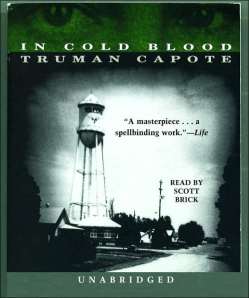
 Truman Capote captured my undivided attention with this medium-largeish* book in remarkable fashion. My first issue for this review: is this fiction, or non? It is most commonly referred to as a “nonfiction novel,” a term I have a lot of trouble with. The story is either based very closely on, or is, the true story of the quadruple murder of the Clutter family in small-town Kansas, and the investigation, arrest, and eventual execution of the two perpetrators. (My library’s OCLC listing calls it “postmodern fiction.”) Capote himself said, “I wanted to produce a journalistic novel, something on a large scale that would have the credibility of fact, the immediacy of film, the depth and freedom of prose, and the precision of poetry.” So, fiction or non? I’m going with fiction, but clearly this is one of those areas where the line blurs. More on that in a bit.**
I came across this book recently in several blogs, which is curious because it’s not new; it was first published serially in Life magazine in 1965, and in book form in 1966. I already had the book on my radar, but these fine fellow bloggers definitely solidified my interest. In telling you about the story, and the book constructed about the story, I’m going to be fairly spoilery, because this is history. If you want to read it yourself and be surprised, I’m not your top-choice review.
So. The subtitle reads, “A True Account of a Multiple Murder.” On the night of November 15, 1959, the Clutter family was bedding down on their farm in Kansas, just outside the small town of Holcomb, itself a suburb of Garden City. Herbert Clutter, the patriarch, was a respected member of the community and devout Methodist; his wife Bonnie had been suffering from depression and had been in and out of hospital, but at this time was home. Sixteen-year-old Nancy, the belle of local society, sweet, talented, generous, and universally beloved, had just sent her boyfriend Bobby home and was getting ready for bed. Fifteen-year-old Kenyon was slightly socially awkward but friendly and respected as a member of a well-liked and important family. The two older Clutter daughters were living on their own outside the home – one married, one about to be.
Meanwhile, two paroled convicts of the Kansas state prison system were on the road. Perry Edward Smith and Richard Eugene “Dick” Hickock had been cellmates and although very different in temperament, had teamed up for an endeavor that Dick described as being the perfect crime. As you’ve already guessed (or already knew), these six characters converge when Dick and Perry kill the Clutters in the night and make off almost as perfectly as Dick imagined. They spend months traveling, living briefly in Mexico where Perry hoped to become a successful treasure hunter, and then roaming the US again until they were apprehended in Las Vegas. They were tried in Kansas, convicted, and finally hanged in April of 1965.
Capote follows both groups of characters – the Clutters, and Perry & Dick – alternately in the days leading up to the night of the murder. Then he follows Perry and Dick in their roaming, and then through their imprisonment and trial, and right up to the hangings. His voice is omnipotent third person, and he quotes extensively from letters, documents, and trial proceedings, as well as from his interviews with various players and especially Dick and Perry themselves. Capote was on the case (so to speak) well before they became suspects, and published after they were killed, so his perspective and the timeline of his coverage is pretty extensive.
But, perhaps not entirely objective. The Clutters are painted in admirable detail, in lovely little vignettes. But their role is minor and short-lived (ouch, pun not intended). And of the two killers, Perry Smith is treated far more sympathetically and examined more deeply. I was pondering this as I listened to the book, wondering if this was all Capote’s apparent subjectivity, or if Perry was inherently more sympathetic; in other words, would I have found him so if I had been researching this case myself? There are a few fairly easy markers for this, at least for me: for one, Dick liked to rape little girls. Perry apparently stopped him from raping Nancy (by both their accounts). Dick ran over stray dogs with his car for fun, which Perry found revolting (as do I, obviously). Perry’s childhood was patently rough, while Dick’s is characterized as fairly normal. Perry seems to more clearly have a mental illness or defect that “causes” his criminal and violent tendencies. But, I’m not sure we get all of Dick’s story; Capote looks much more closely into Perry’s past. So what I’m trying to say is, I think there may be a bias in favor of poor Perry the murderer, having been manipulated by evil Dick. Apparently, it was alleged that Capote in fact had a sexual relationship with Perry while he was imprisoned, although obviously I can’t speak to that. This is not a criticism. I just want to point out that perhaps Capote is not entirely impartial with regards to his two main characters.
I found this book incredibly powerful. Capote has a fine sense of drama and of timing. Scenes and people are sketched artfully, sometimes quickly and with broad strokes that paint a pretty complete picture just briefly, and sometimes in painstaking detail. The stories of the Clutters’ deaths and Dick and Perry’s adventure and executions are fascinating and engrossing, yes. But it’s Capote’s rendering that makes this book, more than his subject matter. (I guess this is always the case.) I was blown away by the emotional effect of this story. I couldn’t get enough; I wanted more of the inside of Perry’s head, of Dick’s (ew, how creepy), of the small-town life of Holcomb and Garden City. This is my first experience with Truman Capote, and I’m a fan.
Also, as Marie said at The Boston Bibliophile, Scott Brick’s narration is excellent. I recommend this book on audio if you’re so inclined. (I also picked up a paperback, though, to have on hand. I never did reference it while listening but I think I’d like to have it for future use.)
*My audio version is 12 cd and 14.5 hours; my paperback edition is just under 400 pages.
**Back to the fact vs. fiction question. It does seem that Capote behaved like a journalist in putting this book together: gathering facts, interviewing key players, confirming dates. It could pass as “true crime,” a genre which itself may have trouble with fact vs. fiction. The biggest place where Capote appears to leave the realm of nonfiction behind is in dialogue; he has recreated a great many pieces of dialogue, mostly between Perry and Dick, that were unrecorded. He has relied upon Perry and Dick themselves in this recreation, I think, but memory being what it is, some creativity definitely come into play. I did note that on the night of the Clutters’ deaths, Capote has not tried to recreate their experience or any dialogue, except in the accounts shared by Perry and Dick in their confessions. This seems to show a reluctance to just “make things up,” and a respect for the question that (I think) still remains: did Perry kill the two male Clutters and Dick the two women, as Perry originally claimed? Or did he Perry kill all four, as he amended his story to say, and as Dick claimed all along? Capote doesn’t answer this question for us – presumably because he respects the fact that he can’t answer it authoritatively. (I do wonder what he thought, though, considering that he apparently was very close to Perry in particular.)
Filed under: book reviews | Tagged: audio, creative nonfiction, misc fiction, nonfiction, true crime | 6 Comments »