Miss Peregrine’s Home for Peculiar Children by Ransom Riggs

What an odd, fun, creepy little romp this was! I had been fascinated by the idea of this book months before it came out. The story is this: our first-person narrator, Jacob, has always been close to his grandfather. Grandpa Portman has told him stories all his life of the peculiar, magical children he grew up with, in a home for orphaned refugees during World War II. He even has pictures: a levitating girl (on the cover); an invisible boy; a skinny boy lifting a giant boulder. As Jacob grows up a bit, he begins to understand that perhaps Grandpa’s stories were just that, stories; but when Grandpa dies in a mysteriously disturbing fashion, in Jacob’s arms, and with the strangest of last words, he begins to wonder again. Under the care of a psychiatrist, Jacob travels with his father back to the tiny Welsh island where Miss Peregrine’s Home for Peculiar Children was located. The story he begins to unravel… well. I don’t want to ruin anything for you.

This is really a YA (young adult) book, for two reasons: 1, the reading level, and 2, the young adult protagonist. Jacob is 16 or 17 years old. I found it very enjoyable, though, and I don’t read YA very regularly. It was a quick read, partly because of the rather basic reading level. But here’s the unique bit: there are quite a few pictures mixed in with the text. Grandpa Portman had a collection of pictures; Jacob has a few of his own; he discovers a cache of pictures in his explorations of Cairnholm Island. And every one of the pictures mentioned in the story is included, so we get to do our own examining of them alongside Jacob. This was very cool, because the oddness (or perhaps, the peculiarity) of these pictures is a large part of the point of this book. And here’s the kicker: while this is a work of fiction, and the impossibility of the photos is obvious, I found an interesting detail at the back of the book. The author writes, “All the pictures in this book are authentic, vintage found photographs, and with the exception of a few that have undergone minimal postprocessing, they are unaltered.” I don’t know what “minimal postprocessing” might entail, but it made me go back and reexamine the pictures all over again, knowing that they each have a real life mysterious story behind them. I love it: an additional facet to this curious tale.

This is a paranormal story, even one of time travel. I don’t necessarily spend a lot of time in these areas, but I found Jacob to be a likeable (if doofy – is this a regular facet of YA, too?) protagonist, and his Grandpa was a real hero. The peculiar children were extremely likeable and fascinating. I had a lot of fun with this diversion from my more normal reading.

Teaser Tuesdays: Miss Peregrine’s Home for Peculiar Children by Ransom Riggs


Teaser Tuesdays is a weekly bookish meme, hosted by MizB of Should Be Reading. Anyone can play along! Just open your current read to a random page and share a few sentences. Be careful not to include spoilers!

This book is great fun so far. My teaser comes from page 142:

We walked through the house, past more curious eyes peeping through door cracks and from behind sofas, and into a sunny sitting room, where on an elaborate Persian rug, in a high-backed chair, a distinguished-looking lady sat knitting. She was dressed head to toe in black, her hair pinned in a perfectly round knot atop her head, with lace gloves and a high-collared blouse fastened tightly at her throat – as fastidiously neat as the house itself. I could’ve guessed who she was even if I hadn’t remembered her picture from those I’d found in the smashed trunk.

South Texas Tales by Patricia Cisneros Young

South Texas Tales: Stories My Father Told Me by Patricia Cisneros Young is a slim volume of short stories, taken in part from the stories the author grew up with. It’s a quick and easy read, and an enjoyable one.

These simple and simply told stories read almost like fables; they reminded me of the Coyote Native American stories I read as a child. These stories aren’t just for children, though. The writing style is sparse and straightforward, but these vignettes evoke a time and a place.

Issues addressed include race and racism, marriage and spousal abuse, religion and faith, and even suicide; many stories are about family, love, or the value of hard work. But all of these themes are understated. The stories are quietly powerful but always unpretentious. I enjoyed the minimalist, unfussy style very much; it’s rather palate-cleansing. There’s nothing fancy here, but the stories have value despite being… spare.

Just to give you a quick sampling:

Shibboleth is a story about the Masons acting ruthlessly for their own benefit, and feeling the wrath of the community in turn. The characters are drawn quickly and in broad strokes but it’s enough to feel the pride of the Hinojosas, and to respect Don Manuel’s speaking out, even if it’s too late.

Blood Moon Lullaby is heartbreaking but, I fear, all too true and common a tale.

The Courtship of Red Collins is a bit clumsy but also an awfully realistic-feeling portrayal of small town society and racism, with a surprising turn at the end. Unrealistic? Perhaps. But in that these tales read like fables, I can appreciate the moral.

A Good Day for Dying is a wise choice to finish the collection, because I found it to be the most powerful story of them all. I appreciated Don Sebastian and would like to sit under the mesquite tree with him, myself. It begins:

The old man was tired. Life had given him his fair share of trials and woes and now Sebastian, after surveying his vast estate, decided that the time had come for him to die. The bed that he crept out of had been imported from Paris and brought out to his ranch by mule train. It had been a surprise gift for Sara, the woman who had shared it with him for forty-eight years. He missed her warmth.

These unadorned, down-to-earth stories were remarkably powerful, and I think them a fine accomplishment for such a modest little book. I’m glad I stumbled across them.

Teaser Tuesdays: South Texas Tales by Patricia Cisneros Young


Teaser Tuesdays is a weekly bookish meme, hosted by MizB of Should Be Reading. Anyone can play along! Just do the following:

* Grab your current read
* Open to a random page
* Share two (2) “teaser” sentences from somewhere on that page
* BE CAREFUL NOT TO INCLUDE SPOILERS! (make sure that what you share doesn’t give too much away! You don’t want to ruin the book for others!)
* Share the title & author, too, so that other TT participants can add the book to their TBR Lists if they like your teasers!

I first learned about South Texas Tales: Stories My Father Told Me when I got a request for it here in the library. I’d not heard of it, but it sounded very interesting, and I was pleased to pick it up when we got it in (not least, because of that beautiful cover! Look at that!).

Your teaser today comes from page 65:

Jagou had not counted on the popular support of the communities, both in Brownsville and in Matamoros, rallying around the grief-stricken Hinojosa family. He watched nervously as regular customers became scarce and his daily sales margins dwindled to a trickle.

I am not sure that Jagou has done a good thing… or are the customers being unreasonable?

I look forward to reading these stories of a unique area right in my backyard.

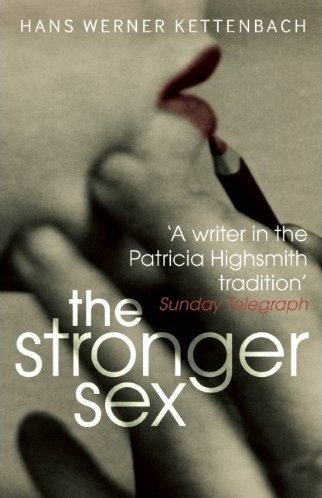
The Stronger Sex by Hans Werner Kettenbach, Anthea Bell

A quietly provocative novel that examines the psychology of sex and aging through the eyes of a nervous young lawyer in over his head.

The Stronger Sex is narrated by the young Dr. Alex Zabel, a lawyer saddled by his boss with the difficult task of defending an incorrigible elderly womanizer. He is immediately in over his head. The legal situation is thorny enough: Herr Klofft has fired his former mistress, an accomplished engineer, for taking sick time, and she has protested before the employment tribunal. Zabel’s real challenge, however, is in human relations: he has to deal with his client, Herr Klofft, with his ornery moods, ever-looming mortality and off-color humor; the surprisingly sexy and seductive Frau Klofft; and Zabel’s own prickly girlfriend. The plot is quiet and unhurried, proceeding sedately toward a resolution that is less important than the journey Kettenbach takes us on to get there. Anthea Bell translates from the German with great skill, with fewer awkward moments than many native-English writers.

This novel contemplates old age, sensuality and the relationship between the two. The advances (and retreats) between Zabel and Frau Klofft feel deathly serious in their implications. The young attorney is deeply embarrassed by Herr Klofft’s vulgarity as well as by his own attraction to the elderly Frau. He reacts almost as an adolescent to her worldly charms, struggling to fit the Kloffts’ eccentricities into his conservative world.

While the events that move the action in this book are muted, the layered, potentially uncomfortable questions resonate in the back of the reader’s head. Kettenbach has succeeded in writing a novel that demands reflection. It’s not a psychological thriller, but a psychological study with a legal background, filled with black humor to accompany Zabel’s slightly bizarre relationships. This meditative novel is mildly disturbing but massively thought-provoking.


This review originally ran in the May 19, 2011 issue of Shelf Awareness. To subscribe, click here, and you’ll receive two issues per week of book reviews and other bookish fun!

Teaser Tuesdays: The Stronger Sex by Hans Werner Kettenbach, trans. by Anthea Bell


Teaser Tuesdays is a weekly bookish meme, hosted by MizB of Should Be Reading. Anyone can play along! Just do the following:

* Grab your current read
* Open to a random page
* Share two (2) “teaser” sentences from somewhere on that page
* BE CAREFUL NOT TO INCLUDE SPOILERS! (make sure that what you share doesn’t give too much away! You don’t want to ruin the book for others!)
* Share the title & author, too, so that other TT participants can add the book to their TBR Lists if they like your teasers!

This is a fascinating book that I’m happy to be reading in order to write a review for Shelf Awareness. Quite at random, on page 97, I found a teaser snippet that pretty appropriately handles the themes of this book, including age, mortality, and sexuality.

I longed for smooth, flawless skin. For a dense mop of strong hair, no thin places in it. I longed for the fresh, clean smell of skin and hair like that, a smell owing nothing to any perfume and at the same time not arousing the slightest suspicion that there could be a touch of sprayed urine or the bad odour of wind in it.

It’s quite an interesting, unique read, skillfully translated from the German. I like it.

Hotel du Lac by Anita Brookner


Announcing International Anita Brookner Day! Coming up on July 16, which this year will be her 83rd birthday, and co-hosted by Thomas at My Porch and Simon at Savidge Reads. The idea is to read at least one novel by Brookner before IAB Day, and then go check out Thomas’s blog to link to your blog post or comment there on his page.

I am grateful to these gents for suggesting that I check her out. I was not familiar before, and am now absolutely a big, big fan, after reading Hotel du Lac. Thomas called her books each “brilliant in its own quiet, often depressing way” and also says that they are all “so similar in theme and tone that it is a little hard for me to keep them straight” but also “each of her novels, regardless of plot, is a perfectly wrought gem of introspective genius.” These comments seem somewhat mixed; depressing and all running together? not quite so complimentary; but then again, he’s organizing a whole Day around Brookner, and uses words like “brilliant,” “perfect(ly),” and “genius.” I was intrigued. And, they’re short books. 🙂 So I found this one and gave it a go.

I will use Thomas’s word and say brilliant, indeed. This is a book about a woman named Edith Hope, who at the start of the novel, arrives at the titular hotel for a medium-length stay on the coast of Lake Geneva in Switzerland. She seems to have been sent away from her home in some disgrace by friends and cohorts, but it’s not altogether clear why. She also seems to have a very passive role in her own indefinite exile. It’s odd.

Edith’s new life at the hotel is quiet and slow, which is not unlike her home life; she works on writing a romance novel (her umpteenth) and socializes by listening to women with larger and not entirely attractive personalities who are also ensconced. She writes letters home to a married man who was or is her lover – it seems to be past-tense – but it’s not clear that she mails them. She’s generally a passive and quiet person. I felt it was so descriptive of her that

…the action startled her, as if her plans had been made final without her having reached any conscious decision.

It’s a generally quiet book. There’s very little action, just musing. And it is depressed, if not depressing. But it is insightful and very funny, too. Brookner’s choice of words is extremely cutting, articulate, and rare. I point you towards a recent post in which I marvel at the line, “not drowning, but waving.” Indulge me with one or two more:

[The schoolchildren] were not given to excess or noise, and once the ship had left the shore they were summoned into the glassed-off observation lounge by their teacher for some sort of lesson. Obediently, they turned like swallows and left Edith and Mr Neville alone on deck.

Only one of many instances in which silence is discussed. It’s a theme. Or, how curious is it that such a coldly civilized man as Mr Neville would say,

Please don’t cry. I cannot bear to see a woman cry; it makes me want to hit her. Please, Edith.

It’s a strange, calm, quiet, leisurely, literary novel in which not much happens, but it’s such a luxurious joy to read it slowly, and go back and re-read. I failed to note where Brookner wrote that

The company of their own sex, Edith reflected, was what drove many women into marriage

and had to go back looking for it; and re-reading 50 pages was pleasurable, not at all a chore. The book might be read as a statement on love or marriage, but I feel like this subject matter is incidental; to me, it’s more of a book of tone, of language, and of character sketches. (How fascinating is Mrs. Pusey as a creature?) It could be about anything.

This book is beautiful. I want to read more Brookner. Will I do so before IAB Day? Who knows; there’s lots to read in my world. But I will definitely read more, eventually. She’s a real treasure. Thanks for the into, Thomas.

discovering something new in “pop fiction”

Happy Friday, gentle reader.

I don’t often find myself reading recently released pop fiction. I’ve never read anything by Nicholas Sparks; I’ve never read Eat, Pray, Love (ok, that’s not fiction, but you get the drift); I haven’t tackled Stieg Larsson’s trilogy yet; and until this week I had not read any Jodi Picoult. (Side story: I so enjoyed Lionel Shriver’s We Need to Talk About Kevin that I began to be interested in Picoult’s Nineteen Minutes which is on the same subject; but Shriver’s book came out ~4 years before and they looked so similar I worried that Picoult was not being perhaps entirely original!) However, after reading my friend Amy‘s blog post about Handle with Care, I became interested in My Sister’s Keeper, which is discussed in that post. (Sorry if this story is a little convoluted.) Because I trust and respect Amy even though she reads and writes sci fi 🙂 I picked up My Sister’s Keeper and started it this week. So.

My usual reading routine is to keep (at least) one book going at work, which I read on lunch breaks, and almost always bring home to finish over the weekend (if I don’t, it’s not a very good book). I simultaneously have one (or more likely several) books going at home. My Sister’s Keeper has been doing so well, though, that I took it home with me last night – on a Thursday – to read at the park before a trail work session. That’s a good sign.

I spent a couple dozen pages being a little, mm, irritated I suppose, by the conversational and youthful style. The story is told from varying viewpoints, a chapter at a time in first person from a variety of characters; but we start pretty heavy on Anna, the thirteen-year-old protagonist. I think perhaps her voice was authentic for her age, and maybe that’s what bothered me a little. I pushed through my grumpiness, though, and I think I’ll take full credit for that grumpiness; I just needed an adjustment period. I like this book! The moral issues at stake are pretty interesting, and while I’m not extremely torn – I’m pretty clear on what I think “should” be – I definitely appreciate what Picoult is doing to illustrate the complexity of the question.

Quick plot synopsis: Anna was genetically engineered and conceived specifically to match older sister Kate’s needs for a tissue donor. Kate has a very complex and aggressive cancer. By the time we meet Anna (13), Kate (16) has lived a decade beyond expectations. Parents Sara and Brian (such prosaic names!) have always just drawn from Anna when Kate has needs; but now, in the face of kidney donation, Anna hires a lawyer and sues her parents for medical emancipation. If she wins, her sister dies. You can see the complexity there. No plot spoilers for now because I’m not done reading yet 🙂 although I did read Amy’s spoilers! (It’s okay, I don’t care, a good book should stand up after spoilers.)

My reaction to the dilemma is entirely on Anna’s side. Kate will die with or without a kidney transplant; Anna has much more to gain or lose in this question, and it’s high time someone took her rights into account. Here’s a kicker: read all the synopses you like of this book, and tell me, how many mention the third (eldest) sibling, Jesse? He doesn’t count at all; and Anna only counts as a body-parts donor. Sara is heard to say “stop acting like a five-year-old” to a five-year-old; she guilt trips her other two children, even at very young ages, that at least they’re not in Kate’s shoes; she rejects many pleas for normalcy because everything has to be about Kate. She accuses Jesse of injecting drugs when in fact his track marks are from donating plasma to his little sister; Sara’s so busy martyring the world that she wasn’t aware of his donations. I don’t think there’s much question here of what’s right or wrong; but for a thirteen-year-old girl to make the decision for her sister to die is pretty heavy stuff. It’s heavy for the mother, too, but I can’t believe she doesn’t have a little more concern for her other daughter.

So even though I find myself a little disgusted with one character, I like what Picoult’s doing. All of the characters are very believable; to not like a character is certainly not to not like a book or a writer’s work.

Sorry I waited so long to give this one a try! I’ll have to be a bit more open-minded in the future.

Just to keep you up to date, I’m working on Alan Bradley’s The Sweetness at the Bottom of the Pie at home (thanks to an RA classmate for the recommendation), and yes I will read Stieg Larsson’s trilogy one of these days, but what’s the rush? I’ll wait til there aren’t lines of people waiting for them and buy them off the used rack in a year or two. 🙂

Enjoy your weekend! I know I will, with so many good books in the world. Ahhh.