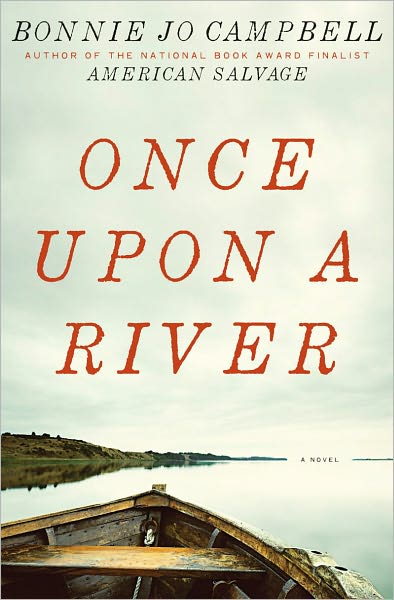
Once Upon a River by Bonnie Jo Campbell

Once Upon a River is a beautiful book. The story is not joyful, let me say that right off. But it’s beautifully wrought, and in fact, when I finished it and stepped back and viewed it as a whole, I decided that the story has a certain beauty, too. A sad beauty, but a beauty that’s true to life.

This is the story of Margo. She grows up in a little town on the Stark River in Michigan, hunting, fishing, and living and breathing the river. She is close to her grandfather, and lives in the outdoors; school and social situations are difficult for her. She’s a very skilled outdoorswoman, and an especially good shot; Annie Oakley is her hero. Bad things happen. Margo’s mother leaves, and as her situation further deteriorates, she takes off upstream in the boat her grandfather gave her to look for her mother. Margo lives off the land and the river, mostly. She makes a few alliances but they all fall apart. People and relationships are not as reliable as the river and the outdoor world in which she feels safe and comfortable. More bad things happen. She grows up some, learns about people, and learns more about the natural world. She moves upstream and downstream, learns how to survive with her hands, a few tools, and her skills, along the lines again of Annie Oakley (she will eventually own two biographies, among her few prized possessions).

This story is painful in more than a few spots. Plenty of bad things happen, including several rapes and quite a bit of death. There’s no shortage of young people having sex, to which your reactions may vary. (Consensual? In itself a “bad thing”?) You will cringe. But like many books that are both sad and realistic, the cringing might be worth it. Margo’s story actually looks skyward, hopefully, at the end. She finds and makes some good things, too.

Campbell has full grasp of metaphor. The river flows on, and Margo learns its rhythms, and how to assert herself while following its current. She finds the river to be a more constant (if not predictable) force than human nature. Campbell has full grasp of language, too; she writes beautifully, lyrically, symbolically. In the end it’s a gorgeous book and I recommend it wholeheartedly. So, to recap: bad things happen, but beautifully. It’s a book about life.

book beginnings on Friday: Once Upon a River by Bonnie Jo Campbell

Thanks to Katy at A Few More Pages for hosting this meme. To participate, share the first line or two of the book you are currently reading and, if you feel so moved, let us know what your first impressions were based on that first line.

Everyone’s been talking about this one for the last several months, and I knew I wanted to read it. The idea of a female Huck Finn (while threatening to prejudice my reading of the book…) was too much to resist. I’m glad I finally got around to it. Here is the beginning:

The Stark River flowed around the oxbow at Murrayville the way blood flowed through Margo Crane’s heart. She rowed upstream to see wood ducks, canvasbacks, and ospreys and to search for tiger salamanders in the ferns. She drifted downstream to find painted turtles sunning on fallen trees and to count the herons in the heronry beside the Murrayville cemetery.

That first sentence is something special, isn’t it? It really captures one of the main themes of the book: that for Margo, the river is LIFE.

I’m enjoying this book very much, and moving through it quickly; you can expect a review in the next few days. For now I’ll say this: it’s beautiful and moving, but also stark and disturbing. Bad things happen. I wasn’t quite prepared for this, although I suppose it’s in keeping with the Huck Finn allegory – his story, too, had its disturbing moments, despite the seeming calm of coming-of-age-on-the-river.

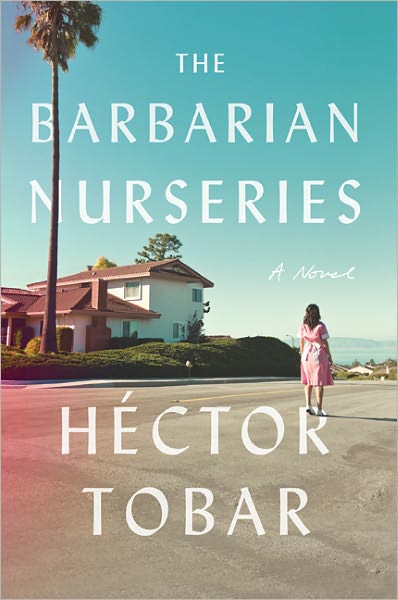
The Barbarian Nurseries by Héctor Tobar

A deceptively quiet story, with swift currents running deep beneath its surface, considers the fate of an unprepared Mexican housekeeper in Orange County left to care for her employers’ young children.

Pulitzer Prize-winning journalist Héctor Tobar‘s second novel tackles the ambitious goal of characterizing Southern California’s multicultural schizophrenia and achieves it admirably.

Araceli is quietly comfortable in her role as housemaid to the Torres-Thompson household in Orange County, one of three Mexican domestics; but when the gardener and nanny are suddenly dismissed, she is puzzled to find herself expected to care of three children she considers strangers. Worse, she wakes up one morning to find both her employers gone with their baby–leaving her alone in the house with two young boys. In desperation, she sets off with them on a daunting trek through diverse and unfamiliar Los Angeles to try to find their estranged paternal grandfather.

Tobar creates an intriguing juxtaposition of cultures, as the Torres-Thompson children are thrust into a huge, unfamiliar, multiethnic city. Most observations are from Araceli’s perplexed, amused, lyrically bilingual perspective. At other times, we look through the boys’ eyes, with all the wonder of the new, including evidence of poverty they’ve never before encountered. The older boy (age 11), in particular, has a unique way of clinically interpreting new experiences through books he’s read, imbuing the world with fantasy. The adventure with the boys is a comedy of errors–Araceli becomes suddenly famous as a symbol of racial politics, and her fate depends upon forces outside her control.

The Barbarian Nurseries is a beautifully written, contemplative and thought-provoking view into Southern California’s diversity and contradictions, as well as a fascinating and well-presented story.


This review originally ran in the September 27, 2011 issue of Shelf Awareness for Readers. To subscribe, click here, and you’ll receive two issues per week of book reviews and other bookish fun!


Y’all! One of the best books I’ve read this year! Rush out there and get it!!

fiction vs. non

I’ve talked a few times recently here at pagesofjulia about fiction and nonfiction. (See for example my discussion of the value of fiction.) Most recently, in my review of In Cold Blood, I ponder the fine line between the two. Sometimes it’s difficult to tell. How do we draw the line? Here at the library, for cataloging purposes, I use OCLC’s bibliographic record; but there is often room for debate. Ernest Hemingway (obviously) is my go-to example of an author of fiction which is so highly autobiographical as to raise eyebrows; and for that matter, he was also an author of nonfiction that may have fudged here and there (i.e. his journalism in times of war in which he claimed a heroic or brave role for himself). And then there are the James Freys and Greg Mortensons of the world, who claimed to be writing nonfiction and later were accused of either smudging their facts or wholly making things up. So, my point is, the line between fiction and nonfiction (a) can be fuzzy and (b) is an important line to be aware of – even when we can’t draw it firmly.

I came across a short article the other day that I want to share it with you here. Robert Gray’s column at Shelf Awareness, is called “Deeper Understanding.” He recently wrote Conquering Our National Fear of Fiction, in which he notes that President Obama has been criticized for reading fiction. He then makes arguments – and quotes studies – in favor of reading fiction for education, and for improving ourselves. His message is one I definitely get behind (again, see my discussion of the value of fiction).

I love reading nonfiction. I think I love it more every year. There’s so much in the history of our world – and in what’s happening in our world today – that’s fascinating and that we should be aware of. Of course, I’m not doing an exceptional job of keeping up on everything. There’s too much to know. But I do enjoy nonfiction. In fact, I feel like I’ve read an awful lot of it this year – but when I look back at my Books Read log, I see that fiction still massively outnumbers nonfiction. Maybe I had a misconception because so much of the fiction I read is very short, and some of nonfiction is quite long, so the time spent on each might be closer to equal… maybe I’m making excuses. My point is, I have nothing against nonfiction, and should read more than I do. But! Fiction! Not an ugly stepchild at all!

So, for discussion here if you please: Do you read mostly fiction, or non? What is the value of each? In other words, is fiction frivolous and nonfiction valuable, or does fiction have a great deal to offer us as people, as a society? Why? What authors have you come across who smudge the line between the two? How strongly do you feel about defining the line, and how do you go about it? For example, is In Cold Blood fiction or non? Or some strange hybrid?


For your reference, I’ve linked here to a few of my favorite nonfiction reads of the last year or two…
Around the World on Two Wheels: Annie Londonderry’s Extraordinary Ride, Peter Zheutlin
Dethroning the King, Julie Macintosh
The Devil in the White City, Erik Larson
Fire Season, Philip Connors
Heroine’s Bookshelf, Erin Blakemore
Iphigenia in Forest Hills, Janet Malcolm
Mr. Playboy, Steven Watts
Hemingway’s Boat, Paul Hendrickson
Newspaper Titan by Amanda Smith

Some Tame Gazelle by Barbara Pym

I have finished reading one of the two books that Thomas of My Porch sent me. You done good, Thomas, I found it charming and funny. Pym is not entirely different from another Barbara I recently discovered, through Stuck in a Book: Barbara Comyns, whose Who Was Changed and Who Was Dead I really enjoyed. Simon, Thomas, anyone, if you can help me come up with a better genre tag for these ladies than “misc fiction,” I’d be obliged. Do these count as “domestic fiction” or whatever they call Jane Austen? Sorry, I’ll get on with it…

Some Tame Gazelle is the story of two spinster sisters, Belinda and Harriet, in a little English village in the 1950’s or thereabouts. We get the story from Belinda’s perspective primarily. She’s the dowdier and more humble of the two sisters, and her day-to-day life revolves, perhaps more than she realizes, around the local Archdeacon, who she knows and still loves as Henry from their school days. Henry is married, of course, and she resignedly sighs and gently envies his difficult wife Agatha, with whom he does not seem entirely happy, and alternately resolves to be a friend to her. Harriet, on the other hand, is still regularly refusing marriage proposals (mostly from the same man, Ricardo, an Italian count who Belinda rather wishes she would marry). Harriet is a bit sillier and prouder than her sister, but they depend on each other and are very much settled in their life together.

We read about this little village, where the sisters have tea, buy groceries, attend church, and help out with church functions. Where Belinda is devoted to the Archdeacon and worries over what garments she can appropriately knit for him, Harriet attaches herself to one curate after another and teases Ricardo and criticizes Belinda’s beloved Henry. Day follows day.

Sort of like what I said about the Comyns novel, this is a quiet book; there aren’t loud noises; you don’t jump in your seat. But my, is it ever quietly funny. Pym is compared to Austen, which I guess makes sense, but they’re not so similar you’d confuse them or anything. Part of this I suppose is the subject matter, that is, spinster ladies vs young women chasing marriageable men of independent wealth. (And I haven’t done my Pym research so don’t know if this is her standard subject material.) But I suppose the tone is comparable to Austen: people are so confined by custom and what the neighbors might think that they do silly things, and worry about silly things, and certain gentlemen do even sillier things that the women make excuses for. It’s a humor of quiet, respectable absurdity.

It also has in common with Austen, a female preoccupation with marriage. I don’t want to give anything away, but there are marriage proposals and there are weddings (okay, only one is onscreen), and there is much agonizing over marriage. There is also some rather blasphemous talk of spouse-switching – all completely theoretical and private, of course.

This book is set firmly in religion; most of the main characters are clergy, or obsessed with a member of the clergy, and all are church workers. This was a little foreign for me, someone with no church or religion in her life (don’t pity me, I’m very happy this way, and I don’t like being judged either, thanks) but I think I followed along okay. It’s not “Christian fiction” in any way; the church is just the backdrop. If anything, the church is an object of some merriment too, since the clergy tend to behave at least as ridiculously as anyone else.

Without getting too spoilery, I’m going to stop here in discussion of plot, but I want to note the title. The book opens with a Thomas Haynes Bayly quotation:

Some tame gazelle, or some gentle dove:
Something to love, oh, something to love!

Which perhaps tells us what this book is “about” better than anything.

If you are okay with the spoilers and/or have read this book, highlight the white text below.

One of my favorite things about this book is that it came full circle and we ended up right exactly back where we started. I was worried along with Belinda that one (or the other!) of the sisters was going to accept a marriage proposal, but I was much happier ending with Harriet preparing to dote on a new curate, and back again to the first line. So this is another book in which not much happens – but it’s surprising how satisfying that can be.

Thomas! You are wonderful! Thanks so much. Can’t wait to get into The Home-Maker.

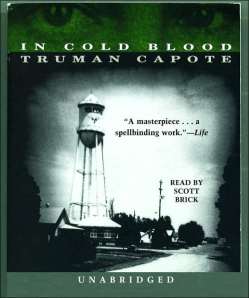
In Cold Blood by Truman Capote (audio)

Truman Capote captured my undivided attention with this medium-largeish* book in remarkable fashion. My first issue for this review: is this fiction, or non? It is most commonly referred to as a “nonfiction novel,” a term I have a lot of trouble with. The story is either based very closely on, or is, the true story of the quadruple murder of the Clutter family in small-town Kansas, and the investigation, arrest, and eventual execution of the two perpetrators. (My library’s OCLC listing calls it “postmodern fiction.”) Capote himself said, “I wanted to produce a journalistic novel, something on a large scale that would have the credibility of fact, the immediacy of film, the depth and freedom of prose, and the precision of poetry.” So, fiction or non? I’m going with fiction, but clearly this is one of those areas where the line blurs. More on that in a bit.**

I came across this book recently in several blogs, which is curious because it’s not new; it was first published serially in Life magazine in 1965, and in book form in 1966. I already had the book on my radar, but these fine fellow bloggers definitely solidified my interest. In telling you about the story, and the book constructed about the story, I’m going to be fairly spoilery, because this is history. If you want to read it yourself and be surprised, I’m not your top-choice review.

So. The subtitle reads, “A True Account of a Multiple Murder.” On the night of November 15, 1959, the Clutter family was bedding down on their farm in Kansas, just outside the small town of Holcomb, itself a suburb of Garden City. Herbert Clutter, the patriarch, was a respected member of the community and devout Methodist; his wife Bonnie had been suffering from depression and had been in and out of hospital, but at this time was home. Sixteen-year-old Nancy, the belle of local society, sweet, talented, generous, and universally beloved, had just sent her boyfriend Bobby home and was getting ready for bed. Fifteen-year-old Kenyon was slightly socially awkward but friendly and respected as a member of a well-liked and important family. The two older Clutter daughters were living on their own outside the home – one married, one about to be.

Meanwhile, two paroled convicts of the Kansas state prison system were on the road. Perry Edward Smith and Richard Eugene “Dick” Hickock had been cellmates and although very different in temperament, had teamed up for an endeavor that Dick described as being the perfect crime. As you’ve already guessed (or already knew), these six characters converge when Dick and Perry kill the Clutters in the night and make off almost as perfectly as Dick imagined. They spend months traveling, living briefly in Mexico where Perry hoped to become a successful treasure hunter, and then roaming the US again until they were apprehended in Las Vegas. They were tried in Kansas, convicted, and finally hanged in April of 1965.

Capote follows both groups of characters – the Clutters, and Perry & Dick – alternately in the days leading up to the night of the murder. Then he follows Perry and Dick in their roaming, and then through their imprisonment and trial, and right up to the hangings. His voice is omnipotent third person, and he quotes extensively from letters, documents, and trial proceedings, as well as from his interviews with various players and especially Dick and Perry themselves. Capote was on the case (so to speak) well before they became suspects, and published after they were killed, so his perspective and the timeline of his coverage is pretty extensive.

But, perhaps not entirely objective. The Clutters are painted in admirable detail, in lovely little vignettes. But their role is minor and short-lived (ouch, pun not intended). And of the two killers, Perry Smith is treated far more sympathetically and examined more deeply. I was pondering this as I listened to the book, wondering if this was all Capote’s apparent subjectivity, or if Perry was inherently more sympathetic; in other words, would I have found him so if I had been researching this case myself? There are a few fairly easy markers for this, at least for me: for one, Dick liked to rape little girls. Perry apparently stopped him from raping Nancy (by both their accounts). Dick ran over stray dogs with his car for fun, which Perry found revolting (as do I, obviously). Perry’s childhood was patently rough, while Dick’s is characterized as fairly normal. Perry seems to more clearly have a mental illness or defect that “causes” his criminal and violent tendencies. But, I’m not sure we get all of Dick’s story; Capote looks much more closely into Perry’s past. So what I’m trying to say is, I think there may be a bias in favor of poor Perry the murderer, having been manipulated by evil Dick. Apparently, it was alleged that Capote in fact had a sexual relationship with Perry while he was imprisoned, although obviously I can’t speak to that. This is not a criticism. I just want to point out that perhaps Capote is not entirely impartial with regards to his two main characters.

I found this book incredibly powerful. Capote has a fine sense of drama and of timing. Scenes and people are sketched artfully, sometimes quickly and with broad strokes that paint a pretty complete picture just briefly, and sometimes in painstaking detail. The stories of the Clutters’ deaths and Dick and Perry’s adventure and executions are fascinating and engrossing, yes. But it’s Capote’s rendering that makes this book, more than his subject matter. (I guess this is always the case.) I was blown away by the emotional effect of this story. I couldn’t get enough; I wanted more of the inside of Perry’s head, of Dick’s (ew, how creepy), of the small-town life of Holcomb and Garden City. This is my first experience with Truman Capote, and I’m a fan.


Also, as Marie said at The Boston Bibliophile, Scott Brick’s narration is excellent. I recommend this book on audio if you’re so inclined. (I also picked up a paperback, though, to have on hand. I never did reference it while listening but I think I’d like to have it for future use.)


*My audio version is 12 cd and 14.5 hours; my paperback edition is just under 400 pages.

**Back to the fact vs. fiction question. It does seem that Capote behaved like a journalist in putting this book together: gathering facts, interviewing key players, confirming dates. It could pass as “true crime,” a genre which itself may have trouble with fact vs. fiction. The biggest place where Capote appears to leave the realm of nonfiction behind is in dialogue; he has recreated a great many pieces of dialogue, mostly between Perry and Dick, that were unrecorded. He has relied upon Perry and Dick themselves in this recreation, I think, but memory being what it is, some creativity definitely come into play. I did note that on the night of the Clutters’ deaths, Capote has not tried to recreate their experience or any dialogue, except in the accounts shared by Perry and Dick in their confessions. This seems to show a reluctance to just “make things up,” and a respect for the question that (I think) still remains: did Perry kill the two male Clutters and Dick the two women, as Perry originally claimed? Or did he Perry kill all four, as he amended his story to say, and as Dick claimed all along? Capote doesn’t answer this question for us – presumably because he respects the fact that he can’t answer it authoritatively. (I do wonder what he thought, though, considering that he apparently was very close to Perry in particular.)

book beginnings on Friday: Some Tame Gazelle by Barbara Pym

Thanks to Katy at A Few More Pages for hosting this meme. To participate, share the first line or two of the book you are currently reading and, if you feel so moved, let us know what your first impressions were based on that first line.

Today I’m reading Some Tame Gazelle by Barbara Pym. She’s an author I am wholly unfamiliar with, but my curiosity was piqued by the favorable mentions of her over at Stuck in a Book and My Porch – and then as you may have noticed, Thomas from My Porch was very kind to send me a copy!!

I am enjoying this book so far, but will resist the temptation to tell you a lot about it here. This is a book beginnings post. Review to come. I daresay, a favorable review.

We begin:

The new curate seemed quite a nice young man, but what a pity it was that his combinations showed, tucked carelessly into his socks, when he sat down. Belinda had noticed it when they had met him for the first time at the vicarage last week and had felt quite embarrassed.

If you’re like me, the “combinations” may have given you trouble (as did the “marrows,” apparently a sort of produce – fruit or veg, that is – a few pages later). I think these are cultural-and-historical confusions, meaning I think they belong to England of the… 1950’s? (that’s when the book was published; I’m shady on the time-setting) and seeing as how I live in 2011 Houston, these terms were new to me. But! The interwebs tells me that combinations are a unionsuit (one-piece underwear – do they have flaps for toileting? or do you have to fully undress?) and marrows are squash. Ah, the wonders of the interwebs.

I like my book. 🙂 What are you reading?

Teaser Tuesdays: The Barbarian Nurseries by Héctor Tobar

Teaser Tuesdays is a weekly bookish meme, hosted by MizB of Should Be Reading. Anyone can play along! Just open your current read to a random page and share a few sentences. Be careful not to include spoilers!

I’m very impressed with this quiet, evocative novel about a Mexican maid working in an affluent white household in Orange County during a time of disturbing upheaval. I have come across several remarkable lines and shall share here – two teasers because I just couldn’t choose.

From page 154:

Brandon and Keenan packed their rolling suitcases and backpacks with extra speed, anticipating another visit to that temple of sugar, and the condominium with the expansive recreation facilities where the elder Torres lived alone in a long-dashed hope that his grand-children might visit him and use the kidney-shaped swimming spool. They packed their bathing suits and Game Boys too, until Araceli told them to leave all toys behind and to bring more underwear instead.

Yes, this next one is longer than the prescribed two sentences. You may stop reading at two if you’re offended.

From page 165:

“What’s it called? Why is it made out of cement? It hasn’t rained, so where does the water come from?”

“Too many questions,” Araceli said.

“Too many?” No one had ever told Brandon such a thing.

“Yes.”

That makes me laugh. You just wait for my review on this one; I think it will be glowing.

This quotation comes from an uncorrected advance proof and is subject to change.

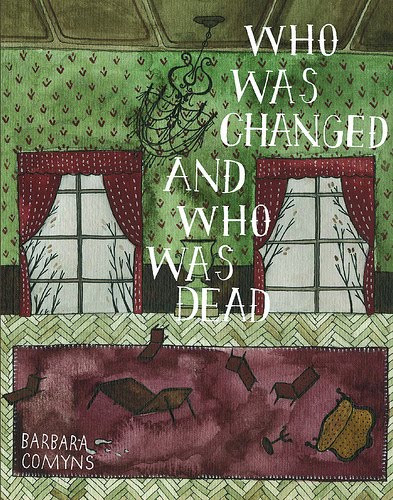
Who Was Changed and Who Was Dead by Barbara Comyns

Thank you so much to Simon from Stuck in a Book for this recommendation. Your future recommendations will be heeded!

Who Was Changed and Who Was Dead is an odd book, a short book, a unique book, and a very enjoyable way to spend an hour or two of your time. The setting is Warwickshire, “about seventy years ago” – published in 1954, so call it the 1880’s. We are mostly concerned with the Willoweed family. The grandmother is rather hateful and gluttonous and deaf; her son, Ebin, is cowed and unsympathetic as well. He has three children who are not in school, but who drift through the Willoweed estate trying to avoid unpleasantness. The town at large plays a role, as well as the Willoweeds’ domestic servants.

The book opens with a flood that disrupts normal life – “the maids pinned their skirts up high and splashed about in the water trying to prepare breakfast.” There are deaths, and then there are more deaths, and then it becomes clear that a plague of sorts has descended upon this sleepy town, which gives Grandmother Willoweed great pleasure. These deaths are treated less as tragedies than as facts of life, no more or less important than the deaths of the hens in the flood at the beginning of the book.

I haven’t given you much of a plot synopsis here, but that’s because the plot isn’t really the point. Things happen to the various characters, rather than them initiating action. But the unique thing about Comyns’ writing is that this book is not necessarily about Things Happening To People, as is usually the case in books. Rather, every event, large and small, and every observation, is treated with equal weight. The descriptions are brief and striking and evocative. The tone is really something different and special; I appreciate this writer’s ability to bring real interest and consideration to items and events that are mundane, or in other cases, horrifying, but in a democratic fashion.

An odd but fascinating book, short and easy to read: I started it in the airport in San Diego and was finished less than halfway into the flight home to Houston. I recommend it, and will be seeking more Comyns. Thanks Simon!

book beginnings on Friday: Who Was Changed and Who Was Dead by Barbara Comyns

Thanks to Katy at A Few More Pages for hosting this meme. To participate, share the first line or two of the book you are currently reading and, if you feel so moved, let us know what your first impressions were based on that first line.

Today’s book beginning comes from an odd and engrossing little British novel by Barbara Comyns, recommended to me by Simon at Stuck in a Book, called Who Was Changed and Who Was Dead. It’s very enjoyable and unique.

And so we begin.

The ducks swam through the drawing-room windows. The weight of the water had forced the windows open; so the ducks swam in. Round the room they sailed quacking their approval; then they sailed out again to explore the wonderful new world that had come in the night. Old Ives stood on the verandah steps beating his red bucket with a stick while he called to them, but today they ignored him and floated away white and shining towards the tennis court.

This matter-of-fact tone regarding some decidedly strange events is one of the hallmarks of the book. Review is to come, but for now let me say, I like.