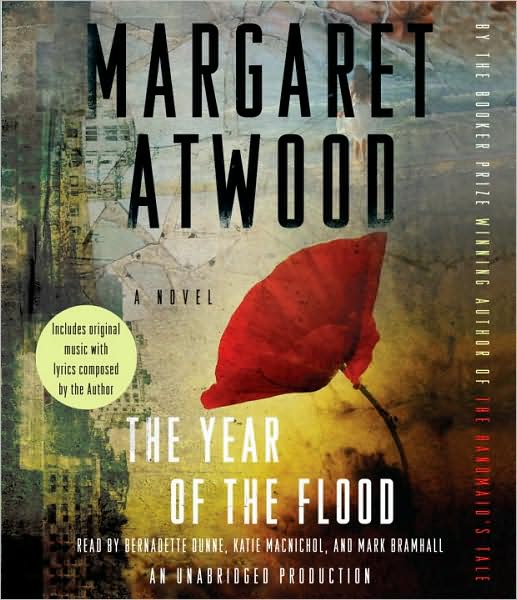
The Year of the Flood by Margaret Atwood (audio)

Margaret Atwood is a master of world-building. This was a great experience: disturbing, thought-provoking, funny, frightening, and completely real.

In The Year of the Flood, we check in with Toby and with Ren, both weathering out the aftermath of the “waterless flood” that seems to have almost entirely wiped out humankind. We’re also treated to a series of flashbacks to their lives before the flood. In that dystopic world, the CorpSeCorps rule a sinister corporate/business/police state, and the Gardeners preach the gospel of the flood to come and their own brand of “green,” vegetarian, wacky Christianity. Toby was an Eve in the Gardeners, and Ren, a former Gardener, was a sex worker in a high-end club. I don’t want to say much more about plot; the constant discovering of new surprises was very special and I want to preserve that for you.

One of the unique aspects of this audiobook was the songs that accompanied the sermons preached by Adam One, the Gardeners’ leader. For one thing, various narrators are employed, which is always interesting; Adam One has his own narrator, so we hear his sermons in his own voice. I found them creepy, but the hymns were creepier still. Music on an audiobook is a great use of the format, and one I’m mostly unfamiliar with. In this case, they helped set a tone that I found overwhelmingly… disturbing. I’m a little alarmed by organized religion to begin with, and pretty sympathetic to vegetarian-hippie-feel-good systems of thought; but this combination of the two was definitely a little bit cultish and perverse. There is an eerie other-worldly feeling to the pre-flood dystopia. And then of course, our flashbacks to that world are interspliced with tidbits of the lonely experiences of Toby and Ren in the frightening new world, where liobams (lion-lambs) and rackunks (raccoon-skunks) run wild.

And speaking of creepiness, can I mention this? One character is a refugee from Texas, which was made unliveable by a hurricane, which of course wins prizes for believability but the flip side of that coin is it’s a little close to home, Ms. Atwood! She does paint an alarming picture of the-world-as-we-know-it, but different.

There are several qualities that make this book special and remarkable. Toby, Ren, Zeb, and Amanda are all such real and fully-developed characters; they live and breathe. The pre-flood world of the CorpSeCorps and the Gardeners is both fantastic and wild and foreign and also startlingly close to home; this may very well be what we’re headed towards, you’ll think as you read/listen. It, too, is well-developed, fully-realized, frighteningly realistic and possible. The pacing of the story builds the tension perfectly; new tidbits are discovered at just the right moments; the tension grows. At the start of the story, we meet both Toby and Ren, each in her respective hiding place and suspecting she’s the last living human on earth; as the flashbacks unfurl, we learn how each ended up where she is. The jumpy chronology adds to the disjointed feeling the book inspires. It’s really just masterfully done. And the audio was extremely well done, too.

I don’t feel I’ve done this book justice. I don’t want to say too much; but maybe too I’m just not up to the task. I recommend Atwood and, as Valerie pointed out, you should read Oryx and Crake before this one as it is a sequel of sorts; although I think it is very satisfying on its own, too. (I did read the former but have mostly forgotten it…) I also want to direct you to Kerry’s review, also of the audiobook, as she did a great job. (Maybe I’m just having trouble following her!)

This is a creepy-crawly, perfectly executed story about the dystopian future we might be headed towards, and the audio is A+.

book beginnings on Friday: The Year of the Flood by Margaret Atwood

Thanks to Katy at A Few More Pages for hosting this meme. To participate, share the first line or two of the book you are currently reading and, if you feel so moved, let us know what your first impressions were based on that first line.

This is a dystopian story, or perhaps even post-dystopian. I’m enjoying it very much and finding it thought-provoking, which is certainly what I expect from Margaret Atwood. It begins:

In the early morning Toby climbs up to the rooftop to watch the sunrise. She uses a mop handle for balance: the elevator stopped working some time ago and the back stairs are slick with damp, so if she slips and topples there won’t be anyone to pick her up.

There is no one there to pick her up because Toby is virtually the last person left alive in this odd world, as far as we know at this point. It’s a very spooky concept.

What are you reading this weekend?

Teaser Tuesdays: Love Medicine by Louise Erdrich

Teaser Tuesdays is a weekly bookish meme, hosted by MizB of Should Be Reading. Anyone can play along! Just open your current read to a random page and share a few sentences. Be careful not to include spoilers!

I’ve been really enjoying this story involving several generations of Native Americans in North Dakota. For your teaser today I’ve selected a passage I found amusing (if sad), that illustrates one family’s struggle with overpopulation!

[The babies] were all over in the house once they started. In the bottoms of cupboards, in the dresser, in trundles. Lift a blanket and a bundle would howl beneath it. I lost track of which were ours and which Marie had taken in. It had helped her to take them in after our two others were gone. This went on. The youngest slept between us, in the bed of our bliss, so I was crawling over them to make more of them. It seemed like there was no end.

I thought this was a good example of Erdrich’s ability to be funny even while telling a serious story.

What are you reading today?

Black Sun by Edward Abbey

I love Edward Abbey for Desert Solitaire, and for his reputation (compounded of course by my love of Fire Season too). My Pops has gotten into him this year, and has brought me quite a few of his books, and I’ve been excited to pick them up. I confess I chose this one for its setting as I’m now working on completing the Where Are You Reading? Challenge, and it covers Arizona for me. But oh! this book has value all on its own. Those 3-4 other Abbey books that are sitting on my shelf right now just moved up the list a little bit. He wrote more nonfiction than fiction, and his best-known novel is The Monkey Wrench Gang; this lesser-known novel involves a fire lookout, which was my attraction (see again Fire Season).

The story is this. Will Gatlin has abandoned his life as college professor and husband to become a reclusive fire lookout in the Grand Canyon National Park. He is mostly alone up there, but does get a few visits and letters from his friend Art Ballantine, who still teaches college but expends more energy on chasing women. To say he is obsessed with sex, breasts, the female anatomy (he uses the c-word), young girls in every application, would be putting it mildly; his letters are raving and silly and self-deprecatingly intellectual. And very funny. In between Ballantine missives Will does his fire-lookout work, observes nature – these parts are poetic, loving and appreciative – and carries on a love affair with a girl named Sandy. I’m not sure we ever learn Will’s age, but he is probably old enough to be nineteen-year-old Sandy’s father. She is a virgin when they meet, and engaged to another man, but none of this stops them from cavorting the wilds (desert, river, canyon and forest) in the nude, wittily teasing one another and having wonderful sex. Here Abbey falls into that lamentable and oh-so-distinctive habit that older male writers sometimes fall into (Papa included!) of creating nubile young beauties who want nothing more than to have endless sex with old men. It’s unfortunate in that it seems to give away the author’s own dirty-old-man fantasies (I don’t know this about Abbey in particular but it is my reaction to the cliché). But if we can move past this issue, Will and Sandy have a great time running around the wilderness, la dee da. That is, until Sandy disappears and her fiancé shows up to accuse Will of disappearing her and punches him in the face.

Abbey writes beautifully, lyrically about nature and about love or at least attraction. The letters from Ballantine (and others) are amusing. The story is tragic, but it requires a certain overlooking of the older man’s fantasy before we could really sympathize with Will’s sense of loss. If you can move past this, it’s a beautiful little story with flora and fauna of the Grand Canyon painting the background. I was only partly successful in that requisite overlooking, but enjoyed it all the same. I have great hope for the other Abbey books waiting on my shelves.

I thought I could clearly see connections in Abbey’s writing style and subject matter to Keruoac, as well as Philip Connors, who in Fire Season acknowledges the debt. I recommend Black Sun, unless of course you’ve had too much euphoric losing of teenage virginities to much older men, in which case perhaps start with Desert Solitaire and I’ll let you know how the rest of them go, too!

book beginnings on Friday: Black Sun by Edward Abbey

Thanks to Katy at A Few More Pages for hosting this meme. To participate, share the first line or two of the book you are currently reading and, if you feel so moved, let us know what your first impressions were based on that first line.

Black Sun is a novel by Edward Abbey (renowned author of much nonfiction, whose best-known novel is The Monkey Wrench Gang; he has been called “the Thoreau of the West”) about a fire lookout. If you read my earlier review of Fire Season you will understand my interest in the subject. I like it so far. Check out this beginning:

Each day begins like any other. Gently. Cautiously. The way he likes it. A dawn wind through the forest, the questioning calls of obscure birds. He hears the flutelike song, cool as silver, of a hermit thrush.

I love this picture of a day beginning gently, the way he likes it… very evocative, mood-setting.

What are you reading this weekend?

The Story of Beautiful Girl by Rachel Simon

I have a lovely book to tell you about today. I’m sorry I took so long to read The Story of Beautiful Girl.

We follow three characters for the course of the book. Lynnie is a beautiful young woman at the beginning, living at “the School” (that is, the School for the Incurable and Feebleminded in Pennsylvania) because she is mentally retarded. No one knows that Number Forty-Two’s name is actually Homan; he is deaf and no one around him understands his brand of sign language, so he has landed at the School as well (he thinks of it as the Snare). And Martha is in her seventies, widowed and living alone in the opening scene in which all three lives coincide.

Martha opens the door in a rainstorm to find Lynnie and Homan standing on her stoop cradling a new-born babe. As Lynnie and her baby are both white and Homan is black, Martha assumes he is not its father; but while these questions of race are clear at a glance, it takes her a little longer to observe that her guests are differently abled. She clothes them and they hide their small charge in her attic just as the authorities arrive; Lynnie is tied up and taken back to the School, and Homan disappears into the woods.

Now we follow the three as they lead independent lives. Martha had a baby many years ago who turned out to be “defective” – we never learn the details – and never left the hospital with her; now she gets to start fresh with the newborn that has been entrusted to her. Lynnie goes back to a miserable institution. Homan runs, intending to return and rescue Lynnie but being thwarted, victimized, blown around the country like a leaf; being unable to communicate cripples him at least as surely as any physical disability. Martha leaves her home to hide the baby whose provenance she can’t explain; she moves around, fleeing the possibility of discovery. Eventually she takes on the identity of grandmother to the child she names Julia, and eventually she is able to start a new life and find new joy and happiness with Julia’s help. She finds a way to turn a spotlight on Lynnie’s plight, and the School is closed down. Lynnie gradually grows as a person; with the help of a School caretaker who becomes and remains a friends, she learns to speak again, learns to read and write and carry on a life. But she always looks for Homan, who never stops thinking of her either – his Beautiful Girl.

This is a beautiful love story, and a story of families and parents trying their best. Several relationships are rekindled after years apart (romantic and otherwise). There is also an exposé of institutions like the School, which is heartbreaking and true-to-life. Simon’s bestselling memoir, Riding the Bus with My Sister, chronicles her experience reconnecting with her sister Beth, a mentally retarded woman as well, and her Author’s Note explains her connection to the subject matter and how she went about her research. I enjoyed this brief look into the process.

This is a lovely book. Sad, yes, but also redemptive. I recommend it highly. (And, it fulfills Pennsylvania for me in the ever-present-these-days Where Are You Reading? Challenge. :))

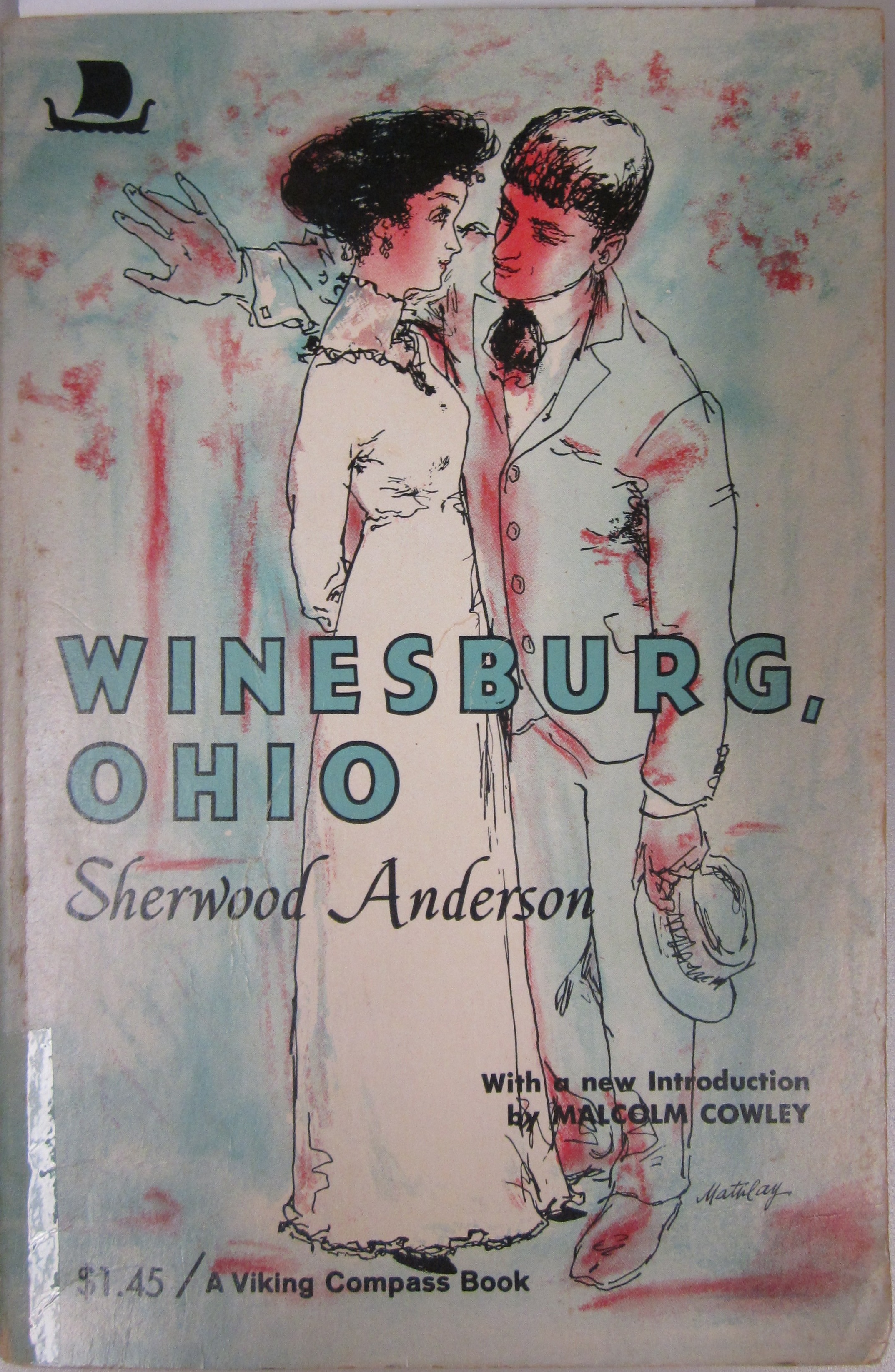
Winesburg, Ohio by Sherwood Anderson

Winesburg, Ohio is a collection of short stories that is more than the sum of its parts; the short stories are connected, all being set in the fictional town of Winesburg and concerning overlapping characters. We are most interested in George Willard, a town native who we most often see as a young man working as a reporter at the town paper (or, “the” reporter). Several of the stories give us Willard’s experiences (always in third person), but a number of them concern other inhabitants of the town. These men and women usually have some small personal tragedy that has thrown off the rhythm or intentions of their lives.

The work as a whole has a very quiet, contemplative tone and mood. Very little of great import goes on; but simple, sad lives are carried out, and hearts are broken quietly. It is moving. Anderson excels at bringing a character to life for a brief moment; and then he moves on.

I came to this book through Hemingway’s recommendation (and was finally motivated to get it off the bookshelf for the Where Are You Reading? Challenge‘s Ohio requirement). It has been a little while since I’ve read a biography of Hemingway so I’m a little rusty on the details, but I recall that Anderson played a role in his early writing career – encouraged him to write, gave him tips, maybe recommended him for publication. I think he pushed Hem to move to Paris as a youngster, which he did with his first wife Hadley, with results that I think we can safely say influenced his career as a writer. Anderson definitely influenced his style; I got this out of Malcolm Cowley’s excellent introduction, but it’s readily evident even without that clue. The same short, simple sentences that say so much with so few words are recognizable in Anderson’s stories; see my book beginnings post, or:

The Presbyterian Church held itself somewhat aloof from the other churches of Winesburg. It was larger and more imposing and its minister was better paid. He even had a carriage of his own and on summer evenings sometimes drove about town with his wife. Through Main Street and up and down Buckeye Street he went, bowing gravely to the people, while his wife, afire with secret pride, looked at him out of the corners of her eyes and worried lest the horse become frightened and run away.

This quotation comes from “The Strength of God,” one of my favorite stories.

As character sketches, these short stories are outstanding. As a whole, though, this book failed to grasp me the way I’d hoped – certainly it failed to grasp me the way Hemingway does. While I saw Papa on these pages, unmistakably, I was also constantly reminded of Sinclair Lewis’s Main Street, another quiet, subdued story about everyday, small-town life and its quiet tragedies. Perhaps it is the repetition of that phrase, “Main Street,” that got me, but I kept seeing Lewis’s work in this one, and frankly Main Street is a more memorable book. Like happens to me sometime when I fail to deeply appreciate one of the “classics” (ahem The Picture of Dorian Gray), I worry that it’s me, not the book, that I’ve missed something beautiful that would be obvious to someone with just a little higher IQ. I have to shrug this off, though. This collection does have value; I don’t want to give an impression otherwise, it just might not be *my* ideal cup. Almost every story builds a character who is real and often sympathetic. The tone is unique and if nothing else, the view into small-town life of a certain era is fairly unique. We can’t all love the same books, and life is more colorful for it.

book beginnings on Friday: Winesburg, Ohio by Sherwood Anderson

Thanks to Katy at A Few More Pages for hosting this meme. To participate, share the first line or two of the book you are currently reading and, if you feel so moved, let us know what your first impressions were based on that first line.


I have Winesburg, Ohio on my shelf because Hemingway recommended it. It turned out to be one of the easier ones from his list of recommended reading for me to get: my mother read the list when I originally posted it, and passed on Winesburg along with another I can’t put my finger on at the moment… this paperback copy, “a Viking Compass book,” was the first reset and redesigned edition since the original typesetting of 1919. It was published in 1960 and has my father’s name in the front cover. I wonder when and how it came to him; he would have been young for it in 1960. I wonder if it was for school? Pops, can you help?

This is a collection of short stories, and the first, entitled The Book of the Grotesque (Anderson’s original title for the collection, in fact) begins…

The writer, an old man with a white mustache, had some difficulty in getting into bed. The windows of the house in which he lived were high and he wanted to look at the trees when he awoke in the morning. A carpenter came to fix the bed so that it would be on a level with the window.

I look forward to my first reading of Sherwood Anderson’s work. His name is less known than many of the writers he influenced, even helped shape, or helped establish their careers – Hemingway being one, along with Faulkner and Henry Miller. Have you read any Sherwood Anderson?

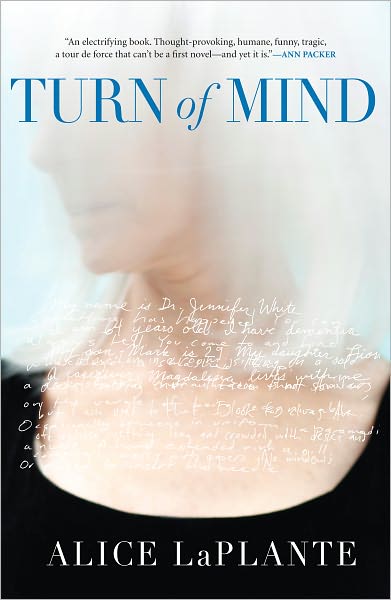
Turn of Mind by Alice LaPlante

This was a sad and fascinating book. I read it in a day – not unheard of, but fairly rare considering that it was a regular work day. Started on my lunch break and finished before bedtime. It was absorbing and unique. A murder-mystery, yes, but also sort of a psychological thriller. The unique framing element of the book is this:

Dr. Jennifer White is sixty-four, and has dementia. When the book opens, she’s in the early-to-mid stages of the disease, living at home with a full-time, live-in caretaker. Her best friend of several decades, who is also her three-doors-down neighbor and godmother to her daughter, has been murdered, several fingers cleanly amputated. Dr. White (whose specialty was hand surgery, ahem) is a suspect, and doesn’t know herself whether she did it or not. Her story is told in first-person; we read snippets from the notebook she keeps, hear conversations, and listen to her private thoughts as she struggles with the questions. The questions are only rarely about Amanda’s murder. In reading about this book I thought the murder case was the main focus, but it’s not. Dr. White is only occasionally aware of the question of her friend’s death, because she’s only occasionally aware that her friend is dead. Her disease and its progression, her confusion, the attempts by her adult children to shape her future, and her eventual fate are the book’s main concern – because we see through Dr. White’s eyes.

The mystery of who killed Amanda is different from the usual mystery we encounter, because we don’t see a murderer trying to cover his or her tracks. Dr. White’s children, and the lawyer they hire, work to protect her from an investigation that may damage her fragile mental health. At one point it is decided that she did kill her friend, but the legal system of course won’t take its normal course even in that event. (I’m not giving it away; there are still twists and turns.) And again, the mystery is not the primary focus of the book. As Dr. White’s story unfolds – backwards, in snippets, jumping around chronologically, and never reliably – talk about an unreliable narrator – we learn more about her husband, Amanda, Amanda’s husband, and Dr. White’s two children, as well as the hired caretaker and even the primary police investigator. Of course, no one’s story is simple or unblemished.

A fascinating and engrossing mystery is only part of the attraction of this book. It’s an exploration into the head of an Alzheimer’s sufferer, engaging and overwhelming and sad and riveting. Make no mistake: this is a terribly sad story. Being young myself, and having parents in excellent health and with plenty of youth and life left, I hadn’t thought much about nursing homes, but this book’s portrayal terrified me. If you can steel yourself for the tragedy, though, this is a beautiful story, communicated in a unique format, gripping and sensitive. I recommend it highly.

Teaser Tuesdays: Turn of Mind by Alice LaPlante

Teaser Tuesdays is a weekly bookish meme, hosted by MizB of Should Be Reading. Anyone can play along! Just open your current read to a random page and share a few sentences. Be careful not to include spoilers!


Turn of Mind caught my eye months ago, when I first purchased it for the library. An older woman, a doctor, suffers from dementia. Her best friend and neighbor is found dead, and she’s a suspect – and doesn’t know herself whether she did it or not. I’m intrigued. Here’s your teaser:

Last week, she threw all her jewelry in the trash. We only caught it by accident – her daughter found a diamond pendant lying outside in the snow next to the garbage. We dug down and found her wedding ring.

Sad, isn’t it? But I can’t resist a good mystery, and this one has a unique format and frame. I’ll let you know…