Teaser Tuesdays: The House on Mango Street by Sandra Cisneros

Teaser Tuesdays is a weekly bookish meme, hosted by MizB of Should Be Reading. Anyone can play along! Just open your current read to a random page and share a few sentences. Be careful not to include spoilers!

I had a difficult time choosing a teaser from this amazing book for you. My review is yet to come, but in a nutshell – read it.

From “Minerva Writes Poems,” here’s your teaser:

Minerva cries because her luck is unlucky. Every night and every day. And prays. But when the kids are asleep after she’s fed them their pancake dinner, she writes poems on little pieces of paper that she folds over and over and holds in her hands a long time, little pieces of paper that smell like a dime.

Speaking of poems… prose poetry, no?

I Capture the Castle by Dodie Smith

I shall set the scene: Cassandra Mortmain is seventeen years old. She lives in an impressive but largely ruined castle that represents various historical periods, in the British countryside near the town of Godsend. Her household is composed of her father (known as Mortmain), who had one extremely successful novel and has been writer’s-blocked ever since; her stepmother Topaz, a free-spirited New Age-y retired artist’s model; her older sister Rose, who laments the lack of attractive, romantic, wealthy marriageable men in their neighborhood; her younger brother Thomas, a schoolboy; and the household help, Stephen, who is crazy about Cassandra. They live in rather abject poverty, about to scrape bottom when the book opens. Cassandra is an aspiring writer, and is practicing by keeping a journal; I Capture the Castle takes the form of three volumes of that journal, a fairly unique format for a novel.

The action of the book begins when a pair of American brothers arrive at the local estate, having just inherited it, and bring fresh life into the Mortmains’ little world. Rose finds men to work on. Stephen pursues Cassandra. The entire family tries to goad Mortmain into finally working again. Thomas matures; Topaz worries; everyone’s world is widened by a little bit of travel, made possible by a friendship with the new Americans; and Cassandra falls in love. I won’t give it away.

This book is rapturously admired by many readers, writers, reviewers, and bloggers whom I respect, and I was excited about it. My final reaction is disappointment; not because I didn’t enjoy the book, but because for me, it didn’t live up to the hype. Cassandra is indeed a sympathetic, clever narrator. I like her. I wish her the best. Her writing is witty, lyrical, reflective, and funny. The entire cast of characters is really great fun; I thought Mortmain and Topaz were especially amusing, and Stephen is poignant. I liked it, really I did, but I read this book much more slowly than usual (the holidays, me having been sick for three weeks now, general malaise), and I didn’t miss it when we were apart; that’s not a particularly good sign. I feel that I will quickly forget it. I’m sad that I didn’t receive the strong vibrations that so many readers do – and again I must stress that I did like this book! It just didn’t take me to the heights reached by others.

By the end of the book Cassandra has grown up a bit, and the family’s circumstances have changed. It’s a coming-of-age story, involving a charismatic young woman, and it comes in a unique format, with lovely, quirky writing. I liked it. If you read it, hopefully you’ll love it, as many do. I cannot give a resounding enthusiastic endorsement, but there are lots of those out there if you’re interested.

Teaser Tuesdays: I Capture the Castle by Dodie Smith

Teaser Tuesdays is a weekly bookish meme, hosted by MizB of Should Be Reading. Anyone can play along! Just open your current read to a random page and share a few sentences. Be careful not to include spoilers!
Here is a book that I had never heard of until I began dwelling in the world of book blogs. Thank you, fellow bloggers!

I Capture the Castle is the whimsical musing of Cassandra Mortmain, seventeen-year-old castle-dwelling aspiring writer. I’ve only just begun it but found a delightful teaser very quickly:

I suppose it was her sheer despair of ever meeting any marriageable men at all, even hideous, poverty-stricken ones, that made her suddenly burst into tears. As she only cries about once a year I really ought to have gone over and comforted her, but I wanted to set it all down here. I begin to see that writers are liable to become callous.

I don’t know about you, but that took me from Jane Austen to Ernest Hemingway in only three sentences, which is an effect I most definitely appreciate. How about you?

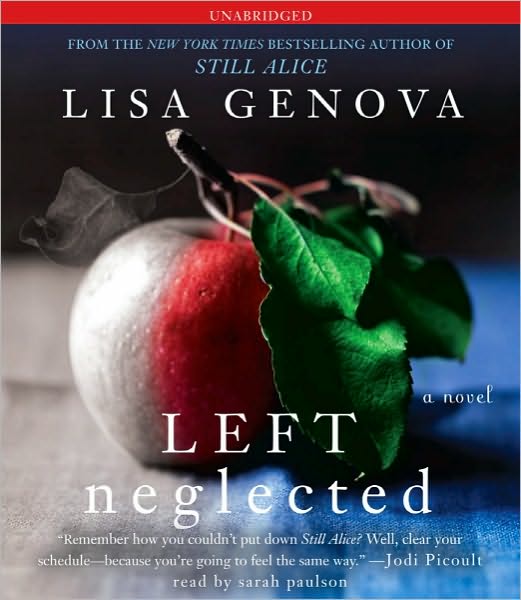
Left Neglected by Lisa Genova (audio)

Left Neglected evoked strong reactions from me, which I think is always a recommendation.

Sarah Nickerson is in her late 30’s, happily married to Bob, with three children (Charlie, Lucy and Linus), and a successful career in a male-dominated hectic corporate world of 80-hour work weeks. She is accustomed to using every odd moment to send emails, make phone calls, or read up on work; she would be lost without her nanny Abby; a slight traffic delay costs her the chance to read to her daughter before bed. In other words, she likes her life, but it’s jam-packed-full with no room for error.

The error comes one rainy day on the freeway; a traffic accident leaves Sarah with a unique sort of brain injury called “left neglect.” She’s missing the left side of her consciousness of the world. She can’t find or use her left arm, her left hand, her left leg; she can’t see things or people on the left side of the room, her dinner plate, her world. She can’t conceive of left. Sarah wakes up in a hospital and has to laboriously relearn everything. Juggling international corporate intrigue with a staff of 1000’s is no longer her primary concern; she can’t even dress herself.

Sometimes post-accident Sarah’s whining and frustration with her condition annoyed me, and sometimes pre-accident Sarah irritated me with her material and work-related priorities. But overall, she was definitely a sympathetic character; and if I was sometimes mad at her, that only made our relationship stronger in the end. As in a real friendship, we had our ups and downs, and our bond increased through those trials.

I sometimes felt that Genova tried to maximize the angst. Sarah’s flashbacks to the childhood death of her brother Nate, and its repercussions for her present-day relationship with her mother, might have been pushing the psych-drama angle a little bit. But overall, it worked.

I was reminded of another book, My Stroke of Insight by Jill Bolte Taylor. I read that one pre-blog so no review here, but it touched me very deeply. Taylor’s book is nonfiction, and deals with a different brain injury; but the two are similar in that they describe a brain injury from the patient’s perspective, along with the recovery. I suffered a brain injury in a bicycle accident in 2007, and while I was lucky to suffer less severe injury than either of these protagonists, I still found myself identifying. My own recovery was fascinating to me and made me think about things I’d never considered before; when I read My Stroke of Insight a year or so later, it helped me look at my own experience and learn from it. Left Neglected held a similar self-referential interest for me. (To go even further out on a limb: I’m now doing physical therapy following my knee surgery, and trying to get back to mountain bike racing. The connection is vague and yet I can’t help but compare my frustrations to the fictional Sarah’s. Again, my injury is very minor by comparison. But the cycle of optimism and pessimism, frustration and success, crosses over.) All of this means that when Sarah gets annoying – failing to recognize how lucky she’s been; refusing to work hard with her therapists; wanting to give up and cry – I’m annoyed, and yet I understand, too.

The massive change in the way Sarah views her world – and not just in terms of right and left – may seem ambitious, even unrealistic, to some readers. This might be said too of Taylor’s change in philosophy in My Stroke of Insight. But in both cases it rang very true for me. I felt that I had traveled so far with the protagonists, both fictional and non, that I was right there with them at the end of their stories. Is my outlook unique? Possibly, but I doubt it. I think we’ve probably all had some life-changing experience (hopefully less painful than the ones detailed here) that allows us to get inside Sarah Nickerson’s head a little bit.

Maybe it’s odd that I’m drawing such a strong parallel between two books that are really rather different, but they both affected me strongly. In the end I give Left Neglected very high marks, and I’m interested in Genova’s earlier novel, Still Alice. For those who are curious, she does have credibility in this subject matter: she has a PhD in neuroscience. Check it out. And if/when you have/do, please let me know if this book touches you as it’s touched me. Here’s to being thankful for our health!

did not finish: Upgunned by David J. Schow and Cosmopolis by Don Delillo (audio)

Just very briefly here, because I didn’t get very far into either…

David J. Schow was the screenwriter of The Crow and Texas Chainsaw Massacre: The Beginning. These credentials are not terribly meaningful to me, not being a fan of horror movies, but they did give me some hope. Upgunned begins with the perspective of a semi-celebrity photographer of the scuzzy, scummy upper crust – drug-addled anorexics and the like. He is kidnapped and forced at gunpoint to take blackmail photos of a local politician. And then the perspective shifts to the man behind the gun.

The plot premise was mildly interesting to me – I can get into a good thriller regardless of framing elements if it’s done right – but the writing and characters didn’t hold up. I found both early characters a little bit cartoonish and overdone, the society in question was just a little too sickening for my taste, and the writing did nothing to redeem it. Nancy Pearl would be disappointed as I quit just 48 pages in, but I couldn’t motivate any further than that.

This DNF review is based on a galley sent to me by the publisher. Many thanks!

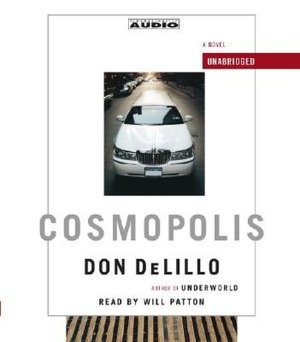
I have fond memories of Don Delillo from his amazing White Noise (and also my buddy Jerko is a big fan and I value his opinions). But Cosmopolis didn’t hold up. (And to be fair, Jerko specifically did not recommend it.) I made it maybe an hour in, which I think should count as 50 pages, if only just. 🙂 The story of Eric Packer’s billionaire troubles while wending his way through the city in his limousine (as pictured on the cover) failed to make me feel anything deep. Delillo’s trademark tone of detached despair is there, but the writing feels a little stilted, a little overdeveloped. Mostly though, I just couldn’t get interested in Packer’s fate.

Am I a little disenchanted and difficult-to-please these days? Hey, it’s possible. We all go through those phases. I will point out, though, that I attempted these two DNFs within a week of reading my two most recent additions to the Best of 2011 list: 11/22/63 and The Home-Maker. So maybe everything else pales in comparison. 🙂 At any rate, I’m sure there’s more outstanding reading right around the corner, and I hope the same for you as well!

Teaser Tuesdays: Left Neglected by Lisa Genova

Teaser Tuesdays is a weekly bookish meme, hosted by MizB of Should Be Reading. Anyone can play along! Just open your current read to a random page and share a few sentences. Be careful not to include spoilers!

This is a smashing audiobook so far. The narrator is doing a terrific job with a terrific story; I’m riveted. Stay tuned for my review to come; I think I will be recommending Left Neglected. Here’s your teaser for the day:

Bob and I are in our master bedroom. I’m leaning against the sink, getting ready for bed. Bob is standing behind me, getting ready to drive back to Welmont. He’s also watching over my brushing, just like he did a few minutes ago with Charlie and Lucy.

Stick around, folks, I’ll be ready to review this one in just a few days. And what are you reading this week?

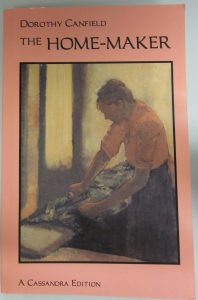
The Home-Maker by Dorothy Canfield

homemakerOh my. This has got to be one of my top *five* books of the year. What a delight! I’m reeling! First I would like to thank Thomas at My Porch, again, for sending me this book along with the also-lovely Some Tame Gazelle. (This was because I have cute dogs. Lucky me!) Thank you, Thomas! You did so splendidly selecting books for me.

I have a lot to say about this book and will try not to be too long-winded.

The Home-Maker is the story of the Knapp family. The mother, Evangeline, is the home-maker – of course, because how else could it possibly be done? (This book was published in the 1920’s and seems to be set about then, too.) She is efficient and hardworking, and miserable; and her three children are miserable as well, and two of them physically ill. Her husband, Lester, is a lackluster breadwinner, also miserable. In an accident (or was it? read the book), Lester is paralyzed, and their world turns on its ear. Eva ends up going to work, and Lester staying at home to play Mr. Mom. And presto change-o, everyone blossoms! It’s lovely. Eva is fulfilled, challenged, in her element; she earns raises and promotions and everyone’s respect and appreciation. Lester gets to know his children, marvels at their youthful struggles, their individuality, their talents. He learns to cook, bake, and darn socks. And the children become healthy, rosy-cheeked, encouraged – and the troublemaker amongst them gazes adoringly up at his father. It’s remarkable, and heartwarming, and, gosh.

As a story of a family, it is engaging, droll, actually laugh-out-loud funny at times. As an instructive tale – which it obviously is – it is straightforward and sensible. Who could not agree that we should all do what we’re best at and enjoy, if we’re so lucky as to have those two things coincide with one another, and to have a family comprised of all the roles necessary for universal happiness? It’s almost so obvious as to be dull; but the sad trick is that even in 2011, when we congratulate ourselves for being enlightened on such topics as gender roles, we still need this book. I can only imagine that this book’s contemporaries felt their feathers ruffled; but surprisingly, the introduction of my Cassandra Edition claims, “very little of the criticism was harsh or outraged.” This edition also includes an article Canfield wrote for the Los Angeles Examiner on marital relations; it’s well worth reading, too, and succinctly echoes the novel’s point: do what you do best, and be happy. That’s a big duh, right? But again, I’m afraid we still don’t have it right!

For example, one point that SCREAMED off the page at me was the same set of ideas applied to the currently uproarious debate about gay marriage. Canfield actually does refer to “a man and a woman” several times, but I’m going to give her credit and believe that if she were writing today, she’d apply the same logic she did to hetero-marriage. Two people who love each other and want to make a family should do it in the way that takes the best advantage of everyone’s skills and passions and makes everyone happiest! To me, this is abundantly easy to understand, but alas, still, we have debate. Sigh. I’m not trying to have that debate here (rather because I don’t think it merits much discussion) but it was an obvious corollary of Canfield’s position here so I wanted to mention it.

For those who fear a heavy-handed instructive tone weighing down a lovely story, don’t. I’m sensitive to that fault, myself (okay, it was nonfiction, but I loved County while lamenting its overly-obvious point). But it’s not an issue here. Canfield is matter-of-fact in her portrayals; I think the strength of the “issues” at play here are that they’re too clear-cut to BE issues. Does that make sense? And the story itself is delightful. “Cosmic Stephen in his pink gingham rompers!”

I really enjoyed this as much as just about anything else I read this whole year. It’s the first to compete with Fire Season by Philip Connors, which I’ve been calling my #1 best of 2011. (Rather different books they are, too.) Thomas, you’ve done me a great service, and here, I’ll try to pass it on: the rest of you, go find The Home-Maker today.


BUT.


Here’s my one caution for seekers of the book. I appreciated that my Cassandra Edition included the newspaper article that I mentioned above, and it’s a nice edition all-around, but for a single glaring flaw: page 134 is followed by page 119, which then runs back up to 134 and then skips to 151. So while reading this book and really enjoying it, I was suddenly thwarted! The publisher (after some discussion of what might be a reasonable way to deal with this issue) promised to put another copy in the mail to me. So it’s a nice edition, but find yourself a different one! Perhaps I’ll be able to make a recommendation when my new copy arrives.

Teaser Tuesdays: The Home-Maker by Dorothy Canfield

Teaser Tuesdays is a weekly bookish meme, hosted by MizB of Should Be Reading. Anyone can play along! Just open your current read to a random page and share a few sentences. Be careful not to include spoilers!
Dorothy Canfield’s The Home-Maker was a gift from Thomas of My Porch some months ago, and I have just now gotten around to it – but it’s WONDERFUL! I shouldn’t have waited so long! You get just a snippet today – the review is to come – but let me tell you now, you want to run out and find a copy immediately. Here’s your teaser:

How he loathed his life-long slavery to the clock, that pervasive intimate negative opposed to every spontaneous impulse. “It’s the clock that is the nay-sayer to life,” he thought, as he climbed the cellar stairs.

I love that turn of phrase. He (Lester) fancies himself a poet, you know. If this teaser is a bit depressing, stay with me; this book turns rather hopeful (at least so far, I’m not finished yet, it could still end in tragedy I suppose) and oh so droll.

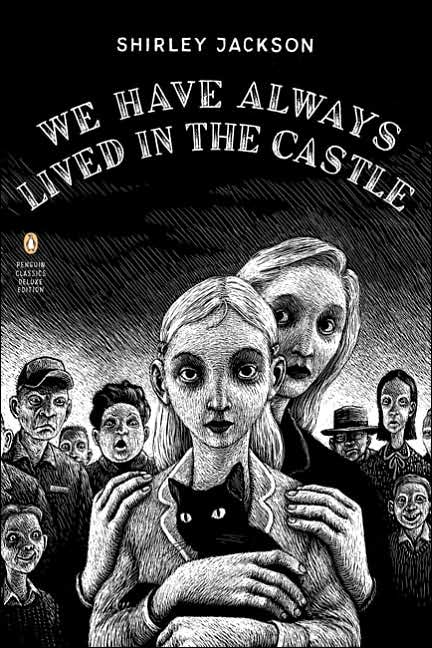
We Have Always Lived in the Castle by Shirley Jackson

Oooh, spooky! Just that cover alone, are you kidding?? I have been hearing about this book mostly just on the blogosphere for a while now (how come I never heard about it in real life, I wonder?) and was so excited to finally find time for it! Yum! My first lightbulb moment was in reading (on the cover, in the blurb, somewhere) that Shirley Jackson also wrote The Lottery, that hair-raising short story we read in school. Aha! Scary stuff, indeed.

This was a delightful little book, and I read its 146 pages in a day – not in a sitting, mind you, but over breakfast, lunch, dinner, and before bed. I didn’t want to let it rest any longer than I had to! I loved the way that Jackson meted out details; I just knew there was something waiting for me around the corner that was going to blow the whole story wide open, if I just turned one more page…

Our narrator, Mary Katherine or Merrikat, opens the book with her last trek into town for groceries and library books. It seems she used to make this trip twice a week; but after that last time, no more. In that prior time – the whole book is told in flashback – Merrikat lived in the big family house with her sister, Constance, and their Uncle Julian, an invalid. The townspeople hate them. It gradually becomes clear why, and only as the story continues to unfold do we learn why the past tense, and what’s different about the present.

Merrikat is a delightful narrator. She sees things her own way, which is the perk of living with two well-loved relatives and a cat (Jonas) and no one else. She has her own system of controlling her world, by burying charmed items, assigning special powers to special words (melody! gloucester!), and concentration. She tries to make Cousin Charles (an unwanted visitor) go away through her own brand of witchcraft, by removing and replacing items in the room he’s staying in. She is also a delightful narrator because her reliability must be questioned.

I don’t want to give any more plot details away. You must read this book! There is a whimsical tone, and a whole new set of rules. I really enjoyed learning how Merrikat viewed the world, what items had significance to her. There was definite suspense. Believe the hype, friends. Shirley Jackson will draw you into her world and tickle the back of your neck and you’ll love it!

Love Medicine by Louise Erdrich

I enjoyed this book, but I finished it still unsure of what actually happened in the story.

This was my first experience with the acclaimed Louise Erdrich, and she writes beautifully. I easily got lost in each chapter’s character and events; she creates a world, a culture, seemingly without effort and so completely. It was a lovely experience. This book is a series of vignettes, or character studies. Each chapter is told in first person by a different character, or even several different characters within a chapter, which to some extent added to my confusion; but they had pretty distinct voices. All the characters are related by blood, marriage, and/or life events, so there is a cohesion to the book as a whole; it’s not a collection or anything. But I’ll be honest. I sometimes lost track of how the characters were connected & who was who, exactly. Sometimes I flipped around trying to resolve things but mostly (especially as I moved further into the book) I just let myself float around a little bit confused. It worked for me this way. If you do a better job than I did of keeping things straight, I’m sure you’ll find a very enjoyable sum of all parts; but even if you take it in as I did, I think you’ll find a string of remarkable evocative stories.

The characters come from several families of Native Americans (American Indians? I’m not sure what’s correct) in North Dakota. The families overlap and merge, through marriage, the production of children both in and out of (and across) marriages; and in local politics and interactions. Their culture – as Native Americans on “the rez” as well as in each distinct, and indistinct, family unit – is one of the framing elements of the book, and I found the cultural examination very interesting. Their relationship with the “outside world” of white Americans was an important feature, too. Mostly, though, the stories feature relationships between our characters: mothers & children, spouses, lovers, aunts & uncles and neighbors. Love is a theme, and sex, and the question of parentage comes up rather frequently. There is lots of heavy drinking and battling with alcohol.

There is sadness in most of the stories, and death, but there is hope and such a great deal of humor, too. Erdrich succeeds in placing me in a place and a culture and making me feel what her characters are feeling. Her writing is beautiful, musical. And so often funny! I pulled a few passages for you that describe one of our matriarchs:

She agreed, taking alert nips of her perfectly covered slice. She had sprinkled a teaspoon of sugar over it, carefully distributing the grains. That was how she was. Even with eights boys her house was neat as a pin. The candy bowl on the table sat precisely on its doily. All her furniture was brushed and straightened. Her coffee table held a neat stack of Fate and True Adventure magazines. On her walls she’d hung matching framed portraits of poodles, kittens, and an elaborate embroidered portrait of Chief Joseph. Her windowsills were decorated with pincushions in the shapes of plump little hats and shoes.

“I make these.” She cupped a tiny blue sequined pump in her hand. “You have a girlfriend? I’ll give it to you. Here.”

…several pages later, still talking about the same woman:

Lulu was bustling about the kitchen in a calm, automatic frenzy. She seemed to fill pots with food by pointing at them and take things from the oven that she’d never put in. The table jumped to set itself. The pop foamed into glasses, and the milk sighed to the lip. The youngest boy, crushed in a high chair, watched eagerly while things placed themselves around him. Everyone sat down. Then the boys began to stuff themselves with a savage and astonishing efficient. Before Bev had cleaned his plate once, they’d had thirds, and by the time he looked up from dessert, they had melted through the walls. The youngest had levitated from his high chair and was sleeping out of sight.

See, isn’t that funny and evocative?

I found Love Medicine a unique and enjoyable read, if unorthodox in its structure. I recommend it.

For those who have read this book: did I space out somewhere, or did anyone else have trouble holding the family trees together? Does it matter?



