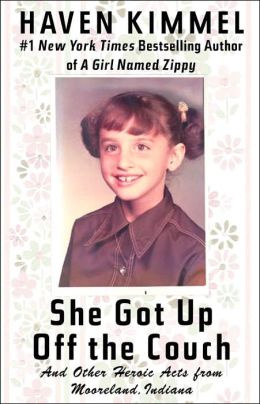
Teaser Tuesdays: She Got Up Off the Couch by Haven Kimmel

Teaser Tuesdays is a weekly bookish meme, hosted by MizB of Should Be Reading. The idea is to open your current read to a random page and share a few sentences. And try not to include spoilers!

couch
Haven Kimmel is absolutely and totally my literary obsession these days. She is hilarious, and wise. I think I might be most mesmerized by her novels; but her memoirs are so funny and strange I can’t put them down. (Thanks, Krinkle, for keeping me up way too late on work nights.) And she has a way with words. Take today’s teaser:

In truth, if there could be said to be one truth about my brother, it is that he carried both a tombstone and scraps of coal in a little red wagon, and what that did to him and what it meant to him is written in a closed book in a library guarded by dragons.

He literally had a tombstone and scraps of coal in his little red wagon. You’ll have to read this book to find out more.

[I wanted to reprint the entire two-page dedication and the preface for you here, but I fear copyright violations. Go read it!!]

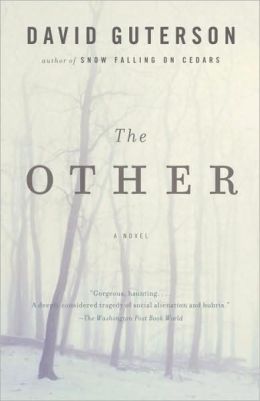
guest review of sorts: The Other by David Guterson, from Pops

In the same spirit in which we both read Endgame and Ishmael, Pops has recently read David Guterson’s The Other, and I have some snippets of his thoughts to share with you. For a little background, I read The Other too, a number of years ago (and pre-blog). I liked it very much; I found it thought-provoking and wise, and it reminded me of a very dear friend. I later read Guterson’s better-known Snow Falling on Cedars, and found it fine but not comparable – so there’s yet another case in which the general opinion differs from mine. Now I will turn this over to Pops, whose thoughts are just represented in brief passages here for you, along with those bits from the book that he found memorable. As ever, thank you Dad for sharing with us.

other

I just finished reading The Other, and it was quite stunning. In fact, it was nearly literally stunning. (Starting a book with a story about a couple runners is quite a hook for me anyway!)

Why did I wait this long to pick this book up? It has been on my shelf for years and I almost discarded it unread several times without ever knowing why I kept it other than a vague knowledge that it came recommended. I’m embarrassed to find that Julia even referenced it in publishing my comments about Fire Season! How could I have overlooked it for so long? Was this book exercising an independent will, waiting for a certain moment?

I don’t remember terribly many details of the plot from my years-ago reading, but I’ll try to assemble a quick synopsis from memory: two young men, Neil and John William, are friends in high school. They run together. After high school ends and they transition towards adulthood, they head in different directions. Neil becomes a teacher, and John William retreats towards the wild. He camps out in the woods, hikes, lives off the land. He is simultaneously very cerebral, reads poetry, discusses it with Neil; they correspond. They play chess. John William is the superior player. Gradually, JW withdraws more and more from society and from his family; he enlists Neil’s help in disappearing entirely. He wastes away out in the mountains alone in ways that look unhealthy to our eyes as trained by society. He also rejects some things but not others, in a way that looks hypocritical but, I came to feel, highlights the contradictions in us all, in society, in what the world has to offer us. I’m not expressing that well; I blame my distant and vague recollection of the book. JW comes to a less than savory end, and Neil is left with his own compromises.

My father does not discuss plot much here. He and I may have to have our own, off-the-record discussion; as I said in my review of Endgame (link at the top of this post), these issues are very personal, and at some point fall outside the scope of this blog. But in the briefest, sketchiest way possible, Pops says…

What is this book about? Why the impact?

• Two runners with a life long bond
• Seattle, the Olympics and other northwest locations evoked with affection and an insider’s eye
• Timing: in the midst of a streak of eerily connected non-fiction, a novel that matches the others for relevance
• Particularly & effectively juxtaposed with my other current read: E.O. Wilson’s The Social Conquest of Earth (an informed scientific look at “who we are”)
• John William, the character focus of much attention, seeks and ultimately sees too clearly the reality of human’s place on earth, and suffers the fate of such seekers; he becomes an isolated loner in an insane world, tragically fated to be branded insane himself (“the other”)
• Neil, the other character and narrator, who is painfully wedded to the civilization torturing his friend yet arguably as alienated in his own way, and ultimately as tortured by his addiction, notwithstanding sudden wealth
• Though only tantalizingly developed, I loved the character of his wife, Jamie.
• Why are Neil’s sons never named? There are more significant characters in the book, all named; but these are the beloved offspring of our narrator!
• Inspiring contemplation on humanity’s endless, frivolous and prideful introspection in pursuit of explaining who we are, while we never grasp the greater tragedy of our puny yet destructive role in the natural world
• The futility of wealth solving any of our problems – and thus the trivial & sad quest for it
• Brouwer’s, the notable Belgian beer bar in the UW area, is specifically described.

Following are some passages, to offer just a few places where I stopped to reread and contemplate.

This paragraph I reread many times, due to the language and the message hidden there; not an easy one to parse out!

“A light he was to no one but himself” – that’s a line from a Frost poem, “An Old Man’s Winter Night,” which a lot of students don’t respond to very strongly. “A light he was to no one but himself” – I wouldn’t choose that, and if I have to suffer it one day, because of circumstances, I’m fairly certain it will lead to my demise, because that cast, that illumination, is foreign to me – I’m finally saddled with my take on things as ineluctably as I’m slowed, and pained, by the neuroma in my foot. So be it. I have the beauty that I have, and none other, in the meantime. One thing has led to the next in my life, but like lines of a poem. I suppose I’ve thrown in my lot with love, and don’t know any other way to go on breathing. I embrace this world – the world my friend hated – and suffer it consciously for its compensations, and fully expect to awake one day to the consequences of this bargain I’ve struck, since life, eventually, closes in.

On heading into the woods, only to find that your mind is not quite with the program for some reason…

The place felt sinister though. Your imagination can get the better of you where a road ends against a forest. It’s easy to feel trapped with your back against trees. Vulnerable to all of this, I got on the trail and tried loving my solitude, but this was a futile and self-conscious effort. I didn’t want to be there, by myself, while the sun went down. I didn’t want to be hiking in such a tense silence. The maple leaves were youthfully green, but that didn’t ameliorate my nervous view of things. Before dark, I bivouacked, tentless, by the river, banking up a fire in front of a boulder and basking in its heat with my journal and The Collected Eliot, 1909-1962, which an excitable professor had asked me to scour, and although all of that might sound pleasant enough, or not a bad way to pass evening hours – especially with the din of water on the gravel bars and my view of stars illuminated silhouetted hills – I didn’t enjoy being there. I suppose you could say that my aloneness got the better of me, or that I felt fear that night, by the river, by myself – but fear of life, and not of animals or the forest. “The Hollow Men” didn’t help, because I couldn’t disown its mood, or break its hold on my thoughts, as I lay in my sleeping bag by those smoking coals, and though this temper made me tired, it also left me agitated enough to prod, more often than I needed to, the sticks I was burning. I mostly felt wistful. I didn’t want to have behind, already, some experiences I couldn’t have again. Reading Eliot by flashlight was like deciphering runes, and made it more difficult to sleep.

On how ephemeral is “reality” about ourselves (individually or as humanity), and how our “advanced” minds can create such enormous conceit out of nothing…

…maybe the truth is that truth is too complicated. If I extrapolate from myself, there’s a lot of deceit in the world without a beginning, middle, or end. The way it really works, a lot of the time, is that you suffer from the weight of what happened, from what you said and did, so you lie as therapy. Now the story you make up starts to take up space otherwise reserved for reality. For phenomena you substitute epiphenomena. Skew becomes ascendant. The secondary becomes primary. When it’s time to confess, you don’t know what you’re saying. Are you telling the truth, or do you confuse your lies with reality? The question is comical. The answer is lost in the maelstroms of consciousness. It’s even possible to pretend, eventually, that the question wasn’t asked. You’ve been kidding yourself about yourself for so long, you’re someone else. Your you is just a fragile fabrication. Every morning, you have to wake up, assemble this busy, dissembling monster, and get him or her on his or her feet again for another round of fantasy. Is this what some sutras by Buddhists are about? Maybe. The book-length bromides on mental health? At times. The biographies on politicians? Take Nixon or Clinton. Anyway, I don’t know anything about Rand or Ginnie. I don’t know if anyone tried to strangle John William. I don’t really know who tormented whom, or why, or if anyone was even tormented at all. I don’t even know much about myself. I only know that Ginnie protested with Chronic Obsessions pressed against her bibbed chest. Then she kicked me out.

And finally, two paragraphs near the book’s end, set apart in a section on their own, on the emptiness of wealth against a background of questioning…

Jamie and I turned in the ’92 Civic and bought a hybrid, which we recently took to the Canadian Okanagan – the Napa of the North that Wiley and Erin told us about. We walked, swam, biked, sunned, tasted wines, ate well, bought pottery, and watched the sun go down, and though all of this was fun, none of it made us happy. We both wanted something else that was unnameable. It might be forever unnameable. In this regard, money changes nothing, which Jamie and I knew before we had it.

When I think about my friend, I think about someone who followed through, and then I’m glad not to have followed through, to still be breathing, to still be here with people, to still be walking in the mountains, and to still be uncertain – even with all this cash on hand – in a way I seem to have no choice about. I’m a hypocrite, of course, and I live with that, but I live.

Powerful stuff.

It is powerful stuff. I realize we haven’t given you much of a review to speak of, here. But I hope we have expressed that Guterson tells a unique tale in an evocative fashion, that has managed at least to provoke two of us to further reflection and discussion.

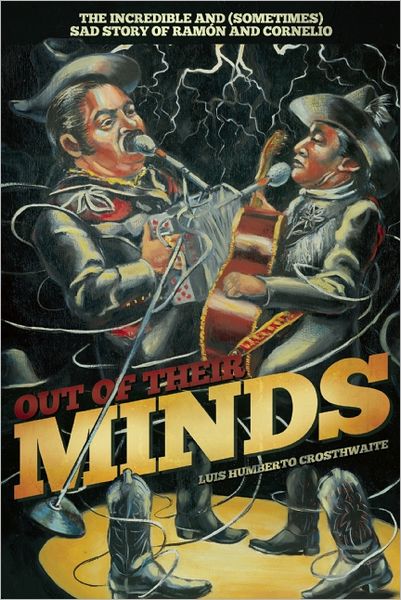
Out of Their Minds: The Incredible and (Sometimes) Sad Story of Ramón and Cornelio by Luis Humberto Crosthwaite

A bizarre and entertaining tale of two Mexican norteño musicians guided by God–and the price they pay for their fame.

outoftheirminds

Luis Humberto Crosthwaite’s Out of Their Minds, a novel first published in Spanish in 2001, is a motley collection of fictional interviews, dreams, dialogues and sketches. It’s centered on Ramón and Cornelio, a couple of bored kids in Tijuana with a bajo sexto and an accordion. Then God speaks to Cornelio, offering to write his songs for him, and the duo known as los Relampagos de Agosto (a sly reference to Jorge Ibargüengoitia’s satiric The Lightning of August?) takes off.

Greeted onstage by screaming women throwing underwear, their world explodes in undreamed-of decadence and groupies. Fast forward a few years, though, and Ramón and Cornelio’s lives are sadly riddled with drugs and superficiality. Unsurprisingly, the two lifelong friends no longer see eye to eye, and the rock-and-roll lifestyle has dimmed their fire. Where they used to lie awake at night and discuss the perfect girlfriend (she must have pretty feet), now their wives have left them and Ramón talks to his accordion instead.

In the ever-shifting perspective of this strange world, where God worries about producing fresh material (“he doesn’t want to be judged as a repetitive God, with few ideas”) while a friend of Cornelio dies over and over again, the duo’s career arc clearly references the Beatles–but places them in Mexico’s norteño music scene. Wry, lyrical and frequently funny, the story of Ramón and Cornelio is indeed incredible and sometimes sad; but the music plays on and we continue to revel in it.


This review originally ran in the May 24, 2013 issue of Shelf Awareness for Readers. To subscribe, click here, and you’ll receive two issues per week of book reviews and other bookish fun!


Rating: 6 blurry nights.

Ishmael by Daniel Quinn

ishmaelIshmael comes recommended by my father, and that’s enough for me.

It’s an environmental novel published in 1992. So, dated? Or prophetic? I’m afraid it stands firm today; we can debate whether it’s overly alarmist (ha) or overly optimistic (sigh), but I didn’t run across anything that dated it especially for me. The premise is: our narrator (who, I’m pretty sure, remains nameless) is a disillusioned 30-something who, as a teen, had looked for someone to guide his idealistic, revolutionary, 1970’s-style environmentalism, and come out disappointed and cynical. Now that it’s “too late”, he’s frustrated to find the following advertisement in the newspaper:

TEACHER seeks pupil. Must have an earnest desire to save the world. Apply in person.

(Is “newspaper” the term that dates this story?) Narrator responds jadedly, assuming this is a charlatan, a scammer; but still he goes to the address listed, because he has to satisfy his curiosity (and presumably because some part of him hopes that someone out there can really teach him how to save the world). In this anonymous retail space, he finds… a gorilla. A big, scary gorilla behind a glass wall; and on Narrator’s side of the wall, a chair. He eventually sits, and our gorilla – Ishmael – “speaks” telepathically to him. Ishmael relates his life story, and they begin discussing What’s Wrong With The World And What We Can Do About It.

Leaving aside the rather strange element of the telepathic and exceptionally well-read gorilla, the structure of this story is much like Sophie’s World, a novel I read pre-blog (thus no review here, sorry) and really, deeply loathed. It is credit to my faith in my father that I picked up Ishmael, knowing it was at all like that other. The structure I’m referring to is part of what I disliked about Sophie, although it works slightly better here: there is no plot, no action in the story, and no character development, because our characters don’t do anything. They form a didactic construction that allows Quinn, in ill-disguised fashion, to voice his own thoughts. If he were doing this in dialogue form, it would make a little more sense; but unfortunately the dialogue mostly consists of many paragraphs by one character, punctuated by the occasional “yes,” “true,” or “I don’t quite understand that part; can you tell me more?” from the other. Now, I liked what Quinn had to say, and I frankly liked the gorilla Ishmael, and so this framing element bothered me far less than it did with Sophie (shudder). But I still felt that it was unnecessary, distracting, and ill-concealed. I’d rather Quinn had just written a manifesto frankly stated as his own.

Quinn’s thesis in a nutshell is that our world is badly f*ed; humans have done it by behaving badly; and we need to change quickly if we hope to salvage the earth itself, its very deserving fellow occupants like butterflies, tigers, flowers and rocks, and any of ourselves. I find this thesis abundantly easy to follow. For decades we’ve known that we were badly screwing up this planet (unless you’re Big Oil and have found a way to put your head under the sand (to look for more oil) in which case you’re probably not reading Ishmael, or this blog). Actually I found the third part of the thesis – that we need to hurry up and change so that we can save the world – hardest to follow, because I think things are worse off than Quinn paints them to be. Of course, I’m writing this more than 20 years later, so I’ll give him a pass there.

That said, the friendly gorilla and the simply stated philosophical approach that he shares with our Narrator make an accessible argument. I could see this being a good entry-level discussion piece – or a jumping-off point for further discussion in a reading group or classroom setting. Ishmael is likeable, and the philosophy is mostly sound (at least until the part about how we can change; I am less hopeful than Ishmael is), and readable.

I am not sorry I read this. But I like Derrick Jensen’s Endgame better, even though it doesn’t have as happy an ending. More on that book to come.


Rating: 5 sessions.

book beginnings on Friday: Ishmael by Daniel Quinn

Thanks to Rose City Reader for hosting this meme. To participate, share the first line or two of the book you are currently reading and, if you feel so moved, let us know what your first impressions were based on that first line.

ishmael

This novel looks to be one of those lesser-known classics, with sort of a cult following but not generally known to the public consciousness. (My local public library does have it shelved under Classics.) Have you heard of it? I only recently did, but it comes recommended from my Pops, so here we are. It begins:

The first time I read the ad, I choked and cursed and spat and threw the paper to the floor. Since even this didn’t seem to be quite enough, I snatched it up, marched into the kitchen, and shoved it into the trash.

Strong feelings, no? I like that our attention is grabbed right at the start!

Happy Friday and happy reading, kids!

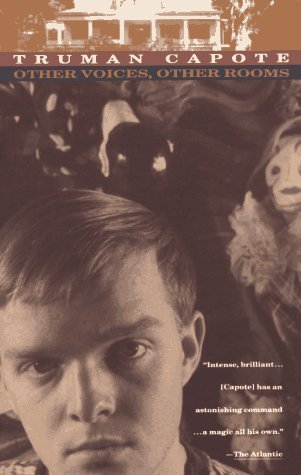
Other Voices, Other Rooms by Truman Capote

othervoicesOther Voices, Other Rooms was Truman Capote’s first novel, and I have picked it up because it was referenced in The Used World. Such is the power of Haven Kimmel.

This is a strange, spooky, sad tale, beginning with an unwanted child: we meet 13-year-old Joel as he’s hitching a ride en route from New Orleans to a crumbling estate in Mississippi. He had been living with his aunt following his mother’s death; now he has been summoned to his father, who he’s never met. Upon arriving at Skully’s Landing, he finds no father, but an odd stepmother and her even odder cousin, Randolph. Approximating friends are a neighbor tomboy named Idabel and a black servant named Zoo. Eventually Joel’s father is revealed, mute, bedridden, and as horrifying as everything and everyone else at the Landing. Among these horrors are a ghostly woman in a window where no woman belongs; a cottonmouth “thick as his leg, long as a whip”; and a mule who hangs himself.

Randolph is clearly gay, and a model for the effeminate Joel to consider, for better or for worse – sexuality aside, Randolph has a dubious moral code. He relates (among other things) the story of how he met Joel’s father, in an episode that rather reminded me of The Sun Also Rises, in which a motley mismatch of characters in a debauched setting (here, New Orleans) are remarkably frank about who wants who sexually. Later, when Joel attends a country fair with Idabel, things turn more towards Alice in Wonderland, in its sinister moments. But Capote is in his own class here, regardless of my literary comparisons. He evokes a startling, ghostly, creepy, sleepy yet stark atmosphere, and for me, that atmosphere was the great accomplishment of this novel.

Plot-wise, Joel’s story is one where not a great deal happens but a major life change takes place, anyway. This is a coming-of-age story, in which Joel starts off decidedly a child but finishes – just a few months later – a young man with a somewhat clearer picture of himself. (But, I think, no happier.) Part of that coming-of-age regards his sexuality, but only in an unstated, amorphous way, which is a fair description of the whole book, really. In fact, I have to admit to some trouble following things, as so much is unstated and wavering and strangely expressed from varying and unreliable viewpoints. That this novel is at least vaguely autobiographical I guessed; that there were themes of understanding one’s sexuality and coming-of-age was clear to me. But the rest was less clear. In fact I was reminded somewhat (to drop another literary name) of Faulkner, a la The Sound and the Fury. I won’t bother regurgitating it for you here – they are not my own interpretations – but even Wikipedia (for example) gets way more out of this story than I got. Go figure.

I think Other Voices, Other Rooms is likely to be another great candidate for a “close reading” with a knowledgeable guide – I picture my high school English teacher, Mrs. Smith – to direct related readings and fill me in on the background. Without such assistance, I still enjoyed a creepy, weird tale of cobwebbed, forgotten Southern grandeur and depravity. Take it as you will. If nothing else, Capote’s talent shines through and foreshadows his future success – but I still prefer In Cold Blood.


Rating: 6 bluejay feathers.

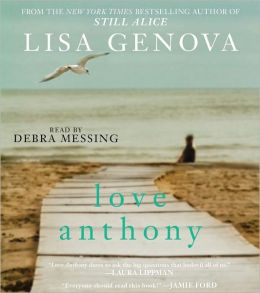
Love Anthony by Lisa Genova (audio)

This whole post below the book cover image is mildly spoiler-y. So, briefly: Love Anthony concerns two unrelated women and their respective pursuits of personal fulfillment and happy family lives. One has a little boy with autism. There is pain, and some redemption. If those few lines appeal to you, consider reading the book before you read this review.

loveantThis is Lisa Genova’s most recent novel, and I have now run out. (Her earlier works are Left Neglected and Still Alice.) This is not my favorite of her novels – that would be Still Alice. But it might be the one I found most thought-provoking.

The story jumps back and forth between the lives of two women who are connected only tenuously for most of the book. First we meet Beth. She lives on Nantucket Island year-round, and has three young daughters and a husband named Jimmy, who we learn even before we meet him is having an affair. She tells him to leave, and he does. For the bulk of the book, one of the central conflicts of Beth’s life is her struggle to deal with his infidelity and decide the future of their marriage and family. And then we meet Olivia. She is newly living year-round on Nantucket, in the cottage that she, her husband David, and her son Anthony have for years used as a summer home or rented out to vacationers. Olivia has recently experienced a series of personal tragedies, and she’s struggling just to hold it together. First, her son has autism, and the knowledge that he would never do all the things she’d imagined him doing – making friends, playing sports, dating, working, moving out of the house – would never happen, is devastating. Next, her son dies. And then her marriage falls apart, in the stress of dealing with Anthony’s autism and Anthony’s death.

Both Beth and Olivia, then, are working to cope with the unfairnesses that life has thrown their way. And here’s a twist: Beth is a writer, something she’d almost forgotten in her years of marriage and motherhood; but when Jimmy leaves, she pulls out her writing materials and begins working on a novel. Olivia is a former editor of self-help books, now working as a photographer (taking beach portraits for all those vacationing families on Nantucket). When the two women meet and discover this synchronicity, Olivia reluctantly agrees to read Beth’s novel when it’s finished. Are you ready for the big play? Beth’s novel is about a little boy named Anthony who has autism.

Beth and Olivia were both well-developed characters with realistic lives and problems. Both experience quite a bit of personal growth. I struggled for a time mid-book, because I didn’t really like either character; Beth was too much a perfectionist, sort of bitchy in her desire for the perfect family portrait in matching outfits, unconcerned with her children’s lives as long as they match and are unstained. And Olivia couldn’t love her son as he was, couldn’t get past her desire for a “perfect” or “normal” child. I was exasperated with both of them. But then they both changed, grew, and if I have had strong feelings about these characters then maybe the author reached her goal. I think there’s been a longer arc in this story than in Genova’s past books, which I loved more unequivocally, but which got me less involved. By the end, both women have changed enough that I liked them better. But they changed by becoming more perfect, which I cannot entirely buy into, so I retain some hesitation.

The friendship Beth shares with a group of women on the island (Jill, Georgia, Courtney, and Petra) is another area where I’m ambivalent. These women are diverse and likeable; but they feel like types more than real people, at least when assembled as a group. And they’re so good! There’s no cattiness, no back-biting. It’s a tight-knit, loving, supportive group, and call me cynical, but *I* have certainly never had a group of girlfriends so awesome; it’s all I can do to find one at a time, at best. They are a lovely part of this story, if they can be believed; but I am not sure they can be believed.

My central concern, however, is in the unscientific nature of the melding and meshing of Beth and Olivia’s lives, and the novel that they share. Beth’s novel turns out to be about Olivia’s son Anthony; the character in the book not only shares Anthony’s name, but his whole world. There is a metaphysical or otherworldly subplot. Is the dead boy Anthony speaking through Beth? I lost my patience here. Lisa Genova writes about hard science, and reliably – she is a neuroscientist by training – and that’s one of my favorite things about her work. So, then, for her to shift into this realm of possibly communing with the dead was jarring for me, and not what I was looking for. I have nothing against a good ghost story, but her work feels to me like it’s aspiring to realism, and I was bothered by the supernatural element. It didn’t fit.

On balance, I really enjoyed Beth’s and Olivia’s stories. Moment to moment, I was totally caught up in their lives and rooting for them. I was fully engaged, and I take my hat off to Genova who took me from not really liking either of her protagonists, to sympathizing fully; there was real growth and development. But when I zoomed out a little, I was unconvinced by and frustrated with several elements of the plot, and the type-casting of certain characters. For my money, her earlier novels were far more persuasive and easier to love wholeheartedly. That said – I am anxious for more. Lisa! Get to work!

As a side note, I found it curious that one of our characters is a woman writing a novel about a boy with autism, because Lisa Genova is of course a real-life woman writing a novel about a boy with autism. I can’t help but wonder how much of that is autobiographical, and I love the journey that line of thinking can take me down. Additionally, Beth’s writing process was fascinating to me, and I expect anyone else who dreams of being an author will feel the same. (I suspect that many avid readers fall into this category.)

Debra Messing, who plays Grace on the tv show Will and Grace, reads this audiobook convincingly, with the shifts, sighs, and varying volumes that represent speech vs. thought; she communicates emotion; a fine job. I recommend the audio version.


Rating: 6 white rocks.

Teaser Tuesdays: Out of Their Minds by Luis Humberto Crosthwaite

Teaser Tuesdays is a weekly bookish meme, hosted by MizB of Should Be Reading. The idea is to open your current read to a random page and share a few sentences. And try not to include spoilers!

outoftheirminds

Among other things, I am charmed by this cover. (And there is more of the same artwork within!) I hope I will be forgiven for this longer-than-usual teaser…

They made their debut at Aunt Yadira’s birthday party. The family was very kind and enthsiastically applauded their versions of “Wildwood Flower,” “Storms Are On the Ocean,” “The Long Veil.” Ramón and Cornelio promised to come back and play at their next party.

Later, Aunt Yadira came up, and in a maternal tone, explained to them that in reality they were very bad musicians and their arrangements were like massive trains wreck. Not just any train wrecks. No. Train wrecks with passengers. Nightmare, pain, irreversible tragedy.

Evocative, no?

This quotation comes from an uncorrected advance proof and is subject to change.

book beginnings on Friday: Love Anthony by Lisa Genova

Thanks to Rose City Reader for hosting this meme. To participate, share the first line or two of the book you are currently reading and, if you feel so moved, let us know what your first impressions were based on that first line.

loveant

I am thrilled to be falling into another absorbing novel by Lisa Genova. I love how she combines hard science (neurology, no less) with women’s lives, families, and relationships. A double beginning for you today. Prologue:

It’s Columbus Day weekend, and they lucked out with gorgeous weather, an Indian-summer day in October. She sits in her beach chair with the seat upright and digs her heels into the hot sand.

And Chapter 1:

Beth is alone in her house, listening to the storm, wondering what to do next. To be fair, she’s not really alone. Jimmy is upstairs sleeping. But she feels alone.

I think these two snippets give an accurate portrayal of some of the tension in this story. If you’re considering reading it, try and avoid reading about it first, is my advice.

I am still loving Lisa Genova, one of my favorite recent discoveries. Check her out. And happy weekend!

The Used World by Haven Kimmel

usedworldMy love affair with Haven Kimmel continues.

Billed as the third in a “loose” trilogy begun with The Solace of Leaving Early and continued with Something Rising (Light and Swift), The Used World inhabits the same space but doesn’t share many of the same characters. In fact, I couldn’t connect any characters from Something Rising, although several are tangential to Solace. I looked again, and Amazon (et al) calls this a “trilogy of place,” so, okay. I’ll start there. The place is Hopwood County, Indiana, and the little town of Jonah. Presumably it is based in part on Kimmel’s own hometown in that state. There are drugs and dysfunction and small-town bigotry and meanness, but it’s not all bad; there are also big-hearted people and open minds, and Pastor Amos Townsend (you’ve seen his name before in an earlier book review) is a bright star. I like that he is simultaneously transcendent, intelligent, & thoughtful, and deeply fallible & human. He has company, in this book, in the three women of a secondhand shop called Hazel Hunnicutt’s Used World Emporium.

Hazel is the proprietor, in her 60’s, decidedly eccentric and devoted to her aged mother and her cats. She turns out (naturally) to have an interesting history which I won’t get into here. Claudia Modjeski is a loner and accustomed to being stared at: she is 6’5″ and well-built, and occasionally gets called sir. And then there’s Rebekah Shook, a fragile woman who only recently escaped her father’s hellfire-and-brimstone cult of condemnation and is still being made to pay for it. Into their lives come a baby boy quite literally forgotten at a nearby meth camp, and an unwanted pregnancy, and everyone’s world shifts a little.

As I’ve said about all the Kimmel books I’ve read recently, this is lovely. She has a fine, crystallized perspective on middle America. The language continues to be stunning: Kimmel is a word wizard. The erudition present in her other books I’ve read, where one or more characters are so cerebral and caught up in the theoretical as to be nearly loony, is not so much present here; but there is decidedly more religious nuttiness. There are really good people, but also less good things (case in point: forgotten baby at meth camp). As a recurring theme, romance and beauty will blossom in the most unlikely places, and I confess I’m a sucker for that. Watch closely for the little details. I had to go back and reread a bit to track a character who starts off as insignificant and suddenly looms. Kimmel is a tricky one. Subtlety. Surprises.

I may have to stop reviewing her books. I feel inadequate.


Rating: yet another 9 for Kimmel, what can I say? 9 pit bulls. (There will always be dogs in her books. I like that I can rely on that.)

Next up: Kimmel’s best-known, award-winning memoir, A Girl Named Zippy, about which I am (understandably, I think) excited, but also nervous because I don’t always agree with the general consensus about which book is an author’s best. I am also excited, perhaps even more so, about her later memoir of her mother, entitled She Got Up Off the Couch – not least because I hope to write my mother’s memoir one day, too.