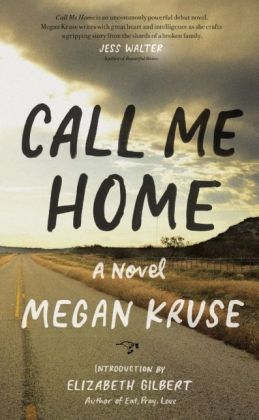
Call Me Home by Megan Kruse

A family story, in multiple voices, of pain and love and the journey to safety.
call me home

In her debut novel Call Me Home, Megan Kruse undertakes sprawling topics including guilt, sex, domestic violence and the complicated love of siblings, parents, children and lovers, in settings across the United States. These ambitious themes and clearly wrought characters are gorgeously rendered in feeling prose.

Amy moved from small-town Texas to small-town Washington state as an 18-year-old newlywed, before he began to beat her. The action of Call Me Home begins years later, alternatingly told in the third-person perspectives of Amy and her son Jackson, and first person by Jackson’s little sister Lydia. Amy tries to leave with her children, repeatedly, but to permanently escape her abusive husband she has to choose just one child to save. Eighteen-year-old Jackson finds himself on the streets of Portland, Oregon before taking work on a construction crew in Idaho. Amy and Lydia hide out at a shelter in New Mexico, then find their way to Amy’s hometown, where 13-year-old Lydia meets her grandmother for the first time. Flashbacks throughout the narrative also portray Amy’s marriage and abuse and the children’s early lives.

Call Me Home offers lovely descriptions of natural settings in Washington, Idaho and Texas, but central are the powerful themes and ugly realities of domestic violence, Jackson’s challenges as a gay teen navigating unfamiliar streets and country, and the shared and unique traumas of Amy, Lydia and Jackson. Kruse’s evocative, often lyrical language serves her subjects well, so that what results is not unleavened pain but painful beauty, even hope.


This review originally ran in the March 10, 2015 issue of Shelf Awareness for Readers. To subscribe, click here, and you’ll receive two issues per week of book reviews and other bookish fun!


Rating: 8 garbage bags.

Teaser Tuesdays: Martin Marten by Brian Doyle

Teaser Tuesdays is a weekly bookish meme, hosted by MizB of Should Be Reading.

This is one of those I fear to even say much about, because I might ruin its perfection. Best book of 2015 so far, for sure.

marten

I have one sentence for you today:

You could, as Dave many times had, just sit there in the sun with your back against a tree and watch and listen to the river sprint and thurble and trip and thumble; you had to invent words for the ways it raced and boiled and dashed and crashed, and indeed Dave had once spent an afternoon trying to write one long word that would catch something of the river’s song and story when it was full of itself like this, not yet the shy trickle it would be in summer and fall, before the Rains came on All Souls’ Day, and then the dim chamber of winter, when snow fell slowly all day every day for weeks at a time, and the woods were filled with soft slumps and sighs as trees shed their loads.

I love so much about this sentence: how it acknowledges what words cannot do, and then uses words to do so much; how its length mirrors the length of the failed word of the river’s song and story; how it encompasses four seasons; the lovely sounds of it. Are you convinced?

This quotation comes from an uncorrected advance proof and is subject to change.

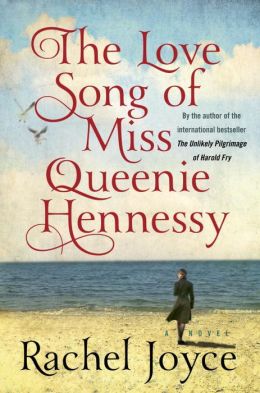
The Love Song of Miss Queenie Hennessy by Rachel Joyce

A companion to The Unlikely Pilgrimage of Harold Fry, and every bit as affecting, sweet and sad.

love song

Rachel Joyce’s The Unlikely Pilgrimage of Harold Fry won many fans with its bumbling but likable protagonist and his improbable journey across England and through his own troubled life. Harold appears off-screen in The Love Song of Miss Queenie Hennessey, in which Queenie replies to the postcards he sent her in Pilgrimage. Readers will be delighted to rediscover the action of the first book, from a very different perspective and with considerable added detail on Queenie’s side. Those considering Pilgrimage should definitely start there, as Love Song comprises one big spoiler. However, it’s not necessary to have read the first to enjoy this second novel.

Love Song begins when Queenie receives Harold’s first postcard. She has written to him from hospice care, sharing the news of her impending death. Harold sets out to visit, asking her to await his arrival. Queenie is startled and alarmed. She has kept an old secret from Harold that she had intended to take with her; she now decides she needs to come clean.

Joyce alternates among three timelines: in real time, as Queenie waits for Harold while composing a long letter of explanation; their separation 20 years ago, when she fled life’s complications; and their original meeting and developing friendship. While the present-day setting is inarguably dour, the action in all three stories is fresh, compelling and deeply emotional, and Queenie’s fellow residents create a charming little world of their own. Just as in Pilgrimage, a major revelation at the end amplifies the impact of an already powerful book.


This review originally ran in the March 10, 2015 issue of Shelf Awareness for Readers. To subscribe, click here, and you’ll receive two issues per week of book reviews and other bookish fun!


Rating: 8 painted nails.

Her Own Vietnam by Lynn Kanter

A woman’s story of wartime PTSD gathers complex characters to shed light on a little-discussed point of view.

vietnam

Her Own Vietnam, by Lynn Kanter, is the story of Della Brown, who served as an army nurse in Vietnam but only begins to address her trauma decades later, when an old friend who shared that experience contacts her out of the blue. Kanter portrays Della’s painful chronicle with sensitivity and surrounds her with a family that is imperfect but, for the most part, making an effort. The resulting novel is insightful in telling of the little-known struggles of women “in that green and poisoned country.”

…Click here to read the full review.


This review was published on February 27, 2015 by ForeWord Reviews.

IMG_4538


My rating: 8 flowers.

Death Comes for the Deconstructionist by Daniel Taylor

Weighty subjects and introspection never bog down Taylor’s quirky characters as they rush toward a surprising finish.

deconstructionist

Death Comes for the Deconstructionist, by Daniel Taylor, is a slim, funny, thoughtful novel about mental illness, academia, self-knowledge, and philosophy, with a murder mystery thrown in.

Jon Mote, a failed husband and failed graduate student, lives with his sister on a houseboat in St. Paul, Minnesota. When the widow of a murdered professor calls, asking him to look into the death of his former dissertation director, Mote is reluctant—his usual part-time research work involves, for example, the history of popcorn or insurance rates—but he needs the money. Alongside his incessantly sunny but unwell sister, Judy, Mote will have to revisit his own past, as well as that of the highly accomplished Doctor Pratt, who turns out to have a surprising number of enemies. The voices in Mote’s head grow more insistent as the case stresses his fragile grip on reality. Despite her own handicaps, Judy may have to hold things together.

…Click here to read the full review.


This review was published on February 27, 2015 by ForeWord Reviews.

IMG_4538


My rating: 7 zippers.

Teaser Tuesdays: Call Me Home by Megan Kruse

Teaser Tuesdays is a weekly bookish meme, hosted by MizB of Should Be Reading.

call me home

What a beautiful book. I had the added feeling of synchronicity, that it handles a move from Texas to my very region of Washington state. But even without sharing those personal details with this family, I think this is a moving story. And then these lines.

There was a bar for every loneliness, he suspected. A bar for every sad story, and one for every joy. All of those things, contained in the shifting glass, the water rings and fingerprints across old wood, the smell of sweat.

I’m a sucker for writing about bars, as place and atmosphere. Stick around.

This quotation comes from an uncorrected advance proof and is subject to change.

Of Things Gone Astray by Janina Matthewson

A quirky, memorable debut novel about things we miss, large and small.

astray

Janina Matthewson’s first novel, Of Things Gone Astray, is startlingly beautiful, both ridiculous and poignant. A handful of people in London wake up one morning to find that they have lost things that matter very much to them. Delia can no longer find her way around the neighborhood she has always lived in; Mrs. Featherby’s house suddenly has no front wall; Marcus’s piano is missing its keys; Robert’s place of work is not where it belongs, though no one else seems to be missing it (a whole building!), and his colleagues’ numbers have vanished from his phone. These bizarre, surreal absences make no sense, but must be accepted as fact because they are blatant, physical. Meanwhile, a little boy named Jake finds himself attracted to lost things: he collects the contents of the Lost and Found room at school, labels and organizes objects that will likely never see their owners again.

On its face, this is a fantasy, an otherworld fortunately accessible only through prose. But Matthewson’s sensitive prose helps us to consider what matters, and the means by which we hang on to those things. Through no overt metaphor, this mystical, whimsical, dreamy world of the lost and the retrieved suggests a fresh and heartfelt new way of thinking, as Jake, in his concern for lost things, may lose track of something far more important and intangible.

Of Things Gone Astray is a stunning, heartbreaking, thought-provoking song of love and memory and family and life, with something to offer any reader, bereft or not.


This review originally ran in the February 13, 2015 issue of Shelf Awareness for Readers. To subscribe, click here, and you’ll receive two issues per week of book reviews and other bookish fun!


Rating: 9 cakes.

book beginnings on Friday: The Love Song of Miss Queenie Hennessy by Rachel Joyce

Thanks to Rose City Reader for hosting this meme. To participate, share the first line or two of the book you are currently reading and, if you feel so moved, let us know what your first impressions were based on that first line.

love song

A sequel to The Unlikely Pilgrimage of Harold Fry: hooray! I’m so excited! Well, let’s not wait around, here’s the beginning:

Your letter arrived this morning. We were in the dayroom for morning activities. Everyone was asleep.

And I think that says quite a lot right there, don’t you? If you recall the original, the book about Harold, you’ll know what letter the narrator is talking about. And that’s a change from the original, which was told in third person: apparently we get to hear Queenie’s own voice here. I am excited, and you should be too.

This quotation comes from an uncorrected advance proof and is subject to change.

The Sweetheart by Angelina Mirabella

The unlikely, humorous, heartrending story of a teenaged female wrestler in the 1950s.

sweetheart
Angelina Mirabella’s debut novel, The Sweetheart, opens with an older woman’s reflections, then quickly flashes back to 1953 Philadelphia. Leonie Putzkammer is an awkward, bookish teen with no self-confidence, despite a figure her peers would kill for and some tumbling skills left over from gymnastics. When she is recruited to attend Joe Pospisil’s School for Lady Grappling in Florida, a star-struck Leonie is sure everything will change. She gains a tag-team partner, Screaming Mimi, and a boyfriend, Spider, as well as an intimidating coach. Soon she is assigned a new name, Gwen Davies–later, Gorgeous Gwen Davies and, finally, the Sweetheart.

Many readers will sympathize with the older protagonist when she addresses her younger self: “What you have wanted more than anything was change… but the idea that the old life would no longer be waiting here for you is hard to accept.” The heart of this story addresses questions of autonomy, self-determination and regret: how to become someone different without entirely losing your past, how to recover from making the wrong choices or even how to tell when you have made wrong choices. Told from an unusual retrospective second-person perspective and perfectly evoking 1950s culture, The Sweetheart is often hilarious but also filled with the wholly realistic yearnings and heartbreak of young-adult reinvention, and is peopled by familiar, sympathetic characters. Mirabella’s impressive debut offers laughter, tears, failure, redemption, striving, success and a sweetheart we can’t help but love.


This review originally ran in the January 30, 2015 issue of Shelf Awareness for Readers. To subscribe, click here, and you’ll receive two issues per week of book reviews and other bookish fun!


Rating: 7 MoonPies.

Teaser Tuesdays: The Unraveling of Mercy Louis by Keija Parssinen

Teaser Tuesdays is a weekly bookish meme, hosted by MizB of Should Be Reading.

unraveling

I’ve only just started this book, so this teaser comes from the early pages, and I am nearly as ignorant as you are about Mercy Louis and her setting.

The whole world falls apart in summer. Murder rates rise with the heat, hurricanes brood off the coast, waiting to batter us.

One thing I do know is that she is an unusual teenager, dreading rather than happily anticipating summer. There is a sense of foreboding from the very first pages.

I fancy myself familiar with her small town, on the Gulf Coast and on the border between Texas and Louisiana, because that’s not far from where I grew up. But the differences between the big city (mine) and the small town can be huge.

This quotation comes from an uncorrected advance proof and is subject to change.