The Vegetarian by Han Kang, trans. by Deborah Smith

A South Korean woman’s decision to become a vegetarian has surprising and memorable consequences.

vegetarian

Yeong-hye was an ordinary woman–a trait her husband appreciated–until she made the shocking decision to become a vegetarian. In South Korea, this is unusual and socially scandalous; her family reacts by railing and trying to force her to eat meat. “I had a dream,” is all she says in explanation. Han Kang’s novel The Vegetarian recounts Yeong-hye’s choice and its consequences.

Three sections tell the story from different perspectives: Yeong-hye’s disgusted and frustrated husband; her brother-in-law, a video artist whose work and every thought become fixated on Yeong-hye and her “vegetal” nature; and finally, her older sister, in the late stages of the extreme situation brought about by a seemingly simple decision. Their different relationships to the protagonist reveal more of her personality, but they cannot understand her. Vegetarianism is only one stage in Yeong-hye’s extreme plan for metamorphosis, as it turns out. As her story unfolds, this single decision brings increasing disgrace, violence and subversion, and her limited control over her own life diminishes.

This is a dreamy story with depth and mystery, translated from the Korean by Deborah Smith with nuance and a tone of growing wonderment. Yeong-hye is a confounding and almost mystical character, never seen through her own point of view. In the end, The Vegetarian asks questions about mental illness and the significance of personal choice. Yeong-hye’s story is disquieting, thought-provoking and precisely formed.


This review originally ran in the February 12, 2016 issue of Shelf Awareness for Readers. To subscribe, click here, and you’ll receive two issues per week of book reviews and other bookish news.


Rating: 7 trees.

Maximum Shelf: Tuesday Nights in 1980 by Molly Prentiss

Maximum Shelf is the weekly Shelf Awareness feature focusing on an upcoming title we love and believe will be a great handselling opportunity for booksellers everywhere. The features are written by our editors and reviewers and the publisher has helped support the issue.

This review was published by Shelf Awareness on February 10, 2016.


tuesday nights
It is New Year’s Eve, 1979. In Buenos Aires, a woman named Franca is raising her son alone. The country is in the midst of the turmoil called the Dirty War; kidnappings are on the rise, and Franca is frightened: she has been baking cakes for an underground group that records the names of the “disappeared.” In New York, a man named James Bennett has had a harder time than most finding his way in life: his synesthesia always made him exceptionally strange, as he refers to colors, sounds and smells no one else sensed. But he’s finally made it, as an art critic for the New York Times. Also in the city, Raul Engales works night and day at his art, painting in poached studio space at New York University, a school he does not attend. He knows his work is better than any of what’s being sold in the big galleries. If he could only get someone important to look at it.

Molly Prentiss’s striking first novel, Tuesday Nights in 1980, covers one year, from December 31, 1979, through the final days of 1980. Says an art dealer with more influence than she perhaps deserves: “I’ve always found Tuesdays so charming, haven’t you? I do everything on Tuesdays.” The action tends to take place on Tuesdays, which sounds like a cumbersome and effortful device, but in fact flows smoothly and almost invisibly, following the lives of a few individuals in a city and an art scene big enough to swallow them. Tuesday Nights in 1980 is a sweepingly large and profound story about art, love and actualization, cleanly and beautifully composed.

The lives of Engales and James form the two main threads of story, with their fortunes rising and falling as precipitously as anything in 1980s’ New York. James’s success is born of the impressions other people’s work makes on him: de Goya and Picasso’s blue period both sound a bold, steady drumbeat; Bill Rice gives him a “nocturnal mood” and a headache; the paintings of Louise Fishman smell strongly of shampoo. “He felt gushes of wind and crawling ants, tasted burnt sugar and gazed at skies’ worth of stars.” Marc Chagall’s work gives him a hard-on. Writing these impressions for a public audience gives him immense satisfaction and a little money, and helps him to accumulate a legendary and sought-after collection of “the pieces that made him hear beautiful music.” Meanwhile, Engales sees the glimmering beginnings of the attention his work deserves. He finds a community: the grouchy woman at his art studio, the fellow creatives at “the squat” where he spends his free time and finally, crucially, a muse. Lucy is an innocent from Idaho who believes in omens, who steps out of a taxicab into a world of promise and finds what she thinks she is looking for in the artist. Then James and Engales each suffer a drastic, shattering loss that changes their respective abilities to create. And a small boy from Argentina appears in their lives, offering new varieties of pain, love and responsibility.

Tuesday Nights in 1980 portrays the arts scene as inspired and genius, and fraught with tension between creativity and the question of “selling out.” James’s weird and enchanting perceptions allow Prentiss to paint the visual arts colorfully, as well as fragrantly, noisily, brilliantly, tenderly and roughly. A central theme is the beauty of damage. “Wounds and deformities and cracks and boils and stomachs: this was the stuff that moved Engales… He could hear his father saying: The scratches are what makes a life.” This is not a concept invented by Prentiss, but her characters struggle with and embody it in moving, new ways.

While always told from a third-person perspective, the focus changes from chapter to chapter among Prentiss’s diverse cast: primarily James, Engales and Lucy, but supported by a number of equally fascinating and colorful associates. James’s wife, Marge, is a woman who presents to him as a deep and glorious red, whose own creative career has been sacrificed to enable his. Arlene is a curmudgeonly painter friend to Engales, given to unconventional sartorial choices: a “long fish skirt and a coat that was somehow both puffy and flowy” or “a flowy dress with an outrageous pattern on it… eccentric cowboy boots and a trench coat of sorts, with many, many pockets.” Prentiss’s talent for characterization is prodigious, and matched by her delightful turns of phrase. The art collector who loves Tuesdays has “the kind of hair that was popular that year, a curtain revealing only the first act of her face: a queenly nose, confusingly colored eyes (were they violet?), cheekbones for days” and “a voice as simultaneously regal and flighty as her hair.” She laughs “like a pretty horse.”

A plot with multiple storylines involving so many characters is easily followed, because the people and events who form them are so memorable–but not to the point of caricature. No, James Bennett and Raul Engales and the rest are only as bizarre as their time and place, which Prentiss evokes perfectly: SoHo on the brink of devastating gentrification; artistic genius on the brink of commercialization or self-destruction, or both; and the insane, everyday choices made by regular people seeking love, identity and community but fearing to make the wrong move. Tuesday Nights in 1980 is a beautiful, poetic novel of ambitiously profound considerations, a large-scale drama in a series of small, perfectly rendered moments.


Rating: 8 shades of astonished gray.

Come back tomorrow for my interview with Prentiss.

Teaser Tuesdays: Mink River by Brian Doyle

Teaser Tuesdays is a weekly bookish meme, hosted by MizB of Should Be Reading.

mink river

Totally unsurprisingly, I am thrilled to be back with Brian Doyle, this time in audio format. Mink River is like Martin Marten in that it examines a small town on the northern Pacific coast, and all its inhabitants, human and otherwise. Whimsical is a good word for Doyle, I think. I’m only a short way in but these lines struck me:

Of course, there are many other people in Neawanaka, so very many. Old and young and tall and short and hale and broken and weary and exuberant. So very many it would take a million years to tell a millionth of their lives, and we don’t have the time, worse luck, for their stories are riveting and glorious and searing. But ah, let us choose two…

I am convinced of this concept, that all creatures’ stories are worth telling, if only we could get to them, which we can’t, not all of them. And isn’t the idea well expressed here? Doyle still recommended.

The Children’s Home by Charles Lambert

Wonderful, eccentric stray children fill a decaying country estate in this strikingly dark fairy tale.

children's home

Charles Lambert (With a Zero at Its Heart) offers a startling and adept blend of realism and frightening fantasy in The Children’s Home.

Morgan Fletcher lives alone, served by a housekeeper and a skeleton staff he purposefully never sees, on a sizable estate of fading opulence. He has been disfigured by a mysterious accident; his inherited fortune has equally enigmatic origins. His family history is only hinted at, but apparently contains ugly secrets. His housekeeper, Engel, seems comfortably wise to these difficulties, and when the country doctor, a “sunlike man,” befriends Morgan, he feels a little like himself again. The real difference, however, is the children, who show up one by one as if out of the air, some of them mere babies on the stoop. Morgan is wonderingly delighted to find himself surrounded by youngsters, whose playful noises echo often through the house, but who are strangely silent when he wishes for silence. These are not ordinary children, but Morgan has had no contact with the wider world for many years and is slow to question their behavior. They seem to seek something within his house and simultaneously seem to know his past already.

Lambert opens with plausibly lifelike scenarios and proceeds with careful pacing through the Fletcher family story. The line between reality and illusion is as imperceptible to the reader as it is to Morgan, until the final, otherworldly action accelerates with glittering vividness both lovely and grotesque. The Children’s Home is unforgettable: fanciful, chilling and poignant.


This review originally ran in the January 15, 2016 issue of Shelf Awareness for Readers. To subscribe, click here, and you’ll receive two issues per week of book reviews and other bookish fun!


Rating: 7 questions.

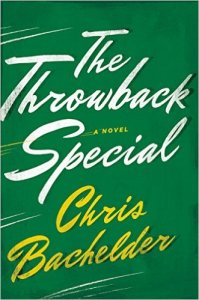
Teaser Tuesdays: The Throwback Special by Chris Bachelder

Teaser Tuesdays is a weekly bookish meme, hosted by MizB of Should Be Reading.

I have a fun one for you today.

throwback special

Chris Bachelder’s novel The Throwback Special had me laughing out loud in the strangest of places. What a gift! Also, this novel is about football – the American kind – a sport and pastime I have no knowledge of or enthusiasm for; and I still loved it. I guess that’s because even more than it’s about football, it’s about people: specifically a group of not-entirely-happy middle-aged men. They interact in some funny ways. I loved this line:

Charles, who counseled adolescent girls with eating disorders, wanted to tell Robert to put that thought in his worry box.

Keep your eyes open…

This quotation comes from an uncorrected advance proof and is subject to change.

short pieces: Walker, Tolkein, Stegner and more

Ah, the irony: I said just the other day that I was done with Faulkner, and yet here we are. In a continuation of going through those pages that have been piling up, I’ve read a few essays and short stories – including one by Faulkner.

A Rose for Emily” by William Faulkner: This may be the format for him & me, because I found him perfectly comprehensible and amusing in this short form. It seamlessly evokes a small Southern town with its prejudices and whisperings and feelings of rectitude; it has atmosphere. It also has an engrossing, entertaining, and fully-formed story in it. And I think this is a mark of the master of the short story: that it can feel complete. Those less adept at it leave us feeling like we missed out on something. Not so here. I won’t say any more about the story itself, except that yes, Faulkner can be enjoyable; and if you’ve balked before, as I have firmly balked, you might consider giving this one a try. If you hate it, it’s only six pages long.

An interview with Terry Tempest Williams from YES! magazine: “Survival Becomes a Spiritual Practice.” I still love Terry Tempest Williams. She is wise, even when she can be kind of gauzy and dreamy, as here. I like that this interview addresses two “places” that “we” are in just now: a state of the world, as well as her own geographical placement, moving back and forth between Vermont (where she teaches part of the year at Dartmouth) and her home in the Utah desert.

The Sense of Place” by Wallace Stegner: If I ever get my hands on an audio-cassette player, I have a whole collection of “sense of place” essays by Stegner, read aloud by the man himself, and I cannot wait to hear them. Send me a tape player, somebody.

This essay rounds out that inaccessible collection, as I understand it. Stegner describes us as being defined by place as well as defining place. He presents a possibly controversial idea, that

at least to human perception, a pace is not a place until people have been born in it, have grown up in it, lived in it, known it, died in it – have both experienced and shaped it, as individuals, families, neighborhoods, and communities, over more than one generation.

A few lines earlier:

The deep ecologists warn us not to be anthropocentric, but I know no way to look at the world, settled or wild, except through my own human eyes.

I like this honesty, because I acknowledge and respect the caution not to be anthropocentric; but Stegner makes a true point that we can only know the one perspective, really. (I guess I would counter that being less anthropocentric should simply involve acknowledging that there are other perspectives. I think Stegner gets that, though.) He gives equal airtime to those who have, perhaps, grown up nowhere, too.

If the rest of this essay collection continues on this path – of exploring what we mean to our places and vice versa, how we define one another – I need to hurry up and find that tape recorder.

Leaf by Niggle” by John Ronald Reuel Tolkien (because that is how his name is spelled out at this link. Funny, I never knew what J.R.R. stood for, I don’t guess). What an enchanting story! Niggle is a “little man… who had a long journey to make.” He doesn’t want to take his trip, but he knows he has to. He’d rather finishing this painting first: a painting of trees and countryside. He wants it to be perfect. But there are other pulls on his time, and he ends up being forced to go on his journey without perfecting his work. In fact, he’s so rushed he does not even pack a bag. I won’t tell you the rest…

I wondered throughout if this was a big beautiful allegory for art, for the making of art – Tolkien’s own writing, or any of ours. There are some lovely images and moments:

He had a number of pictures on hand; most of them were too large and ambitious for his skill. He was the sort of painter who can paint leaves better than trees.

And,

There was one picture in particular which bothered him. It had begun with a leaf caught in the wind, and it became a tree; and the tree grew, sending out innumerable branches, and thrusting out the most fantastic roots. Strange birds came and settled on the twigs and had to be attended to. Then all round the Tree, and behind it, through the gaps in the leaves and boughs, a country began to open out; and there were glimpses of a forest marching over the land, and of mountains tipped with snow. Niggle lost interest in his other pictures; or else he took them and tacked them on to the edges of his great picture. Soon the canvas became so large that he had to get a ladder…

Can’t you just see Middle Earth developing, demanding that Tolkien attend to it, in the same way?

“My picture!” exclaimed Niggle.

“I dare say it is,” said the Inspector. “But houses come first. That is the law.”

Ah, and there’s the rub.

This story can be said to comment on religion, the value of art, the question of what we owe our neighbors; it indicates some of Orwell’s 1984; there is a great deal in this short story (nine pages). Strange and fanciful and lovely, like all of Tolkien’s work.

My Father’s Country is the Poor” by Alice Walker, 1977, The New York Times. In a short two and a half pages, Alice Walker paints beautiful, heartbreaking pictures: of her father and her own life, of a visit to Cuba, of the difficulties of race, culture, class, and their inextricability. She tells us “what poverty engenders… what injustice means.” Only Alice Walker, and even in 1977, so much that we should attend to. I don’t want to comment too much on this; better that you go read her words, which are few and flawless.

The Winter Girl by Matt Marinovich

At a borrowed home in the Hamptons, a couple pulling away from one another are drawn toward the house next door–and its secrets.

winter girl

Matt Marinovich’s The Winter Girl is a brief, chilling story of boredom’s path to crime and secrets uncovered.

Scott and Elise have decamped from New York City to the Hamptons, where they are staying at Elise’s father Victor’s house in unaccustomed splendor while he dies in the hospital of cancer. Their lives have been put on hold as Elise spends her days visiting with Victor and Scott mopes around the house, drinking Victor’s liquor cabinet dry. His career as a photographer has fallen off, although he still takes his camera out to the lake some days. His marriage to Elise is failing, for reasons that are more a natural drift than explicitly detailed. As Scott tells it, “Slowly, we’ve stolen the best parts of each other, carted ourselves away.” It is winter; the backdrop to Scott’s malaise is stark.

In his boredom, Scott starts watching the house next door, which clearly has been emptied for the winter. Every night he watches the light switch off on its timer at 11 p.m. He grows a little obsessed, so the next move is clear: while Elise is at the hospital one day, he breaks in, just to have a look around. “I felt like a suburban astronaut, exploring an abandoned home in which the crew had gone missing.” This is exciting, thrillingly illicit, and he brings Elise in for the fun, which has the perhaps surprising effect of reviving their passion. It also starts a string of increasingly criminal and disturbing thoughts and actions, and begins to unravel a long-guarded tangle of secrets. Just as tension has begun to build, Victor announces he will return home to die. But he seems to be getting stronger, not weaker. Questions pile up. What is really happening to Victor? And what is in the house next door?

Told in Scott’s first-person perspective, The Winter Girl offers strengths in its unsettling tone and moody, atmospheric setting. The events Scott relates become a little surreal in his off-hand telling; the reader is challenged to buy into his perspective, or stand back and try to see matters in a calmer light. Marinovich (Strange Skies) offers an unnerving and entertaining story. However, as the revelations mount, their pacing feels a bit rushed: the stakes rise steeply enough as to be a little jarring. On the whole, though, the experience is exhilarating, if a little leeway is allowed for accelerating surprises. And the dramatic denouement leaves the reader eager for more.


This review originally ran in the December 22, 2016 issue of Shelf Awareness for the Book Trade. To subscribe, click here.


Rating: 6 times I felt a little rushed.

Maximum Shelf: Breaking Wild by Diane Les Becquets

Maximum Shelf is the weekly Shelf Awareness feature focusing on an upcoming title we love and believe will be a great handselling opportunity for booksellers everywhere. The features are written by our editors and reviewers and the publisher has helped support the issue.

This review was published by Shelf Awareness on December 9, 2015.


breaking wildBreaking Wild is the first adult novel by Diane Les Becquets, author of highly praised young adult novels including Season of Ice and The Stones of Mourning Creek. Carefully crafted characters and measured pacing define this tale of two women’s parallel personal journeys in the wilderness of northwestern Colorado.

Amy Raye Latour is a wife and mother, an accomplished outdoorswoman and a strong personality. She is on a camping and hunting trip with two male friends. The men have brought down elk with rifles, but Amy Raye hunts with a compound bow; she needs to get away from her companions to find the stillness and quiet required to get close enough to her prey. So she sneaks away from camp on their last morning, with only a light pack. When she doesn’t show up again that night, her friends call local authorities.

Pru Hathaway lives in the nearby town of Rio Mesa with her teenaged son, Joseph, and her dog, Kona. Pru is an archeological law enforcement ranger with the Bureau of Land Management; Kona is certified for search-and-rescue, including avalanche conditions. The sheriff, Colm McCormac, is a friend; when he gets the call about Amy Raye, he turns to Pru.

The personalities of the two women shape the novel: they are both more complicated than they seem on first meeting, and while they are very different, both have concealed and storied pasts. One of Les Becquets’s triumphs is the tantalizingly paced release of new information: about Pru’s personal history, about Amy Raye’s troubles and the tangled web of her life, any strand of which may be implicated in her disappearance. Similarly meticulous is the build-up to Pru and Amy Raye’s expected meeting. This is the story of a chase: Pru and Kona pursue Amy Raye through the backwoods, tracking her movements through drifting snow and rugged terrain, hoping to find her before she succumbs to a mountain lion or the harsh winter conditions. As one party makes a move, the other makes a corresponding move, and the pressure increases. Breaking Wild is not only a masterpiece of characterization, but a feat of taut anticipation and suspense.

Somewhat relieving this tension are flashback interludes to Pru’s and Amy Raye’s respective histories, and the personal dramas of the present timeline. Pru’s son, Joseph, although not entirely untroubled, is a sweet young man; he wonders if Pru and the sheriff–himself an intriguing minor character–should date. Amy Raye’s marriage is not without its cracks, a situation perhaps symbolized by the description of her hunting in the early pages: her husband prefers to shoot with a camera, and has asked her not to keep guns in the house. Thus she uses the compound bow instead, and it is this choice that causes her to leave camp alone in the first place.

Three sections–entitled “Bear,” “Cougar” and “Deer”–further shape the book; chapters within those sections alternate between Pru’s first-person perspective and a third-person view of Amy Raye’s experiences. This format is telling. The natural landscape of northwestern Colorado is a pivotal feature, the backdrop that sets the stakes for a spectacle of life and death, informing every detail, every decision made. Both Pru and Amy Raye repeatedly note the temperature and humidity level, the wind strength and direction, in judging where, when and if to travel. When Pru first tells Kona to “go find,” on page 36 of more than 300, the reader knows that Amy Raye will not be so easily located. From then on, animal life and nature’s rhythms are increasingly crucial to Amy Raye’s subsistence. Is she hunting, or being hunted? She has gone into the wild seeking something undefined: “In that moment she felt everything–life, death, the tangy sweet smell of pine, the freshness of the rain. It was the immensity of those feelings that drove her mad at times.”

While the niceties of backwoods survival are fully developed, the drama of the natural world is less central to the story than the human dramas. The travels of Amy Raye and Pru give them room to grow, and to ask and answer questions of how to love; what a healthy relationship looks like; the nature of addiction; and the meaning and forms of family and community. Indeed, part of what Amy Raye has gone into the woods to find is a connection to her past; Pru found solace in the outdoors when she suffered a personal tragedy. So the two threads of the story–family and community, natural wilderness–intertwine, just as the lives of two women do.

Les Becquets portrays a credible and compelling cast of characters, especially the two strong women at its center. Breaking Wild is a rare novel in its mastery of both plot and character, with deliberate rhythm, thrilling suspense and a striking backdrop. Its breathless momentum carries through to a dramatic conclusion.


Rating: 7 arrows.

Come back tomorrow for my interview with Les Becquets.

The Merman by Carl-Johan Vallgren, trans. by Ellen Flynn

In this grown-up fairy tale, a young women’s battles with poverty, violence and neglect are further complicated when a mystical creature enters her life.

merman

Carl-Johan Vallgren’s The Merman, translated from the Swedish by Ellen Flynn, concerns the realistic and heartbreaking circumstances of teenaged Nella and her little brother, Robert; at the same time, it is a dark fairy tale about a mythical creature from the deep and the possibility of resisting evil.

Nella and Robert’s parents are terribly incompetent, uncaring people, more focused on drinking and crime than their children’s welfare. Robert struggles with learning disabilities and is bullied at school; protecting him, getting him the glasses he needs, and his general well-being falls to his sister. Nella is hard-pressed to handle the responsibilities of the household, including cleaning up after her alcoholic mother, about whom she muses, “it was about as hard to judge her as it was to understand her.” This mature and nuanced observation is typical of a girl who, despite her own troubles, seems drawn to others who need her help, such as a disabled man who is one of her few friends.

When the neighborhood bullies begin to threaten Robert with violence, Nella turns to her only ally at school, a boy named Tommy. But contact with Tommy’s brothers presents a new difficulty. They have pulled a mystical being from the ocean, whose otherworldly nature and wordless communication will change everything Nella understands about her life. All at once, Nella struggles with the bullies’ extortion and Robert’s fear; their father is released from prison and brings criminals home with him to disrupt their fragile household; their mother threatens to leave; and the sea creature looks to Nella for help. A burdened but strong and compassionate young woman, she will learn and grow through these tests, and wins the reader’s heart by the time her story reaches the final, hard decisions.

Nella is a compelling protagonist, reminiscent of Roald Dahl’s Matilda in her miserable circumstances, but with a harder, more adult edge. Robert’s suffering is almost unbearable, but sadly realistic. In Ellen Flynn’s translation of Vallgren’s tale, dialogue can be a bit stiff and formal, especially in the children’s cases, but overall she establishes a tone appropriate to the balance of reality and mysticism in Nella’s story, and the stark ugliness of her life. Vallgren evokes his fantasy element with wonder and detail; The Merman is a singular story. Fans of adult fairy tales and bleak realism will be haunted and enthralled by this novel of human tragedies, and the mystery of what lies beyond.


This review originally ran in the November 5, 2015 issue of Shelf Awareness for the Book Trade. To subscribe, click here.


Rating: 7 cartons of cigarettes.

Worlds Between by Carl Nordgren

An engaging and sympathetic tale of families and cultures, and the choices that shape them.

worlds between

Carl Nordgren’s Worlds Between is the second in the River of Lakes series, which began with The 53rd Parallel. With dual settings in Ontario and Ireland and a diverse cast of characters, this moving story charts divided loyalties and dangers from all directions.

…Click here to read the full review.


This review was published on November 27, 2015 by ForeWord Reviews.

IMG_4538


My rating: 7 colors in refracted light.