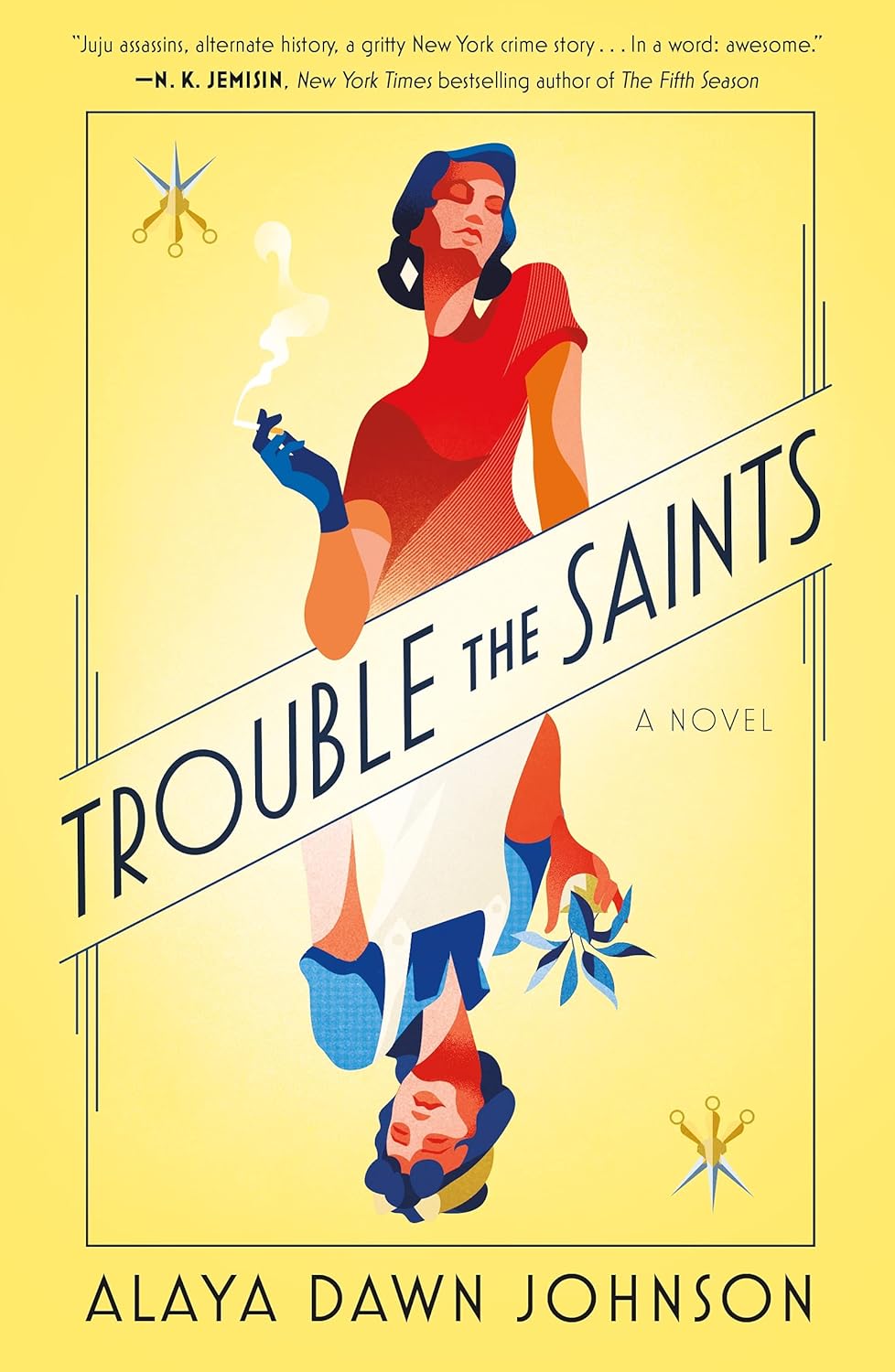
VenCo by Cherie Dimaline

I waited too long to get to this one that was recommended by Liz. Punch line: I think the title’s ‘Co,’ which felt corporate to me, turned me semi-consciously away from this book for a while. (I’ve had it on the shelf for maybe years, since Liz told me I should read it.) And… that’s very much the point, in the novel. As the cover shows (I’ve been looking at just the spine all this time!), ‘VenCo’ is a hidden-in-plain-sight reworking of CoVen. As in witches. Hidden behind a corporation. Very clever. So clever I missed out on reading this great book for longer than I should have. (Facepalm.)

I also read this book immediately following one called Lessons in Magic and Disaster, which is yet to be published so you haven’t seen my review yet, but keep your eyes peeled, because the two books back-to-back could not have been more perfectly paired. Chef’s kiss.

Okay, so here we are in VenCo, beginning with a prologue, “The Oracle Speaks.” Three women in three luxury vehicles pull up outside an understated building in Los Angeles. We get descriptions as they head inside, and the descriptions are a juicy, lovely start. They are the Maiden, the Crone, and the Mother, and together they form the Oracle. They are concerned about time; it’s running out; the circle must be formed under tight deadlines, but the sixth witch is a doozy, they assure each other. Cut to chapter one, “The Legacy of Lucky St. James.” Here we meet Lucky, who is struggling in Toronto. The orphaned (adult) child of an absent father and an alcoholic, but compelling, mother, Lucky lived with and was cared for by her lovely grandmother Stella until the roles reversed and now it would be more accurate to say that Stella, with dementia, lives with and is cared for by Lucky. The younger woman is scraping by, about to be evicted, dubiously employed, unsure how she’ll continue to provide for Stella. Cut again, in chapter 3, to Meena Good, a witch and leader of a coven-to-be, in Salem, Massachusetts. (Yes, we do see how predictable that sounds, but bear with us.) Meena’s group of five witches is introduced from here, until their path intersects with that of Lucky (who reminds me very much of someone Chuck Wendig would create), and the delightful, messy Stella. Every one of these characters is an absolute joy. Even though their story has much darkness and cynicism, they are steeped in and practicing love, just as hard as they can. Except for the one really evil character, who I haven’t mentioned at all yet.

It’s expansive and wonderful: I love how the magic fits neatly into a world we mostly recognize as absolutely and realistically our own. (I love the way Salem, Mass. is handled, the self-aware nod to what a perfect town this is for witch-hunting, ha, but also really.) The stakes are sky-high, the women are doing their best with conflicting goals, they are balancing loyalties and loves and basic survival needs. The future (we hope) coven is something we’re all rooting for.

I found this an easy world to get lost in and felt genuinely sad when the pages closed. I’ve already ordered more from the same author.


Rating: 7 spoons.

The Wildelings by Lisa Harding

Lifelong friends splinter and suffer in their first year of college under the spell of a charismatic older student in this atmospheric roller coaster of a novel.

Lisa Harding (Bright Burnings Things; Cloud Girls) will haunt readers with the psychological drama of The Wildelings, a compulsively readable novel in which a woman looks back on her college days and a long-lost friendship.

Jessica is introduced as she begins therapy, newly divorced, in her 40s. The novel’s inciting event, however, is not divorce but a new play by an old acquaintance. Asked by her therapist to write down her memories and “start at the beginning,” Jessica recalls her first year at Dublin’s Wilde College and “The Unholy Quintet: Mark, Linda, Jonathan, Jacques, and me.”

Linda had been Jessica’s best friend since childhood. When the underprivileged, underparented pair achieves surprising slots at the “pretentious arty” college, Jessica is highly ranked for her beauty as well as her acting prowess; Linda, as ever, dwells in the shadows. But just as Jessica enters a charged relationship with the sexy Jacques, Linda finds love with Mark, a magnetic fourth-year playwright and director, after a false start with golden boy Jonathan. The older student’s grasp on the group tightens, especially after Mark casts Jessica in what he claims will be a breakout play. Mark proves treacherously adept at directing the people around him, on and off the stage.

Harding gives Jessica a self-excoriating, incisive, bitter, and evocative first-person voice. The Wildelings‘ inexorable plot is like the proverbial train wreck: shocking, electric, impossible to turn from. Its psychological tumult verges on horror. With this atmospheric roller coaster of a novel, Harding offers pulsing intensity, gut-wrenching emotional upheaval, and high drama in every sense.


This review originally ran in the April 18, 2025 issue of Shelf Awareness for Readers. To subscribe, click here, and you’ll receive two issues per week of book reviews and other bookish news.


Rating: 7 freckles.

A Sharp Endless Need by Marisa Crane

This poignant coming-of-age novel combines outstanding sports writing and heartfelt expression of the teen experience, set to small-town Pennsylvania basketball.

Marisa (Mac) Crane’s second novel, A Sharp Endless Need, is a propulsive, perfectly crafted coming-of-age story centered on basketball and queer sexuality. With razor-honed prose, Crane (I Keep My Exoskeletons to Myself) offers authentic descriptions of teen angst and young love as well as exemplary sports writing, and a few memorable sex scenes.

Crane’s protagonist, Mack, is a star point guard and the only one at her small-town Pennsylvania high school who is Division-I bound. Between her junior and senior seasons, her beloved but troubled father dies, and on the heels of this trauma, a new girl transfers to the team: Liv is being scouted by the same schools as Mack, and the two are instantly inseparable. Their on-court chemistry is transcendent; off-court, they share good times but are also nearly immobilized by a desire that both are at great pains to conceal. Mack’s senior year is marked by larger-than-average difficulties: grieving her father, struggling with her distant, disengaged mother, playing hard with drugs and alcohol, and grappling with a sexuality that feels firmly forbidden in her community. The basketball scholarship she’s headed for feels imperative. Her mother sees it as a financial necessity; Mack knows it’s bigger than that. “I needed a future that was all basketball all the time because it was the only future I could imagine for myself. Basketball, I knew, was the only thing keeping me alive.”

Mack’s first-person voice is written from a distance of some years, a voice of wisdom looking back on her high school days. This perspective is one of the novel’s strengths. It is the older, wiser Mack who observes that another player “didn’t notice or appreciate the poetry of her pump fakes–she simply used them for their designated purpose. I guess what I mean is there was no romance.”

Anyone who’s ever been a teenager will relate to Mack’s broader struggles with self-destructive behaviors, desires, and pain. Her particular challenges involve a devotion to craft and the one-and-only ticket out that basketball represents. “Everything outside of that stadium, our problems, our anxieties, our fears, could wait; nothing else mattered but this last play.” The best sports writing evokes not only movement, sensory detail, and skill, but passion, and Crane has a firm grasp on these facets. As Mack’s final season nears its close, her relationship with Liv, her college decision, and more hinge upon a handful of choices and impactful moments. A Sharp Endless Need is unforgettable.


This review originally ran in the April 14, 2025 issue of Shelf Awareness for the Book Trade. To subscribe, click here.


Rating: 8 photographs.

My Name Is Emilia del Valle by Isabel Allende, trans. by Frances Riddle

A daring young woman and groundbreaking reporter journeys from San Francisco to Chile in the 1890s to investigate a civil war and her own roots in this stirring novel by the celebrated Isabel Allende.

Isabel Allende brings the experience of more than 20 books to My Name Is Emilia del Valle, a swashbuckling tale of the life and adventures of a young woman born in San Francisco in the 1860s. Emilia’s story is exciting, empowering, and inherently feminist, as she travels from California to her father’s native Chile during that country’s civil war, bucking social norms and going wherever she’s told she can’t.

A young Irish novice named Molly Walsh is about to take vows as a nun when she is seduced and abandoned, pregnant, by a Chilean aristocrat. Devastated, she accepts a marriage proposal instead from a colleague and friend in San Francisco’s Mission District, who will be the devoted stepfather, “Papo,” to her child. Molly remains bitter toward the absent father, del Valle, but Emilia lacks for nothing in the loving household where her mother and Papo teach the Mission District’s children, provide bread to the poor, and support her unusual goals.

Emilia first makes a living by writing sensational dime novels of “murder, jealousy, cruelty, ambition, hatred… you know, Papo, the same as in the Bible or the opera” (under a pen name, of course). Next she decides to become a journalist, launching a newspaper career, soon traveling to New York (where she takes her first lover and otherwise broadens her worldview) and then abroad: Emilia journeys to Chile to cover the civil war as a reporter for San Francisco’s Daily Examiner. Female reporters are vanishingly rare, but as war correspondents, unprecedented; and Emilia del Valle writes under her own name. She is also motivated to fulfill her mother’s lifelong wish to track down her biological father, del Valle. Emilia finds great danger as well as the opportunity to define her identity for herself. The adventures she encounters along the way fill Allende’s pages with violence, love, high society, and human interest.

As she has in previous acclaimed novels, Allende (The House of the Spirits; Inés of My Soul; Maya’s Notebook; The Japanese Lover) applies riveting storytelling to an exploration of history through the lens of a fictional heroine. Allende’s language, and Frances Riddle’s translation, is evocative in its descriptions of Chile’s lovely landscapes, a young woman’s complicated love for her family, and the horrors of the battlefield, with which Emilia will become painfully familiar. This enthralling novel leaves Emilia, still young, in a position of some uncertainty: readers may hope for more from this plucky protagonist in a possible sequel.


This review originally ran in the April 3, 2025 issue of Shelf Awareness for the Book Trade. To subscribe, click here.


Rating: 7 stitches.

Girls with Long Shadows by Tennessee Hill

Identical triplet girls are linked to tragedies across generations in this evocative first novel set along the swampy Texas Gulf Coast.

Tennessee Hill’s first novel, Girls with Long Shadows, is a dreamy, atmospheric tale of sisterhood and coming-of-age in the fictional town of Longshadow, on the Texas Gulf Coast. Nineteen-year-old triplets Baby A, Baby B, and Baby C were orphaned when their mother died in childbirth; their father’s identity remains a mystery. But they have always known family in the form of their loving but distant Gram (“Manatee” to the townsfolk, for her swimming prowess) and their adopted, nearly deaf younger brother, Gull. The whole town looks askance at the girls, spookily identical and associated with their mother’s early death. The family’s golf course, Bayou Bloom, provides respite, and the bayou itself (where Gram takes a daily swim, joined sometimes by one or more of the girls) offers a connection to nature, its fecundity and floods. Then one fateful summer, an act of violence, combining desire and objectification, ruptures the triplets, the family, and the town.

A tautly plotted Southern gothic, Girls with Long Shadows takes a distinctive perspective in Baby B’s elegiac narration. “That weekend something gurgled beneath, rattled us where we stood.” And: “Even before the worst of what that summer would bring was upon us, I began to mourn the girls we had been.” Baby B speaks as “we” as often as “I.” Only a few people other than themselves can tell the girls apart; even the boys they date may not make the effort. And intermittently the perspective shifts to a “Front Porch Chorus,” in which the town speaks collectively, observing the girls from without: “They’re a blur we never bothered to untangle.” This lack of distinction is both a wound for the triplets and an indelible part of their identity. They feel each other’s sensations and know that this is a boon. Without that link, they would be less themselves. In the eyes of the town, however, they are less human for being undifferentiated, more object or mirror. “All those boys touching all of us at the same time, hands on hands on bodies on hands. It wasn’t even that Pete was the one touching me, it was all of them, their inability to leave us be.”

Encompassing a single summer in the dripping, humid South, Hill’s haunting debut deals in lyricism and tragedy as it considers the harm done to young women by the outside gaze.


This review originally ran in the March 31, 2025 issue of Shelf Awareness for the Book Trade. To subscribe, click here.


Rating: 7 bikini tops.

Maximum Shelf: To the Moon and Back by Eliana Ramage

Maximum Shelf is the weekly Shelf Awareness feature focusing on an upcoming title we love and believe will be a great handselling opportunity for booksellers everywhere. The features are written by our editors and reviewers and the publisher has helped support the issue.

This review was published by Shelf Awareness on March 25, 2025.


Eliana Ramage’s debut, To the Moon and Back, is a far-reaching, ever-surprising, intricate novel about identity, family, ambitions, career, romance and, yes, astronomy.

When readers meet Steph Harper, she is almost six years old. “I imagine her terrified. Our mother. Two children in the backseat. She drove like a woman followed, even after we left him at the foot of that tall hill. There was blood there, back in Texas, and tiny shards of glass still covered my sister.” Their mother, Hannah, is in flight from a vague threat–abuse, trauma–with her two little girls in tow. Precocious Steph is already developing her obsession with astronomy. Kayla is just a baby, sparkling in broken glass but unscathed by what haunts the others: “Our mother would never have Kayla’s confidence because Kayla had no memory of another self. Of another place. Of what was possible, here on earth. Maybe what was wrong with our mother was also wrong with me.”

From Texas, the fragile family resettles in the Cherokee Nation, in Tahlequah, where Hannah hopes to recover community and reclaim her heritage. Steph and Kayla learn to speak Cherokee. Steph watches the sky and fine-tunes her plans to become an astronaut: when readers meet her for the second time, she is 13 and concerned only with getting into Exeter Academy, which she hopes will put her on course for Harvard and then NASA. She studies the biographies of astronauts and the hard science she will need, with the help of a telescope gifted to her by her mother’s new boyfriend, Brett. “It had been my goal to understand the origins of earth, the universe, and everything in it by my fourteenth birthday. I was behind schedule.” This dream is what gives Steph’s life focus; she needs this to live. “I’d picture an astronaut watching me back. Some astronaut would call his daughter through mission control and she’d say tell me what you see and he’d say oh, the Northern Hemisphere, North America, and that would be true, but also true was Oklahoma, a field, a tree. A girl alone, looking up.” It is also true that the dream, which in some ways saves her, may be what keeps her from finding happiness in relationships on Earth: with her mother, her sister, or the love of her life.

Distracting her along the way are her feelings for girls, which she suspects will not be appreciated in Tahlequah: “If I could figure out the money and the applications and the getting myself to college, I decided I would be gay. Or bi, maybe? At schools like Harvard, they let you figure that out.”

As Steph moves from Tahlequah to Hollis College in rural Connecticut, a parallel character is introduced. She was named Della Owens at birth, when she was adopted by a Mormon couple in Provo, Utah. But as the center of a legal case resting upon the Indian Child Welfare Act, she became known as Baby D. Many Native Americans believe she belongs with her people. Della’s path intersects Steph’s when they find themselves at Hollis together, and they will intertwine from there, coming of age in parallel and navigating romance, Native heritage, and ambition.

For a portion of the book, Della’s first-person voice alternates chapter-by-chapter with Steph’s, which otherwise dominates. Later, these perspectives are joined by various epistolary elements: e-mails, social media posts, text messages. To the Moon and Back excels in surprise; these points of view are only one area in which Ramage takes her reader in unexpected directions, geographically and otherwise. The novel is gloriously expansive, epic, and sweeping. It covers just a couple of decades, from 1995 to 2017, although the history of previous generations certainly comes to bear on the present timeline. But like Steph herself, the story keeps reaching beyond its expected limits. It is not only a coming-of-age story, but also about a variety of Native American experiences, and about queer experiences and those intersections. It’s about lofty goals, astronomy, and yearning. Just when readers grasp the enormity of Steph’s single-minded focus on becoming an astronaut, she reaches further, to becoming a better human being. The events of Steph’s life are often sensational, but always, in Ramage’s expert storytelling, believable.

So many threads would be too much for a less skilled writer to wrangle, but these characters are developed with such steady pacing, depth, and perfect detail that they always feel natural. A plot summary with spoilers would sound, perhaps, absurd. But To the Moon and Back is anything but. It is a complex, absorbing, thought-provoking novel, compulsively readable. Steph is exceptionally eccentric, and her story is also universal, all-encompassing. Her impressive character arc comes, eventually, to wisdom and an unlikely peace: “I want to love the universe, even if I don’t know what it is. I do not have to know what it is.” Readers will be enriched for having shared these pages with her.


Rating: 9 M&Ms.

Come back Monday for my interview with Ramage.

No Names by Greg Hewett

This dazzling first novel applies poetry to the overawing power of art, friendship, and the ways in which many forms of love blend into one.

Following five books of poetry, Greg Hewett (Blindsight; darkacre) astonishes with a transcendent first novel about friendship, desire, music, loss, and love in its many forms. No Names is rough-edged, glittering, and brilliant as it spans decades and lives, traveling from a fictional American refinery town to Europe’s capitals, from Copenhagen to a place known simply as the Island, and back again.

Solitary teenager Mike’s world expands when he meets easy, outgoing Pete, with whom he shares a love of literature and especially music, and a nearly instant firm bond. Music, for Mike, is all bound up with sex and violence and epiphany: “It’s like I’m busting out of the prison of myself and giving to the world whatever part of me that’s worth anything.” The two guitarists form a punk band in the late 1970s, and with their two bandmates take off on a rocketing tour of the United States and then Europe that ends in enigma and tragedy.

In 1993, another angst-ridden teen from the same gritty, class-divided hometown discovers a dusty record in his mother’s attic and goes looking for a mostly forgotten punk band. Isaac will pursue the mystery of the No Names until he unearths Mike on a remote island in the Faroes, where the haunted older man has been living as a hermit since the band’s 1978 dissolution: “a mythical musician who, for a time, dwelt here and filled the place with songs.” Mike is supported by a Danish classical pianist named Daniel who had briefly been a friend to the band. On the island, Mike describes to Daniel “a state of ecstasy, or ekstasis–that is, becoming entranced, being brought out of oneself” by the aurora borealis, but these lines could as easily describe their relationship with music, or with one another. Mike, Pete, Daniel, and Isaac, among others, form permutations and re-combinations of friendship, affection, artistic inspiration, love, and desire.

Hewett brings a poet’s ear for language to a complexly layered story that treats sex, drugs, and rock & roll as simultaneously hard-grained and gorgeous. His evocations of music and the power of the muse are tantalizing and apt, as are his lines about the strain of finding oneself, of love and lust and pain. By the time No Names flashes forward to 2018, readers will be spellbound, and as much in love with the novel’s protagonists as they are variously entangled with one another. Hewett’s first novel is scintillating and absolutely unforgettable.


This review originally ran in the March 14, 2025 issue of Shelf Awareness for the Book Trade. To subscribe, click here.


Rating: 10 walnuts.

Bad Nature by Ariel Courage

Bleakly funny, gloomy, and magnetic, this novel’s revenge-fueled, terminal road trip will tender surprising truths.

Ariel Courage presents a provocative, hypnotic excursion with her debut novel, Bad Nature, which offers a road trip, a revenge fantasy, and a snarky sendup of American culture.

Courage’s mesmerizingly repellent protagonist, Hester, is a successful lawyer with money to burn–one form of revenge upon her “impracticable, unprofitable” upbringing–and an antiseptic lifestyle kept up by a personal trainer, a dermatologist, a cosmetic dentist, and other professionals. In her nondescript but designer-decorated Manhattan condo, she has regular, emotionless sex with the “objectively repulsive” building super.

Hester relates early in her narrative: “I was always going to kill my father.” This intention shifts from someday to immediate when, just after her 40th birthday, she receives a breast cancer diagnosis. The oncologist tells her that, without treatment, she has six months to live. With characteristic, practiced detachment, Hester quits her job and leaves Manhattan in her Jaguar E-type, aiming for her long-estranged father’s new home in Death Valley. She will kill him and then herself with the gun in her glove box. Simple.

Hester’s cross-country road trip is beset with trouble. She loses the E-type to theft at a Philadelphia rest stop, and with it, her gun and her mother’s ashes. The first lesson that her wealth–an important feature of her constructed armor–will not solve all her problems comes when she must settle for an insultingly affordable rental car. She picks up a hitchhiker: “what my mother had euphemistically called an urban outdoorsman and what in college I would’ve called a crustpunk.” This young man, John, becomes her unlikely companion on a convoluted and indirect route toward the eventual destination. John is a principled traveler: eschewing consumerism, he photographs Superfund sites, documenting destruction. Stops along the way include Hester’s (only) ex-boyfriend from college and a friend (likewise) from high school, with disappointing if predictable results. Hester gets sicker. The outcome of her larger journey is less easy to guess.

Caustic Hester is aware she has “daddy issues” but “I’d rather pluck his eyeballs out with a fork and eat them jellied on toast than endure five minutes of therapy.” Her first-person voice is deeply sarcastic, darkly funny, and almost entirely self-aware. Bad Nature‘s title offers commentary on Hester’s terminal cancer (and her mother’s), on the violent impulses of her hated father (and her own), on the environmental devastation John is called to witness. Even more than wealth, rigorous self-grooming, and personal aloofness, Hester’s carefully cultivated cynicism is her final weapon, and its potential loss might be the most painful and surprising part of this madcap expedition. Courage delights and challenges with this mashup of emotions, until readers may be surprised, in turn, to care about Hester after all.


This review originally ran in the March 6, 2025 issue of Shelf Awareness for the Book Trade. To subscribe, click here.


Rating: 7 dirty fingernails.

Nothing to See Here by Kevin Wilson

Thanks to Liz for this one! I’ve had this on my shelf for a few… years? since she recommended it. I really enjoyed it. It was fun, and absurd, and sweet, and funny, and then quite poignant. Unique. I’m pleased.

Lillian comes from a life of not much money, love, or opportunity. She works hard for a scholarship to a fancy private school, where she makes one essential friend: Madison is from the kind of wealth where just almost literally anything is possible. They match each other’s weird, that one year. Then Madison gets busted with coke, and it’s all a bit foregone: Madison’s father pays off Lillian’s mother. Lillian takes the fall. She goes back to her depressed and depressing little life. Madison’s star continues to rise. When we meet Lillian, she’s working a series of shit jobs, pen-palling with Madison, who is now married to a senator, with a perfect little boy “who looked like an expensive teddy bear that had turned human.” Madison sends her $50 and tells her to come on down to Franklin, Tennessee “because she had an interesting job opportunity for me.” Lillian gets on a bus.

Senator Roberts was married before Madison. His ex-wife has just died. And left behind are his elder children, ten-year-old twins named Bessie and Roland. Lillian, who has no prior experience, expertise, or interest in childcare, is to take them on as charges. She has to keep them safe and relatively happy and oh yea, very private and low-key, because Senator Roberts is hoping to become Secretary of State in the near future, and the twins are a little different. They spontaneously combust. They are uninjured by this event, but their clothes burn off, as does everything around them. The Senator doesn’t need this kind of publicity.

And before Lillian can get used to limitless bacon sandwiches on demand (the Roberts estate employs a large staff, including an outstanding if weird chef named Mary), she is reinstalled in the guest house behind the mansion, which has been retrofitted to house small, recalcitrant fire children.

I love absurdism when it is reality-adjacent and also sweet and odd and fun, which this is, although it is also sad stuff. I love a literalization: the two children in Lillian’s care have been hurt by their life so far. They are a little damaged, slow to trust, quick to combust. Lillian is a bit that way, herself, but her combustion isn’t literal, where the twins’ is. Especially late in the story, Nothing to See Here gets to be about what it means to love someone, to choose to love someone and to take care of them. Lillian is not a parent, but she is as smitten and as wrecked as any parent, and as far at sea. “There was so much that I should have been doing, that I could have been doing, but not a fucking thing made sense to me. I just fed them, made them wash their hands, listened to whatever nonsense they wanted to tell me. I took care of them, you know?”

I should find some more Kevin Wilson. Outstanding.


Rating: 8 bounces.

I Leave It Up to You by Jinwoo Chong

A young man wakes up from a coma and returns to the family, and the family sushi restaurant, that he’d left behind, with comical, heart-wrenching, hopeful results.

I Leave It Up to You by Jinwoo Chong (Flux) is a funny, bittersweet, heartwarming story about family, love, and making every minute count.

Readers first meet Jack Jr. in what he is slow to realize is a hospital room. He wakes up intubated and gagging. He’s confused about his whereabouts and circumstances, and he asks for his husband. His nurse is thrown into a full panic: Jack Jr. has been in a coma for 23 months and was not expected to regain consciousness.

No one will answer when he asks for his husband. Jack Jr. has missed his 30th birthday and the first 18 months or so of the Covid-19 pandemic. A few weeks into this remarkable recovery, he returns home, not to his Manhattan apartment, but to his father’s home in New Jersey. He goes back to the family business, a struggling Korean-Japanese sushi restaurant, which was once meant to be his life’s work and which he has not seen in 12 years. Jack Jr. has lost everything, and he finds himself in an unfamiliar, masked world. For much of the narrative, the old wounds he was avoiding–that he will now have to face–remain shrouded from the reader.

Jack Jr.’s kind and loving Appa (father) is a passionate sushi chef and workaholic; his Umma (mother) is private, reserved, and fiercely loyal; his especially estranged brother, James, is a recovering alcoholic with a dear wife and a new baby to join the teenaged nephew that Jack Jr. barely knows. Wise, gawky, 16-year-old Juno is perhaps the member of his family that Jack Jr. best connects with. And then there is Emil, formerly Jack Jr.’s nurse, and now potentially poised to become something more. Through these endearing characters, Jack Jr. considers that perhaps “there was more to loving something than smiling at it.”

In Jack Jr.’s first-person voice, these mysterious, painful new challenges are wrenching, but his love for his wacky family, and theirs for him, are unmistakable throughout. Alongside the flavors of carefully prepared nigiri, dak juk, soy, ponzu, and plenty of pork belly, humor and off-kilter love shine brightly in this tale of realizing what’s really important and making the most of one’s own time. The title of I Leave It Up to You refers to a translation of omakase, the Japanese dining tradition of asking for the chef’s choice, and also nods to the novel’s sweet attention to the care of self and others. While recovering from his physical injuries, Jack Jr. must also navigate old fractures with a family he hasn’t seen in years, let go of a relationship with no closure, and remain open to a surprisingly promising future. The story winds up delightfully warm and soothing, for all the bumps along the way.


This review originally ran in the January 31, 2025 issue of Shelf Awareness for the Book Trade. To subscribe, click here.


Rating: 8 bowls of juk.