The Hare by Melanie Finn

A totally captivating novel to read in as few sittings as possible (beware!), often a bit disturbing or discomfiting, but always engrossing.

We first meet Rosie and Bennett in 1983. They’re on a date, which doesn’t go very smoothly, and highlights their differences. He’s older, far more sophisticated; he comes from money, while she’s a little awkward. (Or maybe just young.) She dutifully takes his cues, but the reader is immediately uncomfortable. Rosie’s perhaps not as uncomfortable as she should be.

We rewind just a bit to gather up her backstory. A childhood of privation in Lowell, Massachusetts; an art scholarship at Parsons School of Design in New York City. She’s a student there when she meets Bennett at MoMA, and is excited and flattered at his attention. And they’re off and running.

Somewhere inside, Rosie had the idea, like a stone buried deep in the Presbyterian loam of her soul, this pregnancy was punishment for being greedy. Her orgasms were rich as chocolate cake or red velvet. Layers of sweetness and dripping icing.

What lovely lines, hm? And a good example of Finn’s expressive writing, and Rosie’s rich interiority. We follow her from here over decades, eventually to rural Vermont; and I don’t think I’ll tell you much of what happens, but she grows and changes and learns so much. She’s a riveting character. While I empathize deeply with Rosie (eventually, Rose) throughout the book, there are times I disagree with or feel disturbed by her perspectives. This perhaps only deepens the connection, though, and my need to see her through.

The Hare is told in close third person, meaning Rosie is ‘she’ rather than ‘I’ but we still see what she sees, which allows for the question of whether she is really a reliable narrator. There are a few types of unreliable ones: there’s the narrator who is being deceitful and lying on purpose, and then there are other kinds, who maybe can’t see their own worlds clearly. Do I see myself the same way that you see me? Can I reliably narrate myself? Tiny spoiler here: Rosie consistently tells us she’s not much of an artist. But some others around her think she might be gifted. Who do you believe?

The visual-arts frame is a neat one – I love this stuff when it’s done right. A certain Van Eyck painting plays a small but pivotal role. And a little more subtly, Rosie’s eye for image, color, line, and perspective have an enormous impact on how we see what she sees. This is a novel with layers to it in a way that I love; I think I’ll be thinking of it for some time.

Gender is central to this book. Rosie’s position in her life, her situation in several senses, and her feelings of powerlessness are attributed to her being a woman. Her gender, and those of other characters, are always and unavoidably related to their roles and relationships. The novel itself is a commentary on gender roles; Rose eventually make explicit commentary, but she was always make implicit observations, too. The back-of-book blurb calls her “an authentic, tarnished feminist heroine,” and I think that’s about right. In some ways this is a coming-of-age story, but lasting far beyond the time in her life that we tend to think of as the coming-of-age time. She’s still growing up, as we all are (I have come to see), and I really appreciated noting that here.

Finn is absolutely expert at mood and atmosphere. We are with Rosie when she feels dread on a Connecticut (I think) back road; luxuriates in a boathouse on a fancy estate on the coast; works in fear, numb and bone-tired, in the snowy Vermont mountains. This is a book to take you out of your own life.

This review has included almost no plot summary. That’s on purpose. I want you to read this work of suspense and be as surprised by events as I was. It’s beautifully thought-provoking, often lovely, and occasionally frustrating (in that Rosie sometimes frustrated me – as I feel sure Finn intends). Haunting. The hare of the title does extraordinarily broad and deep work. I am enchanted.


Rating: 8 duck decoys.

Sophomores by Sean Desmond

A boy begins to find himself as his parents face private battles of their own in this poignant and searching novel.

With Sophomores, Sean Desmond (Adam’s Fall) evokes late-1980s Dallas and its suburbs with eerie precision. A nuclear family–father, mother, son–and the worlds they navigate are full of anxieties, choices and possibilities. Spanning just one school year, this is a novel to get lost in.

In the fall of 1987, Dan Malone is a sophomore at the Jesuit College Preparatory School of Dallas. He belongs to a tight foursome of boys who support each other at school and in their forays with the girls of Ursuline Academy. A bit tortured by his shyness in both areas, Dan’s interior workings are self-consciously earnest but endearingly real. “Dan felt a sudden awareness, a shimmering sense of discovery, that his journal, the newspaper, music, writing, reading, it was all connected with some hidden purpose… The hour when he would take part in the life of the world seemed to be drawing closer, and Dan wanted to think and write and listen to his heart and find out what it felt.”

Dan’s father, Pat, is an airline executive facing a serious industry downturn, culturally Irish Catholic and miserably estranged by his displacement (for work) from his native Bronx. He drinks too much and hides it poorly from his family. He struggles with a recent diagnosis of multiple sclerosis.

Mother and wife Anne provides an essential counterpoint to Dan and Pat’s heavily male worlds. As a devout young woman, Anne had been a novice at Sisters of Charity, but she grew into a worldly, quietly feminist woman, inclined to be contrary in her internal monologues. Still a serious Catholic, Anne argues with the pastor both in her head and via anonymous phone calls.

These three perspectives triangulate to offer a rich, subtle story of family grief and love, teenaged seeking and adult angst. Desmond places crises in the classroom, where Dan strives for growth and recognition from a teacher “legendary for rigor and Socratic curveballs,” on equal footing with the murder trial where Anne serves as juror. Flashbacks to Anne’s and Pat’s pasts illuminate their characters and provide nuance and empathy. Events vary from the absurd (an ill-fated swim team trip) to the profane (one particularly colorful episode in Pat’s fall from grace), but throughout this narrative there is a sense that all of this is somehow serious, important, holy.

Sophomores is a sharp, crystalline look at a few months in the lives of a “regular” family. With a keen gaze, it captures a city in transition and a boy just coming of age. Dan and his parents will stay with the reader long after the story is finished.


This review originally ran in the January 8, 2021 issue of Shelf Awareness for the Book Trade. To subscribe, click here.


Rating: 8 sticks.

Copperhead by Alexi Zentner (audio)

I was quite entranced by Touch and so I jumped into Copperhead with nothing but the author to go on. It’s quite a different book, ambitious, and good, but flawed. This novel takes on the timely – not to say trendy – topic of race and racism in contemporary America. I don’t question Zentner’s earnest commitment to the topic, but it’s a tricky thing to execute seriously in fiction without getting a little overwrought.

Our protagonist is 17-year-old Jessup, a high school senior in Cortaca, New York (a thinly disguised Ithaca, with Cortaca University obviously Cornell). He’s a talented football player and excellent student, but still wrong-side-of-the-tracks because of his family’s hand-to-mouth existence, the trailer they live in, and the fact that his brother and step-father are serving prison sentences for the deaths of two Black college students in what was either self defense or a hate crime, depending on who’s telling the story. Jessup’s mother and sister still attend the Blessed Church of the White America. Jessup would tell you he’s not a racist; his girlfriend is Black. He resents that people judge him for his family history and their association with the white supremacist church.

This is all background information; the novel’s action takes place over four days, Friday night’s football game through Monday night’s protests, but it is action-packed. What might be called a series of unfortunate events explodes into increasing posturing, grandstanding, violence. Jessup is pressured to choose sides. Zentner’s greatest accomplishment is the empathy his reader feels for this kid. We don’t like to spend much of our compassion on white supremacists, but this novel ticks boxes for two intellectual puzzles I’ve long been interested in: 1, the concept that bigots are made or taught, not born, and there’s somebody there, at some early-enough point, that I do feel for. And 2, the question of when we begin to hold a person responsible for his own crimes – the abused child we feel for, but when he grows up to be an abuser we don’t; at what age or stage is the cut-off? I feel like Jessup’s character begs both these questions. He is in some ways a good kid. And while he’s far more fair-minded than some of his family and church, he’s also a white supremacist, by default rather than by hate. The puzzle of Jessup himself I think is well-expressed; we stay with his close third-person perspective throughout the novel, and I find it easy to like and sympathize with him, even though he’s problematic too. I find it realistic that (especially) a 17-year-old boy with such a troubled past would have the kinds of blind spots that Jessup has. That doesn’t mean I think it’s all okay, but I think it’s realistic.

The events that kick off (no pun intended) the weekend’s action are a bit contrived, in terms of narrative: a perfect-storm sequence. Sometimes life really does work in such strange ways, but it is also clearly a novelistic device to get the issues moving that Zentner needs to address. That’s more or less okay with me, but the mechanics of plot here are showing a bit more than some might like. Characters other than Jessup are less well developed than he is (also understandable; a lot has been put into this protagonist, and there’s less left over for everybody else). Things get a little ham-fisted with the stepfather, David John, who is just such a great guy aside from the white supremacist business… and this allows Jessup to wonder how it’s possible for a racist to be such a deeply decent dude? (The answer, staggeringly obvious to everyone but Jessup, is that he’s deeply decent to white people. But honestly, I do buy Jessup’s blindness on this account – again, as one of those believable blind spots. Seventeen years old!) Where the novel goes most wrong is in the final events and epilogue: wrapping up this complicated and fraught story is a challenge, and Zentner was maybe a little overcommitted to a redemption narrative. Only in the final pages (minutes, in my audiobook) does the novel, which excels in drawing out my sympathies, descend into morality tale. It gets a little graceless. Again, Zenter’s earnest good intentions are not in question, and it’s a pretty good morality tale, one that will yield good discussions in classrooms and book clubs. But as a novel, the last bit is a bit cringey.

There are some beautiful, moving, thoughtful moments, and absolutely memorable images, and I think Jessup’s character is all win. The complexities of family, legacy, and the taught-and-learned nature of hate are well illustrated. Copperhead took on an ambitious mission, and as a novel, doesn’t quite stand up to that tall order, but it gives us plenty to think about. I think its greatest accomplishment was in how much I empathized with Jessup, and how uncomfortable I felt with my own empathy – not always a pleasurable experience, but an instructive one. I was certainly engaged throughout, and I do recommend this read, with a few caveats. I respect Zentner’s work here, and I’ll look for more from him.


Rating: 7 text messages.

Red at the Bone by Jacqueline Woodson

At just under 200 pages, Red at the Bone is a brief novel, but rich. I read most of it in a single day and finished it the following, but that doesn’t mean it’s not full of feeling. In fact, it has the kind of multigenerational sweep that we usually find in big, fat novels of 500+ pages, the kind that require lots of time and rest to take in. I appreciated the compressed depth.

Each chapter takes a close third-person perspective (sometimes first person) of a different person in the family, beginning with sixteen-year-old Melody, on the night of her presentation to society in a formal ceremony in her grandparents’ Brooklyn brownstone. The first word of this novel is ‘but,’ which you don’t see very often: “But that afternoon there was an orchestra playing.” They’re playing Prince’s “Darling Nikki,” but without the lyrics, naturally.

In other words, the novel begins in media res. Gradually we move through the perspectives of Melody’s mother Iris and father Aubrey, and Iris’s parents Sabe and Po-Boy; in their memories, especially Sabe’s, we learn of earlier generations. This family has come from all over – Aubrey from cities up and down the Gulf Coast, his mother from Santa Cruz and Berkeley; Sabe’s family stretches back to Tulsa and, crucially, the massacre of 1921. When Iris gets pregnant as a teenager, Aubrey is all in, but she wants to get out, and eventually goes away to college at Oberlin where her world widens while Aubrey and baby Melody make a family with Sabe and Po-Boy in the brownstone of the opening scene. The “fire and gold” remembered from Tulsa reaches forward in time to 9/11, and beyond.

This is a story about family and legacy, about what does and doesn’t carry from one generation to the next, about love and changing cultures and also about class. It has tragedy and comedy and love and heartbreak and love – again, that large and sweeping scope, but in a compact form, easy to take in practically in a single sitting. This is some very fine storytelling, especially because each chapter inhabits a different voice. And I appreciate all the markers of culture and time, like music, literature and fashion. In other words, Red at the Bone checks a lot of fine-fiction boxes in a really accessible package (no small feat). Woodson makes it look effortless. I enjoyed Another Brooklyn, but I think this one is better still. I’ll look for more from this author.


Rating: 8 drops of milk.

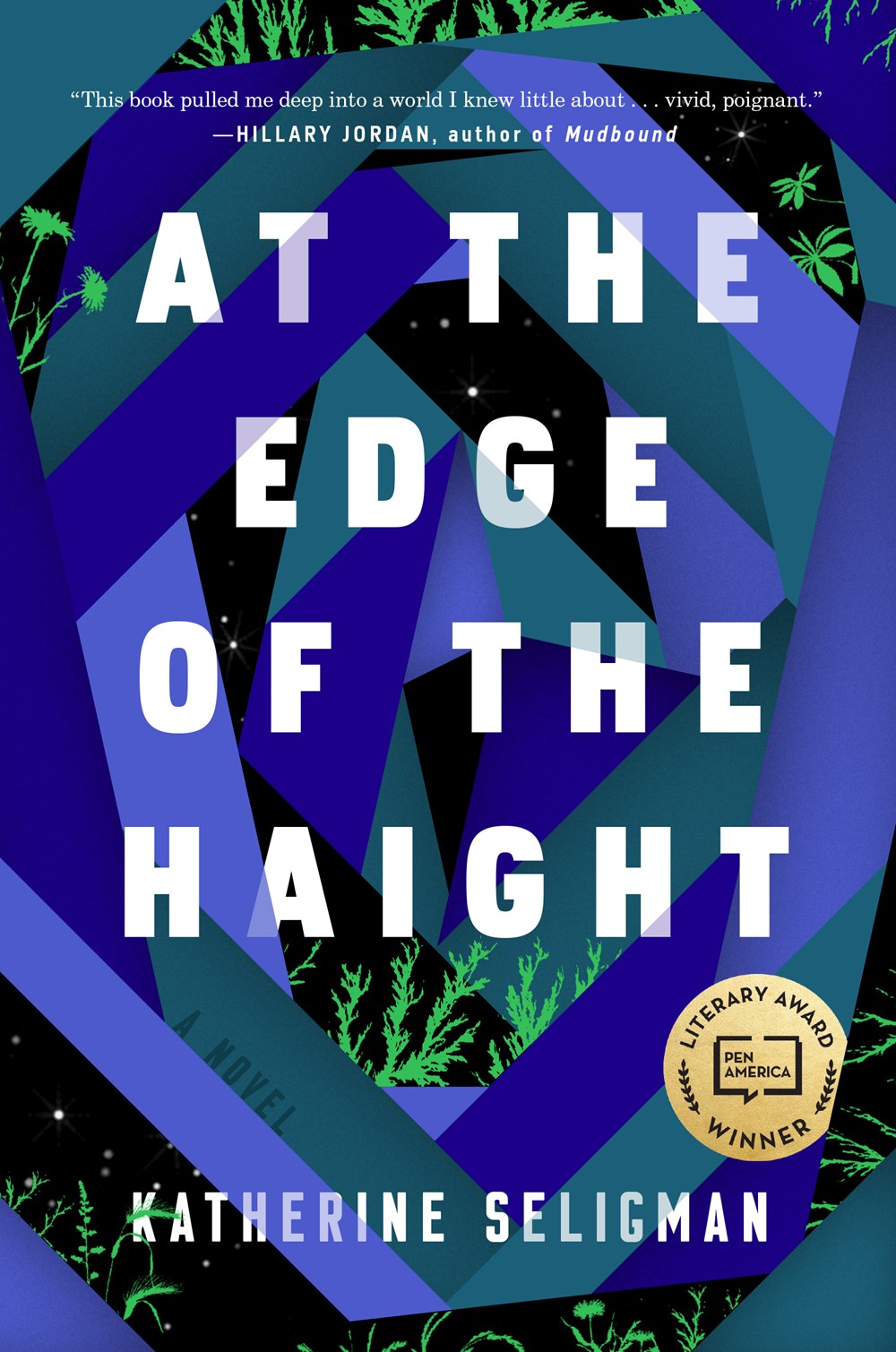
At the Edge of the Haight by Katherine Seligman

In this quietly compassionate novel, a young homeless woman stumbles into a crime scene on the edge of Haight-Ashbury, and eventually reconsiders how she got there.

Katherine Seligman’s gripping debut novel, At the Edge of the Haight, explores a community on the edge of a historic setting and on the edge of getting by, with a compelling protagonist and an array of issues to wrestle.

Twenty-year-old Maddy Donaldo lives in present-day Golden Gate Park, after Jerry Garcia and Janis Joplin are long gone, with a sort of chosen family. There’s Ash, “a skinny upside-down triangle” of a young man, “the most no bullshit guy around” with a talent for effective design of cardboard panhandling signs. Quiet, gentle, strawberry-blond Fleet has a pet rat named Tiny. Spike-haired Hope talks to everyone; she’s good with the tourists, but a bit of an instigator, too. And, most importantly, there’s Root, Maddy’s devoted dog. Together the friends scavenge food, find shelter, protect one another and navigate their tricky streets. It is Root who leads Maddy into the bushes in the first pages of this absorbing novel, where she stumbles upon a young man taking his last breath, and a man standing over him.

Maddy knows immediately that this sight will haunt her, that she is danger. She’s been handed a problem she didn’t earn; quickly the death of the boy named Shane follows her. The cops have questions. A man shows up at the local shelter and identifies himself as Shane’s father and asks for Maddy’s help. She gets to know Shane’s parents, Dave and Marva, and finds her loyalties beginning to split. Dave is a birdwatcher; Maddy observes the creatures, human and nonhuman, who live with her in the park. She investigates Shane’s murder, and along the way alienates her friends and finds herself nudged toward her own past, which she most wants to avoid.

At the Edge of the Haight is told in quiet prose from Maddy’s first-person point of view, so the reader is privy to her thoughts and fears, including an interiority that both protects and isolates her. All other characters are secondary, but this is a novel captivating in both its story and its characters. It is concerned with the social ills of homelessness, including addiction, mental health challenges and economics, without becoming polemic. The mystery of Shane’s death is a side plot, not the central focus; rather, it’s the situation that pressures the tenuous life Maddy has set up in the park. Seligman’s San Francisco is colorful and detailed. Readers are drawn into a challenging world with sympathetic characters, but it is Maddy’s internal turmoil that makes this novel memorable.


This review originally ran in the December 11, 2020 issue of Shelf Awareness for the Book Trade. To subscribe, click here.


Rating: 7 green apples.

Stillicide by Cynan Jones

This minimalist meditation on climate change and human choices offers stark realism, haunting characters and lovely lyricism.

Cynan Jones (Everything I Found on the Beach; Cove) beautifully reprises his distinctive voice and poignant themes in Stillicide, a novel of climate change and human relationships. This novella-length meditation excels in its thoughtful considerations, quietly lyrical language and memorable lines and characters.

Water is rare and sought after. A water train has replaced the old pipeline to bring this commodity into cities, which are resented by the surrounding countryside. The train is armed: “Deer. Dog. Man. If it was still alive and present when the water load passed, the defence guns of the train would fire automatically.” In the opening chapter, a marksman stands by as additional security, life and death in his hands. Meanwhile, the authorities plan to replace the water train with a new and wider corridor, to drag an iceberg overland into the city. “A gash cut through the city,” this will displace many residents; protestors gather.

The subsequent chapters focus on different characters and their perspectives. A construction worker for the new iceberg path wonders if his work is for good or ill, and contemplates the work of his partner, who makes flowers from refuse to plant “in the cracks of the kerbs.” A young nurse contemplates an affair; an older nurse lies dying. A boy chases a stray dog through the streets. An elderly couple on the coast refuses to move inland even as they see the future approaching. These perspectives note where the natural world still gleams in a city increasingly dry and dusty–aphids, butterflies, the rare deer, “sparrows and pigeons, as if from nowhere.” A professor finds evidence of an endangered species in the iceberg’s path, and with it hope: “A dragonfly could stop an iceberg. For a while at least.” Many of these characters remain nameless, so that even in their specificity they stand in for a larger human experience, and the effect is that this thirsty world is a little blurred.

Stillicide is a sobering consideration of a possible near future, and a moving work of fiction. Jones is easy to appreciate also for his writing, for the poetry in “the contained clatter of the runnelled rain.” The marksman guarding the water train, where the novel both begins and ends, drives home questions about what to value and protect, and when to let go. This is a quiet masterpiece of language, imagination and grim possibility.


This review originally ran in the October 26, 2020 issue of Shelf Awareness for the Book Trade. To subscribe, click here.


Rating: 7 drops of water.

A Million Aunties by Alecia McKenzie

After a great loss, a man returns to his mother’s homeland of Jamaica in this stunning novel of love, loss, grief, healing, art, identity, family and home.

Jamaican author Alecia McKenzie (Sweetheart) offers her readers delightful characters and thoughtful themes in A Million Aunties.

Chris seems to be running from something when he arrives in the Jamaican village of Port Segovia from New York City. In the opening chapter, “How to Paint Flowers,” his grief is gradually revealed: a woman, Lidia, now gone; Chris’s dark paintings; the impulse now toward light, as if to make up for what is lost. His friend and agent, Stephen, has sent him to Auntie Della in Port Segovia, promising, “You’ll have anything and everything you want. The whole range of tropical beauties: hibiscus, bird of paradise, bougainvillea.” Della owns a local nursery.

Just as readers settle into Chris’s pain and paintings, McKenzie shifts the focus. Chapter two is told from the point of view of Chris’s father, aging in Brooklyn. He worries about his son and their frayed relationship. Other chapters focus on other characters: Chris’s agent, Stephen, Jamaican by birth, who lives in New York; their friend Féliciane, a French artist who works with found objects; Uncle Alton, a painter in Kingston; Miss Pretty, Port Segovia’s local eccentric, who walks all day long in a fur coat. Chris was born in the United States, to a Black man from Alabama and a Jamaican woman. His father remembers first meeting her, and noting “the arrogance and confidence of growing up as a majority. The shortsightedness of it.”

Chris and Della are the heart of this story, but the kaleidoscope of other perspectives enriches it. Chris begins to heal from the loss of Lidia and even reconsider his relationship with his father, with the help of a new auntie and a broadening view of the world. The myriad characters offer a textured background to this central story. From rural Jamaica to New York City, Paris and the Firenzes of Alabama and Italy (Chris: “Firenze was always Firenze, never Florence”), and across generations, they share common threads: art, flowers, love, loss. “Painting flowers is political action,” Chris’s best-remembered teacher used to say. Now this seems to be all he can do for Lidia, who rearranged her life to devote it to flowers.

Stephen’s relationship with Auntie Della offers perhaps the novel’s central theme of human connection, built families: “In his most morbid moments, he sometimes thought: lose a mother, gain a million aunties.” A Million Aunties is an exquisite novel about beauty and pain, and what binds us together. Through captivating character studies, quiet lovely writing and deceptively simple storytelling, McKenzie illuminates basic commonalities and rethinks what family and home mean.


This review originally ran in the October 22, 2020 issue of Shelf Awareness for the Book Trade. To subscribe, click here.


Rating: 7 heaped plates.

Maximum Shelf: Outlawed by Anna North

Maximum Shelf is the weekly Shelf Awareness feature focusing on an upcoming title we love and believe will be a great handselling opportunity for booksellers everywhere. The features are written by our editors and reviewers and the publisher has helped support the issue.

This review was published by Shelf Awareness on September 16, 2020.


Outlawed by Anna North (America Pacifica; The Life and Death of Sophie Stark) is a wild, ripping western with a firm feminist bent, set in an alternative North America.

“In the year of our Lord 1894, I became an outlaw.” Some decades ago, the Great Flu decimated the national population, the United States government collapsed and, in its place, the people established Independent Towns west of the Mississippi. Ada has grown up in the Independent Town of Fairchild, where she has lived a good enough life. Her mother is a skilled midwife; Ada excels in her own training in the profession and helps care for her beloved three younger sisters. She marries at 17, as girls do when they become able to reproduce, and so begins the serious and sacred work of trying to become pregnant. But when six months pass, then more, Ada begins to worry. To be barren in Fairchild is a crime punishable by death.

At the end of a year, her husband’s family rejects her, and Ada’s mother sends her to the Sisters of the Holy Child, hoping to keep her safe. In the nunnery’s library Ada continues to read and study, seeking the truth about infertility; her mother had taught her, against popular belief, that barrenness was a medical condition and not witchcraft, but the details are not well understood. It is not a wish to have children herself, but Ada’s hunger for knowledge that drives her from Holy Child and further west, to join up with the infamous Hole in the Wall Gang. This band of outlaws is led by the Kid, “nearly seven feet tall, the sheriff said, and as strong as three ordinary men put together. His eye was so keen he could shoot a man dead from a mile away, and his heart was so cold he’d steal the wedding ring from a widow or the silver spoon from a baby’s mouth.” But like everything else Ada has been taught, these stories aren’t quite accurate. The Kid is charismatic, beloved and possibly dangerous in entirely different ways than the rumors insist, and the outlaws are not what they are thought to be. It is only in the West that it occurs to Ada that “perhaps barren wives were not hanged for witches everywhere.”

Outlawed is a delightful tale of adventure, rebellion, the importance of knowledge and the value of family–however family is made or defined. With the Hole in the Wall Gang, Ada finds unexpected freedoms and fluid gender roles, and is forced to consider what she has to offer her new friends and the world. “I don’t think I’m much of a threat,” she tells the Mother Superior when she leaves Holy Child, but her story is just beginning.

In her new life of crime, Ada learns to care for horses, to shoot and to be a member of a community she’s chosen and loves. As the gang plans and attempts robberies, North’s narrative is often lighthearted, with style, humor and a sense of fun, but her protagonist never forgets the high stakes. Ada meets men and women who are not what they seem, including an actor who’s studied male dress, movements and mannerisms because “the male roles were the most prestigious.” She becomes aware of not only gender but also race as a point of prejudice and contention in North’s version of the Wild West. She learns new skills to supplement her midwife training; she treats gunshot wounds and mental illness and comes to be called Doctor. She learns to carry herself differently. But she never stops worrying about the sisters she’s left behind in Fairchild, who are vulnerable to punishment simply for their relationship to Ada, “a barren woman, a discarded wife, an outlaw wanted for cursing women’s wombs even though I had helped coax dozens of babies into the world.” Ada does not take naturally to the business of holding up stagecoaches or robbing banks, but her devotion to her new group of friends forces her to take risks. Eventually she must choose to invest in their future, or strike out on her own again.

Part of the genius of Outlawed is that its feminist themes juxtapose neatly with the traditionally male-dominated western genre. In Ada’s first-person narration, the critical significance of reproduction and fertility seems simply a background element, central to the workings of North’s fictional world, which is in itself curious and thought-provoking. Ada’s voice is perfectly authentic and easily believable: her developing rebellion is organic, born of her love for her family and friends. She is a maverick, and the best kind of heroine: adventurous, innovative, self-doubting but brave, with intense loyalty and a magnetic, compelling curiosity.

Outlawed boasts a lively, quick-paced plot, a well-constructed alternate-historical setting and an indomitable heroine. While North clearly has something to say about gender in society and the politics of reproduction, this novel is absolutely a work of energetic literary entertainment first. For all readers in all times.


Rating: 7 drops.

Come back Friday for my interview with North.

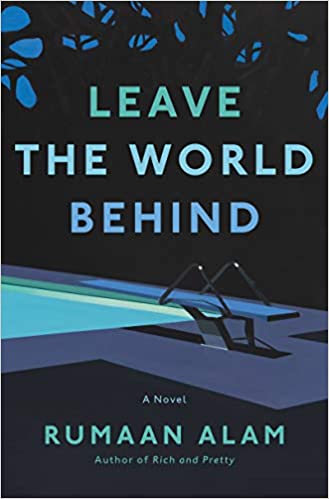
Leave the World Behind by Rumaan Alam

Ominous events throw two families together and off-balance in this captivating, thought-provoking novel.

Rumaan Alam (Rich and Pretty; That Kind of Mother) thrills and unsettles with Leave the World Behind, a novel about family and other relationships, getting what’s desired and reactions in the face of crisis.

The story begins mid-road trip, a white family of four on their way from the city to their vacation rental. Amanda is an account director in advertising, Clay an English professor; Archie is 15, Rose 13. They have an apartment in Brooklyn (“really Cobble Hill”) and a mid-range sedan somewhere between luxurious and bohemian. “The life they had was perfect,” Amanda frequently reflects, and yet they are jealous of their well-appointed Airbnb, its idealized decor and the imagined lives of its owners. The four of them enjoy the house, the pool, the beach. Their vacation is perfect if a little boring, like the family. Alam’s narrative and descriptions are gorgeously detailed and impeccably paced, so that this is a story for readers to sink into, effortless and comfortable, even sumptuous. Until a knock comes at the door.

Ruth and G.H. are the owners of the vacation home, and the arrival of the older couple in the middle of the night is disturbing enough, but their story is stranger: a blackout in New York City, fear driving them out into the country, invading the family’s perfect getaway. Amanda is suspicious. Unexpectedly, Ruth and G.H. are Black. Amanda wonders if it wouldn’t make more sense for them to clean this beautiful house, rather than own it.

The almost entirely undefined external situation–the reported blackout, loss of cell and Internet services, televisions reduced to blank blue screens–forces the four adults and two teenagers together and holds them there, a delicious narrative device that leaves them simmering. The resulting tension touches on generational differences, gender dynamics, class and race–Clay and Amanda are self-conscious of their faux-benign racism, and the story serves subtly as a criticism of social norms. There is a note of the locked-room mystery and heaps of foreboding. Readers gets meticulous details of Amanda’s grocery shopping and the vacation home’s furnishings, but the extent and nature of the outside threat is delivered in mere hints. “Some people got sick, because that was their constitution. Others listened and realized how little they understood about the world.”

Leave the World Behind is pitch-perfect in atmosphere, easy to read and deceptive in the high polish of its setting. Alam has crafted a deeply bewitching and disquieting masterpiece.


This review originally ran in the September 4, 2020 issue of Shelf Awareness for the Book Trade. To subscribe, click here.


Rating: 9 green porcelain lamps.

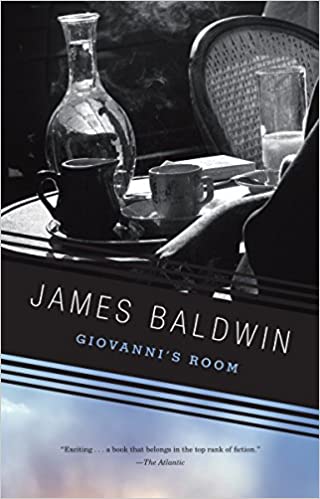
Giovanni’s Room by James Baldwin

Extra long review today.
I have owned this book for years and years. I have no idea why it’s taken me this long to read it. I have many times referenced a quotation on page 92: “perhaps home is not a place but simply an irrevocable condition.” (My copy of the book falls open naturally to page 92 and the line is highlighted. It’s pretty weird to have this relationship with a book I’d never read before.)

The novel’s narrator is a young man named David, an American who has been living in Paris. The book opens: “I stand at the window of this great house in the south of France as night falls, the night which is leading me to the most terrible morning of my life.” He takes much of the book, however, to reveal what is so terrible about the morning to come. One of Baldwin’s interesting artistic choices here is a disjointed chronology; the story is told from this night-before-the-terrible-morning, in flashbacks, which sometimes jump backward and forward in time, and then we return to the night and the terrible morning. David had been in Paris with a woman named Hella. When he proposed, she left to go travel in Spain; she needed time and space to think things through. She’s an independent woman. In her absence, David accompanies a sort of frenemy, Jacques, to a gay bar, where he strikes up a conversation with the bartender. (Jacques had intended to hit on him, but got distracted.) This is Giovanni, a young Italian man, with whom David finds interesting conversation, mutual attraction, and a very complicated set of feelings: push/pull, desire/revulsion, love/hate. They go back to Giovanni’s room, and they live together there until Hella’s return some months later, when David leaves (saying nothing to Giovanni) to return to her. She has decided she wants to be married, and David is too bound up and self-loathing to stay with the man he loves. Giovanni is distraught. I will not spoil the plot item that is the “most terrible morning of [David’s] life.”

The story is told in David’s first-person perspective, and it is full of angst and disquiet. I don’t think he’s supposed to be remotely likeable. He’s disappointed in his relationship with his father, in his relations with women (including but not especially Hella), in his feelings for men (before Giovanni, there was a boy in his boyhood as well, though he has repressed this memory), in his view of his own masculinity. He struggles with the ideas of home and belonging, both in terms of geography and identity. He is a miserable partner to Giovanni, and we are left with the impression at the book’s end that David will walk away from these events angsty as ever but materially fine, while Giovanni most certainly does not.

Giovanni’s Room has a handful of themes and angles for interpretation, but there are a few that especially interest me.

For one thing, I think the novel is very much about power structures. Jacques, the friend who takes David to the bar, is older and richer; David doesn’t actually like or respect him but wants to borrow (or “borrow”) money. Giovanni’s (also older) boss at the bar holds an analogous power over his employee: as an immigrant, Giovanni’s work prospects are few, and Guillaume is an egregious sexual harasser. David and Giovanni have a twisted codependency, and the power dynamics within their relationship are complicated. Giovanni works while David keeps house (some basic cleaning duties, but he is clearly anxious about the housewifeliness of it all). David comes from a far more secure background, economically, although he’s effectively broke on the ground in Paris because his father won’t send him any money. By contrast, Giovanni is in real danger of homelessness and starvation if anything goes wrong in his life. David withholds emotional intimacy; Giovanni is always chasing after something he can’t get from his partner. As discussed with my friend Vince, though, I think there’s an argument that each is obsessed with the other, in different ways. Then there is Hella, the strong woman who fled a marriage proposal to travel alone: she returns changed, suddenly dedicated to a life in which she explicitly wishes to be beholden to a man. She’s decided it is women’s only option, only way to truly live. (Vomit: but this is the 1950s.) I think in the end, David’s anxieties about manhood and masculinity, and his distress at his homosexuality (bisexuality?), are in some ways about power structures, too.

On a related subject: the elephant in the room here is that Baldwin’s protagonist is a blonde-haired white man. I felt surprise when I discovered this (as do many readers), which bears examination. Who do we expect to write about whom? Clearly I expected Baldwin, a Black man, to write Black characters. (To be fair, he has done so in all the other works of his I’ve read, but that’s not the root of my assumptions.) Baldwin was also a gay man, and an American who lived in Paris: he gave his protagonist these characteristics of his own, but not race. What does it mean, for one thing. And, this is too big a subject to be properly handled within this review, but it’s also part of the ongoing question about representation in fiction: what identities are represented, by what authors (of what identities), who gets to be the “default,” and on from there. Elsewhere Baldwin has written his frustration that, as a Black man, he’s expected to write about “the Negro problem,” and never allowed out from under that bell jar. Here he just turned his back on the topic entirely (or did he?), and if I felt surprise, or even if I felt a bit cheated, this is a good time to be reminded that he doesn’t owe his readers any content in particular. He is quoted in The New Yorker: “I certainly could not possibly have—not at that point in my life—handled the other great weight, the ‘Negro problem.’ The sexual-moral light was a hard thing to deal with. I could not handle both propositions in the same book. There was no room for it.”

There is an argument that racial tension does appear in Giovanni’s Room. Giovanni is Italian in France, and there is no question that this is a) racial and b) a disadvantage for Giovanni. Baldwin does not go Heart of Darkness with darkness imagery, not in terms of skin tone: when we meet Giovanni, he is “insolent and dark and leonine,” but that is the only mention I found. There is however a lot of darkness imagery in the story: mainly related to spaces being dark, which can be related to their boding ill, to privacy, to queerness, to the shame David feels about this and other liaisons. Based on the above quotation from Baldwin, it sounds like he either did not intend commentary on race, or he didn’t want to acknowledge it; it’s entirely possible that any such commentary was subconscious, but that doesn’t mean it isn’t there. I think there’s an undeniable power imbalance between the blonde David and the Italian Giovanni, which is most explicitly about class, rather than race – but since when have class and race ever been extricable? And let’s keep in mind that Italian immigrants to the United States (where both Baldwin and David grew up) were historically considered very much not white, although that would change shortly after this book was published.

Physical spaces, and a sense of home and the belonging that it entails, make up another theme that fascinates me here. (Recall that line marked in my copy.) As I keep reminding my students: pay attention to titles; they are trying to tell us something. This novel is not titled for the story of David, or of Giovanni, or for love, or death; it is titled for the room. Giovanni’s room is the place where he and David live and love together, a life and love which David feels are dirty, and sinful. It is rather obsessively described and recalled, always in negative terms. Small, claustrophobic, dirty, untidy, in a state of change (“Giovanni had had great plans for remodeling the room and there was a time, when he had actually begun to do this, when we lived with plaster all over everything and bricks piled on the floor”), cluttered, garbage-filled, dark. It is like living underwater. Other spaces where David does sinful things are also dark and dirty, as are corridors, alleys, and the spaces under bridges where men tryst, and the bars where they meet. David leaves Giovanni’s room to go to Hella’s. He never has a space of his own. The book opens and closes in the “great house” in the south of France which he must clean before he leaves it. He is embarrassed for the landlady to see the state he’s kept these rooms in. All of this accrues to anxiety about place and about spaces, and the connection between spaces and the activities they contain. None of which even begins to address the American-expat-in-Paris problem, which is a whole genre of novels unto itself (see also Stein, Hemingway, Henry James). Whew.

[I was reminded of Hemingway often. The American expat in Paris; certain aspects of character, like detachment and resistance to intimacy (others have cited Jake from The Sun Also Rises); a writing style that lends itself both to brevity as well as syntactic complexity; an insecure obsession with masculinity. I wonder if I project my own reading history. But no, Baldwin has named Hem as an influence. It shows.]

In addition to home as irrevocable condition, consider this Schrodinger’s cat between Giovanni and David.

‘…you will go home and then you will find that home is not home anymore. Then you will really be in trouble. As long as you stay here, you can always think: One day I will go home.’…

‘Beautiful logic,’ I said. ‘You mean I have a home to go to as long as I don’t go there?’

He laughed. ‘Well, isn’t it true? You don’t have a home until you leave it and then, when you have left it, you never can go back.’

‘I seem,’ I said, ‘to have heard this song before.’

I’ve heard it before, too: the version I like comes via Maya Angelou in a 1987 interview. “You can never go home again,” is the famously quoted version. The completion of her fuller line is instructive. “You can never go home again, but the truth is you can never leave home, so it’s all right.” Okay, I’m revealing my own obsessions now, but I think it’s safe to say that Baldwin shares them (and David, too).

This review has gotten awfully long, and yet I’ve barely scratched the surface of what there is to interpret and interrogate about this novel, brief at under 200 pages and yet deep and rich. What can I say about Baldwin? Go read him yourself.


Rating: 8 glasses.