Salvage the Bones by Jesmyn Ward (audio)

Following on Ward’s excellent (nonfiction) Men We Reaped, I found her earlier novel Salvage the Bones, read by the same narrator, Cherise Boothe. This one I loved less for a while in the middle, but I loved it at the end. And I’m afraid my one real criticism of this novel is my fault and not Ward’s. I’ve read 14 and a half books since I started listening to this audiobook – the shape of my life involves so little listening time these days. The long middle of the book dragged for me; I felt the pacing was off, but it might be the pace at which I took the story in, and not the pace at which the story is told.

Esch is fifteen years old, the only girl in the family. She has three brothers. Skeetah, sixteen, is entirely consumed by his love for his fighting pit bull, the china-white China. Randall, seventeen, is a gifted basketball player, whose friends occupy much of Esch’s attention – especially Manny, who she can’t keep her eyes off of. Then there’s Junior, seven, fed and diapered by Esch and Randall after their mother died giving birth. They live in Bois Sauvage, Mississippi, and their father is present, but only physically. He is drunk and a bully, and more concerned with hurricane season than his four children. Only halfway into these pages do we hear the name Katrina for the first time.

The novel opens with China giving birth in a poorly lit shed to her first litter of puppies. The whole family gathers round. Skeetah is rapt; his dog and her puppies are his whole world. Esch watches him watching them. He is the brother she is closest to, but China’s motherhood also holds new meaning for the girl, who is just realizing she is pregnant. In the novel’s twelve day span, from the birth of China’s puppies to the aftermath of Katrina’s devastation of their coastal town, that pregnancy feels like the subtext of every other story: Daddy’s obsession with the approaching storm; Skeetah’s obsession with his dogs; Randall’s focus on his sport; Junior’s low-level whining and neediness; Manny’s distance from the girl he treats as sex toy and not human; Edith Hamilton’s Mythology, which Esch is reading for school. This thread makes a significant contribution, even though its screen time (if you will) is brief. Esch is captivated by the strength and singlemindedness of Medea, the crooked model of motherhood she presents. In the world of Bois Sauvage – poverty, lack of parenting, the closeness of siblings who care for each other when no one else does – Medea offers a surprising outside point of reference. Also, I read the same book for school at the same age (under very different personal circumstances), and I found the parallel striking.

There is a stagnant time in the novel’s middle, again, where I got a little adrift. And again, it may have been my slow reading (listening) pace. But Esch takes her time acknowledging her pregnancy; she vomits and can’t get enough to eat; China’s puppies begin to die one by one; Daddy behaves badly; the weather hangs heavy and humid. Actually, the weather and restiveness feel a lot like the time before a hurricane hits. Also, Manny is such a terrible guy that I got sick of him very quickly and was forced to spend more time considering his awfulness than I’d have liked. So there was a hard bit for me in the middle.

But once Manny’s betrayal becomes clear, and the storm begins its approach, things pick back up. The stakes rise before the water does; there is a dog fight, and a human one (or several). In the end, this novel considers the profound effects of Katrina and the fierce love of kids who look out for each other. The account of the storm itself is striking and impactful. Esch is a hero, not a victim.

Katrina: the mother that swept into the Gulf and slaughtered. Her chariot was a storm so great and black the Greeks would say it was harnessed to dragons. She was the murderous mother who cut us to the bone but left us alive. Left us naked and bewildered as wrinkled newborn babies, as blind puppies, as sunstarved newly hatched baby snakes. She left us a dark Gulf and saltburned land. She left us to learn to crawl. She left us to salvage. Katrina is a mother we’ll remember, until the next mother with large merciless hands committed to blood comes.

Motherhood is bloody when it is taught by Medea, and by China, the mother who fights and rips, whose white coat is streaked with blood in her victories. Her own mother is gone, so Esch learns this fierceness. It’s not romantic or pretty, perhaps, but it is something to marvel at.

There is no question that this story is beautifully told and I think masterfully told, my problems with pacing notwithstanding (again, perhaps mea culpa). Ward continues to impress. I am hypnotized by the storm, and the storm in Esch. I do recommend this novel, and Boothe’s narration here.


Rating: 8 shoes.

Hot Stew by Fiona Mozley

Within a London apartment building in some disrepair, diverse lives intertwine in an absorbing story of connections and change.

On a nondescript block in London’s Soho district stands a 17th-century building with a decades-old French restaurant on the ground floor. The specialty of the house is snails in garlic butter. On the rooftop, two women bicker and smoke. In the cellar, an encampment of squatters scrapes out a home. On the middle floors, sex workers entertain clients in apartments where some of them also live. Myriad and motley, these characters and their sordid and sympathetic lives form Hot Stew, a compelling, compassionate novel by Fiona Mozley (Elmet).

Precious is an immigrant mother and grandmother. “Everyone assumes ‘Precious’ is the name she adopted on entering the trade,” but it’s her real name. She shares her apartment with her maid and life partner, Tabitha, retired from the trade. One of the brothel’s customers, Robert, an older man retired from a life of crime, drinks at a nearby pub with his friend Lorenzo, a young actor. The pub is also frequented by two of the cellar squatters: a man who does magic tricks and a woman with a heroin problem and a mysterious past. A young man of wealth and privilege reconsiders old connections as he explores the Soho building that ties them all together. Looming dangerously over all their lives is the formidable Agatha Howard, born of a Russian teenager and a fabulously wealthy crime boss septuagenarian. Agatha owns the building where these lives intersect, and she wants to gut it for renovations to increase her profits. But Precious and Tabitha are disinclined to leave, and once the thread of gentrification is tugged, it becomes clear how complex is the weave of an unassuming building in Soho.

Hot Stew is concerned with class, history, legacies, how each person ends up where they do and the degree to which they hold agency over their futures. Mozley’s character sketches are delightful and engaging: detailed, complicated, flawed and beautiful. As the stakes rise for each and as their apparently disparate stories come together, a sense of menace threatens the interconnected human stew. “The men behind the masks aren’t men. They are a natural disaster: a hurricane, a flood.” Just a few of these variously disreputable but lovable characters feel the tremors that have begun to tease at Soho’s underbelly, until it seems that the fates of the building, its inhabitants and all of Soho are one fate. This is a novel of empathy, shared histories and hope in the most unlikely of places.


This review originally ran in the April 6, 2021 issue of Shelf Awareness for the Book Trade. To subscribe, click here.


Rating: 8 sighs.

The Vanishing Half by Brit Bennett

The only difference between lying and acting was whether your audience was in on it, but it was all a performance just the same.

I’m on a roll: here’s yet another book that threatened to keep me up all night. When I finished reading this novel, I went immediately to buy Brit Bennett’s first book, The Mothers. So far there are just the two; I hope she’s writing right this minute.

The Vanishing Half begins in a curious town called Mallard in Louisiana, just two hours west of New Orleans, founded by a man whose father once owned him and whose mother hated his lightness. “He’d married a mulatto even lighter than himself. She was pregnant then [1848, when he thought up the town] with their first child, and he imagined his children’s children’s children, lighter still, like a cup of coffee steadily diluted with cream. A more perfect Negro. Each generation lighter than the once before.” And so Mallard, “a town for men like him, who would never be accepted as white but refused to be treated like Negroes. A third place.”

This colorism suffuses the novel, which is about family and secrets and the identities we inherit and choose for ourselves and those we cannot, and so much more, but always about race and color too. From that founder, generations later, are descended a pair of girl twins who watch their daddy get lynched and then run away from Mallard to New Orleans, where they part ways. One lives her life as a Black woman, and eventually returns to Mallard with a child “blueblack… like she flown direct from Africa.” The other crosses over, and becomes White.

You could drown in two inches of water. Maybe grief was the same.

Usually I get nervous when I read about ‘multigenerational sagas’ that I’m looking at a 500+ page book. This one is just 343 in my hardback edition, but does span generations – chiefly the twins and their daughters – and the country, from Louisiana to Hollywood to New York City, with other brief stopovers. It went by quickly (again, I had to force myself to sleep and finish it on day two). And yet it feels enormous. I’ve traveled so far, I feel like, with these women (centrally) and men. The plot centers on problems of race and of colorism within the Black community, but it also handles gender, sexuality, class, art, personal agency, and especially and in several forms, questions about family and love and hurting those we love, keeping secrets (as a form of love and wounding), and those questions about chosen identities (gender as well as race). I do love these Big Questions. But Bennett is also astonishing at plot, scene, and character – there are so many characters here whose stories, even briefly, captivate. I mourn closing this book (which is why I instantly ordered Bennett’s other one). Don’t even wait: do yourself a favor and get into The Vanishing Half, if you haven’t already. I wish I could read it again for the first time.


Rating: 9 worn calculus textbooks.

The Memory Collectors by Kim Neville

A poignant exploration of relationships offers a deep dive into the strong bonds that can form between people and everyday objects.

Kim Neville’s first novel The Memory Collectors is a feat of character and plot, as well as an intriguing consideration of the enormous significance objects and places can hold for different people.

In an opening prologue, the reader meets Evelyn, a child who loves working with her father in his antiques and restorations shop; it is a glimpse of idyllic family life. The novel then flashes forward to its central timeline: Ev is a young adult in Vancouver, socially isolated, making a living by picking through recycle bins and alley discards for items to sell at the Chinatown Night Market. Her relationship with her little sister Noemi is fractured. Their family experienced a tragedy that for much of the book remains unclear.

And then there is Harriet, an older woman with a hoarding problem and a mysterious connection to Ev. They share an ability to read an object’s emotional associations by touch or proximity, but they have very different feelings about this gift, or curse. Ev hides from things she thinks of as “stained,” living in new and undecorated spaces, and moving often as her own feelings settle in. Harriet collects the things she thinks of as “bright,” filling the spaces around her with borrowed emotions until she makes her neighbors ill with “the soft, scrambled buzz of thousands of stains.” Harriet hopes to use her collection to heal, with Ev’s help. But Ev may know better just how dangerous a brooch or a balsawood glider can be.

Ev is a heart-rending protagonist, paralyzed by her oversensitivity to the accrued memories and emotions of others. Because of her ability and her shadowed past, she keeps to herself, but still yearns for connection. Harriet’s isolation is different but parallel, as “the grubby, greedy, Gollum part of her” threatens to take over. A perceptive artist named Owen has something to offer each of them; he doesn’t feel objects as they do, but he might be better with people than either one. Ev’s sister is a troubled and troubling youth with secrets of her own. These characters form the rich heart of this tender, electric novel, which is also expertly plotted, with rising tension and danger, and carefully dispensed details from Ev’s murky family history.

The Memory Collectors is a remarkable piece of magical realism, imaginative and vivid in its specificity. Seemingly trivial items offer enormous symbolic opportunities. Thoughtful and thought-provoking, this story and its vibrant characters will stay with the reader long after the pages have closed.


This review originally ran in an abbreviated form as a *starred review* in the March 19, 2021 issue of Shelf Awareness for Readers. To subscribe, click here, and you’ll receive two issues per week of book reviews and other bookish fun.


Rating: 8 jade elephants.

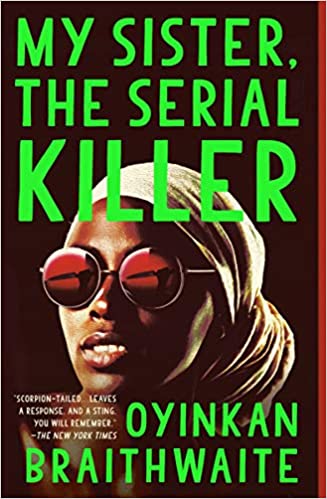
My Sister, the Serial Killer by Oyinkan Braithwaite

Readers of this blog might by now know that I am capable of calling a book about a serial killer light-hearted. Here it is. This is a fun romp about a serial killer.

First-person narrator Korede is a competent nurse at a hospital, where she has a serious crush on a doctor named Tade. He considers her a friend, but nothing more. She is also the responsible sister, and good thing, because her younger sister Ayoola needs one. Their mother is a bit flighty and detached; Korede’s one ally at home is the house girl, otherwise unnamed, another competent but invisible type. Korede and Ayoola’s abusive father, thank goodness, is dead.

Ayoola is a very different sort: stunningly beautiful, she attracts attention everywhere she goes. Men court her and buy her things; women want to be her. She is utterly spoiled, possibly a sociopath, and she has a bad habit of stabbing her boyfriends to death. Thank goodness for Korede’s (perhaps unhealthy) obsession with cleaning products. She knows just how to get the blood out, cover up smells, and where to dispose of the bodies. Her conscience is beginning to nag, however, and so she does what any invisible hospital worker would do: she confides at great length to a kindly-seeming man deep in a coma. You might guess how that winds up.

The delicate arrangement Korede and Ayoola have established to deal with Ayoola’s violent habit is beginning to fray for several reasons, but one event that pushes it to a head is when Tade, Korede’s beloved doctor, asks for Ayoola’s number. The long-overlooked elder sister is forced to decide: is she really willing to protect Ayoola in all scenarios? At all costs?

Chapters are very short, at most a few pages, which is part of what contributes to My Sister, the Serial Killer‘s sense of momentum. I had to force myself to put this one down and get to bed on a school night; it rather demands a single-sitting read. As the present-tense story of Tade’s infatuation with Ayoola unfolds, we also get flashbacks, in chapters titled “Father,” to the story of that patriarch. Braithwaite in no way answers all the reader’s curiosities about this dysfunctional family, but there are surprises along the way, nonetheless.

This novel is set in Lagos, with some Yoruba language sprinkled in, and the family’s foods were often foreign (and interesting) to me. The Lagos police are woefully corrupt and/or incompetent, but other than these details for flavor, if you will, the setting didn’t have an enormous effect on the story.

Despite Ayoola’s murderous tendencies (and generally annoying personality), there is, again, a sense of fun about Korede’s situation: the antics of the women she works with, and Ayoola’s completely ridiculous nonchalance. I felt like the story could keep going, and I would definitely read another installment about Korede’s hapless existence.


Rating: 7 shoes.

The Care and Feeding of Ravenously Hungry Girls by Anissa Gray

Once there was a family. The mother died when her children were young; the father, a traveling preacher, remained mostly absent. The eldest sister, Althea, raised her younger siblings. They are Viola, Joe, and the baby, Lillian. A generation later, Althea and her husband Proctor have twin girls, Kim and Baby Viola. Until recently, they also had a successful restaurant in a struggling Michigan town following a devastating flood (locally called the Great Flood). The couple was trusted in town; they ran fundraisers and charity events for those who lost everything. But then it came out that they’d been skimming off the charity donations. Now, Althea and Proctor are facing a trial and possibly serious time for this transgression. The townspeople have turned against them (Althea’s lawyer says, “the community probably wants to see a public hanging”). Lillian has care of the disgruntled teenaged girls; Viola is en route home from Chicago to lend a hand, although she is beset by problems of her own. And Joe turns up, which is not necessarily a good thing.

Althea refuses to let her daughters visit her. Lillian is losing control, particularly of Kim, the difficult child to Baby Vi’s obedient one. Viola is breaking down mid-road-trip. Joe’s past sins remain unresolved. The legacies of their parents do not rest easy. They come together in the family home, which Lillian has renovated to remove some – but not all – its painful stains; she’s also moved in her former-grandmother-in-law, just to enliven this mess of relationships.

The Care and Feeding of Ravenously Hungry Girls is an emphatically character-driven novel, and these characters are wonderfully formed: a mess in all the best ways. Viola is a practicing therapist plagued by her own eating disorder and her failing marriage to a rather saintly, patient woman whom the reader really wants to see her with. Lillian’s childhood trauma has left her obsessive-compulsive and guilt-ridden – it is in part this guilt that causes her to care for the elderly Chinese woman with broken English whose grandson she’s wronged, but the friendship that results is in fact a gift. Althea’s mood is foul enough to keep her somewhat opaque, but she is also the heart of this family; just because she was the responsible eldest does not mean she’s escaped her own wounds. The novel follows the three sisters most closely, with chapters moving among their points of view. The title refers to Viola’s eating disorder, to the various literal and figurative hungers of the sisters, and beyond.

Proctor, whom we see less of – in flashbacks to the time before the arrests; in emails to his wife as they are both incarcerated – is still a lovely character, whose love of music has been a gift to his daughters, and who sends punny musical hints to Althea as a game they used to play. He at one point quotes the lyrics of Jason Isbell (whom he leaves unnamed, but I am the reader for this moment, y’all, so you know that gave me a thrill). There are other still more minor characters who make a real impact on the world Anissa Gray builds here, including Viola’s and Lillian’s respective childhood friends, Kim’s goofy stoner boyfriend, and the women Althea serves times with.

There are a few plot-level details that never especially coalesced for me. The Great Flood this small town has experienced feels like a looming matter of importance that never quite comes to life, although the long-dead mother had some comments to make about women, water, and rivers that should have connected a bit more strongly there. The crimes Althea and Proctor committed – fleecing their neighbors – are sort of neither here nor there; the plot needed them incarcerated, but it never matters much what they did. I spent some time considering this: Gray had to define their crime, of course, couldn’t just leave it unnamed; but this feels like an odd choice. It’s ethically quite off-putting, while in the grand scheme of things (murder, for example) also relatively minor (embezzlement?), and we’re left with a vague sense of the agency with which the crime was committed. It felt a little bit like Chekhov’s gun never went off. These are minor concerns, and it’s not unusual that a novel so gorgeously and richly character-driven might have some plot weaknesses, but I noticed.

The timeline of Care and Feeding is pretty tight, mostly contained within a few weeks as Althea and Proctor’s trial approaches, their sentences are set, and the immediate fallout occurs. There are flashbacks to earlier times (all the way back to the four siblings’ youth), and a final epilogue-style section set after the dust has settled. But chiefly, this novel is concerned with the quasi-locked-room situation when Lillian and Viola come together to sort out family histories and unhealed wounds. It’s about relationships, the pull of the past, the question of cycles broken or continued, and love.

I found it absorbing; I enjoyed sinking in to the lives of these women and girls, getting to know them, accompanying them. I cared, and they felt very real and immediate. If I cocked my head at the odd and somewhat unresolved crimes Althea and Proctor have committed, so be it; life is sometimes confusing in this way. As a story of regular, imperfect, but good people dealing with life’s confusions, The Care and Feeding of Ravenously Hungry Girls was more than satisfying. Gray’s brief “Beyond the Book” essay at the back of my paperback edition tells us that Viola was a fictional character who just wouldn’t go away, who demanded her story be told. And that makes perfect sense to me; I too would follow Viola wherever she wants to take me, narratively speaking. I would read more.


Rating: 7 1/2 Snickers bars.

Rabbit Cake by Annie Hartnett

Thanks to blog reader Annie Long for the excellent recommendation.

This is a sad, sweet book with an accurately written first-person child protagonist struggling with loss and grief, and with a decidedly odd view of the world, possibly reflecting neurodivergence. (Someone at school calls her ‘retarded.’) If this sounds a lot like the mad originality of The Curious Incident of the Dog in the Night-Time, I thought so too. That earlier novel was so unprecedented it blew readers’ minds; and while this one has a lot in common with that one, I don’t think that makes it a bit unoriginal. It’s still a pretty wild (and wildly unusual) model; there’s plenty of room for more surprises in this area.

“On my tenth birthday, six months before she sleepwalked into the river, Mom burned the rabbit cake.” It was one of the wonderful things about her mother Eva that she made rabbit cakes for all occasions – believed in celebrating all the small events of life. Elvis is ten-and-a-half when her mother dies, and she has questions. For one thing, how could such a good swimmer have drowned? Her mother was a frequent if not constant sleepwalker, and “she was an excellent swimmer in her sleep.” Her mother was a gifted scientist. And besides, her mother’s psychic had always been very clear that Eva would die by suicide.

Elvis is clearly a young person who craves control, and so she sets out to take care of things around the house, because her father surely isn’t; he’s taken to wearing Eva’s lipstick and her bathrobe around the house, and mostly ignoring his daughters. Elvis’s fifteen-year-old sister Lizzie has moved on from beer drinking and breaking her best friend’s jaw (in three places) to a particularly self-destructive sort of sleepwalking (although no sleepswimming). Elvis dutifully sees the counselor at school once a week during recess, until she says something especially disturbing and gets upgraded to daily sessions. Ms. Bernstein instructs her that the grieving process generally takes eighteen months, and so dutiful Elvis marks her chart counting down the days until she will not grieve her mother any more. She also works on finishing her mother’s massive book (working title: The Sleep Habits of Animals and What They Tell Us about Our Own Slumber). Elvis knows a lot about animals – enough to annoy everyone around her, until she gets a volunteer posting at the zoo. She comes across an entry in The Reference Guide to Porcupine Anatomy and Behavior in the zoo’s library that mistakenly relates the echidna to the porcupine when it is closer to the platypus. She makes a note to write to the publisher.

You get the picture: this is a child precocious in some areas and a bit hopeless in others. She indulges in magical thinking, but what child doesn’t? and for that matter, who in the throes of grief? Despite Elvis’s story being completely heartbreaking at every turn (warning, friends: this family also has an old dog. Will it never cease? Don’t ask what happens to the giraffe), it’s also frequently hilarious. There is a strong current of absurdism running through it. Lizzie the sleepwalker and breaker of jaws is institutionalized, and returns home with a pathological liar who the distant and negligent father allows to move in. Lizzie decides what she needs is to set the Guinness World Record for most number of rabbit cakes baked. Most, but not all of them, will need to be decorated. Elvis is driven mad by the delicious smell of baking cakes – which she associates with happy memories of their mother – but she is not allowed to eat any of the cakes, which Lizzie must preserve for her world record. I won’t even tell you about the troubles Elvis gets into at the zoo. Or what she discovers about her mother’s sex life.

Delightful, absurdist, ridiculous, heartbreaking; laugh-out-loud funny in the most morbid ways, if you’re into that sort of thing. (Case in point: the reason Elvis’s school counseling gets upped to daily sessions.) I was frequently quite angry at the adults in this child’s life who consistently, near-criminally fail her; I usually keep my cool with fictional characters better than this. In other words, it’s a deeply involving story, with some very wise points to make about grief in the end. That ending is surprisingly upbeat – or maybe it’s not surprising at all.

I’ll be thinking about Elvis for a long time, and about this singular, weird, troubled, endearing little family. I’m remembering Have You Seen Marie?, another gorgeous meditation on grief in fictional form. Cisneros said about that book that she did not conceive of it as being for children. And even though Rabbit Cake‘s star is a child, I don’t think this is a children’s or YA book, except to the extent that any book is right for the reader who’s ready for it. (Tin House, who does not publish children’s books, has marketed it as simply fiction. Although these labels may be worth less than we think they are.) It’s quite a deep-thinking novel, with nuances to satisfy readers of all levels of maturity, especially those who may need to laugh and cry in the same sitting.


Rating: 9 librarians aptly named Reasoner.

Forget Me Not by Alexandra Oliva

A woman with a strange past struggles with a near-future reality in this riveting, moving masterpiece of both character and plot.

In Forget Me Not, Alexandra Oliva (The Last One) introduces a strong, damaged protagonist in a near-future world very similar to our own. Captivating characters carry this absorbing cautionary tale.

It’s been six years since the pandemic. Everyone wears a Sheath around their forearm that links them into social networks, maps, business reviews and details about the people they pass on the street. But Linda didn’t grow up in this world: she was 12 years old when she climbed over the walls that circumscribed the only world she’d ever known. Twelve years old when she was thrust into a never-ending spotlight, because of where she’s come from and who she is.

Now, as an adult, she lives alone in an apartment in Seattle, terrified to step outside, to make eye contact, to interact. “People bemoan the inhumanity of her childhood, but the outside world is so much worse.” That childhood remains an enigma for much of the book, but Linda remembers running barefoot and relying on herself, a life that seems more natural and straightforward than the one she knows now. “She was limber and determined and not once in her life had someone ever asked her, Are you okay? She knew no other way but to keep going.”

Then an unusual woman moves in down the hall. Anvi seems open, forthright; Linda knows better than to trust anyone, but Anvi captivates her. She’s persistent. And she introduces Linda to a virtual reality gaming world where she feels, perhaps paradoxically, a bit more real. Reality itself begins to look less certain: “Could her whole existence simply be someone else’s side quest? She can feel the urgency with which she wants some version of this to be true. To wipe herself of responsibility–to claim it wasn’t fear but an algorithm that made her run….” When Linda’s past resurfaces, Anvi accompanies her back to the place where she grew up, to search for answers she may regret finding. Linda’s shaky understanding of her very existence is thrown into question.

Forget Me Not explores humans’ relationships with the natural world, with technology and with each other. It is far from polemic, however, with affecting characters, a real sense of urgency for their various plights and a thriller’s racing plot. Linda is deeply troubled and deeply sympathetic; Anvi is a dear, quirky young woman with insecurities of her own. This is a poignant novel of isolation, terror, misperceptions and, ultimately, empathy.


This review originally ran in the February 19, 2021 issue of Shelf Awareness for the Book Trade. To subscribe, click here.


Rating: 8 buzzes of the Sheath.

How to Order the Universe by María José Ferrada, trans. by Elizabeth Bryer

Through a child’s clever but innocent point of view, this inventive debut novel considers family, hope and the harsher realities of 1980s Chile.

María José Ferrada’s How to Order the Universe offers an imaginative view of Pinochet-era Chile through a child’s eyes, as she assists her father in his work as a traveling salesman of Kramp brand hardware items. The world appears complex, fascinating and a little magical to M, the narrator. Elizabeth Bryer’s whimsical translation from the Spanish feels appropriate to M’s exceptional perspective.

Ferrada’s playful, poignant novel opens with the story of a young man named D, whose “first sales attempt happened the same day a man took a step on the moon.” He meets a beautiful woman. They marry and have a child, M, and so the narrator enters her own story. She begins accompanying D on his sales calls when she is seven. M’s school attendance is sporadic; her work as D’s assistant is important to both of them, and M’s mother is a bit detached. Father and daughter are close, in their dreamy interactions with each other and with a small community of salesmen and shopkeepers. She is treated as a small adult: “in recognition, I think, of the fact that I had grasped the complexities of human beings at such a young age, D showed me how to blow smoke rings. Small rings that crossed the city, expanding and dissolving in the distance.”

M’s narrative voice is solemn, serious. She is a little obsessed with categories and classification. D’s understanding of the world, and therefore M’s as well, involves hammer, nails, the moon and stars. “Every person tries to explain the inner workings of things with whatever is at hand. I, at seven years of age, had reached out my hand, and had grasped a Kramp catalogue.” She studies the organization of items for sale in shops: “I thought that discovering the sequence would bring me a little closer to comprehending the classifications used by the Great Carpenter to order the universe.” M is a precocious philosopher, but also a child, for whom certain realities eventually come as a surprise. When the family circumstances unexpectedly change, “There were two possibilities: A. Precariousness had always been with us, and I’d never noticed. B. Something had changed. Whichever it was, my childhood memories fractured: crack.”

How to Order the Universe is fanciful, sweet and moving, as M gradually registers and questions the changing world she inhabits, wrestling with violence, absence, the ability to make one’s own luck “with well-shined shoes and the right outfit.” Much of this evolution is filtered through her irrevocably changed relationship with D. “We had been deeply united by a catalogue of hardware store products: nails, hammers, door viewers, screws. But that catalogue no longer existed.” This is a beautifully translated, thought-provoking novel of profound themes and childlike wonder.


This review originally ran in the February 8, 2021 issue of Shelf Awareness for the Book Trade. To subscribe, click here.


Rating: 7 door viewers.

We Run the Tides by Vendela Vida

An uncertain adolescent girl narrates a heart-aching tale of coming of age in a city in transition.

We Run the Tides by Vendela Vida (The Diver’s Clothes Lie Empty) is a dreamy, tricky tale of girlhood, secrets and the shifting sands of truth set in mid-1980s San Francisco. This captivating coming-of-age novel asks readers to consider friendship, cruelty, deception and consequences.

Narrator Eulabee begins her story with the first-person plural point of view. “When I say ‘we,’ I sometimes mean the four of us Sea Cliff girls who are in the eighth grade at the Spragg School for Girls. But when I say ‘we,’ I always mean Maria Fabiola and me.” The foursome is close, but it is beautiful Maria Fabiola who enraptures Eulabee and, apparently, everyone else–children as well as adults–in their rarified world. Theirs is a neighborhood of au pairs, chauffeurs and views of the Golden Gate Bridge. “Sea Cliff is for solitude, for when you want to protect yourself from people.” Bad things still happen here, but the community handles them in whispers, while looking away.

Earnest, awkward, devoted Eulabee is perhaps less polished than her friends, or perhaps it only seems so because readers are privy to her insecurities. The trouble begins when she and Maria Fabiola fail to see a minor event in the same way, literally. Did Eulabee miss a small, important detail? Or did Maria Fabiola make it up? The truth almost doesn’t matter; what matters is that the girls are equally firm in their divergent truths. An insignificant moment snowballs until Eulabee’s world is shattered. Lives may be endangered; the foursome disintegrates; nothing will ever be the same again. “I stand there, on the cusp of the ocean and listen to its loud inhale. And then it recedes and takes everything from my childhood with it–the porcelain dolls, the tap-dancing shoes, the concert ticket stubs, the tiny trophies, and the long, long swing.”

We Run the Tides is an enchanting, literary novel, realistic but a little unreal. Vida gives a tender, incisive portrayal of adolescence. The girls’ cruelties are visceral and impermanent, the stressors of Sea Cliff somehow both superficial and profound. Decades later, the events of 1984-85 remain “part of the lore. The newspapers called what happened the Sea Cliff Seizures,” and in adulthood, Eulabee both has and has not outgrown them. Her friends and classmates have moved on; San Francisco has changed. “Symphonies of tiny violins play themselves to shreds.” And Vida’s readers will be changed, too, by this cleverly woven story about honesty, betrayal, charm and illusion, about what matters in youth and what matters always.


This review originally ran in the January 26, 2021 issue of Shelf Awareness for the Book Trade. To subscribe, click here.


Rating: 8 text messages.