The People We Keep by Allison Larkin

A teenaged singer-songwriter takes to the road, both hoping for and running from an experience of love and acceptance.
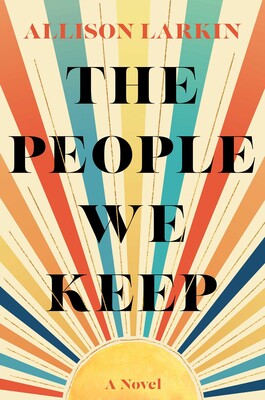
It is 1994 in Little River, N.Y., when 16-year-old April steals her neighbor’s car to drive into the next town for an open mic night. She returns the car when she’s done, but the teasing taste of freedom she finds on the road–and the crowd’s positive reaction to her songs–set the standard for the rest of this propulsive novel. Allison Larkin’s The People We Keep is the story of April’s journey away from Little River: escape, both seeking something (home, community) and fleeing from it.

Her mother is long gone and barely remembered; her father alternates between abuse and neglect, but he also gives April her first guitar. It is clear that her music is essentially her only lifeline: “My dad used to say that good folk music is etched with the rhythm of the road. I always listen for it in songs and I find it in the best ones. So when I’m driving, I pay attention to all the noise… and I start my song. It begins like a story in my head….”

April finds her first hope and solace in Ithaca, a town with hippies and colleges and baffling coffee drinks, and where she gets a job and a lover and makes her first true friend. Thanks to her past and trauma, though, she both yearns for and fears attachment; she has to keep moving. The rest of the novel follows April up and down the eastern seaboard, living out of her car, busking and playing bars and coffee shops, finding and losing what she most wants, over and over again.

The People We Keep is intimate, urgent and direct; April’s first-person voice is magnetic, compelling. She is damaged and still so young–years go by and she is still in her teens–but extraordinarily resilient, a “miracle girl who is so full of piss and vinegar that she survived it all.” Just when it begins to feel like she’ll never learn to stop moving, she makes a discovery. “We have people we get to keep, who won’t ever let us go. And that’s the most important part.”

This is a novel of great empathy, about connections and coming of age, built families and self-acceptance. It contains heartbreak and redemption, and a plucky, irresistible protagonist. For any reader who’s ever wished they could go, or wished they could stay.


This review originally ran in the July 1, 2021 issue of Shelf Awareness for the Book Trade. To subscribe, click here.


Rating: 8 picks.

The Council of Animals by Nick McDonell, illustrated by Steven Tabbutt

A council of animals decides the post-Calamity fate of humans in this wise, witty, perfectly compelling tale of adventure and survival.

In the witty and compelling The Council of Animals by Nick McDonell (Twelve), humans are nearly extinct following an unspecified disaster (“The Calamity”) of their own making. The animals, also sorely suffering in a changed world, gather to debate and vote on the next steps: to allow the humans to live, or to kill and eat them all. This council includes a grizzled, arthritic bulldog; a not-so-bright horse; an underfed grizzly bear; a religious crow; an aloof and possibly turncoat cat; and a bully of a baboon. The belated seventh council member is the source of some trepidation and mystery. When the humans (who mostly remain offscreen) appear doomed, a motley alliance must form, swelling the ranks of animal characters to encompass a trio of moles, a giant lizard that thinks it’s a bat, a small but important scorpion and more. To save humanity, these intrepid creatures will travel and adventure together, learning interspecies trust and new animal facts, and finding hilarity and danger along the way.

This story contains both whimsy and life-or-death consequences, charmingly related with humor and sagacity by a narrator, “a humble historian (or animal contextographer),” who conceals their own identity until the very end. The details of this animal-centered world are endlessly entertaining, as reference is made to “the wallaby who taught Elvis how to sing. The lobsters who elevated Salvador Dalí’s conceptual practice. The raccoon who, quite disastrously, advised Calvin Coolidge.” Steven Tabbutt’s deceptively simple illustrations reinforce the storybook impression and advance character development, as when the bear classically addresses a human skull during an existential crisis. While frequently playful, this narrative is not all fun and games: the dog might have PTSD, the baboon has disturbingly dictatorial tendencies and the stakes couldn’t be higher. McDonell’s clever, lively prose and snappy pacing propels readers onward.

The Council of Animals has the feel of a fable, both a romp with sweetly goofy animal characters and a serious and clear-eyed story about the real world and its dangers. “It is the duty of the historian to face the hideous facts, and violence is one.” Ultimately, this is a tale about community and cooperation. Humans may have something to learn from the animals about communication and mutual responsibility: “Even bony zompompers at the bottom of the Marianas Trench like to chat with blue whales now and then.” Thought-provoking, captivating, funny, instructive: this is a book for readers who have ever yearned for a little extrahuman wisdom and cheer.


This review originally ran in the June 21, 2021 issue of Shelf Awareness for the Book Trade. To subscribe, click here.


Rating: 7 crustacean colonial novels.

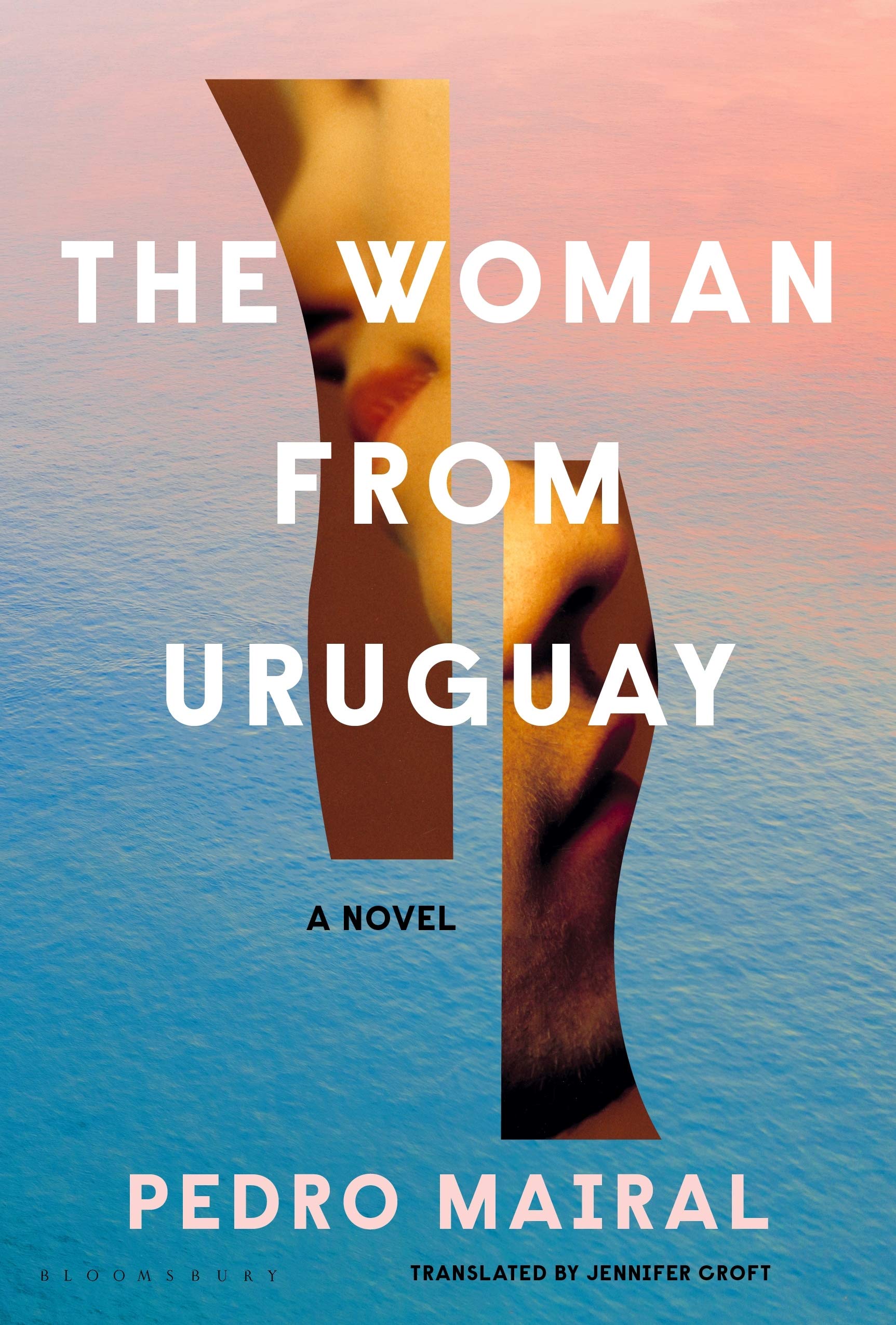
The Woman from Uruguay by Pedro Mairal, trans. by Jennifer Croft

Part picaresque, part tragedy, this critical day in the life of a hapless Argentine writer and would-be lover is both entertaining and thought-provoking.

Pedro Mairal’s The Woman from Uruguay follows a contemporary Argentine writer named Lucas for a single fateful Tuesday, as he travels from Buenos Aires to Montevideo and back again. Lucas narrates these events, with flashes forward and back in time, in a lengthy direct address to his wife, Catalina. “You told me I talked in my sleep. That’s the first thing I remember.” He is stumbling, if not entirely failing, as a writer, in debt to nearly everyone he knows, and fairly sure that Catalina is cheating on him. The purpose of the day trip to Uruguay is ostensibly to collect a significant sum of money in cash (advances on two books), which Lucas expects will change his fortunes. His hidden, secondary purpose is to visit the titular woman with whom Lucas has been captivated since they met at a writers’ festival months earlier. He calls her Guerra–war–and is obsessed by their so-far-unconsummated affair.

Lucas is not an entirely likable narrator. He is self-pitying, a bit sleazy in his adulterous aspirations and at best a mediocre husband and father. He resents his wife for her ability to support him financially, and his young son for disrupting his work (“How am I supposed to write with my kid dangling from my balls?”). But readers will be drawn in by the mysterious Guerra and the pathetic and darkly comic narrative of Lucas’s unlucky day. He can be woefully misguided by desire (for Guerra, for escape from responsibility), artful in his telling (Lucas is a writer, after all), wry, clever and even wise. In buying a ukulele for his son: “I realized I’d rather play the ukulele well than keep playing the guitar poorly, and that was like a new personal philosophy. If you can’t handle life, try a lifelet.” The translation from Spanish to English by Jennifer Croft (Homesick) handles such moods and idiosyncrasies perfectly. Lucas’s child is a “tiny little elderly man, that haiku of a person,” “a drunken dwarf.” Readers may not be precisely rooting for Lucas to get what he wants (which is a bit unclear even to Lucas), but they will certainly be eager to find out what happens next.

In just 17 hours, this luckless protagonist experiences great hopes and severe losses, navigating both a marital crisis and an existential one with limited grace but great ardor and intensity. Challenged in love, marriage, parenthood, finances and fantasy, he makes a mess but comes away with a story to tell and, for a writer, there are worse endings. “May death be to know all,” he muses in hindsight. “For now, I can only imagine.”


This review originally ran in the June 4, 2021 issue of Shelf Awareness for the Book Trade. To subscribe, click here.


Rating: 6 hopes.

This Shining Life by Harriet Kline

A family struggles to honor the loss of one of their own and a remarkable boy works to solve the puzzle of the meaning of life in this poignant, loving debut novel.

Harriet Kline’s This Shining Life opens with a brief prologue: a happy family, a joyful party at sunset. Then the tone shifts. “My dad died. He gave everyone a present before he died. He gave me a pair of binoculars. They smell of books that haven’t been read for a very long time.” This is the voice of Ollie, a boy with certain gifts (sudoku, puzzles, literal meanings) and challenges (socks, hugs, turns of phrase). As the novel considers the death of Ollie’s dad from various points of view and at different points in time, Ollie’s chapters will always begin the same way. “My dad died.”

Ollie’s dad, Rich, was spontaneous, fun-loving, kind and a great lover of cheese. He was a devoted husband to Ollie’s mom, Ruth. Ruth’s sister, Nessa, originally set them up; she and Rich had been best friends since college. Ruth suffers from depression, like their abrasive, troubled mother, Angran; Nessa believes in charging in and grasping life in a firm grip, consequences be damned. Rich’s parents, Gerald and Marjorie, are starched and proper where Angran is bohemian (Gerald says it as if it’s a dirty word) and brusque. They are a motley crew, but all devoted to Rich. In this engrossing story of grief, love and mix-ups, Ollie fixates on the puzzle he believes his father has left him, in the presents he left behind. Because of something Rich said, Ollie believes these gifts hold the secret to what it means to be alive. “I want to do that puzzle now. I want to feel happy like he did. All I have to do is get the answers right.” Time jumps around, so that Rich is dead and alive again, as Ollie attempts to track the gifts Rich has sent to his loved ones and discern their hidden meaning.

In a novel about grief and love and continuing on, these characters are heartbreakingly flawed: Nessa’s pushiness, Angran’s rudeness, Gerald’s blustering into dementia. Shifting perspectives do the essential good of enforcing empathy even in the face of quite bad behaviors. As Ollie single-mindedly pursues the solution to his father’s puzzle, the adults around him seem too caught up in their own struggles to aid him; will they rally in time?

This Shining Life is attuned to the importance of setting, including natural spaces like the waterfalls that dominate this family’s neighborhood, and the deep potential significance of objects, like those fraught gifts that Rich gives. It is a sad story, of course, but also joyful, in the style of Rich delightedly offering cheese at his final party. It proposes that grief and love are inextricable, and that there may be light even in pain.


This review originally ran in the May 27, 2021 issue of Shelf Awareness for the Book Trade. To subscribe, click here.


Rating: 8 threads.

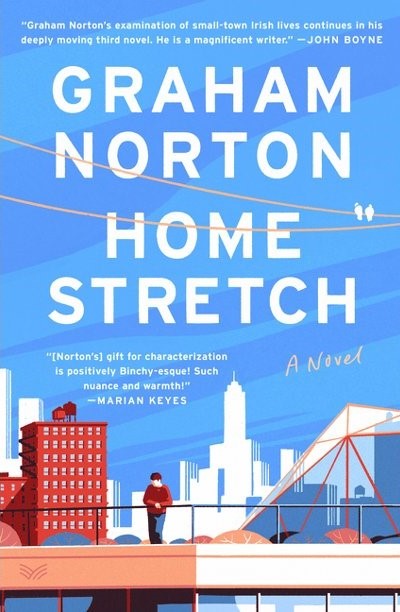
Home Stretch by Graham Norton

This novel of strong bonds, secrets and small-town Irish life is both sweet and horrifying, and completely absorbing.

Home Stretch by Graham Norton (Holding; A Keeper) wends its way from small town to big city, from Ireland to England and the U.S., and back again, tracking family and community. This aching saga begins in 1987, in a small village in Cork, when six young people are in a car wreck on the way home from the beach. Three are killed, one lies comatose and two walk away unscathed–physically, at least. But their lives, and those of everyone in the village of Mullinmore, are changed forever.

The novel follows these characters over the ensuing decades, most centrally Connor Hayes, the social outcast who was inexplicably driving the car when it overturned, and his younger sister, Ellen. Turned out of town by shame, blame and guilt after the tragedy, Connor lives and works in Liverpool, London and New York City, wrestling with his past and self-loathing. “The task of untangling the mess of secrets that he had created seemed so impossible.” Ellen stays in Mullinmore. A chance encounter in a Manhattan gay bar will eventually reconnect Connor to his distant past and see the next generation get another shot at correcting certain mistakes.

Norton rotates the novel’s point of view so that readers see the impact of the car wreck from many angles. The Hayes family suffers Connor’s survival alongside the grief of the families of the dead, two of whom were on the eve of their wedding. But it is that tangled mess of secrets that will most haunt these characters, and readers, as Norton doles them out teasingly into the final pages.

Home Stretch is by turns charming and harrowing as it accesses some of humanity’s darkest moments and impulses, as well as some of the best. That expert balance of comfort and pain is perhaps the most memorable feature of a novel with complex plotting, twists and turns and characters who do not fit easily into likable and unlikable categories. This is a story of the many kinds of love and betrayal that can hold and haunt people, of filial and community ties and the meaning of home. “This is what homecoming meant. Arriving in a place to discover you’re fluent in a language you’d forgotten you ever knew.” Home Stretch is a riveting narrative, a character study, a love letter to a place and a culture, and a moving coming-of-age story.


This review originally ran in the May 21, 2021 issue of Shelf Awareness for the Book Trade. To subscribe, click here.


Rating: 8 pints.

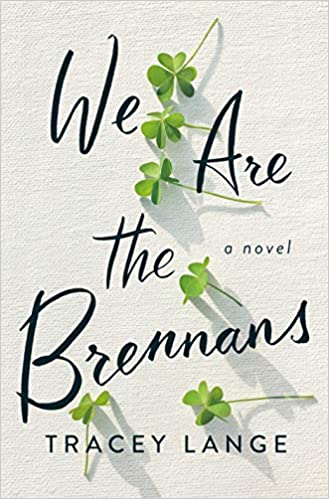
Maximum Shelf: We Are the Brennans by Tracey Lange

Maximum Shelf is the weekly Shelf Awareness feature focusing on an upcoming title we love and believe will be a great handselling opportunity for booksellers everywhere. The features are written by our editors and reviewers and the publisher has helped support the issue.

This review was published by Shelf Awareness on May 12, 2021.


Tracey Lange’s We Are the Brennans is an utterly riveting debut novel of family ties, secrets and the depths of love. Beware the unintended single-sitting read: this magnetic story has the power to draw its reader from cover to cover in one gulp.

The Brennans are an extremely tight-knit Irish American family living in West Manor, N.Y., just north of Manhattan and “leaning upper middle class.” Mickey Brennan is now widowed, but the memory of his wife, Maura, casts a shadow. They have four children. The eldest, Denny, has a large frame and a large personality. He is half owner of a pub called Brennan’s (or Ó’Braonáin’s, in the Gaelic), begun on a loan from Mickey and Maura and very much the family business. Next in age is Sunday, the only child to have left the neighborhood, much to the family’s chagrin. Jackie is her Irish twin, at just 14 months younger: recently in trouble with the law, he’s moved back home to save money and help out. Shane is the youngest, genial and developmentally disabled, around whom all the Brennans rally. And then there is Kale: Denny’s business partner, a neighbor since childhood, an honorary Brennan–and Sunday’s former fiancé. Aunts and cousins cycle through as well; the charismatic Brennans have a large, comfortable household with a strong center of gravity.

As exceptionally close as they are, the Brennans also specialize in secrets. Denny has not been honest with his wife or Kale about the pub’s poor financial situation. Jackie is the only one who knows why Sunday really left town.

Chapters alternate perspective among these characters, chiefly the four siblings but also the other Brennans and Brennan-adjacents. There is an argument to be made for Sunday as main character; she was the glue that held this clan together, and it is her homecoming that sets the novel’s events in motion. But the book’s title points toward the family unit as central; their inextricability is compelling, unique and apparently infallible. Each chapter ends with a line of dialogue that also opens the next chapter, but from a different point of view, which contributes to the momentum that will keep you up all night to finish this book in one go. The effect is nearly cinematic, as if the camera shifts to show the same scene from another angle. This technique also highlights the impact of a deeply bonded family insisting on keeping secrets.

The Brennans are captivating, even hypnotic, for readers as well as for those who enter their orbit in the world of West Manor. In her debut novel, Lange shows a sure hand with characters both flawed and complex: Jackie loves bartending and is a talented painter, although only Sunday supports his art. Kale’s devotion is complete, even when he’s had to navigate the relationship of his best friend (Denny) and his childhood sweetheart (Sunday). Kale’s wife is challenging, but nuanced. Denny’s daughter Molly is sweet and spirited: she embraces her new Aunt Sunday wholly (after sitting her down for a serious talk about the preexisting plan for her to inherit Sunday’s room when Molly turns five). These damaged, fierce, loyal Brennans and their intricate problems will capture readers’ hearts entirely and not let go. Their story has everything: intrigue, crime, heartbreak, therapeutic awakenings and a romance that feels both impossible and inevitable.


Rating: 9 broken glasses.

Come back Wednesday for my interview with Lange.

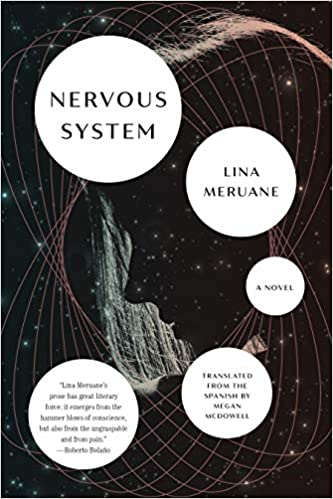
Nervous System by Lina Meruane, trans. by Megan McDowell

This complex novel moves between outer space and private torments to embrace bonds forged in pain.

Lina Meruane’s Nervous System is a novel both fanciful and visceral, pairing the study of the cosmos with medical mysteries and wounds on earth. It is set dually in “the country of the present” and “the country of the past,” the latter swimming with political violence and trauma, and bearing a resemblance to Meruane’s native Chile. Megan McDowell’s translation from the Spanish establishes an eerie tone, both emotional and detached.

The protagonist is Ella. Her partner is El: Are these names, or the Spanish pronouns She and He? El is also known as “the bone guy,” a forensic scientist combing through mass graves, “more migrant bodies made to disappear piece by piece,” to determine cause of death. Ella’s father is simply the Father, her stepmother the Mother; only gradually the reader becomes aware of the Firstborn and the Twins (Boy Twin and Girl Twin), completing a family filled with holes and secrets. Ella is supposed to be writing her doctoral dissertation in astrophysics, but she has stalled. “This final attempt would be spent on stars that had already lost their light and collapsed in on themselves, forming dense black holes.” Instead, she winds up tracking not solar systems but the systems of her own body, as an undiagnosed condition contributes to her long, slow downfall.

The narrative unfolds in a bit of a fever dream, as Ella’s thought process combines words in lyric but not-quite-literal forms, and chronology moves backward and forward. Chapters are set in “future time,” “restless present,” “between times” and “past imperfect.” “The universe has never known harmony, has never been a perfect mechanism, it’s no good for measuring time precisely.” Ella’s “voice is many voices, her question is nervous nebulous shooting short circuit of stars.”

The novel is narrated in a third-person perspective close to Ella’s own consciousness, and characterized by a dreamy, distant way of describing even horrendous events, “women hacked to pieces and children lost in arid lands.” Eventually readers understand that illness, injury and all sorts of damage manifest in the body and in the memory, and great love and animosity can and frequently do exist side by side. Amid these personal and political traumas, family and history, lies commentary on the modern world, relationships, grief and connection. “Maybe with time everything would be restored, but maybe not, because there in the night the stupid stars still hung and sprinkled calcium over the universe.” Nervous System is filled with anguish and unease, but also starlight, which touches Ella at its close.


This review originally ran in the April 27, 2021 issue of Shelf Awareness for the Book Trade. To subscribe, click here.


Rating: 6 treacherous rats.

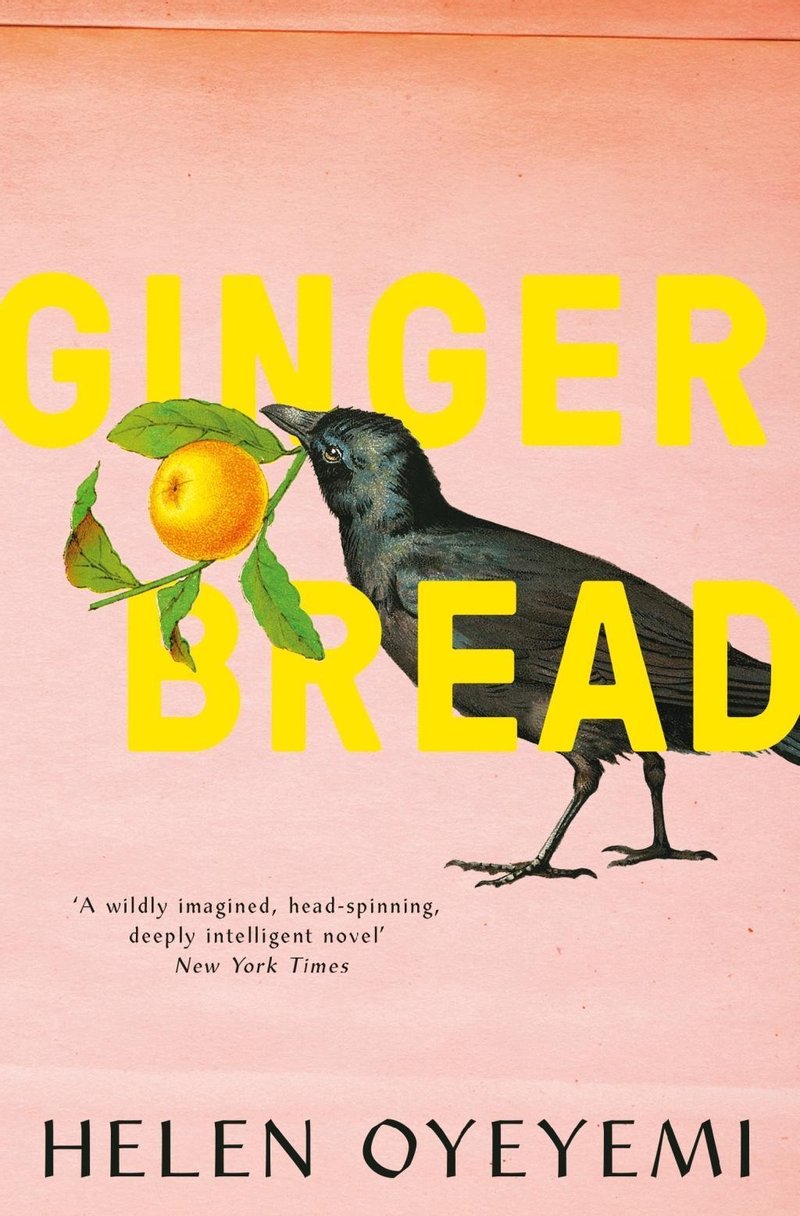
Gingerbread by Helen Oyeyemi

Helen Oyeyemi’s reputation is stellar, and her backlist is healthy: six novels besides this one and a story collection, and she’s just 36. (Wow.) With this, my first of her books, I’m adding my voice to the chorus. Oyeyemi is a prodigious talent.

Gingerbread is under 300 pages, but I’m still a little intimidated by the task of saying what all is in it. There are three generations of women in our story from the start, and they remain our focus. Margot Lee, her daughter Harriet, and Harriet’s daughter Perdita make up a very close family, and the titular gingerbread is a family recipe with magical powers, apparently – but literally, or figuratively speaking? They live in London, but Margot and Harriet come originally from a country called Druhástrana, where Perdita has never visited. [I was immediately intrigued by the name Perdita: this word in Latin means lost; it is the name of a moon of Uranus; and it is the name of the heroine of Shakespeare’s The Winter’s Tale. Which of these undertones is intended or instructive here? Maybe all of them.] “Several prominent thinkers have proposed reclassifying Druhástrana as a purely notional/mythical land”; at any rate, it is unclear how one would get there, or from there to here.

There are magical elements sprinkled throughout, in a book that is mostly realistic; just enough magic, then, to keep me a bit off balance in my reading of this world. Perdita has four dolls that speak (and not just to her); they are like her chorus, in the classical Greek sense. The Lee family gingerbread has powers, certainly. Druhástrana is a land of rather more magic: “She’d seen some plant-vertebrate combinations in the clearings, glassy gazing dormice and owls that earth had risen up around; the ground was growing them, and they looked uncomfortable, as if they’d been stretched and stuffed with straw. There was a leaf that people chewed for relief from pain, and the girl brought this leaf to the plant-vertebrate combinations when she had time; it seemed to make things a bit better for them.” Another girl “had two pupils in each eye; that’s why her eyes looked like bottomless lakes in the torchlight.”

Perdita, being a remarkable 17-year-old, manages a rather extreme act in search of her motherland. As she lays in bed recuperating from this adventure, Harriet sits with her (and her four speaking dolls) and tells the story of her own – Harriet’s – childhood and coming of age. This is the story of growing up in Druhástrana, the legacy of the gingerbread, and Perdita’s heretofore unknown paternity; it’s a story of families and class distinctions, and it takes up the bulk of the novel, right up until the story told at Perdita’s bedside moves into the present, when they get up and go continue to live it.

I love these characters: strong women with strong senses of humor and independence, and wise one-liners. “Everybody around her was living out a different story in which events had different causes and motivations according to how they were perceived.” “Life isn’t ill-natured; it’s just dirt poor, like any other public resource.” Harriet’s anxieties about the intimidating, insular Parental Power Association (what Perdita’s school has in place of a Parent Teacher Association) and its social structure are priceless, hilarious, and relatable.

I’m a sucker for a blend of realism with a few key points of wild unreality, which we find here, and I fell hard for Margot, Harriet, and Perdita. There is a real satisfaction to this novel’s ending, even if it doesn’t tie up all loose ends. I’m definitely in for more from Oyeyemi.


Rating: 8 powders.

Mary Jane by Jessica Anya Blau

In this heartwarming, hilarious novel, a dutiful child from a conservative household becomes nanny to a family of riotous hippies, and her world beautifully explodes.

“I had just turned fourteen, it was 1975, and my ideas about home, furniture, and cleanliness ran straight into me like an umbilical cord from my mother.” In the upper-crust Baltimore neighborhood of Roland Park, Mary Jane’s emotionally distant father thanks God every night at the dinner table for giving him an obedient child. Her world is exceedingly neat and regimented, until she begins working as a summer nanny for the Cone family down the street. This is the summer that will change everything for the protagonist of Jessica Anya Blau’s Mary Jane.

Mary Jane’s first-person narration and extremely limited experience of the world make this story both poignant and tremendously funny. While her own family oozes Stepford-style 1950s values, the Cones are consistently barefoot and scantily clad, and their home is a shock. “I’d never before been in a house where every space was crammed with things to look at or think about (could it be that all messes weren’t evil and didn’t need to be banished with such efficiency?).” Mary Jane’s charge, Izzy Cone, is a completely delightful five-year-old girl with untamed curls, copious energy and few boundaries. And then Dr. Cone (a psychiatrist) moves a patient and his wife into the guest quarters. They turn out to be a heroin-addicted rock star and a movie star, respectively–even Mary Jane has heard of them. She finds herself newly enfolded in boundless affection, acceptance, good humor and nonstop (mostly harmless) shenanigans. How will she reconcile this wild, disruptive, noisy new world with the life she’s known?

Mary Jane is unendingly charming and fun. The lovable Izzy; the messy but endearing details of the Cones’ home life; the surprisingly kind, down-to-earth pair of stars; and Mary Jane’s own earnest, bewildered narration combine for a romping good time. Music is an important thread: Mary Jane enjoys Broadway show tunes (from the shows her mother finds appropriate) and singing in the church choir. Her new “family” at the Cones’ teaches her about rock, soul and blues, encouraging her to sing along, and takes her to visit “Night Train Music: The Greatest Record Store in America.” There is of course a lesson to be learned in this coming-of-age story: “that adults weren’t always right and could be just as confused and make just as many mistakes as kids,” among other things. But Blau’s appealingly naïve narrator is at her best when she leaves such conclusions to speak for themselves and simply wonders at the colorful world just emerging, in this enchanting novel about personal growth and changing times.


This review originally ran in the April 20, 2021 issue of Shelf Awareness for the Book Trade. To subscribe, click here.


Rating: 7 silverware drawers.

guest review: Memory of Water by Emmi Itäranta, from Pops

My father wrote this up to convince me to read the book; but I liked it enough to share it here. He worried about spoilers: “There is also much to say about the story itself, but I didn’t take the time to puzzle over how to do it without spoiling such an unusual book.” But I think it’s a good review, and a good handling of that problem. Some book reviews are definitely harder to write than others! I think he’s talked me into this one, but not sure how soon it will come to the top of my considerable list. Here’s Pops.

First published in Finland in 2012, Wiki says she wrote it simultaneously in her native Finnish language and English; it is now out in English too (2014); she lives in England.

Set in the far off future: China rules Europe, including the Scandinavian Union, which is occupied by the police State of New Qian. Earth has been devastated by severe climate crisis and oil wars, coastal cities completely flooded, infrastructure destroyed by war and accessible fossil fuels depleted. From clever reuse, this impoverished future retains some basic technology like primitive solar power and handheld ‘pods’ that serve as both information source and text communication. Weapons are knives and sabers, with guns seldom used.

Water is an obsession; fresh sources are limited and controlled by the State; water is a form of currency in local barter economy, held and transferred in plastic ‘skins’ in constant need of repair since plastic is no longer produced. Plastic is the common form of reuse, as it has still not degraded; only its usage changes.

Noria Kaitio is the 17 year old daughter and apprentice of a master of tea ceremony, an ancient practice of orchestrated tea serving and contemplation intended for all comers, but in fact an indulgence of the affluent and powerful. Events and thoughts of the Masters of each teahouse have been recorded for centuries in old books. She has inherited her mother’s quest for knowledge; she’s an avid reader of the rare paper books her mother collects, in a world where the State seeks to control all knowledge, especially history.

Her close friend is Sanja Vanamo, same age, who lives in the village and cares for her mother and little sister Minja, who is sickly. Their friendship is very close, but with tension over status difference. Sanja’s family is poor and must scrounge for water; scarcity contributes to Minja’s illness. Sanja is clever and mechanically skilled; she scavenges in the ‘plastic grave’, the landfill of junk, and makes use of it in many ways.

Itäranta is a master of restrained, sensual language and contemplative narrative. The tea ceremony itself sets the tone for the book’s voice, told with Noria in close third person. As readers we are not hurried, and encouraged to savor what we have before us, in the moment. Water is a constant object and metaphor, often depicted as a force in itself, a bottomless well in Noria’s life. For her, water is a complete source of life-giving sustenance: physical, emotional, spiritual. Such passages are brief and concise, scattered amidst narrative that moves along at a deliberate pace, consistent with the leisurely pace of a tea ceremony.

The narrative follows Noria’s life as she is disrupted by constant change. She is sensitive but wise; she is unswerving in upholding her independence when gender roles threaten.

Sounds compelling, and with some unusual literary elements. Thanks for sharing, Pops.