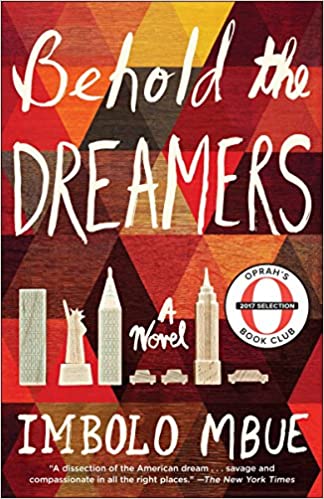
Behold the Dreamers by Imbolo Mbue

This book found its way onto my bookshelf and lived there a while before I picked it up, at which point I didn’t even know what it was about. I purposefully avoided even flipping it over to read the back-cover blurbs and went in thoroughly blind. Early on, it’s about a family of immigrants from Cameroon to New York City, beginning to make their way there, and I began to have a bad feeling – for a novel to work, there has to be conflict, right? I wanted things to be easy for this family (a couple and their young son), but I just knew (because of how stories work) that something had to go wrong. I was tempted to flip the book over, but I resisted, and I’m really glad they did. That’s going to affect how I write this review: I’m glad I kept my ignorance and experienced the story as an innocent, so to speak, and I want that for you too. I absolutely recommend this book.

If you’re game for just a little more information, here are some observations in white text (highlight to read): The father/husband figure in this story feels very fortunate to get work as a chauffeur for an important figure at Lehman Brothers. Well, that name alone tells us a lot about where the plot turns, doesn’t it. Near the end I found myself strongly reminded of Upton Sinclair’s The Jungle (a book that’s very important to me). There’s a hint there, too. These remarks are only as spoiler-y as the back-cover blurbs, FYI.

I will say that our central characters are Jende and Neni Jonga, the Cameroonian immigrants, and eventually their counterparts, Clark and Cindy Edwards, who are white New Yorkers of great wealth. The two families become somewhat intertwined, and it is to Mbue’s great credit that despite enormous differences, they conflate as well. A Q-and-A with the author at the back of my paperback tells us that Mbue didn’t necessarily set out to do this work, and did not find empathy for the Edwardses easy. It’s not empathy that lets anyone off of any hooks either, though.

It might be said that this is a book about immigration politics (or any number of other capital-I Issues: capitalism, race and American racism), but I think it’s true – and I think it’s a strength – that it’s about the Jongas first (and secondarily the Edwardses), and about those Issues only because they are the ones that the Jongas live through, if you will.

It’s a beautifully told, absorbing story to get lost in. Each character has a distinctive voice, and even though none is a saint, they all earn our compassion. Mbue is an impressive writer and I was pleased to spend this time with her characters.


Rating: 8 bacon-wrapped shrimp.

Ocean State by Stewart O’Nan

In this unforgettable novel–disturbing, gorgeously written and poignant–working-class women and girls are pushed to extremes.

“When I was in eighth grade my sister helped kill another girl. She was in love, my mother said, like it was an excuse.” So opens Ocean State by Stewart O’Nan (West of Sunset; City of Secrets; The Odds: A Love Story). If this were a murder mystery, the killer’s identity is immediately known. But it’s not the crime itself that occupies the novel’s spotlight so much as the challenges faced by its four central characters.

They are four women, closely connected but very different. Angel is a popular high school student. Carol, her mother, is a nurse and stressed-out single mother, a bit preoccupied by her dating woes. Marie is Angel’s younger sister, forever watching other people’s lives as if they were movies and waiting for hers to begin. Birdy is Angel’s classmate. They both want the same boy, a rich kid who inevitably will leave their small town behind. Angel is his girlfriend of three years, Birdy his secret. The way these lives converge will change all of them forever. O’Nan presents the four women’s perspectives in turn, so that readers watch them build and crescendo to a violent crime and then tumble through its aftermath. The events are horrifying, and not only in terms of that final violence, the writing is lovely, glimmering. O’Nan evokes Ocean State‘s setting, the blue-collar Rhode Island town of Ashaway, with equal care: perhaps unbeautiful, but rendered with detail and tenderness.

O’Nan’s greatest accomplishment is in the compassionate portrayal of characters who are each guilty of smaller and larger wrongs, but whose motivations, concerns and battles always feel of real concern. Marie desperately wants to connect, with anyone. Carol wants the best for her daughters but can scarcely keep her head above water. Birdy has strong family ties but has succumbed to a dangerous infatuation. Angel is gripped by a version of love that contains a large dose of possessive rage. Interestingly, the boy that these girls focus on does not have his perspective revealed; readers meet him only as Birdy and Angel see him.

Because of how the book begins, readers always see the crime coming. Somehow, this does not reduce the suspense, as tension builds toward the unavoidable climax. Ocean State is a compelling, propulsive read: easy to inhale but difficult in some ways to stomach. This is a story less about love than about obsession and family connections and disconnections, and about the devastations of hardscrabble lives. The ugly turns beautiful in O’Nan’s scintillating prose, and his four main characters will linger with readers long after their stories end.


This review originally ran in the January 21, 2022 issue of Shelf Awareness for the Book Trade. To subscribe, click here.


Rating: 7 coffee cabinets.

Monday’s Not Coming by Tiffany D. Jackson

This is the story of how my best friend disappeared. How nobody noticed she was gone except me. And how nobody cared until they found her… one year later.

Our narrator is Claudia, who returns home to Washington, D.C. from Georgia (where she spends summers with her grandmother) to enter eighth grade, and finds her best friend Monday has vanished. Monday hasn’t returned Claudia’s letters all summer, and now she can’t track her down by phone or at home. The timeline shifts between a few points before Monday’s disappearance – so that the readers gets to see their friendship – and the time after. Claudia’s first-person narration is heart-breaking: her angst, the drama and despair of teenagerhood, her isolation after losing her only friend (otherwise, social settings like school are not particularly kind to her, at least in her own view), and feels authentically like a fourteen-year-old’s voice. I found it a well-written book in general, with good pacing and tension and a sense of momentum; these 400+ pages flipped easily by.

The story of Monday’s disappearance is a mystery, even though the opening lines (quoted above) foreshadow at least one important element of the final solution. Monday’s Not Coming could fit into a few genres, including amateur detective story, as Claudia searches relentlessly for her friend even when everyone around her encourages her to give up. She begs her parents for help, tries a police detective – even Monday’s older sister tells her to just leave it. The reader slowly becomes aware of some issues Claudia herself faces, which bear on the unique relationship between the two girls – almost a codependence, in fact. Where we come to see that Monday was a strong student, Claudia struggles with her schoolwork, but has an intuitive feeling for color and design; she is a dancer, an artist and a creative thinker. “We lived in our own world,” she recalls, “with our own language and customs. We lived inside a thick, shiny bubble that no needle was sharp enough to pop.” A few reveals keep the plot moving neatly along. I have to say, though, that a final big reveal in the book’s last 50 pages felt like one step too many for this reader. I think it was gripping enough and this may have taken it a hair into the incredible. I don’t think the story needed that final complication.

Back-cover blurbs and promotional copy for this novel point out that its plot is “straight from the headlines,” in which girls of color do indeed disappear with scarcely a ripple in cities like D.C. In this regard, Monday’s Not Coming is firmly rooted in fact. How does a teenaged girl truly vanish without anybody noticing? Well, for one thing, it’s not quite that nobody notices as much as nobody seems to care, which is not less horrifying. It is to Jackson’s credit that the unbelievable is made believable in this narrative (even if I wasn’t a fan of the final wrinkle).

Claudia is a very real and painfully struggling young person, and a compelling narrator; it was an excellent choice to make hers the perspective for this story. Monday is a little bit of a shifting target. We mostly see her, obviously, through Claudia’s eyes, and Claudia comes to doubt her own truth; we are offered an idea that there was another version of Monday than the one Claudia knew (which I think is generally true of humans). Regardless of the ability of a teenaged girl – or any of us – to present multiple faces, Monday is a tragic figure and one we will mourn alongside her best friend. I was disappointed with some of the adults in this story (unavoidably), but they felt real, too. It certainly sheds a light on a very sad real-world issue, as intended. Alongside society’s failings of young women of color, Monday’s Not Coming touches on issues of class, gender representation, sexuality, and various cultural norms. I think it’s a strong choice for discussion groups (classrooms, book clubs) for these reasons.

I really enjoyed reading this one – well, ‘enjoy’ may be the wrong word for such a sad story, but I admired Jackson’s work.


Rating: 7 shades of red.

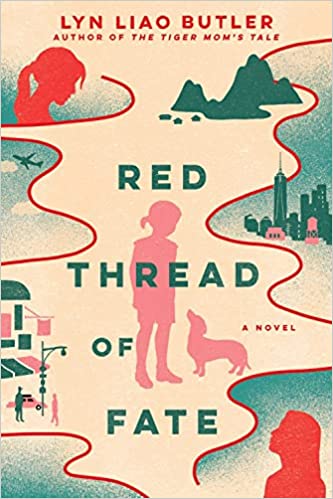
Red Thread of Fate by Lyn Liao Butler

Amid grief, betrayal and exposed secrets, a new widow learns to forge unexpected bonds.

Lyn Liao Butler (The Tiger Mom’s Tale) offers secrets, tragedy, hope and redemption in a novel centered on family and forgiveness. When Red Thread of Fate opens, Tam is on the phone with Tony, her husband. They are a bit short with each other; the marriage has been a little off, but they’re generally headed back on track and preparing to adopt a little boy from China, which both look forward to. Then there is cursing, a roaring sound–and just like that, Tam is a widow. The shocks come quickly, one after another: Tony was not in Manhattan, where he should have been, but in Flushing, Queens, and accompanied by a cousin Tam thought he’d been estranged from for years, killed by the same truck that struck Tony. Then Tam is surprised to be named guardian of the estranged cousin’s five-year-old daughter, even as her son-to-be still awaits adoption in China.

Tam, the California-born daughter of Taiwanese immigrants, and Tony, an immigrant from China, negotiated an uneasy peace with their families and their new lives in New York City, and with each other. Upon her own immigration, Tony’s cousin Mia lived with the couple for nearly two years, before unspecified events broke up the happy household. Now Tam is left to untangle the mysteries of Tony’s life, which seem to multiply the more she learns; Mia’s history is even more enigmatic, but Tam is committed to parenting her orphaned niece. She carries a guilty secret of her own, too.

By nature a shy and private woman, Tam is prompted by her new life–widowed, a single parent, grieving–to accept help, against her instincts. Slowly, she builds a family and a community: taking in her niece, moving toward adoption (which must be renegotiated now that she does not have a husband), deepening friendships and finding new ones, even beginning to mend relations with her mother. This process also involves navigating cultural nuances and divided loyalties. By the time Tony’s secrets come fully to light, Tam is a changed woman, with new strengths and allegiances, and better equipped to meet her many challenges.

Red Thread of Fate is a novel about what ties people to one another, and the nature of those bonds, the unintended consequences of choices and the possibility of a fresh start. With contemplative characters, surprising humor and a twisting plot, Butler’s thought-provoking story of nontraditional family models will appeal to readers interested in fate and identity.


This review originally ran in the December 6, 2021 issue of Shelf Awareness for the Book Trade. To subscribe, click here.


Rating: 6 wontons.

The Turner House by Angela Flournoy

Humans haunt more houses than ghosts do. Men and women assign value to brick and mortar, link their identities to mortgages paid on time. On frigid winter nights, young mothers walk their fussy babies from room to room, learning where the rooms catch drafts and where the floorboards creak. In the warm damp of summer, fathers sit on porches, sometimes worried and often tired but comforted by the fact that a roof is up there providing shelter. Children smudge up walls with dirty handprints, find nooks to hide their particular treasure, or hide themselves if need be. We live and die in houses, dream of getting back to houses, take great care in considering who will inherit the houses when we’re gone.

Family, home, and sense of place. Pathos and humor. What’s not to love? This is a Great American Novel, telling the story of one prodigious family over generations, and in it the story of a city and more: the Turners’ Detroit is the story of the Great Migration, of racism and striving. Francis Turner came up from Alabama to Detroit in 1944, to be later joined by his wife Viola and first son, Charles or Cha-Cha. From there, from one rental house to another, the family grew, purchasing the house on Yarrow Street in 1951, where they would raise thirteen children, whose ages span 23 years. Readers meet these character briefly in 1958 and then spend much of the book’s space in 2008, as a widowed Viola weakens in Cha-Cha’s home and the old house on Yarrow falls into decay (and, if you remember 2008, there will be financial repercussions). The timeline jumps around: The Turner House is most concerned with 2008 and the final disposition of the title house (and its matriarch), but to tell that story, we have to flash back. Not all thirteen of the siblings get equal time, of course; the eldest, Cha-Cha, and the youngest, Lelah, play large roles, as do patriarch and matriarch, and a few others along the way, including partners.

There is a bit of a mystery at this story’s heart, too: Cha-Cha saw a haint in the Turner house when he was just a boy, and in his 60s he sees it again, while driving an 18-wheeler for work, which ends his career. His efforts to resolve this haint – its reality or unreality, its meaning – drives much of the book’s plot, serving as the main conflict in the 2008 timeline, although readers gradually become aware of how tenuous the family’s very existence was in the 1944 timeline as well. And Lelah is fighting demons of her own – as are all thirteen siblings, presumably, as are all of us. It’s an expansive story like that.

One man’s haunting is another man’s hallowed guest.

There is humor as well as pain, and many truths about families and homes, especially large families. One sideplot, which is both heartwrenching and funny, involves a minor character whose curiosity about big families causes her to make some spectacular missteps. As an outsider to large families myself, I sympathize, and I enjoyed this glimpse into a big, warm, loving, dysfunctional, unwieldy example.

He felt like a hostage in his own house. He saw now that these parties were larger than him and Tina, and even Viola. That his family could go on party prepping in Cha-Cha’s house when his home life was an obvious wreck indicated of a lack of respect. This was what happened when an open-door policy–something Cha and Tina had prided themselves on–ran amok. When mi casa es su casa was taken literally. His house had become an extension of the Brotherly Banquet Hall of their youths, except his siblings slept here too, and paid no security deposit for damage. In exchange, Turners thought their presence was expression of love enough; that they’d booked flights and crossed state lines to invade Cha-Cha’s space was supposed to be some sort of gift to him. It felt more like an ambush.

You know I have a special weakness for literature that tackles our relationships to places. Detroit is not a city I know well, but this version certainly felt fully formed to me; I didn’t look up street names but these are real places as far as I’m concerned, and that’s good enough. The importance of home, of connection to place and (sometimes) to the walls of one place in particular is very much a part of my worldview.

This book is about families and relationships, about connections to the past, about mysticism, about race and housing discrimination and Detroit and the Great Migration and the United States, about the significance of place and home. It is beautifully written and entirely absorbing; none of these characters is without flaws, but the narrative oozes with empathy through it all. It’s a masterpiece.


Rating: 8 hot links.

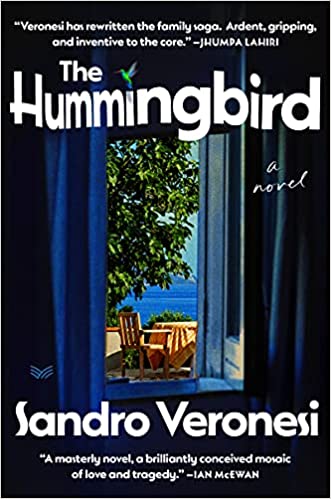
The Hummingbird by Sandro Veronesi, trans. by Elena Pala

This family saga set in Italy, with one life at its center, is moving, literary, philosophical and multi-layered.

The Hummingbird by Sandro Veronesi (Quiet Chaos; The Force of the Past), translated from the Italian by Elena Pala, is a shape-shifting, multigenerational novel of family, love, loss, joy, change and pain.

When readers meet Marco Carrera, the year is 1999 and he is a 40-year-old ophthalmologist in Rome, about to meet destiny in the form of a psychoanalyst breaking his confidentiality oath. From here, chapters jump back and forth in time from 1960 to 2030. Readers meet the great love of Marco’s life, visit his childhood, witness his marriage and divorce. When he is just a boy, Marco stops growing, remaining small and childlike well into his teenage years: his mother nicknames him “the hummingbird” for his stature, a moniker that will echo into his adulthood. He becomes a father and eventually a grandfather, so that four generations of his family flash kaleidoscopically across these pages; Marco is ever at the novel’s center, however, even as he is accused of holding still through life’s storms. “You can keep still as time flows around you, you can stop it flowing, sometimes you can turn back time, even–just like a hummingbird, you can fly backwards and retrieve lost time.” The novel mimics this movement with its nearly stop-action chronology.

Some chapters take a straight narrative form, others are transcribed conversations, letters, postcards or e-mails. Elena Pala’s translation from the Italian feels perfectly suited to this twisting, many-faceted form, as different voices take the lead. The pieced-together story moves between Rome and a Tuscan coastal town where the Carreras have a vacation home; its characters travel much farther (Spain, Germany, the United States), but Marco’s orbit is limited. Rather, as he keeps still, his family and friends revolve around him.

In these various forms, across time and space, Veronesi refers to numerous other literary voices (a Samuel Beckett epigraph sets the tone) and concepts from ophthalmology, psychotherapy, architecture and design, among other disparate fields. The Hummingbird is clearly an intellectual exercise, but can also be read more simply as a story about a single, deceptively ordinary life: Marco might appear unremarkable at first glance, but he has lived remarkable tragedies and triumphs, which will define him. He is affected by his experiences as if by ocean waves, his life a series of natural forces, or natural disaster. Packed with pathos, humor and tragedy, the novel’s finish is both a quiet goodbye and a crescendo, the only fitting end to such an unobtrusive but resounding life.


This review originally ran in the December 2, 2021 issue of Shelf Awareness for the Book Trade. To subscribe, click here.


Rating: 7 appointments.

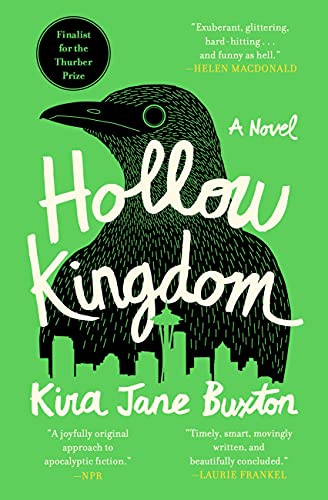
Hollow Kingdom by Kira Jane Buxton

I cannot recommend this to you enough: find something that you believe in, right down deep in the depths of your silvery plumage, and then throw your heart at it, blood and valves and veins and all. Because I did this, the world, though brambled and frothing at the mouth, looked more vibrant; blues were bluer, and even the fetid puddles that collected under rusting cars tasted as sweet as summer wine.

I have so much to say about this book, but in trying to avoid spoilers I think much of it should remain unsaid here.

Hollow Kingdom is set in contemporary Seattle, and its protagonist and most-of-the-time narrator is a domesticated crow. (Chapters do alternate perspectives, so we get a handful of other voices – very colorful ones that make enormous contributions, and come from all over the world. But our star keeps the mic for the majority of these pages.) His name is S.T., which is short for Shit Turd (naturally), and he has enjoyed a good life with his human, Big Jim, and a bloodhound named Dennis with a deathly fear of windshield wipers and alpacas. The book begins “after,” however, and S.T. is here to tell us what happened to Big Jim and his neighbors: we meet the beloved human only in past tense. He got sick and started acting strangely (more strangely than usual), and then his eyeball fell out, and then things went from bad to worse. Eventually S.T. is forced to venture out of the home and into the wider world, where he’ll have to interact with wild crows, for whom he feels mostly contempt, as well as many other forms of nature, likewise distasteful. And he takes Dennis with him, although he feels a similar disdain for the (not so bright) dog, at least at first. S.T. mostly knows the outside world from television and the opinionated Big Jim. And now he’s up against the worst of times with his limited knowledge and his distrust of the natural world – which may be all that’s left.

Among many remarkable features of this unusual novel, I enjoyed S.T.’s voice: salty, foul-mouthed, neurotic, loyal, loving, admiring of humans (whom he calls MoFos – Big Jim’s influence again) and their inventions, sarcastic, self-deprecating and hilarious. He hates penguins (“hambeast-bellied egg timers”) and says of Dennis, “Man’s best friend indeed. More like man’s neediest parasite that would trade you for a bull-penis dog chewy at the drop of a hat.” Squirrels are “five-star sexual deviants” (borne out by later events). The other voices that occasionally interweave with S.T.’s chapters are equally singular, apt, and surprising: there is a Scottish cow named Angus, a young camel in Dubai, and an irascible, tyrannical cat right there in Seattle, among others. (Genghis Cat thinks of his humans as Mediocre Servants, or “dildo-nosed potatoes.”) A very large part of S.T.’s ongoing struggle is wrapped up in his confusions about identity: unmistakably crow, he believes himself to be an honorary MoFo, meant to be human but trapped in black feathers; in the new world, though, he’s going to have to make new allegiances with those who look more like himself. His relationship with Dennis likewise evolves: he begins scornful of the bloodhound’s apparently lesser intellect, but their partnership deepens in tough times, and he discovers that even if Dennis does not talk like the crow does (and as most animals in this world do), he may have a lot to offer. The lessons abound, but Hollow Kingdom never loses its joyful, wacky ridiculousness, even as it gains in wisdom and profundity. Sounds like a hell of a thing, right? This is an unusual and startling book from the first pages, and keeps on surprising to the end.

I also marveled at how many notes I made as I read. I generally make a few notes, but this tight-packed bookmark with overflow onto the other side is rare.

Many of those notes I will not be sharing here because I’m avoiding spoilers. But I can point out that S.T. has a vocabulary: I had to look up formicary, synanthropic, fuliginous, voltaic, collacine, pedipalp, myotonic, and chatoyant. I also loved his use of so many collective nouns: clowder of cats, murmuration of starlings, collacine of maggots, quarrel of sparrows, and of course the constant reference to S.T.’s own murder (of crows) – these are just a few. I’m a big fan of collective nouns.

Hollow Kingdom approaches a few commonly-occurring incidents in literature (which I am still not naming here) with truly fresh eyes. The voice of a domesticated crow navigating an identity crisis in the context of a wider-world crisis is new and inventive. This book is filled with tragedy, but is simultaneously hilarious, hopeful, even joyful.

Trust, it turned out, was a very beautiful and fragile thing with a taste like wild raspberries and experienced only by the very brave.

There are Big Thoughts alongside toilet humor, and commentary on the importance of relationships even in the most bizarrely changing world imaginable. Lots to love. Buxton has a rare and fascinating mind and I love the weird voices she’s created here; I’ll definitely look for more from her.


Rating: 8 Cheetos.

When Me and God Were Little by Mads Nygaard, trans. by Steve Schein

A rocky childhood on the Danish North Sea is rendered in weird but apt terms by an extraordinary young narrator.

Mads Nygaard’s When Me and God Were Little, translated by Steve Schein, is a stark portrayal of a hardscrabble childhood in a blue-collar, small town in Denmark, on the coast of the North Sea. Its narrator is seven-year-old Karl Gustav (who would rather be called Big Ox), and his distinctive point of view is filled with preposterous details that make perfect sense to him. “In our town you couldn’t drown barefoot,” he begins, and yet his big brother, Alexander, has managed to do just that, permanently upsetting Karl Gustav’s worldview.

His father is a drunk, but owns his own business building houses, and “Our house was so big that Mom still hadn’t gotten around to vacuuming all the rooms.” “Dad weighed 250 pounds and it was all muscle, except for the hair,” but then Dad goes to jail (something about the papers in his file drawers; the young narrator isn’t concerned with the details), so Karl Gustav and his mother move into a county-owned house in a new town. Unperturbed, the child carries on obsessing over soccer (he plays alone over four fields through the winter) and terrorizing his teachers. Years pass, very few friends come and go, and readers follow Karl Gustav’s experiments with porn, disastrous employment, grifting, a doomed love affair with another damaged young person and a developing relationship with his father. The loss of his brother will always loom large, for Alexander was a hero: “He just smiled, knowing everything.” But other losses accrue, as Karl Gustav learns more about the wide, perplexing world. By the book’s end, the narrator is a teenager, perhaps still ungainly, but wiser for the trials he’s seen.

This is an unusual novel, its narrator’s voice colorful, unpolished and unforgettable in Schein’s gruff translation. It is Karl Gustav’s singular perspective that makes When Me and God Were Little the memorable, bizarre, poignant adventure that it is. It’s absurd and often fantastic, as this narrator delivers an earnestly nonsensical account of events that readers know to be impossible. And yet it rings true, because what is childhood if not nonsensical? Karl Gustav is all bluster and pain, bluffing in the face of forces bigger than he is. His story is gritty, messy but real, and there are no happy endings on this harsh coastline. The novel is filled with cigarettes and swagger and masturbation literal and figurative, often unbeautiful but somehow still lovely in its authentic, unvarnished view of a difficult coming-of-age.


This review originally ran in the October 29, 2021 issue of Shelf Awareness for the Book Trade. To subscribe, click here.


Rating: 6 hedgehogs.

Maximum Shelf: Vladímír by Julia May Jonas

Maximum Shelf is the weekly Shelf Awareness feature focusing on an upcoming title we love and believe will be a great handselling opportunity for booksellers everywhere. The features are written by our editors and reviewers and the publisher has helped support the issue.

This review was published by Shelf Awareness on October 18, 2021.


Julia May Jonas’s Vladímír is a compelling debut, discomfiting and riveting, and timely in its themes. With dark humor, pathos and sly references to art and literature, this smart, edgy novel challenges assumptions and forces fresh perspectives.

In small-town upstate New York, an unnamed narrator teaches English at a small college. She lives an easy enough life, reading, writing, teaching, exuding “Big Mom Energy” and enjoying the admiration of her students, whose earnest eagerness for improving the world she appreciates. Then a scandal erupts: her husband, John, chair of the English Department, is revealed to have had sexual relationships with a number of his former students. The narrator herself is quick to point out that these all took place before such relationships were explicitly forbidden. She and John had always had an understanding about their extramarital activities. She is surprised to find that her colleagues and students disapprove not only of John but of the narrator as well, and finds herself increasingly resentful: of John, of the academic machine, of her students and of herself.

Into this upheaval comes Vladimir Vladinski, newly hired junior professor and up-and-coming experimental novelist. Vladimir is 20 years or so the narrator’s junior, sexy, flirtatious and married. The narrator is quickly captivated, then obsessed. A two-time novelist with generally disappointing reviews, she has largely turned to literary criticism and book reviews, but now feels inspired to write fiction again. For the first time she feels the work flowing from her effortlessly, and credits Vladimir as her muse. “There was a burning in my body, an extra level of excitement keeping part of me fed and running that required no sustenance. It was longing for the love of Vladimir.” She writes, masturbates and surreptitiously follows Vladimir one day and her beleaguered husband the next, and then even Vladimir’s wife–beautiful, traumatized, a masterful writer herself. Sexual, romantic, literary and workplace jealousies overlap. Things fall apart: John’s hearing (people keep calling it a trial) at the college looms as their already distant and fractured relationship continues to crumble. Their adult daughter moves back home, in dual personal and professional crises of her own, which throws the narrator into new light as a mother. She neglects her work, becoming increasingly reckless until, consumed by her fantasies, she finally commits a shocking act that precipitates a life-changing event for all involved.

That this narrator is a 58-year-old woman is significant, and provides opportunities to consider issues of gender, age, societal and literary expectations and subversions. Her troubled body image provides an undertone from the very first pages, with near-constant references to weight control and her evening skin care regimen. “I prefer to conceal my neck,” she confides, as she compulsively grooms and criticizes her body before each meeting with Vladimir. “A man could always make me feel worse than anything a woman could ever say to me,” she reflects, as she struggles to align her own sexual revolution with the values of her students. Vladímír questions gender and generational tensions, and the intersection of art and morality within the bubble of academia. In the family, household and larger social realms, it addresses every permutation of human relationship and the relationship between power and desire, while also carrying a strong thread of disturbed body image and issues around aging. In other words, this novel is as varied and harried as life.

As a novel so rooted in English departmental affairs should be, Vladímír is also jam-packed with literary references. Vladimir is compared to Jay Gatsby. “Enraged at my vapidity,” the narrator laments, “I forced myself to sit down and read several articles in the latest issue of the New York Review of Books.” Insisting she’s not jealous or bitter about her own novels’ failure to impress, she notes however that “Margaret Atwood wrote exciting books that practically lived inside of a uterus.” Vladimir’s wife says of her own mental health struggles, that her story is “like Nurse Ratched, like Girl, Interrupted, like The Bell F**king Jar.”

Jonas’s narrator has a strong, assured voice, incisively thinking through her decisions and the surrounding issues while simultaneously–and with self-awareness–mucking up her life. The narrator and the novel take on any number of thorny topics. Were the college students who slept with John seizing agency and free love in an empowered, feminist stance? Or were they taken advantage of by an older man with the power structure on his side? What are the pros and cons of an open marriage? Is our cultural hang-up about intergenerational affairs perhaps a little overblown? Some of these questions and perspectives are decidedly uncomfortable, but Jonas consistently pushes those edges, leaning always away from easy answers and toward nuance. Vladímír‘s central characters are rarely likable but they are always captivating; this story harnesses formidable momentum to pull readers through even its most uncomfortable moments. It is a rare victory in a novel to wrestle with such prickly issues and yet be as entertaining as this. Jonas’s prose is clear, forceful and unflinching, and highly sensual: food, drink and sex are ever-present and frankly, complexly evoked.

The narrator writes of Vladimir’s own debut: “The book was funny, clear, awake, vivid. The prose was spare but the voice was not sacrificed in his exact word choice. It felt both like life and beyond life.” The same comments might be made of Vladímír, a clear-eyed treatment of academia and the human condition.


Rating: 7 caipirinhas.

Come back Friday for my interview with Jonas.

Real Life by Brandon Taylor

Real Life centers around Wallace, a biochemistry graduate student in an unnamed Midwestern town. He feels unmoored and isolated despite having a group of “friends” (he’s not sure how true this term really feels) from school; he is one of the only Black people in this town, running from a traumatic past in Alabama. This novel takes place over the course of one weekend, when Wallace (who is gay) hooks up with one of his male friends (who insists he is straight), and tries to navigate this intrusion into his closely protected personal sphere alongside micro- and macroaggressions at work and among the friend group. The title refers to Wallace’s persistent worry that what he is living is somehow not “real life”; he is considering leaving graduate school but doesn’t know where to turn instead.

What gazes up out of the lapping black sea of his anger? What strange dark stones make themselves known to him?

It is a book of few joys, certainly. Rather, Wallace and his friends experiences large and small traumas and frustrations, hurting themselves and each other. It is a book of beauty, though, in its precise, quietly evocative writing and close observations. As Wallace carefully watches the miniscule creatures he breeds and destroys in the university lab, he likewise tracks the moves, desires and motivations of the people around him, from whom he feels removed. His tennis partner has just discovered that his boyfriend is on “that gay app” and may be cheating on him. A female friend is on the rocks with her Tolstoy-studying boyfriend. His colleagues are generally toxic, mildly if not overtly racist, except for the one woman of color, who is horrified that Wallace would consider leaving her there alone.

Gifted is the sweetness meant to make the bitterness of failure palatable–that a person can fail again and again, but it’s all right, because they’re gifted, they’re worth something. That’s what it all tracks back to, isn’t it, Wallace thinks. That if the world has made up its mind about what you have to offer, if the world has decided it wants you, needs you, then it doesn’t matter how many times you mess up. What Wallace wants to know is where the limit is. When is it no longer forgivable to be so terrible? When does the time come when you’ve got to deliver on your gifts?

A friend-of-friends is blatantly racist, and none of the group (all white) will speak up to even the most obviously offensive comments. We get the sense that Wallace would happily quit this scene if he could identify another option in the world.

The most unfair part of it, Wallace thinks, is that when you tell white people that something is racist, they hold it up to the light and try to discern if you are telling the truth. As if they can tell by the grain if something is racist or not, and they always trust their own judgment. It’s unfair because white people have a vested interest in underestimating racism, its amount, its intensity, its shape, its effects. They are the fox in the henhouse.

These characters are compelling and memorable, and the writing is indisputably fine. If there is a final takeaway, perhaps it is that this is real life – all of life is – and that we are all more or less miserable, whether quietly or demonstrably. It’s an admirable book but not a pleasurable one.


Rating: 7 nematodes.