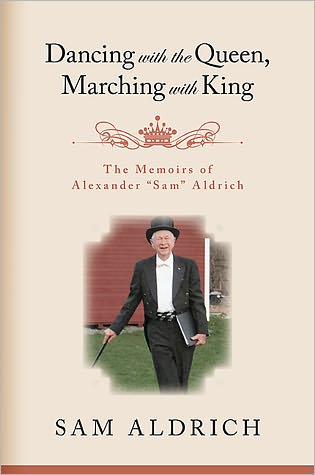
book beginnings on Friday: Dancing with the Queen, Marching with King by Sam Aldrich

Thanks to Katy at A Few More Pages for hosting this meme. To participate, share the first line or two of the book you are currently reading and, if you feel so moved, let us know what your first impressions were based on that first line.
Here’s an interesting memoir that has just crossed my desk.

The two most exciting public events of my life occurred before I turned forty.

In the spring of 1953, when I was only twenty-five, I was invited to attend the opening of the new American Embassy residence in London.

This is your standard, matter-of-fact (auto)biography/memoir beginning. Not much flare, and that does seem to be Aldrich’s style. But! I think he has an interesting enough story to make up for it. We shall see.

This quotation comes from an uncorrected advance proof and is subject to change.

One Day I Will Write About This Place by Binyavanga Wainaina

Binyavanga Wainaina’s memoir, with details of various African backgrounds and his sensitive artist’s perspective, paints a poignant and lively picture.

Wainaina’s memoir of his life in Africa begins with his childhood in Kenya, follows him through university in South Africa, to a family reunion in Uganda, and on to his travels throughout Kenya, to land him finally in New York State as a writer and professor. His tale, however, is far from simply a recounting of one man’s life. At its heart, the book is the story of an artist, his struggles as a child to adjust to his view of the world and his discovery of writing as an outlet. His perspective as a child verges on the fantastical as he confuses colors with shapes and objects with sounds. The lyrical, imaginative writing throughout the book reflects this unusual vision. Wainaina paints pictures with words; his writing is reflective and playful and worth lingering over. Music, too, plays a role–almost as another character–as he describes his intense reactions to the music of Kenya, of Africa and of the world.

Another worthwhile aspect of this book is its intelligent and informed study of the politics of the African continent and the diversity of Kenyan perceptions. Wainaina tells of the battle between tribalism and a united Kenya, and the richness of linguistic and cultural perspectives there. Politics, however, is never the main subject; it is merely a background to his personal story. The Africa evoked is captivating and will be exotic and new to many readers.

Wainaina’s memoir is by turns funny, sad, hopeful and occasionally cynical, but always engaging. Fanciful abstractions of his environment and instructive tales of African politics combine to give us a fascinating vision of his world.


This review originally ran in the July 22, 2011 issue of Shelf Awareness for Readers. To subscribe, click here, and you’ll receive two issues per week of book reviews and other bookish fun!

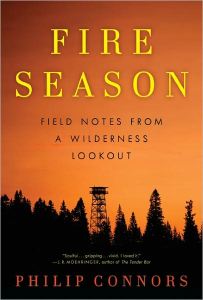
guest review: Fire Season by Philip Connors, from Pops

Today we’re visiting my father again, who’s traveling this summer. I put the screws on to compel him to buy a copy of Fire Season for himself to read on the road because I loved it so much (see here). I promised to buy it off him if he regretted the purchase; and I may, anyway, because I want to own a copy. Actually, though, I don’t know if it’s for sale. He did like it. I’m compiling some of his thoughts via email to share with you; they’re mostly in response to my original post (see link above) but I thought his slightly different perspective was worth sharing. Here’s Pops.
I finished Fire Season yesterday while I was camping in the finest of the rain forest valleys in Olympic NP, the Hoh river. I found it as exceptional as you said. The timing was impeccable; e.g. I was reading his passages about the magical meditative element of long walks… (or, I would say, endurance activities – you could read Bill McKibben’s Long Distance for a bit of the same; I found it wonderful, and you should know who McKibben is anyway for his potential to be one of the great environmental soothsayers of our time) …and it helped me decide a plan for my Monday walk: a full 10 hour day of wandering up and down the valley in rain and mist marveling at the magical forest – when I wasn’t daydreaming. I loved how he wove in stories of Kerouac, Edward Abbey, Chief Victorio, Alice the dog, Aldo Leopold, Cormac McCarthy, Gary Snyder (new to me) – and others. And we certainly learn about wildfires. Thanks for the tip.

So glad you liked it!! [And, incidentally, what safety precautions are you taking on 10-hour walks? Do you call Mom to let her know you’re going off on such things, and then call in when you return?]

And have you made the connection with current events? – with a massive fire burning for weeks now in eastern Arizona (the western borders of Fire Season) and today all around the Carlsbad Caverns area in NM (within the eastern horizon view of Fire Season).

Maybe not specifically those fires; but West Texas has been ravaged for months and it made my reading of the book a touch more personal. This spring race series, we raced two races in a row only to hear that the race course saw a wildfire start as we were leaving. (We promise we didn’t start these fires.) One was in Arksansas, one in central Texas. And we have a friend/teammate who tried to race in Ft. Davis, but the event was canceled due to one of the bigger fires we’ve seen; it swept across a considerable part of the state we’re used to driving and riding through. Close to home.

Did you also make the connection that we all went camping in the Gila Wilderness twice when you were 3 and 4 yrs old? (and that, because we had been there before you were born)

No, of course I don’t remember that, but very cool!

I really endorse what you said about his eclectic voice, and the many priceless vignettes he blends into his story. (I really wish I had read it with a highlighter!)

I also found him to be an endless stream of contradictions (perhaps we all are?) – he could be a sedentary slug for hours/days on end, but was also often driven to minimalist walks & overnights (an evening walk from a summit inevitably involves a serious down & UP!); he obviously functioned well in cities & bars, as well as wilderness; he became well versed in much wilderness language, yet succumbed to the elementary, pitiful, dreadful trap of the young fawn.

I cried over the fawn.

And, re: your comment about the contradictions. I am reminded of David Guterson’s The Other as well as Jon Krakauer’s Into the Wild (the first, fiction, the latter non) – both books about young men going into the wilderness, thinking they wanted to get away from it all, but also strangely and paradoxically clinging to certain odd elements of society. As the protagonists of both books came to unpleasant ends, I think perhaps Connors has found the perfectly balanced way to do it! In fact, I think I mentioned balance in my initial review. The writing in his book is balanced; and his interactions with his world are balanced. His saintly wife helps him be balanced. I daresay we all aspire to a lifestyle like this; I know I do, and I think, Pops, that you do. But then, you’re closer than most of us right now!

Based on your and my reactions, I’m guessing that readers will appreciate many different aspects of this book. You particularly noted the lessons about wildfire & forest policy, which I knew much of already. I loved the many references and new details about Kerouac, Snyder and the various personalities of the Beat generation who so influenced my 60s & 70s, and subsequent characters like Edward Abbey and Dave Foreman.

You barely mention Alice! I thought she was an elusive minor character, disappearing for times but playing a key role at many turns. Moments were familiar to Barley’s world; like her unilateral retreat to accompany Martha home from the lookout summit, and her personality change from city to wilds. Most poignant – Alice evoked my most secret lonely moments, far up a mountain trail without Barley’s companion spirit, spunk and relentless energy. “Alice is the only living being I know who will take a forty-mile walk in the woods without any need of cajoling, planning, or consulting a calendar.”

My apologies to Alice; you’re entirely right… she was a special creature and character, and a neat side-story proving (yet again) that dogs are our best friends and offer relationships unlike what we humans can offer one another. Here, I’ll treat our readers to a picture:

Hops (brown) & Ritchey (short white hair) who live with Husband and I, and my parents' Barley (scruffy white hair)

Finally: “…the movements of my limbs help my mind move too, out of its loops and grooves and onto a plane of equipoise… If I weren’t a walker I suppose I would be a television addict, a dope fiend, a social butterfly.”

Because I had to look it up, I’ll share. Equipoise: an equal distribution of weight; even balance; equilibrium.

Thank you for your musings, Pops. I hope we’re (still) encouraging folks to find this book! I think I’m ready to call this my best read of 2011 to date.

Fire Season by Philip Connors


EDIT: You might also want to check out my father’s review, and friend Tassava’s, of same.


This is an amazing book. The first sentences immediately grabbed me. Connors works summers in a teeny, tiny tower room way up in the sky in the Gila National Forest in New Mexico, as a fire lookout. His job is to spot smoke and call it in for control or “management” of the fires. But his “field notes” tell so much more than the story of his career as a lookout. This is the story of his time alone in the Gila, and of the visitors he receives and the visits he pays back to town; it’s the story of his and his dog Alice’s interactions with nature. It’s the story of fire and smoke and the Forest Service’s management of fire. It’s a history of fire, of the Forest Service, of the Gila, of so very many aspects of our nation’s history, and the natural history of the southwest. Connors discusses the varied reactions the government has had to fire: the policy of fire suppression, consistently and in every case, versus the concept of “controlled” or “prescribed” burns, and the ongoing debates. He contemplates society, its benefits and our occasional desire to escape it. He discusses his unique model of marriage, in which he spends some five months a year living alone and mostly out of touch. He also relates ecological issues like fire as a natural control mechanism, erosion, and the preferences of flora and fauna. And more.

I found Fire Season astounding and important. There’s a zen-like balance in it. Connors is a rather balanced man, in that he still craves human contact; he’s not an entirely back-to-the-wild isolationist, nor does he fail to appreciate cold beer and a variety of media. But he achieves a special and rare state of commune with nature, too. His writing, for me, parallels this balance. He can wax philosophical, crafting lyrical, beautiful odes and hymns of reverence to nature, fire, and life; but he never gets overly wordy, tempering the poetry with (still beautifully written) narrative history.

Connors tells so many little stories I would love to pull out of this book and share as vignettes. For example, the story of Apache Chief Victorio’s last stand (that lasted over a year) in the vicinity of the lookout tower where Connors is stationed:

That September day in 1879, on the headwaters of Ghost Creek, marks a peculiar moment in America’s westward march: black soldiers, most of them former slaves or the sons of slaves, commanded by white officers, guided by Navajo scouts, hunting down Apaches to make the region safe for Anglo and Hispanic miners and ranchers. The melting pot set to boil.

Or the history of the smokejumpers, which I didn’t know before – the parachuting firefighters who pre-date paratroopers and taught them their trade. Or the tale of the Electric Cowboy. Or the story of the little fawn. I cried, mostly because I empathized. Really, it could be read as a series of anecdotes; but the whole is greater than the sum of its parts. The larger story is important, too. I even glimpsed traces of the training I’ve received in trail-building and (more broadly) land management.

The history, the lore, the anecdotes, the author’s relationship with nature, his relationship with his wife, the landscape of the Gila, the details about local species of bird, fish, and game… there are so many gems in this thoughtful, loving, lovely book. I am not doing it justice. It’s a very special book and I strongly recommend this to everyone, no matter who you are. But I especially recommend it if you are… a nature lover, a hiker, a dog lover, a government bureaucrat, a pyromaniac, an environmentalist, a city dweller, a romantic, a firefighter, a skydiver, a cribbage player, a whiskey drinker, a writer, a loner, a philosopher, a historian, a student, or a teacher. This book goes on The List.

Teaser Tuesdays: Fire Season by Philip Connors


Teaser Tuesdays is a weekly bookish meme, hosted by MizB of Should Be Reading. Anyone can play along! Just do the following:

* Grab your current read
* Open to a random page
* Share two (2) “teaser” sentences from somewhere on that page
* BE CAREFUL NOT TO INCLUDE SPOILERS! (make sure that what you share doesn’t give too much away! You don’t want to ruin the book for others!)
* Share the title & author, too, so that other TT participants can add the book to their TBR Lists if they like your teasers!


In a tiny room in a tower 10,000 feet above sea level, Connors keeps watch for fire over New Mexico’s Gila National Forest. This contemplation of solitude and the power of nature sounds like Edward Abbey’s Desert Solitaire which I enjoyed so much. I’m looking forward to it. From page 75:

No matter the length or sweetness of a reprieve, the wind always returns, gales to test the endurance of anyone exposed in a high place. Trees that elsewhere grow a hundred feet tall here hug the ground like shrubs, shrunken, gnarled, and twisted, as if cowering from an invisible foe.

Lovely. I anticipate beautiful writing and a study of nature and natural places. I’ll let you know!

Teaser Tuesdays: One Day I Will Write About This Place by Binyavanga Wainaina


Teaser Tuesdays is a weekly bookish meme, hosted by MizB of Should Be Reading. Anyone can play along! Just do the following:

* Grab your current read
* Open to a random page
* Share two (2) “teaser” sentences from somewhere on that page
* BE CAREFUL NOT TO INCLUDE SPOILERS! (make sure that what you share doesn’t give too much away! You don’t want to ruin the book for others!)
* Share the title & author, too, so that other TT participants can add the book to their TBR Lists if they like your teasers!

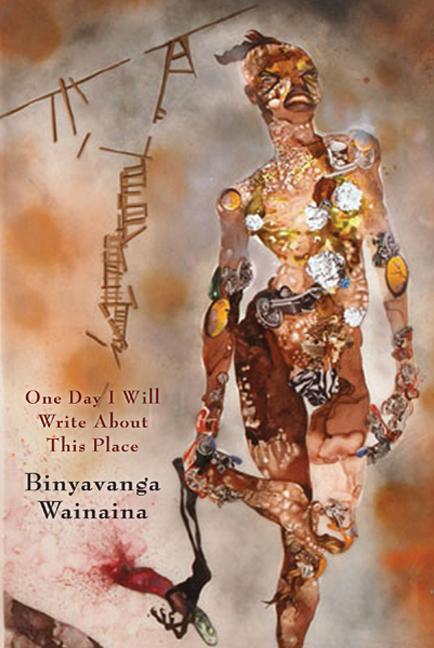
Would you look at this beautiful, complex cover? Very interesting – perhaps overwhelming, or perhaps thought-provoking, depending on your day! I found it a bit intimidating at first but after just a few pages, I feel that it fits the story. This book is a memoir of the author’s life in Africa, and his growth as a writer. My teaser is a good example of what I’ve found, and like, so far. From page 10 (of my pre-publication proof, so pending change before final publication):

…just when your marble is wheeling along, groovily swinging up the walls of your trough and back down again, challenging the edge, whistling and gum chewing and downhill biking and yo-yo bouncy and American – gravel pounded by rain outside your bedroom window becomes sausages frying, and sausages frying can shift and become squirming bloody intestines or an army of bristling mustachioed accordions chasing you, laughing like Idi Amin.

I am finding this a most interesting read.

finished Running the Books and more Burke

Well it turns out that Running the Books gets a resounding endorsement. Author Avi Steinberg started a touch slow, but he grabbed me hard in the end. As our protagonist, Steinberg develops as a character and as a human being as the book unfolds, making some real personal discoveries. It’s a very human story, poignant and forgiving and realistically ambivalent in its eventual conclusions (or lack thereof) about the nature of prisons and criminals. I really enjoyed it.

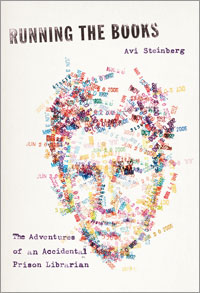
(If you can’t tell in the image at left, his face is made up of lots of date stamps. Like due date stamps. It’s rather an interesting and clever piece of librarian-art if you care.)

I’m now well into another James Lee Burke, The Tin Roof Blowdown, that my mother gave me quite a while ago. That’s the Dave Robicheaux novel set in New Orleans and New Iberia in the aftermath of Hurricane Katrina, and boy, you want to talk about something stark and visceral… putting aside for a moment the beauty that is a Dave Robicheaux novel, the realistic descriptions of Katrina’s destruction are gut-wrenching. The death and suffering, the necessary decisions about who lives, who dies, who a person chooses to save, the morals and ethics involved, the widespread racism, the political neglect, and the gritty reality of the blood and guts and sewage… it’s very real, and those moral dilemmas are evoked expertly. (I expect nothing less of Burke.) This one is grabbing me a lot harder than Cadillac Jukebox did recently. I really like the character of Alafair, Dave’s adopted daughter, too. (Burke has an adopted daughter named Alafair, who like her fictional namesake is also a writer; one wonders where fact meets fiction.) The chasing of the bad guys by Dave and and perennially self-destructive Clete Purcel is as finely wrought as ever, but for me, what’s special about this book is the rawness and realism of Katrina’s destruction. Whew.

I am, as usual, swamped in fine reading material, and don’t think Burke will take me too long, so stay tuned for one of the three books I recently named as coming next! 😉

identifying with the prison librarian

Well, you tell me, does this make me a little nuts, or just mean that Steinberg is a skilled author? It’s occurring to me that our situations are parallel: we both work in “special libraries” (that’s a real term), meaning we’re not in schools, universities, or public libraries. Prisons and hospitals are fairly unique environments. I’m not sure my employer would appreciate the comparison, but both are large institutions, and I have heard my patrons say they feel a little bit like they’re being processed in a machine. I’ve been thanked for using their names instead of 8-digit numerical identifiers. That’s kind of sad. I just had this strange feeling as I walked back from lunch, having reluctantly closed Running the Books, that perhaps it’s weird that I’ve become accustomed to seeing signs on escalators that say “If You Are Feeling Dizzy or Unstable, Please Use the Elevator” and in bathroom stalls that say “If you have had an accident or soiled your clothing and need help, please call XXX.XXX.XXXX.” People here are not necessarily happy to be here. Also, I share with Avi the prison librarian the embargo against connecting with our patrons. There are different reasons – his are a serious security risk, are considered to have lost the privilege of making friends, threaten his job. Mine have a federally protected right to privacy and are going through utterly life-changing events. But they’re all people and we all too easily see ourselves and our loved ones in these strangers. Of course, Avi sees the same people for long periods of time (very much the norm in prison I think) and my people come and go unpredictably (and when they go, I never know why). But I’m getting into this book and identifying with Avi’s workplace conundrums.

a few mysteries and more prison libraries

Well vacation was outstanding and too short as usual. Hope everyone enjoyed. With a total of 22 or so hours on planes and 8 or so hours on trains… I did some reading!

I started with Unhinged, by Sarah Graves, which is “A Home Repair is Homicide Mystery” – one of those specialist mysteries like the quilting or recipe-filled ones, or one of the book-related ones I binged on recently. Pretty interesting as such, but my fear with books of this sort is always that they’ll be sort of simplistic, or rely on their novelty status. This one didn’t do half bad; I was amused and interested and the characters were cute. It wasn’t terribly serious or literary and was definitely a cozy. I might pick up another with the same casual interest for an airplane ride, but it was unremarkable. I’m no home-repair buff, but the related details were light and unobtrusive. Of course if you were a home-repair buff, I’m not sure you’d be satisfied with those aspects.

Next came another Lee Child, One Shot. I am decidedly a fan. I love the Jack Reacher character; those who told me he’d be a good character for me based on my love for Connelly’s Bosch were so right! The fast pace and strong sense of place are great; I stayed up late into the night to finish this one, and have recommended it to the Husband, who likes Connelly, couldn’t get into the more thoughtful pace of Raymond Chandler, and reads just a few pages at a time with long gaps in between, so fast pace is pretty important to him. He likes it so far. One Shot is set in small-town Indiana, which is not an environment I’m familiar with, but Child makes it seem plenty real. I just love the suspense and the loner aspects of Reacher; he has the Bosch characteristics of seeming intolerant of people trying to form relationships, while really being something of a softie inside, though he has trouble giving in to this impulse. Reacher is a little bit of a caricature Rambo-type, but I’m so into it that I don’t mind. I’ll definitely be pursuing this series – and good thing, since I’m all out of Connelly for now.

Finally I picked up the James Lee Burke I found to bring along, Cadillac Jukebox. Classic Burke with Robicheaux going it alone (despite being a member of law enforcement) in renegade cowboy fashion against massive injustice, including the racial and sexual kinds. Clete Purcel makes a few minor appearances, and New Iberia, New Orleans, and the surrounding environs are strongly evoked. Burke writes beautiful, poetic, prose with an appreciation for nature. These are great books. But, I’m noticing that the more time I spend with Connelly and Child, the slower Burke feels to me. His books aren’t slowly paced by any means, but they’re decidedly more leisurely than the other two. Robicheaux is also a bad-boy loner, also with soft spots (the wife in this book is Bootsie and daughter Alafair is present as well), but his self-destructive tendencies almost feel more pronounced to me. Where Reacher is fairly well outside society, completely outside law enforcement, has no ties, and is completely unstoppable in physical combat, Burke is more human and seems to have more to lose. Where Bosch has loyal compatriots in the force and a teflon-like mastery of department politics, Burke feels isolated and more vulnerable. Here in Cadillac Jukebox he gets wrongly accused of sexual assault and is threatened with the loss of his health insurance, both of which somehow feel unlikely with Bosch, who (in the course of the series) leaves and returns to the LAPD without significantly changing his relationship with crime investigation. At any rate, full marks for Burke as usual, but I’m starting to notice that he’s not the perfect counterpart to Connelly I once thought he was – that might be Child – while on the other hand, I just had a patron request Connelly and Burke in the same sentence, so clearly I’m not alone in my tastes!

I was without reading material for the flight home 😦 but I made it anyway, and am now back to Avi Steinberg’s Running the Books and ready to render a verdict on the questions I asked earlier. Not tiresome, but fascinating and engaging! It took long enough, but by halfway through, I’m hooked and anxious to get back into it. The separate story lines have converged, if minimally, but more so, they’re no longer anecdotes but continuing tales involving characters that I really care about. These are real people (literally, but they also feel real) and I mourn them when they die. (This is about prison; not everyone gets a happy ending; just past halfway, I’ve yet to find one happy ending, in fact.) Avi, the narrator, is emerging as a real person with some soulful stuff on the line, too; he gets involved with his inmate patrons and some of the larger issues as well. I enjoyed the tour he takes of past prison and jail buildings and his historical/social/philosophical/literary discussion of them (look for Sylvia Plath). What I called a clever and potentially pretentious writing style I have come to find engaging, contemplative, self-reflective, maybe even slightly poetic. I enjoy the part I’m reading now, about the difference between archivists and librarians, and which of them Avi will turn out to be – bearing in mind he didn’t have a library degree or any background when he took the job, so he’s learning as he goes. I’m giving this book an endorsement, in case you can’t tell.

Stay tuned… next I’m trying to decide between Still Missing by Chevy Stevens, finally starting Larsson’s series with The Girl With the Dragon Tattoo, or getting into the fat Sharon Kay Penman I’ve got looking at me on my desk, When Christs and His Saints Slept. What are YOU reading?

I’d Know You Anywhere by Laura Lippman, and Running the Books by Avi Steinberg

I had some trouble selecting a new book to read over the weekend, and ended up taking home Avi Steinberg’s Running the Books: the adventures of an accidental prison librarian. But before I could get to it, while putting new books up on my new books display, I came across Laura Lippman’s I’d Know You Anywhere, and got involved in it!

I’d Know You Anywhere is about a woman with a pretty good life: husband, two kids, nice house, generally serene, other than her daughter’s beginning to be a teenager. Then she gets a letter from the man, on death row, who abducted, raped, and held her for six weeks when she was 15. Her life is disrupted by corresponding with him, which she feels powerless to avoid. Years of carefully constructed anonymity are threatened.

It was a fun book. I read it almost straight through; it was gripping and interesting; the characters felt like real people. I found a certain theme of family and motherhood, that’s a little new and different to me in the mystery/thriller genre; this was present in Lisa Scottoline’s Look Again as well. I’m not as excited or sentimental about motherhood as some, so this theme could potentially get a bit tiring for me, but in both of these examples the authors have pulled it off. Barely. I’d Know You Anywhere is fast-paced and realistic and raises some interesting questions about victim’s rights and the death penalty, but remains an easy read (it could be a thinker only if you choose it to be). I was glad to spend my time on it.

Then yesterday I got around to Avi Steinberg’s Running the Books. It’s biographical; he’s telling his own story: former Orthodox Jew, then Harvard student, then underachieving freelance obituary writer, finally turned prison librarian. (Whew.) I haven’t gotten very far in, but I’m walking a tightrope: enjoying his clever writing style while worrying that he’s getting a bit pretentious. There’s not much question that there are some interesting stories here, but so far they’re unrelated anecdotes. Let me say this book shows potential to be fascinating and amusing, or tiresome. Jury’s out.

I’m also housing a big, fat Sharon Kay Penman paperback called When Christ and His Saints Slept, and I enjoyed The Reckoning by the same author so much that I’m excited, and hope not to be disappointed since my expectations are so high! So that’s in the queue. Also, I fly to Belgium in just 3 days for a short vacation and will need ratty paperbacks that I can leave behind on the trip. (Not sure Penman’s qualifies for this job.) There’s always more to read…

Enjoy your holidays and please do let me know what you find!