book beginnings on Friday: Walking It Off by Doug Peacock


Thanks to Rose City Reader for hosting this meme. To participate, share the first line or two of the book you are currently reading and, if you feel so moved, let us know what your first impressions were based on that first line.

Doug Peacock was a good friend of Edward Abbey’s, and was the inspiration for the Hayduke character in Abbey’s highly regarded The Monkey Wrench Gang – thus, obviously, my interest in this memoir. It begins:

High in the shadow of Dhaulagiri they are bleeding the yaks. Two Tibetans hold the curved horns of the shaggy beast and a third man uses a wooden bowl to catch the bright red blood that pulses and spills out a hole in the yaks’ neck.

So, a little rough in the beginning if you don’t like pulsing blood! I’m okay though. 🙂 What are you reading this weekend?

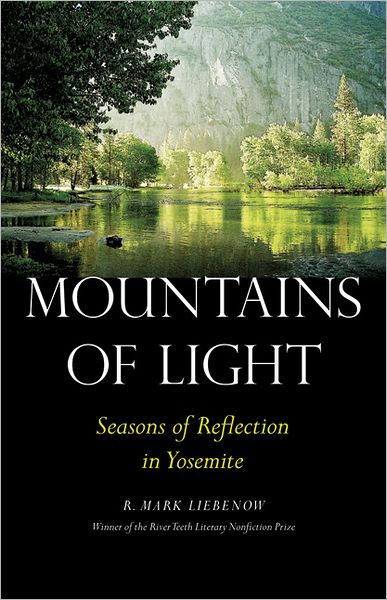
Mountains of Light by R. Mark Liebenow

A quiet, moving memoir of grief and recovery set in the Yosemite Valley.


When his wife of 18 years died, R. Mark Liebenow was overcome with grief. He sought relief by following in John Muir’s footsteps, consulting naturalists, historians, spiritual guides and artists along the way. Mountains of Light covers a year which he spends (in many short trips) in the Yosemite Valley, contemplating the natural world and the significance of death. He is “looking for the mystery of life,” he writes, “even if it can’t be solved but only hiked further into.”

Mountains of Light is lyrical and decidedly literary. Liebenow’s focus drifts: he describes a mountain vista, waxes mystical about the roles that insects and waterfalls and clouds play in the universe, quotes poetry (and Muir), confers with cutting-edge science and remembers his late wife. He includes morsels of history (particularly of Yosemite, from Native Americans through the Mariposa Battalion to the present) and catalogues plant and animal life. He considers various religious and spiritual understandings of nature and death and the mountains, mulling over his options for accepting his tragedy. The background for all this musing is dynamic, as Liebenow takes challenging hikes, explores, gets lost in the wilderness and watches his fellow campers and mountain climbers take still greater risks. The scenery changes drastically in four seasons, which Liebenow interprets metaphorically.

Part travelogue, part natural study and part memoir of grief, Mountains of Light is meditative, lovely, thought-provoking and, yes, sad–but worth it for the appreciation of this natural gem and the redemption it brings.


This review originally ran in the March 9, 2012 issue of Shelf Awareness for Readers. To subscribe, click here, and you’ll receive two issues per week of book reviews and other bookish fun!


Please note that this book makes a fine readalike for Fire Season or Edward Abbey’s Desert Solitaire. And look at that lovely cover, too!


Rating: 6 moments of contemplation.

Papa: A Personal Memoir by Gregory H. Hemingway

Gregory Hemingway, known as Mr. Gig or Gigi to his family, was Ernest Hemingway’s youngest of three sons; his mother was Pauline, Papa’s second wife. This is his memoir of his father, and it begins and ends with Papa’s suicide, and the ways in which that trauma shaped Gigi’s life. It is a short but monumentally touching and surprisingly well-written book; I think it is the most moving biography of Papa (who, presumably, you know I adore) that I have read. While Gigi does relate several of his father’s uglier moments, including crimes against his son, he emphasizes Papa’s humanity and good qualities. The story told here seems to be of a fundamentally good man who got sicker and sicker at the end – though I think he always struggled with mental illness, from being cross-dressed as a toddler through pursuit of success, fame, and the fading of his talent – and fell apart. There are other perspectives out there; many biographers and commentators see Hemingway as a monster, and I accept that that is one perspective, and has evidence to back it up. But I’m always drawn to the outlook that he deserves our pity for the illness he struggled with that finally killed him; and that is more what we get here.

Gigi tells heartwarming stories, and some bad ones (like Papa blaming Gigi for Pauline’s death). He shows what good advice Papa gave; he was a good teacher. He addresses some of the myths surrounding his larger-than-life father, even though he is often unable to refute or confirm them because he was so small (or living with his mother). And it’s all so beautifully done! Who knew Gigi was a bit of a writer, himself? (Make note of the tale of his plagiarized short story, back when he still hoped to follow in his father’s footsteps.)

To me, one of the most poignant things about this slim memoir is our present knowledge of where Gigi went from here. At the time the book was written, he was a practicing physician and still married to Valerie (whose own memoir of Papa I have on my shelf waiting for me). He would later divorce Valerie (after some 20 years of marriage) and go on to two more marriages; become a cross-dresser and take steps toward a sex change; lose his medical license; battle alcoholism; and finally die in a women’s jail in Miami. In his book, there is a general tone of “look at me, I’ve come this far” – not bragging so much as in relief to have resisted the darkness for this long. He seems to have a positive attitude. But there is also quiet acknowledgement, here and there, of the sinister element within himself that he has worked to resist. This same subtle awareness of the darkness inside is present in Papa’s work beginning at a young age, and the youngest son Andrew in Islands in the Stream, clearly modeled on Gregory, has a “badness” in him as well. The descriptive passage about Andrew, in fact, is quoted at the beginning of this book, before Norman Mailer’s (excellent) introduction, implying that Andrew’s darkness as well as Papa’s and Gigi’s is acknowledged by all the parties.

This book was like a gift to me from yet another tragic Hemingway man. It gave me lovely, appealing moments with Papa, as well as those ugly moments in which he could be so vicious. It was beautifully written. I loved getting to know Gigi better; he struck me as a very likeable, sympathetic man. But it was also sad, as reading about the Hemingways always is.

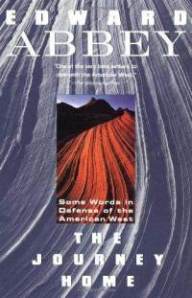
The Journey Home by Edward Abbey

This is why we read Ed Abbey. He has the power to make me laugh and cry within a few pages.

I cannot describe The Journey Home better than Abbey does himself: this book is a collection of “adversary essays and assays, polemics, visions and hallucinations… published piece by piece in various odd places from Audubon to the Vulgarian Digest” and “fragments of autobiography, journalistic battle debris, nightmares and daydreams, bits and butts of outdoors philosophizing” (from Abbey’s introduction). The subtitle is “Some Words in Defense of the American West.” It works very well in the ways he describes: it is indeed a defense of the American West (although as he puts it another way: “the idea of wilderness needs no defense. It only needs more defenders”). It is a lovely collection of some journalism, some hallucinations and dreamings, and some eloquent essays.

The introduction to The Journey Home is devoted to arguing why he is not a nature writer; he’s just a guy with a lot of experience in and love for nature, writing a memoir that naturally includes a lot of nature. I hope he would forgive me, were he still here, for saying: Abbey, you are a nature writer. Memoirs they may be (and watch out for his novels, too: I loved Fire on the Mountain; was disappointed by Black Sun which apparently he really loved; and am excited to crack open his best-known and arguably movement-starting The Monkey-Wrench Gang) but they are also some of the finest nature writing we’ve seen. His own arguments notwithstanding, Abbey absolutely belongs in the company of Thoreau and Muir. I recognize so much of what I, and modern authors and political thinkers and philosophers I admire, have thought and felt and written, in Abbey’s earlier work. He is important.

He is also so angry! He can be so funny, so flippant and casual (Husband and I both laughed til we cried over “Disorder and Early Sorrow”), but so angry, too. Rightfully so, of course, in detailing strip-mining operations and the destruction of the woods he played in as a kid. He is a contradiction; he reminds me very much of a much-loved friend who will recognize himself in this review. He throws beer cans out the window as he drives:

Rumbling along in my 1962 Dodge D-100, the last good truck Dodge ever made, I tossed my empty out the window and popped the top from another can of Schlitz. Littering the public highway? Of course I litter the public highway. Every chance I get. After all, it’s not the beer cans that are ugly; it’s the highway that is ugly. Beer cans are beautiful, and someday, when recycling becomes a serious enterprise, the government can put one million kids to work each summer picking up the cans I and others have thoughtfully stored along the roadways.

(from “The Second Rape of the West,” which deals not with beer cans on highways but strip-mining for coal, among other large-scale littering operations.)

…but is at the same time an ardent defender of wildness and nature, left alone. He advises a leave-no-trace approach to wilderness, packing out trash, dismantling fire rings, because after all, “the search and rescue team may be looking for you.” (That’s the wilderness, as opposed to the public highway.) He’s so incredibly (sadly) relevant today, only dated in some of the little details. He is poignantly hopeful; I regret the ways in which we’ve not lived up to his hopes in the few decades since he wrote. For example, our US Census in 2000 unfortunately showed our national population at 281,421,906 rather than the 250 million at which Abbey predicted we would “level off,” and we are now estimated at not quite 313 million.

Funny, angry, righteous, well-researched, poignant. A priceless glimpse into a fascinating, contradictory personality, and a moment in American time that will never be replicated. I want nothing more, after reading this book, than to go on one of his ill-conceived and poorly-planned backcountry trips with him. He makes me think – he makes me think in ways that we all desperately need to think, even more so today than when he wrote (original pub date 1977). I challenge you to read of his attempt to shake hands with a mountain lion (in “Freedom and Wilderness, Wilderness and Freedom”) and not get goosebumps.

In the end, this is a collection of essays and ramblings by a gifted author who loved our natural world, about small things as well as the big issues, like why we shouldn’t destroy what little of it we have left. I found it incredibly moving (again: I laughed and cried) and beautiful and can’t wait to read more Abbey. I only hope he’s right that

If man in his newfound power and vanity persists in the attempt to remake the planet in his own image, he will succeed only in destroying himself – not the planet. The earth will survive our most ingenious folly.

I’m afraid we’re going to push the point.

Teaser Tuesdays: Mountains of Light by R. Mark Liebenow

Teaser Tuesdays is a weekly bookish meme, hosted by MizB of Should Be Reading. Anyone can play along! Just open your current read to a random page and share a few sentences. Be careful not to include spoilers!

Mountains of Light: Seasons of Reflection in Yosemite is a lovely contemplative book, both reminiscent of and different from my 2011 favorite, Fire Season. My review will come closer to the book’s publication date of March 1, but here’s a teaser for you now.

I lower my expectations for how glorious this dawn will be, wanting to regard whatever happens as a grace. To borrow a Japanese Buddhist image, I must empty my begging bowl in order to receive not what I think I need but what is being offered, and to regard whatever comes as oryoki–just enough.

Isn’t that a lovely image and concept? And it gives a glimpse into the tone of the book.

This quotation comes from an uncorrected advance proof and is subject to change.

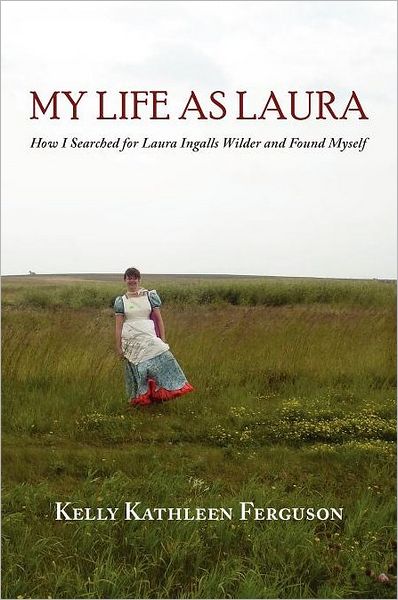
My Life as Laura by Kelly Kathleen Ferguson

Kelly Kathleen Ferguson grew up in the belief that she was Laura Ingalls’s long-lost twin, or perhaps her reincarnation; she was bored and frustrated by her suburban upbringing and longed for the simplicity, beauty, and utility of the world of the Little House books. After earning an English degree and attempting to be a rock-n-roll star, she ended up waiting tables… for decades. At thirty-eight, unhappy with work and her love life and feeling like a failure, she sets out to follow in her hero’s wagon tracks across the United States, visiting the sites of the various Ingalls homes as represented in the books. My Life as Laura is the story of Ferguson’s travels, and her reflections on her own life and what lessons she can learn from Laura.

She dons a “prairie dress” (which mostly makes her miserable, but occasionally helps her get into the spirit of things) and drives her Camry west. Laura’s home sites sometimes feature the preserved original structure, sometimes a replica or a monument to the location; sometimes tours are available; but they seem to always feature a gift shop. Ferguson’s most adventurous moments involve interacting with hotel and gift shop staff while wearing her period costume; but these conversations are generally perfunctory. She spaces out during tours, but reads a few books purchased in the gift shops and learns more about the object of her admiration – like the disturbing news that there is some question as to Laura’s authorship of the books, and the level of her daughter Rose’s involvement. Ferguson discovers that, while she’s a first-class expert on Laura the character of the books, she really didn’t know Laura the (arguable) author of the books very well.

Nothing much happens in this book. If you’re looking for adventure, experience, the trying of new things (or any attempt to live the Ingalls’ nineteenth century lifestyle), look elsewhere. Rather, what action there is is inward-looking, as Ferguson contemplates and picks apart her own past through the lens of Laura’s experiences. At the end she has made some personal growth and undertaken to write a book (ta-da!). The changes she makes to her life are modest, but she’s honest about what she’s able to take on.

This book has its strengths, humility and honesty being chief among them. But I was disappointed with the action component, and had expected more brave and outgoing feats than registering for a hotel room in an odd dress and subsisting on junk food. It didn’t feel like Ferguson’s boundaries were expanded much, even in a cross-country solo road trip. Perhaps the greatest downfall of the book was Ferguson’s success in convincing me of her own weakness and tendency towards failure. I feel badly writing that, but it was my reaction; I don’t mean to be unkind, but she had me talked into the thesis of her underachievement. Also, I have to note her repeated reference to the Amish driving around in their minivans. In nonfiction especially, that kind of sloppy error really stands out to me. [The Amish don’t drive cars.]

In conclusion, this book has a mild feel-good effect, and there are certainly some positive reviews out there. Ferguson is always brutally honest about her own weaknesses, and I respect her for it. But its lack of action and growth, and a few sloppy details, left me decidedly lukewarm.

I received a copy of this book from the author and I’m only sorry I didn’t have a more positive reaction to it.

book beginnings on Friday: My Life as Laura by Kelly Kathleen Ferguson

Thanks to Katy at A Few More Pages for hosting this meme. To participate, share the first line or two of the book you are currently reading and, if you feel so moved, let us know what your first impressions were based on that first line.

Today I’m giving you the beginning of My Life as Laura, a memoir of Kelly Kathleen Ferguson’s journey in the footsteps of Laura Ingalls Wilder as given in her Little House books. She begins:

I admit that the origin of the dress mandate was fuzzy at best. All I can say is the instant I decided to retrace the pioneer journey of Laura Ingalls Wilder, I knew I would wear a Laura dress.

And thus we meet the dress and begin the journey. I’ll keep you posted!

What are you reading this weekend?

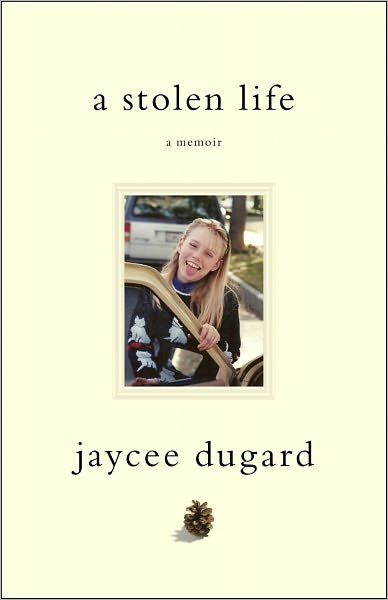
A Stolen Life by Jaycee Dugard

Jaycee Lee Dugard was kidnapped while walking to school in 1991. She was 11 years old. She was held by her captor, Phillip, and his wife Nancy, for 18 years, until 2009, when she was discovered very much by accident. By this time she had two daughters, products of Phillip’s repeatedly raping her while she was in captivity. This is her memoir.

She begins with her childhood, briefly; she grew up in California and then moved to Tahoe with her mother, new stepfather, and baby (half-)sister. Then she was kidnapped. Phillip was a sex offender on parole; he had two small sheds, and eventually a series of tents, built in a “secret” backyard, hidden by fencing and foliage, where he kept Jaycee and her daughters. Nancy was complicit in his crime. Jaycee was so young when she was kidnapped, lived with Phillip for so many of her formative years, that she was very confused – some would say “brainwashed” I suppose. She knew he was bad, that he hurt her, that what he did was wrong, but she was also convinced that he was trying to protect her and her girls, that the world out there was bad and frightening. In her increasing freedom, she may have been able to escape or to ask for help from the outside world, but she was confused and scared. When she was finally rescued and her true identity known, it took quite a bit of adjustment and therapy to help rebuild her family (her mother, sister, and aunt were very supportive when finally reconnected) and adjust to the larger world. She always loved animals, placing great store in pets – and she was eventually allowed to keep a small menagerie in Phillip’s backyard. Now, she has established a foundation (the JAYC Foundation, which stands for “Just Ask Yourself to Care”) to help families recover from trauma, using animal therapy.

Jaycee’s memoir is, most obviously, heart-wrenching and horrific and tragic; I don’t need to explain that aspect to you. It is also very raw and real. Jaycee has only a 5th grade education, and this book appears to have gone straight to print from her own rough writing. It is full of run-on sentences, fragments, ramblings that change tense throughout, grammatical errors, etc. I found this distracting at first, but ultimately I can’t help but respect how fully and authentically she’s put herself out there. The decision to publish her memoir must have been a difficult one. She speaks of wanting to publicize the bad things that Phillip and Nancy did, to not let them get away with it (or get away with thinking it was okay, or that Phillip was a victim – ugh). Also, some proceeds from the sale of the book go to the JAYC Foundation.

She tells her story very candidly and discusses her feelings very candidly. It has rather a different feeling than most memoirs you’ll find; it reads like a journal, unpolished. But again, once you get used to it, it makes for a unique experience.

What led me to pick this book up, you ask? I’m still wondering, myself. I felt a little weird reading it: voyeuristic, prurient, icky. I guess it’s the same as the train wreck you can’t look away from. My heart certainly goes out to Jaycee. She works very hard to stay positive and hopeful, and states that she doesn’t harbor hatred for the people who’ve done this to her; she doesn’t have time for hate, it’s wasteful, she wants to move forward and live and think positively. Good for her. She’s definitely still innocent, inexperienced, and lacking in formal education. But I’m impressed with her attitude, and she seems to have a really excellent support system in place; her family sounds great. I think she’ll be okay; she certainly has my best wishes.

This was a quick and easy read, and good for helping us be grateful for what we have in life (to put it mildly).

Teaser Tuesdays: A Stolen Life by Jaycee Dugard

Teaser Tuesdays is a weekly bookish meme, hosted by MizB of Should Be Reading. Anyone can play along! Just open your current read to a random page and share a few sentences. Be careful not to include spoilers!

A Stolen Life is Jaycee Dugard’s memoir of trauma. Remember Jaycee? She was kidnapped from Tahoe in 1991, at 11 years old, and discovered 18 years later (18!) still living in captivity and with several children. It’s a shocking story. I’m not sure what makes me want to read about this; am I sick? But I found a copy and picked it up. Let me warn you: Jaycee wrote this book herself and apparently without much editing; it is implied that it was important to her to tell it her own way. I find it a little bit distracting to read, because there are numerous errors of grammar, sentence structure, and just sort of simplistic writing. But I’m ultimately okay with it; it feels very authentically like Jaycee’s own voice, and I guess that’s what I came for.

Here’s your teaser:

Today I sometimes struggle with feelings of loneliness even when I am not alone. I think this feeling began in that room Phillip put me in. Hours turned into days, days to weeks, and weeks to months and then years. I have spent a lifetime alone, or so it seems to me sometimes.

Not surprisingly, this is a sad and painful book. But she is very positive and hopeful in her message, too. I wondered at her choice to write a book – and she says she didn’t intend to at first. But the proceeds go to a foundation she’s put together, to help families recover from trauma. It ultimately feels like a brave thing she’s done.

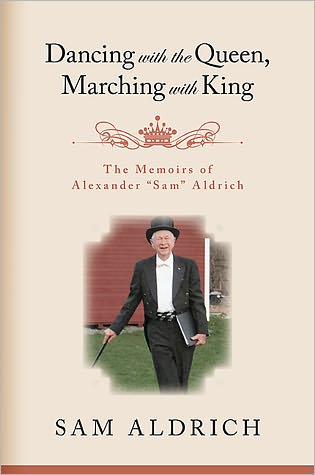
did not finish: Dancing with the Queen, Marching with King by Sam Aldrich

I was sent a galley copy of this book for review, but was not able to stomach it.

Alexander “Sam” Aldrich was born a blue-blood in New York state, silver spoon and all. He received a good classy upbringing, but pursued more philanthropic goals than just earning money as I believe was expected of him. He worked as a lawyer, then in city and state government. His book begins with an explanation of the title: first, a brief account of having danced with the Queen of England at age 25, and then a several-chapters-long narrative of his experience marching with Martin Luther King, Jr. from Selma to Montgomery, in his thirties. In telling of the march on Montgomery, Aldrich is at his strongest; his passion and indignation at injustice comes through. And although I looked carefully, he never claimed to have fully grasped what it was like to be a poor black man in Alabama in the 1960’s.

Throughout, Aldrich’s writing is very poor. He’s clearly writing as he talks; it’s conversational; but it’s also full of grammar mistakes, run-on sentences and the like. A conversational style can be endearing and casual, but this came across as amateurish; surely the State University of New York Press wants to keep its name clearer than this. Yes this is a galley copy, but I’m not talking about a few typographical errors that will be corrected in copy editing; I’m talking about a writing style that made my skin crawl.

Aldrich’s story fell short for me quickly. I made it about halfway through the 270ish pages and felt bored. I fear that the Selma to Montgomery march may have been his greatest moment, and if so, he may have done better to not let it go in the first few chapters. I think his claim to fame is his refusal to be a standard rich guy, but what he did instead did not strike me as so remarkable as to keep this book afloat.

The final straw was reference to the outing, blacklisting, and harassment of communists in the 1950’s, which I thought we were done being proud of; but this 2011 publication toes the McCarthyist party line perfectly. I had been peering suspiciously sideways at Aldrich’s semi-concealed conservative agenda, and coming across this ugliness was the end for me.

Final verdict? I can’t entirely judge, of course, having been unable to even finish the dern thing; but my impression is: a poorly written memoir of a semi-remarkable life, with a partially-concealed political agenda that I personally find abhorrent. Not for me.