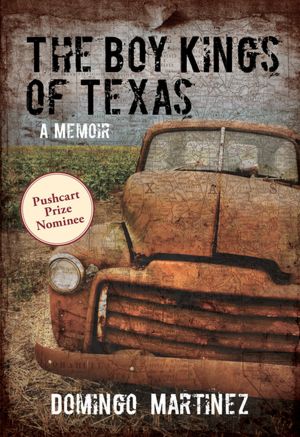
The Boy Kings of Texas by Domingo Martinez

A starkly honest memoir of growing up on the Texas-Mexican border in the 1970s and ’80s, with a wry twist.


Domingo Martinez was born in the early 1970s in Brownsville, Texas, on the Mexican border. His youth was marked by violence and family drama; he grew up wanting only to escape, but unsure how to do so. The Boy Kings of Texas introduces readers to Martinez’s embarrassing, philandering father; his terrifying, work-obsessed grandmother; his older sisters (two of whom successfully pose for a short time as rich white girls); his generally forgotten mother; and centrally, his older brother, Dan. (There’s also the passed-down story of his grandfather, who died young–a Mexican criminal celebrity recalled as the Brer Rabbit, the Billy the Kid, the Rhett Butler of his day.) Martinez describes in glaring, painful detail his drug-dealing friends and family–one time, he bought pot from two local thugs who turned out to be his uncles but who didn’t recognize him through their drug-induced haze–and his gradual, excruciating withdrawal from Texas and the life he’d always known.

The Boy Kings of Texas eventually follows Martinez to Seattle and his agonizing attempts at starting fresh there, handicapped by a misguided childhood whose dominant lesson was machismo at the expense of all else. While a final, happier ending is hinted at (“but that is another book”), this memoir is concerned with the deep distress of a bordertown kid unclear on his place in the world. Martinez’s story is heartrending and uncomfortable, but he maintains a surprising sense of humor that keeps his reader cringing and rooting for him.


This review originally ran as a *starred review* in the July 3, 2012 issue of Shelf Awareness for Readers. To subscribe, click here, and you’ll receive two issues per week of book reviews and other bookish fun!


Rating: 5 tortillas.

book beginnings on Friday: Before the Rain by Luisita Lopez Torregrosa

Thanks to Rose City Reader for hosting this meme. To participate, share the first line or two of the book you are currently reading and, if you feel so moved, let us know what your first impressions were based on that first line.

Before the Rain: A Memoir of Love and Revolution has one of the more impressive opening lines I’ve come across lately. I’m very glad to be able to share it with you!

In the years since that first letter came, postmarked NEW DELHI and written on pale lavender Claridge’s Hotel stationary, I have begun this story a hundred times, and each time I was afraid.

I find that lovely in that it says a great deal, piques the curiosity, and introduces the narrator, all at once; it also has a certain lyricism to it. I don’t know about you, but I now want very much to know what was in the letter and why it is a frightening story to tell. She next increases the suspense by taking two steps back in time and detailing scenes and characters unrelated to the lavender letter. I’m enjoying this one so far.

What are you reading this weekend?

This quotation comes from an uncorrected advance proof and is subject to change.

Bossypants by Tina Fey (audio)

This book has been out for a little over a year. What took me so long? Thank you, fellow bloggers who raved about this book, for finally getting it into my ears. As others have said before, get the audiobook! It does make it slightly cumbersome to go find your pdf file to see the pictures she refers to; but it’s so worth it to hear her make her jokes herself.

Tina Fey is a funny lady. This I knew, and I looked forward to the laughs, which are there in abundance. But what I hadn’t entirely expected was the more serious handling of issues like a woman’s place in male-dominated industries – which was silly of me, because Tina Fey does address issues. She tells stories about her own upbringing, her youth, her discovery of acting and comedy, her time spent at SNL, the creation of 30 Rock, her honeymoon, motherhood, and more. She is always classy in her discussion of other celebrities or folks from the industry: any criticisms are well packaged in understanding and explanation, while she mostly praises her colleagues in glowing and meaningful terms. She doesn’t just call everyone talented and charming – she gives thought-out, complex, positive evaluations. And any time she has dirt on someone, she leaves that someone entirely cloaked in anonymity (“the letters from their names are sprinkled randomly through this chapter”). I never got the impression she was being less than honest, because she still made her criticisms, but she was always respectful of the people she has worked with, and that impressed me.

Tina analyzes the challenges that face a woman in a position like hers, breaking into a field that (in her early days especially) was thought to be men’s work, and she does so fairly. For example, she writes (narrates) a funny and wise anecdote about the moment that she realized that she was experiencing, not institutional sexism, but a sheer male ignorance of menstruation and “feminine hygiene.” And she gives good advice.

She is also hilarious, and wise, about women’s fashion and body image, and the culture of Hollywood, modeling, and television. In the chapter entitled “Amazing, Gorgeous, Not Like That,” she describes a “typical” magazine photo shoot in great detail. I found the scenes regarding hair and makeup especially exotic, weird and different. I’m pretty far from a fashion photo shoot, myself.

This book was great fun and very funny, as you might expect; but as you might not have guessed right off (I didn’t), it also makes some good, serious points. There’s some well-stated feminism to be found here amid the good times. Highly recommended, and as many others have said before me, do get the audio version.


Rating: 7 pairs of Tina Fey glasses.

book beginnings on Friday: Bossypants by Tina Fey

Thanks to Rose City Reader for hosting this meme. To participate, share the first line or two of the book you are currently reading and, if you feel so moved, let us know what your first impressions were based on that first line.

I am coloring outside of the standard and accepted “book beginnings” lines here, because just beyond the first two sentences Tina Fey gives us our first giggle, and I thought that was worthwhile.

Welcome, friend! Congratulations on your purchase of this American made, genuine audio book. Each component of this audio book was selected to provide you with maximum audio performance, whatever your listening needs may be. If you’re a woman and you bought this audio book for practical tips on how to make it in a male-dominated workplace, here they are. No pigtails. No tube tops. Cry sparingly. Some people say, never let them see you cry. I say, if you’re so mad you could just cry, then cry. It terrifies everyone. When choosing sexual partners, remember, talent is not sexually transmittable. Also, don’t eat diet foods in meetings.

And that, friends, is a great sample of what this book is: punchy, pithy, and containing some good advice, actually, amid the giggles. I heard it far and wide – good book, excellently narrated by the lovely talented Ms. Fey – and I think I’m going to add my voice to the chorus. Check it out, kids! Happy Friday!

book beginnings on Friday: The Boy Kings of Texas by Domingo Martinez

Thanks to Rose City Reader for hosting this meme. To participate, share the first line or two of the book you are currently reading and, if you feel so moved, let us know what your first impressions were based on that first line.


The Boy Kings of Texas is a memoir by a man who grew up in the barrios of the Texas-Mexico border. It begins:

They were children themselves, my mother and father, when they started having children in 1967 on the border of South Texas. Dad had just graduated from high school and in a panic asked my mother to marry him because he wanted to avoid the Vietnam War draft. Mom had eagerly agreed, in order to escape something even worse.

And so we get right into it. While not necessarily a comfortable book, it feels authentic to me, and I’m enjoying it.

This quotation comes from an uncorrected advance proof and is subject to change.

Teaser Tuesdays: Racing Through the Dark by David Millar

Teaser Tuesdays is a weekly bookish meme, hosted by MizB of Should Be Reading. Anyone can play along! Just open your current read to a random page and share a few sentences. Be careful not to include spoilers!

David Millar is a veteran professional bike racer who has raced in all the biggest events – the Vuelta, the Giro, the Olympics, and the Tour de France where he’s worn the yellow leader’s jersey. This memoir tells the story of his childhood discovery of the sport he loves, his journey upwards through the professional ranks, and his eventual bust for doping – and then his comeback to the sport, as a “clean” racer. It’s an emotional and unfortunately relevant topic for any fan of professional road racing. Here’s a teaser for you.

After winning Denmark, it would have been reasonable for me to think that I didn’t have to go to Italy, that if I worked hard and put my head down and believed in myself, I could win the Vuelta prologue – clean.

Perhaps if I’d had people – somebody – around me whom I could have talked to about it, then that might have been the conclusion I’d have come to and I’d have canceled the trip to Tuscany.

This is an example of the problem Millar describes as a lack of support for those racers trying to stay clean. He stops short of blaming his decision to dope on pressure from the sport or his team; in fact, he receives very little direct pressure. But the culture surrounding him, so nonchalantly accepting of doping, as he portrays it, makes it difficult for him to resist at a certain point, and no one supports his attempt to stay clean. There is definitely a discussion point here about the meaning and power of peer pressure, alongside the ever-looming question of “clean” competition vs. doping in sports and cycling in particular… I will say for now that Millar never struck me as making excuses. Review to come after this book’s US publication date. [Note: this book has been out in the UK for almost a year. US pub is this June.]

This quotation comes from an uncorrected advance proof and is subject to change.

A Queer and Pleasant Danger: The True Story of a Nice Jewish Boy who Joins the Church of Scientology and Leaves Twelve Years Later to Become the Lovely Lady She is Today by Kate Bornstein

A radical gender theorist and performance artist’s memoir makes its eye-catching subtitle look staid.


Kate Bornstein started life as Albert, a Jewish kid on the Jersey shore who knew when he was four and a half years old that he wasn’t a boy. Bornstein’s path was predictably complicated from there, but the lengthy list of problems she lists in her prologue astounds: she suffers from leukemia as well as anorexia, borderline personality disorder, post-traumatic stress syndrome and a history of cutting; she’s a sadomasochist, a transsexual and a former member of the Church of Scientology. Furthermore, A Queer and Pleasant Danger states from the outset its purpose of hopefully someday introducing Kate to her daughter and grandchildren, currently estranged.

If this list of disorders and minority statuses sounds alarming, never fear. Bornstein is funny, flippant, irreverent and witty. We follow Albert as a child in Jersey, a student at Brown, post-graduate studies in theater at Brandeis and the search for meaning that brought him to Scientology; then on his journey to become Kate, through a new life in San Francisco, Seattle and finally New York, with a series of relationships of every arrangement imaginable (and unimaginable). She generally has a good time, especially after becoming Kate, and her story ends on a positive note. Her tone is most serious in discussing the world of Scientology, which she presents as decidedly distressing and wacky, but her voice overall is impertinent and great fun. A Queer and Pleasant Danger is not for the faint-hearted, for reasons that become fairly evident (see: sadomasochism), but is ultimately uplifting, hopeful, even joyous–and always droll.


This review originally ran in the May 11, 2012 issue of Shelf Awareness for Readers. To subscribe, click here, and you’ll receive two issues per week of book reviews and other bookish fun!


Rating: 6 upheavals.

did not finish: The Bar Mitzvah and the Beast by Matt Biers-Ariel

I tried to read this on my trip to Ireland and gave up. Just a few brief notes as to why.

Backstory: the author’s son, at twelve, states that he will not be having a bar mitzvah because he is an atheist. The author still wants him to have a coming-of-age event, and suggest a cycling trip cross-country. Mom, Dad and both sons (the younger is 8 and will ride on the back of his dad’s tandem) start planning, and undertake a cause to attach to the trip: they will ride to Washington, D.C. gathering signatures on a petition to do something about global warming. My interest, of course, is in the cycling angle.

But Biers-Ariel failed to make me care about his admittedly heartfelt and well-meaning journey. The hope for anti-global-warming legislation is sympathetic, but a bit naive. Prosaic prose, simplified concepts, and jokes that fell flat wore on me; I read 53 pages, didn’t care what happened next, and was annoyed by author’s voice, but I wish him well. Did the family make it? You’ll have to read the book to find out for yourself.

Walking It Off by Doug Peacock

My path to this book feels so very obvious: I have become a big fan of Edward Abbey, and of The Monkey Wrench Gang, and it seems a very natural step to pick up Walking It Off. Peacock was one of Abbey’s closest friends, viewed him as a father figure of sorts, and this memoir focuses in part on their relationship, which was made pricklier by publication of The Monkey Wrench Gang: Peacock was the model for the hero-character George Hayduke, making Peacock a cult figure unto himself. Therefore nothing could be more natural, as I read up on Abbey and his ilk, than to read Peacock. I wonder how many people come to Walking It Off on other paths? There are other paths, of course. First of all, I must give Peacock credit for being a gifted writer himself; it’s not just that he has a powerful story to tell. Nor is Abbey the only object of consideration here; another subject is Peacock’s experience as a Green Beret in Vietnam (which he shares with Hayduke, of course) and the PTSD he suffers ever after. And finally, it is a lovely piece of nature writing, and a contemplation of death – not for the first time am I reminded of Hemingway, who like Abbey spent much time and ink meditating on the meaning of death, preparation for a “good” death, and considering suicide.

The subtitle of this book is “A Veteran’s Chronicle of War and Wilderness,” and that it is. Abbey is a thread that Peacock picks up and puts down, but more constantly, we follow him through wilderness walks and his process of trying to live with what he experienced in Vietnam. I would not have thought that there would be such a connection between war and wilderness, but it makes sense now that I’ve read this book.

After my war, home was the Rocky Mountains. I wasn’t looking for grizzlies but found them anyway. What was invaluable was the way the bears dominated the psychic landscape. After Vietnam, nothing less would anchor the attention. The grizzly instilled enforced humility; you were living with a creature of great beauty married to mystery who could chew your ass off anytime it chose.

Over the course of this memoir, Peacock walks and camps in various wild spaces; we jump around in time, revisiting a mountain-climbing trip in Nepal that nearly killed him. We revisit Abbey, too; early on, Peacock describes Abbey’s death in a fair amount of detail, and the burial, and the conflict of not wanting to let go of a dearly beloved friend who was more ready for his own death than Peacock was ready to lose him. Later, he remembers Abbey, reads some of his journal passages for the first time, and finally, many years after its publication, he struggles to read Hayduke Lives!, the sequel to The Monkey Wrench Gang. But it turns out that Abbey plays a smaller role than I had perhaps expected, and that is more than okay, because this book has so much to offer. I’m doing my own considering of wilderness, its value to us urbanized humanfolk, and the appropriate treatment of our natural spaces, and Peacock gave me still more to think about. From Aldo Leopold’s A Sand County Almanac:

All conservation of wildness is self-defeating, for to cherish we must see and fondle, and when enough have seen and fondled, there is no wilderness left to cherish.

Which is a very fair point about limiting our use. From Peacock:

You don’t visit the Grizzly Hilton for the salve of gentle nature, a relief from your real life at the office. Here, you live within the land with all its creatures; you engage with it. You have no choice in this realm but to enter the ancient flow of life. This is not the sort of place to compose a wilderness journal of self-reflection.

The Grizzly Hilton is Peacock’s name for a tiny haven of perfect grizzly habitat that he likes to visit; his first book was the result of many years studying the bears, called Grizzly Years and recommended by Phil Connors. Virtually all the action in this book takes place in wilderness areas, on wilderness walks, most of them solo; it’s only inside Peacock’s head, in his contemplation, that we see war, Abbey, other options. We see his first marriage end, and we see him struggle to be the best father he can be. Peacock is a difficult character, a difficult man. How much of this we attribute to the PTSD is I suppose a cause for debate; I would imagine a lot, but perhaps it’s a moot point.

The aging warrior was weary of his own predictable behaviors and emotional tightness fueled by senseless rage. I detested this legacy of anger and, aware that its deeper roots lay in war, knew it wouldn’t be easy to shake. I wanted to stalk this elusive center, using my primitive tools of self-examination – walking, solitude, wildness – to reach back in and touch the source of my wound. Of course I was a poor candidate for a meditative life. My life was a catalogue of psychotic twitches and addictions: official government-sanctioned post-traumatic stress disorder, a combat disability, borderline attention deficit disorder, marginal Tourette’s syndrome, occasional depression, a borderline schizoid paranoiac, a history of alcohol abuse. Guys like that don’t become Zen masters.

But it’s funny, because in a way he does offer Zen. Peacock’s musings on wilderness are thoughtful, beautifully composed, and rooted in history, considerate of ancient cultures and of differences. This is an intelligent book, a lovely consideration of war and its ugliness and also nature and its beauty – and, as a necessary corollary, the ugliness again of humans’ and industry’s effects on nature. Walking It Off is Peacock’s continuing quest for redemption and peace. It is much better than I expected, and I recommend it.


Rating: 9 grizzly bears.

When Women Were Birds by Terry Tempest Williams

Terry Tempest Williams’s thoughtful, melodious meditations on the contents of her mother’s journals.


Terry Tempest Williams (Leap, Refuge, etc.) approaches a very personal subject in When Women Were Birds. The opening scene sets the stage: Williams’s mother, on her deathbed, directs Williams to her journals (of which the author was unaware). They turn out to be empty–and the rest of the book is a series of ruminations on this mystery.

Williams contemplates the meaning of a person’s (or more specifically, a woman’s) “voice,” in the sense in which a writer might use the term and in its more literal sense. She contemplates mothers and daughters and the meaning of their relationship, sharing some of the traditions of her own family and of the Mormon faith in which she was brought up. She also shares anecdotes from her marriage, so that the book follows her (in nonlinear fashion) from her foremothers through her childhood and into the present. There are lots of women in this book, as well as lots of birds. Williams touches on serious topics–including abortion, environmental activism and ax murderers–but always with a respectful, quiet, lyrical tone.

Often as much poetry as prose, and full of lists, quotations and letters, When Women Were Birds is truly a tribute to several generations of the strong, inspiring and interesting women of Williams’s tribe. It is a loving creation, showing all the musical, reflective intelligence we expect from Williams, and a lovely example of her own voice.


This review originally ran in the April 20, 2012 issue of Shelf Awareness for Readers. To subscribe, click here, and you’ll receive two issues per week of book reviews and other bookish fun!


Rating: 7 pagesofjulia.