A River Runs Through It, and other stories by Norman Maclean

riverNorman Maclean is a poet and a genius. Annie Proulx’s foreword, and Macleans’ own acknowledgements, had me spellbound from the first moments; even before I began the first of three stories, I had to put the book down and meditate on what I’d read. Consider the final lines of the acknowledgements:

This, then, in summary, is a collection of Western stories with trees in them for children, experts, scholars, wives of scholars, and scholars who are poets. I hope there are others also who don’t mind trees.

This is Maclean’s first book, published when he was already an old man. It includes three pieces I have a little trouble categorizing. Short stories? Well, they’re not particularly short, not consistently: the first one is over 100 pages and therefore more properly a novella; the second is 20 pages; the third, 90. They are also nonfiction, which makes calling them short stories or novellas also problematic. Take that as you will. They are very fine, whatever they are.

I am going to write this review much like I did yesterday’s, heavy on the quotations because this writer is such a Writer.

“A River Runs Through It,” the title story and the one best critically received, begins:

In our family, there was no clear line between religion and fly fishing. We lived at the junction of great trout rivers in western Montana, and our father was a Presbyterian minister and a fly fisherman who tied his own flies and taught others. He told us about Christ’s disciples being fishermen, and we were left to assume, as my brother and I did, that all first-class fishermen on the Sea of Galilee were fly fishermen and that John, the favorite, was a dry-fly fisherman.

We meet a young Norman and his brother Paul, briefly as boys to establish their personalities and their relationship with fishing (every bit as reverent as those opening lines suggest), and then we delve into their lives in their early thirties. They fish together. Paul is a gifted fly fisherman. They have a noncommunicative (stereotypically male) relationship, but they worship together at the river, hone their craft, share special moments; their world is intruded upon by the unpleasantness of Norman’s brother-in-law, who is (gasp) a bait fisherman. Paul also likes to fight, and he comes to a young and violent end. All these years later, the Maclean who writes this story might be seen as exorcising a youthful trauma; lucky for us it is as thoughtful, wise, delicate, and beautiful as it is.

…I could never be talked into believing that all a fish knows is hunger and fear. I have tried to feel nothing but hunger and fear and don’t see how a fish could ever grow to six inches if that were all he ever felt. In fact, I go so far sometimes as to imagine that a fish thinks pretty thoughts.

Again I see Derrick Jensen here: fish are people, too.

What a beautiful world it was once. At least a river of it was. And it was almost mine and my family’s, and just a few others’ who wouldn’t steal beer. You could leave beer to cool in the river, and it would be so cold when you got back it wouldn’t foam much. It would be a beer made in the next town if the town were ten thousand or over. So it was either Kessler Beer made in Helena or Highlander Beer made in Missoula that was left to cool in the Blackfoot River. What a wonderful world it was once when all the beer was not made in Milwaukee, Minneapolis, or St. Louis.

If you don’t see Hemingway’s legacy there, I don’t know what I can say to help you. Maclean was born just three years after Papa, but Hemingway had been dead over a decade when this, Maclean’s first book, was published, so at least in literary terms they are a generation apart. No one can write prayerfully about fishing and the beauty of a trout stream without channeling that man.

I sat there and forgot and forgot, until what remained was the river that went by and I who watched. On the river the heat mirages danced with each other and then they danced through each other and then they joined hands and danced around each other. Eventually the watcher joined the river, and there was only one of us. I believe it was the river.

Again, talk about prayerful – a word he uses several times, actually, and appropriately. I won’t quote the famous final line of this story for you. Go find it out for yourself. I cannot argue with the accepted notion that “A River Runs Through It” is Maclean’s masterpiece.

Next is “Logging and Pimping and ‘Your Pal, Jim'”, a story of Maclean’s work as a young man on a logging camp, during the summers while he’s not in school becoming an academic. The man who signs his letters as in the story’s title is a mystery, and the fact that Maclean leaves him unexplained felt a little strange but, of course, very real. It’s an entertaining and rather disturbing little tale, worth the time, but nothing compared to River.

And then there is “USFS 1919: The Ranger, the Cook, and a Hole in the Sky,” almost as long as the first story and less well received critically, but in my opinion very striking. It focuses on just a few weeks during the time Maclean spent working for the Forest Service, yes, in 1919, when the world was a little different place:

We were fairly representative of early Forest Service crews as I came to know them – maybe not even that good, because the war had ended less than a year before and many of the best men had not yet returned to the woods, and the earth was still pretty much in the care of the old with corrugated skin and tiny steps and young punks looking for a fight and gassed Canadians and anonymous lookouts who had to be there but can’t be remembered. Not one had ever seen the inside or the outside of a school of forestry. But, as Bill said, we were a pretty good crew and we did what we had to do and loved the woods without thinking we owned them, and each of us liked to do at least one thing especially well – liked to swing a jackhammer and feel the earth overpowered by dynamite, liked to fight, liked to heal the injuries of horses, liked to handle groceries and tools and tie knots. And nearly all of us liked to work. When you think about it, that’s a lot to say about a bunch of men.

The first line introduces our narrator:

I was young and I thought I was tough and I knew it was beautiful and I was a little bit crazy but hadn’t noticed it yet.

And there is wisdom about nature:

…the mountains of Idaho, poems of geology stretching beyond any boundaries and seemingly even beyond the world.

And work:

The unpacking was just as beautiful – one wet satin back after another without saddle or saddle sore, and not a spot of white wet flesh where hair and hide had rubbed off. Perhaps one has to know something about keeping packs balanced on the backs of animals to think this beautiful, or to notice it at all, but to all those who work come moments of beauty unseen by the rest of the world.

And as a historical moment in time, I found it only a hair’s breadth less impressive than River. I like to read about the Forest Service, and I can’t wait to get into Maclean’s Young Men and Fire, about the Mann Gulch forest fire of 1949, in Montana, where a bunch of young smokejumpers were killed. (My fascination with forest, and fire, holds over from Fire Season, obviously.)

I am reeling from this book. Especially having read A River Runs Through It back-to-back with The Solace of Open Spaces, and with the two set side-by-side (or, top to bottom) in Wyoming and Montana, I feel swept away. Sometimes our reading happens this way, that a set of books come together to effect more than the sum of the parts. So, like Ehrlich’s lesser-known work, I will say that Maclean’s is… wise, compassionate, lyrical, and so important and beautiful in its honoring of a dying version of our world. Highly recommended.


Rating: 9 beads of sweat.

The Solace of Open Spaces by Gretel Ehrlich

Edit: see Pops’s review here.


solaceThe observation that sticks with me most from this slim, beautiful book is: it’s interesting how poetic nature writing never grows old for me, even though in some ways Ehrlich’s work here is not particularly new. She is unique, like every one of us snowflakes – I don’t mean to call her derivative; read on – but she definitely follows in a tradition; and what I’m trying to say is, I am always ready for another literary descendant of Thoreau, Leopold and Abbey. Especially when she’s a woman and offers a little different take in that respect.

Gretel Ehrlich is decidedly special, for all that I’ve compared her to the greats that she has followed. For one thing, her writing is exquisite, like perfect drops of water with points of light shining on them. Her story is her own, too. She was a filmmaker in New York City who traveled to Wyoming in 1976 to shoot a film, and also to escape the way in which her life was falling apart: the man she loves, her business partner, had just been given only a few months to live. She hangs around sheep ranches until she becomes one of them, a sheepherder, a ranch hand, a rancher. She visits with the dying man, keeps in touch, in pain, and then he dies far away while she’s preparing to fly home to see him. So her time in Wyoming, in the wild, on the frontier, with animals and laconic men, is a time of mourning and healing, as in Mountains of Light, or somewhat as in Fire Season.

Ehrlich’s wild is not Ed Abbey’s, or Phil Connors’, or Derrick Jensen’s, or Aldo Leopold’s wild; hers is populated by humans, nonnative stock animals and plant species, and irrigation. But it is far wilder than New York City, and far wilder than most of our country then and certainly most if not all of it now. It retained a wildness, including a human wildness. I love her descriptions of the human and animal personalities she comes to know. I also love her discussion of what it is to be a cowboy (or cowgirl, of which there are also several stunning examples).

But the best part has got to be her writing. And as I’m inclined to do in such cases, I’m trying to write less myself and share more of her lovely thoughts and phrases.

Disfigurement is synonymous with the whole idea of a frontier. As soon as we lay our hands on it, the freedom we thought it represented is quickly gone.

The old conundrum. We love it; we want to save and preserve and conserve it so we can enjoy it; but every act of enjoying is a failure of preservation. If we all lived in the wild it would be gone. (Which we’re headed towards, anyway.)

True solace is finding none, which is to say, it is everywhere.

As the title indicates, Erhlich is seeking solace – in the mourning of her lost partner, but also in the need for change more generally, I think.

Because she is the granddaughter of Ralph Waldo Emerson, I imagined she possessed unusual reserves of hardiness. But she protested. “I don’t do a very good job of it,” she said modestly. “I get in these hoarding moods and get mad at myself for all the stupid things I do. Then I pick up this old kaleidoscope and give it a whirl. See, it’s impossible to keep just one thing in view. It gives way to other things and they’re all beautiful.”

Isn’t that lovely? It’s always changing, and always beautiful. (Can’t say I’m not partial to an Emerson allusion, either.)

Winter scarified me. Under each cheekbone I thought I could feel claw marks and scar tissue.

Great imagery here, about the harshness of the world out there, in a Wyoming winter.

The seasons are a Jacob’s ladder climbed by migrating elk and deer. Our ranch is one of their resting places. If I was leery about being an owner, a possessor of land, now I have to understand the ways in which the place possesses me. Mowing hayfields feels like mowing myself. I wake up mornings expecting to find my hair shorn. The pastures bend into me; the water I ushered over hard ground becomes one drink of grass. Later in the year, feeding the bales of hay we’ve put up is a regurgitative act: thrown down from a high stack on chill days they break open in front of the horses like loaves of hot bread.

Derrick Jensen would like that. Ever since I read him (and before; but especially since), I’ve been thinking about the concept of land ownership, so this struck a chord.

And finally –

Leaves are verbs that conjugate the seasons.

Could a person ask for more than this? Leaves as verbs. Gretel Ehrlich, you have won me over.


Rating: 9 cowboys.

Teaser Tuesdays: A River Runs Through It, and other stories by Norman Maclean

Teaser Tuesdays is a weekly bookish meme, hosted by MizB of Should Be Reading. The idea is to open your current read to a random page and share a few sentences. And try not to include spoilers!

river

It has taken me too long to find Norman Maclean. Those who recommended him were, of course, oh so right; and now I can’t wait to get a hold of Young Men and Fire.

My 25th anniversary edition of A River Runs Through It includes three stories, but the titular one is the bulk of the book. It is from that story that I’ve taken this lovely teaser for you today.

It was so hot that the mirages on the river melted into each other. It was hard to know whether the utterances I had heard were delphic.

Of course I’m a sucker for the classical reference in the use of the word ‘delphic’. And now I will try to bite my tongue and save it for my review; but let me say, this is a beautiful book.

book beginnings on Friday: The Solace of Open Spaces by Gretel Ehrlich

Thanks to Rose City Reader for hosting this meme. To participate, share the first line or two of the book you are currently reading and, if you feel so moved, let us know what your first impressions were based on that first line.

solace

Fil wins again with this outstanding and unknown (to me, and I’m pretty sure he said to him as well) little book. Gretel Ehrlich writes beautifully and I love it. She begins:

It’s May and I’ve just awakened from a nap, curled against sagebrush the way my dog taught me to sleep – sheltered from wind. A front is pulling the huge sky over me, and from the dark a hailstone has hit me on the head.

She’s writing about living in Wyoming, nearer nature than most of us do, working as a sheepherder and a ranch hand and escaping her life in New York City and a recent personal tragedy. It’s lovely. I marvel at how I can’t get enough of lyrical nature writing; and this is a woman’s story of dealing with life, to boot. I recommend it. Review to come.

As usual, thank you, Fil.

Teaser Tuesdays: A Girl Named Zippy by Haven Kimmel

Teaser Tuesdays is a weekly bookish meme, hosted by MizB of Should Be Reading.

As promised in yesterday’s review, I am here today to share a few of my favorite passages with you from A Girl Named Zippy.

zippy

Our dogs never misbehaved, our tires never went flat, and if the people camping next to us needed five gallons of gas, he would just happen to have it. When he was at the wheel, everyone else could sleep, because he never would. In short, he was what it meant to be a father and a man in 1971. Up against his power I could see none of his failings.

I love this image of Man In 1971 and a girl’s adoration of her father. (Also, the longer version of how her father packs up to take the family camping is freakin’ hilarious.)

Christmas was my favorite time of the year, in part because of the excellent speech, “Fear not: I bring you good tidings of great joy…” and because of the song “The Little Drummer Boy.” Anything that involved such persistent percussion was undoubtedly both religious and true.

Such persistent percussion, yes, naturally!

She was sitting at her sewing machine, making curtains for the nursery down the hall. She wasn’t pregnant yet, but would be anytime, because nobody would be a better mother, which was a thing God definitely paid attention to when He was passing out babies.

How about that sarcasm. No emoticons needed.

A Girl Named Zippy by Haven Kimmel

zippyHaven Kimmel wins again. This is her best-known and best-selling book, and her first memoir, and my first of her nonfiction. It is everything I had hoped for. She’s hilarious. She communicates a rather modestly lived mid-American existence in such a way that it is compelling, interesting, and occasionally involves small-scale tragedies; and at the same time it is recognizable as the lives of all of us. But on the other hand, make no mistake: Kimmel’s life as a small girl called Zippy (for her high speeds) is frequently bizarre. She was apparently funny-looking, with eyes too close together, and as a baby she was bald for an unusually long time, save a tuft of hair on the top of her head. She did not speak a single word until she was nearly three, when she began (we are told) with complete sentences. As in her novels, Kimmel introduces fully realized canine and other animal characters that her reader comes to love.

I would read anything Haven Kimmel writes; but I am especially excited about She Got Up Off the Couch, her memoir of her mother. Said mother is a character in Zippy who receives relatively little treatment, but is hinted to possess hidden depths, and I can’t wait to get to know her in my next read. Kimmel’s father, a funny, likeable mischief-maker, is a little more heavily featured. Her brother continues the theme of odd, amusing relatives. Friends from the neighborhood and from school, the local storekeeper, the old lady in the haunted house next door, and various teachers are described in brief sketches that make me giggle and paint a complete portrait in a paragraph.

A Girl Named Zippy is very, very funny; occasionally sad; insightful, beautifully written, and long on pathos. Tomorrow, come back around for quotations from a few of my favorite passages.


Rating: 8 science fiction novels.

book beginnings on Friday: A Girl Named Zippy by Haven Kimmel

Thanks to Rose City Reader for hosting this meme. To participate, share the first line or two of the book you are currently reading and, if you feel so moved, let us know what your first impressions were based on that first line.

zippy
The beginning of this book is so good that I would like to post the prologue in its entirety. But I’m worried about copyright; so I’m instead going to post a link to Amazon, where you can “look inside” and see all of the prologue (about three pages). Do it. It’s worth it. Here.

Or, to more faithfully follow instructions, and for those of you who don’t have time to read three awesome pages (shame!), here are the opening lines…

If you look at an atlas of the United States, one published around, say, 1940, there is, in the state of Indiana, north of New Castle and east of the Epileptic Village, a small town called Mooreland. In 1940 the population of Mooreland was about three hundred people; in 1950 the population was three hundred, and in 1960, and 1970, and 1980, and so on.

And so on. Go read the rest.

Harley Loco: A Memoir of Hard Living, Hair, and Post-Punk from the Middle East to the Lower East Side by Rayya Elias

A visceral exploration of sex and drugs in 1980s New York City.

harley

Rayya Elias was born in Syria in 1960 but fled with her family to Detroit at age seven. Too young to appreciate her family’s culture fully, she doesn’t fit into her new environment, either, and suffers a rocky youth in Detroit before escaping to New York City with her newfound passions: rock ‘n’ roll, hairstyling and drugs. The Lower East Side in the early 1980s was a sparkling playground for a young woman trying to find herself, and Elias becomes sought after both as a hairdresser and as a new wave musician.

It will take her years to identify as a lesbian, but the affairs with women that began back in Detroit blossom into full passion (and dysfunction) in New York–and, for a short time, in a shared London apartment with a married woman and her husband. Her drug abuse also blossoms into an addiction to cocaine and heroin, a problem that will take countless stints in rehab and detox facilities–and jail–to conquer. By the end of her story, Elias is clean, back in New York and pursuing healthy musical creativity.

Far from being just another story of addition and redemption, Harley Loco (a nickname the author earned in jail) is unusual in its rawness and feeling. Elias perfectly evokes New York City in the 1980s and ’90s, complete with sour odors and pain. Her personality–hard-edged and unrepentant, yet tender and vulnerable–is thoroughly bared and, in the end, irresistibly likable.


This review originally ran in the April 19, 2013 issue of Shelf Awareness for Readers. To subscribe, click here, and you’ll receive two issues per week of book reviews and other bookish fun!


Rating: 7 second chances.

What The World’s Strongest Librarian is Reading

Following up on my review of Josh Hanagarne’s new book, The World’s Strongest Librarian, and my interview of the man himself: this section didn’t get printed in Shelf Awareness but I thought my readers might be interested. I certainly was! For one thing, The Black Count is on my list.

So, from our interview conversation: What the World’ Strongest Librarian is Reading.


Josh says, “I read a book almost every day. Because I can’t sleep. It’s really hard for me to go to sleep with the tics, so that’s one of the silver linings, that I get to read so much. I shouldn’t say I read a book every day, but I finish a book almost every day. I read everything from juvenile books to big giant books that I’ll finish after eight days of reading.”

What good books have you read lately?

Truth in Advertising by John Kenney. It has never been this fun to be cynical. Kenney was an insider in advertising and copyrighting in New York, and it is just the most brutal look at the superficial world of advertising, and the storytelling – I really want everybody to go read it.

The Black Count: Glory, Revolution, Betrayal, and the Real Count of Monte Cristo by Tom Reiss is about Alexander Dumas’ father, who was the basis for The Count of Monte Cristo. He was a black man during the Napoleonic campaigns, and he rose to great power in a time when the world and the military were definitely ruled by whites. He winds up being imprisoned for something like 20 years, and the whole time he’s in prison his jailer is trying to poison him. Then it turns into this incredible story, if anything more swashbuckling and gigantic than The Three Musketeers or The Count of Monte Cristo. It’s a crash course in the Napoleonic campaigns that doesn’t feel like a history book. It’s just a wonderful book, the wildest adventure story.

I have been rereading Mark Twain, which I always am.

I just read a University Press book, Conversations with David Foster Wallace, that was quite good. Very theory-intensive, which I don’t enjoy so much anymore, but really good since I’m a fan of Wallace’s.

I just read The Liar’s Club by Mary Karr again.

And, The Twits by Roald Dahl. I just read that with Max. Max is finally old enough to want Roald Dahl. And that has made me happier than anything.”


See more of Josh’s book reviews and related and unrelated writings at his blog, The World’s Strongest Librarian.

Maximum Shelf author interview: Josh Hanagarne

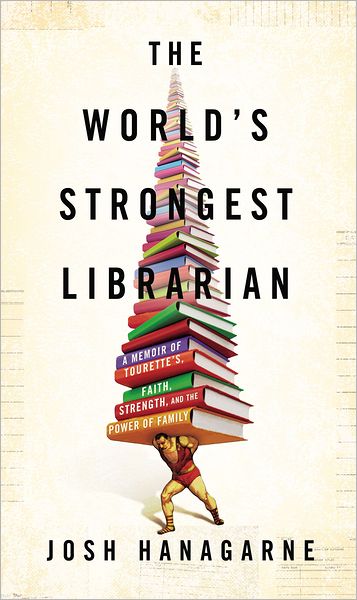
Following yesterday’s review of Josh Hanagarne’s new book, The World’s Strongest Librarian, here’s my interview with the man himself.


Josh Hanagarne: The World’s Strongest Librarian Writes

Josh Hanagarne is from Moab, Utah, and lives with his wife, Janette, and son, Max, in Salt Lake City, where he works at the beautiful main branch of the SLC Public Library. His memoir, The World’s Strongest Librarian, touches on the bizarrely various pieces of his life: his struggles with Tourette Syndrome; his journey to becoming a husband and a father; his love affair with books and libraries that would eventually lead to a career; an obsession with the gym that became a penchant for tearing phone books and full decks of cards; and a less-than-smooth lifelong relationship with the Mormon Church, where he still finds family and friends but less faith than he once held.

worldsstrongest

Your book includes a lot of personal and painful history that belongs not only to you but to your wife and family as well. What was the process for sharing those personal details?

It was hard. During the first draft I didn’t think too much about how people were going to react. When I started going through on the second draft, I started showing things to Janette or to my mom and asking, is this accurate? Is this something you’re okay with having in here? Sometimes it was, sometimes it wasn’t. Whenever anybody was mildly uncomfortable with something, I just took it out–nothing of real consequence. I guess when you write a memoir, you choose which periods of your life you’re going to represent, and then you choose which episodes best represent those periods. If you’re a normal person, sometimes that means you’ll look good and sometimes it means you’ll look bad. So that wasn’t fun, but it was honest, I think, without being tedious and self-flagellating.

I’ve always used humor kind of in self-defense, because I knew if I could make people laugh I could make them focus on something other than my tics. I think this book is kind of sad, and I think a lot of humor is rooted in something sad. I believe Kurt Vonnegut and Mark Twain both talked towards the ends of their lives about having various forms of irony fatigue, because humor was mainly a self-defensive tool for them. I think in any book where you get to pick and choose what you put in, the sadder stuff’s going to get sadder, and the funny stuff’s probably going to get funnier.

You’ve included Dewey classification numbers under each chapter heading. Do you think this resonates with the general population, or mostly just librarians?

I don’t know. I think most people, even if they don’t get it, will probably be intrigued. Some people have pointed out that they don’t all work out exactly the way capital-“L” Librarians think they should, to which I will just say, the numbers do exactly what I want them to do. I think it’s eye-catching. I didn’t necessarily think of it as being gimmicky, because it really does tie in thematically with each chapter. What I really like about it is that you can kind of see what’s coming and yet sometimes not have any clue how one thing will lead to the next.

Tell us about the process of writing this book: When did you write? Were you still working at the library?

This is probably going to disappoint a lot of aspiring writers who put off writing until they have hours of free time every day, but I don’t think I ever sat down and wrote for more than 15 minutes at a time. I just can’t; the tics won’t let me. I wrote whenever I could. I’d guess I rarely wrote more than half an hour total in a day. I do write really fast. I found out that, at least now, I’m the sort of writer who has to make a gigantic mess and then clean it up, because if I start trying to anticipate all the editorial questions on the fly, I just freeze up and I don’t get anything done. So I wrote a lot more to get to this book than I probably could have, if I were another writer. I wrote the first draft totally on my own and then I sent it to my editor, and things had just been going so well that I kind of assumed, yeah, my first draft is surely anyone else’s fourth or fifth. Then my editor sent it back and said, you’ve got to get rid of 120 pages. We can’t even talk yet. Fix this. Which was a great lesson to learn, and not an easy one. But editing was really kind of fun, because Megan [Newman] is really the right editor for me. I think it took three total drafts between us, but about eight on my part. I learned that it takes a hideous amount of work to appear spontaneous. But it was a lot of fun. The shortest way to answer your question is: I wrote every day, I only wrote for a few minutes at a time, and I just kept going. A big part of it is being willing to show up.

Was the writing process cathartic for you?

If this book hadn’t come about, I think I’d probably still be going through the motions in church, trying not to make waves. The ideas I’ve gotten from church have everything to do with my relationship to my body, and the explanations I thought I owed for my life. In writing the book, I realized, I’m actually going to have to deal with this. So I got into the sticky situation of writing a book about how much I love my family and yet gently distancing myself from the church, knowing that that would be painful for my family. That was the biggest catharsis: realizing that I was going to have to deal with that shift in faith. Spending so much time thinking about that, and trying to word it correctly, is what taught me what I actually do think about it all.

Would you say that you had a message or even a cause to communicate with this book, related to Tourette’s, or libraries, or anything else?

I’m not much of a crusader. But when I go speak to groups of people with disabilities, or their parents, or special educators, the reaction I get is so humbling and overwhelming. If people I speak to are actually getting out of this story what they tell me they are, I knew I really needed to do this book as well as I can. So that it can go be me in all the places I can’t be. There’s definitely no downside to spreading the word about Tourette’s. This story seems to inspire some people without me ever needing to claim I can inspire anyone. As far as libraries, obviously this whole book is my love letter to books and libraries. That’s not necessarily what I intended, but for me to write about myself honestly, that’s the only thing that could have happened.

What do you most want people to know about you that’s not in your book?

To entertain my son occasionally in the morning when I put my pants on, I will hold them up at about waist height and I will try to jump into my pants. So I jump all the way up in the air and tuck my knees in and if I do it right, my feet come through the pants and I’m dressed. And if it goes wrong it goes really badly wrong. And about one of every 10 times I can put my pants on this way. Once in a while. You know, one out of 10 might be optimistic.


This interview originally ran on April 9, 2013 as a Shelf Awareness special issue. To subscribe, click here, and you’ll receive two issues per week of book reviews and other bookish fun!