The Narrow Door by Paul Lisicky

The Narrow Door is literary, smart and poignant, an extended eulogy for a friend and a meditation on friendship.
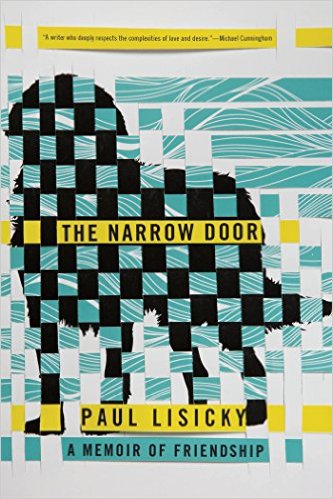
narrow door

The Narrow Door is a striking memoir of love and loss by Paul Lisicky (Lawnboy; The Burning House). At its center are the life and death of Denise, Paul’s longtime best friend; in parallel, Paul and his husband slowly pull apart and finally break up. The ups and downs of these two relationships define the story Lisicky tells, but they also give him space to muse on larger questions: the craft of writing, competition among writers, the meaning of love and events in the larger world.

Paul met Denise in the early 1980s, when they were both teaching assistants at Rutgers. They became fast friends, talking on the phone for hours, sharing the pain and joy of writing. Denise becomes a published novelist first, but Paul’s later success threatens her. A tender passage about “Vincent” and Gauguin, about the painters’ competitive feelings and their wrecked friendship, helps Paul deal with his struggle with instincts leaning both toward and away from competition with Denise. This is only one example of the wide range of Lisicky’s subject: the Deepwater oil spill and the Haitian earthquake likewise influence his reactions to Denise’s cancer diagnosis and other immediate concerns. Paul and Denise are Joni Mitchell fans, and their story is guided by her music. When a hotel in Atlantic City is demolished, Lisicky writes, “It comes down as a person would…. I take it personally.” These disparate threads are tied together expertly, with tenderness, in careful prose.

Paul’s husband, identified simply as M, is a successful poet and has his own, weaker friendship with Denise. He supports Paul when she dies, but soon after, the couple begin their drift apart. The Narrow Door employs a disordered chronology, in sections headed by year: 1983, when Denise and Paul’s friendship is budding; 2008, when she dies; 2010, when Paul and M are at their rockiest; and times in between, as these relationships grow, change, climb and descend. When he fights with Denise, Lisicky considers losing a friend, as opposed to breaking up with a lover: “Sure, it might feel like rage, but aren’t rage and love part of the same water?”

This is an artistic work, poetic and layered and carefully structured. The tangled sequence of events emphasizes the ever-changing nature of relationships and emotional reactions. Lisicky’s tone is sometimes elegiac, sometimes gently humorous, and consistently introspective, questioning. The Narrow Door is not a long book; nonetheless, it requests the reader’s measured consideration of language, pitch, philosophy and emotion. This portrait of a friend in all her complexities is lyrical, intellectual and occasionally challenging. In an austere mood, Lisicky avoids the idea of comfort for its own sake but asks, “Couldn’t there be some rigor to comfort?” The Narrow Door answers with both, in a compelling package.


This review originally ran in the January 4, 2016 issue of Shelf Awareness for the Book Trade. To subscribe, click here.


Rating: 8 cups of coffee.

Half in Shade: Family, Photography and Fate by Judith Kitchen

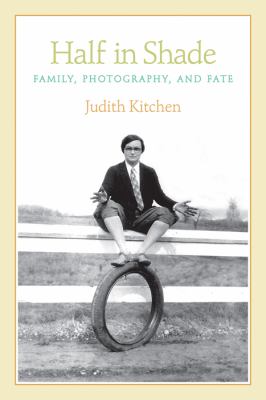
This is a complex one. Judith Kitchen has inherited dusty boxes of old photographs, belonging to her family and stretching back over generations. Some of the black-and-white figures she finds there are labeled, or recognizable to her; but many are strangers. In a series of short pieces – meditations, essays, ramblings, experimental forms – she wonders over these photographs. Sometimes she uses her imagination to tell their stories; sometimes she uses research.

She is also being treated for cancer, and the narrative of surgery, chemotherapy, and radiation responds to the history she researches and creates. She plays with concepts. Every photograph has an unseen character, the one behind the camera; who was he or she, what did he or she see? In looking back into time, she can see both more and less than the characters in these pictures. They know one another, they know where they are, and oftentimes Kitchen does not. But she knows what Paris in 1939 has looming over it. She knows what will come.

My reactions to these pieces varied. Kitchen is a poet, and she wanders into a sort of free-form poetry that reminds me of abstract art: I understand that the people around me see and interpret a great deal that is hidden from me. I wonder if I’m not smart enough for the appreciation of this art. I like Kitchen best when she says what she means, playing with language a little along the way. The more abstract she gets, the less I comprehend. I don’t think my mind works the same way hers does.

But I like what she did with the idea of photography, the examination of light and exposure, the questions about how certain confounding photos (like the young woman surrounded by handled objects before a snowy lake) were posed, arranged, intended, carried out. I like what she did with history, and family history, and the uncertainties we have to accept. I love the artistry of this sentence:

The clapboard’s horizontal plane cuts through the outlines of their lives as they stand facing us across the intervening years, chance encounter that will fuse her rough pinked hem, his knot at ease, our own unbridled mysteries.

The homonym of knot, the rhyme of ease and mysteries.

Half in Shade is a complicated thing and contains many different opportunities to delve in. I’m not sure I’m up to it, at least not on my own. I think this is a class someone could teach for a whole semester. Recommended for people who understand and like Faulkner.


Rating: 7 second looks.

Maximum Shelf: The Sound of Gravel by Ruth Wariner

Maximum Shelf is the weekly Shelf Awareness feature focusing on an upcoming title we love and believe will be a great handselling opportunity for booksellers everywhere. The features are written by our editors and reviewers and the publisher has helped support the issue.

This review was published by Shelf Awareness on November 29, 2015.


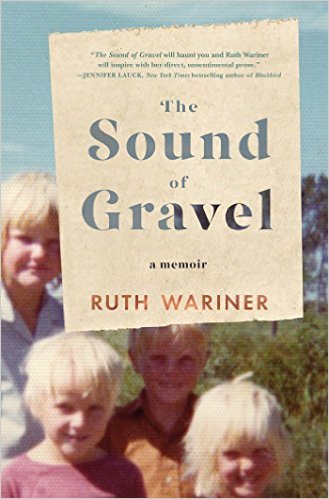
sound of gravelIn The Sound of Gravel, Ruth Wariner tells of growing up in a Mormon polygamist colony in the state of Chihuahua, Mexico. Her childhood was filled with sad and shocking hardships, some painfully difficult to read. But Wariner’s tone is never self-pitying, and her love for her mother and siblings imbues a distressing memoir with nuance, and eventual relief.

Ruth’s mother, Kathy, became the fifth wife of Joel LeBaron when she was 17 years old. Joel’s father founded Colonia LeBaron in Mexico because the practice of plural marriage was better tolerated there than in the United States. Ruth was Kathy’s fourth child and Joel’s 39th. He died just three months after Ruth’s birth–murdered by his brother over a conflict about church authority. Kathy remarried a man named Lane and bore another six children with him. Ruth was the eldest nondisabled female child and, over the years, many domestic duties, including childcare, fell to her.

The Sound of Gravel begins with the family history of the LeBarons, whose status as church leaders impressed the young Ruth, and with Kathy’s personal history, as told to her daughter. The earliest scenes Ruth relates from her own memory find her at age five, and introduce her siblings: Audrey, the eldest, with a disability that remained undiagnosed for years and that led to occasional violence against the other children; Matt, a responsible boy; Luke, good-natured but developmentally delayed; and the baby, Aaron. Later the family grows as Meri, Micah, Leah, Elena and Holly are born. Lane, Ruth’s stepfather, promises to complete Kathy’s family’s dwelling and add a showerhead, electricity and other longed-for luxuries, but is slow to do so. Lane’s first wife and her children receive preference as to the basics, in the tradition of the LeBaron church. Ruth dislikes Lane early on, for his failure to support her mother as well as his harsh discipline. From an early age, Ruth sees her mother’s conflicts and jealousies with her sister wives, and worries that plural marriage looks more like misery than the holy state her church teaches it to be.

Ruth grows up quickly as the household swells in size. The family moves around: Kathy leaves Lane after he beats her, and moves to the United States where her parents live, but returns to him. Lane relocates his families as they seek work: they harvest and sell pine nuts in New Mexico, camp out in El Paso, and smuggle undocumented Mexican workers across the border under the children’s makeshift bed in a camper. But Kathy, Ruth and the other children always return to Colonia LeBaron because, Kathy says, “this is where you kids belong.”

The poverty and poor living conditions that come with Kathy’s choices are based on her religion, her devotion to and dependence on Lane, and a belief that the United States is a Babylon “standing between us and our connection to God.” Squeezing a living out of food stamps and Lane’s meager earnings–shared among four wives and an uncounted number of children–means mostly subsisting on beans and rice. The children are pulled out of school in their early teens–Ruth at age 14–because “Mom insisted that it was more important for me to be around to help her take care of the house and the kids.” But the most heartbreaking aspect of Ruth’s childhood is Lane’s sexual abuse, which continues for years even as Ruth repeatedly reports him to her mother. Kathy exhorts Ruth to forgive and move on; but even a town tribunal fails to stop the abuse. The community’s betrayal of its children is an especially disturbing phenomenon in a story filled with the tragedy and woes of day-to-day hardships of poverty, the absence of creature comforts, illness and accidental death.

However, through it all flows Ruth Wariner’s careful, loving portrait of her mother, a woman doing her best with limited options, believing that her church knows best. Despite her profound anger at her mother’s failure to protect her from Lane, Ruth understands that she is loved, and deeply loves her mother in return. “I realized how little she had asked of the world, and how even that had been too much for the world to give.” She reflects that “Mom couldn’t teach me that because she didn’t know herself. She couldn’t show me how to be happy, only how to barely survive.” These and other contemplations establish Ruth as a wise and thoughtful narrator.

The Sound of Gravel is straightforwardly told, in chronological order and with little lyrical adornment. Its power lies in the facts of the story, which is deeply affecting both in its horrors and in its redemptive conclusion. At the end, when Ruth saves herself and her sisters by escaping Colonia LeBaron, she has earned the reader’s sympathy and respect, and an identity beyond that of survivor.


Rating: 8 babies (and counting).

Come back on Monday for my interview with Wariner.

Wild by Cheryl Strayed (audio)

wildI took my time getting around to this, because I wasn’t convinced it was really worth my time. But I’m glad I did get around to it.

Then I took my time listening to it, because (as I’ve been saying for several audiobooks now), my listening time is much diminished these days by my lack of commute. In fact, after this one, I’ve decided to lay off audiobooks for a while except for long road trips.

Happily, though, Wild worked just fine with my slow pace and long breaks. The story Cheryl Strayed has to tell is that of her solo hike over much of the Pacific Crest Trail (PCT), at age 26, following a series of self-destructive behaviors and personal tragedies beginning with her mother’s death and including a divorce and a heroin habit. The chronology jumps around: we first see her late in her hike, when she loses her hiking boots; we then flash back to learn much of her history: her childhood, close relationship with her mother, her mother’s death and her struggles afterward. In part because of its episodic nature, it was okay to move into and out of this story over time. If I’d lost track of her momentary situation, I knew she was hiking the PCT and struggling somewhat; and in just a few seconds, I’d placed her again. Credit for this ease is also due, of course, to the engaging and memorable story she has to tell. Her mother is a sympathetic, interesting and engaging character; her brother, sister, stepfather and ex-husband are less developed but still present as individuals. Cheryl’s own voice is clearly portrayed, and while she frustrated me at times (only natural, I promise), she was ultimately absolutely a compelling, likeable and very real person.

Where Bill Bryon’s A Walk in the Woods was a little exasperating in its silliness, Wild achieves the right blend of humor and real struggle. She is definitely hapless; she has definitely made some serious blunders in getting out there on her own, with a wildly heavy pack, and no preparation. But she persists. She won my respect – I am tempted to say my grudging respect; call it semi-grudging – but better than that, she wins her own.

The writing is expressive, occasionally a little overwrought but only (I believe) as Cheryl was herself overwrought in those moments; it is descriptive and plain. I began to write that the writing is not the achievement of this book, that it is rather Cheryl’s distinctive story that carries it; but that’s not actually true or fair. The structure of this book, the pacing and order in which she reveals herself to us, are intelligently put together. The disordered chronology was carefully considered. The writing is not a straightforward narrative but includes metaphors and images that help bring the story to life. It’s more that the writing fades away and the reader experiences the story starkly: I forget I’m listening to a book and just see the journey unfold before me. This is indeed an accomplishment of writing, but it is an accomplishment of invisible writing rather than the decorative sort employed by Amy Leach, Brian Doyle or Terry Tempest Williams, which I also enjoy and which is easier to see.

I’m sorry for my earlier hesitation: pop sensation it may be, but Wild is also an example of fine writing, well-designed structure, and a hell of a story. I’m glad I studied it. Oh, and Bernadette Dunne’s reading on this audio edition felt like it captured the right voice, for me, of a young Cheryl Strayed. I happily recommend this format as well as this book.


Rating: 7 cold glass bottles of lemonade.

Refuge: An Unnatural History of Family and Place by Terry Tempest Williams

I am slowly, painfully discovering that my refuge is not found in my mother, my grandmother, or even the birds of Bear River. My refuge exists in my capacity to love. If I can learn to love death then I can begin to find refuge in change.

refugeWhen I read this book, I was continually reminded of the first Terry Tempest Williams book that I loved, as a child: Pieces of White Shell. I knew immediately that I would need to follow this book with a reread of that one. For me, Refuge is the more personal, more intimate, more grown-up and more exacting version of the kinds of things I found in Pieces of White Shell. I think I found this one more difficult, more thought-provoking and challenging; the other was both sparer, and offered clearer, more accessible comforts. Refuge is stripped, exposed pain. If there are balms for its wounds, they are more complex. Pieces of White Shell is metaphorical, symbolic, spiritual, seeking wisdom and humbly finding some of it; Refuge is bared emotions and loss. It is many birds. Each chapter is headed by the name of a bird – burrowing owls, killdeer, sanderlings, avocets and stilts, on and on – and by a level of Great Salt Lake.

Over the years in which the story of Refuge takes place, Great Salt Lake rises beyond its usual depths and boundaries. I learned in this reading that this Lake is shallow and covers a great area; therefore a few feet of rise can cover miles, and cause great destruction. Terry Tempest Williams saw her mother die of cancer as she saw her beloved Bear River Migratory Bird Refuge overtaken by saltwater, the birds displaced and many of them lost. In Refuge, she meditates on both losses and the relationship between them, how the Refuge offers refuge to her and to her mother, how they are linked – birds and women (clearly presaging her later When Women Were Birds), people and place (Terry’s Mormon family with the Great Basin and Utah), the cancer that runs in her family (“the clan of one-breasted women”) and their home (neighboring nuclear test sites).

Refuge involves nature, of course, and Terry educates us with precision about the birds she loves. It involves people, and society, and our interactions. It is beautifully written, with poetry, and with liberal gaps in which the reader may draw her own connections. Terry has an imaginative and generously interpretive mind, more so than mine.

The cancer process is not unlike the creative process. Ideas emerge slowly, quietly, invisibly at first. They are most often abnormal thoughts, thoughts that disrupt the quotidian, the accustomed. They divide and multiply, become invasive. With time, they congeal, consolidate, and make themselves conscious. An ideas surfaces and demands total attention. I take it from my body and give it away.

She finds wisdom in the world, as her mother and grandmother did; and of course, centrally, she finds refuge, which is not quite to say recovery or redemption, although those arguments can be made.

Terry Tempest Williams is a lovely writer. The story of her mother’s life and death, their relationship, and the difficulties and beauty of letting go, are all well accompanied by the pain and beauty of the migratory birds of the Great Basin that Terry knows well.


Rating: 7 phalaropes.

Teaser Tuesdays: Refuge by Terry Tempest Williams

Teaser Tuesdays is a weekly bookish meme, hosted by MizB of Should Be Reading.

I am pleased to have found the time, finally, to pick up more work by Terry Tempest Williams. Refuge is her well-regarded memoir of her mother’s life and death within the region of Great Salt Lake, in Utah.
refuge

Today I chose a few lines that not only tell succinctly what this book is about, but speak to me personally as I work through my own relationship to place.

Most of the women in my family are dead. Cancer. At thirty-four, I became the matriarch of my family. The losses I encountered at the Bear River Migratory Bird Refuge as Great Salt Lake was rising helped me to face the losses within my family. When most people had given up on the Refuge, saying the birds were gone, I was drawn further into its essence. In the same way that when someone is dying many retreat, I chose to stay.

I am, of course, very excited about this book, as Terry Tempest Williams consistently impresses me. I am also already planning to reread one I loved as a kid: Pieces of White Shell. So look out for that one to come.

Body Toxic: An Environmental Memoir by Susanne Antonetta

Body Toxic is a striking book, both in the story it has to tell and in the manner in which it’s told. I am impressed, and challenged. It’s complicated.

body toxicSusanne Antonetta grew up in New Jersey, in the Pine Barrens region, a bogland unique in several senses: culturally isolated, and environmentally contaminated on a shocking, unimaginable scale. She and other members of her family have suffered from a list of medical complaints: asthma, endometriosis, a double uterus, growths on the liver, allergies, tumors and cysts, sterility, seizures, manic depression, various cancers; an extremely rare quadruple pregnancy that ended in miscarriage. The families she is descended from include Italian immigrants and those from Barbados, who nevertheless self-identify as English. Both sides of her family exhibit a predilection for silence, non-communication or the glossing over of undesirable details. The legacies Antonetta has inherited, then, are many and complex: cultural (in terms of countries of origin, and the culture of the New Jersey Pine Barrens, and immediate family cultures), environmental and medical (oh, the prodigious and horrifying list), and psychological (mental illness and perspective on the world). Oh, and Susanne Antonetta is not her real name, but an “alter ego”: “I’ve used five or six different pseudonyms in my life. The name I’m using now is not my name but the name of a recovered female relative, a lost woman, and as a recovered woman she’s just a skeleton that must be fleshed out by the same process of fantasizing and filling in that I resist.” Indeed, identity – multiple identities, our attempts to define ourselves and others’ attempts to define us – is another theme throughout.

And that is the complexity of this book, that so much is going on. The story is itself obviously gripping, and brimming with evocative and provocative anecdote. Indeed, Antonetta tells us, “I wrote a piece about the miscarriage and an editor sent it back, calling it ‘raw.’ He suggested I lose the death or the multiple pregnancy, or both… The poem of this body is a bad poem, trite.” The enormous irony, of course, being that she can’t “lose” the death or the multiple pregnancy, or countless other maladies, complaints. All this material aside, though, Body Toxic shines entirely for another reason too: the writing is bold and nuanced, presses and pulls back, reflecting a little the manic depression (or, these days, bipolar disorder) that also waxes and wanes throughout Antonetta’s story. It is, of course, poetic: the author is an acclaimed poet as well, under the name Suzanne Paola.

There are so many threads. Business and government disposed of chemical and radiation waste in Antonetta’s childhood beaches and bogs, through a combination of ignorant, unethical and criminal irresponsibility. (Thus Rachel Carson is named by comparison.) Antonetta’s extended family makes a series of decisions about how to live in this environment, in which they were underinformed but also trusting, stubborn, or willfully ignored the signs. (They mostly still won’t talk about the negative effects.) The family incubates a sexist tradition, favoring the eldest, male grandchild, repeatedly reminding Antonetta explicitly and implicitly of her “place.” She explores her identity as woman: “I spent a lot of my eleventh and twelfth years pining for my menstruation to begin. I can’t remember why”; and later in her inability to reproduce, and what this means for the family at large. (When her family visits relatives back in the Italian community of her father’s origin, his cousin tells him, “You have big children, but I have grandchildren.” There is an implied failure there, which Antonetta ascribes to environmental poisoning, but the family seems to ascribe to Antonetta herself.) There is the fallibility of memory, a theme so common to memoir but one I never tire of, because it – like memory – is different in each interpretation: each memoirist has something new to say. In this case, Antonetta did a lot of drugs, presumably compounding the muddiness of some of her early memories; luckily she was an avid journaler, which allows her to interrogate those documents, artifacts of a young woman she barely knows, itself an interesting and fruitful technique. And then there are all those identities. I love the idea of her father constantly referencing “my daughter” when speaking to her: she finally lets his declarations about that daughter stand, having realized that her father’s daughter is a different person from herself.

I could keep going. This was the challenge and the allure of this book, and the reason I will not quickly forget it: many threads, many layers, told in an ever-evolving voice, ebbing and flowing. The meandering structure made me work to pull it all together, but it was worth it.

I am taking a writing class from the author (under another name, that of the poet, Suzanne Paola) in the coming months, which is why I came to this book in the first place, and now I am both more excited than ever, and intimidated. I recommend Body Toxic for a reading experience to get lost in; for a richly fertile field of topics for discussion with family, book clubs, community groups; for the study of craft; and for the story it (quite disturbingly) tells about the New Jersey Pine Barrens, immigrant experiences, and one woman’s outlandish life.


Rating: 8 newspaper clippings.

Dispatches from Pluto: Lost and Found in the Mississippi Delta by Richard Grant

An occasionally bumbling Brit moves into the Mississippi Delta and delivers a romping survey of the surroundings.

dispatches from pluto

Richard Grant (Crazy River) is “a misfit Englishman with a U.S. passport and a taste for remote places,” a writer and professional peripatetic when he encounters an old plantation home in the Mississippi Delta. Later he will ask, “What sort of idiot goes on a picnic and ends up buying a house?” He then explains.

In Dispatches from Pluto: Lost and Found in the Mississippi Delta, Richard moves, with his girlfriend, from New York City to a spot even the locals find remote. They struggle with home improvements, an enormous vegetable garden and the moral problem they encounter in hunting for their meat. After some hilarious hiccups along the way, they take pleasure in living in large part off the land. Perhaps more challenging are questions of culture: the liberal newcomers are sensitive to their conservative religious neighbors, who are surely suspicious in turn. But from the beginning they manage to bond like family.

Grant narrates the next year with reflection and humor, from electoral politics and absurd local news to learning how to hunt and party like a Deltan. The myriad forms and intensities of racism and racial tension develop into a theme, as Grant pursues diverse friends and acquaintances. But he finds beauty as well as complexity, and concludes, “I had done the thing that modern life conspires against. I had fully inhabited the present without distraction.” Dispatches from Pluto offers a lovely, appreciative and entertaining tour of the strange and rich Mississippi Delta.


This review originally ran as a *starred review* in the October 27, 2015 issue of Shelf Awareness for Readers. To subscribe, click here, and you’ll receive two issues per week of book reviews and other bookish fun!


Rating: 7 armadillos.

book beginnings on Friday: Body Toxic by Susanne Antonetta

Thanks to Rose City Reader for hosting this meme. To participate, share the first line or two of the book you are currently reading and, if you feel so moved, let us know what your first impressions were based on that first line.

This memoir by a local author and professor at my local university comes highly recommended, and at a glance the subject looks fascinating, too. (Sometimes – I might even say often – excellent writing carries a subject I’m not consumed with; but better to have both.)body toxic A brief blurb reads, “For readers of Refuge, A Civil Action and Silent Spring, comes a harrowing story of a family, a body, and a place: an immigrant family in the Pine Barrens of southern New Jersey, a hauntingly beautiful, hauntingly compromised landscape.” Who is not intrigued? And those titles cited for comparison: wow!

It begins:

In nineteen question-mark question-mark my silent grandfather came to the United States.

He left the hot chatty island of Barbados and because he existed in silence no one knows when he came.

Simple, but a lot has already been communicated; and I love the “hot chatty island.” I am optimistic.

My Life on the Road by Gloria Steinem

Gloria Steinem’s straight-talking memoir is rich with personal anecdote, political history and a fervent love for living on the go.

steinem

Gloria Steinem, founder of New York and Ms. magazines and many women’s organizations and a noted leader of the women’s movement, shares her stories from along the way in My Life on the Road. This simply stated memoir recounts Steinem’s childhood, her organizing and activism from her youth into the present, with commentary on the social and political events of those decades. But it is also explicitly a story of life lived on the move. As she sees it in hindsight, Steinem inherited a love for constant motion from her father, who lived for most of her life out of his car, with little Gloria keeping him company for her first 10 years. As a young woman not ready to settle down to marriage and motherhood, and then as an organizer, she kept moving. One chapter is dedicated to her choice to travel communally rather than use an automobile of her own, because it offers increased opportunities for contact.

In stating her goals for this book, Steinem cites storytelling as a central drive. Much is told in short vignettes, stories from those she’s met in her travels or lessons learned on her way. There are more than a few instances of Steinem making assumptions about people (Harley riders, cab drivers), only to have them proven wrong–emphasizing the idea that every person is more than he or she appears.

Steinem hopes to encourage her readers to hit the road, too. She is clearly deeply passionate about the advantages of travel: for perspective, for personal development and for plain enjoyment. She recommends that politicians travel the country and the world: “I called big-city contributors from on-the-road places, so I could say, ‘You don’t know what it’s like out here.'”

My Life on the Road is not a history of the women’s movement, although of course it contains many references to that history, as well as to the U.S. political climate and events of the second half of the 20th century. Instead, Steinem’s memoir is a glimpse into one remarkable woman’s life and philosophies of the road. It includes profiles of Steinem’s immediate family and friends like Bella Abzug, Wilma Mankiller and Florynce Kennedy, and briefly addresses the conflict between Steinem and Betty Friedan. Steinem’s writing style is personal, warm, approachable and straightforward. Her fans will be satisfied by this personal view, one that combines a love for people and places and stories and change with a love for movements–in both senses.


This review originally ran in the October 15, 2015 issue of Shelf Awareness for the Book Trade. To subscribe, click here.


Rating: 7 stories.