guest review: Mother Tongue: My Family’s Globe-Trotting Quest to Dream in Mandarin, Laugh in Arabic, and Sing in Spanish by Christine Gilbert, from Mom

My mother is here today to guest-review a book to which she brings special expertise. Mom has a Master’s degree in Applied Linguistics from the University of Houston; used to teach English as a foreign language to adults in community college settings; and now volunteers her time tutoring English language learners one-on-one. The disclosure here is that I was sent a free copy of this book in exchange for my mother‘s honest review. (It’s fun how that fact plays off this book’s title.) Thanks, Mom!

mother tongue

Christine Gilbert is quite the adventurous spirit. She tells the story in Mother Tongue about her quest to learn three languages – Mandarin, Arabic, Spanish – in less than three years, while living in three countries. This adventure includes a baby who acquires a sibling along the way. She and her husband have few ties to the U.S., and are able to work remotely. Thus they are perfectly placed for the language quest.

The quest is primarily hers, but includes her son as he grows and learns the local language effortlessly, as children do. (Her back-story includes a genetic disposition to Alzheimer’s disease, and she learns of brain research that suggests that young bilinguals have an advantage over monolinguals that gives about five extra years before onset of Alzheimer’s.) She sets out to understand language learning theories, while researching all the logistics of moving house and choosing the places.

Gilbert does her homework on language acquisition theory, and she makes her case for total immersion (no hanging out with English speakers!). She works long days in language study. In the beginning – Beijing during a very cold winter with pollution too severe for the family to go out much – she chooses to hire a tutor for working at home, as well as a housekeeper who doesn’t speak English. When a crisis takes the family away suddenly, she reviews her experience and decides complete isolation within the foreign country is not the only way to absorbing language and culture. Each move and new setting will bring more lessons, and Gilbert gets quite good at her tasks.

This is not a dry tome about memorizing vocabulary for long hours. We make friends along the journey, we learn to talk and savor local food. Gilbert is a fun character, and her husband’s story is equally interesting; the book is a travel story on lots of levels. As a parenting and family dynamics study, Mother Tongue is yet another book. I’ve been involved enough in the bigger story to follow her adventures as told on her blog, and can reveal that this is an unending quest – two more countries appear there, and since I haven’t looked lately, who knows where they may be now.

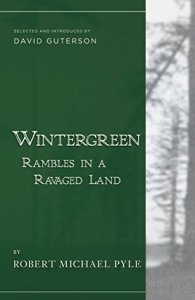
book beginnings on Friday: Wintergreen: Rambles in a Ravaged Land by Robert Michael Pyle

Thanks to Rose City Reader for hosting this meme. To participate, share the first line or two of the book you are currently reading and, if you feel so moved, let us know what your first impressions were based on that first line.

wintergreen

I am reading this in preparation for the upcoming Chuckanut Writers Conference and a class I will be taking from Robert Michael Pyle himself. An introduction from David Guterson is intriguing, as is the Pharos Edition (same folks who brought Still Life With Insects back into print). It begins:

At any time of the year and in any weather, my bedroom window frames a green and pleasant country scene. Halfway open, it makes a Kodachrome slide of the bucolic valley below, bordered by white sashes and molding.

Lovely. And this setting is just a few hours south of where I live.

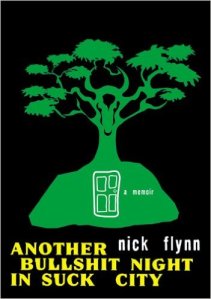
Another Bullshit Night in Suck City by Nick Flynn

another bullshitI read Another Bullshit Night in Suck City for class, and I’m glad: glad I read it, and glad I had a class to guide me through it. I think I got more out of it this way. It would have been a little opaque to me on my own.

Nick Flynn’s father Jonathan was mostly absent in his son’s youth, although sort of a towering absence. Nick met the father he scarcely knew when Nick was working at a homeless shelter in Boston, where Jonathan became a client. This is Nick’s memoir of his father’s troubled, mysterious life and ugly effects on those around him – his wives and children – and Nick’s search for answers. (If this sounds familiar to you, you may have seen the movie made from this story, Being Flynn, which starred Robert De Niro but didn’t do terribly well.)

As illuminated by my professor, Another Bullshit Night in Suck City pulls heavily from the themes and style of absurdist theatre and theatre generally. Nearly every chapter involves some form of stage setting, awareness of audience, or other element of performance. King Lear and Beckett’s Endgame are particularly present. I know almost nothing about absurdist theatre, and would certainly have missed this subtext without help; and it really did help me to see some of what Flynn was up to.

It is an unusually, but very carefully composed book. Chapters vary in format. Some are written as short plays; some take different hermit crab forms. One of my favorites is a list of “thirteen random facts.” An illustration or two and one very important diagram come in. Despite the differences in form, there is a fairly straightforward narrative at work: the life of a father as seen (therefore, in pieces) by his son, and the life of the son, at first as it applies to the father’s story but in bursts beyond as well. This narrative is not strictly chronological, but any disjoints in its telling only reflect the way it was lived, the way information about Jonathan came to Nick, in dribs and drabs and jolts.

Readers new to the varied forms Flynn uses may find them a little distracting, but I don’t think they’ll pose a real challenge. The scrapbook-feel echoes the subject matter, echoes real life. And despite looking at a glance like it was thrown together – indeed, like real life – there is extraordinary artistry and intention at play here. Look for recurrent images throughout, like the donut, and the life raft, which sometimes takes the donut-echoing shape of a lifesaver. Look for theatricality, framed stages, costumes and sets. And the question of caring about appearances, or designing appearances.

Obviously, Nick Flynn tells painful and personal stories in this book, raising some of the classic questions of the memoir genre: how much to share, how much is too much, and what reader response is appropriate. Flynn struggles with these questions, especially in the final section called “aftermath (one year later): questions often asked, and some possible answers.” I was reminded of a Bernard Cooper essay I read – I believe it is titled “Marketing Memory,” from The Business of Memory, a collection edited by Charles Baxter. It dealt with Cooper’s surprise at reader reactions, and his inability to control what those readers take away from his work, and what they are curious about. It might seem like some of these issues are obvious ones, but there’s no accounting for people, always and in all directions, and the possibilities fascinate me.

I found this a brave, complex and moving book, and I recommend it. For a little taste, here is the obituary written for Jonathan Flynn, nearly ten years after the book’s publication. As Brevity notes, it is unattributed but presumably written by Nick.

I look forward to finding time for a reread, for further study.


Rating: 9 circles.

The Song Poet: A Memoir of My Father by Kao Kalia Yang

In celebrating a father’s traditional Hmong song poetry, this memoir records the painful history of a loving family and a people.

song poet

In The Latehomecomer: A Hmong Family Memoir, Kao Kalia Yang related her family’s immigrant experience. With The Song Poet: A Memoir of My Father, she focuses on the life and art of Bee Yang: “my father raps, jazzes, and sings the blues when he dwells in the landscape of tradition Hmong song poetry.” The storytelling and emotional communication of that art form was a defining element of Bee’s contribution to his family and his culture, from their home in Laos to a refugee camp in Thailand and, finally, in the United States. When his mother died, Bee stopped singing, and Yang considers the significance of that silence as well.

As its title suggests, The Song Poet is lyrical and beautifully composed, with themes of loss and love, realistic and raw, but enriched by gentle metaphor. It is divided into “Side A” and “Side B,” the first told in Bee’s first-person perspective and the second in Yang’s. These points of view offer immersion in a Hmong culture that values family, and shares a complex system of spiritual celebrations and a way of life centered on the day-to-day necessity of growing and harvesting food. War and violence drive the family to Minnesota, where Bee and his wife do hard, dangerous labor, and are poorly equipped culturally to battle racism and exploitation. But they retain their reverence of family and tradition. The Song Poet is a message of love and thanks to a father who sacrificed for his children’s future, and a memorial to his art.


This review originally ran in the May 17, 2016 issue of Shelf Awareness for Readers. To subscribe, click here, and you’ll receive two issues per week of book reviews and other bookish news.


Rating: 8 flip-flops.

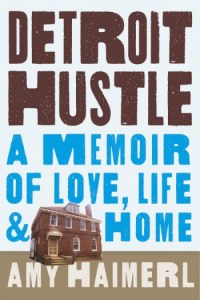
Detroit Hustle: A Memoir of Life, Love, and Home by Amy Haimerl

This memoir of home renovation in Detroit delves into much more, including the importance of place, the meaning of urban revival and the building of lives and loves.

detroit hustle

Journalist Amy Haimerl and her husband, Karl, loved their Red Hook neighborhood in Brooklyn, N.Y., but were facing rising costs and considering relocating. Friends and family were surprised by their choice of famously struggling Detroit, Mich., but they fell in love with a 1914 Georgian Revival (lacking heat, electricity, plumbing, windows and much more), and took the plunge. The house they named Matilda cost them $35,000 to purchase–and exponentially more in renovations.

Detroit Hustle is Haimerl’s memoir of rebuilding Matilda and building her marriage to Karl in parallel. But it is also a musing on what it means for a girl from a working-class family in rural Colorado to move through Mississippi and New York to arrive in the gritty and disparaged city of Detroit. Five weeks after they buy, Detroit declares bankruptcy. Amy covers the court proceedings for Crain’s Detroit Business while researching her new city and its history. Her study of the city yields complexities and contradictions, a portrait of proud residents and the difficulties of gentrification.

Haimerl is thoughtful and reflective about her relationship to place and to the intricacies of Detroit’s past and future; quirky, funny and loving about her marriage; and by turns vexed and inspired by the process of home renovation. Her vivid personality pairs well with the rich, colorful, troubled city she loves. Detroit Hustle is a remarkable memoir spanning home repair, political and culture geographies, and the choices we make for the people, places and things we love.


This review originally ran in the May 6, 2016 issue of Shelf Awareness for Readers. To subscribe, click here, and you’ll receive two issues per week of book reviews and other bookish news.


Rating: 8 dentils.

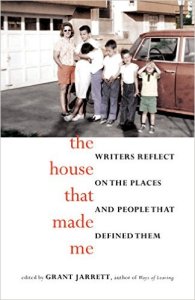
The House That Made Me: Writers Reflect on the Places and People that Defined Them edited by Grant Jarrett

Carefully curated essays take on the concept of home from varied points of view.

house made me

The House That Made Me collects essays by 19 writers reflecting on their childhood homes (or whichever home each writer has found most influential). Editor Grant Jarrett developed the idea for this anthology while contemplating his own first address via Google Earth, and he directs the contributors to that software. While the majority of essays hew close to Jarrett’s initial notion, some also riff on the concept: Roy Kesey considers those who view our homes from above, including birds, spies, angels, gods, astronauts and children climbing on roofs, as he once did.

The resulting assembly of voices offers a range of approaches and backgrounds: Kris Radish’s nostalgia for an idyllic rural community; Patricia Jabbeh Wesley’s attempts at home-building in Liberia just before civil war erupted; and the juxtaposition of Pamela Erens’s privileged upbringing on the lake in Chicago and Jeffery Renard Allen’s difficult one in that same city’s Southside. Justine Musk writes of the possibility that “a person has two homes: the place where you were born (literally, not metaphorically), and the place that fits your soul.” As she works to leave her small Canadian hometown for Los Angeles: “It’s that sense of not-belonging that can become, slowly and over time, its own kind of belonging.” While each essay is a worthy and thought-provoking piece of craft, the true achievement is in the sum of these parts, a chorus of diverse experiences that work together to define “home” in all of its possibilities.


This review originally ran in the April 22, 2016 issue of Shelf Awareness for Readers. To subscribe, click here, and you’ll receive two issues per week of book reviews and other bookish news.


Rating: 8 parachutes, for its matching my personal obsessions, these days.

Growing Up Twice: Shaping a Future by Reliving My Past by Aaron Kirk Douglas

A raw, honest, and inspirational memoir about a young man growing into his own while mentoring another.

growing up twice

Growing Up Twice is Aaron Kirk Douglas’s memoir about acting as a Big Brother to an at-risk teen named Rico and how their interactions moved him to rethink his own upbringing. The sometimes unpolished language does not detract from a story that is powerful and heartfelt, and certain to appeal to a wide variety of audiences.

…Click here to read the full review.


This review was published on March 23, 2016 by ForeWord Reviews.

clarion 3 star


My rating: 6 Frisbees.

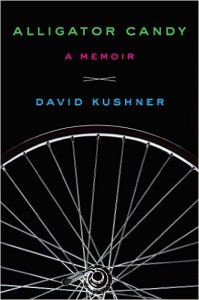
Alligator Candy by David Kushner

This tender, intimate memoir probes the childhood murder of the author’s older brother.

alligator candy

On a Sunday afternoon in 1973, 11-year-old Jon Kushner rode his bike through the woods to the 7-Eleven. His four-year-old brother, David, had asked for one kind of candy in particular. Jon’s family never saw him alive again. Journalist David Kushner still struggles to fathom his brother’s murder and his family’s experience; Alligator Candy is his memoir of investigation and connection.

Kushner lovingly portrays his hippie parents, eldest brother and Jon, who struggled with an auditory deficit disorder and was known for his compassion. Their community in Tampa, Fla., included activists and academics, and emphasized freedom and the outdoors. It was perfectly natural for a boy to ride alone through the woods. Jon’s murder presaged an end to the “ability of kids to simply get on their bikes and go,” as one family friend put it.

Alligator Candy explores how a family and community survive loss. The twin terrors of not knowing fully what happened versus knowing the horrific details of exactly what was done to Jon comprise only two reasons that this is a painful story. However, Kushner can also be funny, and he skillfully captures a child’s innocent curiosity, even in loss. He writes so simply, but this is deceptive. Alligator Candy is sensitive, insightful and understated.

Forty years later, Kushner (Bones of Marianna; Masters of Doom) still struggles with grief, isolation and guilt. In writing Alligator Candy, however, he discovers certain details of his brother’s case for the first time, begins to comprehend his family’s coping methods and, finally, achieves a long-sought connection with Jon.


This review originally ran in the March 25, 2016 issue of Shelf Awareness for Readers. To subscribe, click here, and you’ll receive two issues per week of book reviews and other bookish news.


Rating: 7 pieces of gum.

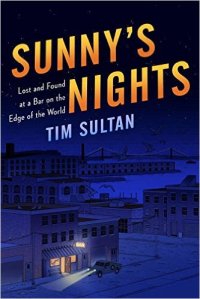
Sunny’s Nights: Lost and Found at a Bar on the Edge of the World by Tim Sultan

A vividly portrayed Brooklyn bar serves as vehicle in a young man’s ode to his friend.

sunnys nights

Tim Sultan wandered by accident through the door beneath the sign that read simply “Bar,” in the derelict neighborhood of mid-1990s Red Hook in Brooklyn, N.Y. Charmed by the proprietor, Antonio Raffaele “Sunny” Balzano, Sultan become a bar regular, then a bartender, and eventually left his Manhattan high-rise job to devote himself to the bar–or, more accurately, to Sunny himself. Sunny’s Nights: Lost and Found at a Bar on the Edge of the World is an appreciation of that man.

Sunny’s bar is “on the edge of the world” because Red Hook is both a point on what Sunny calls the Mississippi-Hudson River (because of the Hudson’s role in his youth, which he recalls in parallel to the adventures of Tom Sawyer and Huck Finn), and an outlier in the consciousness of greater Brooklyn. Sultan explores the history of the neighborhood as well as of Sunny and his bar, a family affair for generations. The result is both memoir and biography, alternating between the protagonists’ years of friendship and their separate pasts: Sultan grew up in West Africa and Germany while Sunny’s childhood was confined to Red Hook. Also an artist in diverse media, Sunny is wildly charismatic, with endless stories that unfailingly hold his audience spellbound; this is the real story of the bar. As Sunny and Sultan share histories, escapades (including a near-drowning in the Mississippi-Hudson) and hospital visits, old Red Hook wise guys (some still bending an elbow at Sunny’s), poets, lovers, musicians and artists make for a colorful, eclectic and winning tale–like Sunny himself.


This review originally ran in the March 1, 2016 issue of Shelf Awareness for Readers. To subscribe, click here, and you’ll receive two issues per week of book reviews and other bookish news.


Rating: 7 Bathtubs.

The Cowshed: Memories of the Chinese Cultural Revolution by Ji Xianlin, trans. by Chenxing Jiang

This memoir by a survivor of the Chinese Cultural Revolution poignantly sheds light on an under-examined period in history.

cowshed

Ji Xianlin was one of many Chinese intellectuals held in makeshift prisons, called cowsheds, on university campuses during China’s Cultural Revolution, which began in 1966 and lasted for 10 years. He was mocked, humiliated, beaten and starved. He wrote about these experiences only reluctantly, observing late in life that none of his fellows had done so and that younger Chinese need to know their history in order to learn from it. In 1998, he released his memoir, now translated into English for the first time as The Cowshed: Memories of the Chinese Cultural Revolution.

Ji narrates his years of torment compellingly, in remarkably fair-minded fashion. He claims that his work is not literary, but it is adorned with lovely metaphors: he compares his torture to Indian and Chinese concepts of hell, “a veritable pagoda of horrors,” and makes reference to the steep path to Mount Tai, one of five Taoist sacred mountains.

Ji’s story is painfully moving and beautifully related, elevated by his preface and journalist Zha Jianying’s introduction, and his appendix, an abbreviated memoir of Ji’s whole life that puts the bulk of The Cowshed into perspective. He ponders the question of human nature as basically good or bad, and illuminates Chinese culture with sensitivity and humor; for example, “We Chinese intellectuals are descended from a tradition of scholars who would rather be killed than humiliated.” Until his death in Beijing in 2009, the wise older man who wrote this book remained a patriot who wanted the best for China and who appreciated that he saw the Cultural Revolution so intimately, if only so that he could bear witness.


This review originally ran in the February 5, 2016 issue of Shelf Awareness for Readers. To subscribe, click here, and you’ll receive two issues per week of book reviews and other bookish news.


Rating: 7 cornmeal cakes.