The Company of Owls by Polly Atkin

A poet and nature writer shares the grace, beauty, and lessons in her quiet observations of “my neighbours, the owls” in this loving memoir.

Polly Atkin (Some of Us Just Fall) brings a poet’s sensibility to a contemplative study of nature and self with her memoir The Company of Owls. From her home in the village of Grasmere in England’s Lake District, Atkin can hear tawny owls calling to one another; on short walks, she feels privileged to watch them hunting, nesting, raising their young. During and after the Covid-19 lockdown, she marveled at their lives, so little known to us, and mused on isolation, companionship, humans’ relationship to the rest of the natural world, and more. Not an ornithologist by training, Atkin feels drawn to her poorly understood subject, associated with both wisdom and death, night-dwelling but sun-loving: “This book is about owls, but it is also about me.”

Atkin, who lives with several chronic illnesses that limit her mobility and ability to work in traditional ways, found herself under lockdown questioning the nature of solitude and our many reactions to it. She made art of Middle English words for aloneness: uplokkid, reclused, onlihede, and solnes, which become chapter titles. “But the more times I wrote the words out, the more shades of meaning leached from my brushstrokes. The more ambiguous I felt my state of seclusion to be, the more ambiguous I felt about isolation.” She related to what she perceives as the owls’ need for both separation and togetherness. In her own insomnia, she connected to their apparent affinity for both darkness and light. “Without other humans to see you and claim you as theirs, you feel less and less like one of them, more and more likely something else. Something nocturnal. Something unbound.” She watched a trio of owlets navigate siblinghood, and worked to resist what felt like anthropomorphism.

This is a classic memoir in its meditative pacing, thoughtfulness, and self-examination. And of course its author, with several volumes of poetry to her name, takes special care with both language and detail. The Company of Owls balances a careful focus on the hyperlocal owls immediately surrounding Atkin’s home, and a survey approach to the history of owls in the region, the humans who study them, and the owls Atkin encounters online via friends and algorithms. Despite the easy assumption (as she notes) that “technology disconnects us from the world around us,” Atkin benefits from a larger world of owls. That wider lens improves her view of what lies just beyond her own home: the Lake District’s tawny owls, in their small movements, births, and deaths. Atkin’s lovely, reflective memoir reminds all readers to slow down, listen, and find joy.


This review originally ran in the November 24, 2025 issue of Shelf Awareness for the Book Trade. To subscribe, click here.


Rating: 7 tourists.

rerun: Gone to the Woods: Surviving a Lost Childhood by Gary Paulsen

I still think about this book and should find time for a reread. In case you missed it, please check on Gary Paulsen and his wonders (and traumas).

I had not thought of Gary Paulsen in years, until I saw the Shelf Awareness review of this new book. (Hat tip to my colleague Jen Forbus for that review.) Paulsen might have been the first author I really fixated on; I remember setting out to own all his books, and while I didn’t get very far (maybe six or eight of them), I’m pretty sure I wrote “Julie’s Gary Paulsen library” or some such inside the cover of each one, and had them set up on their own little shelf. Early signs of something, there. My favorite was Hatchet, of course, and its sequel; and I vividly remember a scene from the beginning of another book where the narrator watches a… chipmunk? eating another creature, blood down its front… what book was that?

Anyway – when I saw that he’s returned with a memoir of his own childhood, I was sold. And let me tell you. This book had me entranced from the opening lines. I wept.

Gone to the Woods has an innocence and a simplicity built into its writing style and the value system, I think, of its narrator. This makes it accessible to younger readers, but not at all to them alone. I think this is a memoir for everyone. Paulsen tells his story in the third person, calling his protagonist only ‘the boy,’ although the name ‘Gary’ is used once or twice by other characters. This helps to give the boy an elemental quality, like he’s sort of an archetypal boy, although his story is very specific. When the book opens, he is five years old, living in Chicago with his mother in 1944. She has a factory job, and coming from a small farm in northern Minnesota, is “not even remotely prepared to resist the temptations of the big city.” She lives in the bars and does not parent her small son, who she’s trained to perform for the men who try to win her favor. Grandmother hears of this lifestyle and is “critical, then concerned, and finally… past horrified and well into scandalized.” Her solution colors the boy’s method of problem-solving for life: “If it doesn’t work Here, go over There.”

The first adventure of the book, then, is the five-year-old boy’s solo journey by train from Chicago to International Falls, Minnesota. This takes several days and involves a train absolutely jam-packed with severely injured soldiers, smelling of and oozing pain and death, so that the boy is physically ill from it all – because didn’t I say, his father, who he’s never met, is a soldier off in the war. The boy becomes stuck in a train toilet, among other things, and observes out the train window the woods that will become his sanctuary. By the time he arrives at his aunt and uncle’s farm he is wrung out with exhaustion, trauma, and confusion. But the farm will be a perfect place for him, the first place he feels he belongs, is valued, is taught. He’s given his own room and bed. It’s lovely. Then it’s taken away from him.

I’ll stop summarizing here. The boy’s upbringing is one trauma after another, including a few years on the streets of American-occupied Manila, and a continuing absence of parental concern. I appreciate that the narrator is slow to judge his parents, and I think it would have been easy (narratively speaking) to be ugly about the mother’s drinking and many boyfriends, for example, but neither the young boy nor the adult man who writes these lines takes that easy road. (At least until the teenager’s perspective, at which point he thinks of both parents as vipers. But this is about the damage they do to him, rather than some puritanical judgment of mom’s moral choices.) He is an unjudgmental creature in general. Paulsen is wonderfully good at the innocent child’s perspective, elements of which are present in the teenager too.

Trauma after trauma, but with a few bright points, like the aunt and uncle in the Minnesota woods, and a saintly librarian when he is thirteen years old who makes him a gift of notebook and pencil, for whom this book might be considered a gift in return. And the woods and rivers and streams, which are always a bright point. From age five, the boy learns that the woods will allow him to take care of himself, even when he lives in a city again, keeping to the alleys and nights to avoid bullies, and escaping to the stream where he can fish for food or shoot squirrels and rabbits when his parents fail to provide for him. Even in Manila, a city of a certain sort of trauma (truly, the violence and death this child witnesses by his sixth birthday is unfathomable), he finds beauty and human kindness.

At times the events were hard for me to take in, and I wondered if younger readers were really the right audience for this. But on reflection, I think Paulsen offers just enough. I think children might take away what they need from this book – I’m no proponent of censoring life’s pains from kids – and it’s the adult mind and perspective that makes it even harder to read, if that makes sense.

The story is harrowing but also lovely, always riveting, and an important testimonial from a generation that we will eventually lose access to. It is excruciatingly beautiful in how it’s told. The immediacy of traveling with the boy is heart-rending and direct. I can’t imagine how this book could be improved upon.


Rating: 10 willow branches.

Mailman: My Wild Ride Delivering the Mail in Appalachia and Finally Finding Home by Stephen Starring Grant

Within the high highs and low lows of rural mail delivery, a laid-off white-collar worker builds new relationships with place, with his neighbors, and with himself.

In 2011, Stephen Starring Grant moved his wife and two daughters back to his hometown of Blacksburg, Va. In early 2020, Grant, the family’s primary wage earner, was laid off from his consulting job. He found himself unemployed at the start of the pandemic in a town that had limited employment options, and with a recent cancer diagnosis to boot. Unable to find anything in his field, he took a job as a rural-route carrier for the United States Postal Service. Mailman: My Wild Ride Delivering the Mail in Appalachia and Finally Finding Home offers his stories and reflections on a year spent in a position he’d never thought much about before.

Grant began with a bit of an ivory-tower complex, as he imagined his intellectual background overprepared him for the simple drudgery of mail delivery (which turned out to be untrue), but he ended with a profound respect for postal and other service workers, and balanced thoughts on class and background. These pages vary in tone, by turns hilarious and thoughtful. Grant describes religious experiences, being threatened at gunpoint, bonding with strangers over their deliveries and finessing their political differences. He discusses types of incompetence (a few months in, he “graduated to the consciously incompetent stage, lost in the burning wasteland of self-awareness that I was really not very good at delivering the mail”) and the intense discomfort involved with learning new things, with great effort and limited success, in adulthood. Musing on the origins and purpose of the USPS, he expresses a nuanced patriotism: “America is the greatest country in the world… America is a steroidal monster… Both versions of America are true.” And, he notes: “Our delivery vehicles were like democracy, the worst of all possible vehicles, except for the alternatives.”

Between indulging in fantasies of delivering the mail with Barack Obama at his side and performing neighborly services like basic car maintenance for favorite people along his route, Grant brought his kids for added help and dropped in on his parents for pancakes. Along the way, he informs the unschooled reader of the process that mail carriers undertake to sort, order, and “case” the mail for delivery, and the hazards: backbreaking labor, the ergonomic disaster of right-hand drive (especially in a left-hand-drive vehicle), extremes of heat and cold, and dog attacks. Via an adventure with unfamiliar blue-collar work, Grant discovered new values, new people, and a new relationship with home. Mailman is a classic memoiristic blend of whimsy, storytelling, and insight.


This review originally ran in the May 22, 2025 issue of Shelf Awareness for the Book Trade. To subscribe, click here.


Rating: 7 Slim Jims.

Wildfire Days: A Woman, a Hotshot Crew, and the Burning American West by Kelly Ramsey

This beautifully crafted memoir features both dramatic action and deep soul-searching by a woman on an elite wildland firefighting crew.

Kelly Ramsey’s Wildfire Days: A Woman, a Hotshot Crew, and the Burning American West is a memoir of wildland firefighting and gender, but also of trauma, family, and navigating love and life at any age.

Ramsey’s expertly structured narrative shifts in both place and time, beginning with a hazardous fire event in her firefighting career, then moving to where she started that career (the Klamath River and its surrounds in Northern California), then a Kentucky childhood and her parents’ story. She paints a portrait of her mother that is a masterclass in the single-paragraph capsule profile. “Raised in a home where someone might vacuum a spill from the front lawn, my mom grew into an inquisitive, determined woman who was in the right almost as often as she believed she was.” Ramsey’s father was an alcoholic, eventually homeless and lost, whose absence caused the grief she may have been fighting along with the extreme challenges of becoming a wildland firefighter and other, still more self-destructive behaviors. This introspection occurs in flashbacks and fragments alongside the main timeline in which Ramsey, in her late 30s and after a wildly varied life, joined the Rowdy River Hotshots.

Hotshots live in barracks or on the road, sleeping on the ground as often as not, packed into a crew transport with their firefighting gear, working shifts that sometimes stretch to 24 hours in tremendously hazardous conditions. They hand-dig firebreak lines, run chainsaws and carry swamp brush, and hike vertiginous slopes under loads that can exceed 70 pounds, often amid active fire. The only woman on the crew her first season (and the first in nearly a decade), Ramsey was also one of the smallest and one of the oldest. She and “the boys” wrestled individually and collectively with how to treat her difference while integrating her into a crew that was necessarily tightknit: they relied on each other for survival.

Showcasing lovely writing and storytelling, Wildfire Days contains just enough firefighting and fire suppression policy history to contextualize Ramsey’s personal journeys. Ramsey is far from a saintly character, and she portrays her own less flattering moments clearly: worrying over her tendency to smile and people-please; her fear that she aligned herself with her male fellows in singling out the next woman to join the crew. This honesty is refreshing. Not a hero, Ramsey lets readers see her earnest and imperfect strivings. Her growth by the memoir’s end is ongoing, but impressive. “Here was the secret I kept stumbling upon: that our deepest wounds were the fertile soil of our growth. New life tended to spring from bitterest ash.” Tense action, fraught self-examination, pain, triumph, and romance make Wildfire Days propulsive and unforgettable.


This review originally ran in the May 8, 2025 issue of Shelf Awareness for the Book Trade. To subscribe, click here.


Rating: 8 smiles.

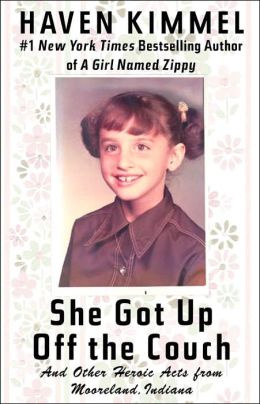
rerun: She Got Up Off the Couch by Haven Kimmel

I have never stopped thinking about this masterful character profile / biography / memoir / feat of creative nonfiction by Havel Kimmel, and I’m very pleased to share it with you here, again. There was also a reread post, from when I was doing my MFA, and even as I write these words, I wish I had time for a reread now. (I am, for the record, really enjoying TJ Klune’s latest, so no regrets there, and stay tuned. Here’s to authors we love who keeping writing new work.)

couchThis book follows A Girl Named Zippy, and I adore Kimmel’s explanation in her Preface: that she would definitely never write a sequel to Zippy, but that people kept on asking her if her mother ever got up off the couch; and here we are. This is an extension of that first memoir, then, with the focus being not on the girl called Zippy (Haven Kimmel herself) but on her mother, who in that first volume was a somewhat shapeless woman who mostly inhabited the couch and read a lot, talked on the phone, watched television, and didn’t worry too much about her children. This is told not unlovingly, but as fact. Zippy’s childhood is on balance awfully joyful and fun, and although a critical adult’s eye might point out lots of points of minor neglect, she clearly loves her family very much. This tone is continued in She Got Up Off the Couch. The family and each of its members is still, realistically, flawed, but lovable and well-loved. Kimmel’s brother is now mostly absent, with a family of his own; her sister marries and has two babies; her father finds work as a sheriff’s deputy (or similar job title); but her mother’s is the great change of this second memoir. This was, what, the late 1970’s I suppose, in a tiny Indiana town of a few hundred people. Zippy’s dad, Bob Jarvis, holds the keys: her mother Delonda doesn’t know how to drive. This will work as a fine metaphor (and indeed is part of the literal action), as Delonda calls a phone number on a television commercial to look into going to college. She wrangles a ride into the next town over for an entrance exam, which places her out of fully 40 hours of college credits. Under Bob’s clear disapproval – he says of the woman who takes Delonda to her test, “time was, a woman wouldn’t have gotten in a man’s marriage that way” – she persists in attending classes, studying, reading, talking to new people, and in 23 months, graduates summa cum laude – and continues on to graduate school. Eventually she earns a Master’s degree in English and becomes a high school teacher. This is all a stunning change. Along the way, to get to school and back, she learns how to drive and purchases a vehicle that is, in itself, a good joke.

She Got Up Off the Couch also follows the format of A Girl Named Zippy: chapters jump around, more as connected anecdotes than as clear narrative. Each chapter stands alone admirably as a hilarious or heartfelt – usually both – nugget of tears, joy, preadolescent confusion, and filial love. [In fact, as soon as I finish writing this review I’m off to read my favorite chapter out loud to Husband, if he’ll let me, while he smokes a brisket in the backyard. If you’re curious, it’s called “Treasure,” and is about a hippie college student hiking cross-country who camps out in the Jarvis backyard for a few days. It’s hilarious and heart-wrenching.] It’s a great structure, this anecdotal style. If I ever write my own mother’s biography, which I keep dreaming about, I have something similar in mind. Yes, there are odd characters that the reader of just one chapter would wrinkle her forehead at; but this is true of the whole book, too. Zippy has had an odd and happy life, and that’s exactly why we enjoy reading about it.

Zippy herself, naturally, also grows and changes in this book. Delonda is our star and makes the most life-changing journey. Kimmel writes in her preface, “I will never do anything half so grand or important,” and I know exactly what she means: the decision of Delonda and other women of her time who broke out of where they were told they belonged have done something for the women of my generation that we are now saved from having to do, if that makes any sense. It is something I’ve long felt about my own mother. But I was saying that Zippy continues to grow up: we see more of her engaging and eccentric friends, Rose and Julie Ann, and we meet a new friend, Jeanne Ann. And when she gets a nephew and then a niece, Zippy becomes hopelessly devoted. The blizzard that sweeps through when her niece is long overdue and panics the family is, again, funny and riveting at the same time.

I’ve now read everything that Haven Kimmel has written except for every single one of her blog posts, and that one children’s book. I hope she is getting to work right now on another book – fiction or non, more Haven Kimmel, stat.

I love it. Funny, true, humble, real.


Rating: 9 cherry-red polyester suits.

rerun: Dirt Work: An Education in the Woods by Christine Byl

Because I still talk about and think about Dirt Work, and because (I still can’t believe my good fortune) I now get to build trails for a living, it feels right to talk again about this transcendent book. I hope I get time to reread it someday. Original publication and review from 2013. For more, check out Lookout, which also got a 10 (and those are rare).

Christine Byl opens her memoir with the pleasant scene of herself and three fellow crew members, crusty and dirty, having a post-hitch beer at a small-town Montana bar. A young woman approaches and asks how she keeps up with the boys, one of whom volunteers that it’s all they can do to keep up with her.

She then backs up and tells the story of how she got there. Like many young women in our culture, Christine was expected and expecting to go to college, to do cerebral work and keep her hands (literally) clean; but a summer gig held her, and she reveled in physical challenges, in learning new things, in the mechanical world. Eventually she reveled in her hardening muscles and her expertise, in surprising men with her ax-work and in mentoring other young women coming up in the “matriarchy” of trail work (still predominately male) within Glacier National Park.

After six seasons in Glacier, alongside boyfriend and eventual husband Gabe (a delightful character: mostly off screen, but clearly a capable young man in his own right, and clearly happy to stay lovingly out of Christine’s way), she does return to graduate school, in Alaska. But during the summers she still works on building and maintaining trails, this time in Denali. Christine and Gabe come to love Alaska – yes, even the winters: there is a delightful passage arguing that the light summers are in some ways harder than the dark winters, and I made both my parents (recently moved from the Mexican to the Canadian border) read it. They settle a few miles outside the borders of Denali National Park, and Christine finds a balance between the cerebral – she gets an MFA in fiction, and writes this beautiful book; and the physical – she and Gabe now run their own independent trail-building company.

So many things to love in this book; where to begin? As a sometimes volunteer trailworker myself, I don’t pretend to know 2% of what Christine does; but I might know just enough to appreciate what she loves about it, and what a challenge it can be. I still haven’t mastered the efficient, all-day ax swing myself, but I’d like to. Also, I have a friend named Susan who I’ve written about before, who has a great deal in common with this author. (I briefly wondered if “Christine Byl” was a pseudonym.) Susan, like Christine and apparently like many trail workers, has an advanced degree but chooses to labor for a living; she’s a woman in what is clearly a man’s world, and is half of an independent trailbuilding company. I get the impression that while it’s hard work, Susan and her husband Ryan wouldn’t do anything different.

Christine writes beautifully about the phenomenon of choosing to do physical work when she could be keeping her hands soft. She writes about the well-intentioned questions her family asked, about when she was going to get a “real job”: she says that they have confused happiness with orthodoxy. (I can only imagine how many of us can sympathize with that concept!) She writes about the “sorority” of men in trailwork, and the way that pulls women together; she writes about the pride she feels when upending male expectations of her blonde head and small frame. As a writer, and clearly a gifted one, she structures this book as solidly as she would a bridge or retaining wall. Each of 6 chapters is represented by a tool (axe, rock bar, chainsaw, boat, skid steer, shovel), a location (North Fork, Sperry, Middle Fork, Cordova, Denali twice) and a locale (river, alpine, forest, coast, park, home). Within those chapters she roves and rambles, musing on natural phenomena, social relations, her own body and personality, strengths and shortcomings, and then returns to tool and place to ground herself. The structure of this book, then, is both well-anchored and floating, and I found that it worked very well.

I was charmed by Christine Byl’s honesty; her love of place; her range of experiences and understanding of two worlds, that of universities and that of woods; and of course her lovely writing. She’s hard as nails, with two hernia surgeries and a preference for outhouse over indoor plumbing. She’s brash and can tend towards a loud and dirty mouth (that makes two of us), but she’s got a soft core. I like her; I’d like to be her friend, and of course I’d really love to learn from her.


Rating: 10 pulaskis (my personal favorite trailwork tool).

So good.

Frighten the Horses by Oliver Radclyffe

Oliver Radclyffe’s memoir, Frighten the Horses, is an arrestingly forthright and open account of self-realization, a portrait of a transgender experience that is beautiful, honest, and raw.

After an absorbing, funny opening scene, Radclyffe rewinds to a less happy time. Readers accompany him on a difficult path as he spent the first four decades of his life trying to live up to expectations. His British upper-class childhood was privileged but disjointed. On brief occasions in boarding school, art school, and while riding motorcycles, he felt like one of the boys, but never felt he truly fit in. He became a housewife of status, then immigrated to the Connecticut suburbs and soon found himself raising four children and a golden retriever puppy. But something had always been off, and the memoir moves back and forth in time to portray Radclyffe’s anxiety and soul-searching. He eventually comes out as lesbian, divorces, and comes out as a transgender man.

These events and discoveries are presented in scenes with color, detail, and dialogue, and Radclyffe’s writing style is smooth, relatable, and effortless to read. With humor and compassion for himself and others, Radclyffe describes his own resistance to and acceptance of his gender and sexuality as he wrestles with the complexities of gender identity, sexual orientation, feminism, class, and family dynamics. This disarming, gorgeously written, and generously vulnerable memoir uses imagery to great effect. In sharing this individual narrative, Radclyffe expands and advances the way trans experiences are represented in literature. Smart and incisive, Frighten the Horses is unforgettable.


This review originally ran in the September 20, 2024 issue of Shelf Awareness for Readers. To subscribe, click here, and you’ll receive two issues per week of book reviews and other bookish news.


Rating: 9 steps.

Come back Friday for my interview with Oliver Radclyffe! I’m really excited about this one.

Something in the Woods Loves You by Jarod K. Anderson

A profoundly depressed poet takes to the woods and delivers a lovely, moving memoir of nature writing and mental illness.

In his 40s, poet Jarod K. Anderson (Field Guide to the Haunted Forest; Love Notes from the Hollow Tree) left his job in academia to try to survive the debilitating depression he’d mostly hidden for decades. Early on in his memoir, he describes taking a walk in the woods, quietly observing nature as he had not in some time. He communes with a great blue heron and finds that there may be solace in a place where he’d forgotten to look.

Something in the Woods Loves You describes the slow and difficult process of seeking help and getting better, in increments, and with relapses. Anderson’s journey to wellness is not and perhaps never will be complete, but he does progress, and with a poet’s sensibility and attention to language and detail, this memoir relates not only his story but also philosophies and outlooks that will be helpful to many readers. While its subject matter is undeniably heavy, Something in the Woods Loves You is frequently light and positive.

There are notes of advice, but they’re always couched within Anderson’s personal experience, which he acknowledges will not be universal. The result is a memoir of the slow passage toward improved mental health, a deeply beautiful work of nature writing, and a treatise on the underestimated connections between the human and “natural” worlds. The setting is solidly grounded in Anderson’s home landscapes in Ohio (and, briefly, Tacoma, Wash.).

Organized in a seasonal cycle, Something in the Woods Loves You opens in winter: “A white page. An elm scribbled on a snow hill. Empty space making each syllable of life more vital…. Winter is the deep breath before a song.” In that stark season, not without effort, Anderson decides to seek help. In spring (“a gentle calamity of warmth and color”), he obtains access to antidepressant medication and, after a false start, finds a good fit in a counselor trained in cognitive behavioral therapy. In summer, the depression begins to lift. Fall brings a relapse, and the lesson that life will involve ups and downs.

Something in the Woods Loves You is also structured around 20 species, which include sugar maple, morel, eastern bluebird, lightning bug, raccoon, and human. “Fieldmouse” considers toxic masculinity in Western culture, including the unwillingness to ask for help. “Crow” contemplates a balance between science and magic. These are joined by many shining, glinting details, rendered in a poet’s prose under a careful eye: great blue herons “are a mix of shaggy and angular, a blade of yellow stone dressed in flowing robes stitched from overcast skies.” With these and other scintillating observations, Something in the Woods Loves You is revelatory.


This review originally ran in the July 16, 2024 issue of Shelf Awareness for the Book Trade. To subscribe, click here.


Rating: 8 seeds.

Cactus Country: A Boyhood Memoir by Zoë Bossiere

This hard-edged, incisive memoir of gender-fluidity in a desert trailer park offers an essential perspective.

Memoirist Zoë Bossiere writes, “I see a lone, barefooted boy with short blond hair walking along the road in Cactus Country… looking for something despite feeling uncertain it could ever be found.” At age 11, Bossiere moved with their parents to a trailer park on the outskirts of Tucson, Ariz. Before leaving Virginia, Zoë gets a short haircut “like a boy’s.” “I’d thought I might need to go by a new name to pass as a boy in Tucson. But it quickly became apparent I was the only Zoë most people I encountered had ever met… so I kept it.” Cactus Country: A Boyhood Memoir tells of living as a boy in the desert, struggling with gender, class, and a shortage of options for self-expression, and eventually taking a great leap in leaving for a wider world.

Although Bossiere’s father introduced them as a daughter, they were on the whole able to make a fresh start in Cactus Country, inhabiting a long-held dream of boyhood. The version of masculinity they found in the desert is characterized by stoicism, camaraderie, and violence, as they learned from the trailer park’s revolving cast of boys and men how to perform toughness through acts of cruelty and self-defense. Especially as their body entered puberty, Bossiere struggled with gender expression in a world where they never encountered the concept of transgender, and the only queer role model they met insisted on a gender binary and harbored suspicions about bisexuality. Bossiere for a spell accepted the feminine identity assigned by the outside world, without settling into a self-identity that felt right. After a troubled childhood and young adulthood, it was by studying creative writing that they eventually saw a way out of the Tucson area and into new spaces, geographic and otherwise, including the concept of genderfluidity.

Cactus Country is a wise and wonderfully crafted memoir, treating its characters and subjects with compassion in the face of assaults, addictions, dysfunction, and violence. The desert and Bossiere’s experiences there are stark and severe but also include earnest attempts at connection. They must leave Cactus Country to grow and to find their truest self, but it’s only by returning in memory that their journey begins to feel whole. After a childhood as harsh as the desert sun, they write tenderly about place and a past “where broken boys with sunburned faces could be beautiful, kings worthy of inheriting the place they called their home. A place where a Cactus Country boy would always be a Cactus Country boy.”

Gorgeously written, thoughtful, and tough, this memoir of gender and a hardscrabble coming-of-age in the American Southwest excels at nuance.


This review originally ran in the March 19, 2024 issue of Shelf Awareness for the Book Trade. To subscribe, click here.


Rating: 7 paloverde beetles.

repost: No Son of Mine by Jonathan Corcoran

This is a repost of an earlier review, because this moving book has just become available today.


Disclosure: Jon has taught as guest faculty in my MFA program. I admire his work and he is a dear friend.


I found this memoir remarkable. It encompasses much in terms of its time span and the bigger events in the world, and Jon accomplishes something special by being raw and vulnerable, and never self-indulgent. I think the struggles he portrays here will offer something to any reader, because we are all struggling to navigate even the closest of relationships. I am impressed by the writing in terms of that larger storytelling and meaning-making, as well as line by line.

Corcoran grew up in a small town in West Virginia that is just a few minutes’ drive from where I live now. (It’s always a little exciting to read a place written well that you personally know, and I did enjoy that part here. Elkins is not perfect, but I think this author has handled it with respect for both positive and negative qualities.) As a gay kid, he suffered in the town, in the evangelical church his family attended, and in his family itself. He did some secretive explorations of sexuality in West Virginia (not too dissimilar, I think, from those in The Rope Swing, which is however fiction), but did not live as an openly gay man until he left for college at Brown University. Coming from poverty, Brown was both a great accomplishment and a shock: a wider world, but rarified, and Jon was a foreigner to many of his peers and professors there. It’s at Brown that he met Sam.

In his second year at Brown, Jon is in Portland, Maine, with his boyfriend, Sam, meeting Sam’s family for the first time. It’s his twentieth birthday when his mother calls, seething with what she’s discovered. Jon confirms that he is gay. “You are no longer my son,” she says, and she hangs up. This leaves him traumatized, trying to finish college with no financial or emotional or any other kind of support, with no family, and no options, surrounded by Ivy League administrators whose understanding of what all this means is so poor that he is advised to take a year off and travel. His mother spends the next six months calling in the early morning and waking him up to tell him he will die of AIDS or go to hell, or both.

Jon and his mother spend years–fifteen years, the rest of her life–being estranged and trying again, having massive, blow-up fights and years of silence, and abuse and toxicity and cautious attempts at peace and acceptance. Her bad behavior is horribly, shockingly bad. But tangled up with the bad is the fact that this is his mother, his caretaker, whom he has loved, and who still (somewhere, twistedly) loves him, and misses him when they are on the outs. It’s a level of trauma that’s hard to fathom if you haven’t lived it. But as a narrator, he does a good job of describing its effects, including a mistrust of memory and various physical ailments. It also poses some challenges for his relationship with Sam, which will continue until they eventually marry, and into the present.

This is a memoir of trying to reconcile a parent that the narrator loves, his memories of her and of his hometown, with the pain inflicted at the hands of that same person (and place). It’s all a puzzle, to question the causes, to wonder how much forgiveness is due to such a figure. It’s a memoir that is also an assay, both a personal narrative and an exploration of ideas. “…some part of my brain is perpetually trying to explain her actions, to find the root cause for them, and what this really comes dangerously close to is the notion that her actions have an excuse, that if I searched hard and long enough the hurt and pain she caused me can be written away. But she hurt more, a voice says, and I don’t doubt that. So here I am, operating the world’s worst justice system from the recesses of my brain.” “I do not know how to balance all the pain she caused with all the pain she felt.”

There’s a lot to appreciate here, and a lot of wisdom that I think will help just about anybody. Not to say answers, but wise observations about one man’s experience. Most of us are wrestling with difficult, tangled-up relationships where abuse and love meet; many of us are struggling with what to take and what to leave about a family or a place. “I hear her laugh, hear the crinkle of her dyed-blonde hair. I rub her cracked feet, feel her hand on my back. I smell her nicotine fingers. There is her cup of Lipton tea in the little ceramic mug that is white with flowers around the brim. I taste the milky black tea. And I say, I don’t want to lose this all. I don’t want to lose what made me.” There is also some lovely writing here. If the story itself is often difficult, there’s a remarkable amount of grace, beauty, and hope. I think it’s a book for anybody and everybody. Thank you, Jon, for sharing so much in a way that feels both raw and wide-open, and careful and thoughtful. I’m awed.


Rating: 9 paper bags.