Emily St. John Mandel

1. I am charmed and seduced by her most recent novel, Station Eleven. It is hypnotic.

2. She has five different people available for contact on her website (for representation; speaking; and publicity in the US, Canada and the UK). They are named Kelsey, Katherine, Kate, Kate, and Kate. Surely she had to have done that on purpose??

3. The title line for her short bio piece on the same website is: “St. John’s my middle name. The books go under M.” She has a sense of humor and c’mon, librarians and booksellers.


Dear Emily St. John Mandel,

I have a dear friend named Liz, and she is who recommended that I read your latest book. Liz is still batting 1000 with her recommendations to me, which is unprecedented and very impressive; nowadays her recommendations often move straight to the top of my very long list. She recommended I listen to the audiobook of Station Eleven, and so I am.

I am entranced by this world you’ve created, which is so closely related to but also so far apart from our own. I love the world within the world, of Station Eleven; I love that we meet the artist behind that world just a step behind entering it ourselves. I really appreciated the detail of the doctor calling from the emergency room near the beginning of the book. Dahlia is outstanding, and her speech got me thinking just as it did Clark. I was fascinated by Jeevan’s story at the start and, at nearly halfway through, I am anxious to know: will we go back to check in on him and find out his fate? When I checked in with Liz, I found that both she and her partner Steph had the same reaction: they wanted to hear more about Jeevan.

I haven’t even finished your book yet, but I know it has to end. And Liz says she doesn’t feel that this should be the end of the world you’ve imagined; she wants you to write more. Because I trust Liz, and because I love the first almost-half of this novel and know I will feel the same way, I want to say: please keep going. I know you have three earlier novels for me to go back and discover, but I’m not sure that’s enough.

Keep up the good work.

Thanks, and all my best,

Julia

“Total Eclipse” by Annie Dillard (from Teaching a Stone to Talk)

I began by thinking I could review this essay, but I can’t. Annie Dillard and the force of these words here are too much for my limited powers of communication. Read this and wonder.


(As usual from that excellent source of excellent things, Liz.)

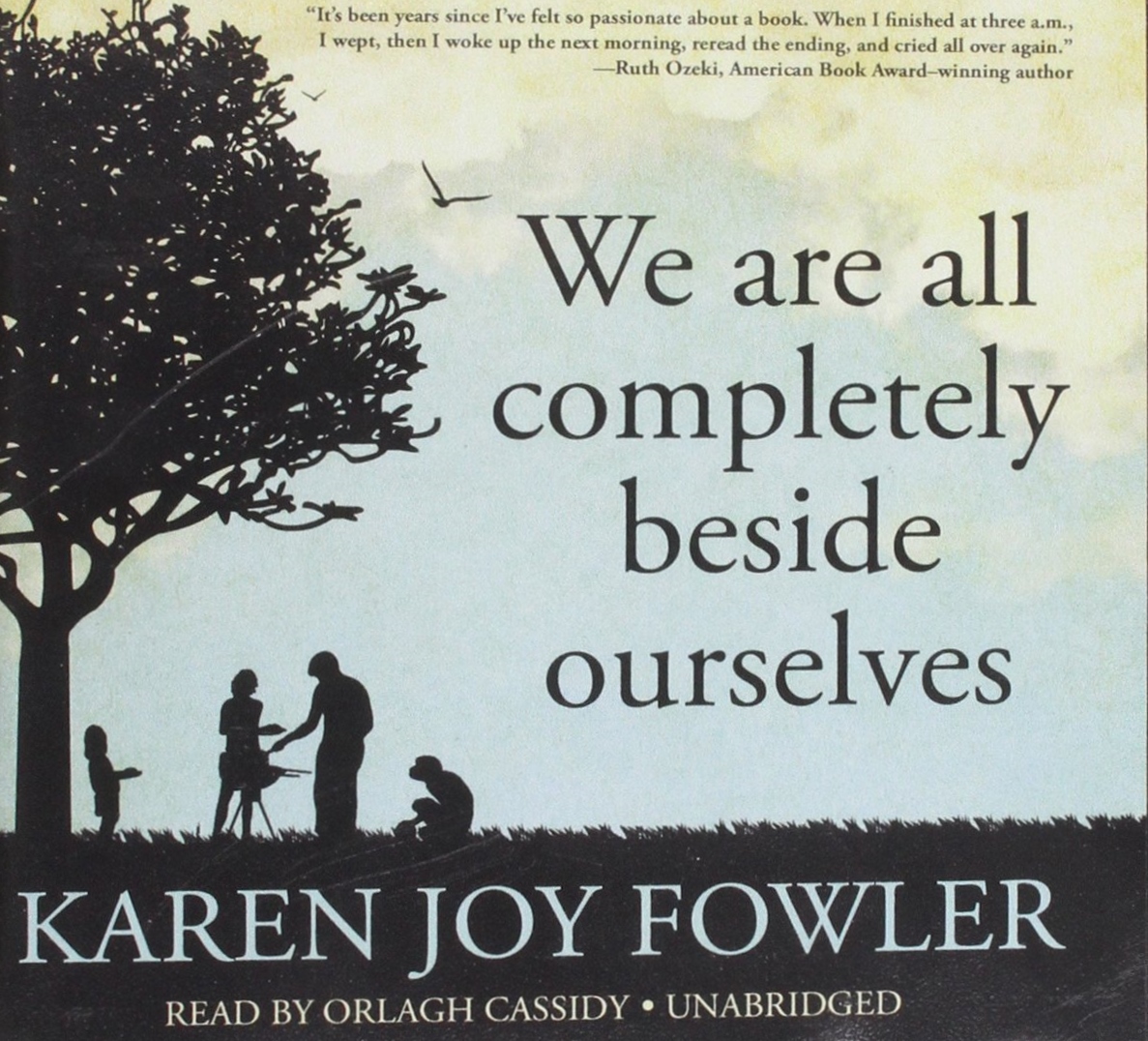
We Are All Completely Beside Ourselves by Karen Joy Fowler (audio)

**AVOID SPOILERS!** (There are none below.) As a commenter pointed out, there may be spoilers even on the dust jacket or other coverings for the book or audiobook itself. Proceed cautiously. Just trust me and read the book itself.


beside

This is one of those with a big reveal to it that *makes* the book. For the love of whatever you love, please, avoid all discussion of We Are All Completely Beside Ourselves until you read it. Excepting this review, of course, which promises to be spoiler-free and is therefore safe, and brief.

I’m glad Liz recommended this one to me, on audio specifically, and I shall do the same. Get the audiobook, which is beautifully and feelingly narrated by Orlagh Cassidy. Our young female protagonist/narrator Rosemary is a little troubled, but likeable right from the start. She uses the unusual second-person voice, breaking down the fourth wall to talk directly to her audience: “you may have the impression from what I’ve just said, that… but here’s another thing I’d like you to know…” Her story is compelling from the beginning, and involves a number of different threads and an occasionally disjointed timeline. I don’t know what else I can tell you without giving it all away. It’s about family, self-determination, the nature of memory. Life. You will laugh and be amazed. Go out and get this book now, and don’t let anybody tell you anything about it. Oh – a little bird told me Karen Joy Fowler gave away the big secret in a book talk somewhere. She is an outstanding writer, but apparently a potentially disastrous speaker. Avoid her talks til you’ve read the book. Go read the book. That’s all.


Rating: 8 studies quoted.

from the New Republic: on books

Thanks, again, to Liz for sending this along. The New Republic‘s issue of October 21, 2013 featured a cover focus on books and publishing, with five articles included. They range from a one-page infographic to 3 pages long; no serious time commitment here, although you will have to find them. I accessed these stories through a database (Ebsco, if you’re curious) through my employer; you may have similar access through your local public library, for example. I know that on Houston Public Library’s page you can go to “research databases” and search for the publication you want (New Republic), and then you’ll need to put in your library card number to see the articles. Contact your local librarian if you want to get in and you need some help; she or he will be happy to assist. Or, there’s always the print edition, if you subscribe or know of a decent newsstand!

I found these articles interesting (obviously) and wanted to share just a few thoughts. In the order I read them (I have no idea how this relates to the print magazine):

  • “Books Don’t Want to Be Free: how publishing has escaped the cruel fate of the other culture industries” by Evan Hughes examines the fact that books have avoided the way music and movies have become open to pirating and price drops. Those industries are struggling, Hughes writes, in ways that the book publishing industry isn’t. (And don’t even get started on print magazines and newspapers…) This article is optimistic and thus refreshing. It touches on the recent price-fixing court case between a group of major publishers, and Amazon. It also speaks to pricing differences between e-books and traditional print, which is addressed in the next item:
  • “The Words Business, In Numbers,” an infographic (sort of) identifying trends in revenue (e-books vs. print), reader trends, and foreign readership. In a word, “e-books are growing the pie.”
  • “The Dastardly Defender of Letters” by Laura Bennett is an article about and interview with Andrew Wylie, “who still makes millions off highbrow.” He is an infamous agent for clients including – I shamelessly reproduce those listed in the article – Amis, Nabokov, Bellow, Rushdie, Roth, and more in that vein. He is delightfully curmudgeonly, snobbish about the lowbrow, and defending books as they should be made (says he, and I largely agree). This was the most fun piece to read. His apparent serene calm regarding the future of traditional books was heartening.
  • “I Hope They Read Books in Hell” by Norene Malone, on the other hand, touches on the opposite end of the spectrum. Malone visits with the editor, Ruby-Strauss, and agent, Leavell, of Tucker Max, author of I Hope They Serve Beer in Hell.” Max’s cache, if you didn’t know, is being 1) internet-born and 2) offensive as all get-out. Ruby-Strauss and Leavell work with others in the same vein: Snooki from Jersey Shore, that University of Maryland student who wrote that bitchy email, Shit My Dad Says (whose twittering I like, btw). It was interesting to consider that counterpoint, the lowbrow, which (it is argued) helps finance the highbrow.
  • Finally, “The Rancid Smell of Success” was written by Lionel Shriver, author of a good number of novels, most famously We Need to Talk About Kevin, which became a major motion picture. She laments the changed life of a successful novelist: from the scary, financially insecure obscurity of an undiscovered writer to the publicity-exhausted successful author – who is still financially insecure and has to immediately begin work on the next book, but can’t because of all the promotional demands of the current one. It’s a beautifully written article, and she acknowledges the problem with her complaints about the literary festival she has to attend in Bali; but she justifies her complaints, too. It’s a thoughtful piece.

On the subject of e-books versus print – and the question of the future of the traditional book (“is it dead?!” they ask hysterically) – others have said it better before me, but I’ll briefly file my position. The birth or the rise of the e-book does not signal the death of the book, any more than the birth or the rise of television sounded a death knoll for radio. Radio has changed over the decades, but we still have a recognizable semblance of what it was when the television was born. There’s room for both e- and print books in this world, and both have their uses, their pros and cons, their seasons if you will; and both have their fans. Those of us who prefer print (even if we occasionally read electronically!) will continue to buy and borrow real books. Everybody calm down, is my concise message. And please, read books – any kinda way.

from Liz: Sean Hemingway interview on alternative endings to A Farewell to Arms

She does it every time, you guys, because she a) knows me and my tastes quite well and b) scours the internet and the podcasts and whatnot constantly.

Liz sent me this: an interview with Ernest Hemingway’s nephew, Sean, on a radio show called “To the Best of Our Knowledge” (acronym TTBOOK, which is cute). It opens with a movie clip (from a movie I’ve never heard of, which is a reflection on me, not the movie) about Hemingway’s very well-regarded World War I novel, A Farewell to Arms: the movie’s protagonist is upset about the ending, as many of us have been and will be. Sean Hemingway has recently released a new edited version, A Farewell to Arms: The Hemingway Library Edition, which includes all the alternative endings that Hemingway wrote before settling on the one we know. There were 47 of them.

Click the above link to listen to, or read, the interview, which includes a few of the alternate endings. (I started by listening – which was good, for the movie clip, and for hearing Sean’s voice; but then I got impatient and read through the rest.) Um, this should be clear, but if you haven’t read the book, beware of spoilers in the interview!

I was intrigued because, as interviewer Steve Paulson says, these alternate endings give us a real window into Hemingway’s process and his difficulty, himself, with the ending. And as Sean points out, most of us have lost a loved one, and the difficulties Hemingway had working out how to end this book are analogous, at least, to the difficulties we have in letting go.

Do I want this new edition? Do I want to reread the novel, or just the 47 endings? I’m not sure; my appetite is certainly whetted by this interview, but I don’t think I’m up for a full reread. For one thing, although much-lauded, A Farewell to Arms is far from being among my favorite Hemingway works. I’d reread it before I reread Death in the Afternoon, but that’s about it. And I still haven’t read everything he wrote, either, so it would be hard to justify. I could run through those endings, though… we shall see.

Thanks, Liz, for another great reference. Go check out the interview – it’s short.

Pilgrim at Tinker Creek by Annie Dillard, part the second

pilgrimattinkercreekI’m afraid I am continuing with my mixed feelings here, as in my first review. Pilgrim at Tinker Creek, for me, comes in sections, or in three parts. As I wrote, the early bits were difficult for me, a little too metaphysical and spiritual. And then, remember how I said that chapter 7 blew me away? Well, chapter 8 is even better.

Chapter 8 is entitled “Intricacy,” and addresses the amazing, extraordinary intricacy, complexity, tiny detail and huge scale and huge scale of tininess in the natural world. Dillard relates statistics that are mind-boggling: “the average size of all living animals, including man, is almost that of a housefly.” “There are… two hundred twenty-eight separate and distinct muscles in the head of an ordinary caterpillar.” “Six million leaves on a big elm.” She writes about the Henle’s loop in the human kidney, the lower lip of the dragonfly nymph. Tiny, infinitely complex things that make our world so strange. She uses this phenomenon to explore the idea of a creator – and here Dillard and I will disagree a little, but that’s okay. “Look… at practically anything… and see that not only did the creator create everything, but that he is apt to create anything. He’ll stop at nothing.” She takes the strange and prolific nature of our world to be proof of a creator – “no claims of any and all revelations could be so far-fetched as a single giraffe” – and I don’t. It’s all right, though; this book is plenty safe for atheists; she’s not preaching. She’s just exploring. And I love the science, all that tiny tiny trivia, the explanations of the human kidney and the aquatic horsehair worm.

Next is chapter 9, “Flood,” and here I am going chapter by chapter – that’s how good this book is. “Flood” addresses Hurricane Agnes, and hurricanes are something we’re increasingly familiar with, not only in Houston but in New York City these days as well. (Which leads me to point out that Dillard is blissfully unaware of climate change and ecological collapse; happy her in 1974.) There is more of what I love in Dillard: detail, observation, science, and a glorious, joyful celebration of the world.

And then it falls off again, descending (or ascending, depending on your feelings) into the spiritual once again. My level of detail falls off here, too, because what can I say? I paid less attention when she zoomed back out into the mistiness. The last few pages of this book were an effort, and I didn’t retain anything I can tell you about now.

Verdict? Rather a difficult one. Liz said, great, I’ll just read those middle chapters! But of course that’s no way to go unless you know your tastes are mine.

I am glad I read this book; it yielded some inspirational moments and great quotations (as you will see). But those came overwhelmingly from the middle portion of the book. Others, I have no doubt, will swoon over the “patting the puppy” and the tree with the lights in it. Discover for yourself; but I do think it’s worth the effort, in the end. If I were to do it again, I would just read the middle parts. Rather like Walden, then, in my final conclusions – just as I thought at the beginning.


Rating: in an attempt to be fair, 6 mushrooms.

hemingWay of the Day: as an archivist

Oh my word, Liz does it again. Never was there an article more designed to make me sigh and daydream. From PRI’s The World comes

This came to me from Liz, who got it in turn from Jessamyn West (blog – twitter). A solid pedigree right there. I swoon; this is my dream job.

Liz’s Pinterest from The Son

I once wrote about how I keep a piece of scratch paper as a bookmark, one sheet dedicated to each book, for keeping notes: page numbers for referral or quotation, words to look up, thoughts that belong in my review. My coworker (who has contributed to this blog several times), Liz, read that post, and says she thought it a great system. Now, lately, Liz has been telling me about reading The Son, by Philipp Meyer. Set in the American southwest, The New York Times calls it a “multigenerational family saga spanning the years from 1836 to 2012,” one of those “greatest of historical novels… we come to feel both the distance of the past and our own likely complicity in the sins of a former age, had we been a part of it.” (High praise!) Apparently Liz has been making a number of notes on historical terms and references that she needed to look up – and she’s gone a step well beyond my vocabulary lessons, and created a visual collection of those notes on Pinterest.

I’m not on Pinterest at this time – too many things to keep up with! – but it’s an attractive way to see what she’s learning… what do you think? Anybody else have any Pinterest pages based on books out there? (Silly question, I know! Do share!)

more on Maclean from Liz

Nature, unfortunately for the organization of academia, is vexingly interdisciplinary.

Why are the activities aboard the Titanic so fascinating to us that we give no heed to the waters through which we pass, or to that iceberg on the horizon?


Last week I posted a review of Norman Maclean’s A River Runs Through It, and other stories. My coworker Liz, who more than once has directed us to some great reads, immediately found and forwarded a 1989 Past President’s Address to the Western Literature Association by a Glen A. Love. Her comment was: “After reading your review I went looking for Maclean biography and found this, I know you dislike the form but I was compelled to send it along anyway.” She’s referring to my dislike of essay collections – I know, it’s terrible, right? but I can’t get excited about collections of essays. A single essay, however, for no good reason, I am game for.

This one turned out to be very interesting. (Liz wins again.) It begins:

Describing the early rejection of the manuscript for his widely admired book A River Runs Through It, Norman Maclean recalls in his acknowledgments the cool dismissal from one New York publisher: “These stories have trees in them.”

And then it largely abandons Maclean; but never fear. It’s a great argument for the failure of Literature to address ecology; it’s a polemic, and sadly no less relevant and (to my inexpert eye) no less correct in its criticisms today, despite being 24 years old. I thrilled to read about great nature writers whom I’ve loved, and also those I haven’t yet discovered (and note the reference to Gretel Ehrlich, of whom I’d never heard until recently). She is mentioned as one of those writers who “seem to slough off their New York or L.A. skins when they confront western landscapes.” If that doesn’t remind you of Phil Connors, you haven’t been paying attention. Maclean inhabits this article mostly in that phrase, quoting a rejecting publisher: “These stories have trees in them.” Love argues that this is one of the tragedies of Maclean’s kind, and a chief failure of the literary establishment: that to write about trees will get you derisively branded with “the contemptuous epithet nature-lover.”

I muse, as I read this article, about some books I’ve read that were partly nature writings, but only as a framework through which to dissect the human condition: Mountains of Light was lovely, and awed by Yosemite, but the author was really there to exorcise the particular demon of his wife’s death; and Almost Somewhere was even more overtly a drama of young women coming of age, and the unfortunate cattiness that often accompanies them, set against the John Muir Trail. This is one of Love’s points, too: that we (as a society, not only as writers & critics) continue to fail to consider nature, or the earth, in its own right, and instead keep considering its role in human experience.

I think Phil Connors and especially Derrick Jensen would agree with Love’s assessments. So, I’m feeling more of that synchronicity that I’ve written of before: I’ve found another kindred spirit, as Anne of Green Gables might say.

Pulitzer Prize-winning multimedia journalism

(Today I send you elsewhere for your reading.)

Remember that very cool article I pointed you all towards several months ago? (Here.)

Liz strikes again, making me aware of the latest round of Pulitzer Prize winners.

You guessed it! Among them is Snow Fall: The Avalanche at Tunnel Creek. And so well deserved. Thanks for the head’s up, Liz.