Soil: The Story of a Black Mother’s Garden by Camille T. Dungy

Whether a plot in a yard or pots in a window, every politically engaged person should have a garden. By politically engaged, I mean everyone with a vested interest in the direction the people on this planet take in relationship to others.

This is the best book I’ve read this year.

Soil has an appropriate subtitle, succinctly naming some of the most important elements of what it offers. Camille Dungy is Black, a woman, a mother, and she is determined to grow a garden in the backyard of the home she moves to with husband Ray and daughter Callie in 2013. Their new home is in Fort Collins, Colorado, an overwhelming white city in an overwhelmingly white state*, which is also Dungy’s home state. “Black people are, and always have been, planted everywhere in this country.” They come from California, where Callie was born; Ray is from New York.

Dungy, a respected poet and academic, comes to Fort Collins to teach at Colorado State University. She has always appreciated gardens, gardening, flowers; she comes from gardeners. As a Black person, and as a woman, she has no choice but to track the unjust and frightening trends in the world around her. As a mother, she must balance her work life – her entire life – against the needs of a child. These intersections of identity define the experience she describes in this book, which is a memoir of gardening, as a Black mother, in Fort Collins, in the United States, in a time that includes the 2016 election, the COVID pandemic, numerous murders of Black Americans by police and vigilantes, climate change and environmental degradation, and increasing wildfires in the American West. These are a few of her concerns. In the same sense that every space is political and every person with an interest in humanity’s direction is politically engaged… of course gardening is about race. Everything is about race. “One thing always leads into another here,” she writes, but that’s everywhere, too.

I see this book as a braided essay, in chapters. Dungy chronicles her life, and snippets of Ray’s and of Callie’s, mostly in terms of her garden; but gardening is inextricable from the history of Fort Collins, of Colorado, of the country, of Black Americans. She interrogates history and also literature, particularly nature writing, whose tradition is overwhelmingly white, nearly as overwhelmingly male, and largely free of domestic details, as in, do any of these people ever do laundry? Did you know John Muir had a wife and kids? “What folly to separate the urgent life will of the hollyhock outside my door from the other lives, the family, I hold dear. My life demands a radically domestic ecological thought.” Annie Dillard receives special attention, as does poet Anne Spencer. Dungy writes about the fear her family feels on the night of the 2016 election, and the fear they feel–achingly, that her young child feels–when they hear yet another story like that of Elijah McClain, a 23-year-old Black man who was killed by police in Aurora, Colorado in 2019. It’s all interconnected.

The craft of Dungy’s braid is exquisite, and her points are razor-sharp, wise, true. Because she’s a poet, her writing is obviously strong, too, lyric and imagistic and color-saturated and lovely. She wields metaphor to great effect. “Some large part of gardening, like some large part of living, is figuring out what to cut and when.” It’s just an all-around beautiful book. It made me cry, and it made me pause; it wasn’t always joyful, because nothing true is. Whew.

“I am no angel,” writes Dungy, about her own failure to live flawlessly with regards to “build[ing] a more equitable and sustainable world.” Nobody’s getting it exactly right, but we should still try. Similarly, she wrestles with being a gardener and nature lover when there’s so much she doesn’t know–but she’s learning. “When I told Ray I didn’t know the proper name for the broken digging tool, he didn’t laugh at me. He accepted the fact that I am still and always learning.” (This is one of the attributes I love most in a human: to be still and always learning. Also, there are some sweet notes about a good marriage in this book, too.)

On the simplest literal level, I loved Dungy’s writing about her garden. She works to reclaim the yard of the house they purchase from sedately manicured garden plots, lots of lawn, and river rocks over plasticized landscaping fabric. The aim is to restore more native plants and those that will be drought-resistant, pollinator-friendly, and friendlier to more wildlife in general. These are goals I share in principle, at my own little house, but in practice I’m pretty daunted by the work involved. I do not love the work of gardening nearly as much as Dungy does, and she is honest about how much work it is. I wish I were more like her, in this respect and others. It’s inspirational.

Thank you, Liz, for the recommendation. Like its lovely dust cover and endpapers (I had to go back and tell Liz, who listened to the audiobook, to get a print copy!), this is just a gorgeous book.


Rating: 10 blooms.

*84.5% and 86% “white alone,” respectively, according to the 2022 US Census Bureau QuickFacts sheets for city and state.

Vera Wong’s Unsolicited Advice for Murderers by Jesse Q. Sutanto

This is a very cute, sweet, pleasurable story: a cozy mystery, a loving family tale, with rom-com style matchups and a loveable amateur sleuth. Vera Wong is an older lady – in the world of this novel, she’s just sixty but also an ‘old lady,’ all things being relative, I guess. (Despite Vera’s starring role, the rest of the perspectives are decidedly youthful.) She’s widowed, and she misses her beloved husband, but it is in her personality (and, implied, part of her ‘Chinese mother’ culture) to soldier on. She has a small business she’s very proud of: Vera Wang’s World-Famous Teahouse, in San Francisco’s Chinatown. (Yes, she’s taking advantage of the more famous Vera Wang’s name recognition.) She lives upstairs, and wakes every morning precisely at four-thirty to start her day with a brisk walk and a text to her adult son, Tilly, who receives a number of these texts every daily, exhorting him to proper behaviors; he rarely responds. The voice of Vera’s chapters (in close third person) is resolute and cheerfully bossy; but we understand that she is very lonely. Despite its name, her teahouse is far from famous. She knows it will soon have to be shut down.

Then something terribly exciting happens: she comes downstairs one morning to find a dead body in the teahouse. Vera is thrilled! She calls the police, but they do not seem nearly as worked up about the possible murder as they should be, and they are not at all appreciative that she has helpfully outlined the body for them in Sharpie. “Vera knows they won’t do anything… but… nobody sniffs out wrongdoing quite like a suspicious Chinese mother with time on her hands, and what does Vera have but time?” And so the nosy, overbearing, but somehow magnetic Vera is on the case. If there is a case – the dead man, Marshall Chen, is originally ruled an accidental death. But Vera won’t let this stop her.

Soon other characters (suspects!) surface: there is Julia, Marshall’s widow, worn into submissive passivity by his years of verbal abuse, and her sweet toddler daughter, Emma. There’s Oliver, Marshall’s twin (who gives everyone a start when he first shows up on scene), long estranged from his bully of a brother. And then there are Sana and Riki, both of whom pose as reporters but who are each hiding a secret connection to the dead (murdered?) man. In her usual domineering manner, Vera takes each of these younger people under her wing, even charming the somewhat troubled Emma into calling her Grandma. It helps that Vera never stops cooking up wild, wonderful feasts of traditional Chinese food anytime they gather. Even as she’s befriending them and improving their lives (with a little insistent advice, not to say pushing), Vera is investigating each of the foursome as murder suspects. But as they come together to form an unusual little family of their own, she is less and less pleased at the thought of turning one of them into the police (incompetents!), especially as it is increasingly obvious that the late Marshall was not a nice man at all.

Vera Wong’s Unsolicited Advice for Murderers trades rather heavily on stereotypes about Chinese mothers, to an extent that I think would be problematic if the author did not herself come from that culture. She pokes fun in a loving manner. Does her in-group status excuse using stereotypes as the punchline? I don’t consider myself qualified to make a firm call on this, especially as I am not in-group; I’m cautiously okay with this case, but mine is not perhaps the final judgment that matters most. I will say the book is intended in good fun and comes off as such. Jesse Sutanto has published an impressive number of adult, young adult, and middle grade novels, and the writing style of this one leans toward the cute rather than the literary. Some constructions feel quickly slapped off. It’s fine for an easy, entertaining read, and this one hits the mark.


Rating: 7 bowls of congee.

The Last Graduate by Naomi Novik

Book two of the Scholomance series was every bit as thrilling and engaging as book one. I love our grumpy, standoffish teddy bear of a protagonist.

El had good character development in A Deadly Education; now she’s continuing to develop as a person, both because she’s a teenager (coming of age) and because she’s made friends for the first time in her life. She’s reluctant to believe in this, because she’s endured a lifetime of trauma at the hands of almost everyone she’s ever known. Her new friends and allies do have something to gain from working with her at graduation, now that her power as a wizard is becoming more widely known, so she’s not entirely wrong to consider that this may motivate their friendship; but the reader can see better than she can that their friendship is real, too. It’s poignant to see such a sweet but enormously curmudgeonly, damaged, dear kid struggle to accept that people might actually care about her.

The privileges of class and nationality at work here, the power structures that are most invisible to those in power, and the injustice of it all, are more overtly at the center of this book. I think there are some good magical parallels to our real world here that can be instructive but also entertaining and fit neatly into the fantastical wizard-y world of Novik’s imagination, which is prodigious, by the way; this is expert-level worldbuilding. Late in the book the focus begins to move beyond the Scholomance to consider the whole world, which is clearly where book three will take us; this one ends on another final-line cliffhanger (!), so I’ll be getting there fairly quickly.

Perhaps because they were both Liz recommendations, I am reminded of the Murderbot series here, which also featured an outsider first-person narrator who is actually a loveable marshmallow on the inside but puts forward a hard, aggressively antisocial exterior. Despite being mostly rejected by their respective societies, both are driven to right the big wrongs. I do love this set-up, and I love El for being a hard-nosed, sarcastic badass.

In this installment, I actually questioned the YA label. The series does star teenagers, and deal with coming-of-age problems (therefore YA). On the other hand, it also deals with some very dark themes, heavy enough that some readers move it out of the YA category; but after some consideration, I don’t think that’s necessarily a disqualifier. It’s definitely for older kids, not least because there’s some (non-graphic) sex in this one. Maybe the line between YA and adult is blurred; certainly it depends on the reader. There’s no question that these are books for adults (hi), but I think they’re also books for young adults who are up for serious thinking on dark subjects, and some really good writing. This is a step adultward from Hunger Games, which are however very fine books in their own right. Who’s to say what kids should read, anyway? My parents didn’t seem to me to monitor my reading much, and I definitely read some stuff beyond my comprehension at a young age, and all that seems to have done is whet my fire. As ever, your mileage may vary.


Rating: 8 glaciers.

A Deadly Education by Naomi Novik

Another perfect recommendation from Liz, A Deadly Education is narrated by El, short for Galadriel, a wizard-in-training at the Scholomance. Her world looks much like ours, but you and I would qualify as ‘mundanes’ – people who don’t see or believe in magic. El is in school to learn spells and tricks and control, and as an independent wizard kid, possibly to earn an invitation to join an enclave. Wizards banded together in enclaves are much safer than indies like El, whose mother raised her in a yurt on a (mundane) commune in the Welsh countryside. But her mother Gwen is much beloved, a talented healer and source of all things good, while El’s affinity or tendency is toward large-scale destruction, as in mass murder. She is not a bad person: in fact she has spent her nearly three years in school working hard to keep her affinity in check, hiding the true extent of her powers, and making no friends with her eternally sour attitude. The tension within El between her natural affinity (murderous) and her value system (protective and good) is one of the central conflicts of this story.

Now the school itself: the Scholomance is full of terrors, like mals (short for maleficaria), monsters of all sorts; they live in the in-between spaces so that it’s dangerous to go anywhere alone, even to the bathroom, which is hard on a loner like El. Each year the massive, circular, magical space rotates and ratchets around so that the freshman dorms move down to become sophomore dorms, etc., and everyone gets closer to graduation, which is a euphemism for the seniors being dumped into a space filled with mals where they’ll have to fight their way out to real-world survival. Many of them won’t make it. Thus are your four years at the Scholomance taken up with working to form alliances to help you through graduation, unless you were lucky to come in an enclave kid from the start, with privileges and protections built in.

This accounts for several other intriguing conflicts within the novel: class and classism are up for debate within the enclave system. School in general is filled with petty jealousies and social politics, in ways recognizable to those of us who attended mundane high schools, and with the essential addition of life-or-death machinations re: mals and magic. There are plenty of larger questions about right and wrong and personal agency and what ends justify what means, but none of this is overtly or pedantically the point of the story: this is a page-turning, deliciously readable story of one awkward, socially ill-adjusted, fundamentally sweet but somehow also deadly teenager. El wants to secure her safe place in the world, but she really doesn’t want to hurt anybody. (Well, sometimes. She has a bit of a temper, and she does take a lot of abuse.) She also really wants friends, although she wouldn’t be quick to admit it.

It’s a great story, with some great secondary characters, including those cautiously interested in working with El, and the enigmatic oaf who wants to protect her. By the final chapters (which include some great action/battle sequences to boot) I was hooked and cheering. The last six words of the novel (!) contain a bombshell, and I cannot wait to start book two of this trilogy. Strongly recommend this one for awesome female lead characters, intrigue and world-building, fun magic, and poignant human drama.


Rating: 8 argonet teeth.

The Storied Life of A. J. Fikry by Gabrielle Zevin

Another winner from Liz. It felt for a split second like it was going to be a bit too easy a meet-cute, but things got immediately complicated for the better.

The first thing the reader sees at the start of Part I is a brief annotation to Roald Dahl’s story “Lamb to the Slaughter,” by an A.J.F. (we assume, the title character). These annotations begin each chapter, but it takes a while to discern their intended destination or use.

Next is a chapter starring Amelia Loman, whom we meet painting her nails yellow on a ferry ride from Hyannis to Alice Island. She has a mild hangover but still feels upbeat about the appointment she’s ferrying toward: she’s a new publishing sales rep going to call on A.J. Fikry, proprietor of Island Books. Amelia is a likeable character, but A.J. – first encountered through her eyes – is prickly. I was surprised to learn that he is just thirty-nine years old, because my first impression was of a crusty old curmudgeon of a shopkeeper (a ‘type’ I recognize from bike shops, but bookstores will do just as well). He certainly fits the type, just younger than I’d originally guessed. And after that first chapter, Zevin wisely takes us from Amelia’s focus (in the close third person) to A.J.’s. I love a jerk whose bad behavior is suddenly complicated and made sympathetic by backstory.

A.J. has suffered a major loss, and he is a jerk – or at least he’s coping poorly – but then the unexpected strikes. It’s not Amelia, as I’d originally thought. It’s something a little different, and my synopsis stops here.

The Storied Life of A.J. Fikry is delightful. It has grumpy but endearing book nerdiness; earnest, messy human emotion; the complications of grief and loss and family; whimsy and mishaps; and yes, a little romance. Also, a bookshop in a small town, with all the social drama and love and support that that can entail. It’s definitely on the sweet side, approaching precious, but never saccharine; I’m pretty sure when Liz recommended it she acknowledged that it would be best read in a mood for something sweet and light-ish, but it’s not the least bit fluffy, and even involves a sequence about the line between fiction and memoir and does it even matter? I read it in a single day and wish it had lasted longer. I could sink into the world of A.J. et al much further. I am off to see what else Zevin has written. Do recommend.


Rating: 8 vampires.

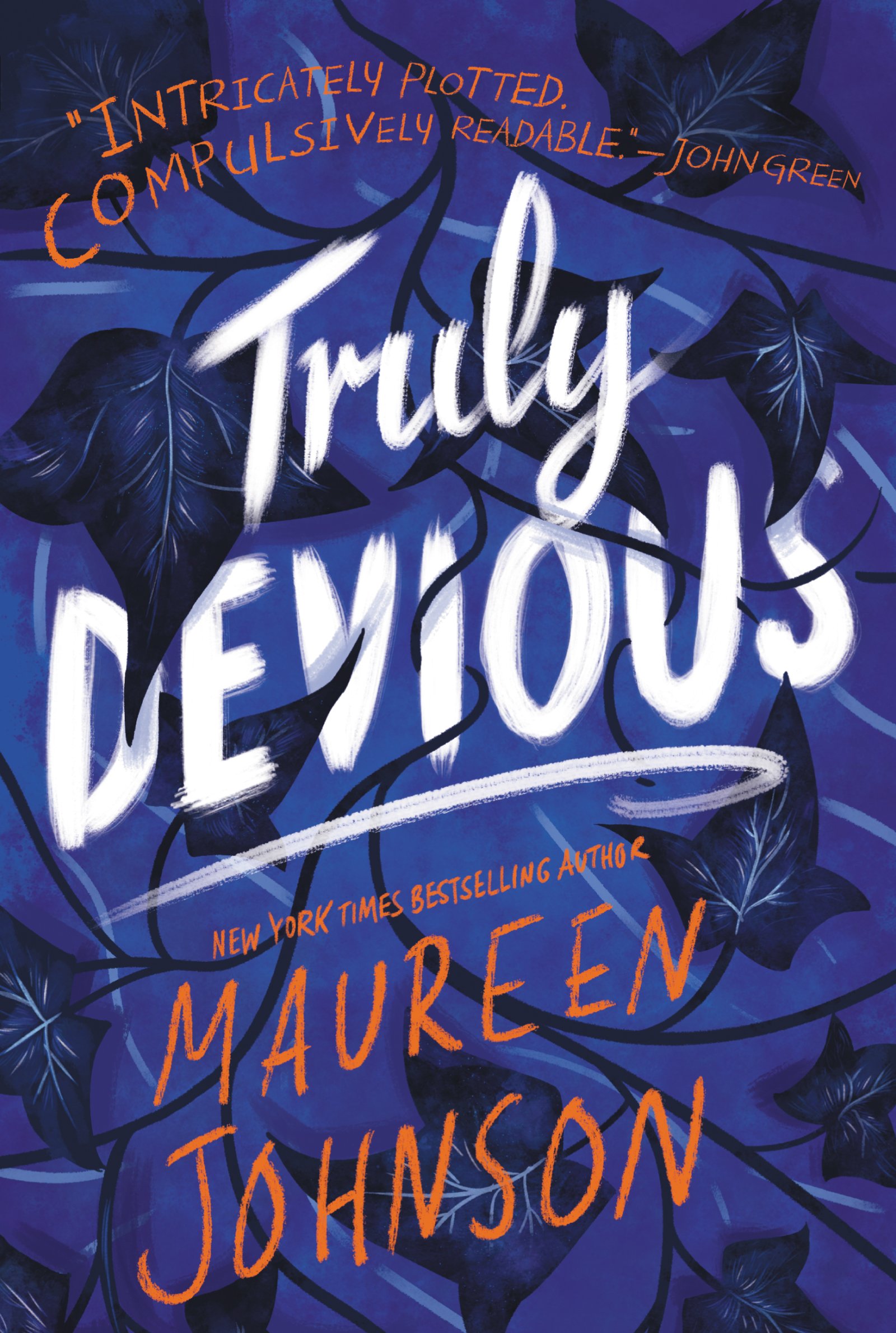
Truly Devious by Maureen Johnson

Yet another gem from Liz, Truly Devious is a positively delightful piece of fun (that also involves murder). It’s for young adults, but easily well-written enough, and sufficiently funny and clever on a few levels, to please adults (like Liz & me).

There are two timelines, although we spend the bulk of the book in one of them. First, in 1935, a teenaged genius is lucky enough to be plucked out of her New York City public school to attend a special new educational experiment in the mountains of Vermont: Albert Ellingham, major mogul, has established the Ellingham Academy to let kids like Dottie pursue the joys of learning in their own ways. Unluckily, a year later, Dottie is murdered at the idyllic Academy, apparently a bystander in a plot to kidnap for ransom Albert Ellingham’s wife and daughter. Readers get a glimpse of Dottie’s final moments, but her assailant is unnamed, undescribed, and genderless.

Much later, more or less in contemporary times (I didn’t notice a year for this timeline?), another teenaged girl is also delighted to be admitted to Ellingham, not despite but because of its murderous history. Stevie Bell, of Pittsburgh, is crime-obsessed: she hopes to become a detective, ideally for the FBI, and the Ellingham Academy murders are her dearest project. The remains of Iris Ellingham (Albert’s wife) were found as well as Dottie’s, but the body of young Alice Ellingham, aged four at the time of her disappearance, has never been found; technically Alice is Stevie’s host and educational benefactor in absentia. Socially awkward Stevie arrives at Ellingham determined to distance herself from her parents (who love her but do come off rather obnoxious, especially with their unfortunate political leanings), begin a new chapter in her life, maybe finally make some friends, and – most importantly – solve the biggest best crime she knows. Each of these goals will turn out to be ambitious, but Stevie is both smart and scrappy. She easily pairs up with Janelle (who hails from Chicago and excels at building machines and gadgets) and establishes a harder-won friendship with even more socially awkward Nate (a published and thoroughly writer’s-blocked novelist). Their dormmate Ellie is a free-wheeling artist who both impresses Stevie and makes her nervous; there is also a famous and spectacularly handsome filmmaker/actor (who however seems not very smart), and a mysterious boy named David who both attracts and repels Stevie.

While we check back in with 1936 (investigation, trial of an apparent straw man, Ellingham’s grief), the modern timeline dominates. Stevie is both a fine amateur detective (in a long literary tradition) and a teenaged girl, grappling with hormones, friendships, school, the sandpaper grip of her parents, and other challenges that will be familiar to all readers, not just those with true crime obsessions and unusual educational settings. By nature of having a female lead, Truly Devious involves some girl-empowerment messaging, but like its handling of nonbinary genders and queer characters, this messaging is simply built into the story, not A Point To Be Made.

Was this was pretty was?
Who knew. This was what a Stevie was, anyway.

Stevie and her friends are lovable above all; also smart, bumbling, funny, painfully awkward, and pleasingly eccentric. There is everything to enjoy.

I finished this book having just ordered book two but it wasn’t here yet and I felt a real sense of loss. I expect to burn right through books two through five, so look out for more Stevie Bell.


Rating: 8 poles.

The Spare Man by Mary Robinette Kowal

Well, this is the most fun thing I’ve read in a while (and that’s saying something). Liz let me know that Martha Wells (of Murderbot) gave this book 5 stars on Goodreads. So I bought it.

Tesla Crane is traveling incognito on a space cruise to Mars with her new spouse, Shal. Tesla is an uberfamous and uber-rich inventor-engineer and heiress, and she just wants to enjoy her honeymoon in privacy, but then a woman is murdered on the way back to their luxury cabins after karaoke, and ship security makes the bad mistake of arresting Shal (himself a recently retired detective), so Tesla is on the case. She is also physically limited by some extreme injuries and a touch of PTSD following a lab explosion, for which she uses the assistance of a Deep Brain Pain Suppressor (DBPS, usually turned up a bit higher than is actually safe), occasionally a cane, and most charmingly, a service Westie dog named Gimlet. With Shal locked down, Tesla is a bit hobbled but also highly motivated (not to say pissed). She navigates the ship, high society, and her investigations with cleverness and aplomb and a sometimes imperfect awareness of her privilege, as Shal gently reminds her; she will make a few friends along the way, but everyone’s a suspect, especially as the body count climbs. Tesla herself is very likeable, but Gimlet steals the show (for readers and most of the ship’s passengers and staff).

I love the elements that combine in this story. There is a strong core of sci-fi, which other reviewers assure us is accurate and well-researched (this reviewer is happy to assume this is the case and move along). There are some fun, thought-provoking cultural elements, especially around gender: in the year 2075 we don’t have much patience for gendered language, using Mx. in place of Ms. or Mr. and spouse in place of the gendered versions, and it is extremely rude and outdated to introduce anyone without noting their pronouns. (Tesla’s spouse Shal is a very masculine type and very handsome but also very engaged with textile arts, particularly embroidery.) The protagonist couple takes their cocktails and coffee very seriously, and each chapter opens with a cocktail recipe (some of which are zero-proof); bar culture and bartenders also form a significant framing element. Gimlet the service dog gets full appreciation both for her skills and training and for her dogness (she’s a dog, not a robot). It all forms a really neat combination, although let me also say the plot needed no bolstering: the mystery itself is fully-formed and legit. What’s not to love?

I was completely absorbed and stayed up late into the night finishing this one. Firmly recommend. Thanks for the tip, Liz & Martha.


Rating: 8 ounces.

“Autobiography of a Traitor and a Half-Savage” by Alix E. Harrow

Thanks to Liz for making me aware of this ebook-only short story by one of my new favorites, who has not written nearly enough books yet.

Our narrator, Oona, was “born in 1892 on the banks of the Mississippi, in that muddied, mongrel part of the world where East and West are separated only by the coalsmoke-scummed river.” Her mother was an Amerind, of the West; her father an Easterner, “one of those scruffy, perennially drunk men who float down the river like driftwood.” Oona never knew him. She is therefore a mixed child, “half of one thing and half the other,” born to be a mapmaker. “In our language, the word for mapmaker is also the word for traitor.”

Oona is indeed a mapmaker as a young adult when we meet her. Mapmakers in this world do not make maps, but rather hold the world in place, literally, while it bucks and reshapes itself to defy easy travel; she works for the Easterners who hope to conquer the shifting, untamed West for their own profit. She is therefore a traitor to her Western roots. But mapmaking was the only source of reasonable income available to a young orphaned woman with a dependent: her younger brother Ira is ill, and her employers hold him hostage, his care and medication in exchange for her continued service. Until Oona must lead her hated boss to a bone tree – what Easterners would call a graveyard, and Oona’s people might call “the trees that take up the dead to sing for seven generations.” And things change again.

My greatest complaint with this short story is that it is short. Oona is compelling, caught in a moral quandary, bound by her love for her brother whose love for her will have hard consequences… and caught between East and West, two halves of herself. This world is both recognizable (themes of traditional lifestyles versus colonialism; exploitation, self-determination and magic) and foreign (magic). Harrow uses footnotes in this story, an opportunity for a little extra narrative musing, and the tricky use of outside sources that imply authority in a work of (yes) fiction (her sources too are fictional). The whole thing is both fun and moving. I’m just sorry it’s over. Well worth the pennies it cost me. Write more, Alix!


Rating: 8 malevolent stars.

Why Fish Don’t Exist: A Story of Loss, Love, and the Hidden Order of Life by Lulu Miller

Another one hit way out of the park by Liz. I no longer remember what she said, but I think it involved some superlatives; I bought the book and finally got around to it and now have some superlatives of my own. It was just early April when I read this book, but I’m confident stating this will be the best book I read all year.

Why Fish Don’t Exist is one sort of book I love, in that it involves several threads woven together. In her prologue, Lulu Miller pits our most precious loves against the force of a capitalized Chaos. “Chaos will crack them from the outside–with a falling branch, a speeding car, a bullet–or unravel them from the inside, with the mutiny of their very own cells. Chaos will rot your plants and kill your dog and rust your bike. It will decay your most precious memories…” Etc. Then we first meet David Starr Jordan, as Miller did. He was a taxonomist specializing in fish. An earthquake destroyed his collection of thousands of specimens, dashing them in their glass jars to the ground, separating them from their identifying tags. To which he responded by hand-stitching tag to fish specimen, and starting over. Miller is entranced by this “attack on Chaos.” She struggles herself with the forces that tend to defeat us, and wonders of Jordan: “Who are you?… A cautionary tale? Or a model of how to be?

From here we accompany Miller on her study of Jordan – his life and his thoughts – in search of a model for how to be, how to live with joy and be indefatigable in the face of all frustrations, all forms of Chaos. Why Fish Don’t Exist is thus partly a biography of Jordan and a layperson’s introduction to fish taxonomy and its principles. (The title is not a joke. There are existential arguments and philosophies to be discovered, too.) It’s also part memoir, as we get to know Miller better, the demons she’s faced and the tools she’s used to try to mend herself. Her father is a delightedly nihilistic scientist, with some parallels to Jordan, which is of course fascinating. The book is perhaps most of all an inquiry into Miller’s original concern: how to live and not despair, not choose to die, in such an overwhelmingly imperfect world as this one.

Miller’s writing style is colorful, phantasmagoric, impassioned, with high highs and low lows. She sees beauty and desolation in the world, and describes them evocatively. Among Jordan’s discoveries are

A small lantern fish with glowing spots, “which had risen from the deeps in a storm.” A tiny, rainbow-scaled fish that was found inside the belly of a hake, which was found inside the belly of an albacore. A crimson fish with yellow stripes that they nicknamed “the Spanish flag.”

The only fish he ever named after himself, “breathtaking, absolutely, but frightening, too, in the way of an M.C. Escher drawing.” “Its fins look like dragon wings, serrated and sharp.”

Without ruining too much of the story, I will say that Jordan, like all our heroes, is not purely heroic. He turns out to be in fact profoundly problematic, as our heroes tend to, and so Miller must wrestle with that, too. Chaos again. His methods are ruthless –

He began inventing more aggressive techniques for capturing fish. Blowing them out of the water with dynamite, hammering them out of coral, and perhaps most ingenious, for the “myriads of little fishes” that hid inside the tiny cracks in tide pools: poison.

and he’s harder on people than he is on fish. In more than a few ways I won’t give away here he will disturb our modern sensibilities. He disappoints us, as he disappoints Miller – horribly – but her own perspective never disappoints.

Illustrations by Kate Samworth open each chapter and advance their contents; these lovely black-and-whites resemble woodcuts (if that’s not in fact what they are) and will be part of what makes this book memorable for me. I think Samworth deserved to have her name on the book’s cover.

Transcendent. Best book of the year. Wrecked me, but in the best way. I’ll be thinking about this one for a long time.


Rating: 10 holotypes.

Aurora’s End by Amie Kaufman and Jay Kristoff

I am sad to see book 3 of this trilogy go by. Liz, what’s next?

With Aurora Rising, we met our cast of wacky characters, and saw them just begin to fit together. With Aurora Burning, we saw those bonds tighten even as the group began to be split apart by circumstance. Aurora’s End then brings all the dramas and plot conflicts, large and small, to their conclusions. This installment got still more convoluted in its science, and hit that note that sci-fi sometimes does for me, where it made me glaze over a bit: I just let the science go by and trust that it makes sense. It was definitely fun to mix up some timelines, I’ll say that. I am sorry to see it all come to an end, obviously, but I feel really good about where Kaufman and Kristoff left my new friends. There was some trickery right at the very end, but they brought it all around. And they are masterful worldbuilders; I’m going to look into their other work and see if there’s more there for me. This trilogy was such a treat as absorbing escapism, and I really needed that.


Rating: 8 gremps.