Yale lectures on Hemingway, Fitzgerald and Faulkner by Wai Chee Dimock: lectures 17-25; conclusions

(See my first two reviews: lectures 1-7 and lectures 8-16.)

First I’d like to share another example of something that I wished to debate with this professor. The discussion below contains spoilers regarding For Whom the Bell Tolls, which is probably my very favorite book ever ever (possibly competing with The Odyssey and The Jungle), so if you haven’t read it, you might skip this part of my review.


Spoiler begins

At about 32 minutes into lecture 19 (“For Whom the Bell Tolls,” Part IV), regarding the scene late in the novel when Robert Jordan’s leg is broken and Pablo is going to lead his small band onward without him:

The symmetry here is between Robert having a broken leg and Pablo having much head. He is the brainy one. This is the ultimate rewriting of the power dynamics in For Whom the Bell Tolls. We’ve been going along with the assumption that it’s the person with the knowledge and the technology, the person with the knowledge of the world, the person that speaks several languages, we’ve been going under the assumption that that person is going to be on top, that the future belongs to him. The ultimate irony of this novel is that in fact this is the person who’s going to lose out, who’s going to have no future at all.

While I see her point about the disruption of power between the educated, foreign-empowered Robert and the rather much maligned and dissipated Pablo, I couldn’t disagree more about the disruption of the reader’s expectations. I realize I can only speak for myself, but I think I can find some Hemingway to back up my impressions.

When I read this book for the first time (in a beach camp in the little town of Sayulita, Nayarit, Mexico), I had a strong sense of foreboding about Robert’s fate, and indeed, the fate of Pablo, Pilar, and the rest. Robert’s daydreaming of his life together with Maria in other times and places – in Paris, in the United States, as the wife of a professor entertaining undergraduate students – has a tone of wistfulness, as if Robert suspects this will not come to pass. He likewise daydreams about suicide – his father’s, and the avoidance of his own – and is increasingly pessimistic about the fate of this band of guerrillas. The end of El Sordo has an air of doom about it, which reflects further than those who die on the hilltop; the odds are admittedly against a little guerrilla group in these mountains. When I read this book without knowledge of the ending, I felt sure that Robert and Maria wouldn’t make it out of these hills together and alive; I suspected Robert’s demise specifically, and worried for the rest of them as well. And while I know this is just one person’s reading, I think there’s evidence that Hemingway directed me toward these suspicions. So I’m not sure Dimock has grasped it when she says she’s turned all our expectations on their head. Hemingway has disrupted the power dynamic, yes, but intentionally and with foreshadowing; I’d argue that one of the messages of this novel lies in his statement on war and the value of military technologies, in the way that Dimock shows, but he didn’t surprise us with it so much as build us steadily towards this ending.


Spoiler ends

I am arguing with Dimock here not because I think she’s unintelligent or anything, but because I enjoy debating literature I love. I just wish I could be there and ask my questions and make my points, engage the prof and my classmates. In other words, I would like to be back in school again. What else is new.

I both enjoyed very much, and was very frustrated (see above) by Dimock’s study of For Whom the Bell Tolls. I think this is natural. Next we studied Tender is the Night, which I reacted to similarly but less strongly; that’s a book I’ve read, though not recently, and I feel less strongly about it than I do FWTBT; it might be my least favorite Fitzgerald (I thought The Last Tycoon, for example, was better), but ho hum. And then there was Light in August, the only Faulkner I’ve read, and if you read my two reviews of that, you know I’m settling in as not a Faulkner fan. So, the final question of this semester of Hemingway, Fitzgerald and Faulkner: for me personally, did this class help me understand and enjoy Faulkner, or make me want to read more of him? And to that, a resounding “no.” I am discouraged by Dimock’s repeated confession that he is difficult, makes little or no sense, that she often does not understand what he’s up to. I was turned off by the other two works discussed in this course, and the final four lectures on Light in August shed precious little (wait for it…) light.

I now want to go back to school and study more literature; and I want to avoid William Faulkner from here on out. Those of you who enjoy him are welcome to your enjoyment and I’m happy for you. I’ll be over here.

As for Wai Chee Dimock’s course: I think she fails to articulate her thoughts sometimes; also, I disagree with some of them, but respectfully. I would certainly be happy to take courses from her if I were going back to school. As for this course via iTunes U, however, I give the combination of Dimock’s speaking style and the poor audio recording quality a C-, at best. However, I listened to all 25 lectures at ~50 minutes apiece. If you’re interested, they’re out there, and for that I’m grateful. We’ll see if I have any success with iTunes U in the future.

Yale lectures on Hemingway, Fitzgerald and Faulkner by Wai Chee Dimock: lectures 8-16

Well, compared to my earlier review of lectures 1-7, I confess I’m a little less enthused with this second set of lectures. (By the way, for clarity’s sake, I downloaded all 25 lectures at once with no indicated break. These breaks for review purposes are random and my own.) I continue to find some audio issues – volume variations, breathiness, background noise – distracting and a little frustrating; I can better understand other users’ complaints as I go on and as this annoyance builds. And I have decided I do not want to read any more Faulkner. It’s not encouraging to have this professor repeatedly confirm that he is difficult; and what I’m learning about the two studied works I haven’t read (The Sound and the Fury, As I Lay Dying) is not motivating. I am perplexed by Dimock’s characterization of As I Lay Dying as “Faulkner’s version of To Have and Have Not” (this is at 15:00 or 14:55 of lecture 16, if you want to hear more). I confess listening to Dimock acknowledge Faulkner’s esoteric nature, combined with being thrilled to hear Hemingway discussed, is only serving to cement me further in my feelings about these two men. And that’s not really the purpose of academia, is it! I wish I could attend this class with classmates and participate in the study sections she refers to; I’d love to write papers as assigned and get feedback on them; maybe one day I’ll still go back to school and do these things, but for now, listening to these lectures is… still worthwhile, but sometimes frustrating. I hear things I don’t agree with, or need further explained, and there’s no platform for that. I could criticize and pick apart Dimock’s thoughts here, but it doesn’t feel entirely fair. I’d feel much better about doing it in the format intended: class discussion. Besides that, it’s difficult to articulate my arguments for you here, in front of this keyboard, after having listened to the lectures while driving my car and thus not taking adequate notes! These are the limitations of “study” under these terms as a busy professional. I’m still listening. But part of what I’m getting out of these lectures is just more regret that I’m not a full-time grad student!

I will choose one concept to argue here. It struck me hard enough that I made a note and went back to listen to this quick bit at home so I could share with you.

This is in lecture 16, covering For Whom the Bell Tolls (for the record, my favorite Hemingway novel). Dimock reads briefly from a conversation between Robert Jordan and Anselmo (whose name, inexplicably, she pronounces more like Ensalmo; it drives me nuts) in which Anselmo says of the gypsies,

To them it is not a sin to kill outside the tribe. They deny this but it is true.

Dimock comments.

Usually, for most of us, the injunction is against killing, period, right? So there’s just no qualifying after that… [but for the gypsies] outside your tribe you’re free to kill anyone. That’s an incredible charge to level against the gypsies.

She continues on to argue that this accusation, that gypsies lack some moral rectitude that the rest of us possess, is a statement that Anselmo is making about the gypsies’ inferiority; she goes on to discuss Robert Jordan’s apparent ignorance of Spanish culture & history based on a comment that he makes about the Moors. Well, I’m not so sure that Robert Jordan is all that ignorant, but that’s another argument. I think Dimock missed a key piece of irony in that statement about gypsies killing outside their tribe. What struck me about Dimock’s response was her dismissively clear-cut understanding of “our” rules about killing: “the injunction is again killing, period.” First of all, the groups that Anselmo and Robert Jordan belong to (the Abraham Lincoln brigade; guerrillas; Spanish republicans) certainly don’t have a universal injunction against killing people: they kill fascists, don’t they? In other words, depending on how you define one’s tribe, they also feel that it’s permissible or justifiable to kill outside the tribe. Or let’s take this a step further: nowhere does Anselmo, or Dimock, note that it’s okay or not okay to kill humans outside one’s tribe. No, she states that “for most of us, the injunction is against killing, period.” This couldn’t be further from the truth. People kill sentient beings by the billion: to eat them, to take their habitats, as collateral damage during our search for fossil fuels, on and on. To take a more modern approach, we as a society not only kill all nonhuman things as a matter of course and without a second thought; we also seem to accept under certain circumstances that it’s justifiable, at the very least, to kill nonwhites, or non-Americans, or non-Christians; in the post-9/11 United States, there was (is) a certain acceptance of our right to kill Muslims or brown people who live in certain countries! Now, Hemingway didn’t live to see 9/11, but this brand of ethnocentrism is not unique to my generation’s experience. I believe that Hemingway, unlike Dimock – and likely Robert Jordan too – saw and intended the irony in Anselmo’s statement about gypsies killing outside the tribe. It’s all a matter of how you define one’s tribe. Dimock herself pointed out in an earlier lecture that Hemingway’s work is simply dripping, saturated, with irony. I think she missed a fine example here.

Yale lectures on Hemingway, Fitzgerald and Faulkner by Wai Chee Dimock: lectures 1-7

This is a series of 25 lectures – a semester course, presumably – available on iTunes U here. The description provided says…

This course examines major works by Hemingway, Fitzgerald, and Faulkner, exploring their interconnections on three analytic scales: the macro history of the United States and the world; the formal and stylistic innovations of modernism; and the small details of sensory input and psychic life.

Some of the user comments/reviews on iTunes U accuse Professor Dimock of being difficult to understand; I’d like to speak to that first. These are not ideal audio recordings, it’s true. She’s a little faint, as if the mike was not pinned to her lapel but in the room somewhere (students coughing and rustling are audible); or maybe sometimes she has it too close to her mouth, and we get unnecessary breathiness. I had to crank my volume way up, and Dimock has some (natural, I think) variations of volume that had me making adjustments and occasionally jumping when she speaks up. And she does have an accent. And she does use “ums” and pauses; but again, I think most of us do. While she is not the most articulate, professional speaker I’ve ever encountered, I think she’s plenty fair for a college professor. (They don’t get to be professors by being professional speakers, kids, in case you didn’t know.) And the recording quality is partly to blame for the minor difficulties I had understanding these lectures. All that said, I found it entirely possible to turn up the volume, concentrate, and receive what Dimock had to say; and it was well worth it.

Now on to the content.

In the early episodes, I can’t say that Dimock presented any ideas that were wholly new to me. Here’s where I’ll take some credit for having read at least a little Faulkner, a medium-sized chunk of Fitzgerald, and most of Hemingway (repeatedly), and read similar proportions of biographical material on each, and studied literary criticism in the past. However, I haven’t tried to think in such academic interpretive terms in some time, and this warming up (if you will) of that part of my brain was useful and welcome. It felt really good to think in academic terms again.

I have to say that I couldn’t get on board with all of Dimock’s concepts. For example, her conflation of the “vagueness” of The Great Gatsby (that was, I believe, Maxwell Perkins’s word) with her “counterrealism” of same is problematic to me. I think you could be vague in your portrayal of realism, and I think you could be precise and use clear outlines in representing counterrealism; so I don’t think it works to substitute the one for the other. In addition, I’m 90% confident that in discussing Hemingway’s short story Indian Camp, she first asserts that childbirth is a manmade event (because it takes a man’s action to bring it on, of course) rather than a natural one; and then later comes around and asserts that it is as natural as rain (which I am much closer to agreeing with than the first assertion, by the way). I don’t always agree with her concepts, then, and I don’t always think that she is all that consistent or puts her arguments together all that well. However, all that aside, I’ve really enjoyed having these parts of my brain stretched out again, and I would very much enjoy being in this class to argue these points with her. So my disagreements and criticisms wouldn’t have me pulling out of this class, in other words, and I won’t stop listening now, either.

One big hope I had for these lectures was that they would help me to work my way through my difficulties with Faulkner. In that respect, they’ve been moderately successful. On the one hand, I am vindicated by Dimock’s saying that The Sound and the Fury is really difficult to understand! Now, I began that book at one point, years ago, and I don’t think I made it 15 pages; but already things are illuminated. So perhaps, as I suspected, Faulkner would become comprehensible to me if I had a good teacher looking over my shoulder and consulting page-by-page. I still don’t think I’m going to try The Sound and the Fury again anytime soon. But I look forward to hearing about my recent read, Light in August.

Perhaps unsurprisingly, the sections on Hemingway so far haven’t given me anything I didn’t know. I suspect I’m fairly well-informed, for an amateur, on that subject.

So in a nutshell, I’m feeling stimulated and am enjoying these lectures very much so far, and will be continuing through all 25.

more on Maclean from Liz

Nature, unfortunately for the organization of academia, is vexingly interdisciplinary.

Why are the activities aboard the Titanic so fascinating to us that we give no heed to the waters through which we pass, or to that iceberg on the horizon?


Last week I posted a review of Norman Maclean’s A River Runs Through It, and other stories. My coworker Liz, who more than once has directed us to some great reads, immediately found and forwarded a 1989 Past President’s Address to the Western Literature Association by a Glen A. Love. Her comment was: “After reading your review I went looking for Maclean biography and found this, I know you dislike the form but I was compelled to send it along anyway.” She’s referring to my dislike of essay collections – I know, it’s terrible, right? but I can’t get excited about collections of essays. A single essay, however, for no good reason, I am game for.

This one turned out to be very interesting. (Liz wins again.) It begins:

Describing the early rejection of the manuscript for his widely admired book A River Runs Through It, Norman Maclean recalls in his acknowledgments the cool dismissal from one New York publisher: “These stories have trees in them.”

And then it largely abandons Maclean; but never fear. It’s a great argument for the failure of Literature to address ecology; it’s a polemic, and sadly no less relevant and (to my inexpert eye) no less correct in its criticisms today, despite being 24 years old. I thrilled to read about great nature writers whom I’ve loved, and also those I haven’t yet discovered (and note the reference to Gretel Ehrlich, of whom I’d never heard until recently). She is mentioned as one of those writers who “seem to slough off their New York or L.A. skins when they confront western landscapes.” If that doesn’t remind you of Phil Connors, you haven’t been paying attention. Maclean inhabits this article mostly in that phrase, quoting a rejecting publisher: “These stories have trees in them.” Love argues that this is one of the tragedies of Maclean’s kind, and a chief failure of the literary establishment: that to write about trees will get you derisively branded with “the contemptuous epithet nature-lover.”

I muse, as I read this article, about some books I’ve read that were partly nature writings, but only as a framework through which to dissect the human condition: Mountains of Light was lovely, and awed by Yosemite, but the author was really there to exorcise the particular demon of his wife’s death; and Almost Somewhere was even more overtly a drama of young women coming of age, and the unfortunate cattiness that often accompanies them, set against the John Muir Trail. This is one of Love’s points, too: that we (as a society, not only as writers & critics) continue to fail to consider nature, or the earth, in its own right, and instead keep considering its role in human experience.

I think Phil Connors and especially Derrick Jensen would agree with Love’s assessments. So, I’m feeling more of that synchronicity that I’ve written of before: I’ve found another kindred spirit, as Anne of Green Gables might say.

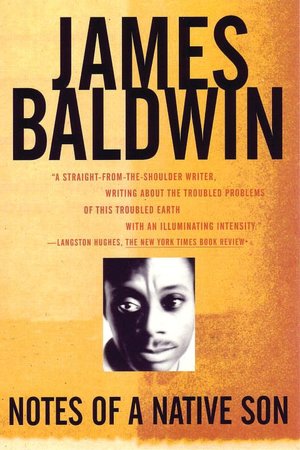
Notes of a Native Son by James Baldwin

Notes of a Native Son is a 1955 collection of James Baldwin’s essays and articles, all previously published elsewhere as I understand it. Their subjects range over books, movies, personal history, and social commentary; what each piece has in common is a consideration of race relations in the United States. He is concerned with the American “Negro” (this is no longer considered the right word, but I’m tempted to use it here, because he did) and the relationships amongst Americans, white and black. A persistent question he ponders is that of the black man’s search for identity in a nation that variously rejects him, resents him, or feels guilt over its treatment of him, made more difficult by the loss of his own personal history pre-slavery.

There are some heavy bits here, unsurprisingly. While not exactly academic, some of it is definitely on the philosophic side of things. When Baldwin dives deeply into literary criticism, he loses me (I guess I’m rusty on literary criticism; I used to find such articles much easier to read!): “Everybody’s Protest Novel” and “Many Thousands Gone” nearly made me quit the collection. In “Carmen Jones: The Dark Is Light Enough,” he discusses a movie, and actors, so unfamiliar to me that I was only reading on the surface – where I rather enjoyed the essay, it is true, but where I certainly failed to understand fully what he had to say. On the other hand, “The Harlem Ghetto” struck me as intelligent, occasionally amusing, and relevant today. And as you know, I am always thrilled to make connections across seemingly unrelated books I’ve read or historical figures I’ve studied. Before I was halfway through this book, I’d seen mention of Lillian Hellman (see a recent biography, one of my favorite books of the year) and the Patterson family (another), not to mention of course threads that take me back to The Warmth of Other Suns, which is how I got to this book in the first place. Ah, the circularity of things: it amazes and thrills me.

My favorite pieces in this collection were the autobiographical ones. I like Baldwin’s voice very much: he is wry and funny even when discussing the serious and the tragic. And I was most interested in learning more about him. My edition begins with a “Preface to the 1984 Edition” followed by “Autobiographical Notes,” both of which set the bar high. The titular essay comes about midway through and is also excellent. But my very favorites were the last two. “Equal in Paris” relates Baldwin’s experience being arrested in Paris and tried for possessing a bedsheet from the wrong hotel. It was hilarious, and ended chillingly. And “Stranger in the Village” covers his time spent in a tiny Swiss village where the residents had never seen a black man before, and is where I felt he made his most sweeping and hopeful statements about our present and our future. It was tragic, but forward-looking.

I really enjoyed Notes of a Native Son, although there were a few moments where I got bogged down. Baldwin’s voice charmed me. I recommend him.


Rating: 7 blocks in Harlem.

Hemingway’s Boat by Paul Hendrickson

A lyrical, textured, and meticulously researched meditation on Hemingway from a fresh new angle.

Paul Hendrickson, NBCC award-winning nonfiction author for Sons of Mississippi, pulls off the remarkable feat of finding a fresh, new angle from which to approach Ernest Hemingway: his boat Pilar. Purchased in 1934 with an advance from his longtime publisher Scribner, she saw him through three wives, great achievements and critical failures in his writing career, big fish and little ones, and the beginnings and the endings of many relationships. Hendrickson suggests that Pilar may have been the love of Hemingway’s life.

This is not a biography but a careful and compassionate rumination on the man through the lens of the boat. Hendrickson has brought to his readers a Hemingway who is neither object of worship nor monster, but a full and complex human who made serious mistakes in his relationships and fought pitched battles against his own demons, and finally lost.

The Hemingway fan will be enthralled with new details of his life, and the study of figures previously treated as minor but now revealing new facets of the man. The less familiar reader will be fascinated by this comprehensive account of the master and his complex spiderweb of varied effects on so many lives, large and small. Hendrickson presents his unusual and noteworthy story with beautifully quiet intensity and contemplation. Hemingway’s Boat achieves a terrific feat in reworking Hemingway’s story.


This review originally ran in the September 23, 2011 issue of Shelf Awareness for Readers. To subscribe, click here, and you’ll receive two issues per week of book reviews and other bookish fun!


Further notes… I can’t tell you how much this book moved me. Perhaps you have noticed that pagesofjulia is a raving fan of Hemingway. I’ve read several biographies, works of literary criticism, and other spinoffs (see The Hemingway Hoax and The Paris Wife); I’m a little obsessive. But Hemingway’s Boat holds a very special place for me. Hendrickson (PH) treats Papa (EH) sort of gently, but doesn’t spare EH in his moments of monstrosity… PH comes from several different angles, interviewing different people who knew EH more or less well, unearthing some new details. PH approaches EH with the relatively unique concept that he was just a man – a great artist, but also human, with flaws and moments of everyday beauty. This book was noteworthy in all my reading of EH and the surrounding literature. It made me laugh and cry; I treasure this galley copy, where I usually pass them on as soon as I’ve turned in my review. This book alone has made my recent career as Shelf Awareness book reviewer worthwhile. (PH also recently came around here to comment on a post, which I found very exciting. Hi Paul!) I wholeheartedly recommend this book for fans of Hemingway, or of literary biography, or of well-written nonfiction, or for those looking for vignettes in Key West or Havana history.