






You can read my review of the previous issue here.
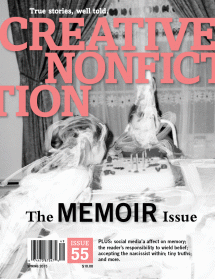
 “True stories, well told.” In this issue, they are stories concerned with waiting, whatever that might mean to the writer. (A few craft-related essays are also included.) Unsurprisingly, I am very impressed with the stories CNF chose to publish.
There’s not much not to love here, beginning with Editor Lee Gutkind’s opening piece about all the waiting that goes on in his and my line of work; Dinty W. Moore’s ponderings on the genre name “creative nonfiction” (I am an unrepentant Moore fan); and the essay “Waiting and Wading through Story” by Maggie Messitt, about immersion research and storytelling and the lessons she’s learned from other writers. But I was really blown away by this issue’s winning essay: I agree wholeheartedly with their choice of Joe Fassler’s “Wait Times” as winner of the Best Essay Prize. If you read nothing else in this magazine, please go read this story. It is heartrending and thought-provoking and disturbing, and I’ve thought about it at least daily for more than a week since reading it. It’s about a medical emergency experienced by his wife.
I found Judith Kitchen’s “Any Given Day” harder to love, and I’m sorry to say that, because I’ve heard such wonderful things about her (and have her Half in Shade waiting on my TBR shelf), not least from Gutkind in his opening piece. She died last fall of cancer, and this piece is in part about that ending. But the form of it – loose, amorphous, wandering – didn’t quite work for me. Just a personal reaction; perhaps you’ll find it mindblowing, and I’d love to hear if you do. Certainly she is a fine artist. But this piece didn’t work for me quite so well.
“Lost and Found” by Josephine Fitzpatrick was more a straightforward narrative piece, and call me simple-minded but that struck me more forcefully. Fitzpatrick’s brother went missing in Vietnam when they were both teenagers, and this is the story of waiting for him to come home or for his story to be somehow resolved, for many decades. It is of course touching and thoughtful and, I think, potentially helpful for others suffering from “ambiguous loss” (see also Sonya Lea’s outstanding Wondering Who You Are). Mylène Dressler’s “End Over End”, about coming to surfing as a mature adult and finding the stoke, finds a good balance between cerebral wanderings and narrative.
Following essays and stories about waiting, Sangamithra Iyer’s “The Story Behind the Story,” about searching for her grandfather’s history as civil servant turned activist in Burma, is a touching and instructive piece, not least in its realization that “not getting the story was part of my story, too… the loss of memories, the erasure of our histories, is part of the narrative of many of us children of the diaspora.” I love this concept.
Rachel Beanland’s “Required Reading” was another revelation, about handling the loss of her father by reading numerous memoirs of others’ losses. This strategy was deemed strange or not shared by others but made sense to her, helped her, and this makes sense to me, too. Look, I just said something similar, above, about “Lost and Found” and Wondering Who You Are. This is a short but powerful essay and it contains lots of titles and snippet-quotations that I’m marking for later.
I always look forward with intrigued anticipation to “Pushing the Boundaries,” the section of each issue that includes an “experiment in nonfiction.” This time it is Nathan Elliot’s “An Honest Application,” a response to the part of an immigration application that asks him to justify and place a value on the marriage that hopes to qualify him for permanent Canadian residence. His actual written response is short and simple, but it is accompanied by lengthy footnotes that include all the emotion and indignation he couldn’t put in his application. It is genius – I loved it – and I love as well the story of love that he has to tell.
There were others, but these are my favorites. You can view these pieces and more, or buy the whole issue (do that!) here.
Filed under: book reviews | Tagged: creative nonfiction, essays, lit journals, nonfiction, periodicals | 1 Comment »
 pagesofjulia