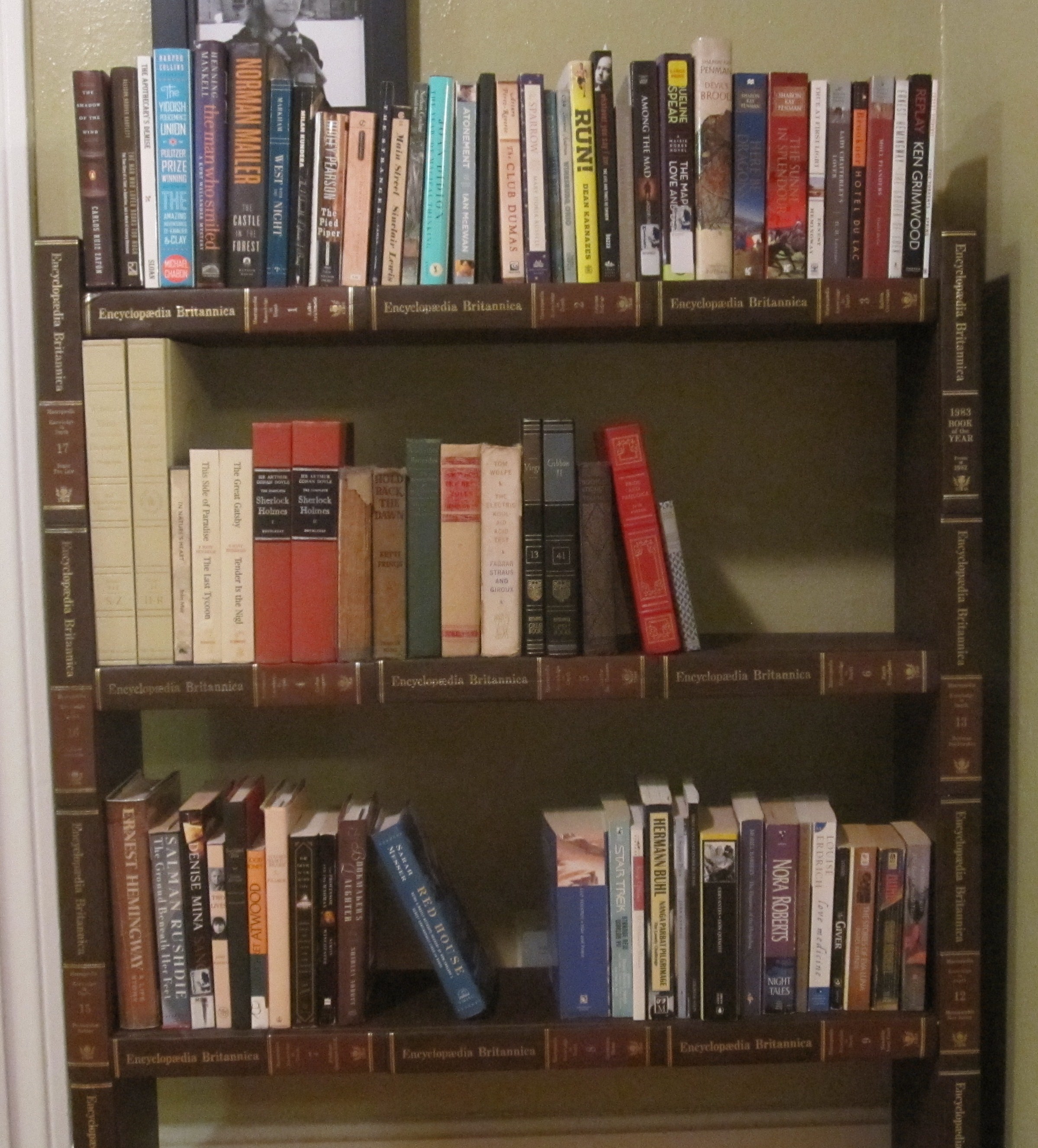
BTT asks, own or borrow?

As usual, I’m late on this one, but the real point, seems to me, is the discussion, not the timing of the discussion. Sometimes I need to let these topics ruminate for a day or days before my own feelings become either articulated in my head, or strong enough to warrant a blog post.

Booking Through Thursday asked, on June 9:

All things being equal (money, space, etc), would you rather own copies of the books you read? Or borrow them?

My response in this case has been shaped and strengthened through reading lots of other responses, so thanks, fellow bloggers. Special thanks to A Guy’s Moleskine Notebook for the mention of supporting his local library!

So. What’s my answer? Like some of these other discerning bloggers, it’s not a simple either/or. Of course, as a librarian, an insatiable reader, and a book lover, I have a collecting problem. It’s too easy to pick up a book I know I want to read someday, but have no time to read now, and put it on a bookshelf or in a stack at home; then I turn around and find that the towering stacks are threatening to eat Husband, little dogs and I for lunch. (Part of the problem is that my job sends numerous homeless books my way.) This would seem to indicate a preference for owning.

But! When given the opportunity to think it through and give a reasoned answer, as here :), I would not always choose to own. For one thing, there are too many good books in the world to ever read, or own, or house, them all. (This is both a good thing and a bad thing.) I know the question presupposes endless storage space, but there has to be a limit. I don’t ever want to live in a space the size of the Library of Congress times 10,000 or whatever it would take. I think the “etc.” in the question (unlimited “money, space, etc.”) is ability to choose! Or maybe time to read! I feel that books are meant to be shared, and passed on. Now, don’t get me wrong; there are many books in my collection, and in my future or dream collection, that I wouldn’t part with. That copy of The Jungle (etc.) that belonged to my parents; the beautifully bound; the unique early editions. My favorite books, especially those with a high chance of being reread or quoted from, I would always want to own a copy of. But I also enjoy passing books on. Recommending a book to a friend is one thing; putting a physical copy in his/her hands is another. (That’s one reason why it’s fun to meet up with Amy or Fil for dinner or drinks: the prospect of physically handing over books.)

Also, as a librarian, part of my life’s work seems to be providing other people with reading material. I work in a library that runs a paperback collection off donations; I’m always happy to put books into this collection, and really, a “light read” of genre fiction may as well go back into circulation as languish on my shelf never to be reread. Also as a librarian, I’m hyper-aware and extremely appreciative of the prospect of a free and unlimited supply of books to read. Even with all the money in the world, I wouldn’t buy every book I’m interested in reading; if it turns out to be a dud (and some do!), I don’t want it living with me afterwards! But with all the money in the world, I would be likely to buy some of the best books I’ve read from the library that turn out to be excellent. (Most recently, that would be Fire Season and The Heroine’s Bookshelf.)

So I guess what I’m saying, to question of buying vs. borrowing is… both, of course! Moderation in all things (thank you Aristotle), and a place for everything and everything in its place (variously attributed). Some I want to own, but most I think I would borrow, even with all the money and storage space in the world. What I most need is not money or storage space, because we have these wonderful libraries everywhere! (Support your local libraries, friends!) What I most need (besides more storage space, certainly) is more time to read. And some really beautiful, well-crafted bookshelves.

an average day in the life of a librarian

…means taking things home. We will eventually have a storage problem in my house. Or perhaps it has already begun, considering that the books have outgrown my study (Husband calls it the “book cave” which is really unfair as there is lots of lovely natural light streaming in) and the TBR bookcase is in the dining area. Here is a picture, which is now dated; it’s all full up these days…


Some days I just carry my regular work bag, which only allows a book or two along with my lunch and personal effects. But some days I carry a supplemental book bag. Like today. Today I’m bringing home…


Starting upper left and going clockwise:

Hotel du Lac by Anita Brookner. My interest is inspired by Thomas at My Porch, and I’m nearing the end of it now and very well pleased.

The Heretic’s Daughter by Kathleen Kent. Katy at A Few More Pages has written up this and other of Kent’s books, and I’m intrigued.

These Things Hidden by Heather Gudenkauf, which I’ve had my eye on for a while now. Now, litlove (at Tales From the Reading Room) did take issue with this book, calling it commercial fiction. But I’m still interested.

The Red House Mystery by A.A. Milne. The one and only mystery from the author of Winnie the Pooh etc.? I’m sold.

Rebecca by Daphne du Maurier. I’ve never read it (gasp!) and want to; plus I saw this post the other day at Savidge Reads and got a final nudge.

Without Fail by Lee Child. My current genre favorite; he hasn’t let me down yet. It’s always good to have some light pleasure reading lying around!

By-Line: Ernest Hemingway has been discussed here before. I’m still not quite done.

Gone Tomorrow by Lee Child on audio. This is in the car right now. More of my current genre guy.

And… Tales from Watership Down by Richard Adams. On the long list of books I’ve always vaguely intended to read, so I grab when I can.

It’s a dangerous world when you spend over 40 hours/week in a library!!

Crossings.

I have a few things to share with you today. They aren’t books, but you might be interested anyway.

First, last week I discovered a new-to-me concept called postcrossing. (I was alerted to this concept by write meg!. Thank you Meg.) The idea is an international exchange of postcards – yes the really actually hardcopy kind. It’s not pen-pals; you don’t get from the person you give to. But you send postcards to people around the world (and you get a short bio from them so you have something to write about, if you’re having trouble with that part), and then you get them, too! I really like the idea. It means you get snail mail that is pretty, personal, and not bills or catalogs. So, I signed up immediately upon reading Meg’s post and clicking the link; I’m in! And then I sent my first 5 postcards, to Germany, Austria, Ukraine, Taiwan, and Russia. BUT. I didn’t use enough postage, and I didn’t put my return address, either. So guess what? At lunchtime today I’m going to go buy some international postcard stamps and start again :-/ Ah well. I’m still in! And I’m going to get postcards!

So how funny and coincidental that right after discovering postcrossings, I came across a similar project. (Now that I am trying to retrace my steps, I have NO IDEA how I got there. Sorry.) BookCrossing works a lot like postcrossing does: you register and get a unique identifier code for your postcard or book. This allows the postcard or book to be tracked – so if it’s a postcard, you get credit for having sent it, and you get more postcards coming to you. If it’s a book, you can see where its travels take it – if its recipients are logging it on the website, that is. This is much less likely with BookCrossing, it seems to me, because you can just leave books around, wherever, or hand them to random people, who may or may not care to get online and log their receipt of them. I would guess they wouldn’t, very often. Whereas, in postcrossing, the recipient of your card actively requested it, and is actively participating in the same system, whereby one only receives a card if one gets credit for sending cards; therefore I would guess everyone is fairly interested in logging them into the system. (Also, postcrossing recipients, by definition, have internet access and are comfortable with the system. This is not something we can assume when handing out books or leaving them on park benches.)

I think BookCrossing sounds like great fun, but I won’t be joining that one. Why? Several reasons. I think there are a number of similar programs online (PaperBack Swap, for instance), where people can trade and send books around. Another reason that comes to mind was discussed today over at Tales From the Reading Room: people who are not actively seeking out free things (as the postcrossing participants are) don’t necessarily place a high value on them. I think litlove (the above blogger) is right on target when she points out that “free often means without value,” or at least is perceived that way.

But mostly, I guess, I won’t be BookCrossing because it’s sort of what I do for a living, which is a beautiful reason not to play, really. In the hospital where I work, I run a small library that distributes reading materials. We have a nice collection of hardback books that we purchase new, catalog, and circulate just like your local public library; and just like a PL, we want them back and will ask you to pay for them if lost. But we also have a large collection of paperback books, donated by the boxful every day, that freely roam the hospital and beyond. These books are very much playing the BookCrossing game (minus the tracking), and they make a huge difference to our patients, caregivers, visitors, and staff and faculty. It means that there’s always an abundance of free and various reading materials randomly distributed in our little world, and that’s a beautiful thing.

where do you get your books?

Today’s subject is independent booksellers.

I found an interesting article in yesterday’s issue of Shelf Awareness. For your sake I’m giving you the whole article here since there’s no direct link, although you can find it along with other news at the link above. So first, from Shelf Awareness:

“Local independent booksellers are still fighting the good fight–and winning” was the headline for a Pioneer Press feature on Minneapolis-St. Paul area booksellers, noting: “Strong indie bookstores contributed to the Twin Cities’ rankings in Central Connecticut State University’s list of most literate cities. The annual study included six criteria, one of which was the number of bookstores per capita. Minneapolis came in third; St. Paul was seventh.”

Among the secrets to indie success cited were “hiring knowledgeable staff, selling books off-site, making available books that are hard to find in chain stores and working to become part of their communities,” the Pioneer Press wrote.

“A good local bookstore is like a good local bar, where everybody knows your name,” said Sue Zumberge, manager of Common Good Books.

The increasing importance and popularity of shop local movements was another critical factor mentioned by several booksellers.

“People are recognizing the limits of shopping online, where you have to know what you’re looking for,” said Hans Weyandt, co-owner of Micawbers Books. “My favorite thing, which happens in our store on a regular basis, is when a customer says, ‘I had no idea this book existed.’ That’s why you need a knowledgeable staff.”

Birchbark Books manager Susan White added, “This buy local-spend local trend has been building for several years, and we are benefiting from it. Customers who think about where they want dollars to go purposely come to us, even though it’s out of the way for some.”

The e-book sales option for indies is gaining national attention with the debut of the Google eBookstore. Michele Cromer-Poire, co-owner of the Red Balloon Bookshop said, “We’ve been selling e-books a long time, and with publicity surrounding the Google website, we are hoping things pick up. We want our customers to have options and understand they can get e-books from us at prices competitive with big retailers. But e-books are only a part of the mix. I don’t think picture books are ever going to go away.”

Jay Peterson, manager at Magers & Quinn Booksellers, envisions two models of independent bookstores surviving: “One model is like Birchbark and Micawbers–small, strong stores that do a great job of picking books for their neighbors and the neighbors are supportive. Our model is the other–a mix of new, used, rare and bargain books that covers a lot of price points and a lot of breadth.”

I really appreciated the bookseller’s reference to the larger buying-local movement. I think of “localism” as applying to fresh food, like produce, because from a nutritional standpoint your food will be fresher and more suited to your climate if you buy locally; but of course the larger issue is economic and political. Supporting local and/or small businesses is an admirable cause, and I subscribe to the concept, but I could certainly do a better job, in practice, of supporting my local Whatever-It-Is. (By the way, shameless plug, for a local Houston bike shop I recommend Bikesport.) And in the world of BOOKS this makes at least as much sense as, well, anything else I can think of. I’m a little bit perturbed at e-readers… I’m rather a Luddite, very late to email and cell phones but here I am with this blog and this website, don’t get me started… and I DO see the advantages, really I do. But I am adamant that the printed book is NOT dead, nor should it be, nor am I even that worried. There are just too many times a person needs a BOOK.

But where are we getting our books these days? I stay aware of this issue mostly thanks to Shelf Awareness, which as I’ve said before covers bookselling more than it does libraries, and often beyond my level of interest; but this little article really drew me. Your local book store is important! Again as mentioned by some of the booksellers interviewed, one way in which your LBS (that’s local book store in this case, although I’m more accustomed to it being local bike shop) is important, is in having rare or used books. (I shop for books almost exclusively at Half Price Books.) But the other way in which the LBS is indispensable is in personal relationships: knowing you, knowing your tastes, making recommendations. (Another crossover concept from the local bike shop.)

I want this to be a personal appeal: go shop at your local book store! But I would be a little bit of a hypocrite, you know why? I don’t shop for books much. I don’t think I’ve bought a book in ANY book store for a year! (Maybe once or twice.) I work in a library, which provides a seemingly infinite tempting array of more than I could ever read; and when I need something specific I don’t have, there’s the larger Houston Public Library system, just ready and waiting to serve me. For free. (That is if the budget cuts don’t get them. Don’t get me started.) So really, I don’t buy much from anybody. :-/

Where do you get your books?

in praise of librarians

I almost forgot (shame!) to share this snippet with you, from James Lee Burke’s The Tin Roof Blowdown (are you sick of hearing about this book yet?):

“Then I used the most valuable and unlauded investigative resource in the United States, the lowly reference librarian. Their salaries are wretched and they receive credit for nothing. Their desks are usually tucked away in the stacks or in a remote corner where they have to shush noisy high school students or put up with street people blowing wine in their faces or snoring in the stuffed chairs. But their ability to find obscure information is remarkable and they persevere like Spartans.”

…and then the librarian cracks the case wide open! Robicheaux eventually got a call back from the FBI providing some of the same information but the library beat them to it. Good for you Mr. Burke. 😉

identifying with the prison librarian

Well, you tell me, does this make me a little nuts, or just mean that Steinberg is a skilled author? It’s occurring to me that our situations are parallel: we both work in “special libraries” (that’s a real term), meaning we’re not in schools, universities, or public libraries. Prisons and hospitals are fairly unique environments. I’m not sure my employer would appreciate the comparison, but both are large institutions, and I have heard my patrons say they feel a little bit like they’re being processed in a machine. I’ve been thanked for using their names instead of 8-digit numerical identifiers. That’s kind of sad. I just had this strange feeling as I walked back from lunch, having reluctantly closed Running the Books, that perhaps it’s weird that I’ve become accustomed to seeing signs on escalators that say “If You Are Feeling Dizzy or Unstable, Please Use the Elevator” and in bathroom stalls that say “If you have had an accident or soiled your clothing and need help, please call XXX.XXX.XXXX.” People here are not necessarily happy to be here. Also, I share with Avi the prison librarian the embargo against connecting with our patrons. There are different reasons – his are a serious security risk, are considered to have lost the privilege of making friends, threaten his job. Mine have a federally protected right to privacy and are going through utterly life-changing events. But they’re all people and we all too easily see ourselves and our loved ones in these strangers. Of course, Avi sees the same people for long periods of time (very much the norm in prison I think) and my people come and go unpredictably (and when they go, I never know why). But I’m getting into this book and identifying with Avi’s workplace conundrums.