Upright Women Wanted by Sarah Gailey

My biggest question about this book is, is this the beginning of a series? Because it was so short and maybe a little bit rushed but also left us absolutely on the edge of a sequel, and I’m interested in finding out more.

Upright Women Wanted is under 200 pages, set in an alternative American Southwest under a totalitarian regime with strict control of information and vigilante troops of bandit-sheriffs running small towns. Esther has just run away from home to escape a forced marriage to the former fiancé of her best friend, following that best friend’s execution (by Esther’s father) for possession of resistance literature. The dead best friend was also her secret partner. Esther stows away in a Librarian’s book wagon, hoping the Librarians can straighten her out, in more ways than one, but they will instead open a wider and far more dangerous world than she’d previously imagined. And it might just be a good thing.

Some of the character development and romance goes by a bit more quickly than might have been most satisfying. If queer librarian resisters, spies, and assassins on horseback sound exciting, you should check this one out. That said, there might not be much more than you just saw in the preview. But again, it’s a short little novel, and pretty action packed, and I’m prepared to be excited about book two. Is there a book two??


Rating: 7 synth-pouches of wine.

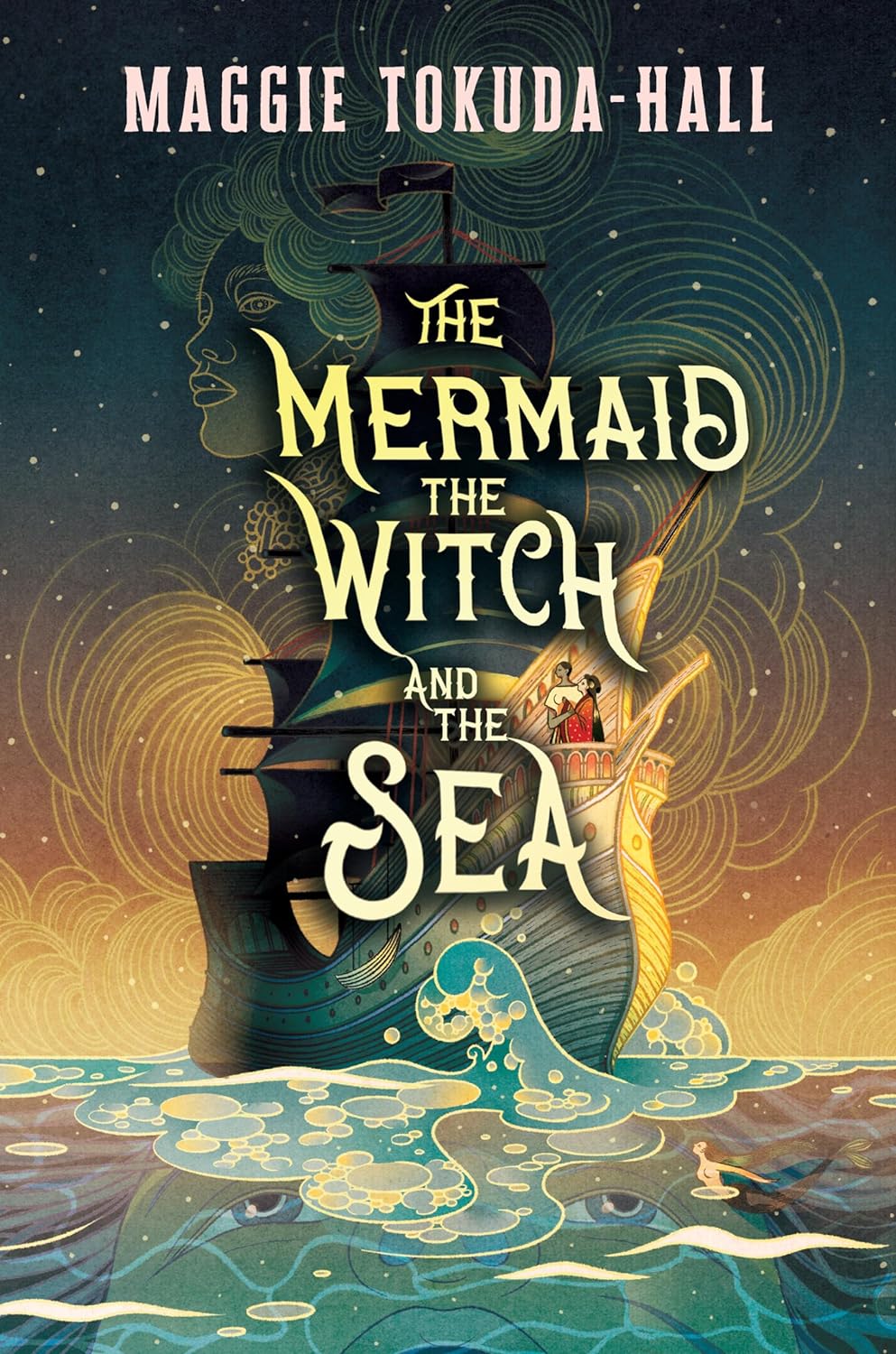
The Mermaid, the Witch, and the Sea by Maggie Tokuda-Hall

There’s a little bit of everything in this unusual fantasy novel for older kids or young adults (or any of us, obviously). Sweet, heartwarming, and surprisingly bloody, The Mermaid, the Witch and the Sea offers mermaids, pirates, and young love. Imagine a bit of Treasure Island, but gender-bending and with a greater emphasis on political workings and class divisions. And magic.

We open with a murder on a pirate ship, then shift to high tea in a house of wealth and privilege. In the first scene, a teenaged boy named Florian earns his keep, having gambled on a life of piracy to save him and his brother from a life of deprivation and scant survival on the streets of the Imperial capital city. In the second, a girl named Evelyn chafes at the bounds of her household, where she enjoys status but not the love of her parents, who plan to send her away to be married to a man none of the family has ever met. Evelyn winds up on the same ship as Florian, where loyalties are split between factions supporting the Empire (who have colonized almost all of the known world, to the discontent of many) and the Pirate Supreme, who serves the Sea. “The Pirate Supreme’s forces were the only thing standing in the way of complete Imperial rule on the open sea. If pirates could still disrupt the merchants, still stymie the trade routes, then the Imperialists could not claim full control. Every robbery, every kidnapping, every galleon destroyed was a protest against the Emperor.” Some loyalties have yet to reveal themselves. And oh, Florian is also Flora, whose pronouns and identity as ‘boy’ or ‘girl’ shift throughout the story. “Both, maybe, but not neither.” “Both were equally true to her” (or him); “neither told the whole story.” Florian is Black and Evelyn is something like Japanese, although these seem to be descriptive details rather than identities that affect status or prejudice in their world.

Flora has lived life on the margins, making hard choices, fighting for life in the most basic ways. Evelyn has suffered a different kind of privation, unloved and lacking agency, but has never imagined the kinds of challenges Flora has faced. The two have much to learn from each other. And I haven’t even mentioned the effects of mermaid blood or its price on the open market, the scarcity of witches in Imperial colonies, or the far-seeing powers of a conscious Sea.

Delightful, weird, fanciful, queer coming-of-age with murder and magic. Violence, rather than sex, may recommend a readership in their teens more than their tweens, depending on blood tolerance, but the themes are solid: finding oneself, living one’s truth, navigating ethical puzzles, being a good friend. And it’s a page-turner to boot.


Rating: 7 haircuts.

Maximum Shelf: The Safekeep by Yael van der Wouden

Maximum Shelf is the weekly Shelf Awareness feature focusing on an upcoming title we love and believe will be a great handselling opportunity for booksellers everywhere. The features are written by our editors and reviewers and the publisher has helped support the issue.

This review was published by Shelf Awareness on January 17, 2024.


Yael van der Wouden’s first novel, The Safekeep, explores the rural Dutch landscape in the years following World War II through the life of a lonely, sheltered woman reluctantly forging new bonds. In what is largely a closed-in, personal story with a solitary protagonist, van der Wouden also examines larger issues in the social context of Dutch postwar society.

The story is set in 1961, in a rural Dutch province that has largely recovered from war, on its surface. Isabel has spent her life tucked away in the house where her family relocated from Amsterdam during the war. An uncle found the place for them, and 11-year-old Isabel took up residence with her mother, younger brother Hendrik and elder brother Louis. Eventually, their mother died and the brothers moved away, but Isabel stayed, believing there was nowhere else for her. She keeps the house meticulously, polishing dishes and micromanaging a series of beleaguered maids. “She belonged to the house in the sense that she had nothing else, no other life than the house, but the house, by itself, did not belong to her.” She lunches occasionally with Hendrik, less often with Louis. In her lonely, strictly regimented life, the house is Isabel’s constant, the thing she can control, her greatest comfort.

The Safekeep opens in her garden. While digging out late-season vegetables, Isabel finds a shard of broken ceramic, “Blue flowers along the inch of a rim, the suggestion of a hare’s leg where the crockery had broken. It had once been a plate, which was part of a set–her mother’s favourite…. There was no explanation for the broken piece, for where it had come from and why it had been buried. None of Mother’s plates had ever gone missing.” This beginning offers an early clue that Isabel’s understanding of the house and its contents, of her own personal history, may be flawed.

Further disruptions follow. Hendrik, a steadfast supporter of his solitary sister, nevertheless lives a life she hasn’t come to terms with. He lives with a man; this makes Isabel uncomfortable. Worse, Louis brings yet another young woman, Eva, to a dinner with his siblings. Eva sets Isabel on edge for reasons Isabel does not understand. Additionally, any serious liaison for Louis implies a threat to Isabel, who is permitted to stay in the house only until Louis (its intended inheritor) settles down to start a family. Worse yet, at Louis’s insistence, Eva comes to stay at the house with Isabel while he is on a trip: Isabel is horrified to be made to share her space with a woman she despises.

The tension in the house rises to a nearly unbearable pitch. Isabel habitually suspects her maids of stealing, and now suspects Eva, whose own history is murky, as well. Isabel obsessively inventories china dishes, silverware, and items of décor, counting spoons and watching Eva’s every move. She cleans and displays and relocates the mysterious shard of plate from the garden, imbuing this small object with outsized power. Eva’s presence continues to feel inexplicable. Louis’s return from abroad, to collect Isabel’s unwanted houseguest, is delayed. Tensions continue to build.

Van der Wouden excels in surprises, including changes in tone. The Safekeep remains, almost in its entirety, nearly claustrophobic in its focus on Isabel’s commitment to her family home. “Bound to the house, [Hendrik] said. As if it was a tether and not a shelter. And not her own love, too.” But this tightly bound, insular story of one woman’s struggle finally zooms out, with near dizzying quickness, to engage with larger questions. An old friend of Isabel’s mother is preoccupied with a dish that was given to her “to keep” before the war, by a neighbor who now wants it back. This friend believes it is hers now; the neighbor disagrees. “What does it matter, gifting, keeping? She gave it to me. It was a terrible time. She was gone for years.” As its title hints, van der Wouden’s novel will puzzle over various meanings of safekeeping. Likewise, the sparsely populated story is punctuated by passages of erotic writing that surprise as much by their loveliness as by their departure from the book’s otherwise lonely atmosphere. Not only the story of one family’s struggle or Isabel’s quiet pain, The Safekeep addresses themes of yearning, possession, the difficulties of Dutch recovery from World War II and of same-sex couples’ experiences in a society still regaining its feet.

In the end, like a country recovering from a trauma, Isabel must step outside her space of comfort and familiarity in order to learn and grow. “Isabel tested one [of the frozen canals] with her foot, and found it solid, and then stood on it in wonder: a miracle, she thought, to stand so solidly on what could also engulf you.” Van der Wouden communicates and implies much with a minimalist style that is often quietly, shockingly, beautiful. “The shadows lifted as though they’d only been glimpsed under the hem of a skirt–the lift on an arm, secrets of the body that only unfolded for the night.” The Safekeep is a slow-burning, deceptively austere novel, whose subtle, crafty questions and lovely, lyric style will follow the reader long after its conclusion.


Rating: 8 pears.

Come back Friday for my interview with van der Wouden.

No Son of Mine by Jonathan Corcoran

Disclosure: Jon has taught as guest faculty in my MFA program. I admire his work and he is a dear friend.


Also, I am teasing you about a book that will not be published for months (April 1 of this year, no foolin’), but I’ll repost then to remind you.

Now on to the show.


I found this memoir remarkable. It encompasses much in terms of its time span and the bigger events in the world, and Jon accomplishes something special by being raw and vulnerable, and never self-indulgent. I think the struggles he portrays here will offer something to any reader, because we are all struggling to navigate even the closest of relationships. I am impressed by the writing in terms of that larger storytelling and meaning-making, as well as line by line.

Corcoran grew up in a small town in West Virginia that is just a few minutes’ drive from where I live now. (It’s always a little exciting to read a place written well that you personally know, and I did enjoy that part here. Elkins is not perfect, but I think this author has handled it with respect for both positive and negative qualities.) As a gay kid, he suffered in the town, in the evangelical church his family attended, and in his family itself. He did some secretive explorations of sexuality in West Virginia (not too dissimilar, I think, from those in The Rope Swing, which is however fiction), but did not live as an openly gay man until he left for college at Brown University. Coming from poverty, Brown was both a great accomplishment and a shock: a wider world, but rarified, and Jon was a foreigner to many of his peers and professors there. It’s at Brown that he met Sam.

In his second year at Brown, Jon is in Portland, Maine, with his boyfriend, Sam, meeting Sam’s family for the first time. It’s his twentieth birthday when his mother calls, seething with what she’s discovered. Jon confirms that he is gay. “You are no longer my son,” she says, and she hangs up. This leaves him traumatized, trying to finish college with no financial or emotional or any other kind of support, with no family, and no options, surrounded by Ivy League administrators whose understanding of what all this means is so poor that he is advised to take a year off and travel. His mother spends the next six months calling in the early morning and waking him up to tell him he will die of AIDS or go to hell, or both.

Jon and his mother spend years–fifteen years, the rest of her life–being estranged and trying again, having massive, blow-up fights and years of silence, and abuse and toxicity and cautious attempts at peace and acceptance. Her bad behavior is horribly, shockingly bad. But tangled up with the bad is the fact that this is his mother, his caretaker, whom he has loved, and who still (somewhere, twistedly) loves him, and misses him when they are on the outs. It’s a level of trauma that’s hard to fathom if you haven’t lived it. But as a narrator, he does a good job of describing its effects, including a mistrust of memory and various physical ailments. It also poses some challenges for his relationship with Sam, which will continue until they eventually marry, and into the present.

This is a memoir of trying to reconcile a parent that the narrator loves, his memories of her and of his hometown, with the pain inflicted at the hands of that same person (and place). It’s all a puzzle, to question the causes, to wonder how much forgiveness is due to such a figure. It’s a memoir that is also an assay, both a personal narrative and an exploration of ideas. “…some part of my brain is perpetually trying to explain her actions, to find the root cause for them, and what this really comes dangerously close to is the notion that her actions have an excuse, that if I searched hard and long enough the hurt and pain she caused me can be written away. But she hurt more, a voice says, and I don’t doubt that. So here I am, operating the world’s worst justice system from the recesses of my brain.” “I do not know how to balance all the pain she caused with all the pain she felt.”

There’s a lot to appreciate here, and a lot of wisdom that I think will help just about anybody. Not to say answers, but wise observations about one man’s experience. Most of us are wrestling with difficult, tangled-up relationships where abuse and love meet; many of us are struggling with what to take and what to leave about a family or a place. “I hear her laugh, hear the crinkle of her dyed-blonde hair. I rub her cracked feet, feel her hand on my back. I smell her nicotine fingers. There is her cup of Lipton tea in the little ceramic mug that is white with flowers around the brim. I taste the milky black tea. And I say, I don’t want to lose this all. I don’t want to lose what made me.” There is also some lovely writing here. If the story itself is often difficult, there’s a remarkable amount of grace, beauty, and hope. I think it’s a book for anybody and everybody. Thank you, Jon, for sharing so much in a way that feels both raw and wide-open, and careful and thoughtful. I’m awed.


Rating: 9 paper bags.

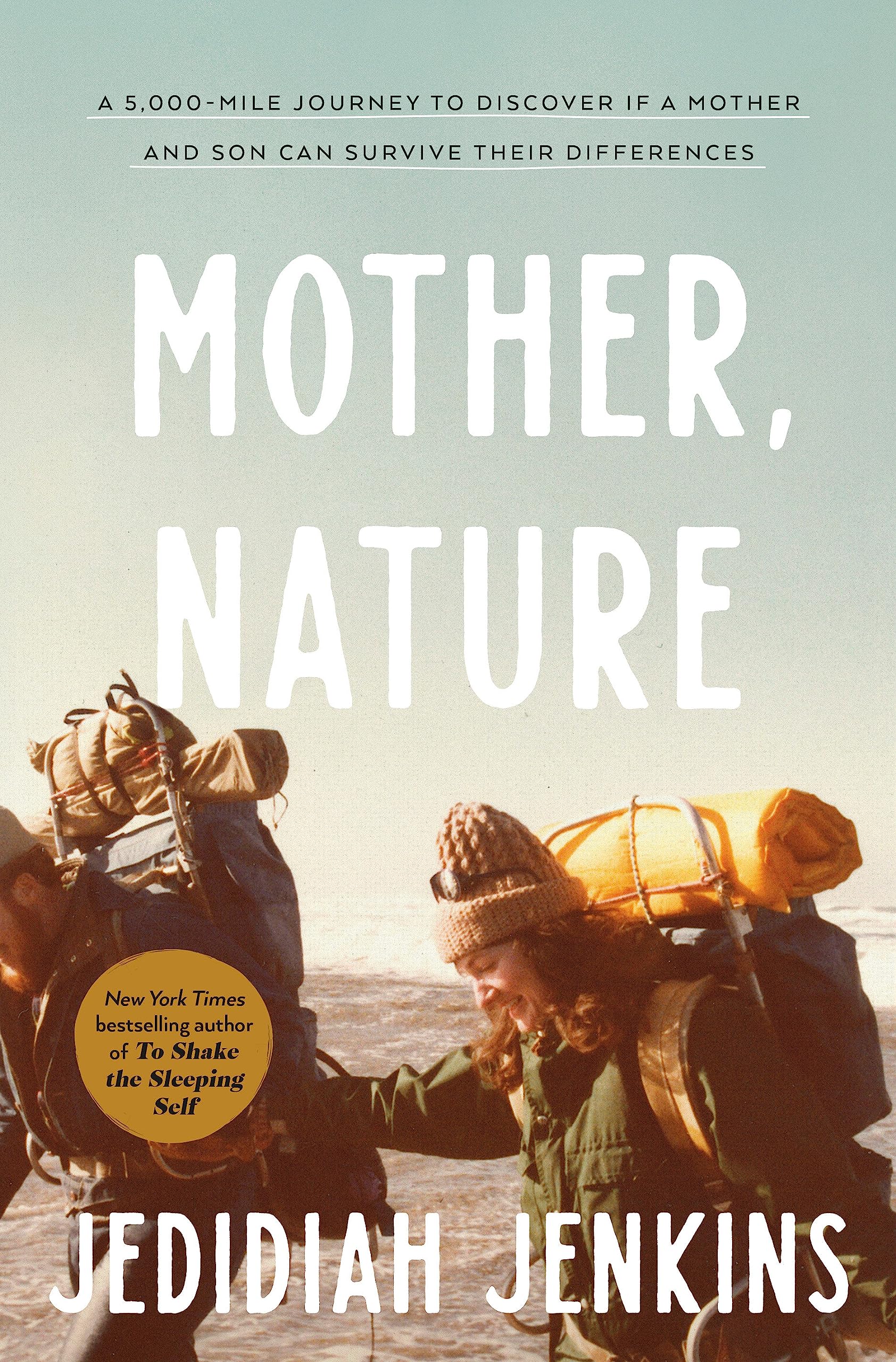
Mother, Nature: A 5,000-Mile Journey to Discover if a Mother and Son Can Survive Their Differences by Jedidiah Jenkins

A loving but troubled mother-son relationship takes center stage during a great American road trip in this reflective memoir about family.

In Mother, Nature: A 5,000-Mile Journey to Discover if a Mother and Son Can Survive Their Differences, Jedidiah Jenkins (Like Streams to the Ocean) presents both a literal and psychological voyage–and an investigation into family and tolerance.

Jenkins, nearing his 40th year, is troubled by his relationship with his mother: loving but fractured by her inability to accept his identity as a gay man. In November 2021, following the Covid lockdown, he undertakes a trip with her that he hopes will help them address their disagreements. The same journey will allow reconsideration of an aspect of her life that Jenkins paid little attention to. In the 1970s, his parents, Peter and Barbara Jenkins, walked across the United States, as famously documented in a series of books (including A Walk Across America and The Walk West) and National Geographic articles. As mother and son retrace those steps by car, Jedidiah wishes to learn more about his mother and her worldview; see the countryside and strengthen their relationship; and perhaps, finally, bring her to terms with his identity.

In driving from Tennessee to New Orleans and cross-country to the Oregon coast, Jedidiah (who lives in Los Angeles) and Barbara (whose best friends come from her Nashville Bible study group) struggle with what to listen to in the car–she likes Glenn Beck, and he likes NPR–what to eat, how to pray. Eventually, they will discuss the question that’s been weighing on the son’s mind: “Would you come to my wedding if I married a man?” Barbara’s conservative political and religious beliefs pose an obstacle to the love and acceptance that he craves from her. Their attempt to bridge such a divide feels relevant in polarizing times; the challenges faced by this loving but fundamentally diverging mother and son may resonate with many families.

Jenkins’s prose is unadorned, but his reflections are elemental ones about family and the static and changing aspects of relationships: “a mother’s influence is difficult to excise. It is not like the scorching sun. You cannot shade yourself from it. It is more enveloping and inescapable, like the air you need to survive.” By the memoir’s end, much is unresolved about the lives still in motion, but Jenkins has found his own peace, and learned a bit about the landscapes of his home country and his family background. Mother, Nature, a loving ode, suggests that the questions will continue to present themselves and that the journey toward discovery is worthwhile.


This review originally ran in the September 11, 2023 issue of Shelf Awareness for the Book Trade. To subscribe, click here.


Rating: 6 baby elephants.

Mudflowers by Aley Waterman

In this reflective debut, young artists in Toronto form a love triangle with both transcendent and painful results for all.

Aley Waterman’s sensitive first novel, Mudflowers, follows a young woman exploring intimacy, biological and built families, and art. A love triangle twists and reshapes itself, with both trauma and revelation. “I wanted so badly to love in a good way,” says Sophie, the protagonist and narrator, 27 years old and a Newfoundland native who recently moved to Toronto, where she lives with a misogynistic writer and her best friend since childhood. He is a beautiful man named Alex who is also her on-and-off lover. Sophie sees Maggie reading her poetry at an event and is immediately swept away. Maggie is talented and enigmatic, “with big eyes full of wide highways.” The two become close friends and, sometimes, lovers.

Sophie creates glass mosaics for wealthy patrons, Maggie writes, and Alex works on indie films. They are young artists scraping together livings in a big city, taking drugs amid art events and the bar scene. They slide frankly and openly in and out of sexual relationships. Sophie obsesses over her mother’s death. Alex’s mother left when he was 12, their parallel losses an unspoken understanding. The addition of Maggie to their close relationship, forming a trio, acts as a magnetic force that both imbalances and strengthens the bond. Secrets surface, and the balance shifts again.

Mudflowers follows Sophie to an artist colony at a castle in France and eventually home to Newfoundland. Place is important to this thoughtful protagonist, who is given to contorted philosophic musings. Newfoundland is “the only place I had been to where there is enough space and isolation and distance from the world for people to really be themselves without even thinking about what that meant.” Earlier, she notes that “in cities so many lives are wildly proximate to each other, just divided by a wall here or a door there, but each wall determined some sort of fate, keeping us organized and away from one another.” She wonders: “What if the people who should be most important in life were just separated by a wall, and what if that wall meant those people never met!” Sophie has met the people most important to her, but keeping them together will be another feat.

Sophie’s physical travels are dwarfed by the scale of her cerebral and emotional movements, as she tortuously navigates desire and fear. She is preoccupied with art, how to love, and purposeful attention. “[W]as it how beauty was directed or how it was received that was most important?” she ponders. “How are you supposed to be a real person when you’re also supposed to be the woman inside of someone else’s mind?” She also often considers mothers and their absences: “Maybe we all need more mothers than we have,” she thinks. “Maybe we all need as many mothers as we can get.” Mudflowers is thought-provoking, expansive, and raw.


This review originally ran in the August 22, 2023 issue of Shelf Awareness for the Book Trade. To subscribe, click here.


Rating: 7 birds.

In the Lives of Puppets by TJ Klune

In the Lives of Puppets is TJ Klune’s third adult standalone novel, in a similar vein to The House in the Cerulean Sea and Under the Whispering Door. These are the only three of his I’ve read, although there are more, and I may still get to those.

I said about Whispering Door that Klune excels at “the juncture of sweetness, fantasy, profundity, inclusivity, wisdom and pure silliness.” Puppets continues in that style. Rather than magical orphans or a magical afterlife, here we have a decidedly sadder challenge. The story begins with a lovely forest. A man (“who wasn’t actually a man at all”) approaches an old, falling-down house in the forest. He builds a life there, a crazy network of add-on treehouses and laboratories a la Swiss Family Robinson. He has a son, Victor. Flash-forward: we meet adult Victor with his two companions, a nurse-robot named Nurse Ratchet (that’s an acronym for Nurse Registered Automaton To Care, Heal, Educate, and Drill, and yes, think One Flew Over the Cuckoo’s Nest) and a vacuum-robot named Rambo. Victor’s father Giovanni is still around, and much-beloved; they have a happy family, although Victor is the only human member of it. Like Giovanni, he is an inventor, builder, creator. He spends many of his days combing through the Scrap Yards, where the Old Ones deposit their detritus, some of which turns out to be useful to Victor’s little forest-dwelling family. It’s where he found Nurse Ratchet and Rambo, both of whom he’s patched up to become the wacky friends they are today. (Nurse Ratchet is forever hoping to murder someone or something, slowly, and document their agony. Rambo is crippled by anxiety, restlessness, and his ceaseless need to clean. He loves the old movie Top Hat.) One day, at the Scrap Yards, Victor finds a new potential friend, one who will change everything.

This book assailed me with literary allusions, some of them less obvious than the two I’ve named already. Epigraphs refer to Pinocchio; Victor’s first name and some other plot elements remind of me Frankenstein; the goofy-sidekick robots make me think of R2D2 and C3PO from Star Wars as well as The Wizard of Oz. Which is to say, Klune is not working with brand-new material here (nor does he think he is). The world of robots gets a decided Klune twist, though: sweet, silly, romantic, hopeful. There are a few big reveals I won’t name here. As I already mentioned, this world feels a bit less hopeful to me than the worlds of Whispering Door and Cerulean Sea. The romance felt a full step less believable to me, somehow, although I can’t quite say why – it’s not like the pairings-off in those first two novels made perfect sense in any real world, but this is fantasy. Something about this one just didn’t go off the same, for reasons I can’t articulate. Possibly (is this too obvious?) it is that difficult to write robots (or androids) as relatable humanish characters. Maybe it’s as simple as where we were left with this love affair.

I really enjoyed this read: I was absorbed, engaged, tickled, and concerned for the characters I’d come to love. It is a good book. I just think it’s less awesomely good than the two previous ones by this author that I’ve read. I will certainly buy the next standalone novel he publishes in this same vein.


Rating: 7 butterflies.

Juno Loves Legs by Karl Geary

In this bittersweet coming-of-age story, scrappy childhood friends from Dublin’s outskirts grow tenuously into young adults with only one another for support.

Juno Loves Legs is a sensitive, scarred coming-of-age story by Karl Geary (Montpelier Parade) set in a troubled housing estate and nearby Dublin in the 1980s. Amid poverty, a harsh and judgmental Catholicism, family dysfunction and personal torment, preteens Juno and Seán form an unlikely but sturdy friendship that will carry them through trauma and violence and–if they’re lucky–into a wider, freer life.

Juno’s harried mother takes in sewing alterations for the neighbors, who look down on her family’s poverty and cheat her out of her meager pay. Her father drinks his days away. “Mam shouted up at him; he shouted down at her. They were two mouths and I was their ear.” Her older sister is absent following her own particularly awful childhood. Catholic school is a trial for a girl as headstrong and underprivileged as Juno. “We were beaten. A sour-smelling odour emerged from Father before he was done. And even Sister’s hands were crimson.” Then she meets Seán, who is shockingly clean but whose home life is equally, if differently, disturbed. For his awkward height she dubs him Legs, and they form an alliance, until an extraordinary act of violence tears everything apart. Years later in Dublin, with new troubles, the young adult versions of these childhood friends attempt a beautiful, possibly doomed, second start.

Juno’s first-person voice is angry, indignant, righteous, both jaded and pitifully innocent: at 12 she sets out to save the family by calling in the small debts owed her mother by their neighbors, but in her temper botches the job. She blusters to hide her vulnerability, where Legs leaves his tender side open and allows the blows to land. Not only the world at large–strangers, predatory adults, a grimly punishing Catholic church, the big city–but their own families are hopelessly cruel to these misfit children: Juno for her poverty, Legs for his sexuality. (A kind librarian provides an appealing single point of light.) They are stronger together, and their bond is artless, crude and true. This is in part a story about the families we build for ourselves: an ode to friendship in which the friends may still not survive. Geary’s young protagonists will face shocking pains before the ending, which glimmers with a touch of hope.

Juno Loves Legs is tender and heartbreaking. Young friendship takes on all the world’s challenges–love, art, family, the simple and overwhelming task of survival–with tragic, poignant results. Readers will find Juno’s bravado and Legs’s persistent sweetness unforgettable.


This review originally ran in the March 23, 2023 issue of Shelf Awareness for the Book Trade. To subscribe, click here.


Rating: 7 small debts.

Deadly Deceit by Mari Hannah

Micro-review today because it’s what I can spare for this title at this time, friends. Thanks for your patience.

On the one hand: I’m glad to be getting a bit deeper into DCI Kate Daniels’s personal (read: love) life. I find her a bit frustrating! but what else is new with our hardboiled detective types. She’s got baggage and lack of closure with an ex (who is also a coworker, remember), and a possible new beginning with a newer acquaintance who we met in an earlier book (who was, briefly, a person of interest in a case). I’m glad for this new sideplot, because that’s part of what I enjoy about mystery series in general: personalities and personal lives.

On the other hand, I found some frustrations this go-round with writing, specifically the overuse of ‘stuff’ and ‘things’ when more interesting nouns would have been appreciated. (This is something I get onto my students about. Maybe it’s just that I’m in-semester now.) I’m giving some grace because I think it was in part intended to be about voice – this was most noticeable in chapters in the close-third-person belonging to one or two characters in particular. Still bothered me a bit. If I’m paying attention to the writing, you’ve lost me for the story, however briefly.

I’m still committed to the series; I care about the people, and am looking forward to book four. But this one was not an unqualified success.


Rating: 7 wigs.

Settled Blood by Mari Hannah

As I said about book one, The Murder Wall, this is a solid mystery series. I like DCI Kate Daniels. The series seems inclined to paint her as your classic self-sabotaging detective: a loner, typically a hard drinker, soft-hearted but with a stony exterior and a tendency to violence. She’s rather sweeter than this, though. Despite points made about always putting the job first and not taking very good care of herself (eating & sleeping, for example), she has strong connections to the other members of her squad, and she’s not much of a drinker. The job itself can certainly be a killer, no pun intended (murder detectives do not have it easy), but as far as self-sabotage goes, she’s a pretty light version, I’d say. I like her habit of jumping on the motorcycle for stress relief, and I like even more her friendships: especially here with her second-in-command Hank Gormley, who has a pretty good feel for what she needs (to be questioned, to be left alone) and where she’s likely to be at a given moment. That is downright tender. Her relationship with her former (now promoted) boss, the prickly Phillip Bright, is a little less healthy, and he is not nearly such a sweetheart, but as character development and narrative complication I like it very much. There are other work relationships, too, that advance the characters and story in pleasing ways. As I said in the previous book, Daniels’s partner (now ex) is still a little under-developed, which I still regret. Will she continue to step forward into the light, or is she just a device? I will let you know, because I’ve already ordered books three and four in this series.

The whodunit itself was stimulating and kept me going through some late nights when I should have turned off the light. A murdered girl; a missing girl who is a lookalike to the murdered one but not in fact the same girl; and then more. Daniels is coming off a bit of a trauma herself – and in fact many members of her team are dealing with difficulties or losses, and I appreciate the way in which this mixes things up in a real-world way. Lots of questions about how much compassion and assistance is owed to people who are on the one hand jerks and on the other hand have suffered greatly. This ethical puzzle is one of my life’s fascinations, so I enjoy the angle.

Still true that Daniels’s identity as lesbian is a bit subtle as a framing element here. I appreciate the way in which that has a normalizing effect, but don’t come here looking for a big-deal LGBTQ headline; it’s more background. (Although Daniels is out to very few colleagues, which I find interesting. Her team seems practically warm-and-fuzzy in how well they support each other – unusually for the hard-boiled murder squad. On the other hand, her erstwhile partner being a distant member of the same work environment is a complication of its own, regardless of gender, and could justify secrecy.)

I am intrigued and interested to keep getting to know this group.


Rating: 7 headlamps.