A Marvellous Light by Freya Marske

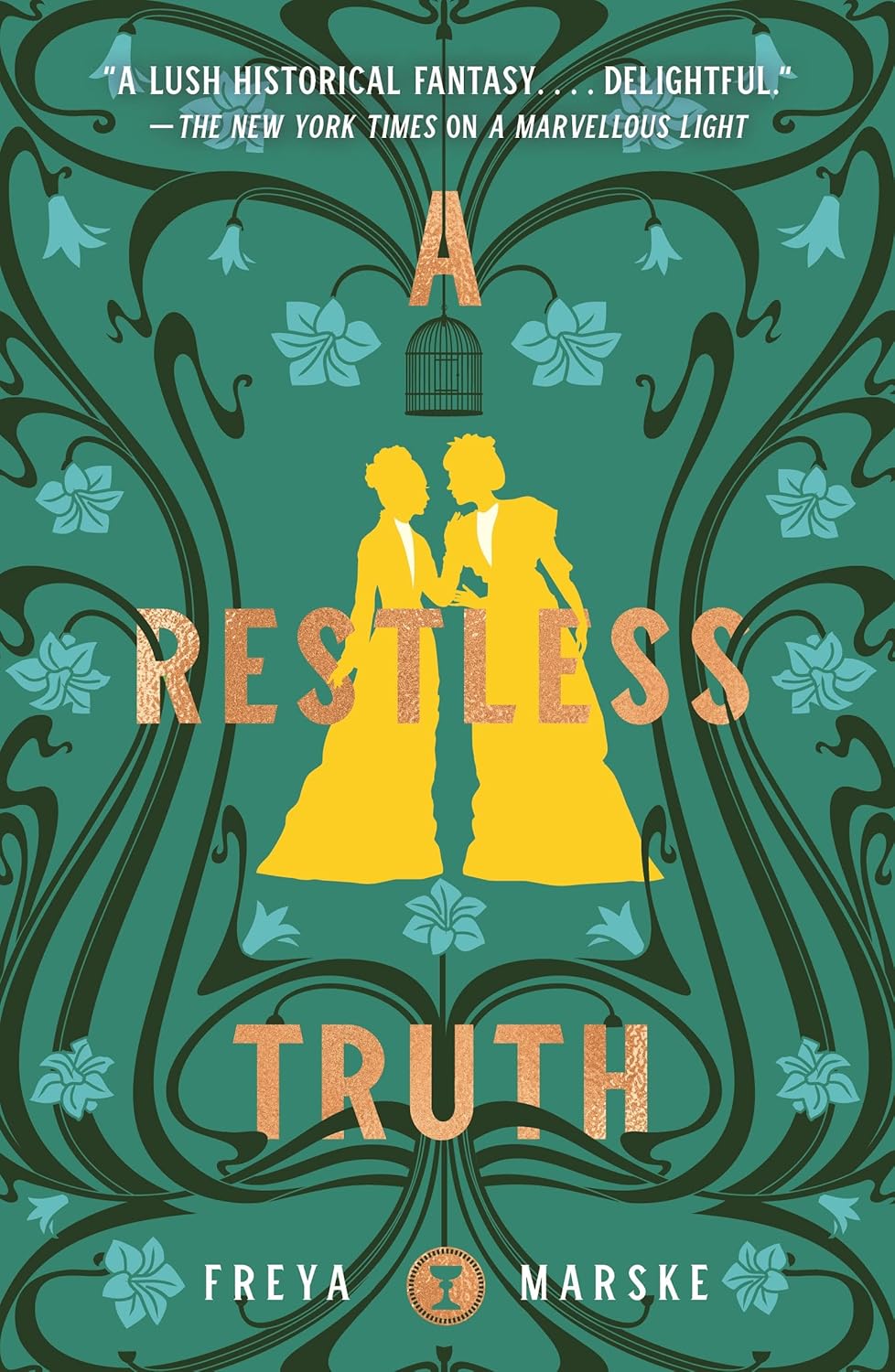
Billed as historical fantasy, with a strong thread of queer romance, this was an absolutely delightful and fun read – not always joyful in the moment-to-moment struggles of its protagonists (whom I loved), but ultimately deeply satisfying. There was romance (and sex), intrigue and angst, wonderful humor, and a complex magical world. I’m excited for book two, and beyond.

We first meet Reginald Gatling in his final moments, and witness his torture and death by magical means at the hands of assailants unknown. They want to know where something is, and all they get from him, past a secret-binding spell, is the location: his office. In the next chapter, we meet Sir Robert (Robin) Blyth, who is irritated and mystified by his new job replacing the missing Reggie – in Reggie’s office. (Here we also meet the indomitable Miss Morrissey, assistant to Reggie and now Robin. As both a woman and a person of Indian descent, she is exceedingly rare in British civil service, and will prove to be one of the most capable, awesome, and entertaining characters in this story, although a relatively minor one.) And in bursts Edwin Courcey, who had been Reggie’s special liaison and is now to be Robin’s, although they do not get off to a good start. For one thing, Robin has no idea what his job is supposed to be.

What quickly follows is Robin’s “unbusheling,” which is what the magical world calls it when a nonmagical person is let in on the big secret that magic does in fact exist. Turns out that in Britain’s already heavily stratified society, there is a yet another distinction between magical and nonmagical families, and even the former can have the odd, unfortunate nonmagical individual – like Miss Morrissey, whose sister is a very capable magician. And then there is Edwin, who comes from a powerful, wealthy, magical family, but is the bullied younger son, and though an enormously accomplished academic student of magic, has vanishingly little power of his own. Robin is an athlete, a jock, not a scholar, and though he has a title, his estate is nearly bankrupt, and he has a much-beloved younger sister to care for on his civil servant’s salary. Add to all of this the mystery of the missing Reggie, a curse soon (and violently) set upon the freshly unbusheled Robin, Edwin’s own family traumas, and an enigmatic threat to the magical world as we know it – indeed, maybe the world overall – and Edwin and Robin may need to figure out how to get along with each other even if it does not come naturally.

Phew. I’ll stop here, with much left unsaid. This was a completely absorbing, page-turning adventure, and when we finally got to the sex-and-romance (after a long slow burn) it was a great relief. (Fully realized sexual content, if that’s a concern.) This magical world and its rules are complex, even sometimes a bit overwhelming – but that’s Robin’s experience too, so we’re just wrestling with it all by his side, and will probably survive as he does.

This book is pretty heavily male, but I cannot understate the value of Miss Morrissey, who may not have magic but outdoes all the powerful men who surround her in cleverness and the ability to get things done, including some scathing (and hilarious) observations about gender in society. I would follow Miss Morrissey anywhere. Book two does promise to be centered on women, although (from a glance) unfortunately not Miss Morrissey. I’m still 100% in.


Rating: 9 swans.

Is This a Cry for Help? by Emily Austin

As its protagonist wrestles with grief and challenges to intellectual freedom, this inspiring and very funny story showcases the power of love and libraries.

In the opening scene of Emily Austin’s fourth novel, a librarian named Darcy narrates her response to a patron watching porn in the library (mainly, per policy, to leave him be). From here, Darcy’s story unfolds to grapple with love, grief, mental health, the importance of libraries, and the navigation of personal, professional, and public relationships. Is This a Cry for Help? continues in the vein of Austin’s winsome work (Everyone in This Room Will Someday Be Dead; We Could Be Rats) with a disarmingly candid narrative voice, outrageous humor, and serious thinking on tough topics.

Darcy has a good life. At her public library, she gets to help a messy cross-section of humanity: not only the toddlers, book clubs, and precocious teens she originally imagined, but also people who lack stable housing or who struggle with substance abuse or mental illness, job seekers, immigrants, and people with opinions different from her own. She has a wonderful wife with whom she shares her authentic self, two cats, and a lovely home. But when Darcy learns of the death of her ex-boyfriend Ben, she is thrown off balance. The disruptions to her carefully organized life are often hysterically funny even as they are harrowing and tragic.

Darcy has just returned to work after a two-month leave of absence following a mental breakdown brought on by the news of Ben’s death. “Before this happened, if someone told me they were off work on stress leave, I might have been judgmental too. Now I understand that issues intensify when we smash them down into our boots.” She is not at her strongest for the new challenge of an alt-right self-appointed journalist harassing the library and Darcy for what he deems a series of moral infractions, including the porn-watching patron. Her community holds an array of political views and opinions on topics as personal as Darcy’s identity as a lesbian, and these values will be called into question by an attempted book ban.

Darcy’s first-person narration lets the reader see her puzzle through the motivations of those around her, parsing social cues and questioning her own choices. Since the breakdown, she’s been seeing a therapist (a process she finds “hokey,” but she’s making an honest effort), and she is well served by her earnest analysis of the actions and motivations of herself and everyone around her. “I’m not just thirty-three; I’m twenty-seven. I’m eighteen. I’m nine. I was just born. And I have to carry all of those versions of myself, the feelings they have, and the mistakes they’ve made, everywhere I go.” Thoughtful and self-aware, if often awkward, Darcy strives intentionally to live as best she can. Is This a Cry for Help? portrays a stressful period in her life, but one she ultimately inhabits with wisdom and grace. Hilarious, wrenching, endearingly odd, Darcy’s story is both enlightening and somehow comforting.


This review originally ran in the November 10, 2025 issue of Shelf Awareness for the Book Trade. To subscribe, click here.


Rating: 8 pigeons.

Clash of Steel: A Treasure Island Remix by C. B. Lee

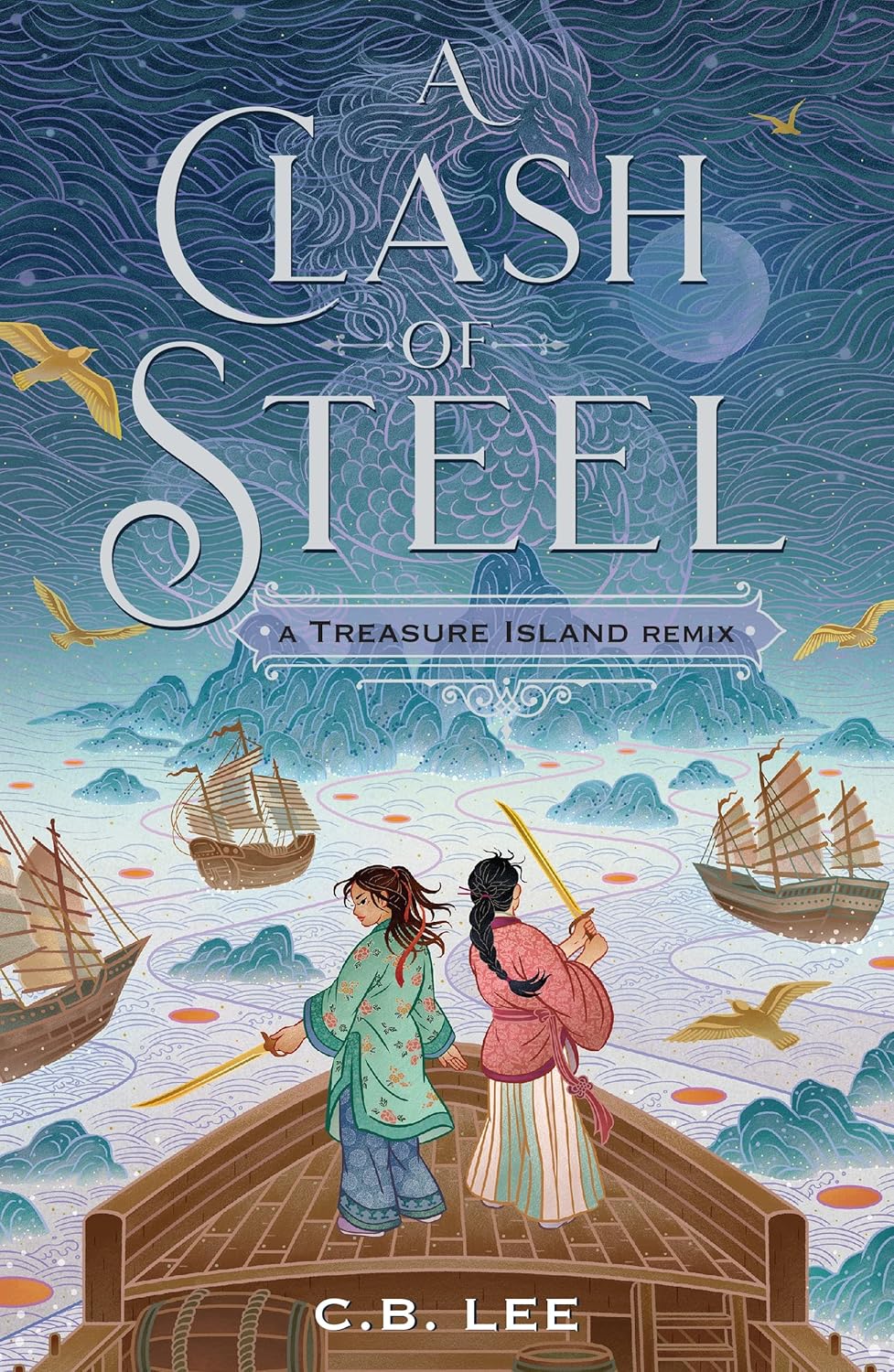
I think this is my favorite of the remix series. Clash of Steel follows Treasure Island perhaps a bit less closely than some, but the broad strokes are there. I love the way that C. B. Lee has adopted their own personal history, and really substantive research into world history, to reset Stevenson’s classic tale of adventure, pirates, hidden treasure, family, loyalty and betrayal (etc.) in the South China Sea in piracy’s golden age. In this process, they offer protagonists who are girls and women, queer, and Chinese and Vietnamese. None of this is cut to fit Stevenson’s story; it’s a riff, set to history, in a time and place where it fits naturally. I loved the whole story. I also loved the supplemental materials at the back of the book, but let’s go in order.

We begin with a prologue set in 1818 South China Sea in which we meet an eight-year-old girl named Anh, aboard a small fishing vessel with her mother (the captain), her little brother, and a small crew. We get a glimpse of dangers at sea, a tight-knit family group, a daring young girl, and an interest in tales of hidden pirates’ treasures. Then we fast-forward to 1826, a small village in China’s Guangdong province. Sixteen-year-old Xiang has never left her village, not for lack of desire. Her father is long dead at sea; her mother is a successful salt merchant and proprietor of several teahouses, including the one where Xiang lives in this backwater, locked away, kept ‘safe’ but unhappy. She dwells in the stories she reads of travel and adventure, and on the high point from where she can view the city of Canton, and dream.

An opportunity comes when she convinces her mother to take her to the city, to visit the larger teahouse there, to see the commercial center–Mother wishes to marry her off to a young man from an appropriate family, but Xiang intends to show enough prowess that she might be permitted to run the teahouse someday. She has always yearned for her mother’s approval, which has never come. If only she could prove herself worthy, she might win that approbation as well as a chance to have a wider life than the village can ever afford. In her brief hours in the city, she meets a magnetic girl her own age–Anh–and gets a snatch of an idea of the kind of life that might be possible: adventure, gumption, authenticity, more. Then a series of events forces her hand. Faced with being shipped peremptorily back to the village forevermore, Xiang takes a chance and runs away. See Xiang on a fishing ship that is also a trade vessel that is also a smuggling ship; see her learn to sail and fend for herself; see her forming closer relationships than she’s ever had before. For a time, it seems all sorts of things might be within reach: family, love, riches, independence. Or violent death and the end of everything she thought she knew about her own background.

Xiang’s story calls on Lee’s own history (descended from Vietnamese refugees of the fall of Saigon, with Chinese roots “tangled together in past generations in conflict and trauma,” and yes, with pirates appearing in that story as well) and the documented history of Zheng Yi Sao, a “pirate queen” who commanded over 70,000 pirates and over 1,200 vessels. I was so pleased by not only the author’s note and acknowledgments, but also language notes, pronunciation guide, and extended historical notes. Finally, we were gifted with an alternate prologue, which (I agree with Lee’s editor) would have revealed too much of the plot if it had appeared at the beginning of the book; but coming where it did, offers intriguing character insight. I wonder if it might have made sense as a sort of flashback late in the story. At any rate, all this extra material enriched my experience of this story, and I loved having the extended historical notes in particular, because I knew nothing of this era of world history in which a Chinese and Vietnamese empire of pirates controlled the South China Sea and subdued all Chinese, British, and Portuguese naval efforts. Thrilling! Oh, and the normalcy of same-sex relationships in this time and place setting, which was apparently disrupted only by Western influence during the Qing dynasty. These references to history make the imaginative adventure tale all the more engaging, at least for this reader.

This story was captivating, and I loved having enough background to appreciate it on several levels. I’ll be looking out for C. B. Lee and am definitely in for more remixed classics.


Rating: 8 baos.

Even Though I Knew the End by C. L. Polk

I’m a big fan of C. L. Polk.

Even Though I Knew the End is romance amid magic and determinism wrapped in a PI novella. (It’s actually a bit of a much-less-dark cousin to last week’s Harmattan Season.) When we meet Helen Brandt, she’s in a Chicago alley attempting an augury, for which she’ll be paid a whopping $50, which she can add to the nest egg she’ll leave her beloved, Edith, on this their last weekend together. The murder she’s meant to investigate turns out much uglier than originally understood, and besides, her augury is interrupted by two members of the Brotherhood of the Compass, a sort of magical professional society from which she’s been barred. Oh and one of them is her long-lost brother (literal). Same-sex love in 1941 Chicago is a challenge unto itself (Helen has friends who have disappeared into insane asylums, for example), as is being a woman in that same setting. Add to that mix angels, demons, souls sold and stolen and earned back.

I loved the historical setting (but plus magic), and the queer speakeasy and community; I loved the femme fatale / gorgeous-but-dangerous-dame sort of character, and found Edith’s religious devotion an unexpected twist. Again (and in such a short time span for this reader) I met some classic or traditional elements of a noir tale, mixed up with new ones. I heard echoes of Chuck Wendig’s Miriam Black. But where Harmattan Season was grim, Polk offers hope – however bittersweet and limited – for a happier ending. As smoke-shadowed as this world is, Even Though I Knew the End is also deeply sweet in its romantic element.

I felt that those Polk shorts I read recently offered varied degrees of success with the shorter format – meaning, some felt a bit more complete or fully realized than others. Many writers, I’d venture, get trained in the novel-length form, and/or have the most reading experience in that length; masters of the short story seem fewer than masters at the novel. (Am I reaching? Do you agree?) I don’t know if that shorter form is harder, or just a place where we tend to get less experience. At any rate. If Polk was experimenting with highly enjoyable but imperfect success in those shorts, here I feel they have achieved something pretty perfect, fully realized, in these 133 pages. Which is not to say I don’t want more of Helen (and Edith) – I very much do. But Helen’s days were always numbered; maybe this is all we get.

Plenty gritty but still sweet, masterfully complete in a small package, with period detail and imaginative flair–I love this story and will follow Polk wherever they may lead next.


Rating: 9 perfect cups of coffee.

Mutual Interest by Olivia Wolfgang-Smith

Mutual Interest is my favorite book I’ve read this year. I loved it. It’s wry, witty, heartrending, extremely cleverly written, and takes a massively wide-angle lens that charmed me enormously. I’m going to keep this review brief and vague, because (even more than usual) I want to recommend that you head into this book knowing as little as possible about plot specifics. If that doesn’t suit you, I can offer you my colleague’s very fine review at Shelf Awareness, which sold me on the book in the first place: longer version here, shorter here.

Here is what I do want you to know:

This brilliant second novel (following Glassworks, which I have not read) is set mostly in Manhattan at the turn of the century from 1800s to 1900s. Our chief protagonist is from Utica, NY, where an unsatisfactory childhood sends her out into a wider world, wringing a life out of her charm, machinations, expert read of other humans, and desperation. Vivian is, arguably, a bit of a con artist, and certainly a master manipulator, but in her own mind, she improves the lot of those she works upon even as she improves her own; she would like us to believe that her exploits are benign, and she is so skilled that we mostly believe her. Eventually, her life will intertwine (she will quite purposefully intertwine it) with two others, in both public and private spheres. I think I’m going to stop there.

Between the ups and downs, loves and heartaches, foibles and hilarities, mad successes and stomach-dropping setbacks of Vivian and her two friends, Wolfgang-Smith employs an immensely omniscient narrator to make observations about the shape of a wide, wide world. “Time and cause unravel in all directions,” this voice tells us, and it all starts with a volcanic eruption, and a bicycle. This astonishing, entertaining, wrenching novel left me reeling; I hope you love it, too.


Rating: 10 manhole covers.

The True True Story of Raja the Gullible (and His Mother) by Rabih Alameddine

An especially wry, wise, comic style distinguishes this unforgettable tale of national trauma, community, familial love, and forgiveness.

The True True Story of Raja the Gullible (and His Mother) is a novel as expansive, funny, and poignant as its title promises. With his signature wit and irreverence, Rabih Alameddine (The Angel of History; The Wrong End of the Telescope; An Unnecessary Woman) charts decades of Beiruti history and trauma through the life of his narrator, Raja, a reclusive, aging teacher of French philosophy.

The novel opens and closes in 2023, when Raja shares his apartment with his overbearing but deeply endearing mother, Zalfa. The bulk of its sections jump back in time: to the pre-civil-war 1960s, Lebanon’s civil war in 1975, the banking collapse and Covid-19 epidemic, and Raja’s ill-fated trip to the United States for an artists’ residency in Virginia. (He should have more fully recognized how suspicious the invitation was: he had written a book 25 years earlier, but “I’m not a writer, not really. I wrote a book, that was it. It was an accident.”) Writer or no, Raja is a knowing, purposeful narrator, teasing his reader with what is to come, defending his story’s chronological shifts: “A tale has many tails, and many heads, particularly if it’s true. Like life, it is a river with many branches, rivulets, creeks….” Self-aware and self-deprecating, Raja names himself the Gullible, the Imbecile, the Neurotic Clown, the Dimwit. His mother is “Raja the Gullible’s Tormentor.” “Deciphering [her] was a feat that would have surely flummoxed Hercules–my mother as the unthinkably impossible thirteenth task.” They bicker constantly, foul-mouthed but fiercely loving.

In past timelines, the reader learns of Raja’s troubled childhood as a gay younger son, bullied by much of his family, especially Aunt Yasmine, “the wickedest witch of the Middle East.” During the civil war, in his teens, he is held captive for weeks by a schoolmate and soldier with whom he begins a sexual relationship that is part experimentation, part Stockholm syndrome. He describes his accidental path to teaching, 36 years of it; he refers to his students as his “brats,” but his care for them and, even more, theirs for him will become gradually apparent. Amid terrible events, like the port explosion of 2020, Raja’s mother befriends a neighborhood crime boss named Madame Taweel: “Only my mother would find a mentor at eighty-two, let alone the most inappropriate one.” Bawdy, rude, and impossibly sweet, with “a laugh so delightful, so impetuous, so luminous,” Raja’s mother is the indomitable star of this loving, heartwrenching novel.


This review originally ran in the July 14, 2025 issue of Shelf Awareness for the Book Trade. To subscribe, click here.


Rating: 7 cans of tuna.

Most Ardently: A Pride & Prejudice Remix by Gabe Cole Novoa

I wasted no time after Into the Bright Open in getting into the next remix. Here, Pride and Prejudice retains its setting in time and place and the essentials of characters, with one great exception: the individual we know in the original as Elizabeth Bennet is here a trans boy named Oliver. Only a few people know his truth: his older sister Jane, his aunt and uncle, and two dear friends, Charlotte and Lu, who are, secretly, a same-sex couple and not the close friends their community believes them to be. He has arranged a workable system for going out as himself, sometimes climbing out the bedroom he shares with Jane at night in clothes stored under his bed, and sometimes going to Charlotte’s to change into clothes she keeps there for him. When he meets Darcy for the first time, he finds him handsome, but is repelled by his poor social graces and Darcy’s obvious disdain for the young person presented as Elizabeth.

Gabe Cole Novoa opens this novel with a note acknowledging that Oliver is frequently misgendered, and his deadname used, by his community and his own family, “though never by the narrative.” Novoa observes that this will be painful for some readers, and gives them fair warning: the author has done his best to handle the issues with sensitivity, but the book centers in some ways around Oliver’s dysphoria. As a reader who does not share this experience, I can only say that I thought Oliver’s dysphoria, misgendering, and seeking against convention for his authentic self were represented with nuance and grace, and accurately as far as I can see from here. Indeed, I thought the portrayal was of a sort to help other cis people like myself empathize with something we haven’t experienced for ourselves, in the best ways, which is some of the best work fiction can do for us.

Beyond that good work, Most Ardently is as sweet and transporting a love story (and a mess of misunderstandings) as the original it’s based on. Oliver presenting as ‘Elizabeth’ versus himself, to the same groups of people – and most importantly Darcy – offers some Shakespearean scenes of confusion, although these are less comedic because the Elizabeth character is a painful lie Oliver is forced to tell. There is one scene when Darcy laughs and laughs at an ironic turn that I do find nicely funny. And there is a parallel to the expected happy ending that is so oh satisfying – perhaps more so for its unlikeliness. (Novoa includes a historical note speculating on trans people who have ‘passed’ undetected in history. By definition, these are unknown to us. Novoa takes a hopeful stance.) I found the whole result sweet, entertaining, sympathetic, and wholly rewarding in the end. This was an easy and fulfilling read, and I’m ready for more in the series. I’m so glad this book is in the world.


Rating: 7 pairs of trousers.

Into the Bright Open: A Secret Garden Remix by Cherie Dimaline

I stumbled into this book because I was following Cherie Dimaline (VenCo), but am glad to have discovered the “Remixed Classics” series from Square Fish, in which “authors from marginalized backgrounds reinterpret classic works through their own cultural lens.” I’m looking into a few of those, including Clash of Steel (Treasure Island), So Many Beginnings (Little Women), and Most Ardently (Pride and Prejudice). I love a daisy chain like this.

Into the Bright Open retells Frances Hodgson Burnett’s The Secret Garden, but in 1901 Ontario. Mary Craven is the unpleasant, lonely, spoiled-and-simultaneously-neglected child of a wealthy, important couple in Toronto, raised mostly by a nanny she does not like who does not like her, when her parents are killed in a car crash and she is shipped off to the Georgian Bay to live with an uncle she’s never met. He is not present when she arrives; she is greeted instead by household staff who treat her with more familiarity than she finds appropriate, but she quickly rethinks her stance as she finds them also warm, even friendly. Her uncle’s estate is grand, but by Mary’s standards, wild. Gardens border upon woods, and the ocean is an untamed thing. Native people and “half-breeds” initially offend her snobbish sensibilities, but Mary is just fifteen: young enough, and lonely enough, to change her mind. This version of Mary struck me as more introspective and more capable of self-criticism than I remember the original Mary Lennox to be. It also got me thinking: while readers are certainly accustomed to accepting flawed and imperfect protagonists, Mary Lennox might be an unusually unlikeable one. This Mary Craven, though: she definitely does unlikeable things, but with the benefit of access to her thoughts & feelings (this is told in a close third person), I find her quite sympathetic. She’s learning. She’s growing.

So. At the uncle’s house, Mary of course discovers the expected (if you know the original): the secret garden, and the secret child, a new friend for the friendless orphan girl, hidden away. There is a neighborhood friend as well, here a girl with wondrous comfort, confidence, and skills in the outdoors. There are further parallels to the original novel, but also a sinister twist.

This version, though set at the same point in history, feels more modern in its perspective, and I suspect would feel a bit more accessible to the modern young reader. I’m excited about the “Remix” series, and still excited by Dimaline.


Rating: 7 lines of poetry.

A Sharp Endless Need by Marisa Crane

This poignant coming-of-age novel combines outstanding sports writing and heartfelt expression of the teen experience, set to small-town Pennsylvania basketball.

Marisa (Mac) Crane’s second novel, A Sharp Endless Need, is a propulsive, perfectly crafted coming-of-age story centered on basketball and queer sexuality. With razor-honed prose, Crane (I Keep My Exoskeletons to Myself) offers authentic descriptions of teen angst and young love as well as exemplary sports writing, and a few memorable sex scenes.

Crane’s protagonist, Mack, is a star point guard and the only one at her small-town Pennsylvania high school who is Division-I bound. Between her junior and senior seasons, her beloved but troubled father dies, and on the heels of this trauma, a new girl transfers to the team: Liv is being scouted by the same schools as Mack, and the two are instantly inseparable. Their on-court chemistry is transcendent; off-court, they share good times but are also nearly immobilized by a desire that both are at great pains to conceal. Mack’s senior year is marked by larger-than-average difficulties: grieving her father, struggling with her distant, disengaged mother, playing hard with drugs and alcohol, and grappling with a sexuality that feels firmly forbidden in her community. The basketball scholarship she’s headed for feels imperative. Her mother sees it as a financial necessity; Mack knows it’s bigger than that. “I needed a future that was all basketball all the time because it was the only future I could imagine for myself. Basketball, I knew, was the only thing keeping me alive.”

Mack’s first-person voice is written from a distance of some years, a voice of wisdom looking back on her high school days. This perspective is one of the novel’s strengths. It is the older, wiser Mack who observes that another player “didn’t notice or appreciate the poetry of her pump fakes–she simply used them for their designated purpose. I guess what I mean is there was no romance.”

Anyone who’s ever been a teenager will relate to Mack’s broader struggles with self-destructive behaviors, desires, and pain. Her particular challenges involve a devotion to craft and the one-and-only ticket out that basketball represents. “Everything outside of that stadium, our problems, our anxieties, our fears, could wait; nothing else mattered but this last play.” The best sports writing evokes not only movement, sensory detail, and skill, but passion, and Crane has a firm grasp on these facets. As Mack’s final season nears its close, her relationship with Liv, her college decision, and more hinge upon a handful of choices and impactful moments. A Sharp Endless Need is unforgettable.


This review originally ran in the April 14, 2025 issue of Shelf Awareness for the Book Trade. To subscribe, click here.


Rating: 8 photographs.

Maximum Shelf: To the Moon and Back by Eliana Ramage

Maximum Shelf is the weekly Shelf Awareness feature focusing on an upcoming title we love and believe will be a great handselling opportunity for booksellers everywhere. The features are written by our editors and reviewers and the publisher has helped support the issue.

This review was published by Shelf Awareness on March 25, 2025.


Eliana Ramage’s debut, To the Moon and Back, is a far-reaching, ever-surprising, intricate novel about identity, family, ambitions, career, romance and, yes, astronomy.

When readers meet Steph Harper, she is almost six years old. “I imagine her terrified. Our mother. Two children in the backseat. She drove like a woman followed, even after we left him at the foot of that tall hill. There was blood there, back in Texas, and tiny shards of glass still covered my sister.” Their mother, Hannah, is in flight from a vague threat–abuse, trauma–with her two little girls in tow. Precocious Steph is already developing her obsession with astronomy. Kayla is just a baby, sparkling in broken glass but unscathed by what haunts the others: “Our mother would never have Kayla’s confidence because Kayla had no memory of another self. Of another place. Of what was possible, here on earth. Maybe what was wrong with our mother was also wrong with me.”

From Texas, the fragile family resettles in the Cherokee Nation, in Tahlequah, where Hannah hopes to recover community and reclaim her heritage. Steph and Kayla learn to speak Cherokee. Steph watches the sky and fine-tunes her plans to become an astronaut: when readers meet her for the second time, she is 13 and concerned only with getting into Exeter Academy, which she hopes will put her on course for Harvard and then NASA. She studies the biographies of astronauts and the hard science she will need, with the help of a telescope gifted to her by her mother’s new boyfriend, Brett. “It had been my goal to understand the origins of earth, the universe, and everything in it by my fourteenth birthday. I was behind schedule.” This dream is what gives Steph’s life focus; she needs this to live. “I’d picture an astronaut watching me back. Some astronaut would call his daughter through mission control and she’d say tell me what you see and he’d say oh, the Northern Hemisphere, North America, and that would be true, but also true was Oklahoma, a field, a tree. A girl alone, looking up.” It is also true that the dream, which in some ways saves her, may be what keeps her from finding happiness in relationships on Earth: with her mother, her sister, or the love of her life.

Distracting her along the way are her feelings for girls, which she suspects will not be appreciated in Tahlequah: “If I could figure out the money and the applications and the getting myself to college, I decided I would be gay. Or bi, maybe? At schools like Harvard, they let you figure that out.”

As Steph moves from Tahlequah to Hollis College in rural Connecticut, a parallel character is introduced. She was named Della Owens at birth, when she was adopted by a Mormon couple in Provo, Utah. But as the center of a legal case resting upon the Indian Child Welfare Act, she became known as Baby D. Many Native Americans believe she belongs with her people. Della’s path intersects Steph’s when they find themselves at Hollis together, and they will intertwine from there, coming of age in parallel and navigating romance, Native heritage, and ambition.

For a portion of the book, Della’s first-person voice alternates chapter-by-chapter with Steph’s, which otherwise dominates. Later, these perspectives are joined by various epistolary elements: e-mails, social media posts, text messages. To the Moon and Back excels in surprise; these points of view are only one area in which Ramage takes her reader in unexpected directions, geographically and otherwise. The novel is gloriously expansive, epic, and sweeping. It covers just a couple of decades, from 1995 to 2017, although the history of previous generations certainly comes to bear on the present timeline. But like Steph herself, the story keeps reaching beyond its expected limits. It is not only a coming-of-age story, but also about a variety of Native American experiences, and about queer experiences and those intersections. It’s about lofty goals, astronomy, and yearning. Just when readers grasp the enormity of Steph’s single-minded focus on becoming an astronaut, she reaches further, to becoming a better human being. The events of Steph’s life are often sensational, but always, in Ramage’s expert storytelling, believable.

So many threads would be too much for a less skilled writer to wrangle, but these characters are developed with such steady pacing, depth, and perfect detail that they always feel natural. A plot summary with spoilers would sound, perhaps, absurd. But To the Moon and Back is anything but. It is a complex, absorbing, thought-provoking novel, compulsively readable. Steph is exceptionally eccentric, and her story is also universal, all-encompassing. Her impressive character arc comes, eventually, to wisdom and an unlikely peace: “I want to love the universe, even if I don’t know what it is. I do not have to know what it is.” Readers will be enriched for having shared these pages with her.


Rating: 9 M&Ms.

Come back Monday for my interview with Ramage.