just for fun: authors and their drinks

port-logoI just couldn’t help but share this mouthwatering article with you here. “Combined Measures: Great Writers & Their Drinks” features just five authors, but unlike some such articles I’ve come across, 100% of those featured authors are ones whose work I like; and all five drinks, as well, whet my palate. You will note that my favorite, Hemingway, is present (as he ever will be, where alcohol is discussed). I am tempted to try some of these myself… particularly the accompaniment to Kerouac’s cocktail, discussed on page one.

Enjoy. 🙂

And do share: which author, or drink, do you fancy?

article from TIME magazine: “Best, Worst Learning Tips” by Annie Murphy Paul

I do all sorts of reading, as you may have noticed here. I read fiction, some of it quick and easy reading (thrillers), for fun and the enjoyment of being caught up in the story; I read classic fiction for appreciation of the art form. I read nonfiction for the sake of learning more about my world, in so many diverse areas, because I love learning new things. I read books so that I can write book review for Shelf Awareness (although only the sort of books that I already enjoy reading). I read travel guides to help me plan trips. I read other people’s book blogs (although I am woefully behind on this) because I like hearing what they (you) have to say. I also read health information in my job as a medical librarian, in an effort to serve my patrons/patients with the best information available.

It’s been a little while since I’ve been in school formally, pursuing a specific degree; but I take short training courses here and there, and I am always aspiring to further schooling. If I had all the time and money in the world, you can bet I’d be a student again.

The advice implicit in the article linked below seems to be aimed primarily at students; but I believe that if we stop to consider, we all read because we want to learn something from our reading material (even if it’s just whodunit).

A friend of mine who works in higher education posted this to facebook – and I hope he won’t mind me quoting him: he called it “a very nice empirical discussion of learning strategies, something not all that common in the education literature.” (Thanks, David!) And here you are: “Highlighting Is a Waste of Time: The Best and Worst Learning Techniques” from TIME magazine. I thought it contained some good ideas for students or learners of any type. Of especial interest to me was the conclusion in the title: that highlighting is a waste of time (not least because it’s distracting to the reader). I couldn’t agree more! My high school English program actually graded us on our highlighting (we had to turn in our books for perusal). Sigh.

What’s your reading style? Are there any tips or conclusions in this article that surprise you or that you especially applaud?

article from Orion magazine: “Dark Ecology” by Paul Kingsnorth

This article came to me from coworker Liz (who always recommends good stuff), and simultaneously from Pops, who also thought it was great. That should be testimony enough; but I am unstoppable and will say just a few words myself, too.

Paul Kingsnorth writes about the future of ecology, conservationism, “green” thinking, or whatever you’d like to call it. This is “dark” ecology because the news is not good. I’ll let him give you the real dish because he does it better – as Pops says, “the good news is that Kingsnorth is a writer first, not a social scientist, so it reads pretty well” – but I really appreciated his willingness to look forward to what’s ahead and what we have to do differently than the old guard of environmentalism, which sadly hasn’t worked. And his ideas about what’s ahead and what we might do in anticipation, however dark, resonated with me. Plus, he writes beautiful thinking lines like these:

Our human relationship to the rest of nature is not akin to the analysis of bacteria in a petri dish; it is more like the complex, love-hate relationship we might have with lovers or parents or siblings. It is who we are, unspoken and felt and frustrating and inspiring and vital and impossible to peer-review. You can reach part of it with the analytical mind, but the rest will remain buried in the ancient woodland floor of human evolution and in the depths of our old ape brains, which see in pictures and think in stories. Civilization has always been a project of control, but you can’t win a war against the wild within yourself.

I give you:

multimedia journalism from the NYT: “Snow Fall” by John Branch

I have a librarian coworker, Liz, who always finds the coolest latest thing, and is expert at sending me articles (etc.) that will interest me. Recently, that was an article from the New York Times that blew my mind in a few different ways. For one, the story is striking: in February 2012 an avalanche in Washington state had tragic consequences for a group of skiers. The story of that day is told in this article in a structure that I very much appreciate. In a manner reminiscent of Jon Krakauer’s Into Thin Air (a book that started as an article in Outside magazine) and Sebastian Junger’s The Perfect Storm, journalist John Branch approaches his subject from various angles. He informs us on the science of weather and snowpack and how avalanches form; the latest trends in backcountry skiing; the biographies of the individuals involved. As a text article, it would be very impressive, and very moving.

But that’s not the full story on this story. As presented online, Branch’s article uses a variety of media: still images and animations, video and audio clips, computer-generated demonstrations of (for example) avalanche activity. And, as Liz points out, all the media are combined in such a way that, as one scrolls to read the article, it all flows and combines smoothly without distracting the reader. How many times have you seen this done the wrong way, where flashing images pull your eyes and/or mind away from the content you’re trying to access? I think I can say that this is the finest multimedia presentation I’ve seen online. Combined with the incredibly powerful story Branch has to tell, this is a unique experience you don’t want to miss.

And with that long introduction…


Before the Rain by Luisita Lopez Torregrosa

An impassioned memoir of love between two journalists, set amid travel and revolution.


Luisita López Torregrosa (The Noise of Infinite Longing) is a New York newspaper editor when Elizabeth comes aboard as a new reporter in the 1980s. Her quiet, self-contained, slightly mysterious air draws Luisita’s attention. When Elizabeth lands a sought-after position as foreign correspondent, she builds a home for herself in Manila. Luisita joins her there, and the two women throw themselves hesitatingly and then wholeheartedly into a passionate affair against the backdrop of the fall of Ferdinand Marcos.

As a love story, Before the Rain is spellbinding and heartwrenching, but Torregrosa’s highest feat is perhaps one of poetry. Her tone is haunting, lyrical and sensuous. Readers will feel the equatorial heat of the Philippines and the beat of the Manila Blues, smell the mangoes and squatters’ camps, taste the margaritas and then feel the biting cold of New York winters as the story returns to the United States.

Before the Rain is a memoir of revolution as well as love: the beauty, upheaval and political turmoil of the Philippines are handled sensitively and lovingly. Besides Manila, Luisita and Elizabeth live and travel in New York, Tokyo, Los Angeles, Miami, Rio and Washington, D.C.– and each of these places leaves its mark. But their relationship is always the book’s main focus. The two women travel, move, work various jobs (some rewarding, some soul-draining); and throughout, their ardor has a momentum all its own. Even in its painful finale, that love is this book’s most lovely evocation.


This review originally ran in the August 10, 2012 issue of Shelf Awareness for Readers. To subscribe, click here, and you’ll receive two issues per week of book reviews and other bookish fun!


Rating: 8 sheets of newsprint.

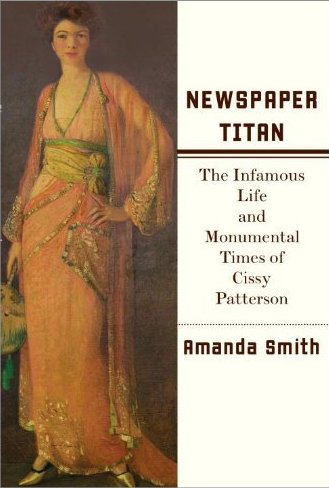
Newspaper Titan: The Infamous Life and Monumental Times of Cissy Patterson by Amanda Smith

The exhaustive–but not exhausting–biography of a complicated and difficult woman, heiress to a newspaper dynasty and a fascinating and controversial figure.

Amanda Smith’s (Hostage to Fortune: The Letters of Joseph P. Kennedy) exhaustively researched biography of Cissy Patterson begins several decades before her birth, with her grandfather Joseph Medill and his creation of the Chicago Tribune. The extended family of Medills, Pattersons and McCormicks would be newspaper royalty for several generations; but perhaps none cut a stranger figure than Cissy.

Eleanor Medill Patterson, known as Cissy, led was born in 1881 into a fractious, influential newspaper family and married a dissolute Polish count who turned out to be broke and who kidnapped their daughter, Felicia. With great effort and the interventions of powerful political figures from around the world, she regained her daughter and divorced. The countess then had a series of unsatisfying relationships and grew estranged from Felicia; published two acclaimed novels; and married a Jewish man despite her apparent anti-Semitism and eventual sympathy with the Nazi cause in World War II. Late in life, she began a newspaper career as journalist, editor and, finally, publisher and owner of the enormously successful Washington (D.C.) Times-Herald, which she created out of two failing papers. When she died in 1948, alcoholic, vindictive and erratic Cissy left a fortune, including ownership of the Times-Herald, whose disposition was held up by court battles sparked by conflicting wills and accusations of her insanity.

Called “perhaps the most powerful” and the “most hated” woman in America in the 1940s, Cissy’s fascinating and curious life is examined here in detail. But this lengthy book is never boring, because its subject is such an outrageously flamboyant and historically significant figure.


This review originally ran in the September 20, 2011 issue of Shelf Awareness for Readers. To subscribe, click here, and you’ll receive two issues per week of book reviews and other bookish fun!

Teaser Tuesdays: Newspaper Titan by Amanda Smith


Teaser Tuesdays is a weekly bookish meme, hosted by MizB of Should Be Reading. Anyone can play along! Just open your current read to a random page and share a few sentences. Be careful not to include spoilers!


Newpaper Titan: The Infamous Life and Monumental Times of Cissy Patterson is a hefty biography of the heiress to the Chicago Tribune dynasty, and formidable newspaperwoman in her own right. Smith covers the family history beginning well before Cissy’s birth in 1881, through her death in 1948. I’m just beginning the book, and actually had never heard of Cissy before, but so far she is proving to be a most interesting subject – meaning, as is usually the case with the most interesting subjects, that she is a controversial and difficult-to-like figure. My teaser comes from page 347:

Although Cissy was the first and only woman editor of any newspaper in the Hearst chain, she was by no means the Chief’s sole female employee. The son of a formidable mother, William Randolph Hearst himself did not share the low estimate of feminine competence that his Washington Herald staff had betrayed when Cissy invaded their city room.

This quotation comes from an uncorrected advance proof and is subject to change.