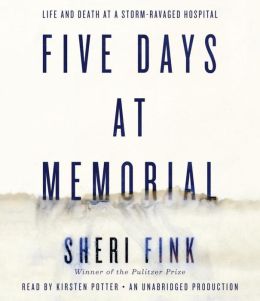
Five Days at Memorial: Life and Death in a Storm-Ravaged Hospital by Sheri Fink (audio)

five daysWell. This one is a lot to tell you about.

Sheri Fink is an award-winning journalist and holds both a PhD and an MD. In Five Days at Memorial, she examines fateful, famous and controversial events at Memorial Hospital in New Orleans in the five days following 2005’s Hurricane Katrina. Forty-five bodies were recovered from the hospital, with about 9 of them (depending on your source) suspected of having been euthanized by hospital staff during evacuations. I had been looking forward to reading this book but was leery going in, because this subject was clearly going to be emotionally fraught, depressing, poignant. I was quickly mesmerized, though: these events, while troubling and difficult to take in, fascinated me deeply. I have been increasingly interested (outside my reading of this book, for some time now) in the subjects of end-of-life, advanced directives, and our culture’s approach to death. And I am always intrigued by ambiguity, situations in which it is clear to see black-and-white or right-and-wrong. If ever there were such a situation, this is it.

Roughly the first half of the book is dedicated to relating the events of these five days, as revealed by Fink’s investigations. (Recall, as I mentioned in my book beginning, that she describes her copious research. I am fairly well convinced of its virtue.) We get to know a number of characters in the story: doctors, nurses, managers and administrators, patients and their family members. We know the ending, in a sense: the hurricane will be far worse than anyone imagined; the hospital will not be evacuated in one, two, three or four days; there will be crimes investigated. But the way the events unfold were unfamiliar to me in their details. Although this is a journalistic account, Fink also imbues it with suspense, which feels very natural: imagine the terror felt by those inside the hospital throughout. Not knowing the whereabouts or well-being of friends and family, isolated by rising floodwaters, without electricity, and plagued by rumor (on which more in a minute), a number of those inside Memorial feared for their lives. And some lost their lives.

The second half of the book describes the investigation of one doctor and (centrally) two nurses. Dr. Anna Pou was eventually called before a grand jury, which (some two years after Katrina) declined to indict her for multiple counts of second degree murder. In this section, we meet new characters, most notably two investigators who work as a comfortable team together. Fink also explores the history of euthanasia as a concept in different cultures and different legal understandings today, and the approach of bioethics, as well as post-Katrina attempts to establish emergency standards for triage, including the allocation of limited resources that will save some lives while ending others.

I was impressed by Fink’s style. I felt, in the end, that she let the facts (as she discovered them) stand alone. Many times throughout it felt like Fink’s voice spoke on one side of this painfully difficult controversy, but pages later she lent that voice to the other side, so that the effect was… shall I say, appropriately discomfiting. The fact is, I strongly feel, that none of us can perfectly know what happened in those five days, what anyone’s real motivation or intention was, and probably that none of us has the right entirely to judge actions taken in such profoundly weird circumstances.

Many questions remain, and I can easily understand and sympathize with divergent views: family members whose loved ones were (allegedly, possibly) euthanized are angry that they weren’t evacuated; hospital workers with no options left to them felt it was better to euthanize than to abandon patients to die slowly, painfully, and alone. I see it both ways. But the details, I think, are lost to me – someone who lived none of it, who’s just read the book. Dr. Pou, it appears, does not find this book’s treatment fair at all. While it’s true that Fink doesn’t exonerate her, I felt that she wasn’t condemned, either. It’s just… so complicated.

One of the more disturbing elements, to me, was the power of rumor and euphemism in the hospital and the accusations bandied about afterward. Doctors and nurses allegedly spoke of “making patients more comfortable,” or said “we won’t leave any living patients behind.” I don’t see how these vague phrases can be used to accuse someone of murder (or euthanasia, or what you like) – what if they literally just meant make someone comfortable? What if they meant that we will evacuate all living patients, thereby leaving none behind? I don’t think these statements necessarily point to killing people – certainly not beyond a reasonable doubt. And then the rumors: New Orleans after the storm saw violent crime and looting, but not (writes Fink) to the extent that it was rumored, within the hospital and more generally. Some of this fear and rumor was racially charged. Such a circumstance serves no one well.

In fact, the most damning evidence in Fink’s book for me was not the evidence that euthanasia had taken place – frankly, my value system allows for euthanasia as a fine option in certain circumstances – but the evidence that other hospitals faced similar challenges (loss of power, rising waters) and functioned better. I can’t recall the name at this moment (and the audiobook format is bad for looking up such things), but there was a hospital under analogous conditions that ran regular shifts – encouraging staff to sleep when not caring for patients – and sternly disallowed the spreading of rumors. (I think the phrase was something like “if you didn’t see it, don’t say it.”) Memorial saw a decidedly higher level of panic, and that was one of its critical failures. This can’t possibly be Dr. Pou’s fault: she’s just one person, incapable alone of preventing or inciting panic. In fact, as Fink presents it, if she did commit certain acts, she wasn’t alone; she was just singled out in investigations.

I can draw no conclusions after reading (listening to) this book, other than to say I think it was well told – visceral – and I am emphatic about the persistent ambiguity of this situation. In other words, I can’t judge, and I think it’s a little outrageous that anyone would try to. But I guess the justice system feels it has to try…

Narrator Kirsten Potter was well up to this task; full credit for the narration. I enjoyed this format for this book, but the major drawback for journalistic work is that I can’t flip back and check names, dates, etc.

Recommended, if you’re up for some tough topics and hearing about suffering.


Rating: 8 sleepless nights.

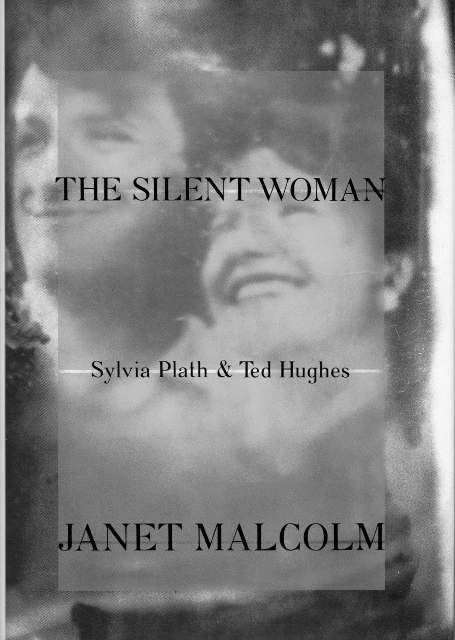
The Silent Woman: Sylvia Plath and Ted Hughes by Janet Malcolm

silentThis was a very interesting read, and not exactly what I’d expected; but it is in line with my own previous Janet Malcolm read, Iphigenia in Forest Hills. As I said on Tuesday, this is not a biography as I thought; it is rather an examination, if not an excoriation, of biographies generally. The life of Sylvia Plath is chosen as a vehicle for Malcolm’s argument, her journey and study toward developing that argument, and she does make an appropriate vehicle. She is a sensation, what with her suicide and all; she has living family members (notably her husband, sister–in-law, and her mother; she also has children, but they are only referred to by others, and don’t show their own faces) to be hurt by biographical portrayals which naturally handle their lives as well, often less than gently; and the biographies that have been written of her have tended to viscerally choose sides. Some are in the pro-Plath camp: she was a fine talent, tormented and abused by her evil husband Ted Hughes and her mother; others are pro-Hughes: he was a saint, she was a terror.

[Here is where I want to point out that this book was published in 1994, so the living relatives Malcolm writes about and that I’m referring to were living then. Plath’s mother Aurelia died in 1994; but in the present tense of this book, she is alive. Hughes died in 1998. I can’t confirm Olwyn Hughes’s status; I am therefore tempted to presume she is going strong.]

Very briefly: you know Sylvia Plath? Troubled poet, author of The Bell Jar? She was married to poet Ted Hughes, had two children, and was separated from him when she made her second suicide attempt, which was successful, by putting her head in an oven and gassing herself. Ted and his sister Olwyn have controlled her literary estate, with Olwyn playing the active role and ferociously defending his reputation.

Janet Malcolm traveled in 1991 to England to meet with Olwyn Hughes, and several Plath biographers, to talk about the Plath legacy and the ways in which it has been mismanaged. While the various parties differ on how, why, and when, I think they will all agree that it has been mismanaged. The biographical processes and products have been fraught with bitterness and poisonous resentments and failures of compassion, of put-yourself-in-someone-else’s-shoes. I am undecided as to what side I’m on, and Malcolm has something to say about this failure to choose sides.

The writer, like the murderer, needs a motive. Rose’s book is fuelled [sic] by a bracing hostility toward Ted and Olwyn Hughes. It derives its verve and forward thrust from the cool certainty with which… she presents her case against the Hugheses… If it had been impossible for Rose to take a side, her book would not have been written; it would not have been worth taking the trouble to write. Writing cannot be done in a state of desirelessness. The pose of fairmindedness, the charade of evenhandedness, the striking of an attitude of detachment can never be more than rhetorical ruses; if they were genuine, if the writer actually didn’t care one way or the other how things came out, he would not bestir himself to represent them.

(The male pronouns, present throughout, strike me as quite a shame. C’mon, Malcolm, you yourself are a writer who is not a “he” – can you not represent that possibility in your writing?)

Okay, so, point taken; but I didn’t get much of a feel for either Plath’s or Hughes’s point of view, honestly, from what I read in this book, and I’ve read none of the biographies. (Ironically, I was trusting to Malcolm to do that job for me; clearly that was a no-go, although what I received instead was worthwhile.)

Malcolm talks with the pro-Plath biographers and the Pro-Hughes biographers; they run a gamut from academic intellectuals through standers-by, friends and neighbors, and frankly (though Malcolm doesn’t use these words) some who strike me as tabloid-mongers. She reads letters and journals – the published ones, and the ones in archives. She reads manuscripts. She is most interested in the conflicts, the ethical questions, the difficulties – of biography generally (again see this week’s Teaser Tuesday for a perfect expression of this problem), and even more so, the difficulties of biography of a living person or one, like Plath, whose supporting cast is still living. (Or, again, was at the time of this book’s publication.)

It is all very interesting: Malcolm’s arguments, the people she meets – and her interview subjects get some excellent characterization. Considering The Silent Woman as a work of literature in itself, these characterizations are by far Malcolm’s strongest moments. I appreciate the criticisms she makes of biography, and of the delicate situation involved with still-living subjects; a person could almost be convinced that we should wait for everyone to have died before we write up their nasty secrets… but not quite.

Malcolm’s style is decidedly cerebral, classical, academic. She goes heavy on the allusions. This is not necessarily a compliment or a criticism, but read these lines:

The framework of deconstructive, psychoanalytic, and feminist ideology on which Rose has mounted her polemic against the Hugheses gives the work a high intellectual shimmer. There are close to eight hundred footnotes.

I’m afraid we have applied the wrong standard here! I certainly hope we’re not down to counting footnotes… of which, by the way, there are none in this book. There is nonetheless a great deal of theory, and it could get a little trying if that was not what you were there for. Just a head’s up.

Also, this:

In a work of nonfiction we almost never know the truth of what happened. The ideal of unmediated reporting is regularly achieved only in fiction, where the writer faithfully reports on what is going on in his imagination… We must always take the novelist’s and the playwright’s and the poet’s word, just as we are almost always free to doubt the biographer’s or the autobiographer’s or the historian’s or the journalist’s. In imaginative literature we are constrained from considering alternative scenarios – there are none. This is the way is is. Only in nonfiction does the question of what happened and how people thought and felt remain open.

This is off-topic and perhaps not highly relevant to the arguments we’re working on here, but I couldn’t let it pass by. Hello, unreliable narrators?? I guess Malcolm’s area of expertise lies in nonfiction, journalism, rather than literary criticism or *novels* – but really! I was surprised that she would make such a blanket statement that “fiction is true”. Just a few example of classic unreliable narrators that I have read might include Humbert Humbert of Lolita (she wanted it, right?), Chief Bromden in One Flew Over the Cuckoo’s Nest, Nick in The Great Gatsby, that guy from Fight Club, Lockwood from my old favorite Wuthering Heights, and (famously, recently, and for me, unreadably) the two narrators of Gone Girl.

I fear that I’ve been rambling. I find Janet Malcolm’s mind-workings fascinating and thought-provoking, and intelligent; I appreciate all the research she made me do in her vocabulary and allusions (you will see a vocabulary lessons post coming soon). Despite The Silent Woman not being what I’d expected, it was well worth my time; and it did take time, being rather dense. She is not a light read, be aware. I’m still on board for Two Lives, though.


Rating: 6 dictionaries.

Teaser Tuesdays: The Silent Woman: Sylvia Plath and Ted Hughes by Janet Malcolm

Teaser Tuesdays is a weekly bookish meme, hosted by MizB of Should Be Reading.

silent

Having been impressed by Janet Malcolm’s Iphigenia in Forest Hills, I knew I wanted to read what I thought was her biography of Sylvia Plath (and, secondarily, husband Ted Hughes). I am not a great scholar of Plath, but I’ve read The Bell Jar twice, and some of her poetry, and I thought the combination of subject and biographer sounded very promising.

I was wrong, though; this isn’t a biography of Plath, but rather an examination (even an exposé) of biography as a genre, using Plath as an example. How interesting! I was still on board, having been interested in some of the problems of biography (and autobiography, and especially, memoir) for some time. Also, I just finished Alison Bechdel’s Are You My Mother?, as you know, and she muses (and her mother muses) on some of the problems of memoir, too. So this is all welcome.

I’ll just share an example from Malcolm’s opening pages that struck me, and that helps to define her understanding of the problem.

The transgressive nature of biography is rarely acknowledged, but it is the only explanation for biography’s status as a popular genre. The reader’s amazing tolerance (which he would extend to no novel written half as badly as most biographies) makes sense only when seen as a kind of collusion between him and the biographer in an excitingly forbidden undertaking: tiptoeing down the corridor together, to stand in front of the bedroom door and try to peep through the keyhole.

Putting aside Malcolm’s use of the male pronoun (shame on you!)…

Part of me, of course, wants to protest on behalf of the Truly Good Biographies out there; but I know exactly what she means. So on the one hand: we read history for some lofty purposes, don’t we? And history includes biographying certain history characters, doesn’t it? Need we be voyeuristic to want to learn about Susan B. Anthony or Major Taylor? I say, no. But oh, then there was my reading of Jaycee Dugard’s book, which made me feel just dirty. And I get the point with someone like Plath, too: she is a literary figure, but admittedly, a certain part (probably a large part) of her fame relates to the lurid details of her failed marriage and her suicide. We’re fascinated with these things. And, as Malcolm will go on to outline, another defining aspect of Plath’s case – and what makes her different from Susan B. Anthony or Major Taylor (and like Jaycee Dugard) – is that the other players in her story are still alive (or were when this book was published). They are still vulnerable to injury from the conclusions a biographer might draw, about Who To Blame; and naturally conclusions of this sort will be drawn, in such a tale of suicide and woe. Point taken, then.

Stay tuned for what looks like a stimulating read.

book beginnings on Friday: Five Days at Memorial: Life and Death in a Storm-Ravaged Hospital by Sheri Fink

Thanks to Rose City Reader for hosting this meme. To participate, share the first line or two of the book you are currently reading and, if you feel so moved, let us know what your first impressions were based on that first line.

five days

I have been intrigued by the idea of this book for some time now. I have some perspective on Katrina, to begin with. Not that my personal life was profoundly effected, but Houston residents saw the consequences come our way. For one thing, in the form of Katrina evacuees, and for another, because when Hurricane Rita was forecast for us just a few months later, the response was quite different than it might have been if our neighbors to the east had not just been so badly beaten. And then I suppose my interest is piqued as well because I work at a hospital now. Finally, I got to see Anna Deavere Smith perform last month (at the Medical Library Association Annual Conference in Chicago), and she did a short piece on the conditions at Charity Hospital in New Orleans that was – naturally – very moving. So here we are, finally.

Five Days at Memorial begins with an Author’s Note in which Fink describes her research methods (lots of interviews & other primary & secondary materials) and notes that she wasn’t at Memorial during the storm, although she visited later. She makes it clear that this is a journalistic work, and that she has been faithful to what she learned in her research – all dialog in quotations comes from interview, etc. – and that she has made an effort to keep her own reactions (“any book reflects the interwoven interpretations and insights of its author”) clearly delineated from the facts. I appreciate this.

I’d like to share two bits for your book beginning today. First of all, “Part I: Deadly Choices” begins with a quotation:

Blindness was spreading, not like a sudden tide flooding everything and carrying all before it, but like an insidious infiltration of a thousand and one turbulent rivulets which, having slowly drenched the earth, suddenly submerge it completely. – José Saramago, Blindness

And then the Prologue:

At last through the broken windows, the pulse of helicopter rotors and airboat propellers set the summer morning air throbbing with the promise of rescue. Floodwaters unleashed by Hurricane Katrina had marooned hundreds of people at the hospital, where they had now spent four days.

And that, I think, says enough for today.

Kingsolver on Knitting and The Interconnectedness of Life

Barbara Kingsolver has captured my heart with The Lacuna and Flight Behavior. Only fitting, then, that she should make such a charming, truthful, and lyrical submission as this to Orion magazine: “Where It Begins”. I can’t decide which is more valuable and valued: her lovely message, which I won’t sully by summarizing, or her lovely writing, for example:

…banish all possibilities, the winter and the summer, the bare feet under the table, the shattered day undone and dregs of old regard and bitter unsettled tea leaves and the words forever jostling ahead of each other in line, queuing up to be written. Especially those. Words that drub, drub, drub at the skull’s concave inner wall. Words that are birds in a linear flock, pelting themselves in ruined fury all night long against the windowpane.

I am so very happy to hear that words are still drub, drub, drubbing at her skull’s inner wall, because I want them out here.

Enjoy. (Thanks, Pops.)

from the New Republic: on books

Thanks, again, to Liz for sending this along. The New Republic‘s issue of October 21, 2013 featured a cover focus on books and publishing, with five articles included. They range from a one-page infographic to 3 pages long; no serious time commitment here, although you will have to find them. I accessed these stories through a database (Ebsco, if you’re curious) through my employer; you may have similar access through your local public library, for example. I know that on Houston Public Library’s page you can go to “research databases” and search for the publication you want (New Republic), and then you’ll need to put in your library card number to see the articles. Contact your local librarian if you want to get in and you need some help; she or he will be happy to assist. Or, there’s always the print edition, if you subscribe or know of a decent newsstand!

I found these articles interesting (obviously) and wanted to share just a few thoughts. In the order I read them (I have no idea how this relates to the print magazine):

  • “Books Don’t Want to Be Free: how publishing has escaped the cruel fate of the other culture industries” by Evan Hughes examines the fact that books have avoided the way music and movies have become open to pirating and price drops. Those industries are struggling, Hughes writes, in ways that the book publishing industry isn’t. (And don’t even get started on print magazines and newspapers…) This article is optimistic and thus refreshing. It touches on the recent price-fixing court case between a group of major publishers, and Amazon. It also speaks to pricing differences between e-books and traditional print, which is addressed in the next item:
  • “The Words Business, In Numbers,” an infographic (sort of) identifying trends in revenue (e-books vs. print), reader trends, and foreign readership. In a word, “e-books are growing the pie.”
  • “The Dastardly Defender of Letters” by Laura Bennett is an article about and interview with Andrew Wylie, “who still makes millions off highbrow.” He is an infamous agent for clients including – I shamelessly reproduce those listed in the article – Amis, Nabokov, Bellow, Rushdie, Roth, and more in that vein. He is delightfully curmudgeonly, snobbish about the lowbrow, and defending books as they should be made (says he, and I largely agree). This was the most fun piece to read. His apparent serene calm regarding the future of traditional books was heartening.
  • “I Hope They Read Books in Hell” by Norene Malone, on the other hand, touches on the opposite end of the spectrum. Malone visits with the editor, Ruby-Strauss, and agent, Leavell, of Tucker Max, author of I Hope They Serve Beer in Hell.” Max’s cache, if you didn’t know, is being 1) internet-born and 2) offensive as all get-out. Ruby-Strauss and Leavell work with others in the same vein: Snooki from Jersey Shore, that University of Maryland student who wrote that bitchy email, Shit My Dad Says (whose twittering I like, btw). It was interesting to consider that counterpoint, the lowbrow, which (it is argued) helps finance the highbrow.
  • Finally, “The Rancid Smell of Success” was written by Lionel Shriver, author of a good number of novels, most famously We Need to Talk About Kevin, which became a major motion picture. She laments the changed life of a successful novelist: from the scary, financially insecure obscurity of an undiscovered writer to the publicity-exhausted successful author – who is still financially insecure and has to immediately begin work on the next book, but can’t because of all the promotional demands of the current one. It’s a beautifully written article, and she acknowledges the problem with her complaints about the literary festival she has to attend in Bali; but she justifies her complaints, too. It’s a thoughtful piece.

On the subject of e-books versus print – and the question of the future of the traditional book (“is it dead?!” they ask hysterically) – others have said it better before me, but I’ll briefly file my position. The birth or the rise of the e-book does not signal the death of the book, any more than the birth or the rise of television sounded a death knoll for radio. Radio has changed over the decades, but we still have a recognizable semblance of what it was when the television was born. There’s room for both e- and print books in this world, and both have their uses, their pros and cons, their seasons if you will; and both have their fans. Those of us who prefer print (even if we occasionally read electronically!) will continue to buy and borrow real books. Everybody calm down, is my concise message. And please, read books – any kinda way.

from NYT magazine: “Stephen King’s Family Business”

Thanks to my mom for sharing this fun article by Susan Dominus, “Stephen King’s Family Business“, in which she sits down with the family – Stephen, Tabitha, their three children Naomi, Joe and Owen, and Owen’s wife Kelly. This crowd of six boasts five novelists, a hefty feat: Dominus calls them “as close to a first family of letters as America is likely to have,” and I think she makes a fair case.

It’s a pleasure to step inside the lives of Stephen King and his family. I am only a beginner-fan, having read, oh, 7 or so of his many many books; but I am a fan, and even at my beginner level, was aware that the King family talent extends beyond Stephen himself. The people portrayed in this article are down-to-earth and likeable, and come across as both a tight-knit family and as distinct individuals at the same time.

Go check it out. I, for one, was already watching my local library for NOS4A2 on audio, but have now requested Heart-Shaped Box as well. Who knows what you’ll find?

a few short pieces


“A Shirt Full of Bees” by Bill McKibben

My father sent me a copy of this essay, but it’s not shareable under copyright restrictions; and I couldn’t find a publicly accessible version I was happy with. I’m sorry. If you can track down this issue of Utne Reader, through your local library for example, you can read the article yourself.

How strange the way things come together. I’ve just recently been enjoying Annie Dillard’s Pilgrim at Tinker Creek; and my favorite parts of that book are her in-depth, lengthy examinations of parts of nature. One of those subjects she gets good and lost in is newts. And here is Bill McKibben, opening “A Shirt Full of Bees” with an episode starring Terry Tempest Williams (When Women Were Birds; I also loved her Pieces of White Shell) and a newt. Williams crouched on her haunches for half an hour examining the newt, “lost in the world of the newt” in McKibben’s words, and he found himself bored, restless, ready to keep walking, to reach the summit – something we do constantly, of course. And then, on another day, he steps on a yellow jacket nest, and as he erupts in hives and dashes down-mountain for medical aid – “My dog was the best dog I’ve ever had, but I doubted she was up to surgery” – McKibben sees more clearly the beauty around him. That’s the larger point in this short essay: we are always pushing for the summit, and too busy to examine the newts on our path. As I observed in Oil and Honey (the only one of his books I’ve read; but my father is rather an expert), McKibben is a gifted writer. He pulls together two anecdotes – his walk in the the woods with Williams and the newt; his walk in the woods with his dog and the yellow jackets – in a lovely, poignant, meaningful, beautifully written and well-structured essay of three pages. This is the goods, right here.


“Confessions of a Recovering Environmentalist” by Paul Kingsnorth

Pops reminds us that Kingsnorth was the author of “Dark Ecology” that I discussed back in January. This latest is available here.

Kingsnorth opens charmingly with recollections from his youth, ages 12, 19, and 22, in natural settings. These are the experiences that taught him to love “the other-than-human world.” He became an “environmentalist,” that radical thing. And now he laments what “environmentalism” has been bastardized into: a quest for zero-carbon emissions, for alternative energy sources, for sustainability – all good things, doubtless, except that “sustainability,” he argues, is code for finding a different way to do the same things we do now. In other words, we need to release less carbon, so we need to find another energy source so that I can still have my lights and electricity and drive my car and buy my cheaply made clothing at the mall. He points out that we seek a way to sustain our lifestyle – not to sustain the earth, which is sort of what we claim to be seeking. And of course there is the central, painful irony, that “the farmers are being edged out by south-country refugees like me, trying to escape but bringing with us the things we flee from.” He even addresses the touchy subject of “industrial wind power stations (which are usually referred to, in a nice Orwellian touch, as wind ‘farms’)” which McKibben has also struggled with. Are “wind farms” environmentalist?? There is an argument.

Kingsnorth is clever in his criticisms: “these days I tend to consider the entire bird with a kind of frustrated detachment” (that is, the oft-cited bird that has a left wing and a right wing), with which I certainly sympathize; “the colonization of the greens by the reds” characterizes all those myriad left-wingers (“disillusioned socialists, Trots, Marxists, and a ragbag of fellow travelers who could no longer believe in communism or the Labour Party or even George Galloway…”) who’ve taken over his movement. But don’t let his wittiness distract you from the fact that he is right. Again ironically, the problem seems to lie in the success of the “green movement”: save-the-planet is now a perfectly respectable, mainstream concept that you can now find on 3 out of 4 cereal boxes, and that bringing of Kingsnorth’s environmentalism into centrist politics has weakened it, watered it down, naturally, as centrism does.

Like the earlier Kingsnorth piece I read, this one gives quite a dark view in examining “environmentalism.” But like that other pessimistic-or-realistic writer, Derrick Jensen, I see his points, and I’m rather more inclined to follow him than I am to follow McKibben’s optimism.


“A Tough Flower Girl” by Phillip Connors

I am not yet done following Phil Connors. This is not a new piece, but one I’ve had to reread now that I am an affirmed follower of Norman Maclean. Connors’ article is available here.

Another fine piece of writing: Connors explores what we find so moving, timeless, and important in Maclean, but he also creates a piece of art in its own right. This short article is an excellent introduction to Maclean, in his best-known A River Runs Through It (and the two accompanying stories), in Young Men and Fire (better-loved, I think, by both Connors and myself), and in The Norman Maclean Reader (imperative for those of us left wanting more by the first two). It is an incisive piece of literary criticism and appreciation; but it also includes a personal story, as Connors opens by pointing out his biographical similarities to the great Maclean. If it is indeed “uncool to admit an enthusiasm based in part on biography”, call me uncool. Not that I share biographical parallels with my literary idols (ha), but I certainly consider their biographies integral to my appreciation. Funnily, I have just finished searching for a good Maclean biography, and am disappointed by the lack. Somebody please write this book. Phil?

Read this article because it says true things about an amazing writer, but also because it is in itself a sparkling, crystalline beauty.


“Smoke” by Phillip Connors

A new piece from Connors, available here.

I am reminded of how much I love Connors’ voice, that he isn’t afraid to have one, first of all, and that he is both intellectual and casual in it. He acknowledges that “self-quotation is a dishonorable habit, but it sounds a little smug to say I saw it coming and leave it at that,” and so he self-quotes from Fire Season, that book I loved so much, in which he predicts that “the big one” is coming. “If you live on a peak in fire-prone country, as I do every summer in the Black Range of New Mexico’s Gila National Forest, the big one will eventually come for you.” This very short piece is the story of that fire beginning, and beginning to be fought, and its victory: it burned over two hundred square miles, just this past summer of 2013. There is always a conflict in considering these events. Fire is nature, a natural part of a forest’s life cycle, healthy. But we the human influence have thrown that cycle off until the fires we finally earn and reap are less healthy for the world we’ve come to love, and that’s part of the tragedy that Connors has to share. He ends this piece, appropriately, on a conflicted, hopeful, tragic note. At least he has those memories.

I’m looking forward to the next book that he is reportedly working on now.

Pulitzer Prize-winning multimedia journalism

(Today I send you elsewhere for your reading.)

Remember that very cool article I pointed you all towards several months ago? (Here.)

Liz strikes again, making me aware of the latest round of Pulitzer Prize winners.

You guessed it! Among them is Snow Fall: The Avalanche at Tunnel Creek. And so well deserved. Thanks for the head’s up, Liz.

from NYT magazine (thanks Mom)

I just wanted to share this brief piece from a recent New York Times Magazine. Via my mother – thanks, Mom.

(I tried to link to the printable version because it involves no pictures or graphics, which I find distracting. It redirects to the main article. Click print if you’re like me. [I was given a clipping of the print version, and that was nice.])

My mother didn’t include a note explaining the relevance of this piece. I think there is value in the observation of how much can be said in very few words, for obvious starters. But the poignancy is possibly the real point. Take what you will from it; I’m trying not to clutter it up with my own words.