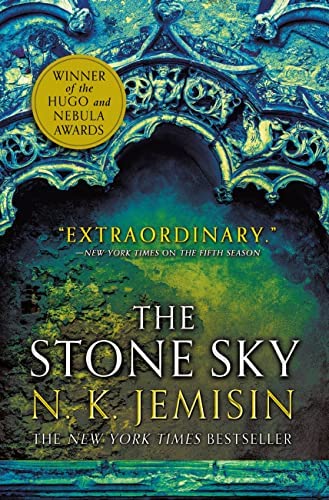
The Stone Sky by N.K. Jemisin

The Stone Sky is Book three of the Broken Earth trilogy (following The Fifth Season and The Obelisk Gate). I raced through this series and am now a firm Jemisin fan. I’m just trying to take a breather before I begin the next of her trilogies, to make them last.

Book two left us with a fairly clear trajectory for this last installment: mother Essun and daughter Nassun had been separated for some time (approaching two years) and were at odds. Nassun has found a new parental figure in – of all people – Essun’s former Guardian (and antagonist), Schaffa. She harbors great resentment toward her mother, who was hard on Nassun – for reasons we can perhaps understand, but still hard for a child. (Orogeny may be a fiction, but this parent-child friction is thoroughly familiar.) Essun wants to find her daughter, but sees practicalities as well, and has been developing her own bonds with the community of Castrima, which feels like both a gain and a liability to her. Still the two draw together, and not just because of the mother’s need to be with the daughter. They share an interest in opening the Obelisk Gate, although they mean to do two very different things with that power.

For me, this book fits all the needs of a final book in a trilogy. We got satisfying character development in several corners. The concerns felt like they deepened both in personal realms (Essun, Nassun) and in larger, world-scale areas (literally, the world ending again BUT BIGGER is what’s at stake here; also, development of secondary characters means I care more about the whole world than I did in some earlier installments). By the time we get to the final, highest-stakes scenes, I feel the impact at every level. Pacing is an interesting issue here: I always felt compelled to get back into this story, but I was also able to put it down several times even in the final few scenes. It had a draw on me, but not a compulsory, stay-up-all-night magnetism – and I think this worked out as a good thing, even if it sounds like a criticism at first. For one thing, this book is 400 pages long, so thank you, Jemisin, for allowing me to take breaks. Also, while I felt the momentum of the story, I also felt able to pause and luxuriate in it in a way I found really enjoyable.

Point of view is another super interesting question to consider. Book one, The Fifth Season, was told in third person, in all three subplots. Book two, The Obelisk Gate, was in second person (the “you” voice), with a specific character-speaker addressing a specific character – but I didn’t realize who each of them were until pretty near the end. Here in book three, that same speaker is still addressing the same “you,” but now I’m on board, and it changes the way the story unfolds. It also implies a future, an “after” timeline in which the speaker can address the audience, which is a fascinating trick.

As I consider this series as a whole, I don’t think I’ve given enough recognition to the themes around the environment and climate change, and major, disruptive climate events, which of course are what Seasons are in this world… They are more than the climate events in our “real” world, but analogous, with the addition of a bit more awareness and purpose. Here, Father Earth is a sentient (and sinister – or merely self-defensive?) being, with motivations, prejudices, and grudges. It’s yet another interesting aspect to consider about the world Jemisin has built (especially because I’m more accustomed to Earth being referred to as a mother – Mother Nature, certainly). So much to consider here! and maybe because I’m so enjoying teaching my literature class this semester, but I find myself thinking in terms of some of our elements of fiction – point of view, character, theme – as I write this review. (I just today, in class, compared this novel to Zadie Smith’s story “Crazy They Call Me.” There’s a connection, promise. Extra credit if you figure out what it is.)

I’m rambling now, but that’s still a commentary on this novel and this series, which sends my brain off in all directions. This is good stuff.


Rating: 8 light-starved mosses.

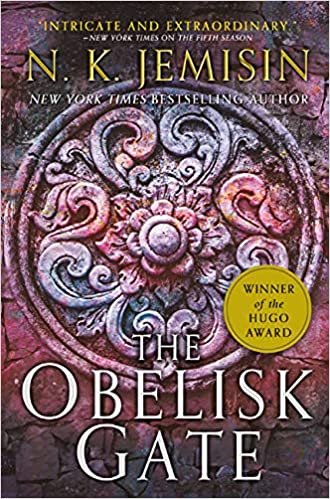
The Obelisk Gate by N.K. Jemisin

Book two of the Broken Earth trilogy went past like lightning, unsurprisingly. (Mild-to-moderate spoilers for book one – but not book two – follow.)

At the end of The Fifth Season, Essun – the latter-day identity of girl we knew as Damaya and the woman we knew as Syenite – was hiking south in a particularly nasty Season, in search of her missing daughter. She had picked up one companion, a strange boy named Hoa, and then another, an equally-but-differently strange woman named Tonkee (who we will learn also wore a different identity in earlier times). The extremely oddball trio had arrived at an apparently abandoned comm (for community) called Castrima, where they had been sort-of-invited, sort-of-taken-prisoner into a hidden but thriving comm underground of Castrima. There, other reunions: Alabaster had also taken up residency, for one. Castrima is a unique settlement in that it tolerates orogenes, even works to attract them and is led by one. That doesn’t mean that all relations are good, though.

The Obelisk Gate alternates between two storylines: that of Essun in Castrima-under (in a Season and under duress), and that of Nassun, Essun’s daughter (the first time we’ve met her). Nassun’s story backs up in time to allow us to follow her from the start of the Season, and her father’s murder of her little brother, until Essun’s narrative present. Essun learns more about the various people (stills, orogenes, and stone eaters) she’s cohabitating with, and continues to learn under her mentor Alabaster, whose own story is drawing to a close. Nassun finds a mentor as well, another character we know (and have decidedly mixed feelings about) from book one. She grows as a mightily powerful orogene and begins to navigate the liabilities of that power. Mother and daughter draw nearer to each other, not geographically but in common traits and efforts. Book three seems sure to follow that drawing-together.

The obelisks themselves, of the title, are important to the outcome of the world in this series; their power and the power to guide and steer them are central to the stories of both Essun and Nassun. But they feel much less important to me than the character arcs and relationships at play – Nassun and Shaffa, Nassun and her father, Essun and Alabaster (and Tonkee and Hoa and Ykka and Lerna, etc.). Plus, the obelisks get a little more technical, both in the science side of the sci-fi and the magic side of the fantasy. And that stuff is always less interesting to me than the human element (even where it’s not entirely clear who is technically ‘human’).

I love, love, love the complex nature of this fictional world and how full and thorough its rules and customs are. I feel well convinced that Jemisin has done the backstory work to know how its parts operate even in ways that aren’t spelled out on the page. It’s compelling and absorbing, a world to lose myself in, which I value highly. I’m excited about book three (and sorry to see the series close, but happy to have bought a whole ‘nother one already!). Jemisin’s characters are convincing: there really isn’t a one of them that I adore and admire entirely, because they all have their considerable flaws. But they’re very real, and I care what happens to them.

This writer is a master.


Rating: 8 boilbugs.

The Fifth Season by N.K. Jemisin

I got sad that there’s still no sequel to The City We Became, so I chose one of Jemisin’s sci-fi trilogies to try while I wait. And it is so good, you guys. I’m already feeling withdrawal from this fictional world.

The Fifth Season is set in a world that keeps ending. It appears to be much like the world I live in now, only much later? (Or earlier? Sometimes the two can blur.) This world has just one continent, as far as its inhabitants know, and it is a very active one. “Like an old man lying restlessly abed it heaves and sighs, puckers and farts, yawns and swallows. Naturally this land’s people have named it the Stillness. It is a land of quiet and bitter irony.” There are ruins scattered around from previous civilizations, that preceded earlier Fifth Seasons, those times when the puckering, heaving land goes a little nuts (tsunamis, blows [volcanic eruptions] and shakes [earthquakes] being the most common issues) and life becomes extra difficult for a period of years. (The book offers two helpful appendices, one a catalog of Fifth Seasons and the other a glossary of terms, most of which were easy enough to suss out by context clues, anyway.) Such an unstable world has sprouted an empire (naturally), a caste system, numerous injustices, and policies meant to help its subjects weather the Seasons: storecaches of food, clear divisions of labor, Seasonal Law. This world is peopled by different kinds of people, too. Some of them are “still,” but others have the power to move the earth. These are orogenes (or the derogatory ‘rogga’), and they can use thermal, kinetic and other forms of energy to control and even cause seismic events. Some of them are controlled and wielded in turn, so to speak, by a class of persons known as Guardians. And then there are the stone eaters…

Jemisin’s narrative centers around three characters, three woman orogenes, in three different, distressing points in their lives. We learn about the possible paths for orogenes from their experiences. One of them is navigating a Season after having just lost a child. Another has been trained at the Fulcrum, and is now being sent out on a humiliating assignment. And one is just a girl, frightened of her own power and identity, newly embarked on the world. As each woman’s story advances, we learn more about the single world they share. There are secrets to be revealed, but not much goodness. (When I say I miss this fictional universe, it’s not because it’s pleasant.) I love a big, complex otherworld. And I loved these characters – not just the main three, but a few others as well. Jemisin’s characters have facets and nuance. I appreciate characters who can be flawed and problematic and maybe not people I’d even want to be friends with, but with whom I can feel such strong connections. That’s true to life.

Also, there are pirates.

Lovely worldbuilding, full and complex and deeply layered, plenty deep enough to get lost in. Despite the presence of those two appendices, which I didn’t find until the end!, I was always more or less clear on what was happening (also true to life: when are we ever on entirely solid ground?). Great characters, beautiful writing, opportunities for philosophical pondering, and some superlatively clever plotting. This book has it all; what’s not to love? Jemisin is a rock star (no pun intended).

I’ve already ordered books 2 and 3 in this trilogy, obviously. And somebody had the very clever idea to include, at the back of this book, snippets from the first books in two other Jemisin trilogies as well, so I ordered one of those at the same time. Good thing she’s written plenty. Stay tuned.


Rating: 8 kirkhusa.

The City We Became by N.K. Jemisin

What a glorious book. N.K. Jemisin is a wonder.

I loved the fantasy/sci fi version of our world presented in The City We Became. When cities have achieved something like a critical mass of culture or soul, they sort of come to life in the form of a human avatar, a preexisting person who best possesses or encapsulates the qualities of that city. It takes a long time, a lot of history and life, for a city to become. There have only been a few in the Americas to get this far. New Orleans and Port-au-Prince were stillborn. Sao Paolo, as the newest city in the worldwide community, is on hand to help with the next birth to take place: that of New York.

New York is unique in that it has multiple souls, one for each of the boroughs as well as one for the city as a whole. Like London; except that something went wrong in London. So New York’s becoming is unprecedented and fraught. The novel opens with the perspective of the unnamed man who will, hopefully, be New York: “too slim, too young, and entirely too vulnerable,” Black, talented, homeless. His voice blew me away in these first pages, before I had any idea what was going on. (It also reminded me of the voice of a friend of mine, a talented young writer. You’re in good company, B.) Here’s the thing: in the birth moment of every city, the Enemy is near at hand, threatening. This is why some cities don’t come to life at all. It’s why some are killed: Pompeii, Tenochtitlán, Atlantis. Oh, yes: it’s not that Atlantis wasn’t real. It just isn’t real anymore.

Something is different about New York: the city’s main avatar may be precocious, but the Enemy (“squamous eldritch bullshit”) is much stronger here, too. The risk seems greater than ever. Luckily, New York (and his helper, Paolo) has the boroughs to rely on. Or does he? Manhattan has never set foot in the city before. He can’t remember his name–the name from before–or what he did, but he thinks it wasn’t good. Brooklyn grumbles that she is “too goddamn old to fight transdimensional rap battles in the middle of the night,” but she’ll do it anyway. The Bronx is always ready to rumble; her people have been here since before there was a New York. Queens would rather return to her studies (she hates financial engineering, “which of course is why she’s getting a master’s degree in it”). Staten Island is a real mess, downright antagonistic to her fellows. And what is Jersey City doing here?

As you may have realized, the idea of a place being personified in an individual is right up my alley; I bought into this concept immediately and whole-heartedly. I love the challenges it presents the author. To choose an individual means choosing a gender, a race, personality traits. It means committing: Brooklyn to be contained within one woman? If she’s a rapper, or a city councilwoman, that’s a commitment to one way of expressing all of Brooklyn: it sounds like a losing proposition from the start, but Jemisin knows her stuff. Here’s where I say that I know little of New York and the personalities of its boroughs; but I know how tricky it is to try and sum up a place, and I respect the complexities of The City We Became. (Also, I can attest that this story works even for the reader unfamiliar with New York.)

This book introduces a rich panoply of fascinating characters, with backstories, histories, cultural and ethnic heritages, professions, personalities, sexualities and gender expressions, to represent a richly varied New York. It is completely absorbing. The science and fantasy of the world in which cities become struck the right balance, for me, between sufficient explanation and satisfying mystery. (I don’t show up to sci fi for the science.) The whole thing is fully-fleshed, compelling, the kind of story to lose yourself in, both clearly related to the one I live in and weird enough to take me out of this one. Jemisin gives each character their own compelling voice, and plenty of sensory lushness to her settings–which are, pretty literally here, characters unto themselves. They are all, in their own ways, so smart. “There’s a lot to consider: particle-wave theory, meson decay processes, the ethics of quantum colonialism, and more.” Lovecraft is often present, “equal-opportunity hater” though he was. I had a fabulous time. And this is just the first in a trilogy! I’m so excited.

Unqualified recommendation: if you appreciate imagination, or a person’s connection to place, or cities, or cultures, or fine writing, get to know The City We Became.


Rating: 10 brigadeiro.