Boule de Suif by Guy de Maupassant

I found a few unaccounted-for minutes the other night, and picked up a short read I’d been meaning to get to: the short stories of Guy de Maupassant. [Recommended by Hemingway.]


This review contains spoilers.

Set in the Franco-Prussian war, this story sees a group of ten citizens of Rouen fleeing Prussian occupation in a stagecoach for Le Havre. They are a mixed group representing a neat cross-section of French society: a merchant couple; a bourgeoisie couple; a count & countess; a Democratic revolutionary; a courtesan; and two nuns. They settle into polite chatting in the stagecoach along social lines, with all turning their noses up at the courtesan. But as the journey goes longer than expected and they are unable to find an inn to serve them lunch or dinner, the courtesan produces a large basket filled with delicacies, and everyone thaws. They make nice with her, and eat her food. The title Boule de Suif is generally translated as “Dumpling” or “Butterball” or the like (I believe, more literally, it is “ball of fat”) and refers to the courtesan:

Short and round, fat as a pig, with puffy fingers constricted at the joints, looking like rows of shorts sausages; with a shiny, tightly-stretched skin and an enormous bust filling out the bodice of her dress, she was yet attractive and much sought after, owing to her fresh and pleasing appearance.

But upon arrival at their overnight lodging, they are held up: the Prussian soldier in charge forbids they continue on their journey until the courtesan will provide her services to him. She refuses, being a patriotic and proud Frenchwoman. And the group seethes: their travels are being held up and, as they point out, this is her business anyway, isn’t it? Why shouldn’t a whore be a whore with a Prussian as well as any other man? They wheedle, exhort, and command – even the nuns – until she is broken down and does the deed and they continue on their way. In the final scene, the socially elevated ladies turn their shoulder away from her again. And everyone has remembered to pack a lunch except Boule de Suif, and no one offers to share with her.

This is a masterfully executed short story, and I can see why Hemingway admired it. The human element is heartbreaking. It is painful to see the defeat of Boule de Suif’s pride and principles; it is maddening to see the disgraceful behavior of the socially superior characters. It is also a neatly devised statement on social class: the merchant and bourgeoisie couples are greedy and grabbing, clearly willing to place their allegiance with whomever will leave them to their profits; the count and countess are weak and craven; the nuns are unchristian in their failure to share food with a hungry courtesan; and the revolutionary is a lecherous drunk. The courtesan is the most patriotic, brave, and principled of the group.

The writing style is enjoyable, too, and again I can see where Hemingway was influenced. Just look at this first sentence:

For several days in succession fragments of a defeated army had passed through the town.

and tell me you don’t see Hemingway there. The meter or rhythm alone reminds me of him; obviously the subject matter as well.

I am rusty in my close-reading skills. I recall a poem I read in high school, for English class, that we picked apart line by line and word by word, finding three and four layers of meaning therein. It was The Black Lace Fan by Eavan Boland, and I really enjoyed the lesson. I think this short story would bear the same sort of close scrutiny. Or, it can be enjoyed as a quick read.

Highly recommended, and I hope I find time for the rest of the stories in this volume soon.


Rating: 9 pretenses.

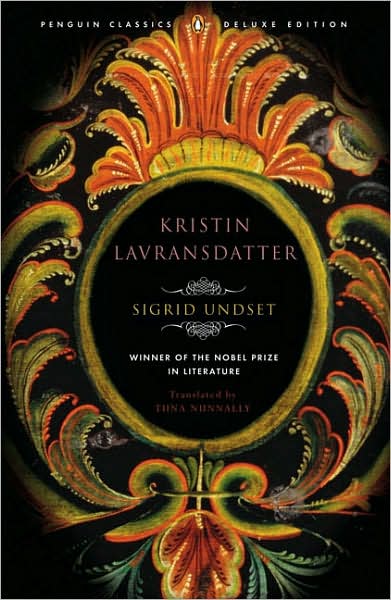
Kristin Lavransdatter: The Cross by Sigrid Undset (trans. Tiina Nunnally)

Kristin Lavransdatter is a trilogy, comprised of The Wreath, The Wife, and The Cross. As my single volume runs nearly 1200 pages, I thought you might permit me three book reviews. 🙂 Here is book three; book one was reviewed here and book two here.


In my reviews of the first two books of Kristin Lavransdatter, I went heavy on the spoilers. It felt difficult to discuss the plot, the action, even the development of the characters – let alone my reactions, without taking that route. I’m going to try to keep this one spoiler-free, though, which also keeps it brief.

In this final installment of Kristin’s life, I felt that she changes more than she did in the first two books. Her children grow up; her circumstances change significantly. Her family grows smaller, between the loss of her children (eventually eight) to death, marriage, and travel, and the deaths of many of her loved ones as she ages. Having done battle with Erlend until the very end, she is left with a sense of remorse that she didn’t appreciate him more, that she focused on the faults. As her world narrows, she’s relegated to the place of an old lady whose values (she’s told) are out of touch; she ends up retreating to a smaller world and focuses on her relationship with God. Kristin experiences a few reunions, towards the end, but the mood of the story continues to withdraw, becoming introspective, turning away from the world.

I found the ending a little strange, circling back as it does to Kristin being an object of admiration… but it did accomplish what felt like the right tone. Kristin Lavransdatter is a fascinating, thought-provoking study of one woman’s life in a time (and place) foreign to me, and to today’s readers generally. It was hard to believe, on finishing, that the trilogy spanned well over 1000 pages. It didn’t feel like it went on that long; it was just one lifetime. But it dealt with all the phases, moods, and issues one could hope. And it was a lovely glimpse into medieval Norway that I would not have otherwise encountered.

I agree with Erin that this is a unique and beautiful book. I also agree that the translation was of high quality, and I’m sorry for those (like my father) who tried older versions and were turned off. It’s long, but it’s an easy read. Check it out.


Rating: 5 babies (whew).

guest review: Out Stealing Horses by Per Petterson, trans. by Anne Born – from Pops

Pops joins us again! You can see other contributions from my dad here. He says he wrote this one just to get me interested in reading it myself. 🙂 It’s on the stack, Pops. Thanks for the review!


This is one of the better books I have read in a very long time. I hesitate to use words like “spectacular!” because it’s not that kind of book. Rather, it is quite simply unique, heartwarming, insightful, and a joy to experience. I could also cite this book’s bestselling credentials (from 2005), and its broad acclaim in reviews – but let’s face it, that doesn’t always count for much.

I am also reluctant to describe what the “story” is, because in fact a summary may in itself sound spare and unremarkable – and spoil the real value here. What’s special is the way the story is told and how it is revealed, the author’s voice and the narrative structure he uses. This is a reading experience; I found myself rereading a paragraph to “taste” it anew each time: the content, the style, the implications. I liked the mood his tale creates – relaxed and thoughtful; the endearing characters, and the story’s sense of place.

Trond Sander is 67 years old as the 20th century is coming to a close and he has just moved into a small Norwegian cabin in the woods for his remaining life. In his first person narrative, we gain glimpses of his life from two perspectives: first, as he reflects while establishing a simple routine around the cabin, in the little village, on walks with his dog. His reflection also takes us back to a few formative years of his youth during & just after the German occupation of Norway, and key events that happened then.

His story unfolds in pieces between these times separated by 50 years. The narrative pace varies, sometimes relaxing and melancholy in short and simple sentences, then sometimes without warning winding up into a rush of action, revelation or redirection all in one long continuous sentence that had me holding my breath by the end. I quickly gave up any temptation to decipher “where is this story going?” – quickly I became deeply invested in the journey, it was so delicious; the destination mattered little.

And in fact, there is no conclusion, or closure, or any such catharsis. Against a simple but rich background, we learn a lot about the man, his life, his influences – and are left to contemplate the rest. Similarly, the narrative style leaves ample “work” for the reader to understand, appreciate, interpret. At the risk of confusing my point, in this way I was reminded of John le Carré – which in my sense is high praise; I love such work.

Finally, a word about the translation from Norwegian. I am always intrigued by wondering what a story was like in its original language. It seems the burden of good translation is great, and the results may be anywhere from great to disappointing; the translator essentially becomes a co-author. I don’t know Norwegian; I can only assume that such distinctive narrative style is from the author, and that its wonderful success in English reflects a skilled and faithful translation. Kudos to Anne Born for that. And, just so we get the author’s name right: Per is like “par” and Petter rhymes with “letter.”

Thanks for those final pronunciation tips. We don’t always know when we read, do we.

Well, I’m talked into it. Lovely review, Pops. Thanks for contributing!

Kristin Lavransdatter: The Wife by Sigrid Undset (trans. Tiina Nunnally)

Kristin Lavransdatter is a trilogy, comprised of The Wreath, The Wife, and The Cross. Here is book two; book one was reviewed here.


SPOILERS FOLLOW.

In The Wreath, we met Kristin as a child, watched her grow into a lovely young lady, and saw her lose her virtue out of wedlock to the dashing Erlend, break off an engagement with her father’s favored choice Simon, and finally, after much familial discord, succeed in marrying Erlend – while carrying his child, unknown to anyone. The Wife, naturally, follows her role as Erlend’s bride and mother to his children. All is not smooth sailing for the couple: first, in a literal sense, as Kristin is miserable on her first ocean voyage to her new home, pregnant and horribly seasick.

She has a very difficult delivery of her first son – who turns out to be the first of no less than seven sons. She and Erlend find themselves distancing almost immediately. When they were lovers, they shared a passion that was, if anything, increased by their shared sin. As I said in my review of The Wreath, Catholicism plays a weighty role. After her marriage, Kristin turns to God and religion all the more, seeking redemption for her betrayal of her father (in the sense that her father’s honor was compromised in her premarital affair). Erlend has a brother, Gunnulf, who is a holy man, and Kristin immediately becomes close to him.

Between the production of babies (the first five in under five years) and her ever-increasing piety (which involves fasting and self-deprivation), Kristin is unavailable to Erlend when he had hoped to have her as a companion nearly full-time; he has to travel on political & military business, and wants her at his side, but she is unwilling if not unable, fearing seasickness and not wishing to leave her babies. In addition, there is the added stress of Erlend’s two bastard children from an earlier liaison: the boy, Orm, warms to Kristin, but the elder Margret remains a source of conflict. Further tension is born of Erlend’s irresponsibility with his property. He is wasteful and profligate, politically less than astute – although his charm takes him further than he would otherwise have gone – and almost entirely faithful to Kristin (which, frankly, is better than I expected of him).

In the end, his risky politics get him into trouble with the young king, and he is imprisoned. Meanwhile, Kristin’s former betrothed, Simon, has married her younger sister Ramborg – more at Ramborg’s insistence than out of his own interest. Both Kristin’s parents have died. When Erlend is arrested, Simon is her closest male kinsman, and provides her with the support she needs; she does not realize he still loves her. Thanks to Simon’s interceding, Erlend’s life is spared, but his property is forfeited.

This was a fairly lengthy book at some 400 pages, but still felt easy to read. For all the friction in Erlend and Kristin’s marriage, they still love each other. When it comes down to it, they always turn back to one another, even after (for example) Erlend has an affair with another married woman purely to get back at Kristin when he feels slighted. I am a little surprised, and impressed at the strength of their relationship. I find it a little inexplicable, as I look back at this book, that I have found it as engrossing as I have. The somber, serious weight of Kristin’s piety is not something I especially identify with. But yes, I am heading into book three, The Cross, with enthusiasm. I wonder what good can come of Kristin’s family now that they’ve lost their tenuous grasp on Erlend’s shrinking estate. And I’m not sure that Simon will continue to be content with being Kristin’s brother-in-law. Stay tuned…


Rating: 5 pagesofjulia.

Kristin Lavransdatter: The Wreath by Sigrid Undset (trans. Tiina Nunnally)

Kristin Lavransdatter is a trilogy, comprised of The Wreath, The Wife, and The Cross. My copy is all in one volume, in a new translation, that came highly recommended from Erin Blakemore of The Heroine’s Bookshelf (my review of her book here; my interview of Erin here). As that single volume runs nearly 1200 pages, I thought you might permit me three book reviews. 🙂 Here is book one.


SPOILERS FOLLOW.

This book opens with a little bit of scene-setting; we first meet the parents of our title character Kristin, Lavrans and Ragnfrid (how you pronounce that, I have no idea), and learn about their properties and inheritances. That is telling in itself. It is Norway in the 1300’s, and Kristin’s circumstances and options will be in large part decided by her parents’ situation. She is a charming little girl, very close to her father, distant from her mother, who is serious and melancholy after losing three sons in infancy. Kristin lives in a small world, defined by the valley surrounding her family’s farm, and has a sweet life, despite her mother’s dampening nature, because her relationship with her father is quite fulfilling. They are an extremely pious family, fasting and observing rituals more than their peers, no small thing in a seriously Catholic community. Ragnfrid has a second daughter, who also lives out of infancy, and is even more physically beautiful and admired than Kristin; but an accident nearly kills her when she is around five years old, and leaves her permanently crippled and ill. Ragnfrid’s emotional state descends still further. There will eventually be a third daughter, treated rather as an afterthought and not highly valued, in Ragnfrid’s grief at the fate of her three dead sons and injured daughter (one wonders why she doesn’t take more comfort in Kristin’s health). Ragnfrid feels guilty, as if her sins are punishing her children: the familiar Catholic guilt.

When Kristin is 15, she is betrothed to a young man, Simon, she does not know well but seems a suitable match and to whom she has no real objections, at first. But she is young and pretty, and things are complicated: first, a servant boy she’s grown up with declares his love, which tweaks her heartstrings. It does not seem likely that she feels “true love”, at that age and triggered by his own declaration, but it causes her first doubts about marrying Simon. There is a nasty episode involving a clandestine meeting with the servant, Arne; Kristin narrowly escaping rape at the hands of another man; and Arne’s death, which ends up implicating Kristin as possibly possibly having slept with her attacker, which is made no easier by the fact she’d kept the attempted rape a secret. Her reputation receives its first bruises, and this is a society where a young lady’s reputation cannot afford dark spots.

Kristin goes off to live in a convent for a year before marrying Simon, hoping to work through the trauma of Arne’s death and the almost-rape. And here things get even more sordid, because she meets another man with a bad reputation (in another time and place he would most definitely be called a rake). One thing leads to another (use your imagination) and although it takes years and much heartbreak and dishonor and dishonesty, Kristin is able to break her betrothal to Simon and marry Erlend. When they marry, she is secretly pregnant. And the first book ends.

The religious implications weigh heavier as this book proceeds. The breaking of the betrothal, the premarital sex, and the lying to her parents, Simon, and the world in general that these feats, require are very problematic. Despite all her sinning, Kristin is a religious woman, and she suffers inside for her sins. Her parents are enormously religious, and her father does a bit of freaking out over the entire Erland situation. Lavrans was close to Simon, liked him very much for a son-in-law, and has difficulty being anywhere near Erland, who he does not like and does not trust to keep his daughter secure. Lavrans seems to fear subconsciously that Kristin may have slept with Erlend, but he won’t allow anyone else to put this theory forward. At the end of the book, he doesn’t know about the pregnancy; but the timing is far enough off that it is inevitable that he will know she was pregnant before she was married (barring miscarriage or, I don’t know, Kristin hiding a baby somehow from… everyone?). I don’t know if it’s necessary to point this out, but premarital sex is a serious thing in this society.

This reading flew by. I love the medieval Norway that Undset paints. The early part, when Kristin is a small girl, and we get an intimate picture of her life on the farm and her relationship with her father, might be my favorite; I love the simplicity and the evocation of another time. I am not a great appreciator of religion, and Lavrans’s version is a particularly cumbersome one, but these are good, simple, virtuous people, and that is easy to appreciate. As Kristin becomes a teenager and begins to encounter *boys*, she becomes very recognizable: her interest in her new betrothed, Simon, and then Arne’s sudden appearance in a new light, and then meeting the dashing Erlend, would work just as believably in modern-day junior high or high school. But I found her a little exasperating. This, too, is recognizable; her flightiness and poor decision making are highly realistic. I wasn’t always entirely pleased with her. But I remain invested. As she marries, hiding her pregnancy from her decidedly oblivious new husband, and gets ready to move to a different part of the country, I am wholeheartedly along for the ride.

I knew nothing coming into this book (other than a tagline that went something like, “epic trilogy of woman’s life in ancient Norway”) and have no idea what is to come. The religion comes on a little stronger than I typically want in my reading, but I’m involved with Kristin and I shall continue. Stay tuned for reviews of the next two books.


A note on translation: this translation came recommended to me specifically; I was told earlier ones were poor, and it turns out that my father tried to read one of those and found it unreadable. Tiina Nunnally’s translation won the PEN/Book-of-the-Month Club Translation Prize and is lovely. (Perhaps I should mention that Sigrid Undset won a Nobel Prize in Literature, before Nunnally’s help! I wonder if the prize committee read her books in Norwegian??) In other words, use this translation and no other, and thank you, Tiina, for bringing this book back to life. We’ll see if Pops wants to try again when I’m done with my copy.


Rating: 5 rosaries.

Ajax by Sophocles, trans. by E.F. Watling

I read Ajax from my copy of Electra and Other Plays after being reminded of his tragic story by Madeline Miller’s The Song of Achilles. It is a short play, an easy read, but like so many of the greatest ancient Greek works, very sad.

Ajax was one of the great Greek heroes of the Trojan War. Indeed, Miller says several times in her book (in the voice of Patroclus) that he would have been The Greatest if it weren’t for Achilles – kind of a poignant thought. He’s like the Jan Ullrich of the Trojan War. This play by Sophocles dramatizes the action following Achilles’s death, as known to myth. The background: Achilles quarrels with Agamemnon and boycotts the war; Greeks are dying; Patroclus goes to battle disguised as Achilles to get everybody going again; Hector (the great Trojan hero) kills Patroclus. Achilles is enraged, takes the battlefield, and in turn kills Hector, thus putting into action the prophecy that Achilles himself will die shortly thereafter. He does: killed by an arrow fired by Paris, who started all this nonsense in the first place.

With the Greeks’ hero Achilles dead, it is time for Ajax to shine. But Agamemnon chooses to award Achilles’s trophies of war, not to Ajax, but to Odysseus. Ajax is furious. And now begins the play…

Ajax has determined to kills the sons of Atreus (Agamemnon and Menelaus), Odysseus, and all the Greeks who have failed to honor him as he feels he deserves. He goes on a killing spree overnight. But Athena, good friend especially to Odysseus, tricks his eyes so that he ends up killing a bunch of livestock and no human Greeks. As the play begins, she is explaining this to Odysseus, offering him the view of Ajax, mad, blind, confused, killing sheep and calling them Greek names. Odysseus balks, but we end up seeing the scene. Ajax comes to his senses, sees how he has been shamed, and immediately begins planning his suicide. The Chorus (that tool of Greek drama, the group of citizens that comments on the action) and Ajax’s wife Tecmessa try to talk him out of it, reminding him of the pain his parents would feel, and the dubious fate of Tecmessa and their son if left without husband/father. He seems to change his mind, and goes offstage. But then his brother shows up, distraught, citing a prophecy that Ajax will die today. The scene shifts to watch Ajax bury the hilt of his sword, make a short speech, and throw himself upon it.

Tecmessa and the Chorus mourn; Ajax’s brother, Teucer, mourns, and plans to bury the body. Agamemnon shows up and makes disparaging remarks, commanding that the body of Ajax not be buried at all. Now, I’ve read these things before, and (ahem Antigone) you’d think these characters would have learned by now: you have to bury the dead! The gods are mightily displeased if you do not. This is an important tenet of custom and piety. Luckily, Odysseus next arrives on the scene. He had been insulting Ajax earlier, declared him an enemy, but here he lives up to his reputation for wisdom: Odysseus talks Agamemnon into allowing a reverent burial, and the grief-stricken family of Ajax carries on with their ritual. It seems that Teucer will take care of Tecmessa and her son.

I find this to be a moving story, despite the removal of centuries and the difference of cultures… I guess I’ve read enough related myth that I have learned to identify with it. I love the stories of gods and heroes, how they’re all interrelated and how the actions of one generation can effect so many generations to come. (See the above reference to the House of Atreus. That man’s impious mistake will continue to cost his offspring – just watch what happens to Agamemnon when he gets home from war.) And I mainly read Sophocles (et al) for the stories… so I had to remind myself to slow down and appreciate the language, too. I think I prefer the poetry of Homer, but I can just imagine actually seeing this performed… that would be a treat.


Rating: 6 dramatic gasps.

Anna Karenina by Leo Tolstoy (audio)

This is a very long book, and I am trying to keep this from being a very long review. In a nutshell, I did not find it the life-changing masterpiece that I hoped it might be. (This is alarmingly often true of the very big name classics, it seems. Maybe too much hype?) However, it had some redeeming features, especially early on.

I will refrain from much plot summation (to keep my review shorter!); you can find that online if you like (for example, here’s Wikipedia). But, quick plot points: Levin is in love with Kitty, the youngest daughter of a good family. He proposes and is rejected, because she is expecting a proposal from Count Vronsky. However, just then the married Anna Karenina comes to town, Vronsky is taken with her, and abandons Kitty. Now we have a sad Levin, a sad Kitty (rather ruined, in fact, with her marriage prospects suddenly bleak), and Vronsky chasing Anna. Slight spoiler: he succeeds, and they become lovers, cuckolding Karenin (her husband). There are other characters, other couples mostly, with their own marital issues. Levin is a landowner with a restless intellect; he is probably the character most actively questioning his society’s unwritten rules, debating new ways of running his land and his peasant laborers, etc. One thread of the book follows discussions of society in various forms. The real spoilers follow in white text (highlight to read) if you want to follow it through: Levin does eventually marry Kitty. Anna has Vronsky’s baby, and goes to live with him after leaving her husband, but they are relatively ostracized by the society they were accustomed too, especially Anna; she is increasingly jealous and insecure, and finally kills herself. Levin finds God. There, that’s my quick plot summary. I have left out a great deal.

I struggled with this book for one main reason: I couldn’t find a sympathetic character. I thought I had one here and there, but they failed me time and time again. Kitty & Levin both overcome obstacles; but they never move past the tragedy of Kitty’s losing Vronsky – they continue to let his shadow lean across their lives, and I got sick of that. For all their observing their own happiness, I was unconvinced. Jealousy plays a large role in their relationship. Anna and Vronsky, too, call themselves happy but the jealousy and the quarreling just went on and on; I was annoyed. I went back and forth: poor Anna, she needs her man, he took her out of her home and life and now he leaves her home alone and lonely! And then again, poor Vronsky, this woman is a total drag! It comes back to the same point: I found none of these characters particularly sympathetic, and I did not have the patience for the woe-is-me drama. Tolstoy seems to use lots of superlatives. I think this is what contributed to my feeling of high drama (rolls eyes).

On the other hand, the ideological musings and discussions Levin indulged in failed to perk up my ears, as well. I would have been interested in working through some of these theories, but I never felt that we got any concrete experimentation with them; rather, Levin thought to himself or mentioned to his gentlemanly peers, and then plodded on. I don’t know why this made me impatient, when Jurgen’s struggles and ideologies in Upton Sinclair’s The Jungle hold me so rapt, but so I found it.

I remained engaged, entertained, and concerned for the characters, and caught up in what I’m calling Tolstoy’s high drama, for a time. I would say more than half of this tome. But it dragged on too long; he lost me. I couldn’t care for that long. The characters who started off as semi-sympathetic, or potentially sympathetic, or at least interesting, dragged on into repetition and selfishness that eventually bored me; I would have found them, the story, and the writing style more interesting if he had wrapped up a little sooner. And I do not fear the chunky epic novel, either; I’m capable of enjoying books of this length when they keep me engaged.

While I’m on the subject of length, though, I wonder if the audio format was perhaps the wrong choice here. I read faster than the narrator reads aloud. It would have taken me less time to read this one in print, and maybe that would have allowed me to get through it without becoming exasperated. A reader feeling the need to rush through a book is not a particularly strong endorsement, though.

In fact I was tempted to quit. Towards the end I was very frustrated, with Anna in particular, as she descends into jealousy and insanity. I recognize the misogyny in this book (for example, see my earlier Tuesday Teaser), and perhaps it should be interpreted as a compliment to Tolstoy that it was so convincing: Anna increasingly struck me as weak and nagging. I realize the difficulty of her “position” as it is referred to, and her shortage of options. But her continued complaining rubbed me the wrong way. I wanted to stop listening to this book; but as I completed disc 27, then disc 28, of 30 (!) cds, I knew I’d come too far to turn back. I had to know how it ended – not because I cared about Anna’s fate, you see, but because I was curious to know if Tolstoy was going to finally engage or impress me, or if his finish pulled something off that I had been missing all along.

And I’m afraid he didn’t. Back to the white text here so you can avoid my spoilers (highlight to read): Anna’s suicide almost relieved me. She was suffering, and she was complaining, and I’m glad she put us both out of our misery. See? I’m sure I missed the point here, but I can only report my own reaction. And as for Levin’s finding of the faith… it happened a little bit too fast for me, although the scene with the lightning was certainly interesting. And to be fair, I’m not your ideal audience for finding-God endings, as I’m a confirmed atheist and just fine with that fact.

I regret that I wasn’t more excited by this one, especially considering the weeks it took me to get through it; but I can’t say I regret those weeks. Now I know. The real question is: is there any chance I’ll enjoy War and Peace, or should I cut my Tolstoy-losses now??


Rating: 4 fancy dresses.

Suite Française by Irène NĂ©mirovsky (audio), trans. by Sandra Smith

Pagesofjulia earlier published a guest review of this audiobook by my father. He did an excellent job of telling the backstory, so I’m just going to quote him here.

Much of the impact derives from knowing the author’s own story and how the book came to life. Born 1903, she was a Russian Jewish immigrant to France (1918), converted to the Catholic Church (1939), published numerous works of renown before the war (including one brought to film), was denied French citizenship in 1938 due to Jewish heritage, and has since been criticized for being a self-hating Jew. She was in the course of writing this work as events unfolded, expecting to create a novel in 5 parts. She finished two parts, was denounced by French collaborators and deported to Auschwitz where she died within a month. Many more of her writings were published since the war. But her daughters retained this notebook manuscript, keeping it unread until 1990 due to anxiety over the expected pain of reading her wartime “journal” – only then, before donating the pages to an archive, did they realize what powerful words those pages held. Written 1940-42, it was published in 2004, acclaimed, translated and read internationally.

(I don’t know where he gets his info from, but his write-up appears to agree with what the rest of the interwebs tells me.)

The backstory does indeed increase the impact of this story for me. For one thing, knowing that she wrote without knowledge of how the story ended makes some of her predictions and judgments especially poignant.

I think the most remarkable aspects of this book for me were the beautiful writing, and the tone of dry humor. See my Teaser Tuesday and Book Beginnings posts featuring this book for a few snippets I appreciated. The poetry flowed so naturally and yet painted such lovely pictures, without ever feeling forced. And as for the tone – NĂ©mirovsky does not spare the French, particularly the upper classes. While they are “victims” of the Nazis, they don’t read as sympathetic characters most of the time; see again that teaser post above for some of her cutting satire (and it goes on from there). The Germans sometimes come across more sympathetically, which I found interesting and not entirely expected. It’s easy to denigrate the Nazis, right? But NĂ©mirovsky gives us a truth: these were all just people, elementally.

Perhaps the point that drove NĂ©mirovsky’s story home for me the most – that is, both Suite Française and her own real-life story – was the ending of the book. NĂ©mirovsky’s daughter chose to publish as one book the first two in an intended series of five novels (so says Wikipedia). She also left behind the outlines of the third part. But in effect, this book ends very abruptly to me, leaving many threads unresolved. The abruptness of the ending was of course made more stark for me in audio format – I’m walking along, listening to the book on my earbuds, and then, nothing. What? Is that the END? I had gotten so engrossed in the story – worried about Bruno, wondering what Lucile would do next – that I’d forgotten the similar plight of the author herself (in that her future was being torn apart and eventually her life ended by the same forces at work in the book). So the cutting off of her work in progress ended up telling the same story for me that her book tells within its pages. I found that very powerful.

Suite Française has an interesting story to tell, both between its covers and without. It is beautifully written, humbling, stark and poignant. The same Wikipedia page (above) calls it “possibly the earliest work of literary fiction about World War II.” It’s really something, and you should check it out. But beware unintended cliffhangers.

Burned by Thomas Enger, trans. by Charlotte Barslund

Henning Juul is an investigative crime reporter in Oslo, just returning to work after a two-year hiatus. He needed that time to recover and mourn after a fire in his flat killed his six-year-old son and badly burned Henning himself. His scars are external as well as internal: Henning is overwhelmed by guilt at having failed to save his son Jonas, and his wife Nora divorced him while he was in the hospital recuperating. With this backdrop, Henning returns to work reluctantly, and is immediately confronted by a horrific crime: a beautiful, talented, popular college student has been half-buried, stoned to death, flogged, and partially dismembered. Yes, you read that right. On the cop shows they call that “overkill.” And finally, Henning is assigned to work this case with his ex-wife’s new boyfriend.

As it turns out, the new boyfriend storyline doesn’t really go anywhere; the plot revolves around Henning’s investigation of the murder case. He does experience some angst over his ex-wife; more so over his son; but primarily we stick to the murder-mystery thread. The case at hand imitates a movie script the dead girl wrote, which is an interesting plot device; there is some question as to whether this is a Muslim honor-killing under somebody’s interpretation of sharia law, or whether the cops’ arrest of the victim’s Muslim boyfriend indicates racism and/or a jumping to too-easy conclusions. As you are beginning to understand, there’s a lot going on here.

That may be one of the downfalls of Burned, though. This plot undertakes many interesting inquiries, and resolves few if any to satisfaction. We get a good picture of Henning’s inner workings, at least; as a series character he shows promise. The tragedy of his own disfigurement, the loss of his son (to death) and his wife (to divorce), and his psychological trauma definitely lend themselves to another book or several. But the many plot threads picked up in this book are mostly put back down again after cursory treatment, which left me feeling a little bit jarred and jumbled. There were several small details that were left unexplained. There were loose ends.

Also the prose was decidedly awkward at times; it’s translated, so I’m assuming this criticism goes to the translator rather than the author. I give you my favorite example, a travesty of pronouns:

Henning sighs. Perhaps it’s right that Jonas is here now, he thinks. My lovely, lovely boy. He remembers the leap through the flames, how he tried to shield his face with his hands and arms, his hair which caught fire, the burning and the stinging, Jonas’s eyes when he saw him, how he helped extinguish the flames, before they got to them.

Really. I tell you. Even if it were the only example – which it wasn’t – a sentence like this will help to ruin a reading experience for me.

It wasn’t all bad, really. Henning is an engaging character and I cared what happened to him. I wanted the solution to the puzzle, which motivated me to keep reading. That solution disappointed me, frankly, but I still care about Henning. The ending clearly leaves the door open for more of him, and I confess I’m tempted. But with this many loose ends, I’m not sure I’ll subject myself to the frustration again (particularly when compounded with such stylistic offenses as the pronoun mess above). Not a complete failure, but far from a raging success, I’m sorry to say.

Many thanks to the publisher for the copy they sent me, all the same!

Ruby Red by Kerstin Gier, trans. by Anthea Bell

Not being a big reader of YA, or time travel, or fantasy/alternate realty/insert-concept-here, it surprised me how much I was drawn to this book. But I was.

Before I tell you about this story, here’s a funny detail I noted right off: the translator, Anthea Bell, also translated the last book I read from-the-German, The Stronger Sex. This title is YA where that one was decidedly adult material, but I guess a strong German-to-English translator is the same across the board. I hadn’t really thought about it before. Just as I said about The Stronger Sex, Bell gets full credit for making the translation invisible. If anything, the language here is a little more awkward; but having read that other example of Bell’s translation, I think this awkwardness comes from the original. If I hadn’t known, I wouldn’t have suspected translation issues – I would have assumed just what I have come to feel is a common YA writing issue. It feels a little bit effortfully simplified, if that makes sense. It’s something I’ve encountered in YA before. I guess it’s a reading-level thing. Like in Miss Peregrine’s Home for Peculiar Children, it bothered me slightly when I focused on it, but the story ended up engrossing me enough that it faded into the background. I don’t read a lot of YA. If you don’t, either, this little issue may irk you as it does me; if you read a fair amount of YA, chances are good it won’t faze you.

Gwen is trying to live a normal teen existence in present-day London, but her obnoxious cousin Charlotte’s destiny is difficult to ignore. Charlotte has inherited the family’s time-travel gene, and any day now, she’s expected to take her first trip. She’s been trained all her life in languages, history, the mannerisms of different periods, fencing, dancing, and music. But when the first uncontrolled time travel occurs, it’s not Charlotte, but Gwen – of all people! – who finds herself in an unfamiliar era. She’s thrust unprepared into a complicated world, and finds herself partnered in adventure with Gideon de Villiers, the time-travel-gene-carrying teen of his own family. He is snotty and bossy… and sooooo handsome…

I enjoyed the intrigue, the plots and codes and ancient documents and secrets and mysteries. I enjoyed the world Gier builds. I even enjoyed, mildly, the juvenile romance. But I didn’t get enough of any of it. I felt like the set-up for the story took 3/4 of the book, and then the story began and –whoosh– please buy the sequel that comes out in 2012. Is this a YA thing? I was frustrated and unsatisfied; but I’m also intrigued enough to seek out Sapphire Blue, the aforementioned sequel. Sigh. I guess she got me.